Part One. Three Lessons from Syria’s Proxy Wars Before the Islamic State
War should be a last resort. Therefore, proxy warfare (like all other forms of warfare) is generally undesirable. However, if the United States is to engage in proxy warfare, U.S. efforts to develop proxies in Syria from 2011-2014 offer three lessons for how to evaluate its success:
- Develop a political strategy that defines the ultimate purpose and end-state of the relationship.
- Assess the capability of proxies to seize and control territory.
- Mitigate the three key challenges that sponsors face in managing those proxies.
This section illustrates these three lessons by examining U.S. efforts to develop proxies during the first four years of the Syrian civil war (2011-2014). The rest of the paper applies those lessons to evaluate the proxy warfare capabilities of other actors in the Syrian civil war. The three lessons drawn from this case can be applied to other cases in order to analyze the character of future proxy relationships.
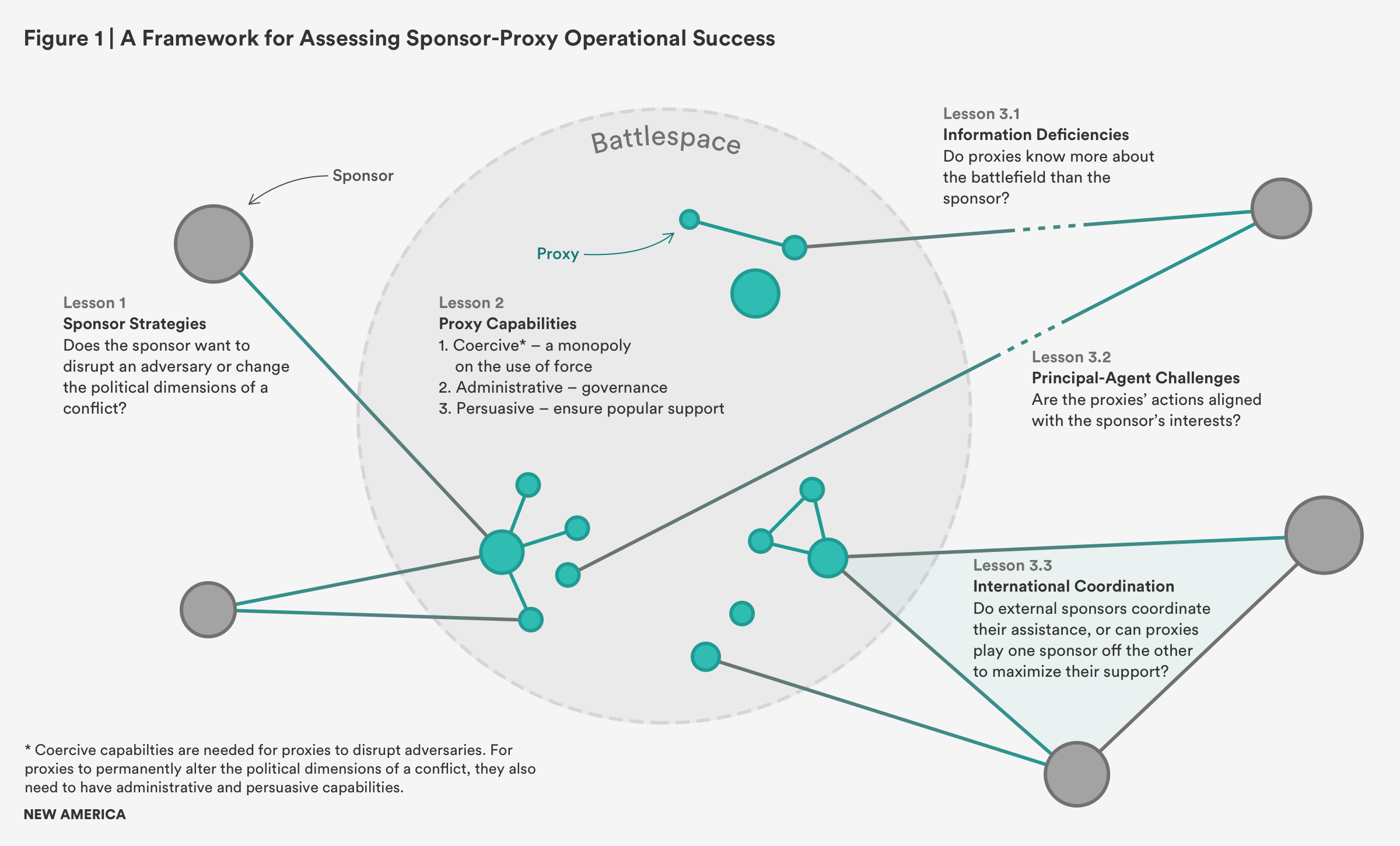
Lesson One is that a sponsor must assess its own strategy to determine the purpose for engaging with a proxy force. As we will show, the purpose of U.S. support to local governing councils in Syria shifted as the war progressed to such an extent that it was not clear what that support was intended to achieve. This was one of the reasons local councils failed to coordinate their activities, scale up, or become effective and resilient once they became targets of armed groups (shown in “Sponsor Strategies” in Figure 1 above).
Lesson Two is that a sponsor must assess the extent of its proxy’s capabilities. Can proxies achieve a monopoly over the use of violence in a given territory (coercive force)? Can they provide governance services and basic necessities (administrative capacity)? Can they persuade populations to support them (persuasive capability)? As we will show, coercive, administrative, and persuasive force are necessary for holding territory over an extended period of time against opposition. If sponsors engage proxies who lack administrative or persuasive capabilities, they should expect that these proxies will only be able to disrupt adversaries, not change the political or social dimensions of an ongoing conflict.
Lesson Three is that a sponsor must assess the extent to which it can mitigate three key factors in its relationship with a potential proxy: the problem of not knowing as much about the battlespace as potential proxies (“information deficiencies” in Lesson #3.1 above), the problem of controlling the proxy’s actions (“principal-agent challenges” in Lesson #3.2 above), and the problem of the sponsor having competing interests with other sponsors in the same conflict (“coordination challenges” in Lesson #3.3 above). The United States tried to develop proxy forces in Syria before the rise of IS, but failed to mitigate these three factors, and so its interests did not sufficiently align with the proxy to advance U.S. goals.
The following subsections will examine these lessons in the context of the U.S. support for Syrian rebels from 2011-2014, illustrating how the failure to heed them contributed to the failure of the proxy strategy.
Lesson One: Governing Without a Political Strategy
The U.S. efforts to back Syrian proxy groups from 2011-2014 failed to establish a clear political strategy. The United States most prominently funded Syrian local councils as a potential alternative for post-Assad governance. Aid to local councils was a critical component of U.S. proxy warfare efforts from 2011-2014, but this effort was plagued by a lack of U.S. strategy in the Syrian war. This lack of clear strategy also applied to the militant opposition. “The problem with American policy in Syria was in some ways the same as it always was: all tactics, no strategy,” explained a diplomat in the Middle East who described the U.S. political strategy for supporting insurgents as “a mess.”1The foreign money provided to support the local councils distorted their operations because, in the best of circumstances, they lacked the resources and vision to match the overarching strategy for how those councils would be used. This highlighted the critical first lesson of waging proxy warfare: the need for a sponsor to have a clear political strategy.
In October 2011, a Syrian activist named Omar Aziz published an essay online called “A Seminar for Establishing Local Councils.” The paper was circulated among anti-government activists and began a process of channeling local protest movements into organized municipal governance as another form of resistance.2 In January 2012, residents of Zabadani, a restive, strongly anti-government region in the mountains northeast of Damascus, were supposedly the first to form a local council. The concept expanded as other towns and city neighborhoods were “liberated” from Syrian government control by newly-active rebel forces.3
In 2012, while working at Caerus Associates, the authors studied 20 such local councils to better understand them.4 We conducted research in 12 of Syria’s 14 governorates in order to understand what local councils had in common despite differing demographics and conflict dynamics across the country.5 We found that, in areas where the Syrian government had disappeared, local councils acted like mini-governments, performing tasks such as cleaning streets, repairing municipal facilities, and keeping schools open. These councils were generally most active in medium-sized towns—small villages lacked the need for higher-order organization, and large cities were too complex for these ad hoc institutions to manage.6
The local councils that were most active were also far from the frontlines and were not based in strategic locations that would be of interest to armed groups, such as border crossings or highway interchanges.7 In addition to being in non-strategic locations away from battlefields, the councils that governed most visibly were based in places that were ethnically homogenous and lacked pre-conflict non-state governance. Ethnic minority areas, such as Kurdish regions in the northeast and Druze regions in the southern governorate of Suweida, had their own form of governance before the Syrian war broke out. These established parallel structures filled governance gaps during the war, but did not resemble the local council model.8
Local councils began receiving foreign funding in earnest in 2013.9 The purpose was to build a governing model for a “post-Assad Syria.”10But foreign sponsors failed to develop proxies capable of accomplishing the task, and as the war went into its third year and beyond, this strategy seemed increasingly at odds with reality.
Frances Brown, who conducted the most extensive evaluation of U.S. government support to local councils in Syria, concluded that U.S. government work with local councils lacked strategic coherence because it failed to adapt to the “political-military realities of the war.”11 Brown found that the initial logic of U.S. support to local councils matched Washington’s policy to plan for a post-Assad Syria. But, as early as 2013, as that possibility became more remote, “the objectives and assumptions of local political assistance in Syria diverged further and further from U.S. high-level policy decisions.”12
The lack of a viable strategy for U.S. support to local councils, combined with a rapid rise in foreign donor funds, meant that, in the words of one official, it was “like watching five-year-olds play soccer. No one played their position.”13 The programs were poorly implemented because, although the strategy might have looked good from Washington, its programs were unworkable once they reached Syria. By the time programs reached Syria, strategic guidance had “all bled into each other at the bottom. [Coordination] was still not working at the ground level.”14
The strategy of developing governing councils for a post-Assad Syria remained attractive in Washington, D.C. long after it had outlived its relevance in Syria. The net result was that the lack of a coherent political strategy undermined grassroots civilian-led local governance structures in Syria. In theory, local councils offered the persuasive and administrative capabilities that could help anti-Assad militants establish resilient, rather than merely brittle, control over territory they had captured. While there were capacity problems and myriad principal-agent problems, the United States worked with the councils through an uncoordinated bureaucracy that lacked strategic guidance. The result was that, after years of assistance, local councils did not develop governing capacity beyond the ideal circumstances where they existed far from the frontlines and locations of strategic importance.15
At first glance, it would seem strange to include foreign aid for governance as part of a paper on proxy warfare. But these local councils were part of a broader proxy war effort to install a more inclusive and technocratic government to replace that of Bashar al-Assad.16 Some local councils were nonpartisan service and aid delivery units,17 but their purpose was initially designed in Omar Aziz’s memo. Aziz’s mission, written two years before he died in a Syrian prison in 2013, was “the establishment of a network of…popular committees whose role was to protect the city and fill the vacuum on the day the security and the police would be forced to leave the city.”18 Thus, local councils were conceived of and supported as a revolutionary “parallel governance” project that provided the administrative and persuasive capabilities to complement the coercive military work of anti-Assad forces. However, when it became clear the Assad government would not simply fall, the United States never clarified what its political objective was in Syria’s war and what it was committed to do to pursue it.
Lesson Two: The Role of Persuasive and Coercive Capabilities in Aleppo
Beyond lacking a clear political strategic objective, the United States’ chosen proxies in Syria from 2011-2014 often lacked the capabilities to take and hold territory. Instead, other groups, notably the fundamentalist militias, successfully outcompeted the rebels backed by the United States. The experience of these fundamentalist groups also emphasizes the important role of persuasive and administrative capability in a competitive environment, as even their hold often proved brittle in the absence of such capabilities. The inability of U.S. proxies to compete effectively in the Syrian conflict due to a lack of capabilities contributed to policy failure.
From September 2013 to January 2014, a small group of researchers working with the authors traveled across Aleppo city.19 Although all were native Aleppans accustomed to the challenges of reporting in their city, they found this period especially challenging. Aleppo, Syria’s largest city, was the center of gravity for the war in Syria’s north. By the end of 2013, fighting was particularly intense: Syrian government forces ended a siege in the western third of the city, while IS fighters entered Eastern Aleppo by force. By January 2014, as pro-government districts were refortified, IS fighters were defeated by a coalition of anti-Assad forces.
As this was happening, the researchers carried out a panel survey over a four-month period of 561 residents across Aleppo’s 56 neighborhoods. They questioned residents from all parts of the city about their political attitudes, perceptions of safety, and daily experiences (e.g., the extent to which they traveled outside their neighborhood, the extent to which prices for commodities were affordable). In addition, researchers collected information about the location of military checkpoints (as an indicator for territorial control, enabling them to identify which insurgent or pro-regime group controlled which part of the city), and the location and operational status of bakeries (as a proxy for humanitarian conditions).
The researchers drew two conclusions about the relationship between power and allegiance in achieving territorial control during intrastate conflict. First, they found that political support for an armed group flowed from military strength. Armed groups did not control territory because people supported them; on the contrary, people began to support them when, and only when, they had established effective territorial control. Second, the researchers concluded that military force alone was not enough to sustain control over territory. In order to achieve resilient, rather than brittle control, armed groups need persuasive tools (i.e. methods of ensuring local legitimacy) along with administrative capacity (i.e., the ability to deliver governance and essential services) and not just coercive tools (i.e., the use of force to compel obedience).
In our Aleppo study, we found that fundamentalist insurgents received more support than members of the Syrian government or the political opposition. In total, 26 percent of respondents reported that “Islamic Brigades” (in effect, fundamentalist insurgents) were the “legitimate representative of the Syrian people.”20 This was the most popular choice after “No One” (39 percent), and a far more popular choice than either the official political Syrian opposition (1 percent) or the Syrian Government (12 percent).21
One reason why fundamentalist insurgents may have registered so much support from residents was not because Aleppans supported their ideology, but because they exerted a monopoly of violence in the neighborhoods they controlled, thereby enabling them to offer safety and predictability to populations in those areas. Before IS entered east Aleppo, neighborhoods such as Bustan al-Basha were protected by local militias. Although these militias were local to the neighborhood, residents felt unsafe with them precisely because they lacked a monopoly on violence: no single group was clearly in charge. Months later, residents in these same neighborhoods reported feeling safer and more supportive of fundamentalist insurgents than anyone else.22 These insurgents—in this case IS—were better trained and better equipped than the local militias in Bustan al-Basha, and more able to establish a monopoly of violence. Later, these neighborhood militias cooperated to force IS, a common enemy, to retreat from Aleppo. But this cooperation was short-lived, as an even more powerful adversary in the form of the Syrian Army defeated them two and a half years later.
The second conclusion from the Aleppo study is that, while military strength alone can achieve temporary control in the absence of opposition, such control is brittle—that is, it lacks resiliency in the face of an external or internal challenge. Insurgent groups need the full spectrum of coercive, administrative, and persuasive powers to achieve resilient control. IS’s rise to power in Aleppo was rapid but short-lived because it governed brutally and incompetently, establishing only brittle control that was quickly shattered when more militarily capable groups arrived to challenge IS.
While the extent of IS’s incompetence as governors would emerge later, this Aleppo study found early evidence of it. IS was the “strongest group” in 12 out of 56 neighborhoods in Aleppo by December 2013—more than any other armed actor not affiliated with the Syrian government. And while residents claimed that they supported IS in our surveys, the same respondents’ observable behaviors indicated that they feared IS instead.
For example, we took the average time for a vehicle or individual to pass an armed actor’s checkpoint as a remotely-observable indicator of local support, on the theory that checkpoints run by groups who had friendly relations with local populations would spend less time searching or interrogating those passing through. The more restrictive an actor’s checkpoints, the less local support that actor could count on—irrespective of statements by (potentially intimidated) respondents. During our Aleppo study, IS was by far the group with the highest proportion of restrictive checkpoints (41 percent).23 By contrast, Liwa al-Tawhid, a locally popular rebel group, had roughly the same number of checkpoints as IS but half as many restricted movements. Additionally, one-third of residents told us they avoided IS checkpoints entirely, 1.5 times higher than the average in Aleppo. As a result, IS needed a large military deployment to control the population in its territory, whereas the more locally-accepted Liwa al-Tawhid controlled almost as many neighborhoods but needed far fewer restrictive checkpoints (and a smaller number of armed actors) to control them.24
In Aleppo, we also found that IS imposed a logic of violence that residents at first found comforting due to its predictability. But IS only had coercive force, not persuasive or administrative capacity, making its control brittle. Residents supported IS because they feared it, and once a coalition of forces opposed to IS pushed it out, the population had no reason to continue to support the group.25Our first report in New America and ASU’s series on the future of proxy warfare found similar dynamics with regard to the rise of IS in Raqqa based on surveys conducted there.26
Lesson Three: Problems with Managing Proxies
The United States also faced difficulties managing its proxies in Syria, which posed problems even where efforts were made to improve their capabilities. U.S. assistance was often exploited because of the poor quality of the information on potential proxies. When the United States provided support, it frequently found its proxies pursuing ends or taking actions it opposed. To further complicate things, the United States struggled to coordinate other international actors, whose own efforts often disrupted or challenged American strategy. These management challenges also contributed to the policy’s failure.
Qutaiba Idlbi was an advisor to the Syrian opposition when he witnessed first-hand the chaos of sponsors trying to identify which Syrian rebel groups to support in the first few years of his country’s revolution. In 2012, he was in Syria with Okab Sakr, a Lebanese Shia Member of Parliament in charge of distributing Saudi money to Syrian rebels as a representative of Lebanese Prime Minister Saad Hariri.27 Qutaiba remembers the chaos of the meetings between Sakr and rebel commanders. These commanders would constantly inflate the size of their groups: the larger their group, the more funds they could receive. “It was, of course, all bullshit,” Qutaiba explained, but he did not have a way to question their figures.28 When he raised the point to Okab Sakr, Sakr justified the support given despite the lack of accountability: “‘We need to fill in the power gap that is happening in Idlib or else it will be filled by Ahrar [al-Sham] and [Jabhat al-] Nusra,’” Idlbi recalled him saying at the time.29
The fog of Syria’s early war gave many commanders the opportunity to raise tremendous amounts of money on the flimsiest of evidence that they actually commanded a rebel group. One of Idlbi’s most vivid memories was the first meeting between Sakr and Jamal Maarouf, organized for the ex-construction worker from Idlib to receive funds for his rebel group, the “Syrian Martyrs’ Brigade.”30 Maarouf “had a bunch of fighters from his smuggling network,” recalled Idlbi, but they had captured civilian registry centers near Maarouf’s hometown of Jebel Zawiya in northwestern Syria. In the meeting with Sakr, Maarouf presented a list of his fighters, which included 15,000 names and national ID numbers lifted from the civilian registry.31 Sakr promised Maarouf millions of dollars—according to one interview he promised $14 million—in that first meeting.32
With those start-up funds, Maarouf launched the “Syrian Martyrs’ Brigade,” which later became the “Syrian Revolutionaries Front,” a coalition of self-proclaimed moderates with over 20,000 fighters.33 Maarouf’s claims about the size of his force became self-justifying once the United States allegedly established the CIA-backed “Timber Sycamore” program, which tried to coordinate donations to Syrian insurgents from countries like Turkey, Qatar, Jordan, Saudi Arabia, Britain, and France.34 The early Saudi money helped Maarouf build an actual force that the United States would eventually support. The United States did eventually provide him with covert support, although its extent is disputed. None of that foreign money proved helpful enough to protect Maarouf from attack by Al Qaeda-linked militants in November 2014, after which he fled northwestern Syria for Turkey.35
Idlbi’s experience shows that finding proxies to support in Syria was messy and complex. This is the information deficiency challenge that all sponsors face when assessing a complex battlespace. As Idlbi experienced in his meetings with Maarouf, proxies are not carefully selected; rather, they are picked on the basis of extremely limited information. Although the complexities of selecting proxies are covered by the principal-agent problem (see below), we set information deficiencies aside as a separate problem for sponsors in the Syrian conflict. This is because the lack of knowledge by sponsors, including the United States, was so extreme as to not just cause problems inside one sponsor-proxy relationship; these deficiencies governed the sponsor’s entire reading of the conflict environment.36
Once a proxy like Maarouf was selected, principal-agent problems immediately emerged. Principal-agent relationships arise when one party delegates decisions and/or actions to a second party.37 Two problems have been identified in principal-agent situations: 1) “adverse selection,” in which principals lack accurate information about the motives or capabilities of proxies before working with them, and 2) “agency slack,” when the proxy takes actions that are not consistent with the preferences of the principal.
Myriad principal-agent problems arose in the early years of the Syrian war between foreign funders and their proxies inside Syria. The first and most important issue was the way in which foreign funding shifted the motivations of proxies away from their intended goals which were, at first, to protect protesters calling for Syrian president Bashar al-Assad’s ouster.38 These motivations changed once groups began receiving foreign funding.39 They “started to change the morals of the fighter,” explained Idlbi. After fighters started earning money to join a militia, Idlbi explained, “they started thinking ‘Why do I need to go and be killed if I am receiving a salary?’” Fewer fighters wanted to actually risk their lives in battle once it became apparent that they could receive a salary for joining a militia. “The Saudi funding had the unintentional effect of paying people to sit around,” Idlbi recalled.40 Foreign funding was intended to pay fighters to accomplish the goals they had initially set out to do, yet its consequences were to push rebel preferences further and further away from those of the sponsor. To make proxies fight harder, sponsors would have to pay more and more.41
Maarouf’s experience was uncommon—few insurgents got $14 million in start-up financing early on. Most needed to raise start-up cash in order to purchase weapons, usually through ad hoc Syrian donor networks (local and expatriate).42 Foreign funders paid for specific operations. Their support would facilitate buying the necessary weapons, ammunition, and troops to ‘liberate’ towns or cities, attack Syrian Army bases, defend critical supply routes, or break the siege of beleaguered neighborhoods of cities.43 Haid Haid, a Syrian activist and analyst of insurgent groups, describes how funding for these operations was “popular and had fewer strings attached—foreign donors wanted people to fight.” It was easier to raise money for operations, the results of which could clearly be seen on the battlespace, than for salaries that could easily be pocketed by commanders. As Haid explains, sponsors would “make a joint fund and give it to battalions who signed up…and is accepted by the leaders of the operation.”44
The opposition’s first offensive on Aleppo in July 2012 was one of the earliest high profile examples of a foreign-backed operation. Aleppo residents were among the least vocal in their opposition to Assad during the first year of the revolution, so revolutionaries wanted to bring the fight to Syria’s largest city. Reuters’ Erika Solomon documented the spirit of the attack on Aleppo in an interview with one of its commanders: “We liberated the rural parts of this province,” he explained. “We waited and waited for Aleppo to rise, and it didn’t. We couldn’t rely on them to do it for themselves so we had to bring the revolution to them.”45 But a Syrian activist with knowledge of the offensive, explained the darker side of rebel motives for attacking Aleppo: “They [rebels] wanted to attack Aleppo,” he said, because “the price was $15 million dollars. It devastated the city…they [rebel commanders] didn’t feel responsibility [to make a careful military plan]. They didn’t care. They just took the money.”46
The third problem, the international coordination problem, was clearly on display in the summer of 2013 when the CIA allegedly established “Timber Sycamore.” This program attempted to coordinate donations to Syrian insurgents from countries like Turkey, Qatar, Jordan, Saudi Arabia, Britain, and France.47 The CIA-backed “Operations Room,” (also known by its Turkish acronym, MOM— Müşterek Operasyon Merkezi—or “Joint Operations Center”) was a clearinghouse for insurgent funding in southern Turkey.48 The Operations Room allegedly tried to fill the gaps in foreign funding to proxies in Syria’s war by helping commanders pay their fighters a salary ($150 for a fighter, $300 for a commander) so that they did not have to carry out offensives willy-nilly to sustain their war effort.49 Funding from the Operations Room would usually include a monthly payment of salaries to fighters in approved rebel groups.
The Operations Room was dysfunctional. Ironically, it rarely supported operations. Instead, it would purchase weapons for an operation and give them directly to fighters, rather than pay them to buy the weapons themselves. Payments in cash, which was easy to steal, were only made in hard-to-reach areas (e.g., Ghouta, a besieged neighborhood in the Damascus suburbs). Proposals for attacking minority areas were strictly prohibited. These guidelines were to ensure that proxy forces did not commit human rights atrocities and that the commanders of these groups were not stealing from their troops. But because so many sponsor countries were in the Operations Room, proposals that were rejected inside the room might just as easily be approved in the back room. After a rebel group’s proposal was rejected by the Operations Room, “people [representing countries in the region] would go outside the room and give them ‘x’ amount of money and say ‘see what you can do,’” explained Idlbi.50
In the end, the U.S. effort to develop proxies in the early years of Syria’s war faced three simultaneous management problems:
- An Information Deficiency Problem, in which distant sponsors lack sufficient knowledge of the proxy’s operating environment to effectively assist or control them.
- A Principal-Agent Problem, in which proxies have different goals from sponsors or act in ways that undermine sponsor interests.
- An International Coordination Problem, in which multiple sponsors struggle to coordinate their sponsorship efforts, allowing proxies to “forum-shop” to maximize access to sponsor resources while minimizing loss of their own autonomy.
First, American policymakers had an information deficiency problem. It was nearly impossible to fact check claims by insurgent commanders like Jamal Maarouf, and certainly impossible to tell whether partnering with any of these forces would advance U.S. strategic interests in Syria. Second, the United States faced principal-agent problems in managing fighters on the ground, such as preventing commanders from stealing funds from their troops or selling equipment to adversaries they were supposed to be fighting.51 Third, donors faced coordination problems: countries in the region pursued divergent policies, aligned with their differing interests, despite being on the same “side” of the conflict. For proxies, this meant that if one donor wouldn’t support a project, commanders could simply approach another.
The three problems explained in this section plagued U.S. policy in Syria from 2011-2014 to such an extent as to undermine any political strategy, no matter how clearly defined. On their own, proxies faced barriers to success (i.e., capability and resources) as did their sponsors (i.e., lack of practical political strategy, limited in-country access). But without being able to monitor the behavior of proxies, without understanding proxies’ capacity or the context of the battlespace in which those proxies fought, and without proper coordination among sponsors, the U.S. effort was bound to fail.
Evaluating Proxy Warfare Efforts: Crafting Policy and Assessments Informed by the Three Lessons
The three lessons described above, 1) the need for a clear political strategy, 2) the need to assess proxy capabilities, and 3) the need to mitigate the problems associated with managing proxies, not only illustrate the failure in Syria from 2011-2014 but also offer a policy framework to guide future engagements with proxies and assess the effectiveness of other sponsors’ strategies.
- The first step is to assess the sponsor’s level of strategic ambition: is this conflict a high or low priority? We can define priority in this case as being whether or not the sponsor wants to change the social and political dimensions of a conflict (high priority) or merely to disrupt an adversary (low priority).52 If a conflict is high priority, then the sponsor is actively trying to change the political order (e.g., to support rebels in overthrowing the government). In the case of Syria from 2011-2014, the United States treated Syria as a high priority conflict rhetorically, but never resourced proxies on the ground adequately. If the conflict is low priority, then the sponsor is trying to eliminate specific threats (e.g., a leader or a cell planning an attack). Low priority conflicts are mainly ones where the sponsor intends to disrupt an adversary or target the network’s activities.
- The second step is to align strategy with the capability of the proxy force. We can define capabilities in this case using the theory of competitive control: a proxy with narrow-spectrum capabilities only has coercive tools to control populations. Proxies with broad-spectrum capabilities have not only coercive, but also administrative and persuasive tools. If a sponsor’s strategy is to disrupt an adversary, then the proxy does not need to be able to control territory or administer populations over an extended period of time. In that case, a sponsor only needs to select a proxy with coercive capabilities. If a sponsor’s strategy involves shifting the social and political dimensions of a conflict, then the sponsor needs a proxy with the ability to control territory over an extended period of time, against opposition (i.e., that proxy needs coercive, administrative, and persuasive capabilities sufficient to establish a full-spectrum “system of competitive control” in areas it controls).53
- The third step is that the sponsor needs to deploy strategies to mitigate the three challenges (noted above) associated with managing a proxy. Those mitigation strategies will depend on the sponsor’s strategy and its expectations of the proxy’s capabilities: If a sponsor needs a proxy to control territory or govern a population, then that sponsor needs to be able to monitor the battlespace and the forces it is supporting. That normally implies the need to deploy forces to the front line as partners.54 If the sponsor only needs to disrupt an adversary or counter terrorist group activity, it can supply support remotely to the proxy (i.e., either covertly or through established channels). If it has more expansive strategic goals or needs to control the proxy carefully, the sponsor must limit the principal-agent problem by being closer to the battlespace. If the conflict is internationalized, the sponsor must find common ground with international partners, or risk losing control over proxies who can otherwise “shop around” for sponsors.
Prior to the counter-IS campaign, U.S. strategy in Syria from 2011-2014 failed because it did not design the campaign in a way that provided policy responses and mitigation strategies for the issues described above. The United States never clearly defined its mission, vacillating between high and low priority goals while failing to align the capabilities of its chosen proxies with those goals. At one point, U.S. strategy asserted that “Assad must go,” but did not develop or resource a plan to assist anyone capable of accomplishing the task.55 Alternatively, a second strategy floated during this time was not to get rid of Assad, but to “cauterize” Syria by preventing the conflict from spilling over into other countries.56 A third strategy from 2011-2014 appeared to be supporting the rebels with enough resources not to defeat Assad but to pressure him into negotiating his demise.57 Neither of these latter two strategies were realistic in theory or in practice—consider as evidence the Syrian refugees who destabilized Europe and the unwillingness of Assad to negotiate, whatever the balance of power in the Syrian war. Moreover, the fact that all these strategies coexisted in the first place is further evidence of the inability to develop a clear plan for what the United States ought to do in Syria.
Inadequate strategy was not the only problem with U.S. involvement in the Syrian war between 2011 and 2014. There were also no proxies capable of accomplishing the tasks set out for them (i.e., control and govern territory), and no plan to manage the relationship or hold international partners accountable for pursuing their own strategies in the Syrian battlespace.
However, as will be seen in the next two case studies, when states take actions in line with the policy framework presented above, they can improve their chances for success. The framework also can help identify where likely points of failure for sponsor proxy strategies lie.
Updated at 10:30 a.m. on April 7, 2020: This report has been changed to conceal the identity of an individual who participated in this report.
Citations
- Erika Solomon, “The Rise and Fall of a US-Backed Rebel Commander in Syria,” Financial Times, February 9, 2017, source
- Ghias Aljundi, “Local Governance Inside Syria: Challenges, Opportunities and Recommendations” (Institute for War & Peace Studies, 2014), source
- Aljundi.
- The authors worked at Caerus Associates, a research and design firm, which conducted field research in Syria from 2012 to 2015, collecting data on economic conditions, population attitudes, and local atmospherics, as well as information gathered through interviews and social media archives.
- Syria’s largest subnational administrative regions are called “governorates.” Governorates are the equivalent of states in the United States. The excluded governorates in our Caerus study were Quneitra, on the border with Israel, and the city of Damascus, which is a separate governorate from the city’s more pro-opposition suburbs. For more information on the methods of research we conducted at Caerus Associates, please refer to Nate Rosenblatt and David Kilcullen, “How Raqqa Became the Capital of ISIS: A Proxy Warfare Case Study” (New America, July 25, 2019), source
- Caerus reporting, November 2012-January 2013.
- The local council of Saraqeb was a notable exception to this finding. Saraqeb is situated at the intersection of two of northern Syria’s largest highways. Yet residents continued to govern themselves despite the presence of many armed groups. For how they did this, see: Anand Gopal, “Syria’s Last Bastion of Freedom,” The New Yorker, December 3, 2018, source
- These regions were governed by pre-existing municipal structures who were not as clearly organized as an ad hoc municipal government in opposition. In minority Kurdish and Druze communities, the municipal governments made more deliberate accommodations with the Syrian regime. See, for example, this dispatch from 2012: Phil Sands, “Syria’s Druze Community: A Silent Minority in No Rush to Take Sides,” The National, February 22, 2012, source
- The Etilaf was formed in November 2012, with representatives for each of the provinces that began the institutionalization of “Local Councils.” This institutionalization continued in December 2012 with the creation of the “Assistance Coordination Unit,” which would channel the aid to local groups. The Local Administrative Council Units were formed in March 2013. One year later, there was a General Directorate for Local Councils that opened a ministry for local administrative units—mainly to manage Local Councils and Provincial Councils.
- “U.S. Government Assistance to Syria.” U.S. Department of State, May 9, 2013, source
- Frances Z. Brown, “Dilemmas of Stabilization Assistance: The Case of Syria” (Carnegie Endowment for International Peace, October 2018), 1, source
- Brown, 1.
- Brown, 35.
- Brown, 35.
- This lesson focuses on the importance of a political strategy, but the authors do not assume that Syria’s local councils would have been successful if they were supported by a clear strategy. Many other factors determined the lack of success for local councils, including shifts in the conflict environment that were outside the councils’ abilities to shape or control.
- Brown, “Dilemmas of Stabilization Assistance: The Case of Syria.”
- Daniel Moritz-Rabson, “In Wartime Syria, Local Councils and Civil Institutions Fill a Gap,” PBS Newshour, July 31, 2016, source
- “To Live in Revolutionary Time: Building Local Councils in Syria” (It’s Going Down, May 19, 2017), source
- This section draws upon the authors’ previous research in “Mapping the Conflict in Aleppo, Syria” (Caerus Associates, February 2014), source
- Out of safety concerns, we used the term “Islamic Brigades,” as a proxy for all fundamentalist insurgents. The way we did this was to contrast “Islamic Brigades” with “local militias.” This helped respondents choose from fighters who were either from Aleppo (nearly all militias), or those who were not (mainly IS, since they were the brigade taking over territory in Aleppo city at the time).
- The surveys were conducted by referral sampling of 560 residents who resided in all 56 neighborhoods in Aleppo. These residents were surveyed once a month for four months. For more on the sampling methodology, please see the authors’ previous research in “Mapping the Conflict in Aleppo, Syria” (Caerus Associates, February 2014), source
- Safety was determined by asking subjective questions like “how safe is your neighborhood?” We also asked more objective questions, such as “How often do you let your children out of the home?” or “About how many times do you travel outside of your neighborhood each week?” and “How frequent are crimes such as stealing or kidnapping in your neighborhood?”
- Restrictive checkpoints were quantified by counting the proportion of residents being stopped as they passed the checkpoint. The most restrictive checkpoints are defined as being places where over half of residents are stopped as they pass through the checkpoint.
- Liwa al-Tawhid’s local legitimacy flowed from its leader, Abdul Qadr al-Saleh, who was from a village north of Aleppo.
- The theory that underpins this set of behaviors, which we designate the “theory of competitive control”, is described in detail in David Kilcullen, Out of the Mountains: The Coming Age of the Urban Guerrilla (New York: Oxford University Press, 2013,)132–14, 157–64.
- Rosenblatt and Kilcullen, “How Raqqa Became the Capital of ISIS: A Proxy Warfare Case Study.”
- Rania Abouzeid, No Turning Back: Life, Loss, and Hope in Wartime Syria (New York: W. W. Norton & Company, 2018), 107.
- Author’s interview with Qutaiba Idlbi, May 23, 2019.
- Author’s interview with Qutaiba Idlbi, May 23, 2019.
- The first name for the group was the “Jebel Zawiya Martyrs Brigade,” which was so named when it was a small group based in a mountainous region in Idlib. As Maarouf received more funding in 2012, he renamed the group the “Syrian Martyrs Brigade.” See: Cody Roche, “Syrian Opposition Factions in the Syrian Civil War,” Bellingcat, August 13, 2016, source
- Author’s interview with Qutaiba Idlbi, May 23, 2019.
- Author’s interview with Qutaiba Idlbi, May 23, 2019; Author’s interview with Zaina Erhaim, January 3, 2020; Rania Abouzeid, “Syria’s Secular and Islamist Rebels: Who Are the Saudis and the Qataris Arming?,” Time, September 18, 2012, source
- Liz Sly, “The Rise and Ugly Fall of a Moderate Syrian Rebel Offers Lessons for the West,” Washington Post, January 5, 2015, source
- Tom Bowman, “CIA Is Quietly Ramping Up Aid To Syrian Rebels, Sources Say,” NPR, April 23, 2014, source; Mark Mazzetti and Matt Apuzzo, “U.S. Relies Heavily on Saudi Money to Support Syrian Rebels,” New York Times, January 23, 2016, source
- Liz Sly, “U.S.-Backed Syria Rebels Routed by Fighters Linked to Al-Qaeda,” Washington Post, November 2, 2014, source
- The information deficiency problem is often covered as a separate issue within the broader principal-agent problem in the “adverse selection effect,” which describes when patrons “do not have adequate information about the competence or reliability of agents” before establishing a relationship with them. Idean Salehyan, “The Delegation of War to Rebel Organizations,” Journal of Conflict Resolution 54, no. 3 (2010): 495, source. However, our reading of the adverse selection effect is that it is not adequately expressed inside a principal-agent relationship. Framing the problem as within the principal-agent relationship seems to work backward in describing why patron-proxy relationships failed, but is not a strong enough framework to explain why a given patron selected that proxy as opposed to others, or how the patron's reading of the battlefield shaped its interest in finding proxies to begin with.
- Robert W. Rauchhaus, “Principal-Agent Problems in Humanitarian Intervention: Moral Hazards, Adverse Selection, and the Commitment Dilemma,” International Studies Quarterly 53, no. 4 (December 2009): 871–84, source
- One account of the formation of armed groups at the beginning of Syria’s revolution describes them as “certainly not anyone’s first choice, nor…the application of a ready-made ideology of militant action. Rather, the military component emerged primarily as a by-product of the regime’s militarized confrontations with the popular protests from the outset. As this reaction grew, it gradually began to draw justification from ideologies already available to Syrians, including the idea of ‘jihad.’ But the strongest and most legitimate justifications have always been self-defence and the protection of civilians from regime brutality.” Yassin Al-Haj Saleh, Impossible Revolution. (Haymarket Books, 2017, 78). One early and prominent insurgent group who started as protectors of Syrian protestors was the Farouq Group. Abouzeid, No Turning Back, 37, 74.
- We define foreign funding as structured assistance channeled by foreign governments or non-governmental organized groups (i.e., charity groups, expatriate donor networks).
- Author’s interview with Qutaiba Idlbi, May 23, 2019.
- These payments highlighted the differences between opportunistic rebel groups, in which new members join for payoffs, and activist rebel groups, in which members are bound by solidarity around an in-group. At first, rebel groups like Maarouf’s were activist, but they changed to an opportunistic group once they received foreign funding. This made them less resilient over the long run than fundamentalist groups (i.e., Al Qaeda-affiliated insurgents), who we would categorize as “activist.” The paper does not delve into these distinctions, as it is not the focus, but acknowledges this dimension of analysis is useful in understanding the reasons some insurgents survived in Syria’s war and some did not. For these distinctions and examples in other conflicts, see Jeremy M. Weinstein, Inside Rebellion: The Politics of Insurgent Violence, Cambridge Studies in Comparative Politics (Cambridge; New York: Cambridge University Press, 2007).
- Author’s interview with an active U.S. Syrian expatriate fundraiser.
- Author’s interview with Haid Haid, May 21, 2019.
- Author’s interview with Haid Haid, May 21, 2019.
- Erika Solomon, “Rural Fighters Pour into Syria’s Aleppo for Battle,” Reuters, July 29, 2012, source
- Author’s interview with Anonymous, Spring, 2019. The details of another foreign-backed offensive in Syria (this one in Damascus in 2013) were leaked by Edward Snowden. They are described by Murtaza Hussein, “NSA Document Says Saudi Prince Directly Ordered Coordinated Attack by Syrian Rebels on Damascus,” The Intercept, October 24, 2017, source
- Bowman, “CIA Is Quietly Ramping Up Aid To Syrian Rebels, Sources Say”; Mark Mazzetti and Matt Apuzzo, “U.S. Relies Heavily on Saudi Money to Support Syrian Rebels.”
- Erika Solomon, “The Rise and Fall of a US-Backed Rebel Commander in Syria.”
- “The Rise and Fall of a US-Backed Rebel Commander in Syria.”
- Author’s interview with Qutaiba Idlbi, May 23, 2019.
- Jamie Dettmer, “Western, Gulf Weapons Supplied to Syria Rebels Leaked to Islamic State,” Voice of America, December 13, 2017, source
- This paper takes as a starting point that if the conflict in question was truly important, the patron would use its own forces to prosecute it directly. Therefore, the “High Priority” and “Low Priority” designations are not relative to all security priorities, but rather to security priorities that the sponsor is willing to delegate to a foreign force.
- Kilcullen, Out of the Mountains, 150, 167.
- This is in keeping with the strategy of “by, with, and through” described by Katz, “Imperfect Proxies: The Pros and Perils of Partnering with Non-State Actors for CT.”
- Fred Hof, Ambassador in 2012 for the Syria transition, explained the interagency confusion with the U.S. mission in Syria: “’Our view in the State Department was, fine, if this is the judgment the president comes to, that Assad should step aside, then what we should really have in place is an interagency strategy to make it happen.’ Hof regretted that the White House did not develop that strategy, on the assumption that ‘this guy [Assad] is toast.’” Source: Charles Glass, “Tell Me How This Ends: America’s muddled involvement with Syria,” Harpers, February 2019, source
- Andrew J. Tabler, Jeffrey White, and Simon Henderson, “Field Reports on the Syrian Opposition,” Washington Institute, March 12, 2013, source
- Aron Lund, “How Assad’s Enemies Gave Up on the Syrian Opposition,” The Century Foundation, October 17, 2017, source