Laura Bornfreund
Senior Fellow, Early & Elementary Education
Gwinnett County is a bright spot for transitions to kindergarten and beyond.
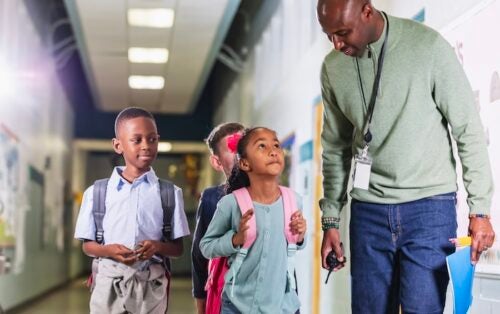
On August 5, more than 180,000 students walked back into Gwinnett County Public Schools, Georgia’s largest district. Many of these students were kindergartners, most entering a school building as students for the first time. For most school districts, that first morning is the finish line for children’s transition. Registration closed, orientation held, supply lists checked. The kindergarten transition, as a project, is complete.
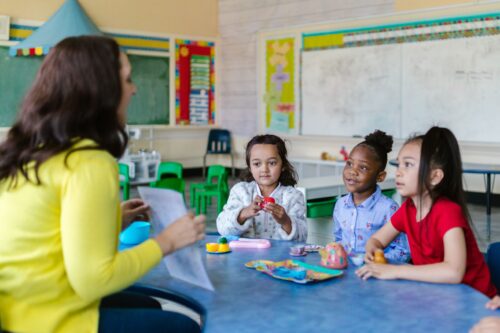
Gwinnett County Public Schools, in Georgia, is worth watching because it doesn’t treat that morning as the finish line. It treats it more like the middle. The district’s before-kindergarten work is substantial. Play 2 Learn, its flagship, offers free birth-to-five classes at every one of Gwinnett’s elementary schools and a few middle and high schools, 90 minutes a week in which children and the adults who care for them learn together in a preschool classroom, with a teacher coaching the grown-ups in real time.
In 2024, the district put a version of it on a bus. Play 2 Learn On the Go is a retrofitted school bus that parks at apartment complexes, churches, and community hubs families can walk to, on the reasoning that transportation shouldn’t determine whether a three-year-old gets a high-quality early learning experience. This fall, the district opened a new preschool academy in a converted wing of a county government building in Snellville, with six classrooms serving 94 three- and four-year-olds, and the district’s first preschool option built specifically for three-year-olds.
Kim Holland, Gwinnett’s executive director of early learning and school readiness, has also spent years focused on early enrollment. In the past many of Gwinnett’s kindergartners haven’t arrived until roughly two weeks into the school year, which forces teachers to rebuild their classroom community midstream. And these late enrollers may not have early access to the activities their school offers. Getting children in the door on day one, in a building they’ve already visited, is an important transition strategy.
Enrolling on time is what opens the door to the district’s summer bridge program. Gwinnett has run a version of one for well over a decade, first as school-by-school kindergarten camps, later as the Rising K Academy, and now as the Rising Kindergarten Summer Enrichment Academy. The design is the same approach the district uses in Play 2 Learn, delivered in June: hands-on activities in which children meet new friends, learn through play, practice cooperating with peers, and get familiar with kindergarten procedures before the first official day.
All of these readiness strategies form the on-ramp for preparing children and families for kindergarten, and it’s the part many districts are actively building.
Gwinnett County has also invested in helping elementary principals and district leaders better understand early childhood development and the P-3 continuum. Gwinnett was one of the first communities outside Atlanta to launch its own cohort of Georgia Early Education Alliance for Ready Students (GEEARS) P-3 Leaders Fellowship, which brings together center directors and principals to learn, collaborate, and create an action plan to address a P-3 priority.
Alongside these birth-to-five and leadership investments, the district has also continued its transition efforts, building on the success of the summer enrichment programs, with what it calls Joyful Learning: purposeful play during morning arrival in kindergarten classrooms. Children come in, and instead of a worksheet at a desk, they get open-ended materials and free choice, with teachers alongside them. The district frames the purpose as language, collaboration, and problem-solving.
It is, in one sense, a small part of the morning, but a meaningful part. Consider this: kindergartners arrive staggered over twenty or thirty minutes, carrying whatever the morning handed them. For a five-year-old, the shift from home to school can be a big change. Play is how young children metabolize that shift. It’s how they find a friend, test a rule, and locate themselves in an unfamiliar room. A classroom that opens with play tells arriving children something: this place works the way you work.
Joyful Learning helps address one aspect of the misalignment that transition research tells us. Children move from settings organized around play, choice, and relationships into settings organized around seat time and compliance, and schools call their resulting distress a readiness problem. In actuality, the “readiness problem” is more often that schools are not ready to meet young students where they are.
Gwinnett County is one bright spot for transitions to kindergarten and beyond. In CELS’s recent briefs on transitions, authors share others worth checking out. In Kindergarten Transitions and Beyond, the “and Beyond” in that title is doing real work. Transition isn’t an event to be staffed in August; it’s continuity that has to be built and sustained across the PK–3 continuum through relationships, communication, and aligned instruction, environments, expectations, and supports.
The CELS briefs find six tenets across research on transitions:
Gwinnett’s efforts map onto that framework more fully than most: family engagement that starts at birth rather than at registration, deliberate attention to who gets access and how they physically get there, leadership development that crosses the sector line, and, the least common piece, a change to what kindergarten itself feels like once children arrive.
What we don’t yet know is whether it’s moving long-term outcomes. That evidence isn’t in.
But when I spoke with Holland this summer, she told me the morning play practices have started to spread into other parts of the kindergarten day, and up into other grades. If that holds, it suggests something useful about how change occurs in a school system. Twenty protected minutes at the start of the day cost a schedule decision, not a budget line. They’re small enough that a principal can say yes, and good enough that teachers don’t want to stop with the morning shift in kindergarten.
Senior Fellow, Early & Elementary Education