
Table of Contents
- Frequently Asked Questions
- Moving Forward: Voices from the Field
- Introduction
- Landscape of Early Care and Education Financing
- Current Financing for Early Care and Education: Financing a Highly Qualified Workforce
- Current Financing for Early Care and Education: Affordability & Equitable Access
- Current Financing for Early Care and Education: Ensuring High Quality Across Settings
- Estimating the Cost of High-Quality Early Care and Education
- A Vision for Financing Early Care and Education
- Behind the Numbers
- Putting it into Context
- Learning from States and Other Countries
- Tools and Resources
- Graphics and Data Visualization
- Glossary
Learning from States and Other Countries
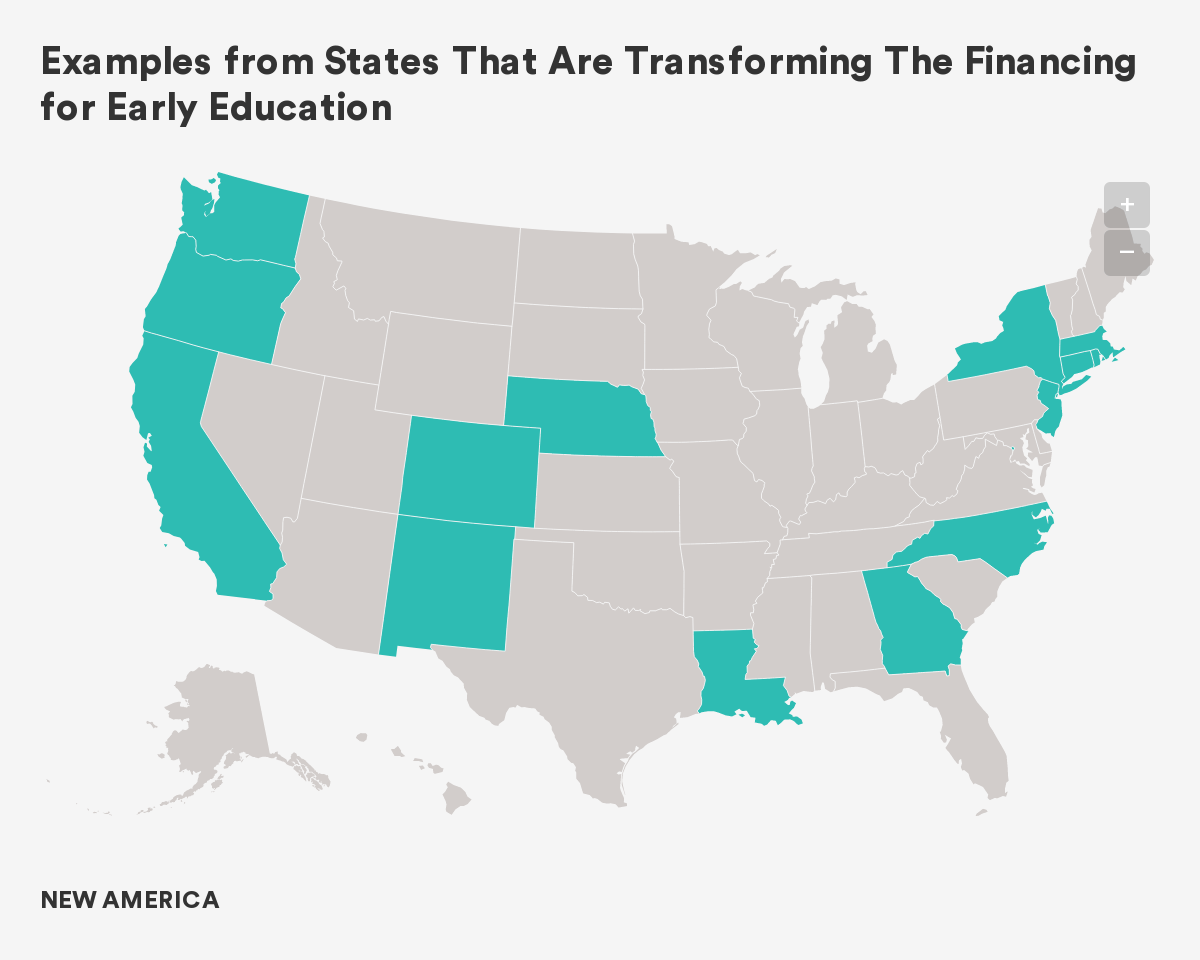
The Transforming the Financing report recommends a major overhaul in the way the United States funds and ensures access to high-quality early care and education for young children from birth to kindergarten entry. While such a change will take time, some places have already taken steps to address some of the challenges outlined in the report. This section highlights state and local actions to increase compensation for the workforce and improve ECE quality, access, and affordability. This section ends with a look at various international approaches to ECE systems building and funding.
Task Forces, Working Groups, and Governance Structures
California
In 2019, the California Assembly Blue Ribbon Commission on Early Childhood Education released its final report with recommendations for “an early learning system that works for children, families and providers.” The commission is envisioning universal access to early education for every family with a focus first on children in low-income families but recognized that while these increases represent an important start, they fail to address the persistent problem of raising workforce compensation. In November 2019, the governor created the State Early Childhood Policy Council and the State Early Childhood Action Research Team; the team is charged with creating a comprehensive plan for universal preschool and access to high-quality, affordable child care.
New York State
The Child Care Availability Task Force, convened by the governor in 2018 and made up of providers, advocates, business, unions, and government, will examine options and develop recommendations to improve access to high-quality, affordable child care. The task force is charged with addressing the shortcomings in the current subsidy system and will look at access to affordable care, availability of child care for families working nontraditional hours, statutory and regulatory changes to promote or enhance access, and the impact of tax credits and deductions. Recommendations will be submitted at the end of 2020.
Oregon
The Task Force on Access to Quality Affordable Child Care will develop recommendations to the legislative assembly to improve access to and affordability of child care by soliciting input from underserved populations, researching how child care subsidies are currently being used (and how they have worked in the past), and studying state and federally funded child care and early learning programs.
Washington State
The Washington Childcare Access Now (CAN) Act establishes a child care collaborative task force to develop a plan for affordable, quality care that includes an investment in the workforce.
Washington, DC
The Birth-to-Three For All D.C Act was signed into law in 2018, but has yet to be fully funded or implemented. The law boosts child care subsidies to both expand access to families and increase the wages of child care workers. It targets families who need it the most, but provides support to everyone.
New Mexico
Senate Bill 22 established a new cabinet-level department dedicated to programs for children from birth to five, the Early Childhood Education & Care Department, with oversight of child care assistance, pre-kindergarten, and home-visiting programs. This department is seen as an important step toward creating more consistency, accountability, and quality across ECE.
Governors’ 2019 and 2020 Budget Proposals
In the 2019 governors’ races, a record number of candidates across party lines included a focus on early care and education in their platforms. As new budget proposals were rolled out, 32 governors and the mayor of Washington DC proposed $2.9 billion in additional state funds for early care and education programs. Many governors continued this trend of advocating for additional state funding for early care and education by including funding increases in their 2020 budget proposals. While the bulk of proposed funding focused on access to pre-K, a few states did take on the important issue of funding for infant and toddler programs, which are higher cost. Here is a summary of state priorities among the seven states with the highest proposal levels:
- California: Expanding the number of subsidized child care facilities, improving and expanding campus-based child care options, expanding full-day kindergarten, and increasing home visiting programs targeting infant-maternal health improvements for African American families.
- Colorado: Funding for full-day kindergarten as a way to improve outcomes for children, reduce child care burden for families, and free up resources for districts to invest in additional pre-K and child care slots, as well as increased funding to help an additional 6,000 children attend the Colorado Preschool Program.
- Washington, DC: A per-child increase in spending that exceeded all other states to enhance the existing universal pre-K program, as well as the conversion of old school buildings into new child care centers, expansion of early action initiatives, improving provider rates, and expanding the refundable child care affordability tax credit.
- New Mexico: The state established a new Department of Early Education and Care, as well as funding to continue to move toward universal pre-K and expand home visiting and early screening services. In 2020, in addition to funds supporting the new Department of Early Education & Care, the state approved a $320 million non-recurring appropriation to create the Early Childhood Trust Fund.
- Oregon: $220 million for early care and education over the state’s two-year biennium budgeting process, including funds for the Baby Promise program to increase access to infant and toddler care and to establish a fund focused on equity in early care and education.
- Pennsylvania: An expansion of free, full-day kindergarten so that it’s available to every child, along with a $30 million increase for high-quality early childhood education.
- Virginia: $95 million to improve the quality and availability of pre-K for three- and four-year-olds from families with low incomes, which is estimated to allow an additional 11,000 children to enroll over the next two years.
State and Local Efforts to Address Specific Components of Transforming the Financing
1) Supporting & Compensating a Qualified Workforce
Self-sufficiency wages:
Bills in six states this year specifically addressed the importance of wages for early educators:
- In Washington State, the child care collaborative task force makes recommendations related to access to quality care to the governor and legislature. Among the issues on which it will deliberate are a number of specifications related to the workforce:
-changing pay scale to achieve parity with K–12 teachers
-preserving and increasing racial and ethnic diversity in the workforce
-ensuring that salary floor is adequate to support recruitment and retention of a qualified workforce
-incentivizing advancements in higher education credentials and equivalencies, training, and years of experience
-considering a provider’s years of experience in the field and at her current site
-differentiating subsidy rates by region
-providing additional compensation to providers serving specific populations, including lower-income families or those with additional linguistic or cultural competency needs. - In Massachusetts, proposed legislation calls for “appropriate professional development and compensation for early education and care providers.”
- In Washington, DC, a law that was signed in 2018, but has yet to be fully implemented, includes a requirement that the Office of the State Superintendent of Education develop a competitive compensation/salary scale for lead teachers and teacher’s assistants with a “cost modeling analysis” to help establish reimbursement rates that reflect the competitive salary scale.
- In New York City, a comprehensive proposal to expand infant and toddler care, NYC Under 3, was introduced to address issues of affordability, availability, and quality of care. The proposal included a provision for investing in the child care workforce through a commitment to living wages for early educators and provides funding for training, professional development, and scholarships as well as for a study to determine reimbursement rates that support quality and provide a wage.
- In Rhode Island, the Moving the Needle on Compensation Task Force made a series of recommendations focused on improving compensation for the infant and toddler workforce. These recommendations include the use of a statewide target wage scale linked to education levels, conducting a public education campaign to highlight the need for improved compensation, and funding a wage supplement demonstration project to help programs retain qualified and effective educators.
- In Nebraska, the Early Childhood Workforce Commission released a plan to fully fund early care and education by 2030. The plan includes a recommendation to close the gap between current investments in early care and education and the total cost of a system with a highly qualified, adequately compensated workforce.
Salary parity:
California’s Blue Ribbon Commission recommended that policymakers ensure salary parity with K–3 educators for those with comparable education and experience, including offering early educators competitive benefit packages that cover health, dental, vision, 20 days paid time off annually, and retirement contribution.
Salary enhancements:
North Carolina’s HB 882 adds a new compensation strategy for early childhood programs that employ qualified teachers who meet new standards. It requires the Division of Child Development and Early Childhood to create a new subsidy enhancement incentive program for programs that use a salary scale and employ qualified teachers. Programs would receive an enhanced child care subsidy payment for doing so, which would give them additional resources to pay teachers better and retain qualified teachers. H882 adds another compensation strategy to two programs already in place:
- The WAGE$ programs supports teacher education and compensation and is made available through Smart Start funding provided by local Partnerships for Children in about half of NC counties.
- The Infant Toddler AWARDS program increased compensation infant toddler leaders who already have an associate degree or higher and who are working full-time in child care programs.
Workforce development plans:
After conducting an ECE workforce study, Colorado developed its Workforce Development Plan 2020, which laid out a set of strategies addressing professional development and education, compensation, leadership, financing, and data and quality improvement.
Collective bargaining:
California enacted A.B. 378, a bill assuring collective bargaining rights for underpaid and overworked home-based child care providers.
2) Financing ECE
Tax Credits
- The state of Louisiana established a set of four School Readiness Tax Credits in 2007. Providers who own and operate a facility where care is given to foster children or to children who participate in the Child Care Assistance Program can claim a refundable tax credit based on the average monthly number of children who attend the facility multiplied by the applicable credit amount based on the quality rating of the child care facility. Refunds range from $750 per child at a 2-star level to $1,500 per child at a 5-star level. Child care directors and eligible staff can claim a refundable tax credit if they work at least six months for a licensed child care facility that participates in the quality rating system and are enrolled in the Louisiana Pathways Child Care Career Development System. Individual teacher and director credits range from $1,715 to $3,429.
- Colorado HB 1005 allows an income tax credit to eligible educators who hold an early childhood professional credential and who, for at least six months of the taxable year, are either the head of a family child care home or are employed with an eligible early childhood education program or a family child care home. The state also enacted HB 19-1013, a limited tax credit to help low-income families cover child care expenses of up to $1,000 per year.
Leveraging state and local tax revenue:
- The recent publication Funding our Future: Generating State and Local Revenue for Quality Early Care and Education1 from the BUILD Initiative provides funding strategies for increasing the revenue from state and local sources that can be directed to high-quality ECE. Based on the premise that state and local tax revenue dedicated for ECE represents a largely untapped approach for leaders to consider, the report enumerates seven available options, provides a set of guiding questions to assess state and local revenue options, and profiles states and localities currently implementing each option.
3) Increasing Access and Affordability
Sliding fee scales:
The Denver Preschool Program makes monthly tuition support available on a sliding scale. The amount of support a family receives is based on family income, the quality rating of the preschool, and the length of day the child attends. Preschools are rated for quality on a scale from 1 to 5. Families with lower incomes who choose higher-quality programs receive a greater amount of tuition support. In Washington DC, subsidized child care co-payments are based on the DC Sliding Fee scale. If the family is assessed a co-pay, it is based on adjusted gross income and family size.
Supports for infant/toddler care:
- A number of states have recently passed Paid Family and Medical Leave legislation, which is being recognized as a key strategy for relieving the high financial burden of finding out-of-home care for very young children. California, New Jersey, Rhode Island, New York, Washington, Massachusetts, Oregon, Connecticut, and Washington, DC have enacted paid family leave policies that ensure parents can take time to care for their babies in the earliest months of their lives.
- In Georgia, the Department of Early Care and Learning has initiated a plan to move 10,000 infant child care slots to a grant-funded model (Quality Rated Subsidy Grants) that enables providers to receive funding on an annual basis instead of being reimbursed based on attendance. This pilot pays providers 35 percent above the state’s base payment rates. In California, the state’s Blue Ribbon Commission recommends that policymakers develop guidelines and provide incentives to licensed family child care homes who wish to specialize in the care of infants and toddlers by establishing a specialized reimbursement rate for those with demonstrated experience and specialized training.
- Citing high costs for infant care ($21,000 per year) in New York City, along with lack of access (one-half of all districts meet the definition of child care deserts) and low levels of public funding (only 7 percent of eligible infants and toddlers are currently supported through public funds), NYC Under 3 increases access and affordability of care by extending child care assistance to working families with incomes up to 400 percent of poverty ($100,000 for a family of four). The proposal also provides funds for startup and expansion.
Tax credits and revenue from taxes:
- Louisiana is providing funding for early care and education programs by implementing a tax on hemp-derived CBD products and dedicating a portion of gambling revenue to its Early Childhood Education Trust.
State investments in expanding access:
- In May 2019, the Oregon legislature passed HB 3427, The Student Success Act, allocating $2 billion to improve education. The Early Learning Account of the Student Success Act leverages $2 million annually to support access to ECE for low-income children from birth to age five. Funds will support expansion of existing programs; support the Equity Fund, a parenting program; and be invested in the early childhood education workforce.
- The 2019 California state budget increased spending on ECE by 15 percent, including expansion of subsidies for 12,400 children, expansion of full-day kindergarten statewide, an increase of 10,000 pre-K seats, and increased access to care for parents in the state work assistance program. Other investments include support for facilities construction, improvements in data collection and utilization, the development of a plan for a comprehensive ECE system, increased family leave periods, and supports for home-based child care providers.
- Louisiana allocated $20 million of its $40 billion state budget to increase access to quality ECE for children four and under.
- Illinois increased funding to its Early Childhood Block Grant to expand and improve 0–5 services and to the Child Care Assistance program to increase access by extending income eligibility from 185 percent to 200 percent of the federal poverty level.
- In Texas, school finance bill HB 3 included funding for the state’s pre-K to help existing programs meet quality requirements and requirements to be full-day.
- In 2019, Washington, DC added $15.8 million in funding for programs included in the Birth-to-Three for All DC Act of 2018, which has not yet been fully funded or implemented. Implementation would build on Washington’s success with universal preschool, expanding access to affordable child care for the youngest children and raising early educator wages.
4) Ensuring Quality Across Settings
Support for facilities:
- Private investments:
- North Carolina’s Self Help, Inc. partnered with the state to guarantee loans to ECE providers using federal block grants from CCDF. The loan guarantee was available to providers who served children whose ECE services were subsidized by the state.
- The Connecticut Health and Educational Facilities Authority partially guarantees private-sector loans to ECE providers. This program combines an interest rate subsidy with its loan guarantee to increase the feasibility of borrowing for ECE programs.
- Tax credit programs also provide opportunities to improve facilities, like the Louisiana School Readiness tax credits program.
- Illinois allocated $100 million for building and updating child care and school facilities as part of an infrastructure package.
- The City of New York’s NYC Under 3 addressed the lack of affordable and accessible infant care by issuing grants for start-up construction and facilities renovation. The proposal offered start-up and expansion grants to providers willing to add infant and toddler seats. These competitive grants would give priority to those in neighborhoods with significant income-eligible populations and limited supply of programs. An additional $500 million capital campaign was included that would build new infant toddler facilities, beginning with city-owned building sites.
- The Federal New Markets Tax Credit, instituted in 2000 to promote economic development and create jobs in low-income communities, provides an incentive for banks, businesses, or individuals to invest in intermediaries that invest in projects in economically distressed areas. While the program is not focused on ECE projects, Head Start and Educare schools have successfully utilized this mechanism, opening the possibility that other ECE programs may qualify for the credit (Transforming the Financing report, p. 145).
5) Estimating the Cost of High-Quality ECE
Cost Modeling/Calculating:
- Identifying a Values-Based Budget for Children, Parents, and Teachers in California is grounded in an “understanding of what is required of early childhood educators and the conditions necessary for effective teaching.” Cost estimates sought to eliminate current disparities among educators based on age of children served, setting, and funding stream.
- A report commissioned by North Carolina business leaders highlights three interrelated issues critical to expanding the state’s pre-K program: accurately determining how many children are eligible but lack access, analyzing whether county waiting lists accurately reflect the need, and eliminating barriers to expanding the program to fully meet the actual need. NIEER used the Cost of Preschool Quality & Revenue calculator to analyze how the state’s pre-K funding mechanism is hampering enrollment.
International Approaches to ECE Systems Building and Funding:
Study 1: Sharon Lynn Kagan, ed., The Early Advantage 2: Building Systems That Work for Young Children: International Insights from Innovative Early Childhood Systems (New York: Teachers College Press, 2019)
This volume begins with the premise that in the rush to address the needs of children, countries are enacting “chaotic policies and services that lack coherent planning and structures,” and as a result compromise both quality and efficiency. The Early Advantage 2: Building Systems that Work for Young Children examines efforts in Finland, England, Australia, Republic of Korea, Singapore, and Hong Kong to advance children’s well-being and enact effective early childhood policies and strategies. The goal of the study was to describe how systems are created and supported, guided by three sets of questions:
- Descriptive questions focused on the “what's”: what system elements, what government structures, and what frameworks were in place, etc.
- Comparative questions focused on similarities and differences in policies, ideologies, services, practices, and priorities across the jurisdictions.
- Explanatory questions designed to illuminate the rationale and strategies that support service delivery, monitoring, and quality improvement.
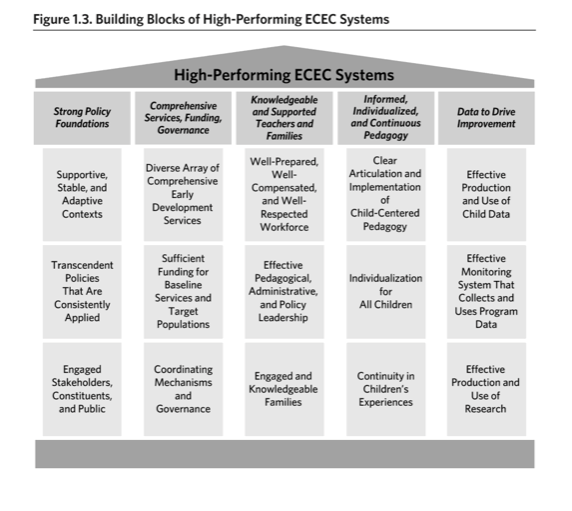
To publication looks broadly at five systems elements (or pillars) including: Strong Policy Foundation; Comprehensive Services; Funding and Governance; Knowledgeable and Supported Teachers and Families; Informed, Individualized, and Continuous Pedagogy; and Data to Drive Improvement. Snapshots and full case studies of each country provide in-depth analysis of each country:
- Australia
- England
- Finland
- Hong Kong
- Singapore
- South Korea
Study 2: OECD, Providing Quality Early Childhood Education and Care: Results from the Starting Strong Survey, 2018 (Paris, France: Organisation for Economic Co-operation and Development, 2019)
The Starting Strong Teaching and Learning International Survey (TALIS Starting Strong) asked ECE staff and leaders in Chile, Denmark, Germany, Iceland, Israel, Japan, Korea, Norway, and Turkey about prevailing policies and practices within the sector. Findings on funding, governance, and quality include:
- Most (90 percent) centers receive government funds. Parents are also involved in funding programs, with more than 60 percent of centers receiving funds from parent fees in all countries except Chile and Iceland.
- Reducing group size, improving salaries, and receiving support for children with special needs are important spending priorities. Access to high-quality professional development is also a high priority, especially among those serving children under three years of age.
- The share of privately managed centers ranges from 10 percent in Israel to 70 percent in Germany. These centers benefit from greater autonomy in the management of budgets and human resources.
- Monitoring activities focus primarily on facilities and financing rather than on interactions. More than 20 percent of staff in Japan and Germany report never having been evaluated on process quality.
The report identified four key objectives for policy:
- Promote practices that support quality and foster learning, development, and well-being; provide pre-service and in-service training programs that can support staff in the use of effective practices, curriculum frameworks, and child-centered activities.
- Attract and retain a high-quality workforce; raise the status of the profession through additional salaries, reduced stress and instability, and access to professional development.
- Give a strong start to all children; address the needs of those facing barriers through staff preparation and additional supports as needed.
- Ensure smart spending; identify and agree on spending priorities and develop assessment and monitoring frameworks that support quality and empower center leaders.
See the Glossary for key word definitions.
Citations
- Roughly $3,200 per year for infants and toddlers and $1,800 per year for prekindergartners