
Table of Contents
- Frequently Asked Questions
- Moving Forward: Voices from the Field
- Introduction
- Landscape of Early Care and Education Financing
- Current Financing for Early Care and Education: Financing a Highly Qualified Workforce
- Current Financing for Early Care and Education: Affordability & Equitable Access
- Current Financing for Early Care and Education: Ensuring High Quality Across Settings
- Estimating the Cost of High-Quality Early Care and Education
- A Vision for Financing Early Care and Education
- Behind the Numbers
- Putting it into Context
- Learning from States and Other Countries
- Tools and Resources
- Graphics and Data Visualization
- Glossary
Frequently Asked Questions
What do you mean by high-quality care?
A high-quality early childhood program provides a safe and nurturing environment that supports learning, health, and family well-being while promoting the physical, social, emotional, and intellectual development of young children. While it is not easy to measure program quality and its impact on learning and development, studies of program quality generally focus on two elements: structural quality (measuring components such as teacher-child ratios, group size, staff qualifications, program duration, etc.) and process quality (focused primarily on relationships and interactions between children and staff). The National Institute for Early Education Research (NIEER) publishes an annual report that tracks state pre-K program progress on 10 quality indicators. In 2018 NIEER assessed preschool policies using an updated set of minimum quality standards focusing on process quality and reflecting recent research on effective ECE. National accreditation is another mechanism for measuring and demonstrating quality. A number of studies have focused on the key elements of high-quality programs and have identified components relating to staff qualifications and strong leadership, high-quality and appropriate curricula, family engagement, continuous quality improvement strategies, and sustainable funding. At the systems level, the Transforming the Financing report identified six principles for a high-quality ECE system:
- A “diverse, competent, effective, well-compensated, and professionally supported” workforce
- Equitable and affordable access for all
- An adequate and transparent financing system
- A variety of delivery options
- Adequate resources for facilities
- Ongoing accountability and evaluation systems
REFERENCES:
Transforming the Financing of Early Care and Education
The State of Preschool 2018: State Preschool Yearbook
Quality 101: Identifying the Core
Components of a High-Quality Early Childhood Program
The Building Blocks of High-Quality ECE Programs
Investing in our Future: The Evidence Base on Preschool Education
Financing Early Care and Education Interactive Guide
Why does the ECE financing system require a transformation?
Currently, there is no system. The Transforming the Financing report says on page one that “despite the great promise of early care and education, it has been financed in such a way that high-quality early care and education has only been available to a fraction of the families needing and desiring it and does little to further develop the early care and education workforce. It is neither sustainable nor adequate to provide the quality of care and learning children and families need—a shortfall that further perpetuates and drives inequality.” In short, “for too long the nation has been making do with ECE policies and systems that were known to be broken” (p. 239). In spite of the recent $12 billion federal investment in the Child Care Development Block Grant (CCDBG), funding at the federal level remains insufficient to make broad changes in the ECE system. At the state level, investments have tended to focus on services for three- and four-year-old children, leaving families of infants and toddlers with fewer options and higher costs. According to one study, most efforts to improve both access and quality have only scratched the surface in addressing the inequities and inadequacies of the system. Efforts to envision better workforce policies and adequate funding have been constrained in part by an assumption that change must fit within the confines of the existing infrastructure and funding streams. Such constraints have undermined a comprehensive approach to quality improvement and workforce policies and have allowed proposals that raise qualifications for the workforce to move forward without being linked to resources that simultaneously address teachers’ earnings and economic well-being. For an overview of the three areas of focus in the report, watch this 2-minute video.
REFERENCES:
Transforming the Financing of Early Care and Education
Early Childhood Workforce Index 2018
Financing Early Care and Education Interactive Guide
Why is financing so complicated?
Funding for ECE services comes from a multitude of revenue streams, including families’ payments, public sector expenditures, and private sources such as philanthropy and employers. As a result, the financing for early care and education in the U.S. is a layering of separate programs, with different funding streams, constituencies, eligibility requirements, and quality standards. What is needed is a more harmonized system that offers a continuum of care.
REFERENCES:
Why is child care so expensive?
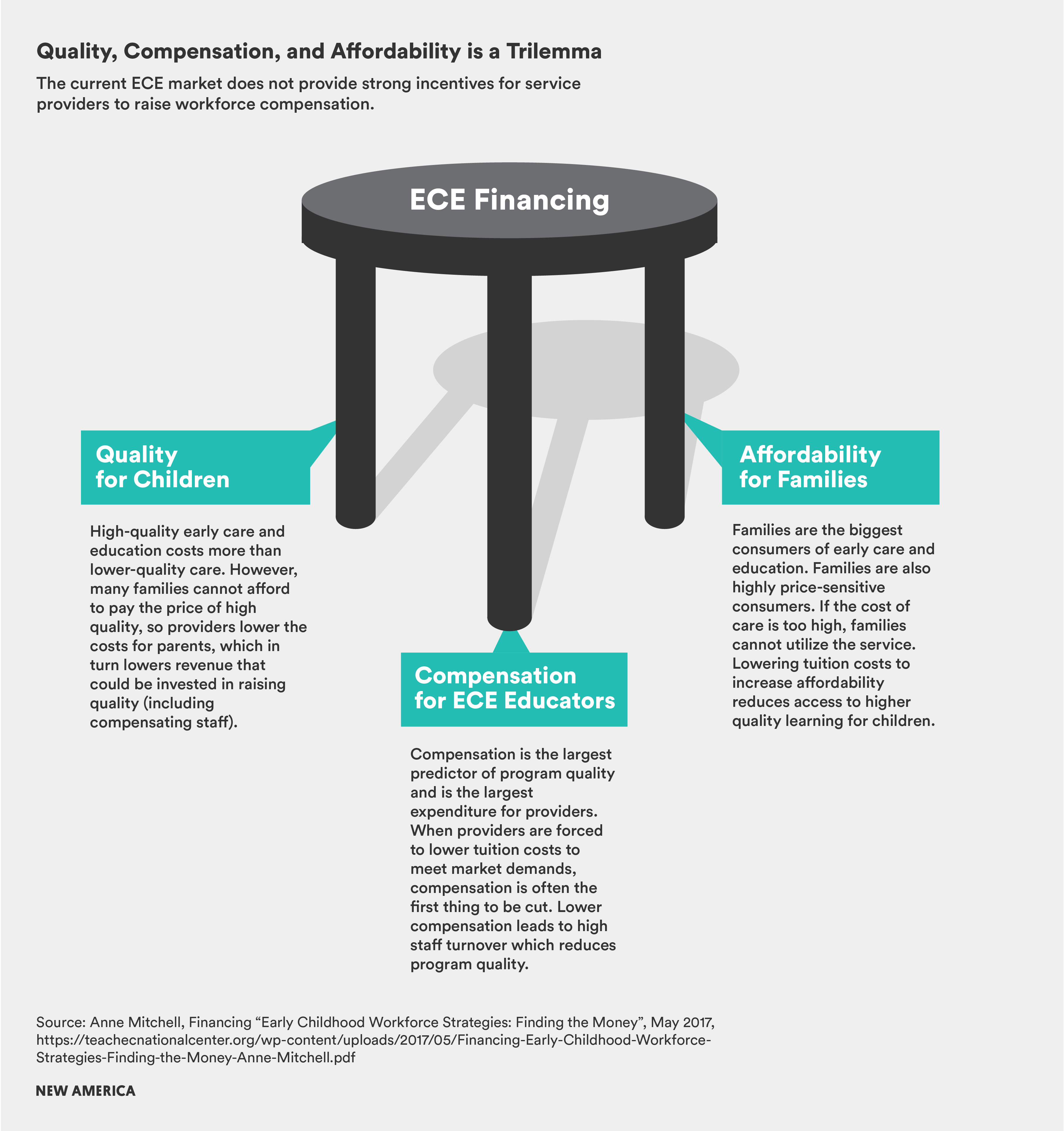
With early childhood educators being paid extremely low wages and providers struggling to make ends meet the burning question is: Why is care so expensive? There is no question that child care in the U.S. is expensive. In the current system, families are paying the majority of the costs in the form of fees and tuition—approximately 60 percent of the total cost of care, which consumes, on average, one-fifth of a median household income. A reasonable estimate of the average cost of child care for families is around $10,000 per year. For infant and toddler care, the costs can exceed college tuition. Child care is a labor-intensive and labor driven industry, and staffing is expensive. The largest cost drivers are salaries and benefits. Licensed programs must meet staffing requirements that set the ratio of caregivers to children. Prevailing child-to-staff ratios suggest a ratio of 1 teacher for every 4 infants, 1 teacher to every 6 toddlers, and 1 teacher to every 10 preschoolers. Other expenses fall generally into three categories: occupancy, office and administrative costs, and classroom expenses. Let’s look at one calculation that illustrates the problem. Child Care Aware asks us to imagine a center that serves 40 children, at an annual cost to families of $10,000, for example. That's a total revenue of $400,000. Let’s deduct the cost of rent, utilities, and maintenance—that is $48,000 and represents 12 percent of the revenue. Now let’s deduct the cost of classroom materials, food, and administrative costs—that is $92,000 and represents 23 percent of the revenue. Finally, let's deduct personnel costs—one director, 3 lead teachers, and 6 assistant teachers working 10 hours per day will cost $260,000, or 65 percent of the total revenue. To ensure all families have access to quality care, numerous studies, including the Financing report, conclude the current system is unsustainable and the best solution is increased public investments.
- Are certain families more hard-hit than others? Child care is unaffordable for parents nationwide; it's worse for millennial parents (those born between 1980 and 1997). Parental cost of child care varies widely from state to state, but with the median income for millennials near poverty levels, affording child care is a huge challenge. For families making minimum wage, the cost of child care takes up two-thirds of their earnings. And while some assistance programs help very low-income families, those whose incomes are slightly higher make too much to qualify for assistance. In order to work, these families often turn to the "grey market" of informal, unlicensed care. New federal legislation such as the Child Care for Working Families Act can go a long way to support working families' ability to access needed quality care.
- What about publicly funded programs—do they help? Head Start, state Child Care Assistance programs, and state-funded prekindergarten programs typically provide resources to low-income families, while tax preferences benefit middle- and upper-income families. (One exception is universal pre-K programs, which are open to families of all income levels.) The current lack of harmonization among these financing mechanisms leads to gaps in ECE affordability for some low-income families and under-utilization of ECE services by middle-income families. Also, in many, if not most cases, funding is not adequate to cover all eligible children.
REFERENCES:
Where Does Your Child Care Dollar Go?
The U.S. and the High Cost of Child Care (YouTube video, 1:48)
The US and the High Cost of Child Care: 2019 (interactive state and county map)
Worthy Work, STILL Unlivable Wages
Child Care for Working Families Act
Working Families Spending Big Money on Child Care
How does ECE funding differ from K–12 funding?
States fund their K–12 education systems based on a funding formula, and for most, this is a per-student figure, with additional money allocated for need. While K–12 funding formulas do not guarantee adequate levels of funding, money distributed through a formula is more insulated from the economic ebbs and flows of the state budget process. The mechanisms through which states collect and fund pre-K programs vary greatly. Many states use more than one source to fund pre-K, including state, federal, and local funding. Funding for a state pre-K program can come from general fund appropriation, block grants, or a funding formula similar to that used in K–12.
REFERENCES:
How States Fund Pre-K: A Primer for Policymakers
How much is the ECE workforce paid now?
Comprised primarily of women, many of whom are women of color, the ECE workforce represents some of the lowest-paid professionals in the country. In fact, nearly 40 percent of ECE teachers rely on public assistance at some point in their careers, in spite of the fact that they have earned required credentials and degrees. While income levels vary across states and regions, as well as by work settings, studies estimate that median hourly wages range from around $10 for child care providers to $13 for preschool teachers across all settings and $26 for preschool teachers in public school settings. To recruit and retain teachers with appropriate qualifications and experience to support young children’s development, programs need to offer adequate compensation. Many teachers suffer from economic anxiety and report “worrying about having enough food for their family…covering routine health expenses, and…paying their monthly bills.” The stress of living in poverty not only affects teachers and their families but can also have negative consequences for the children in their care. When teachers are stressed about their ability to provide for their own families, they are less likely to engage in positive interactions with children, making it challenging to build a supportive learning environment. Compensation needs to be sufficient to recruit and retain highly skilled teachers and ensure that teaching in an early childhood program can be a sustainable long-term career choice.
REFERENCES:
Working Hard for Poverty Wages (YouTube video, 1:27)
Where Does Your Child Care Dollar Go?
Worthy Work, STILL Unlivable Wages
Building a Skilled Teacher Workforce
Transforming the Workforce for Children Birth Through Age 8: A Unifying Foundation (chapter 11)
How many states offer a public pre-K program?
In 2018, public pre-K programs were operating in 44 states and the District of Columbia. States enrolled almost 1.58 million children in state-funded preschool, including more than 1.3 million four-year-olds—one-third of all four-year-olds in the country. Enrollment of three-year-olds was about 227,000, or nearly 5.7 percent. Tracking conducted each year by NIEER reveals that enrollment of state pre-K grew steadily until 2008. The number of children enrolled decreased in 2012. The state pre-K enrollment growth rate has been anemic from 2013 to the present, with average annual increases below the 2008 pre-recession level. At the current pace, it would take states nearly 20 years to serve just half of all four-year-olds in preschool. And with the sunsetting of federal Preschool Development Grant (PDG) support, some states may struggle to even sustain current levels of enrollment. It would take nearly a century to reach the 50 percent mark for three-year-olds at the current pace, according to the 2018 NIEER State Preschool Yearbook.
REFERENCES:
How do funding mechanisms support or incentivize quality?
Family-oriented financing, such as the provision of child care assistance, has some potential to influence quality. The 2014 revisions to the Child Care Development Block Grant created a quality improvement set-aside designed to improve program quality and support school readiness. States have considerable flexibility in deciding how they will use quality set-aside funds as well as in setting reimbursement rates. While the federal government recommends rates be set at the 75th percentile of the current market rate, most states set rates well below that threshold. When states set low reimbursement rates, providers are not able to invest revenue in quality improvement efforts. Many states link payments directly to quality through their Quality Rating and Improvement System (QRIS). Quality improvement incentives such as QRIS are designed to reward the attainment of higher quality with increased reimbursement rates. However, for many providers, the increased revenue does not cover the cost of making and sustaining improvements (e.g., raising salaries or offering professional development). Forty states have implemented a tiered reimbursement approach tied to their QRIS, which offers higher reimbursement rates to providers as programs achieve higher scores. However, three-fourths of the states implementing tiered reimbursement still set rates below the recommended 75th percentile. As a result, tiered reimbursement by itself rarely generates enough revenue to raise quality, and levels of reimbursement are rarely set with a determination that the higher rates are adequate to meet the cost of quality. Provider-oriented financing mechanisms can provide incentives to improve ECE quality and the distributing entity can establish or enforce standards. For example, Head Start regulations link the receipt of funding to quality standards such as staff qualifications, use of evidence-based curricula, etc. and in some cases to a center’s quality rating, thereby making quality a consideration in new or ongoing funding decisions. In some states, funding for state-sponsored pre-K programs is also linked to a provider’s quality rating under the QRIS.
REFERENCES:
Red Light Green Light: State Child Care Assistance Policies 2016
Head Start Policy & Regulations
See the Glossary for key word definitions.