
Table of Contents
- Frequently Asked Questions
- Moving Forward: Voices from the Field
- Introduction
- Landscape of Early Care and Education Financing
- Current Financing for Early Care and Education: Financing a Highly Qualified Workforce
- Current Financing for Early Care and Education: Affordability & Equitable Access
- Current Financing for Early Care and Education: Ensuring High Quality Across Settings
- Estimating the Cost of High-Quality Early Care and Education
- A Vision for Financing Early Care and Education
- Behind the Numbers
- Putting it into Context
- Learning from States and Other Countries
- Tools and Resources
- Graphics and Data Visualization
- Glossary
Current Financing for Early Care and Education: Financing a Highly Qualified Workforce

Key takeaways
- Efforts that have been made to improve compensation levels have been inadequate.
- Relying on loans to fund higher education is risky because of the difficulty the ECE workforce will have in paying these loans off.
- Most states do not have a comprehensive system of professional development for the workforce; access to professional development varies significantly depending on setting.
- There is a lack of high-quality ECE preparation programs that provide the competencies necessary to effectively work with young children.
Summary
In order to ensure a highly qualified workforce, early educators need to receive adequate compensation, have opportunities to access affordable higher education, and receive ongoing professional development. While there has been an increased emphasis over the past two decades on raising the educational requirements of early educators, there has not been an equal emphasis placed on increasing their compensation. The average pay for a Head Start teacher in 2012 was only $33,072, compared to $56,130 for an elementary school teacher. Not only is compensation generally low for the ECE workforce, but benefits are also typically limited in comparison to K–12 educators. Many struggle financially and are forced to rely on public support programs. Inadequate compensation also contributes to the high levels of employee turnover in many ECE settings.
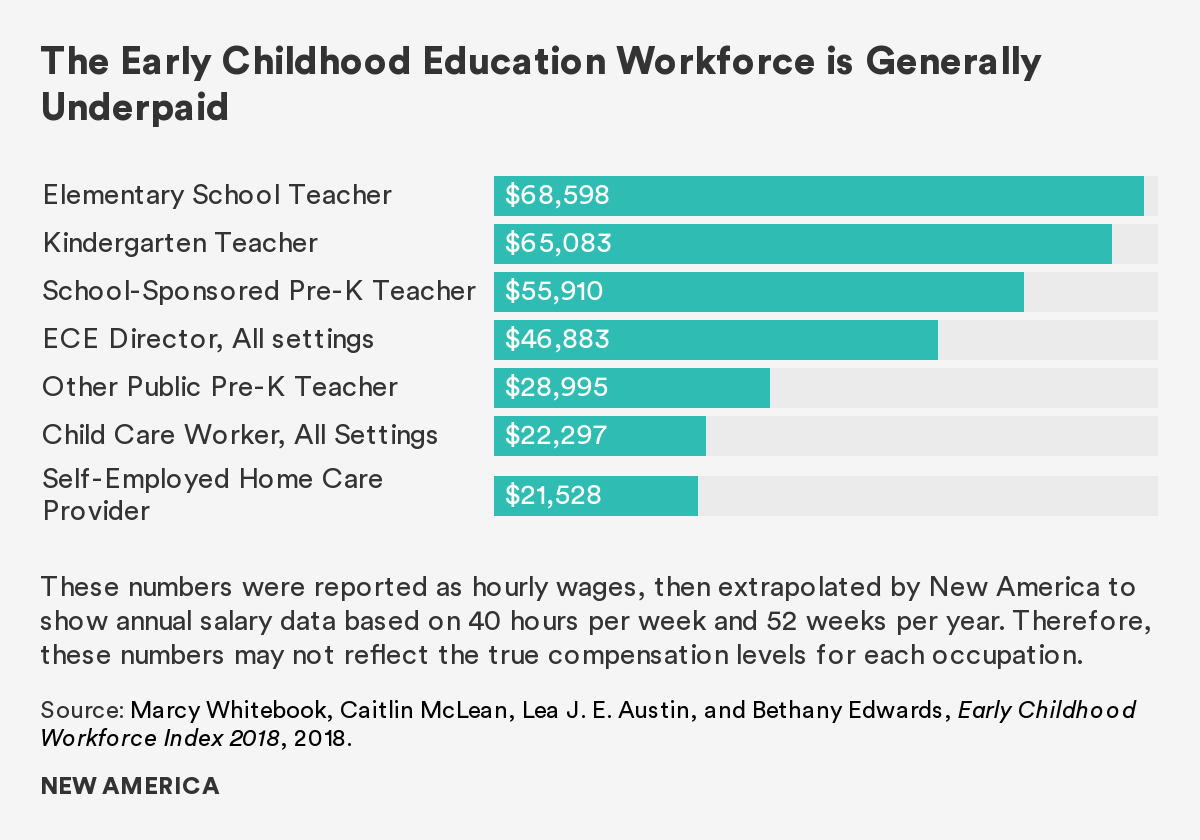
The efforts that have been made to improve compensation have been inadequate. Wage supplements and tax credits may provide temporary financial assistance to early educators, but they do little to alter the low base salaries received by the majority of the workforce. The most effective way to improve compensation levels would be raising base pay through contracts, but there are currently inadequate levels of funding available for such salary increases across all settings. Funding is needed to provide for adequate compensation of the ECE workforce while simultaneously ensuring that higher costs are not shifted onto families who are already struggling to pay for early care and education.
Like adequate compensation, opportunities to access affordable higher education are critical for ensuring a highly qualified ECE workforce. While the Transforming the Workforce report emphasized the importance of bachelor’s degrees or higher for lead educators, it’s also important that financing be in place to support early educators pursuing CDA credentials and associate degrees. As demand grows for early educators with higher education, there is a danger of a large increase in total debt load for them unless scholarships and other financial supports are made available.
There are a few financing mechanisms designed to support the educational attainment of the workforce, such as the T.E.A.C.H. scholarship program, currently in operation in 23 states and the District of Columbia, which provides financial assistance for current ECE educators. Apprenticeship programs are another way to help build ECE workforce qualifications. The workforce can also take advantage of general higher education supports, such as federal loans, which can be made more affordable through the use of income-driven repayment plans. But unless the compensation levels of early educators rise significantly, relying on loans to fund higher education is risky because of the difficulty the workforce will face in paying these loans off over time. Current ECE professionals may also be eligible for need-based grants, such as federal Pell grants, though such grants may not cover the full costs of higher education.
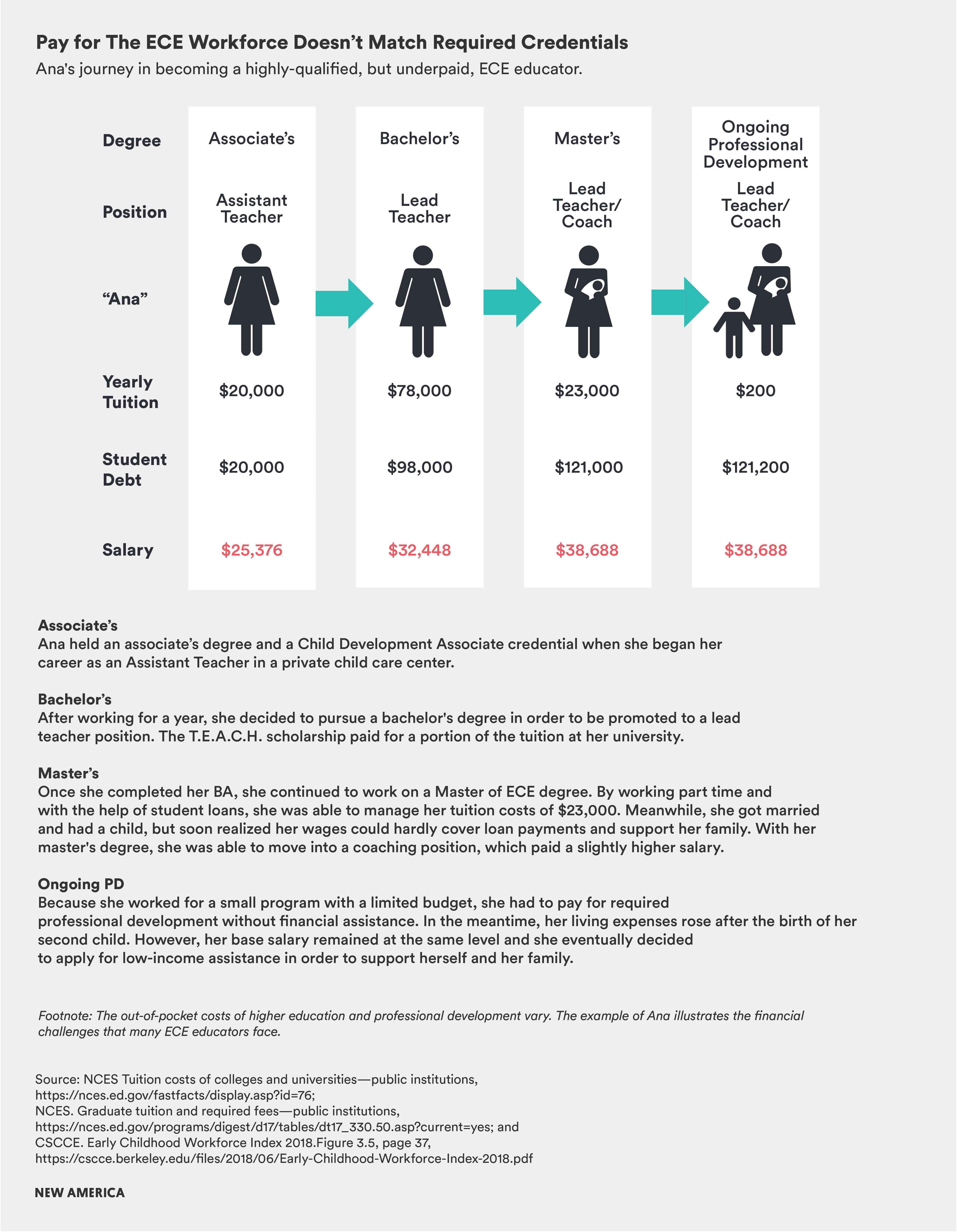
Even if supports are put in place to help the workforce afford higher education, there remains the problem of a lack of high-quality ECE preparation programs that provide the competencies necessary to effectively work with young children. Additionally, ECE degree programs typically have limited to no resources for faculty development. In many states, there has been an overall decline in funding for public colleges.
Once an early educator has graduated from a high-quality preparation program, it’s imperative that she receive ongoing support and professional development (PD). Unfortunately, most states do not have a comprehensive system for training of the ECE workforce and access to PD varies significantly depending on setting. While “one-off” training sessions for ECE staff are often the norm, this type of PD is unlikely to impact practice. Instead, PD should be delivered via sequential learning options and coursework from accredited institutions. Ideally, early educators would be able to translate the skills acquired through PD into credentials and advanced degrees.
Key quotes from the report:
- "Despite an increased emphasis on raising the qualifications and education level of ECE educators over the last two decades, there has not been a commensurate emphasis on raising the compensation of the workforce." (p. 88)
- "Benefits for the ECE workforce are limited and vary greatly by job title and ECE setting." (p. 90)
- "Although wage supplementation is the most common strategy for increasing compensation, there are several disadvantages to how it has been implemented to date, in terms of ensuring the well-being and adequate compensation of the ECE workforce." (p. 93)
- "Unless earnings for ECE professionals rise, relying on student loans to fund new credential requirements is risky because students' low earnings will make it difficult for them to pay off their loans in the future, creating costly burdens for taxpayers who will eventually cover a large share of the debt burden." (p. 103)
- "Existing professional development supports for the ECE workforce reflect the under-resourced and piecemeal ECE system as a whole." (p. 112)
Questions for policymakers:
- What states, if any, have made progress in improving the compensation of the ECE workforce? What are the key policies or levers that have led to that change?
- What levers are there for states to spur institutes of higher education to more effectively support and prepare early childhood educators?
Questions for higher education:
- What supports or innovations are available for non-traditional students and English learners?
- With regards to field placements, how can you meet the need of many early childhood educators to continue working as well as ensure their exposure to strong mentor teachers and high-quality early learning environments?
- What are the most significant barriers to establishing articulation agreements with two-year-institutions and to accepting credit for prior learning?
- What alternative class schedules are available to support early educators who work during the day? What do you need to make alternative class schedules possible?
Question for other stakeholders:
- How can philanthropy help improve supports for and preparation of early childhood educators?
See the Glossary for key word definitions.