
Table of Contents
Analysis
The Landscape of Short-term Training Programs
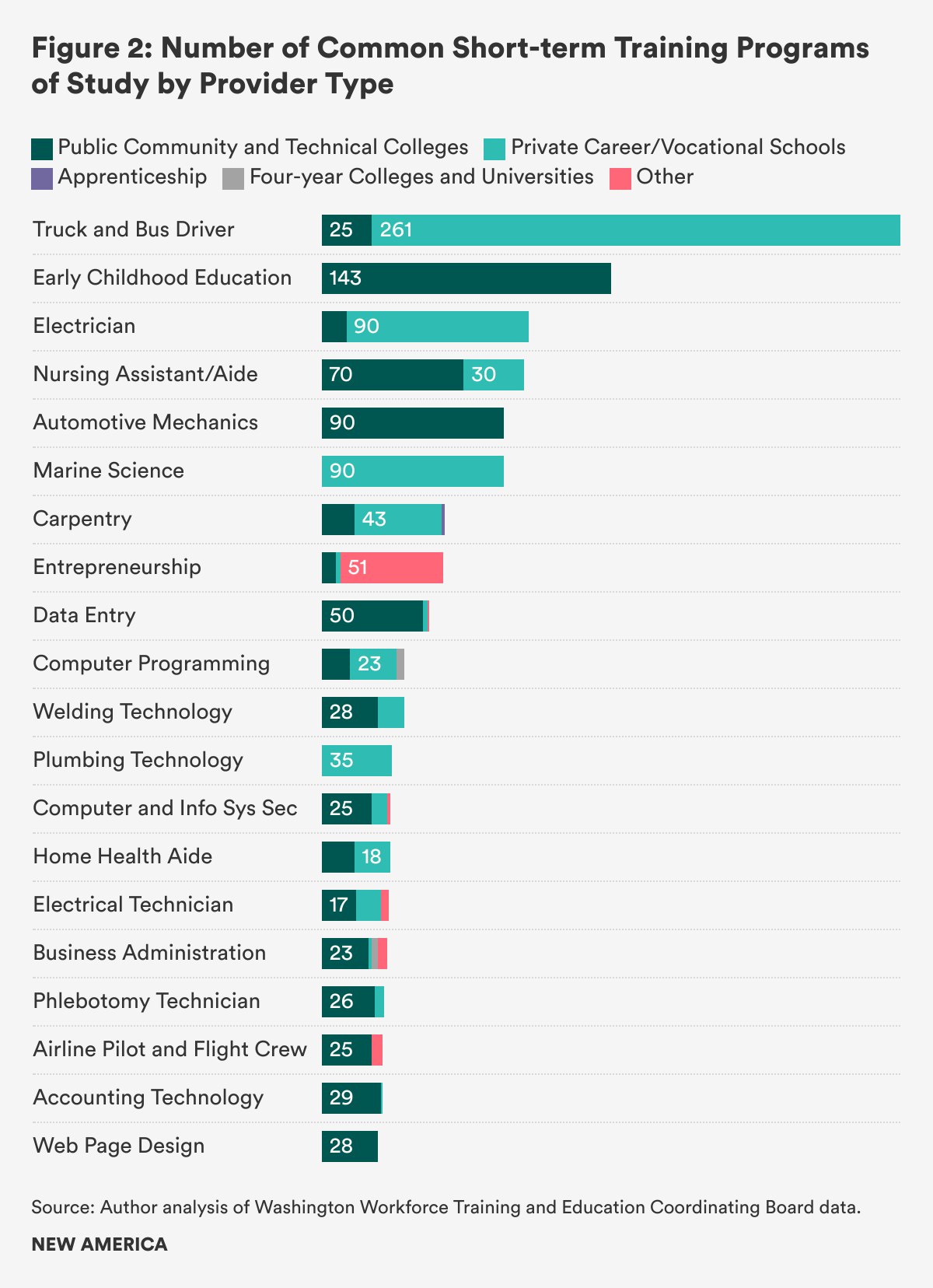
Of the 2,560 short-term training programs analyzed in Washington State, there are 265 different types of programs of study offered by training providers. Truck and bus driver programs account for the greatest share of short-term training (11.6 percent), followed by early childhood education (5.8 percent), electrician (4.1 percent), nursing assistant/aide (4.1 percent), and automobile and marine science (3.7 percent) programs.
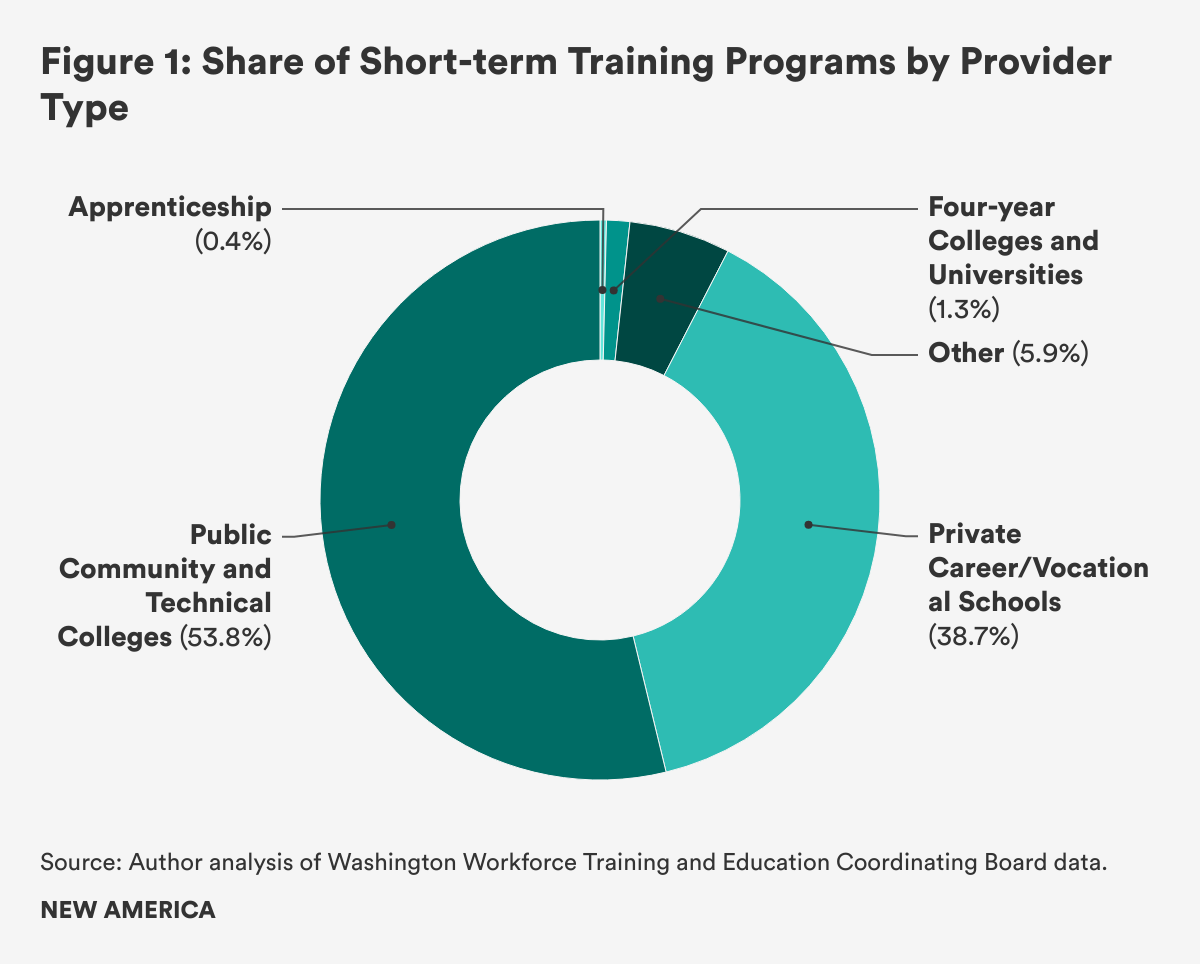
As Figure 1 indicates, public community and technical colleges and private career/vocational schools provide the vast majority of short-term training. More than half of short-term training programs analyzed, 54 percent, were offered by community and technical colleges, while private vocational schools account for 39 percent of programs.1 Yet the data also show that these two providers tend to offer different types of training. As Figure 2 indicates, private career/vocational schools are the primary provider of truck and bus driver, electrician, marine science, carpentry, and plumbing technology programs, while public community and technical colleges tend to offer the majority of early childhood education, nursing assistant/aide, automotive mechanics, data entry, welding technology, computer and information systems security, business administration, airline pilot and flight crew, accounting technology, and web page design programs.
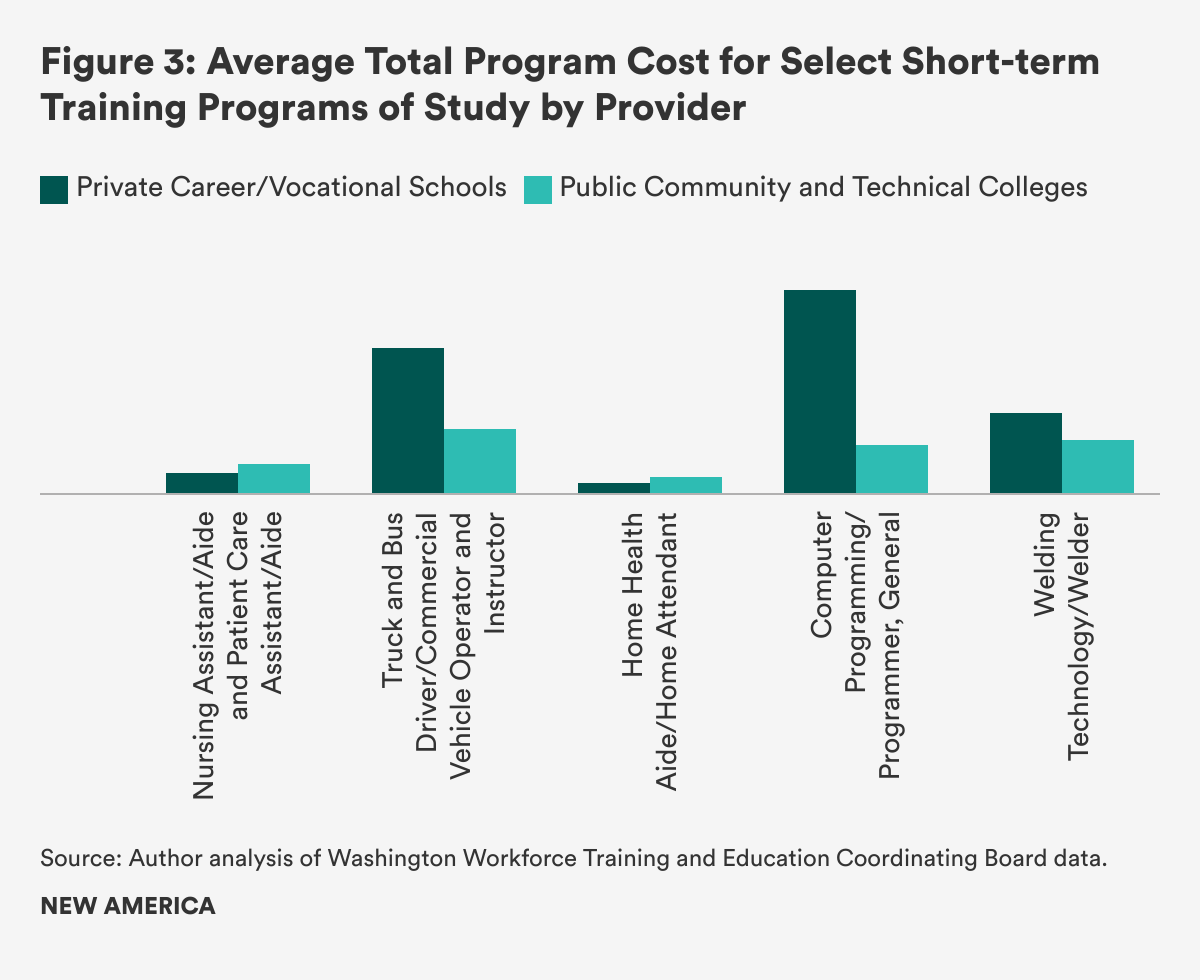
Short-term training programs at private career vocational schools cost more in tuition and fees than those at public community and technical colleges, $3,512.64 compared to $1,375.62, on average. Yet this finding does not hold for all programs of study. We examined five programs of study commonly offered by both public community and technical colleges and private career vocational schools. As Figure 3 below shows, a nursing assistant/aide or home health aide program costs slightly more at a public community and technical college than a private career vocational school, $292.20 and $185.77, respectively. Yet these short-term training programs are among the least expensive. Truck and bus driver, computer programming, and welding technology training programs cost substantially more at a private vocational school—$2,871.35, $5,508.05, and $936.16, respectively, than at a community or technical college.
Yet these program costs do not necessarily reflect the out-of-pocket cost a training program participant incurs. Individuals can benefit from several sources of public workforce funding. Washington's Job Skills Program pays for half the training offered by a community college, while partner businesses cover the other half;2 the Worker Retraining Program gives financial assistance to individuals who need basic skills and technical training via colleges;3 the Washington College Grant covers tuition at eligible in-state public colleges or universities, including community or technical colleges, or approved private colleges or career training programs for low- and middle-income families;4 and the Workforce Innovation and Opportunity Act covers college training programs that confer credit. The state also fully funds or heavily subsidizes occupation-specific training for early childhood education professionals, who are required to take certain community college courses to obtain licensure. Individuals who leave their employment to care for disabled or elderly family members can also obtain their home care professional certification at little or no cost due to state training subsidies. More data are needed to determine how much adults are paying to pursue training and how the cost to individuals impacts decisions about whether to pursue certain types of training.
Profile of Short-term Training Program Participants
Gender
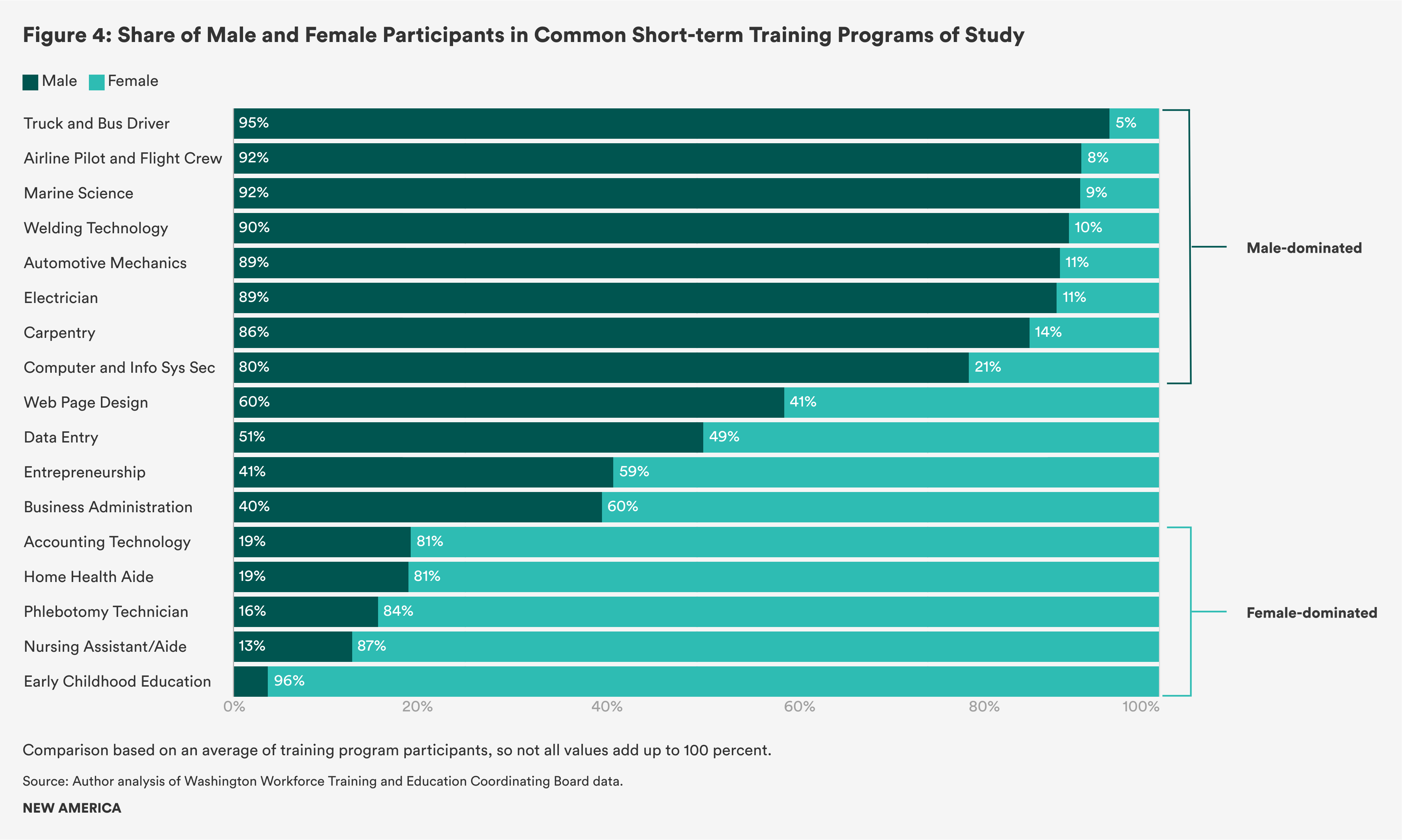
Men make up 54.8 percent of all short-term training participants included in this analysis, while women make up 45.2 percent. However, the gender composition of short-term training varies greatly based on program of study. Consistent with prior research, Figure 4 shows that short-term training program enrollment mirrors the gender-based occupational segregation present in the labor market.5 Men make up more than 80 percent of participants in truck and bus driver (94.7 percent), airline pilot and flight crew (92.4 percent), marine science (91.5 percent),6 automotive mechanics (89.3 percent), welding technology (90.3 percent), electrician (89 percent), carpentry (86 percent), and computer information systems security (79.5 percent) programs. Women, on the other hand, make up the vast majority of participants in early childhood education (96.2 percent), nursing assistant/aide (87.2 percent), phlebotomy technician (84.4 percent), accounting technology (80.8 percent), and home health aide (81.1 percent) training.
Race and Ethnicity
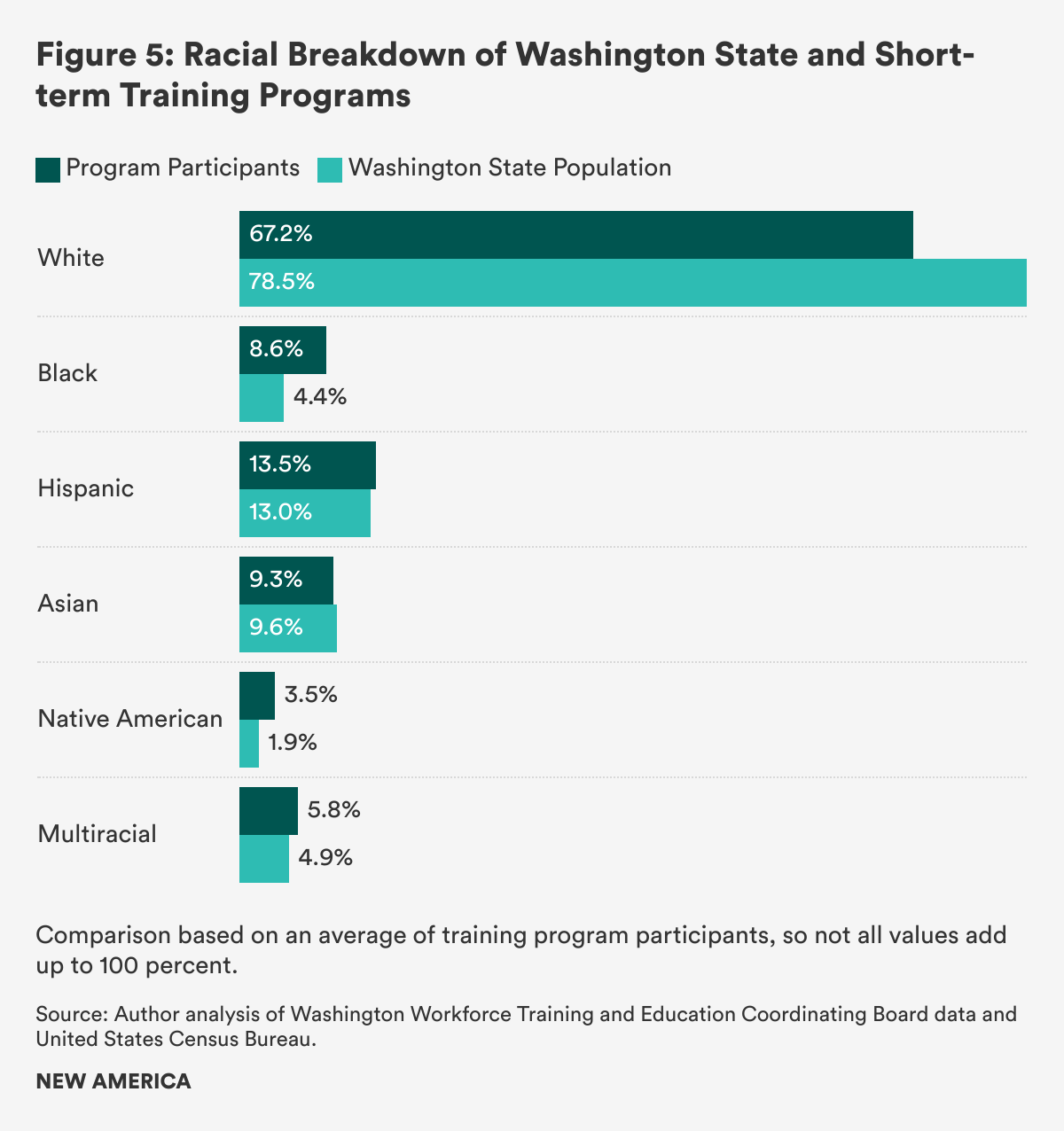
As Figure 5 below shows, white students represent 67.2 percent of those enrolled in training. However, compared to the overall racial and ethnic composition of Washington State, they are underrepresented by about 11 percentage points. Hispanic/Latinx individuals are the largest minority group in Washington State (13 percent) and its short-term training programs (13.5 percent), followed by Asian students, who make up 9.3 percent of short-term training participants and 9.6 percent of the state population. Black students’ participation in short-term training (8.6 percent) is nearly twice this group’s share of the state population (4.4 percent).7
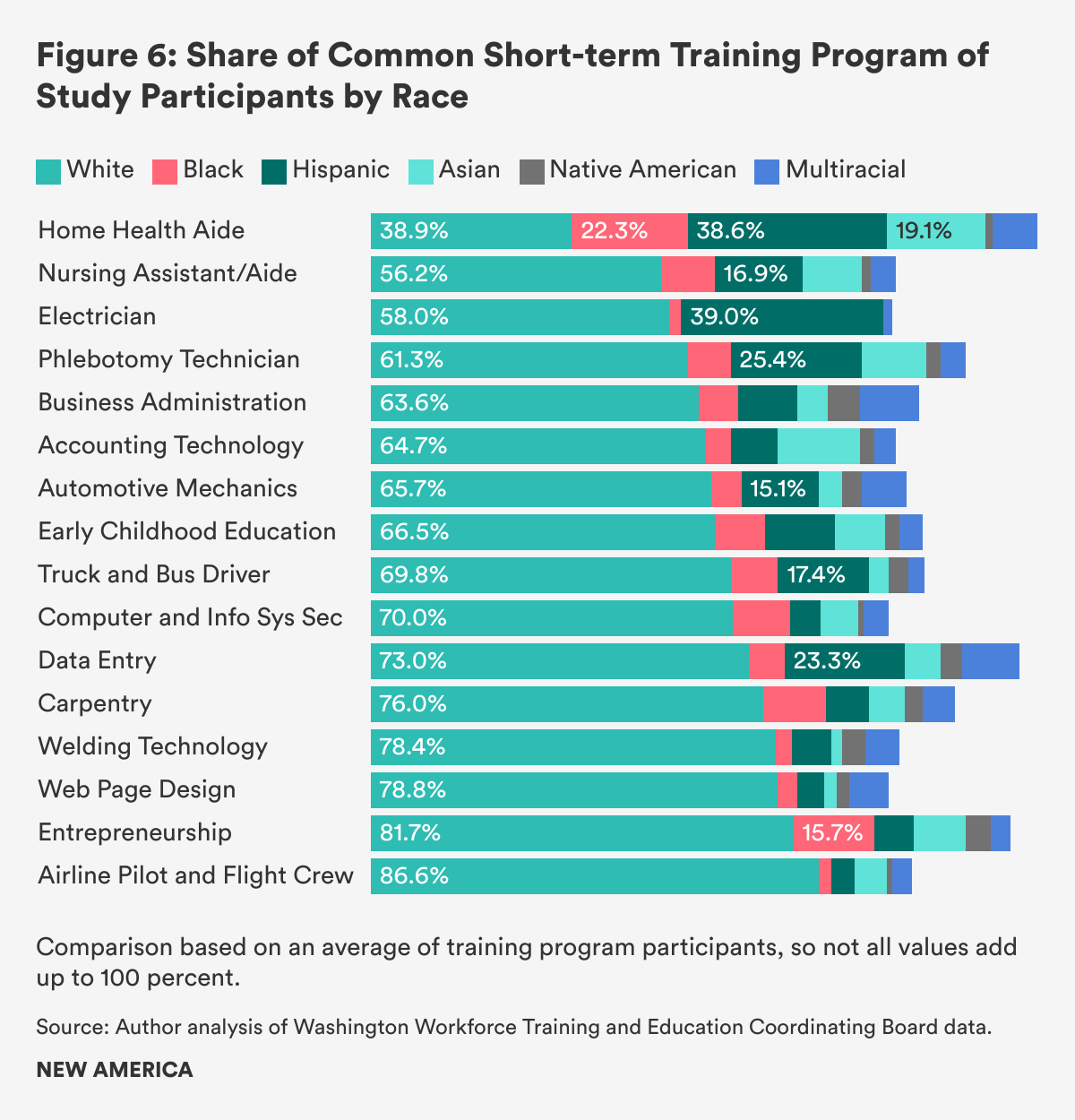
The racial and ethnic composition of short-term training programs varied by program of study, as shown in Figure 6. Health care-related and female-dominated programs are among the most racially and ethnically diverse, with the greatest proportion of students of color. Home health aide programs are 38.6 percent Hispanic/Latinx, 22.3 percent Black, and 19.1 percent Asian, while nursing assistant/aide programs are 16.9 percent Hispanic/Latinx, 11.6 percent Asian, and 10.3 percent Black. In phlebotomy technician programs, Hispanic/Latinx make up 25 percent of participants, while Asian students represent 12.5 percent and Black students are 8.3 percent.
In addition to medical-related programs, Hispanic/Latinx individuals are the most represented minority group in electrician (39 percent), data entry (23.3 percent), automotive mechanics (15.1 percent), and early childhood education (13.2 percent) programs. Compared to their overall share of short-term program participants, Black students also make up a disproportionate share of those enrolled in computer and information systems security (11.1 percent) and carpentry (12 percent). And Asian students are the most represented minority in accounting technology programs (16 percent).
Prior Education
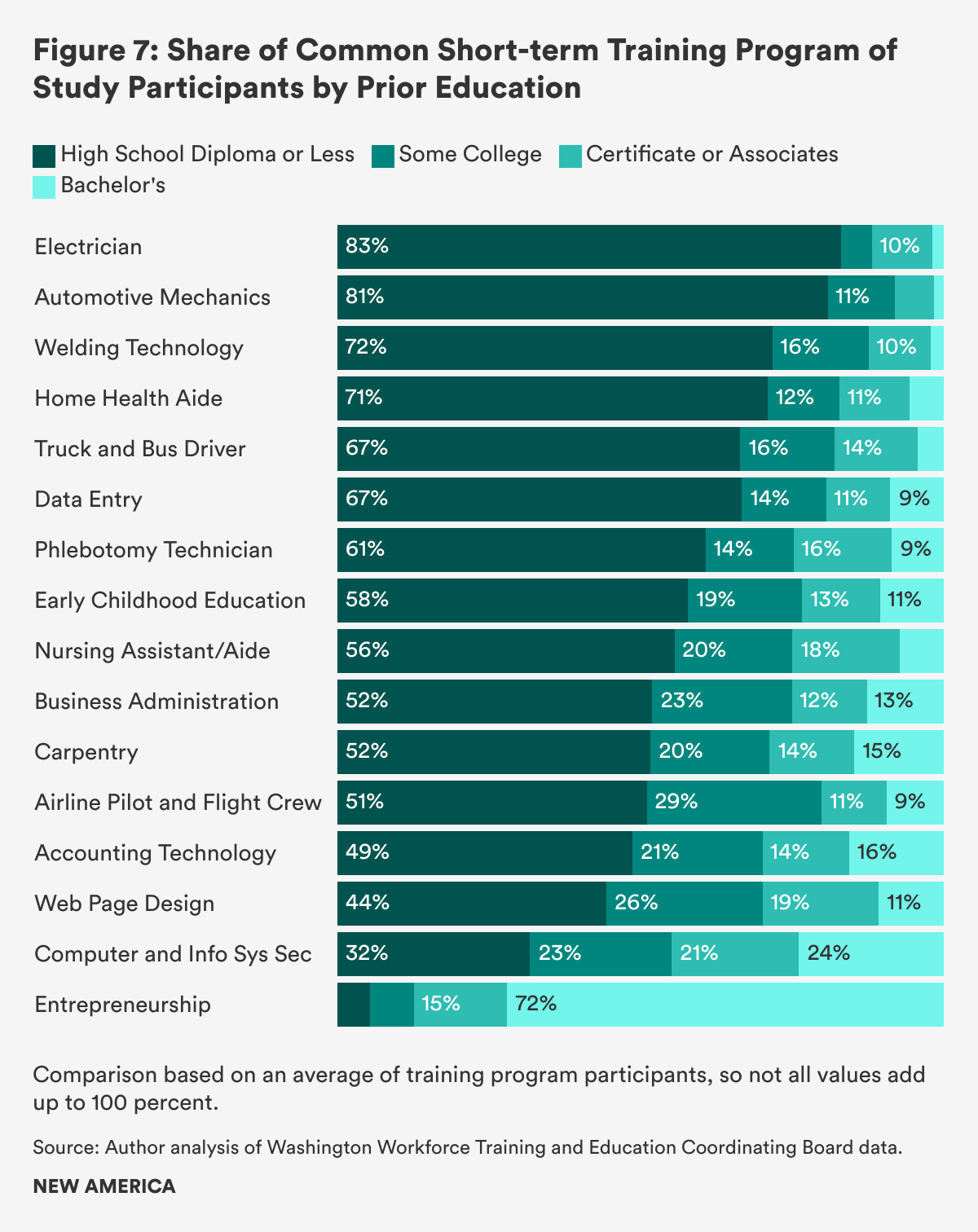
Across all programs of interest, individuals with a high school diploma or GED or less make up the largest share of participants (55 percent), followed by adults with some college (18.4 percent). Individuals who already hold a postsecondary certificate or degree account for more than a quarter (26.6 percent) of all short-term training program participants.
Except for entrepreneurship programs, for which 87.5 percent of participants have a postsecondary certificate or degree, the highest level of education for the majority of participants in the short-term training programs of study examined is some college or less (see Figure 7). In male-dominated truck and bus driver and traditional skilled trades programs, including automotive mechanics, electrician, and welding technology, more than 82 percent of participants have some college or less. Most of these programs also have the highest proportion of participants with a high school diploma or less. Electrician (84 percent) and automotive mechanics (80.4) programs lead with the highest share of those with education at or below the high school level, followed by welding technology (71.6 percent) programs. On the other hand, computer and information systems security, another male-dominated program, has the second-highest share of bachelor’s degree holders, at 23.9 percent.
Female-dominated training programs have a significant but comparatively smaller share of students with a high school diploma or less and also have more college-educated students than most male-dominated programs of study examined. While roughly 55–60 percent of participants in medical-related training programs (phlebotomy technician and nursing assistant/aide) have a high school diploma or less, these programs have some of the highest shares of certificate or associate degree holders. For instance, 16.3 percent of phlebotomy technician and 17.7 percent of nursing assistant/aide program participants have a postsecondary certificate or associate degree. Web page design (19.2 percent) and computer and information systems security (21.1 percent) enroll the highest shares of certificate or associate degree holders.
Outcomes of Short-term Training Program Completers
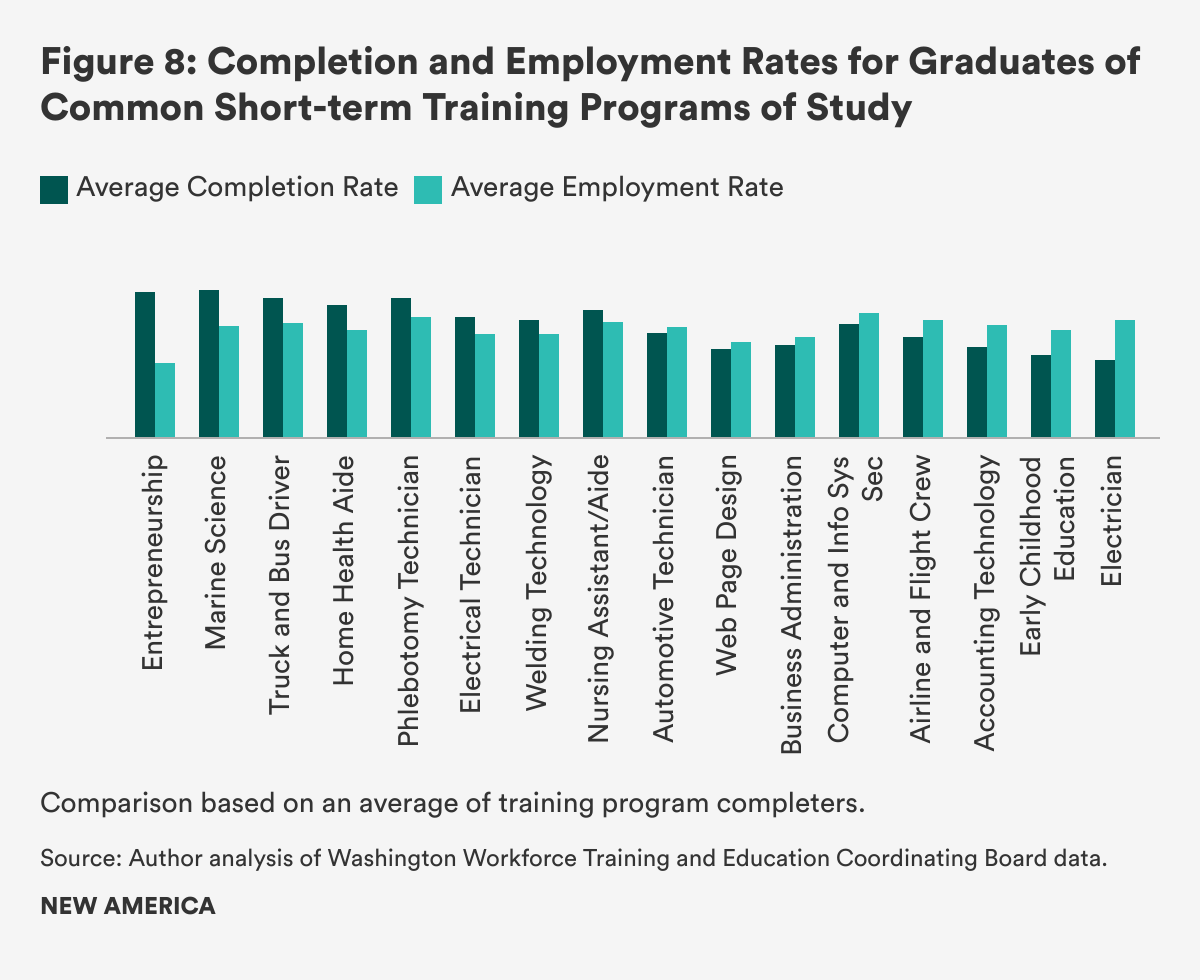
Across all short-term training programs, the average completion rate is 74.5 percent. This captures everyone who graduated with a credential, including a non-degree certificate, as well as community and technical college and private vocational school students who transferred to a four-year institution. Completion rates are notably higher for short-term training than longer programs less than a year in length (68.4 percent), programs between one and two years (66.3 percent), and programs longer than two years (65.2 percent).
Some short-term training programs of study such as marine science (98.7 percent), entrepreneurship (97.4 percent), phlebotomy technician (93.4 percent), truck and bus driver (93.8 percent), nursing assistant/aide (85.7 percent), home health aide (88.9 percent), and electrical technician (80.8 percent) have higher than average completion rates, whereas web page design (59.7 percent), early childhood education (55.6 percent), and electrician (52 percent) programs have lower than average completion rates (see Figure 8).
Across all short-term training programs, 74.8 percent of those that complete a program are employed four quarters after exit. Computer and information systems security (83.6 percent), phlebotomy technician (81.1 percent), electrician (79 percent), airline pilot and flight crew (78.7 percent), nursing assistant/aide (77.6 percent), truck and bus driver (76.7 percent), and accounting technology (75.4 percent) program graduates have higher than average completion rates for short-term training programs. Entrepreneurship, a program with one of the highest completion rates, has the lowest employment rates, at 50.4 percent, likely because many program graduates go on to self-employment and are thus not captured in state employment data systems.
What is unclear is what percentage of those not employed one year after completion are enrolled in further education and the likelihood that short-term training graduates will eventually pursue additional training related to their field of study. Additional data on post-program educational enrollment could shed light on the extent to which short-term training programs offer stackable credentials that position adults to increase their qualifications within a particular career path.
The average median hourly earnings for a short-term training program graduate is $17.84 four quarters after program exit. Whereas the average short-term training program graduate earns more than Washington State’s minimum wage, recently raised to $13.50/hour, not all graduates are bringing home a living wage.8 What defines a living wage is different for each worker and is often determined by family composition and financial obligations.
According to the Massachusetts Institute of Technology, which calculates state-specific living wage models to serve as alternative, more accurate measures of basic needs compared to the federal poverty threshold, the living wage for a single working adult in Washington State is $13.47/hour. A sole earner in a two-adult household must make $20.40/hour, whereas each working adult in a two-adult household must earn $10.20/hour to get by. With dependent children, the required hourly living wage increases. A single parent must earn $27.08/hour to care for a single child and $32.23/hour for two children. A two-parent household, in which both adults are working and sharing the financial load, requires a $14.89 hourly wage per person to support a family of three and $17.45/hour for a family of four (Figure 9).9
Figure 9: Hourly Living Wage in Washington State
| 1 Adult | 1 Adult | 1 Adult | 2 Adults (1 Working) | 2 Adults (1 Working) | 2 Adults (1 Working) | 2 Adults (Both Working) | 2 Adults (Both Working) | 2 Adults (Both Working) | |
|---|---|---|---|---|---|---|---|---|---|
| 0 Children | 1 Child | 2 Children | 0 Children | 1 Child | 2 Children | 0 Children | 1 Child | 2 Children | |
| Living Wage | $13.47 | $27.08 | $32.23 | $20.40 | $24.93 | $27.47 | $10.20 | $14.89 | $17.45 |
| Poverty Wage | $6.00 | $8.13 | $10.25 | $8.13 | $10.25 | $12.38 | $4.06 | $5.13 | $6.19 |
Note: Aggregate living wage figures assume that individuals work 2,080 hours a year, or 40 hours a week
Source: Massachusetts Institute of Technology Living Wage Calculator.
As Figure 10 illustrates, on average, graduates of nearly all of the short-term training programs examined are earning enough to support a single adult household. The one exception is nursing assistant/aide program graduates, who earn $13.19/hour on average and fall short of reaching any of the living wage categories. This group of individuals would appear to benefit most from the recent and steady increases in the state minimum wage. Nonetheless, a nursing assistant/aide with a family is not likely to earn enough to survive unless he or she is part of a two-adult working household. Sole-earner nursing assistants/aides with two children are earning poverty-level wages.
Only marine science graduates who are single with no children earn enough to support themselves and/or a family. All other short-term training program graduates do not. Web page design and automotive mechanics program graduates, who earn $14.83/hour or less, would also struggle to support even one child, even with a partner with comparable earnings.
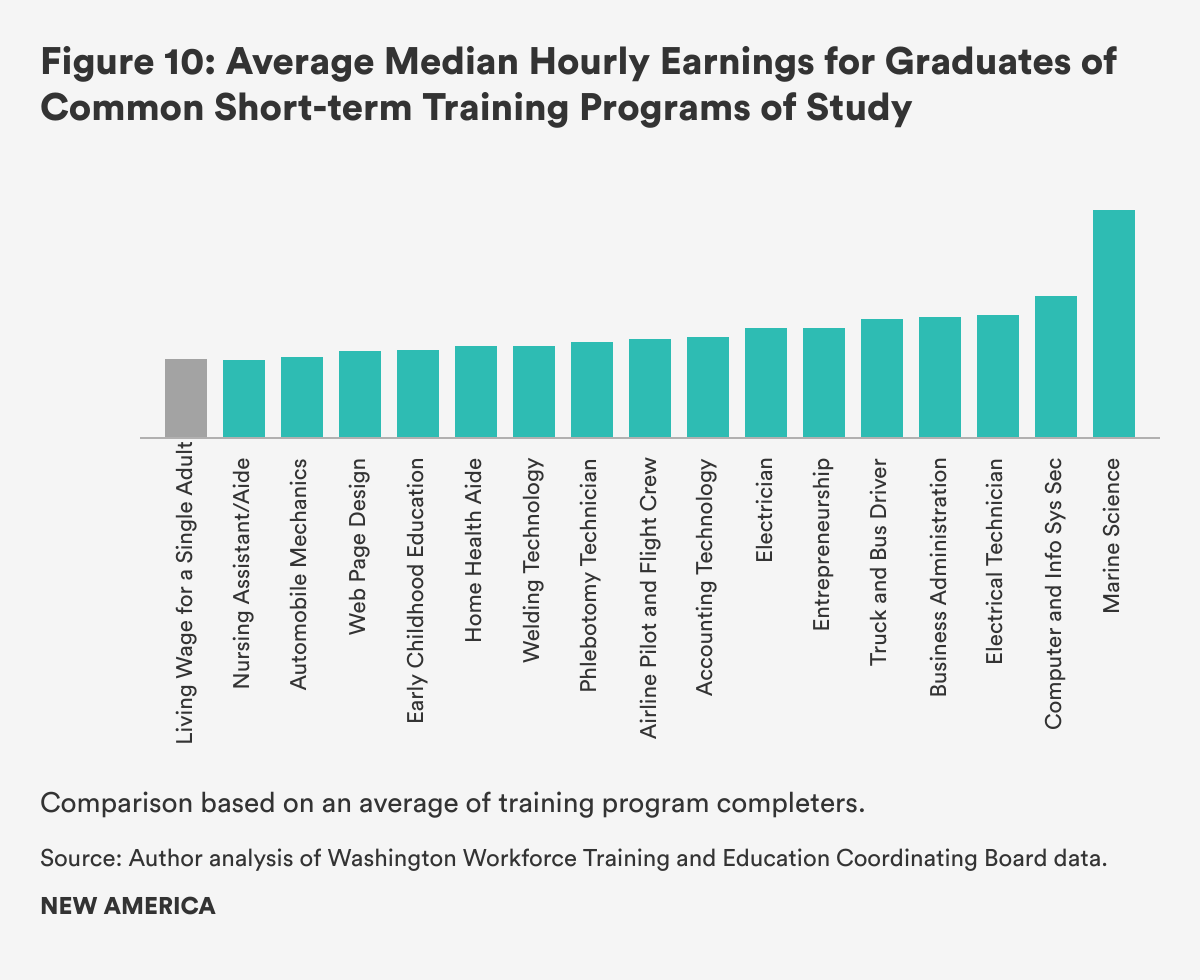
These aggregate living wage figures assume that individuals work 2,080 hours a year, or 40 hours a week, which might not be the case for all short-term training graduates.
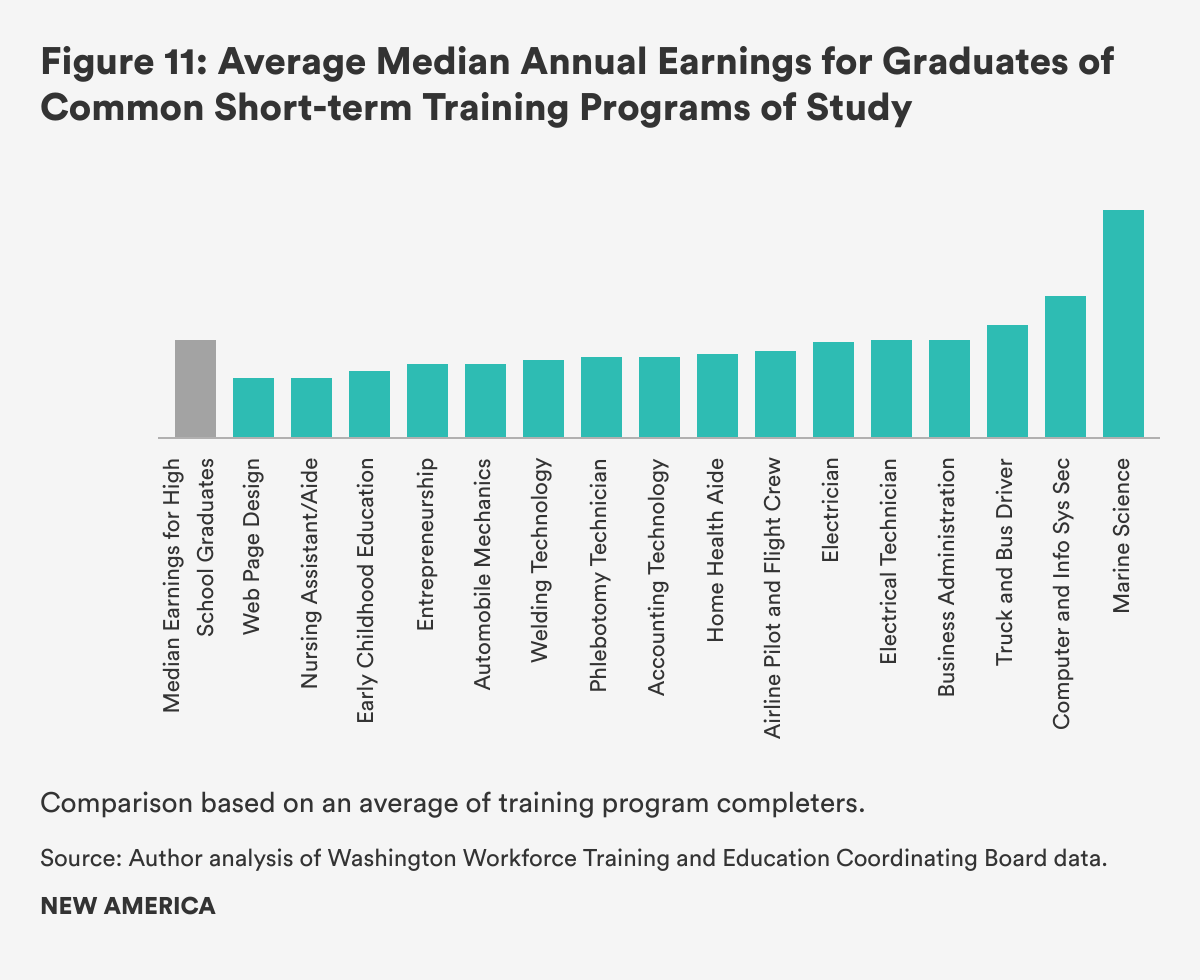
In Washington State, the median earnings of high school graduates is $37,000.10 Yet the average median annual earnings for short-term training program graduates is $33,415. Furthermore, 10 programs studied were associated with lower than average median annual earnings. Of these, five are female-dominated programs and related occupations (accounting technology, home health aide, phlebotomy technician, early childhood education, and nursing assistant/aide), which also tend to enroll more participants of color, whereas three are male-dominated programs (airline pilot and flight crew, welding technology, and automotive mechanics). Graduates of nursing assistant/aide and early childhood education programs, two of the most common short-term training programs in the state, earned $22,720.85 and $25,158.23, respectively, one year after completing the program (see Figure 11).
There have been countless studies reaffirming the presence of gender and racial wage gaps, factors that are likely at play in Washington. Yet, the higher earnings of some short-term training program graduates could be explained, in part, by the educational attainment levels of participants (see Figure 12).
The short-term training program for which graduates average the highest annual median earnings, $53,599.71, is computer and information systems security. This program also enrolls one of the highest shares of bachelor’s degree holders (23.9 percent). This finding reflects the positive relationship between postsecondary education and better labor market outcomes that researchers have documented for a long time.11 But there are some programs like truck and bus driver, business administration, electrician, and airline pilot and flight crew for which graduates earn a solid wage without prior postsecondary education. Truck and bus driver and electrician programs have the highest shares of participants with a high school diploma or less, at 66.5 and 84 percent, respectively. Except for business administration, the programs with the highest-earning graduates enroll mostly male participants. On the other hand, graduates of web page design and female-dominated and racially diverse short-term programs like early childhood education and nursing assistant/aide earn the lowest wages even though roughly a quarter of these program participants are college-educated (i.e., possess a postsecondary certificate, associate degree, or bachelor’s degree).
Research has shown that workers with an occupational license, a required credential awarded by a government agency, tend to earn more than workers without a license.12 The data set does not include information about the licensing of short-term training program participants, thus raising questions about the extent to which graduate earnings might be explained by the possession of non-degree credentials of value.
More research is needed to determine the extent to which prior education and credential attainment influence the short- and long-term earning potential of short-term training graduates, but this analysis suggests educational background—and perhaps other demographic characteristics of those who pursue short-term training—plays a role in graduate earnings. To assume that all short-term training programs position all graduates to land family-sustaining jobs ignores persistent realities about the labor market conditions that have historically disadvantaged less educated, female, and minority workers.
Citations
- Four-year colleges and universities accounted for 1 percent of short-term training providers while other entities, such as community-based organizations and adult education providers, delivered 6 percent of short-term training programs.
- Washington State Board for Community and Technical Colleges, Job Skills Program, source
- Washington State Board for Community and Technical Colleges, Worker Retraining Program, source
- Washington Student Achievement Council, Washington College Grant, source
- Lul Tesfai, Kim Dancy, and Mary Alice McCarthy, Paying More and Getting Less: How Nondegree Credentials Reflect Labor Market Inequality Between Men and Women (Washington, DC: New America, September 2018), source
- Marine science programs prepare individuals to serve as captains, executive officers, engineers, and ranking mates on commercially licensed inland, coastal and ocean-going vessels. Includes instruction in maritime traditions and law, maritime policy, economics and management of commercial marine operations, basic naval architecture and engineering, shipboard power systems engineering, crew supervision, and administrative procedures. National Center for Education Statistics, The Classifications of Instructional Programs, Detail for CIP Code 49.0309: Marine Science/Merchant Marine Officer, source
- U.S. Census Bureau, QuickFacts: Washington, source
- Washington State Department of Labor and Industries, Minimum Wage, source; and Living Wage Calculation for Washington, source
- These living wage figures are aggregated for the State of Washington, with those living in metropolitan areas requiring higher earnings to make ends meet. For instance, in Seattle, where the minimum wage is $15.75/hour, the living wage for a single working adult is $16.09. This analysis does not include an in-depth examination of earnings and living wage thresholds by region.
- Education Research & Data Center, High School Graduate Outcomes (see Median earnings within first 12 years following high school completion), source
- Understanding College Affordability: Variation in Earnings (Urban Institute) source; U.S. Bureau of Labor Statistics, Learn More, Earn More: Education Leads to Higher Wages, Lower Unemployment, May 2020, source; and Social Security Administration, Education and Lifetime Earnings, November 2015, source
- Ryan Nunn, How Occupational Licensing Matters for Wages and Careers (Washington, DC: Brookings, March 2018), source ; Lul Tesfai, Kim Dancy, and Mary Alice McCarthy, Paying More and Getting Less: How Nondegree Credentials Reflect Labor Market Inequality Between Men and Women (Washington, DC: New America, September 2018), source