Training as a Path to an Equitable Post-pandemic Recovery
Table of Contents
Abstract
Based on comprehensive data from the Washington Workforce Training and Education Coordinating Board, this analysis explores short-term training programs, including which providers offer them and in which occupation-specific programs of study; the demographics of those who enroll in programs; and outcomes for program completers or graduates. Given limitations on the maintenance and matching of student-level data at the federal level, state-specific analyses of training program participation and outcomes provide the best glimpse into who accesses and benefits most from short-term training.
Acknowledgments
Thank you to Lumina Foundation for its generous support of the research and production of this report.
We would also like to acknowledge Eleni Papadakis and Randy Smith from the Washington Workforce Training and Education Coordinating Board for sharing the training program data that made this analysis possible. This research report benefited from the support and insight of many New America colleagues, including Mary Alice McCarthy, Debra Bragg, Ivy Love, Clare McCann, Sophie Nguyen, Iris Palmer, and Wesley Whistle, as well as Elizabeth Meza and William Zumeta from the University of Washington. Thank you to Riker Pasterkiewicz, Julie Brosnan, Fabio Murgia, and Hana Hancock for communications support and Sabrina Detlef for editorial guidance.
Downloads
Introduction and Context
In Washington State, as throughout the rest of the United States, the COVID-19 public health and economic crisis has brought about historic levels of unemployment that have persisted for more than a year.1 Most impacted are people of color, particularly Pacific Islanders and Black workers, women, and individuals with lower levels of education—communities that were not fully reaping the benefits of Washington’s pre-pandemic economic boom. The state estimates that hundreds of thousands of Washingtonians will need new skills in order to enter the post-pandemic economy. Under the leadership of Governor Jay Inslee, several state agencies have developed an economic recovery plan aimed at promoting economic stability for historically underserved and vulnerable populations. With a focus on credentials with economic value and building navigable education and training pathways, Washington’s inclusive recovery plan seeks to address the persistent and pervasive structural barriers to high-quality, well-paying jobs.2
As the entire nation grapples with growing labor market and income inequality made even more visible by COVID-19, policymakers at all levels of government are weighing a variety of public investments in education and training to help individuals secure good, family sustaining jobs. Short-term training—lasting less than three months—is often considered by policymakers and workforce leaders as a pathway to middle-skill jobs. It presents a solution for helping dislocated workers quickly reenter the labor market, supporting career advancement or transition opportunities for incumbent workers, and providing new high school graduates with occupation-specific skills needed to land a well-paying job. Short-term training programs are also appealing to youth and adults. They teach discrete, occupation-specific skills; are often more affordable than postsecondary degree pathways; and can often be stacked with other credentials to position workers along an educational and career path.
Given the enthusiasm among some policymakers for expanding access to short-term training, it is surprising how little we know about these types of programs in terms of who provides them, the occupations for which they tend to prepare workers, who enrolls in these programs, and what labor market outcomes are associated with program completion. A limited amount of research on short-term training programs suggests mixed results. While some programs provide demonstrable value to students in terms of employment and earnings outcomes, there is a great deal of variability based on program, provider, and student demographics. Men, whites, and students who already have some college or college credentials tend to have more favorable outcomes than women, students of color, and students who have a high school diploma or less.3
Whether short-term training programs yield positive and equitable outcomes is an important question that deserves attention as federal policymakers consider expanding the use of Pell Grants—need-based grants to low-income undergraduates—and as state policymakers weigh investments in short-term training as part of a higher education completion and economic recovery strategy.
Based on comprehensive data from the Washington Workforce Training and Education Coordinating Board, this analysis explores short-term training programs, including which providers offer them and in which occupation-specific programs of study; the demographics of those who enroll in programs; and outcomes for program completers or graduates. Given limitations on the maintenance and matching of student-level data at the federal level, state-specific analyses of training program participation and outcomes provide the best glimpse into who accesses and benefits most from short-term training.
Citations
- Washington State Department of Commerce, Economic Recovery Dashboard, source
- Workforce Training and Education Coordinating Board, Washington’s Workforce Economic Recovery Plan, September 2020, source
- The Institute for College Access & Success, Short-Term Programs in the Shadows: What Data Show About Program Length, Cost, and Payoff, source; Sandy Baum, Harry Holzer, and Grace Luetmer, Should the Federal Government Fund Short-Term Postsecondary Certificate Programs? (Washington, DC: Urban Institute, December 2020), source
Summary of Key Findings
This study reveals several trends related to the delivery of short-term training programs in Washington, who is enrolling, and how they fare in the labor market.
- Men and women enroll in short-term training at comparable rates, but they generally enroll in different programs. Men represent more than 80 percent of truck and bus driver, skilled trades, and information technology program participants, whereas women are overrepresented in education and health care training. Thus, short-term program participation mirrors, and perhaps reinforces, the occupational gender segregation seen in the labor market.
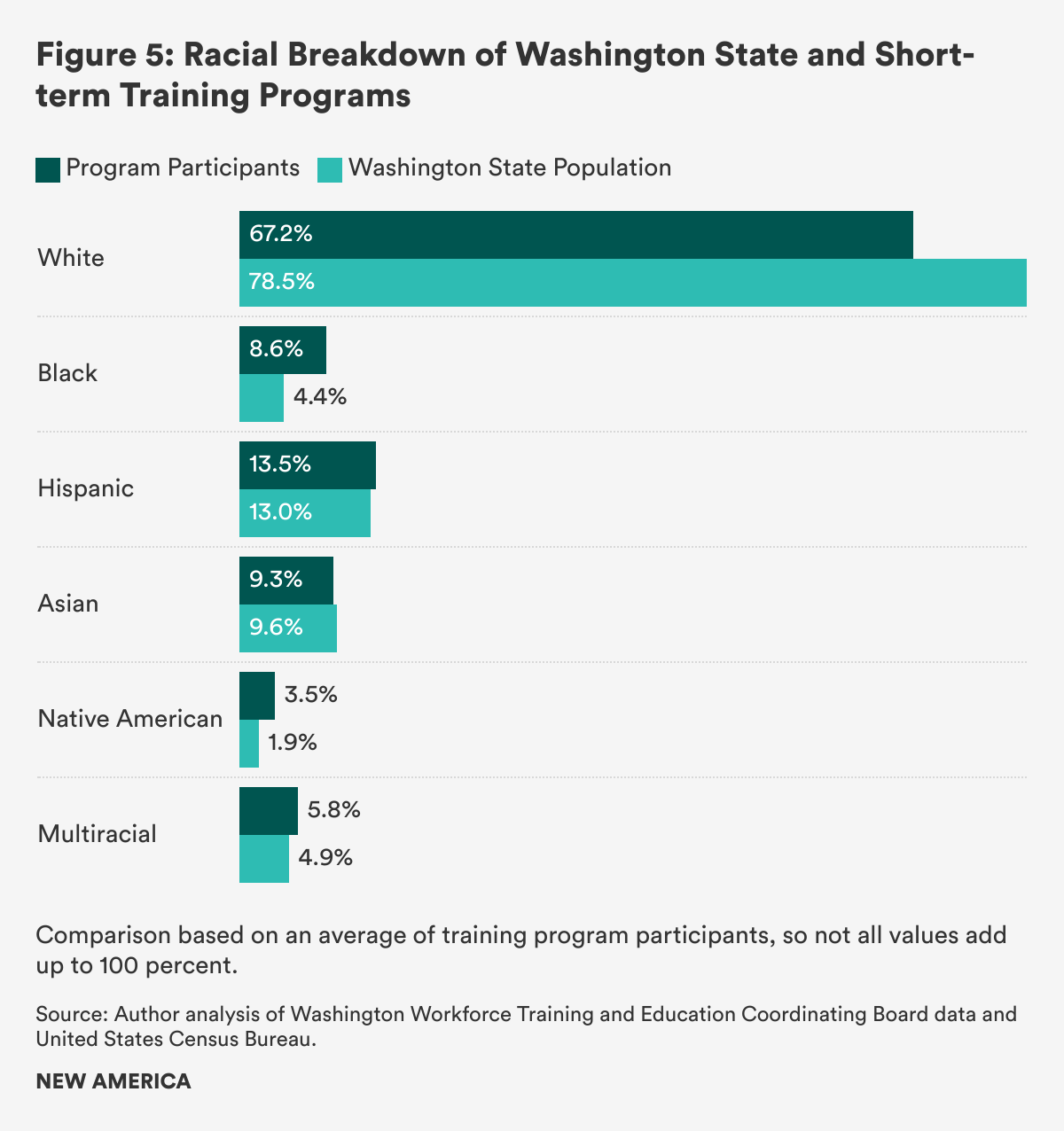
- Black people are overrepresented in short-term training programs. Whereas Black people account for 4.4 percent of the Washington state population, they represent 8.6 percent of students who enroll in short-term training. White students, on the other hand, are underrepresented in short-term training compared to their share of the state population. The share of Hispanic/Latinx, Asian, Native American, and multiracial short-term training participants was within 1.5 percentage points of each group’s share of Washington residents.
- Short-term training programs have higher completion rates compared to longer ones. Across all short-term training programs, the average completion rate is 74.5 percent, which is notably higher than longer programs less than a year in length (68.4 percent), programs between one and two years (66.3 percent), and programs longer than two years (65.2 percent).
- Short-term training programs associated with higher earnings enroll participants with higher levels of education. For instance, nearly a quarter of participants in computer and information systems security programs, which have the highest-paid graduates, possess a bachelor’s degree or higher. Given past studies that demonstrate a wage premium for college graduates, the higher earnings of some short-term training program graduates could be explained, in part, by the educational attainment levels of participants.
- The typical short-term training program graduate earns more than the state minimum wage but not enough to support a family. The average median hourly earnings for a short-term training program graduate is $17.84 one year after program completion. While this exceeds Washington’s minimum wage, recently raised to $13.50/hour, individuals with dependents earn less than the state’s living wage. In fact, the typical short-term training program graduate earns less annually than a high school graduate. The median annual wage for a high school graduate in Washington is $37,000, while the average median annual earnings for all short-term training program graduates is $33,696.
Methods
The purpose of this analysis is to better understand the landscape of short-term training programs, who pursues short-term training, and the labor market outcomes of those who complete these programs. Three main questions guided this descriptive analysis:
- Which entities deliver short-term training programs, and for what fields do short-term training programs aim to prepare students?
- What are the demographic characteristics, in terms of gender, race, and prior education, of individuals who enroll in short-term training?
- What are the completion, employment, and earnings outcomes of short-term training program graduates?
In summer 2020, New America requested and received data on Washington’s training programs from the Washington Workforce Training and Education Coordinating Board (WTECB), the state’s governor-appointed workforce board. The WTECB is responsible for implementing standardized accountability measures for the state’s workforce development system. As part of its accountability function, the workforce board maintains training program participation and performance data. Additionally, it links individual participant records reported by each training provider with unemployment insurance (UI) wage records and other administrative databases, such as the State Wage Interchange System (SWIS),1 to compute statistics on the employment and earnings of training program completers. Through the Washington Career Bridge website, the workforce board publishes detailed enrollment and outcome information for education and training programs that charge tuition in the state.2 The information analyzed for this report was compiled from two sets of extracted data from the Career Bridge site.
The information contained in this report is based on an analysis of 10,976 training programs offered in the State of Washington since 2013. To understand the scope, demographic composition, and outcomes associated with training programs for which current federal legislative proposals could make Pell Grants available, this analysis is primarily focused on short-term training programs that are fewer than 600 clock hours and 15 weeks in length.3 These short-term training programs account for 2,560, or 23.3 percent, of Washington’s training programs included in the data set. Where relevant, we highlight how the participant characteristics and outcomes of short-term training programs compare to longer training programs—those greater than 600 clock hours and between 15 and 52 weeks, one to two years, and two or more years in length.
The compiled data set included comprehensive information about each of the state’s training programs, including a unique program identification number (ID), the type of training provider, the program length, associated clock hours, and six-digit Classification of Instructional Programs (CIP) code. The data set also included aggregate-level data on the demographics (gender, race, and prior education level) of program participants and the outcomes of graduates for each training program, namely the completion rate, the employment rate one year after program completion, and the median hourly and annual earnings one year after program completion. Appendix A provides more detailed information about the key variables used in this analysis.
The analysis contained in this report is descriptive in nature, with much of the analysis consisting of sample mean comparisons. Using CIP codes, which classify instructional programs offered by postsecondary institutions by the occupational field for which program participants prepare, we were able to examine the 20 most common short-term training programs of study, which account for nearly 55 percent of short-term training programs in the data set (see Appendix B for list of common short-term programs of study and corresponding occupations). We also explore which providers tend to offer certain programs of study as well as the demographic profile of participants and the outcomes of graduates based on program of study.
Using aggregate data on the demographics of participants in each training program, we calculated the overall percentage of male and female participants; the percentage of participants who identify as white, Black, Hispanic/Latinx, Asian, Native American, and multiracial; and the percentage of participants whose highest level of education before enrolling in training was some college or less (includes high school diploma and GED holders and those without a high school diploma or GED), a certificate or associate degree, and a bachelor's degree. Using aggregate-level data on the outcomes of graduates for each training program, we were able to calculate the average completion rate across all short-term training programs as well as the average employment rate and median annual earnings one year after completion for each training program.4
Limitations
Because participant demographic data was only available in the aggregate, it was not possible to do cross-tabulations between any two demographic groups (e.g., race/ethnicity and gender). Furthermore, because the data set lacked demographic information about program graduates specifically, it was not possible to assess how the demographic profile of graduates differs from that of those who initially enrolled in the program.
For some programs, the data set lacked complete participant demographic and completer outcome information. The WTECB, which requires that training providers collect and submit participant data on an annual basis, suppresses participant demographic data in Career Bridge if a training program does not enroll at least 10 participants. The WTECB also suppresses the employment and earnings information for training programs that have fewer than 25 completers. Some of the missing outcome data can be attributed to lags in the collection of employment and earnings information for recently completed programs, as the employment and earnings of completers is measured one year after completion. Furthermore, in Washington, much like in other states, UI records exclude self-employed individuals, federal workers, military personnel, and foreign-employed workers, and therefore these groups are underrepresented in the employment and earnings data. The exclusion of these workers from employment and earnings records is more likely to skew the outcome data for entrepreneurship/entrepreneurial studies programs, which have a sizable number of self-employed graduates; or marine science/merchant marine officer programs, many graduates of which go on to contract, federal, or foreign employment.
Given WTECB publication cutoffs and reporting lags, the data set did not include participant and/or completer outcome data for all programs within a common short-term training program of study category. We excluded a common short-term program of study from the in-depth analysis if the data set lacked participant or completer outcome data for at least 10 programs. In all, the data set included sufficient program data for 14 of the 20 common short-term programs of study (the availability of program data on marine science/merchant marine officer; carpentry/carpenter; data entry/microcomputer applications; computer programming/programmer; plumbing technology/plumber; and electrical, electronic, and communications engineering technology/technician programs of study varied across participant or completer outcome indicators and thus are sometimes excluded from certain in-depth analyses). Appendix C includes a list of common short-term programs of study for which sufficient program demographic and outcome data exist. The overall analysis of short-term training programs includes all programs of study, regardless of the number of programs for which participant or outcome data were available.
In the absence of student-level Standard Occupational Classification (SOC) data indicating the specific occupations in which individuals are employed, it was not possible to determine the likelihood of graduates finding employment related to their program of study. Graduates employed in occupations misaligned with their program of study could skew—up or down—the average median earnings associated with a program of study.
Citations
- The State Wage Interchange System (SWIS) is a mechanism through which States can exchange employment and earnings data on individual program participants on an interstate basis with other States. In 2019, SWIS replaced earlier exchange systems, specifically the Wage Record Interchange System (WRIS) and WRIS 2.
- Workforce Training and Education Coordinating Board, Washington Career Bridge, source; Training programs that do not charge tuition, such as those offered by labor management partnerships, are not captured in the Career Bridge data.
- Program length determinations for Pell Grant eligibility hinge on both a minimum amount of instruction time (at least 600 clock hours) and a minimum period of time (at least 15 weeks).
- Individuals who are enrolled in further education or training one year after program completion and also employed are counted in the employment rate. However, their earnings are not calculated as part of the median hourly or annual earnings for program completers because WTECB assumes that they are earning less than the average employed program completer who is not simultaneously pursuing further education or training.
Analysis
The Landscape of Short-term Training Programs
Of the 2,560 short-term training programs analyzed in Washington State, there are 265 different types of programs of study offered by training providers. Truck and bus driver programs account for the greatest share of short-term training (11.6 percent), followed by early childhood education (5.8 percent), electrician (4.1 percent), nursing assistant/aide (4.1 percent), and automobile and marine science (3.7 percent) programs.
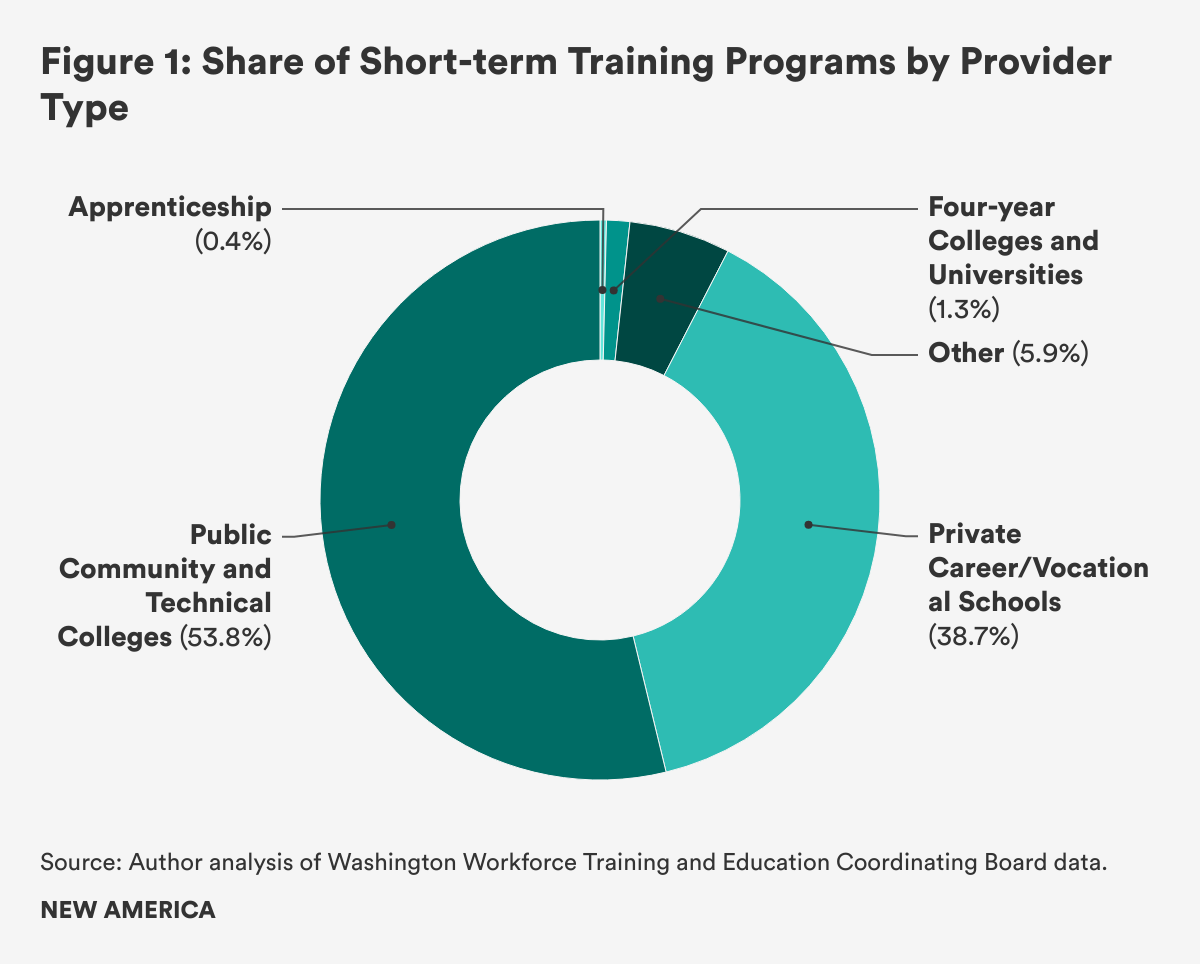
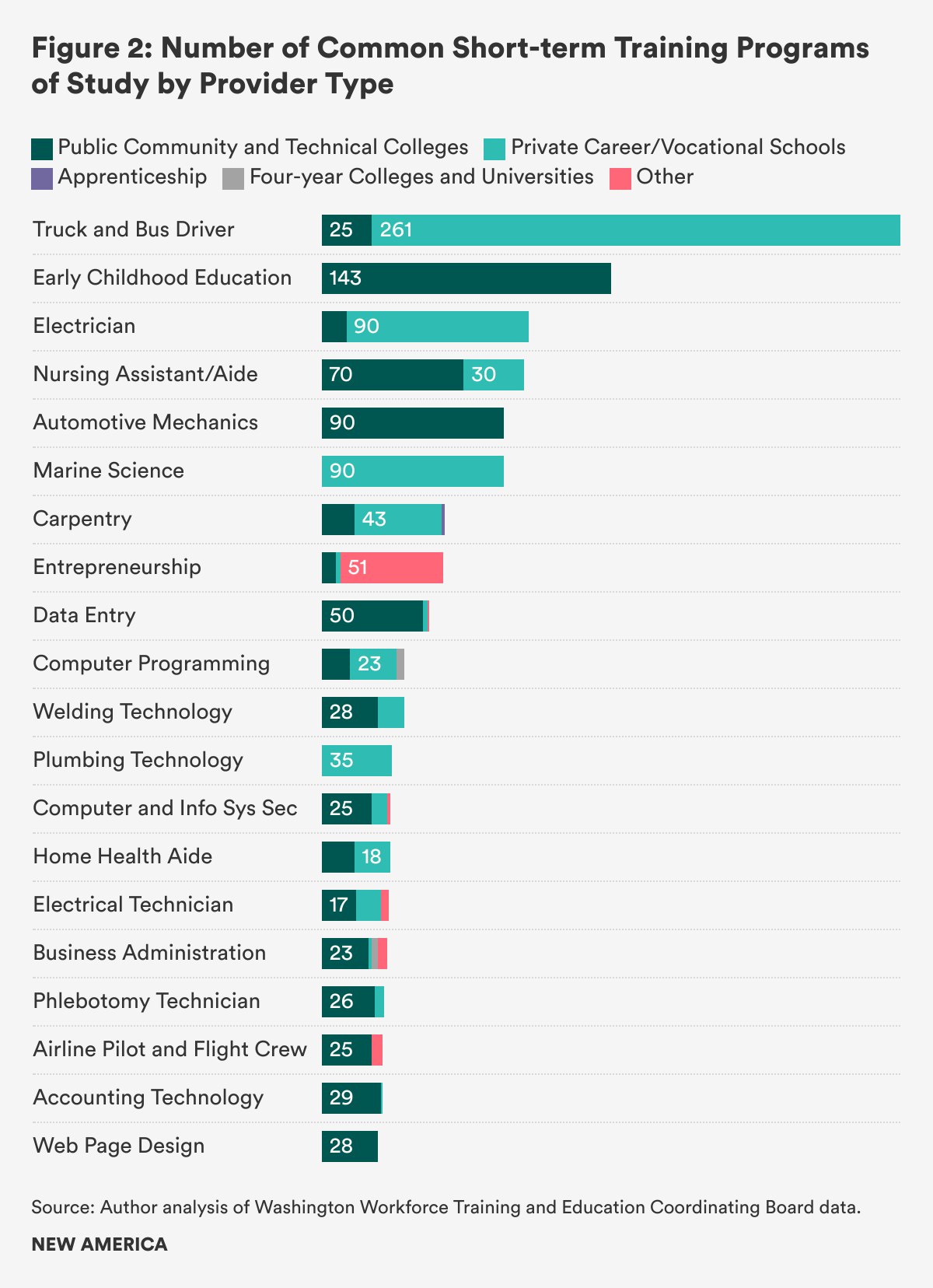
As Figure 1 indicates, public community and technical colleges and private career/vocational schools provide the vast majority of short-term training. More than half of short-term training programs analyzed, 54 percent, were offered by community and technical colleges, while private vocational schools account for 39 percent of programs.1 Yet the data also show that these two providers tend to offer different types of training. As Figure 2 indicates, private career/vocational schools are the primary provider of truck and bus driver, electrician, marine science, carpentry, and plumbing technology programs, while public community and technical colleges tend to offer the majority of early childhood education, nursing assistant/aide, automotive mechanics, data entry, welding technology, computer and information systems security, business administration, airline pilot and flight crew, accounting technology, and web page design programs.
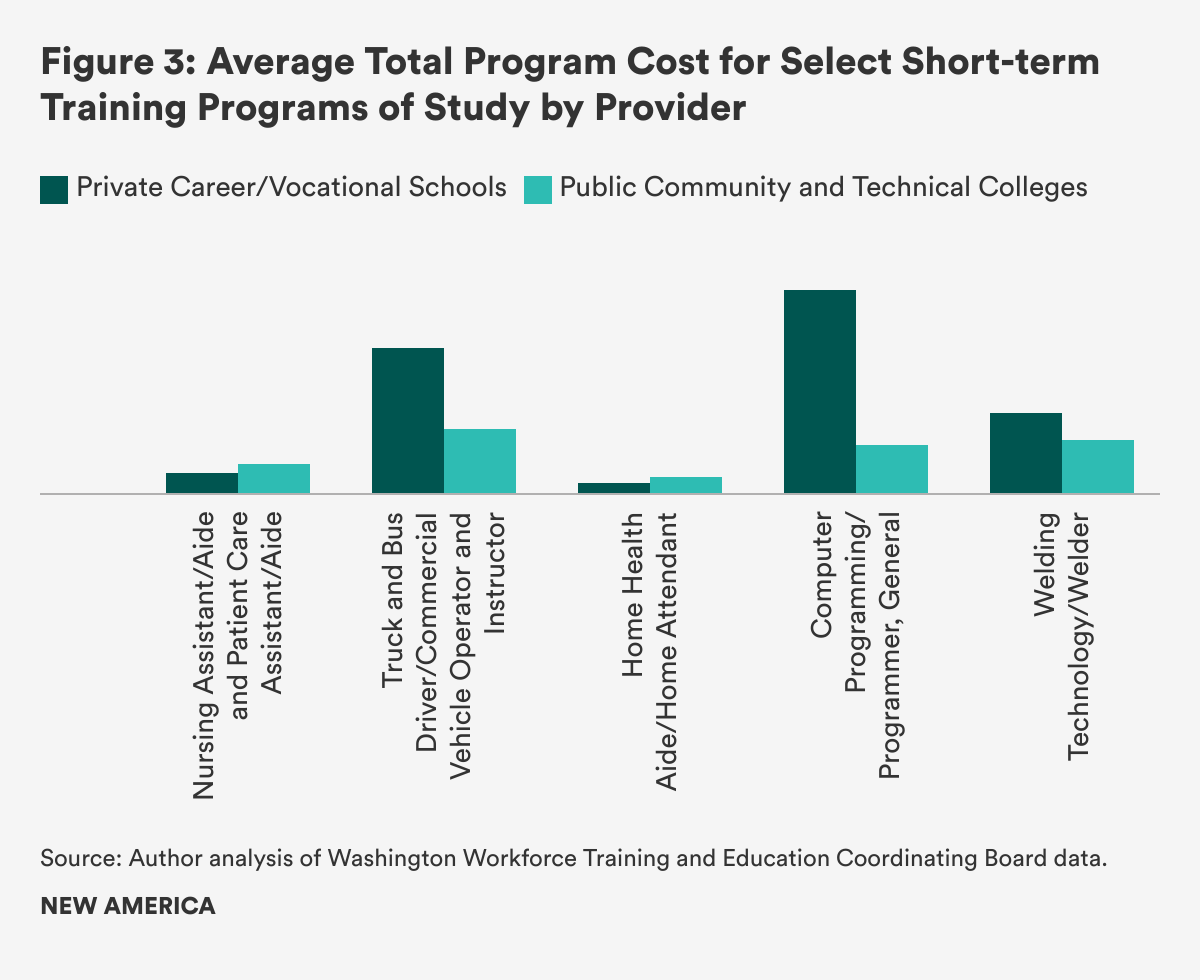
Short-term training programs at private career vocational schools cost more in tuition and fees than those at public community and technical colleges, $3,512.64 compared to $1,375.62, on average. Yet this finding does not hold for all programs of study. We examined five programs of study commonly offered by both public community and technical colleges and private career vocational schools. As Figure 3 below shows, a nursing assistant/aide or home health aide program costs slightly more at a public community and technical college than a private career vocational school, $292.20 and $185.77, respectively. Yet these short-term training programs are among the least expensive. Truck and bus driver, computer programming, and welding technology training programs cost substantially more at a private vocational school—$2,871.35, $5,508.05, and $936.16, respectively, than at a community or technical college.
Yet these program costs do not necessarily reflect the out-of-pocket cost a training program participant incurs. Individuals can benefit from several sources of public workforce funding. Washington's Job Skills Program pays for half the training offered by a community college, while partner businesses cover the other half;2 the Worker Retraining Program gives financial assistance to individuals who need basic skills and technical training via colleges;3 the Washington College Grant covers tuition at eligible in-state public colleges or universities, including community or technical colleges, or approved private colleges or career training programs for low- and middle-income families;4 and the Workforce Innovation and Opportunity Act covers college training programs that confer credit. The state also fully funds or heavily subsidizes occupation-specific training for early childhood education professionals, who are required to take certain community college courses to obtain licensure. Individuals who leave their employment to care for disabled or elderly family members can also obtain their home care professional certification at little or no cost due to state training subsidies. More data are needed to determine how much adults are paying to pursue training and how the cost to individuals impacts decisions about whether to pursue certain types of training.
Profile of Short-term Training Program Participants
Gender
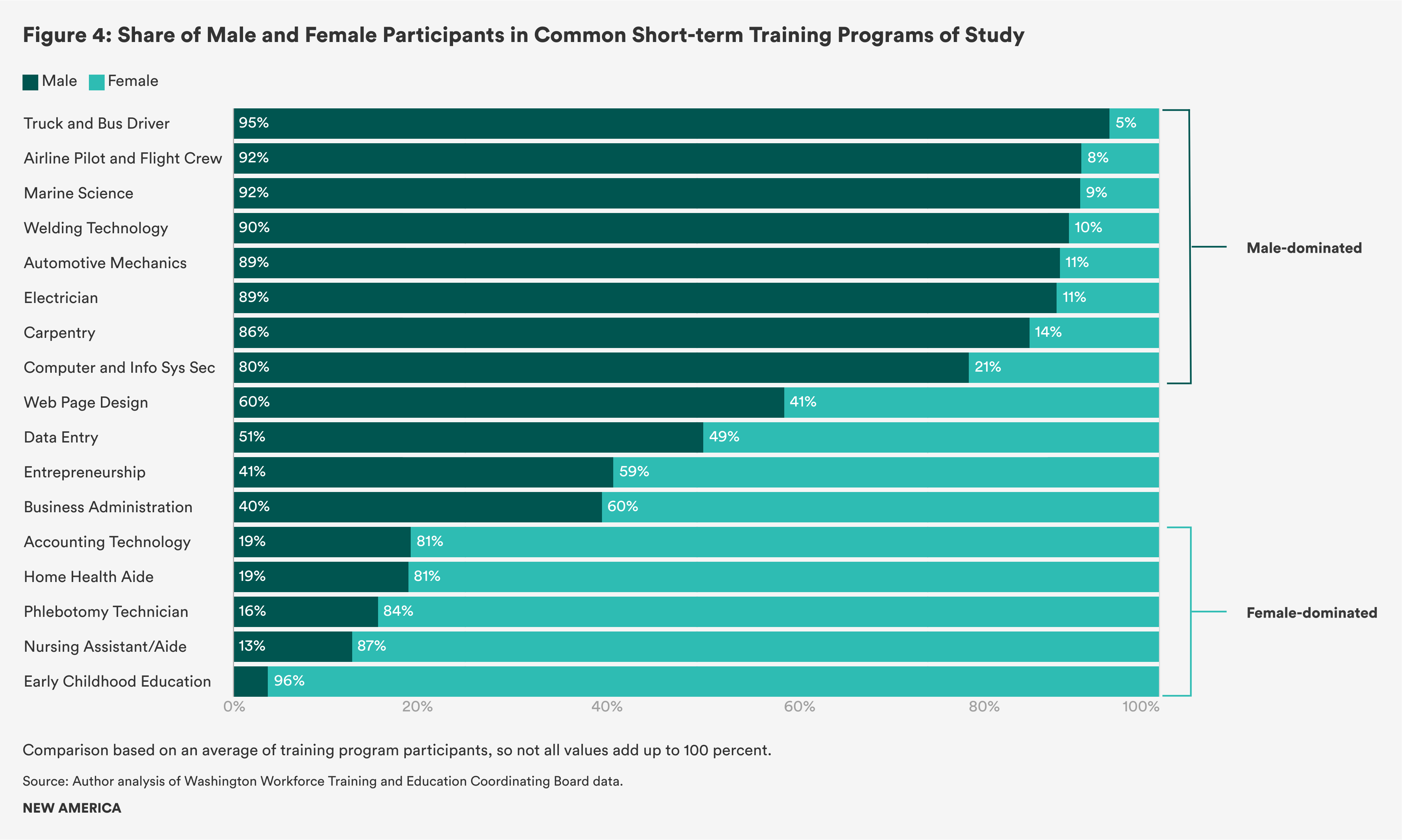
Men make up 54.8 percent of all short-term training participants included in this analysis, while women make up 45.2 percent. However, the gender composition of short-term training varies greatly based on program of study. Consistent with prior research, Figure 4 shows that short-term training program enrollment mirrors the gender-based occupational segregation present in the labor market.5 Men make up more than 80 percent of participants in truck and bus driver (94.7 percent), airline pilot and flight crew (92.4 percent), marine science (91.5 percent),6 automotive mechanics (89.3 percent), welding technology (90.3 percent), electrician (89 percent), carpentry (86 percent), and computer information systems security (79.5 percent) programs. Women, on the other hand, make up the vast majority of participants in early childhood education (96.2 percent), nursing assistant/aide (87.2 percent), phlebotomy technician (84.4 percent), accounting technology (80.8 percent), and home health aide (81.1 percent) training.
Race and Ethnicity
As Figure 5 below shows, white students represent 67.2 percent of those enrolled in training. However, compared to the overall racial and ethnic composition of Washington State, they are underrepresented by about 11 percentage points. Hispanic/Latinx individuals are the largest minority group in Washington State (13 percent) and its short-term training programs (13.5 percent), followed by Asian students, who make up 9.3 percent of short-term training participants and 9.6 percent of the state population. Black students’ participation in short-term training (8.6 percent) is nearly twice this group’s share of the state population (4.4 percent).7
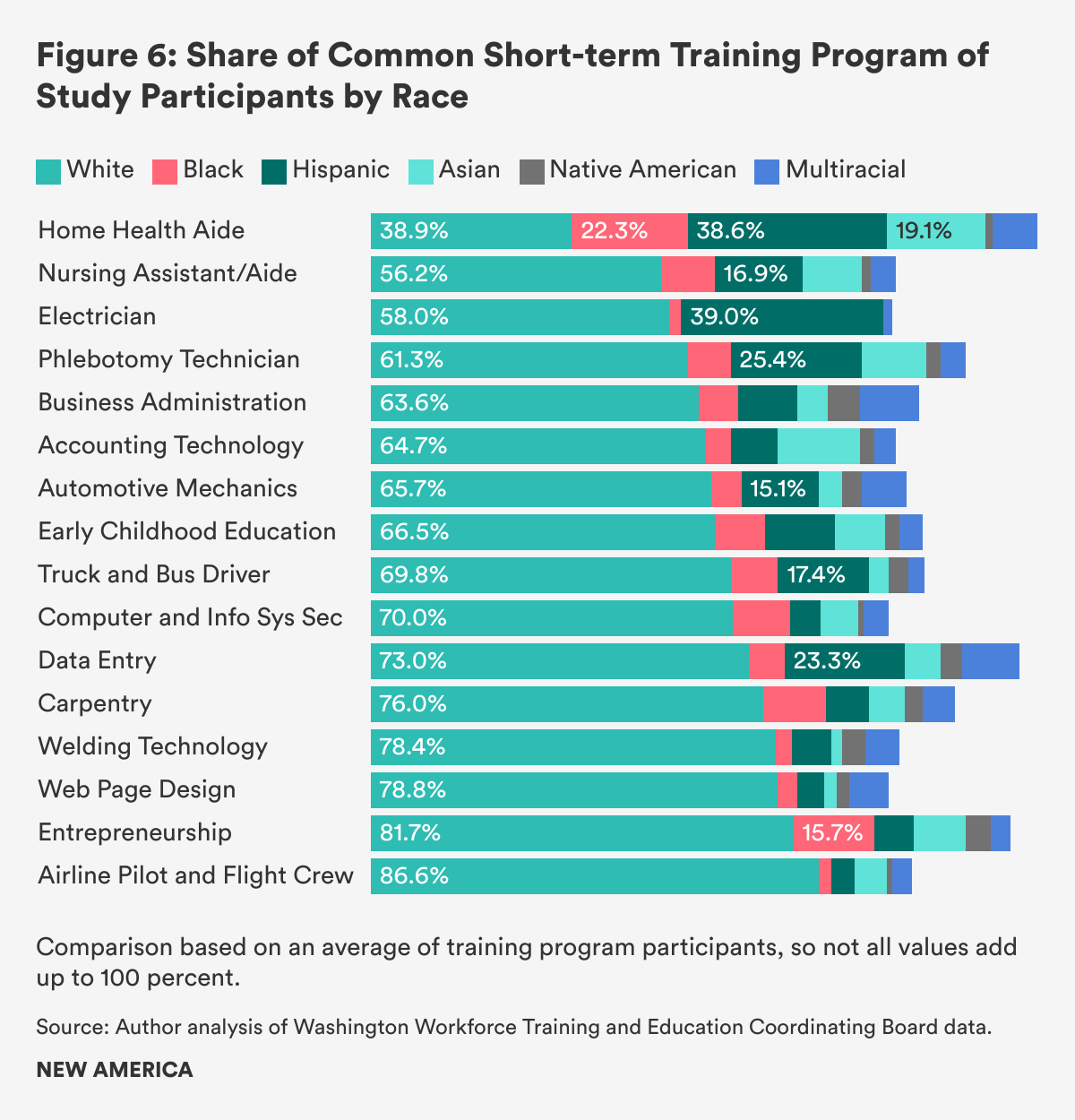
The racial and ethnic composition of short-term training programs varied by program of study, as shown in Figure 6. Health care-related and female-dominated programs are among the most racially and ethnically diverse, with the greatest proportion of students of color. Home health aide programs are 38.6 percent Hispanic/Latinx, 22.3 percent Black, and 19.1 percent Asian, while nursing assistant/aide programs are 16.9 percent Hispanic/Latinx, 11.6 percent Asian, and 10.3 percent Black. In phlebotomy technician programs, Hispanic/Latinx make up 25 percent of participants, while Asian students represent 12.5 percent and Black students are 8.3 percent.
In addition to medical-related programs, Hispanic/Latinx individuals are the most represented minority group in electrician (39 percent), data entry (23.3 percent), automotive mechanics (15.1 percent), and early childhood education (13.2 percent) programs. Compared to their overall share of short-term program participants, Black students also make up a disproportionate share of those enrolled in computer and information systems security (11.1 percent) and carpentry (12 percent). And Asian students are the most represented minority in accounting technology programs (16 percent).
Prior Education
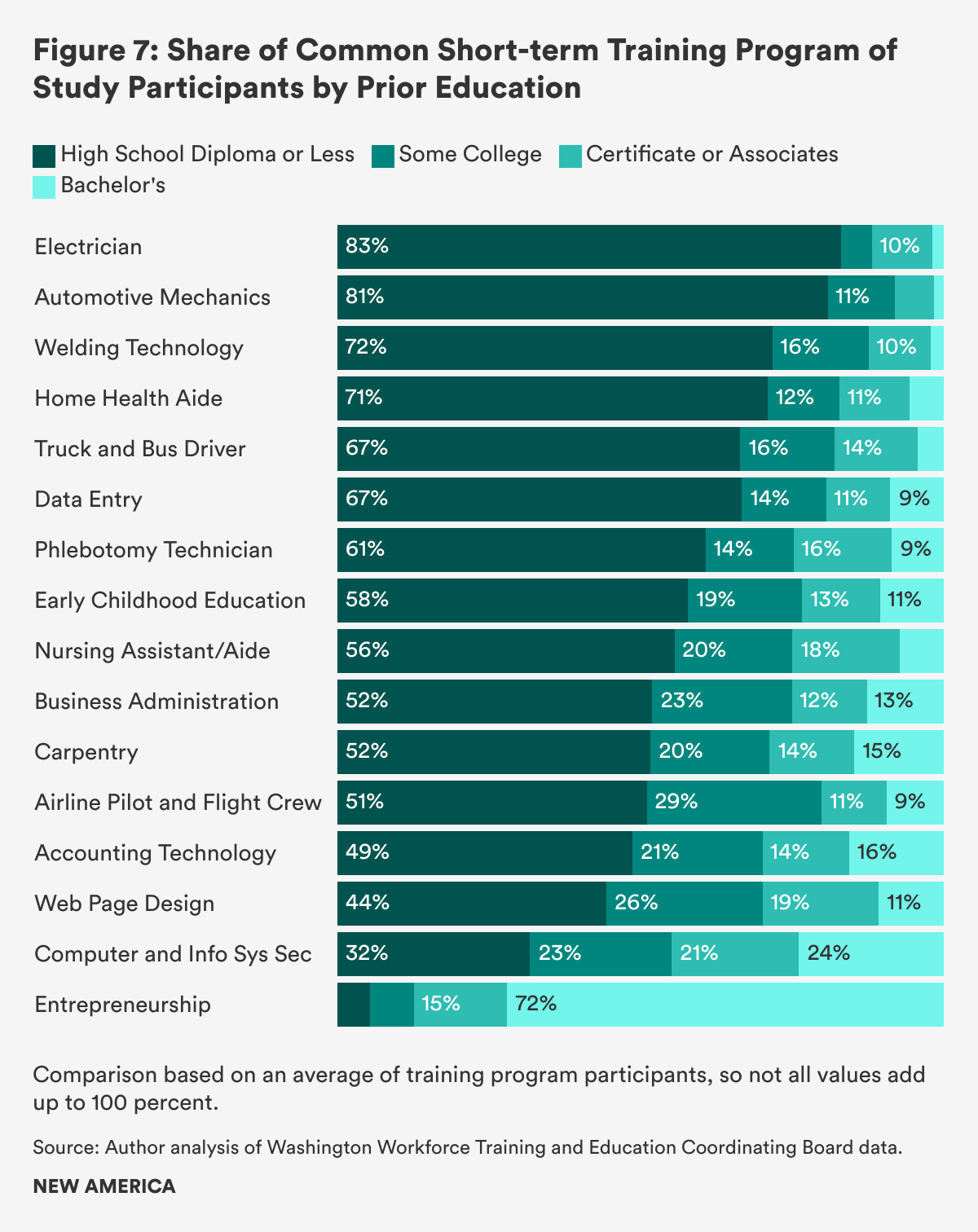
Across all programs of interest, individuals with a high school diploma or GED or less make up the largest share of participants (55 percent), followed by adults with some college (18.4 percent). Individuals who already hold a postsecondary certificate or degree account for more than a quarter (26.6 percent) of all short-term training program participants.
Except for entrepreneurship programs, for which 87.5 percent of participants have a postsecondary certificate or degree, the highest level of education for the majority of participants in the short-term training programs of study examined is some college or less (see Figure 7). In male-dominated truck and bus driver and traditional skilled trades programs, including automotive mechanics, electrician, and welding technology, more than 82 percent of participants have some college or less. Most of these programs also have the highest proportion of participants with a high school diploma or less. Electrician (84 percent) and automotive mechanics (80.4) programs lead with the highest share of those with education at or below the high school level, followed by welding technology (71.6 percent) programs. On the other hand, computer and information systems security, another male-dominated program, has the second-highest share of bachelor’s degree holders, at 23.9 percent.
Female-dominated training programs have a significant but comparatively smaller share of students with a high school diploma or less and also have more college-educated students than most male-dominated programs of study examined. While roughly 55–60 percent of participants in medical-related training programs (phlebotomy technician and nursing assistant/aide) have a high school diploma or less, these programs have some of the highest shares of certificate or associate degree holders. For instance, 16.3 percent of phlebotomy technician and 17.7 percent of nursing assistant/aide program participants have a postsecondary certificate or associate degree. Web page design (19.2 percent) and computer and information systems security (21.1 percent) enroll the highest shares of certificate or associate degree holders.
Outcomes of Short-term Training Program Completers
Across all short-term training programs, the average completion rate is 74.5 percent. This captures everyone who graduated with a credential, including a non-degree certificate, as well as community and technical college and private vocational school students who transferred to a four-year institution. Completion rates are notably higher for short-term training than longer programs less than a year in length (68.4 percent), programs between one and two years (66.3 percent), and programs longer than two years (65.2 percent).
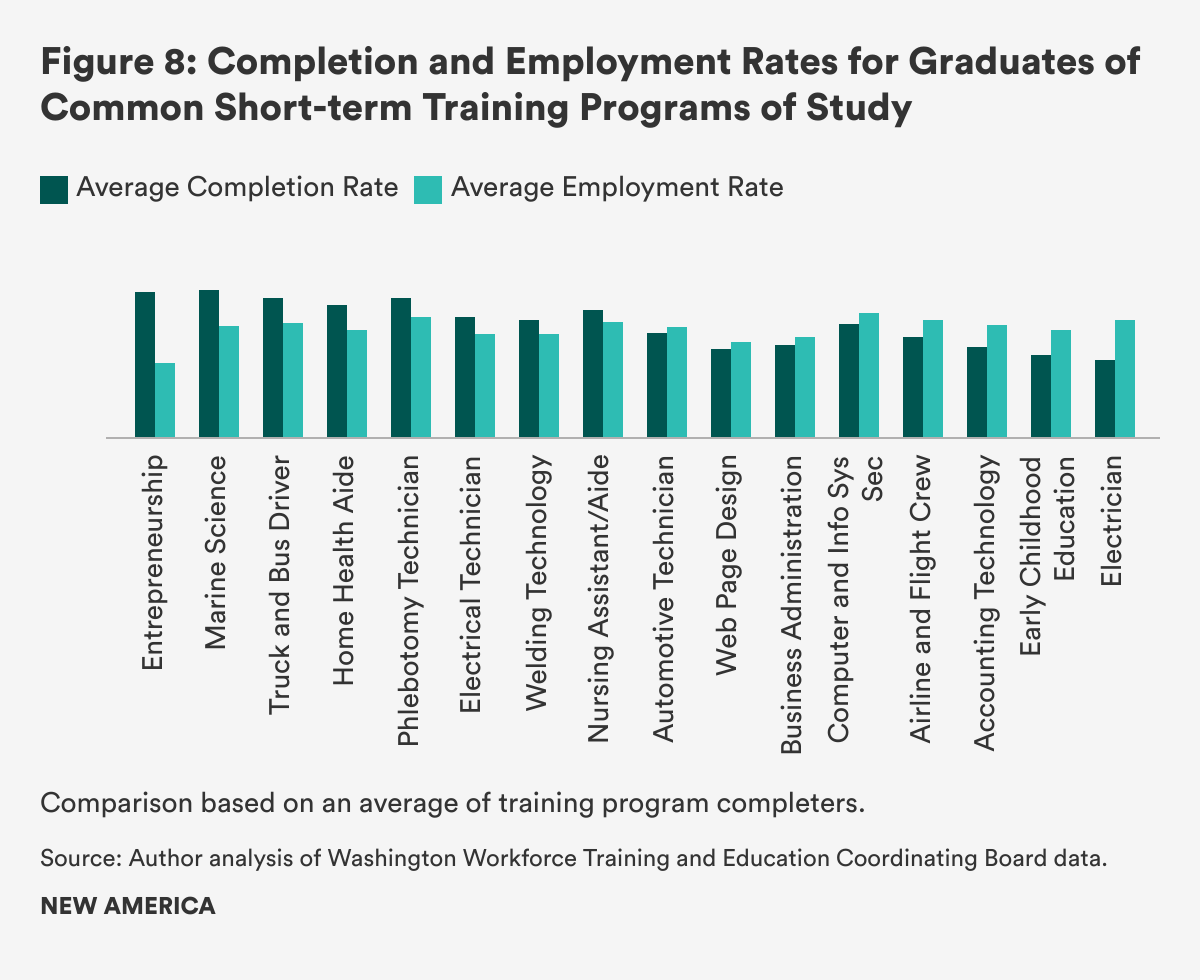
Some short-term training programs of study such as marine science (98.7 percent), entrepreneurship (97.4 percent), phlebotomy technician (93.4 percent), truck and bus driver (93.8 percent), nursing assistant/aide (85.7 percent), home health aide (88.9 percent), and electrical technician (80.8 percent) have higher than average completion rates, whereas web page design (59.7 percent), early childhood education (55.6 percent), and electrician (52 percent) programs have lower than average completion rates (see Figure 8).
Across all short-term training programs, 74.8 percent of those that complete a program are employed four quarters after exit. Computer and information systems security (83.6 percent), phlebotomy technician (81.1 percent), electrician (79 percent), airline pilot and flight crew (78.7 percent), nursing assistant/aide (77.6 percent), truck and bus driver (76.7 percent), and accounting technology (75.4 percent) program graduates have higher than average completion rates for short-term training programs. Entrepreneurship, a program with one of the highest completion rates, has the lowest employment rates, at 50.4 percent, likely because many program graduates go on to self-employment and are thus not captured in state employment data systems.
What is unclear is what percentage of those not employed one year after completion are enrolled in further education and the likelihood that short-term training graduates will eventually pursue additional training related to their field of study. Additional data on post-program educational enrollment could shed light on the extent to which short-term training programs offer stackable credentials that position adults to increase their qualifications within a particular career path.
The average median hourly earnings for a short-term training program graduate is $17.84 four quarters after program exit. Whereas the average short-term training program graduate earns more than Washington State’s minimum wage, recently raised to $13.50/hour, not all graduates are bringing home a living wage.8 What defines a living wage is different for each worker and is often determined by family composition and financial obligations.
According to the Massachusetts Institute of Technology, which calculates state-specific living wage models to serve as alternative, more accurate measures of basic needs compared to the federal poverty threshold, the living wage for a single working adult in Washington State is $13.47/hour. A sole earner in a two-adult household must make $20.40/hour, whereas each working adult in a two-adult household must earn $10.20/hour to get by. With dependent children, the required hourly living wage increases. A single parent must earn $27.08/hour to care for a single child and $32.23/hour for two children. A two-parent household, in which both adults are working and sharing the financial load, requires a $14.89 hourly wage per person to support a family of three and $17.45/hour for a family of four (Figure 9).9
Figure 9: Hourly Living Wage in Washington State
| 1 Adult | 1 Adult | 1 Adult | 2 Adults (1 Working) | 2 Adults (1 Working) | 2 Adults (1 Working) | 2 Adults (Both Working) | 2 Adults (Both Working) | 2 Adults (Both Working) | |
|---|---|---|---|---|---|---|---|---|---|
| 0 Children | 1 Child | 2 Children | 0 Children | 1 Child | 2 Children | 0 Children | 1 Child | 2 Children | |
| Living Wage | $13.47 | $27.08 | $32.23 | $20.40 | $24.93 | $27.47 | $10.20 | $14.89 | $17.45 |
| Poverty Wage | $6.00 | $8.13 | $10.25 | $8.13 | $10.25 | $12.38 | $4.06 | $5.13 | $6.19 |
Note: Aggregate living wage figures assume that individuals work 2,080 hours a year, or 40 hours a week
Source: Massachusetts Institute of Technology Living Wage Calculator.
As Figure 10 illustrates, on average, graduates of nearly all of the short-term training programs examined are earning enough to support a single adult household. The one exception is nursing assistant/aide program graduates, who earn $13.19/hour on average and fall short of reaching any of the living wage categories. This group of individuals would appear to benefit most from the recent and steady increases in the state minimum wage. Nonetheless, a nursing assistant/aide with a family is not likely to earn enough to survive unless he or she is part of a two-adult working household. Sole-earner nursing assistants/aides with two children are earning poverty-level wages.
Only marine science graduates who are single with no children earn enough to support themselves and/or a family. All other short-term training program graduates do not. Web page design and automotive mechanics program graduates, who earn $14.83/hour or less, would also struggle to support even one child, even with a partner with comparable earnings.
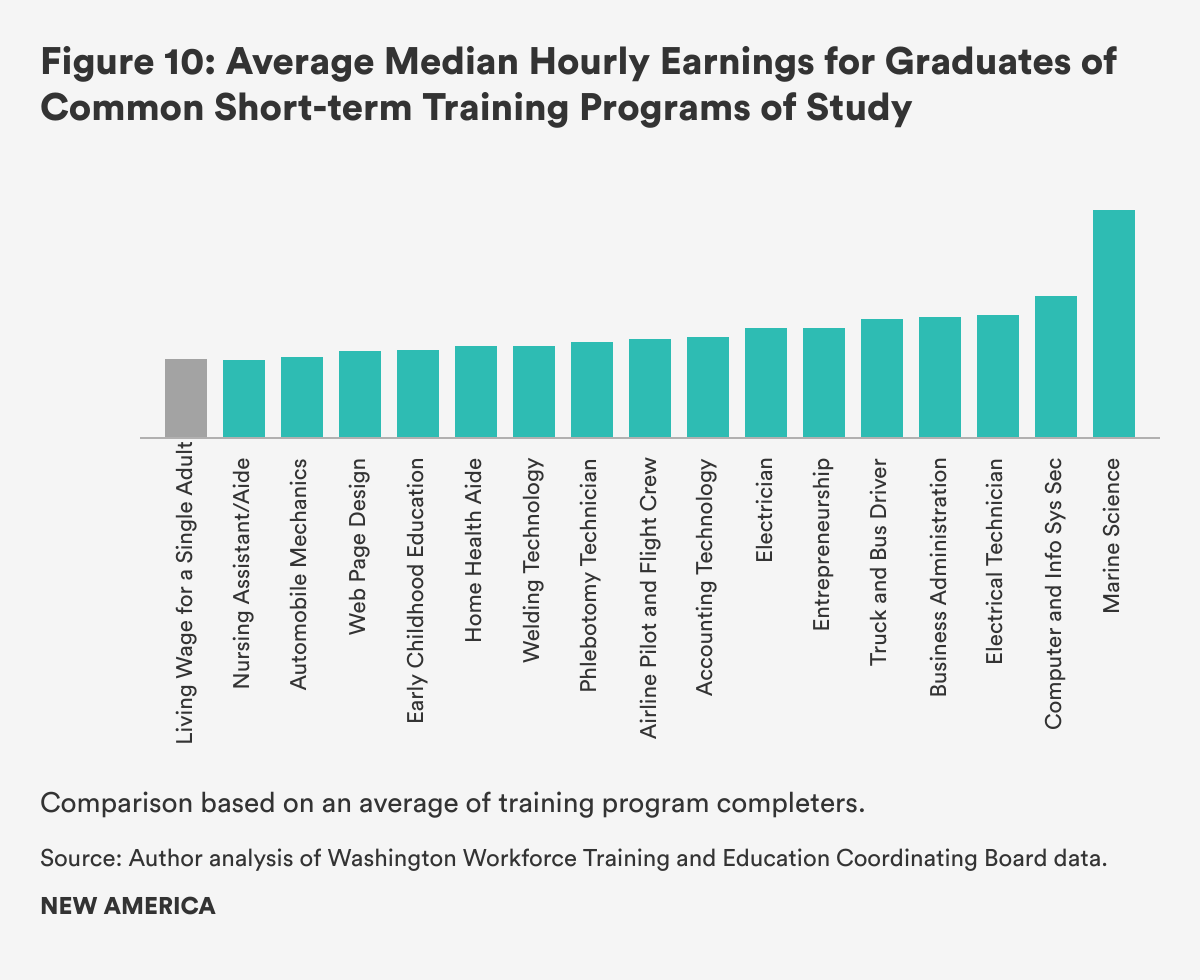
These aggregate living wage figures assume that individuals work 2,080 hours a year, or 40 hours a week, which might not be the case for all short-term training graduates.
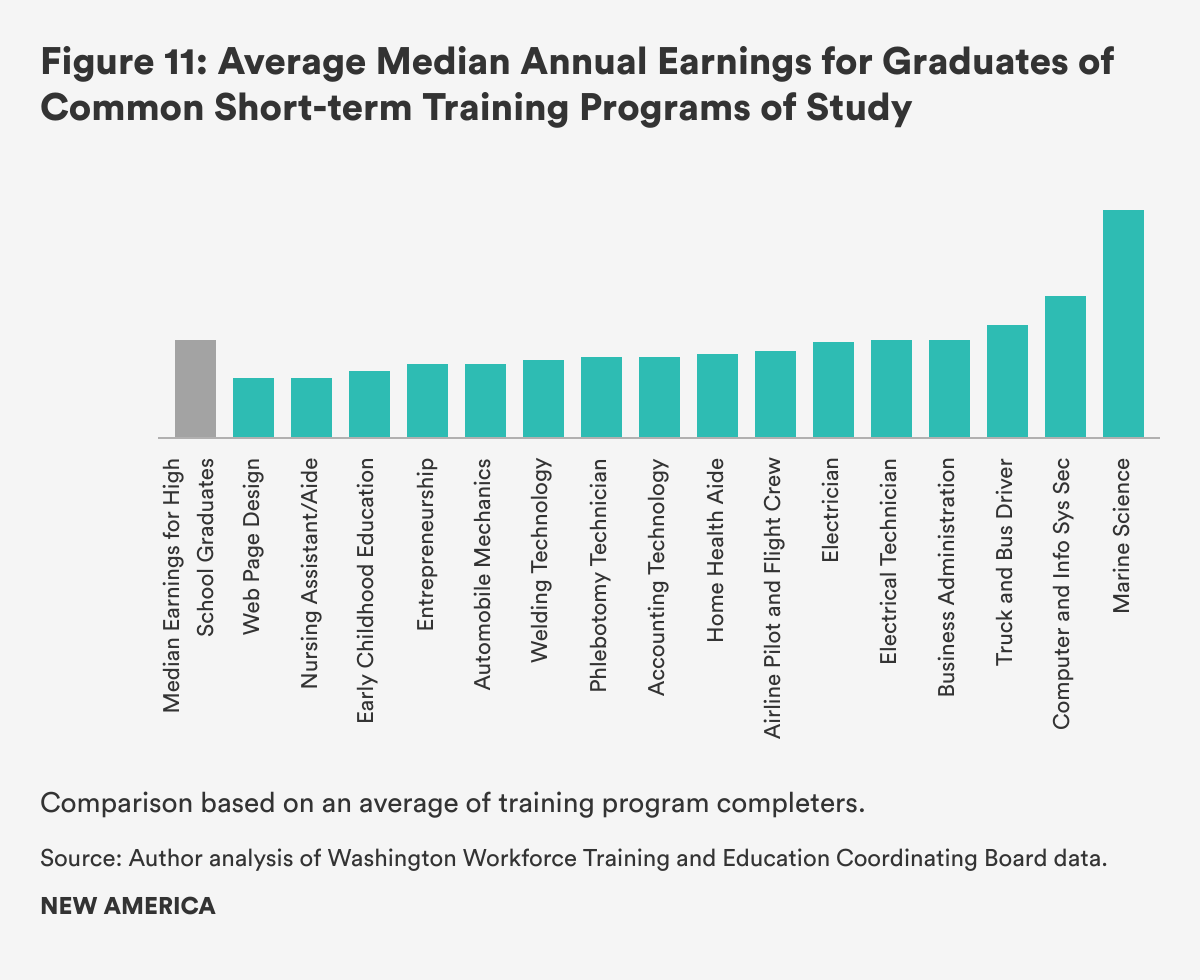
In Washington State, the median earnings of high school graduates is $37,000.10 Yet the average median annual earnings for short-term training program graduates is $33,415. Furthermore, 10 programs studied were associated with lower than average median annual earnings. Of these, five are female-dominated programs and related occupations (accounting technology, home health aide, phlebotomy technician, early childhood education, and nursing assistant/aide), which also tend to enroll more participants of color, whereas three are male-dominated programs (airline pilot and flight crew, welding technology, and automotive mechanics). Graduates of nursing assistant/aide and early childhood education programs, two of the most common short-term training programs in the state, earned $22,720.85 and $25,158.23, respectively, one year after completing the program (see Figure 11).
There have been countless studies reaffirming the presence of gender and racial wage gaps, factors that are likely at play in Washington. Yet, the higher earnings of some short-term training program graduates could be explained, in part, by the educational attainment levels of participants (see Figure 12).
The short-term training program for which graduates average the highest annual median earnings, $53,599.71, is computer and information systems security. This program also enrolls one of the highest shares of bachelor’s degree holders (23.9 percent). This finding reflects the positive relationship between postsecondary education and better labor market outcomes that researchers have documented for a long time.11 But there are some programs like truck and bus driver, business administration, electrician, and airline pilot and flight crew for which graduates earn a solid wage without prior postsecondary education. Truck and bus driver and electrician programs have the highest shares of participants with a high school diploma or less, at 66.5 and 84 percent, respectively. Except for business administration, the programs with the highest-earning graduates enroll mostly male participants. On the other hand, graduates of web page design and female-dominated and racially diverse short-term programs like early childhood education and nursing assistant/aide earn the lowest wages even though roughly a quarter of these program participants are college-educated (i.e., possess a postsecondary certificate, associate degree, or bachelor’s degree).
Research has shown that workers with an occupational license, a required credential awarded by a government agency, tend to earn more than workers without a license.12 The data set does not include information about the licensing of short-term training program participants, thus raising questions about the extent to which graduate earnings might be explained by the possession of non-degree credentials of value.
More research is needed to determine the extent to which prior education and credential attainment influence the short- and long-term earning potential of short-term training graduates, but this analysis suggests educational background—and perhaps other demographic characteristics of those who pursue short-term training—plays a role in graduate earnings. To assume that all short-term training programs position all graduates to land family-sustaining jobs ignores persistent realities about the labor market conditions that have historically disadvantaged less educated, female, and minority workers.
Citations
- Four-year colleges and universities accounted for 1 percent of short-term training providers while other entities, such as community-based organizations and adult education providers, delivered 6 percent of short-term training programs.
- Washington State Board for Community and Technical Colleges, Job Skills Program, source
- Washington State Board for Community and Technical Colleges, Worker Retraining Program, source
- Washington Student Achievement Council, Washington College Grant, source
- Lul Tesfai, Kim Dancy, and Mary Alice McCarthy, Paying More and Getting Less: How Nondegree Credentials Reflect Labor Market Inequality Between Men and Women (Washington, DC: New America, September 2018), source
- Marine science programs prepare individuals to serve as captains, executive officers, engineers, and ranking mates on commercially licensed inland, coastal and ocean-going vessels. Includes instruction in maritime traditions and law, maritime policy, economics and management of commercial marine operations, basic naval architecture and engineering, shipboard power systems engineering, crew supervision, and administrative procedures. National Center for Education Statistics, The Classifications of Instructional Programs, Detail for CIP Code 49.0309: Marine Science/Merchant Marine Officer, source
- U.S. Census Bureau, QuickFacts: Washington, source
- Washington State Department of Labor and Industries, Minimum Wage, source; and Living Wage Calculation for Washington, source
- These living wage figures are aggregated for the State of Washington, with those living in metropolitan areas requiring higher earnings to make ends meet. For instance, in Seattle, where the minimum wage is $15.75/hour, the living wage for a single working adult is $16.09. This analysis does not include an in-depth examination of earnings and living wage thresholds by region.
- Education Research & Data Center, High School Graduate Outcomes (see Median earnings within first 12 years following high school completion), source
- Understanding College Affordability: Variation in Earnings (Urban Institute) source; U.S. Bureau of Labor Statistics, Learn More, Earn More: Education Leads to Higher Wages, Lower Unemployment, May 2020, source; and Social Security Administration, Education and Lifetime Earnings, November 2015, source
- Ryan Nunn, How Occupational Licensing Matters for Wages and Careers (Washington, DC: Brookings, March 2018), source ; Lul Tesfai, Kim Dancy, and Mary Alice McCarthy, Paying More and Getting Less: How Nondegree Credentials Reflect Labor Market Inequality Between Men and Women (Washington, DC: New America, September 2018), source
Discussion and Conclusion
With the COVID-19 public health and economic crisis causing massive and sustained levels of unemployment, short-term training is likely to play a key role in our nation’s recovery strategy.1 Short-term training programs certainly provide some value to graduates who acquire new and relevant job-related skills and credentials, and to employers who benefit from a more qualified workforce. The accessibility of short-term training compared to lengthier programs makes it an attractive option for jobseekers, dislocated workers, career changers, and incumbent workers looking to progress in their careers. However, program value cannot fully be assessed without taking into account the cost incurred by students and the short- and long-term benefits to program completion, in the form of employment, earnings, and career advancement opportunities.
In Washington, much like in other states, the public workforce system, state financial aid, and occupation-specific training subsidies fund many short-term training programs. Yet even if public dollars were to fully fund short-term training programs, removing financial burdens for those who enroll, many graduates would still land jobs that fail to pay a living wage. And the short-term training graduates who earn the least, many of whom are college-educated, tend to enroll in female-dominated programs and go on to become essential workers in female-dominated and racially diverse care occupations. Unfortunately, these earnings trends based on occupation are not unique to Washington State. Nationally, across all occupations, the annual mean wage is $56,310, but child care workers ($26,790), home health aide, personal care aides, and nursing assistant/aide ($29,320) earn substantially less. Workers in male-dominated automotive mechanics ($47,060), truck and bus driver ($52,090), and electrician ($61,550) occupations earn close to or more than the average American worker.2
The Workforce Innovation and Opportunity Act requires that governors or state agencies disseminate information about eligible training providers and the performance and costs associated with the training programs they offer via a searchable database—something Washington State did long before the federal requirement. Now every state has a website similar to Career Bridge to inform individuals about training opportunities in their communities and the job and earnings prospects they can expect following program completion.3
Greater transparency about short-term training program costs and outcomes—albeit an important decision-making tool for jobseekers and a useful resource for evaluating the effectiveness of public investments in training—will not eliminate bad jobs. Neither will dissuading people from pursuing training that leads to low-paying work, or worse, blaming individuals for choosing low-wage work that might be well aligned with their personal interests and/or offer a more conducive environment or schedule for balancing family and other obligations. The reality is care jobs in the early childhood and health sectors are in demand and expected to grow. They require skilled professionals to provide the quality of care that children, the elderly, and individuals with disabilities deserve. Market forces would suggest that the critical importance and challenging nature of care work, coupled with high rates of worker turnover, would translate into better compensation. But deep-rooted obstacles such as societal biases and exclusionary labor laws have long prevented equal access to quality jobs for women and people of color.
The findings outlined in this report speak to the importance of labor policies that ensure living wages, not to mention family-sustaining benefits for all workers. Washington State boasts the second-highest minimum wage in the U.S., behind Washington DC, and the state has committed to incremental cost-of-living adjustments to this wage based on the federal Consumer Price Index for Urban Wage Earners and Clerical Workers.4 This will certainly help, but the state-wide minimum wage falls short of the living wage many families need to get by.
Washington has been a leader in using state education, employment, and wage data systems to assess the value of taxpayer-funded training.5 By using these data to examine whether short-term training graduates were employed one year after program completion and their hourly and annual earnings, this analysis provides a glimpse into the value of this training, which accounts for nearly a quarter of all training in the state.
However, to determine whether short-term training graduates are employed in a field aligned with their training, the extent to which short-term training programs lead to sustained wage increases, and whether short-term training serves as a stepping-stone to advanced career training and career progression, more research is needed. Washington recently passed legislation requiring employers to provide quarterly reports of the standard occupational classifications or job titles of workers, in addition to employee wages and hours worked, beginning in October 2021.6 This occupational data will facilitate a more comprehensive evaluation of all training programs.
Other states and the federal government should follow Washington’s lead. Before even more public investments go toward short-term training programs, it is important to determine whether they are delivering on their promise to jobseekers and helping to dismantle systemic labor market inequities that predominantly hinder women, people of color, and those with fewer educational opportunities.
Citations
- Gene Falk, Emma C. Nyhof, Jameson A. Carter, Paul D. Romero, and Isaac A. Nicchitta, Unemployment Rates During the COVID-19 Pandemic: In Brief (Washington, DC: Congressional Research Service, January 2021), source
- U.S. Bureau of Labor Statistics, Occupational Employment and Wage Statistics, May 2020 National Occupational Employment and Wage Estimates United States, source
- U.S. Department of Labor, CareerOneStop, WIOA-Eligible Training Program Finder, source
- National Conference of State Legislators, State Minimum Wages, January 8, 2021, source
- source; source
- source
Appendix A: Description of Program-Level Variables
| Variable | Description |
|---|---|
| Program ID | Unique identifier assigned to each training program |
| Program length | Indicator of a training program’s length, measured in weeks |
| Program clock hours | Indicator of a training program’s length, measured by the actual number of hours of instruction |
| Classification of Instructional Programs (CIP) | Indicator of the field or program of study to which a training program is aligned |
| Provider | Indicator of whether a training program is offered by a public community or technical college, private career/vocational school, four-year college or university, apprenticeship, or other provider such as a community-based organization or adult education provider |
| Number of participants | Total number of students who enroll in a training program, whether or not they complete the requirements of the program |
| Number of completers | Total number of students who complete the requirements of a training program |
| Completion rate | Percent of training program participants who completed the requirements of the training program |
| Percent employed | Percent of training program completers who are employed four quarters after program exit |
| Median hourly earnings | Median hourly wage for all training program completers four quarters after program exit |
| Median annual earnings | Median annual wage for all training program completers four quarters after program exit |
| Gender | Set of indicators that capture the percent of participants in a training program who are male or female |
| Race/Ethnicity | Set of indicators that capture the percent of participants in a training program who are white, Black, Hispanic/Latinx, Asian, Native American, or multiracial |
| Prior education | Set of indicators that capture the percentage of participants in a training program with no high school diploma, a high school diploma or GED, some college, a certificate or associate degree, or a bachelor’s degree |
Appendix B: Common Short-term Programs of Study and Corresponding Occupations
| Common Short-term Programs of Study (POS) | POS Shorthand | Corresponding Occupations (CIP-SOC Crosswalk) | Share of Overall Short-term Training Programs |
|---|---|---|---|
| Truck and Bus Driver/Commercial Vehicle Operator and Instructor | Truck and Bus Driver | ● Career/Technical Education Teachers, Postsecondary ● Heavy and Tractor-Trailer Truck Drivers ● Light Truck Drivers ● Bus Drivers, School ● Bus Drivers, Transit and Intercity ● Shuttle Drivers and Chauffeurs | 11.61% |
| Early Childhood Education and Teaching | Early Childhood Education | ● Education Teachers, Postsecondary ● Preschool Teachers, except Special Education ● Kindergarten Teachers, except Special Education ● Elementary School Teachers, except Special Education ● Teaching Assistants, Preschool, Elementary, Middle, and Secondary School, except Special Education ● Teaching Assistants, Special Education | 5.81% |
| Electrician | Electrician | ● First-Line Supervisors of Construction Trades and Extraction Workers ● Solar Energy Installation Managers ● Electricians ● Security and Fire Alarm Systems Installers ● Signal and Track Switch Repairers | 4.14% |
| Nursing Assistant/Aide and Patient Care Assistant/Aide | Nursing Assistant/Aide | ● Nursing Assistants | 4.06% |
| Automobile/Automotive Mechanics Technology/Technician | Automotive Mechanics | ● Electrical and Electronics Installers and Repairers, Transportation Equipment ● Electronic Equipment Installers and Repairers, Motor Vehicles ● Automotive Service Technicians and Mechanics | 3.65% |
| Marine Science/Merchant Marine Officer | Marine Science | ● Captains, Mates, and Pilots of Water Vessels ● Motorboat Operators ● Ship Engineers | 3.65% |
| Carpentry/Carpenter | Carpentry | ● First-Line Supervisors of Construction Trades and Extraction Workers ● Solar Energy Installation Managers ● Carpenters | 2.48% |
| Entrepreneurship/Entrepreneurial Studies | Entrepreneurship | ● Chief Executives ● Chief Sustainability Officers ● General and Operations Managers ● Managers, all other ● Regulatory Affairs Managers ● Compliance Managers ● Loss Prevention Managers ● Wind Energy Operations Managers ● Wind Energy Development Managers ● Brownfield Redevelopment Specialists and Site Managers ● Business Teachers, Postsecondary | 2.44% |
| Data Entry/Microcomputer Applications, General | Data Entry | ● Data Entry Keyers | 2.15% |
| Computer Programming/Programmer, General | Computer Programming | ● Computer Network Support Specialists ● Computer Programmers ● Software Developers ● Software Quality Assurance Analysts and Testers ● Web Developers ● Web and Digital Interface Designers ● Video Game Designers ● Computer Science Teachers, Postsecondary | 1.66% |
| Welding Technology/Welder | Welding Technology | ● Welders, Cutters, Solderers, and Brazers ● Welding, Soldering, and Brazing Machine Setters, Operators, and Tenders | 1.66% |
| Plumbing Technology/Plumber | Plumbing Technology | ● First-Line Supervisors of Construction Trades and Extraction Workers ● Solar Energy Installation Managers ● Plumbers, Pipefitters, and Steamfitters ● Solar Thermal Installers and Technicians ● Septic Tank Servicers and Sewer Pipe Cleaners | 1.42% |
| Computer and Information Systems Security/Information Assurance | Computer and Information Systems Security /Computer and Info Sys Sec | ● Computer and Information Systems Managers ● Information Security Analysts ● Computer Network Support Specialists ● Computer Network Architects ● Telecommunications Engineering Specialists ● Database Administrators ● Database Architects ● Data Warehousing Specialists ● Network and Computer Systems Administrators | 1.38% |
| Home Health Aide/Home Attendant | Home Health Aide | ● Home Health Aides ● Personal Care Aides | 1.38% |
| Electrical, Electronic and Communications Engineering Technology/Technician | Electrical Technician | ● Electrical and Electronics Drafters ● Aerospace Engineering and Operations Technologists and Technicians ● Electrical and Electronic Engineering Technologists and Technicians ● Electro-Mechanical and Mechatronics Technologists and Technicians ● Robotics Technicians ● Calibration Technologists and Technicians ● Electrical and Electronics Repairers, Powerhouse, Substation, and Relay | 1.34% |
| Business Administration and Management, General | Business Administration | ● Chief Executives ● Chief Sustainability Officers ● General and Operations Managers ● Sales Managers ● Administrative Services Managers ● Facilities Managers ● Security Managers ● Industrial Production Managers ● Quality Control Systems Managers ● Geothermal Production Managers ● Biofuels Production Managers ● Biomass Power Plant Managers ● Hydroelectric Production Managers ● Transportation, Storage, and Distribution Managers ● Supply Chain Managers ● Compensation and Benefits Managers ● Human Resources Managers ● Training and Development Managers ● Construction Managers ● Entertainment and Recreation Managers, except Gambling ● Social and Community Service Managers ● Personal Service Managers, all other ● Fitness and Wellness Coordinators ● Spa Managers ● Managers, all other ● Regulatory Affairs Managers ● Compliance Managers ● Loss Prevention Managers ● Wind Energy Operations Managers ● Wind Energy Development Managers ● Brownfield Redevelopment Specialists and Site Managers ● Cost Estimators ● Human Resources Specialists ● Logisticians ● Logistics Engineers ● Logistics Analysts ● Project Management Specialists ● Management Analysts ● Compensation, Benefits, and Job Analysis Specialists ● Business Operations Specialists, All Other ● Business Continuity Planners ● Sustainability Specialists ● Online Merchants ● Security Management Specialists ● Business Teachers, Postsecondary | 1.3 |
| Phlebotomy Technician/Phlebotomist | Phlebotomy Technician | ● Health Specialties Teachers, Postsecondary ● Phlebotomists | 1.26% |
| Airline/Commercial/Professional Pilot and Flight Crew | Airline Pilot and Flight Crew | ● Airline Pilots, Copilots, and Flight Engineers ● Commercial Pilots | 1.22% |
| Accounting Technology/Technician and Bookkeeping | Accounting Technology | ● Tax Preparers ● Bookkeeping, Accounting, and Auditing Clerks ● Payroll and Timekeeping Clerks ● Brokerage Clerks ● Statistical Assistants | 1.22% |
| Web Page, Digital/Multimedia and Information Resources Design | Web Page Design | ● Web Developers ● Web and Digital Interface Designers ● Video Game Designers ● Career/Technical Education Teachers, Postsecondary ● Special Effects Artists and Animators ● Graphic Designers | 1.14% |
Appendix C: Data Availability for Common Short-term Programs of Study
| Common Short-term Programs of Study (POS) | POS Shorthand | Gender | Race/Ethnicity | Prior Education | Completion Rate | Employment Rate | Earnings |
|---|---|---|---|---|---|---|---|
| Truck and Bus Driver/Commercial Vehicle Operator and Instructor | Truck and Bus Driver | X | X | X | X | X | X |
| Early Childhood Education and Teaching | Early Childhood Education | X | X | X | X | X | X |
| Electrician | Electrician | X | X | X | X | X | X |
| Nursing Assistant/Aide and Patient Care Assistant/Aide | Nursing Assistant/Aide | X | X | X | X | X | X |
| Automobile/Automotive Mechanics Technology/Technician | Automotive Mechanics | X | X | X | X | X | X |
| Marine Science/Merchant Marine Officer | Marine Science | X | X | X | X | ||
| Carpentry/Carpenter | Carpentry | X | X | X | |||
| Entrepreneurship/Entrepreneurial Studies | Entrepreneurship | X | X | X | X | X | X |
| Data Entry/Microcomputer Applications, General | Data Entry | X | X | X | |||
| Computer Programming/Programmer, General | Computer Programming | ||||||
| Welding Technology/Welder | Welding Technology | X | X | X | X | X | X |
| Plumbing Technology/Plumber | Plumbing Technology | ||||||
| Computer and Information Systems Security/Information Assurance | Computer and Info Sys Sec | X | X | X | X | X | X |
| Home Health Aide/Home Attendant | Home Health Aide | X | X | X | X | X | X |
| Electrical, Electronic and Communications Engineering Technology/Technician | Electrical Technician | X | X | X | |||
| Business Administration and Management, General | Business Administration | X | X | X | X | X | X |
| Phlebotomy Technician/Phlebotomist | Phlebotomy Technician | X | X | X | X | X | X |
| Airline/Commercial/Professional Pilot and Flight Crew | Airline Pilot and Flight Crew | X | X | X | X | X | X |
| Accounting Technology/Technician and Bookkeeping | Accounting Technology | X | X | X | X | X | X |
| Web Page, Digital/Multimedia and Information Resources Design | Web Page Design | X | X | X | X | X | X |
“X” signifies that data are available for at least 10 programs within the common short-term program of study.
More About the Authors

Lul Tesfai
Senior Policy Advisor, Center on Education & Labor