
Table of Contents
- 1. Introduction
- 2. How to Use this Toolkit
- 3. Definitions & Abbreviations
- 4. The State of Children, Families, & Educators in the Second Year of COVID: Challenges & Solutions
- 5. Guiding Framework: How Policy Can Help Meet the Needs of Young Learners
- 6. Six Steps for Educators and Systems Leaders to Strengthen Transitions
- 7. Nine Takeaways from Our Work with States, School Districts, & Communities
- 8. State & Local Policy Ideas with Examples
- 9. Federal COVID Relief Dollars and How They Can Help Fund This Work
- 10. Other Funding Streams that can be Used for Early Learning and Transitions
- Appendix A: Resources by Topic
- Appendix B: Focus Group Questions
- Appendix C: Self-Assessment Tool
- Appendix D: Work Plan
5. Guiding Framework: How Policy Can Help Meet the Needs of Young Learners
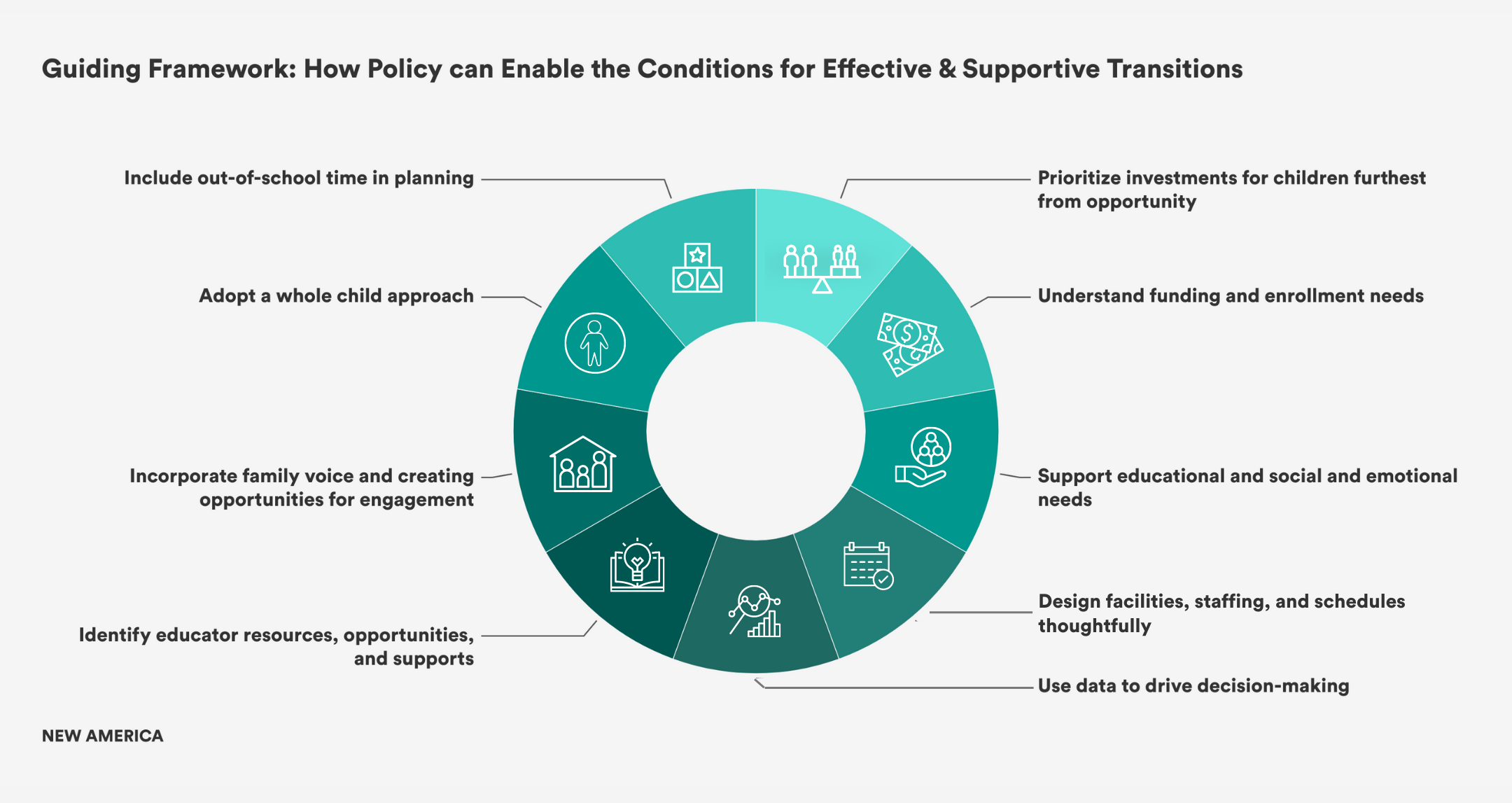
Policymakers will need to consider numerous factors as they develop transitions plans this fall, revise them throughout the year, and strengthen them for the next year and beyond. The nine areas outlined below provide a framework for states and local leaders to create effective systems that enable effective and supportive transitions. Addressing the questions that follow (through the planning process described in section 6) can help guide policy development and create an opportunity for continuous improvement to ensure that the lessons of COVID-19 are embedded in policy and practice.
1. Prioritize investments for children furthest from opportunity
- How can states incentivize schools and districts to use transitions to advance equity through increased opportunities, removal of barriers, and distribution of support for children who are furthest from opportunity, including children from families with low incomes, children of color, and children experiencing homelessness?
- How can states support and incentivize schools and districts to prioritize the unique needs and assets of children with disabilities and dual language learners?
- Given the influx of federal dollars, how are you meeting the maintenance of equity provision to ensure this money is used equitably, on strategies to remove barriers, increase opportunity, and establish systems that appropriately meet young children’s needs?
2. Understand funding and enrollment needs
- What additional funding is needed to address the needs of young children and their families moving into pre-K, kindergarten, and early elementary classrooms?
- What other funding streams (including those targeted for COVID-19 relief) can be leveraged to support the needs of children moving into early elementary classrooms?
- How will you sustain the practices put in place with recovery dollars after relief and recovery funds are spent?
- How are children furthest from opportunity prioritized in state funding formulas and approaches?
- Are early care and education eligibility levels set to ensure enough children qualify for services?
3. Support educational and social and emotional needs
- How will educators accurately assess where children are academically, socially, and developmentally?
- How can educators be supported to ensure that children who need the most support are getting it?
- How can schools, programs, and communities better help teachers thrive?
- What are ways to support program alignment (e.g., curriculum, assessment, learning environments, teaching strategies) across child care, pre-K, and kindergarten?
- What tools, assessments, health information, and other data are needed to understand the needs, strengths, and assets of children entering school?
- How can local and state leaders encourage/incentivize sharing data across ECE settings and agencies to get a more comprehensive view of how children are doing?
- How will educators address gaps in grade-level expectations and where children are? How can different teaching approaches and learning environments be used to better promote children’s social, emotional, and learning growth?
- How can schools and districts collaborate with community-based programs and institutions (ECE, libraries, tutoring programs, community health centers, parks and recreation, etc.) to provide more comprehensive supports to children and families?
4. Design facilities, staffing, and schedules thoughtfully
- Will expanded facilities, staffing (teachers and paraprofessionals), and classroom or school schedules be needed?
- How will officials ensure that the community-based early education workforce is not negatively impacted by staffing changes in the public school system (i.e., community-based early educators leaving to work in public schools)?
- Do schools or districts need to increase investments in mental health consultants or other professionals equipped to support children and staff who have experienced trauma?
- If an LEA chooses to extend the school day or year, what are the implications for facilities, staff, and schedules?
5. Use data to drive decision-making
- Child-level data
- What information is needed to enable educators to make adjustments at the school and classroom level to address individual child needs?
- Developmental screeners
- Formative assessments
- Health assessments
- Family questionnaires
- What information is needed to enable educators to make adjustments at the school and classroom level to address individual child needs?
- School-/classroom-/teacher-level data
- What data sharing opportunities exist with social support staff? Transitions professionals? Home-visitors? Family support services?
- What are school-level best practices for collecting, sharing, and using data to support transitioning children?
- How are schools, early childhood practitioners, and communities understanding teacher and family experiences and needs and using that information to shape policy choices?
- Do early childhood and K–12 educators have school-level systems to share data?
- District- and state-level data
- What data do community-based organizations already collect? For what purposes? How might it be used to support transitions?
- What are district- and state-level best practices for collecting, sharing, and using data to support transitioning children? Are strong security and privacy processes in place to ensure that data are safeguarded?
- How are disaggregated data used to understand the experiences available to young children from varying races, linguistic backgrounds, income levels, genders, abilities, etc. prior to entering K–2? Can it be used to support professional development/system improvement opportunities in the B–5 space?
- How are states understanding teacher and family experiences and needs and using that information to shape policy choices?
- How can data be used to understand supports for young children and inform continuous improvement activities?
- Does the state provide support for integrating data at the community level? Does the state integrate early childhood data in a way that can provide useful information to communities, to support transitions? Is that information then connected longitudinally to K–12 data?
6. Identify educator resources, opportunities, and supports
- With ongoing COVID-related challenges for teachers, what are the equity implications for classroom management and climate, instructional strategies, curricula assessment, learning environments, and professional learning?
- How will districts support teachers in classrooms with wider kindergarten readiness disparities, particularly in 2022?
- Are coaching and professional development appropriately geared towards the needs of educators working with young children?
- Are data collected and used effectively?
- What data are needed on school staff and teacher well-being to ensure they have access to support? How are districts and schools providing that support?
7. Incorporate family voice and creating opportunities for engagement
- What is needed for schools to build trust with all families, understand their needs, and include them more meaningfully as partners in student learning and development?
- How can school and district leaders partner with community-based institutions (including ECE programs) that have strong ties with families?
- What strategies could be used to understand families’ perspectives, engage them in school decisions such as budget priorities, and build stronger relationships?
- Are resources for families available in simple language, translated into multiple languages, and accessible to families who are unable to read them?
- Is there a plan to reconnect with families with which the school has lost contact?
- Do school districts ensure staff members have adequate time and resources to engage with families in a meaningful, way over the course of the year?
- Are there ways to leverage the deep engagement that parents played in their children’s education during the COVID-19 pandemic going forward?
8. Adopt a whole child approach
- What additional investments and resources are needed to address children’s social and emotional needs and physical development, build supportive relationships in the classroom and school, and establish partnerships with community organizations to meet families’ health and economic security needs?
- What guidance is needed at the state and local level to ensure that the full range of children’s needs are supported?
- How are teachers, caregivers, and other staff at the school and community programs supported to understand and respond to children’s needs?
- How can state and local agencies (including those for human services, health, public benefits, job training, and family support) work together to more effectively use funding and program supports to encourage healthy child development across the full range of developmental domains?
9. Include out-of-school time in planning
- What scheduling shifts, strategies, and additional investments are needed in the summer or after school to better support children and families and address individual learning needs?
- How can out-of-school programs be used to get resources to students who need individualized support?
- In what ways can districts form new partnerships to support children outside the classroom?
- How can schools and ECE programs collaborate with museums and libraries to provide programming for children and engagement opportunities for families? How can these places serve as additional learning spaces for children, families, and the ECE workforce?
Planning for the Future
In the spring of 2020, life changed dramatically for everyone. Businesses and workplaces closed, schools moved to virtual instruction, and child care and Head Start programs closed or reduced their capacity. Infants, toddlers, and preschoolers were too young to understand what was happening.
More than two years later, we still face uncertainties. For children under four, a significant chunk of their lives has been during this rocky time. Given what we know about the impact of stress on young children and the importance of trusted caregivers in mitigating this impact, it is critical that we enact and continuously improve policies supportive of the whole child, policies that strengthen family well-being and economic security and that elevate community needs and voices.
Our goal, though, should not be to return to normal, but instead to use this moment of crisis, the attention on early education, and the burst of federal recovery dollars, to transform ECE and K–12 education systems so they support effective transitions and set children up to thrive later in school and life.