Key Findings
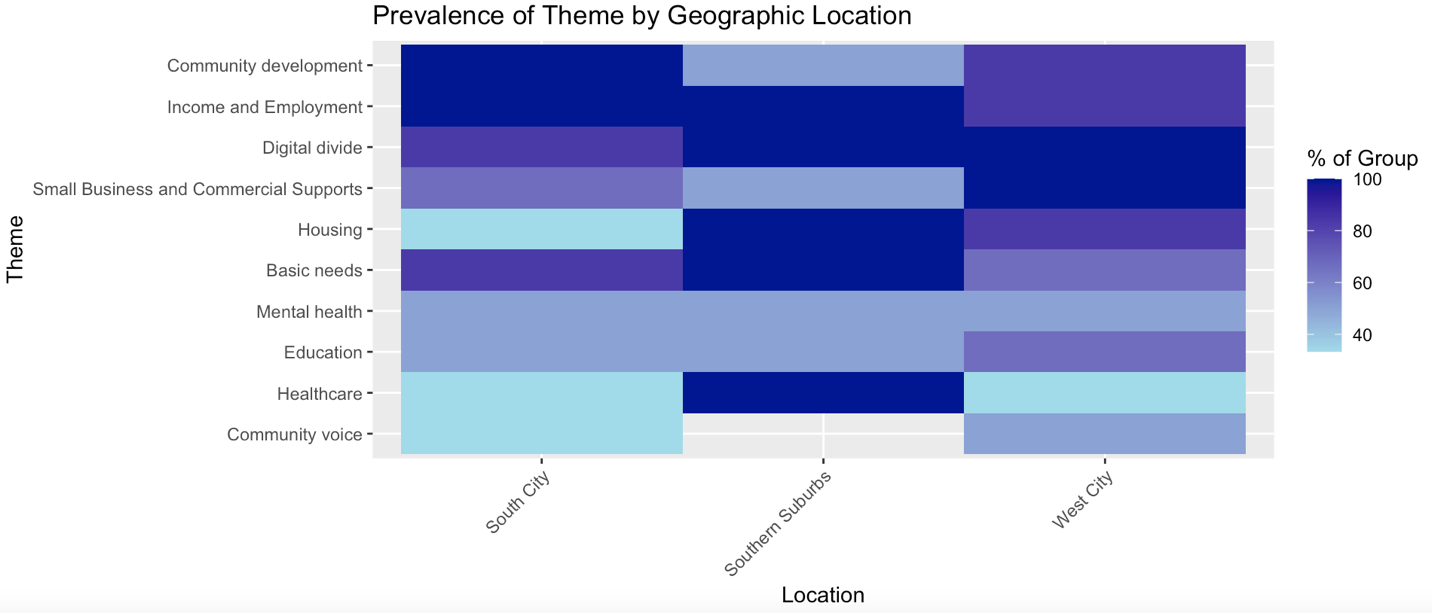
Each interview shed light on the nuances and particular concerns of various communities throughout the Chicago area. However, 10 common themes emerged as the most prominent issues across the interviews. While this document presents each theme as a distinct category, it is important to note that the interviewees discussed these themes as interrelated and dependent ideas. The frequency of these themes by geographic area and by the population represented are displayed below. Themes are presented in this document based on how frequently they came up across interviews.
Community Development
“These areas where the population has been hollowed out by people moving away. It’s even worse now with people dying.” – Mid-south Side Black nonprofit leader
“Arts and culture: that really helps us have a whole community, whole family approach.” -West Side Latinx nonprofit leader
“We can’t have sustainable community development unless it is indigenous. [Without that it] primes us for displacement from our own community.” – West Side Black nonprofit leader
As interviewees imagined what their communities could be, many talked about the need to get rid of negative perceptions of their neighborhoods or towns. They wanted their spaces to feel safe. A few mentioned how important it is to include beauty to help communities thrive and feel good about their cultural heritage. Getting rid of neighborhood stigmas and public apathy was one element. One person described his ideal as including opportunities for community members to co-create spaces to connect with one another; another described their neighborhood getting to a place where residents felt like they belonged.
The other element to realizing the full potential of communities for the interviewees was to make structural or development-related changes. In areas with commercial spaces, like Chicago’s West Side, the structural changes included more art that reflected the people who lived there and made the main corridors more appealing to visit. For neighborhoods and towns on the south side of Chicago or in the south suburbs, interviewees wanted retail spaces to include grocery stores, credit unions, and spaces for small businesses to thrive. At least two participants mentioned that Black communities were already thinned out by people leaving Chicago and that the pandemic and violence were further depleting the population. One interviewee highlighted the importance of environmental hazards in community development and how a development in one part of the city may have significant negative environmental impacts on another, further impacting residents' health and well-being.
Policy Recommendations
- Center the city budget around the needs of working people
- Expand public services, such as school and park programs, to support neighborhoods and invest in middle-class jobs
- Support community-based recovery by distributing money to grassroots initiatives
- Ensure consistent, fast, and affordable internet access
Business Practice Recommendations
- Expand opportunities for low-wage workers to become business owners by investing in worker cooperatives
- Prioritize businesses that reflect residents’ priorities for the community
Community Reform Recommendations
- Invest in capacity development for community leaders
- Increase infrastructure for community connections and information sharing
- Ensure art and artists are valued as elements to create community and increase access to arts within communities
- Ensure access to social services in every community
- Address tensions between Black and Brown communities and the inherent racism in white communities
- Use open spaces (like forest preserves) to promote community health
- Create an ethos of safety and belonging
Income and Employment
“People have resorted to the underground economy. These people are not used to this lifestyle. They are being forced to learn how to make ends meet under duress.”- Mid-south Side Black nonprofit leader
“Workers can’t bring up safety because they get harassed in the company. Companies aren’t paying for sick leave or hazard pay. One company sent people home to quarantine, but they wouldn’t give them either sick or hazard pay.” – South suburban Latinx nonprofit leader
“People are at the end of their resources. People went into the pandemic without resources. They had a number of other jobs like braiding hair or driving Uber that they can’t do during the pandemic.” – Near South Side Black nonprofit leader
Interviewees had a lot to share about income and employment, noting that the pandemic has led to increased unemployment and created or amplified hazardous working conditions in other areas of the workforce. Some of the employment challenges experienced by residents noted by the respondents include: layoffs from jobs, decreased working hours resulting in smaller paychecks, leaving jobs to care for children, and lack of adequate personal protective equipment for essential workers. Job loss is exceptionally high in Black and Latinx communities where people worked in restaurants, hospitality, or entertainment. However, work has increased in fast food or warehousing and delivery. In communities where unemployment or underemployment had been a problem for years, there was a deep-seated concern that the competition for scarce jobs would be even fiercer. For communities with large undocumented populations, the inability to receive stimulus funds further challenged access to income. Harassment has also increased, and undocumented workers are more concerned about losing their jobs if they report it. As the pandemic has shifted the job application process online, it has become harder for individuals with limited computer proficiency, lack of access to computers/tablets, or slow/poor quality internet to learn about and apply for jobs.
Those still working must make difficult choices weighing the amount of risk they are willing to take on by exposing themselves and potentially vulnerable family members to COVID-19 versus receiving less or no pay. The lack of protective equipment was compounded by challenges accessing testing facilities. Slow response times for testing have translated into longer wait times to return to work. One interviewee mentioned workers having to wait up to two weeks to get test results before they could return to work, leading to significant losses in income.
Policy Recommendations
- Provide monthly stimulus payments or increase the amount of stimulus checks
- Make stimulus money accessible to undocumented residents
- Classify warehouse and factory workers as essential to allow access to vaccines sooner
- Relax requirements for receiving relief during the pandemic
- Support or enforce hazard pay to essential workers
- Create job opportunities through public sector growth
Business Practice Recommendations
- Increase entry into construction trades for Black and Latinx people
- Change human resources practices to be more trauma informed, increase opportunities
- Post jobs in accessible languages and in formats that are easily navigated with limited internet bandwidth or skill
- Provide job training programs to support entry into the post-pandemic workforce and the emerging job markets
- Ensure access to personal protective equipment for worker safety
- Consider specific outreach to support women’s reentry to the workforce
Digital Divide
“We have families that are trying to find jobs, but they can’t apply online. They don’t have a way to get online or don’t know how. Some have four or five kids in a house, and there isn’t enough bandwidth. There aren’t enough cellphone towers…There isn’t enough investment.” – Humboldt Park Latinx education leader
“The McDonalds are the new libraries because of the free wi-fi access.” – South suburban nonprofit leader
“We need to rethink education and understand what the pandemic has done. It has forced us back to the screen. A lot of people will have to be skilled up. We will have to work on the digital divide, or the divide will get even wider.” – West Side Black nonprofit leader
The impact of the digital divide on education, work, and accessing support services was a common issue across communities represented in these interviews. Several communities received support in addressing the digital divide early on during the pandemic. Participants acknowledged that school districts and businesses worked to get laptops or Chromebooks into households, specifically referencing the work of child protective services (CPS) to reach out to families. They further noted that internet providers (e.g. Comcast) offered wireless access at reduced rates for low-income neighborhoods.
However, it is clear based on the interviews that additional issues remain in bridging the digital divide. Lack of access to the internet, poor/slow connection, a lack of devices, and lack of computer literacy were issues in most neighborhoods. One interviewee who had worked on this issue noted a substantial need for digital access but found it difficult to connect to the families that needed internet. Gaps in access and computer literacy in adults have led to isolation, an inability to apply for jobs that have transitioned online or to online applications, difficulty requesting help for homelessness services and other support services, and difficulty accessing the vaccine.
The limited bandwidth and quality of internet in communities also impacted the interviewed organizations. Specifically, leaders in communities reported challenges in staying connected to each other and community members, experienced slow internet, and gaps in cellular coverage. A few noted that lack of access to devices made it difficult for them to organize community members and others noted poor internet service had interrupted meetings. One person indicated that bandwidth was poor on the West Side and that cellular coverage was particularly poor crossing from Chicago into the western suburbs. More than one person noted that an additional issue was the number of devices a household needed to allow for everyone in the home to work or attend school remotely. However, addressing this need is complicated by other factors. One interviewee shared that some Chromebooks issued by South suburban schools were ending up in pawn shops because families are so strapped for resources.
Policy Recommendations
- Increase access to household technology
- Ensure consistent and affordable internet access
- Invest in increasing bandwidth
- Provide government oversight and enforcement to ensure government incentives for expanding broadband access actually benefit high need communities
Community Reform Recommendations
- Give nonprofits flexibility to use funding for devices to connect with community members or meet other basic community member needs such as job search
Small Business and Commercial Supports
“I can remember vividly business owners coming in and saying their assets had been frozen because the signature on their SBA loans was on the wrong line or there was something wrong during a stay-at-home order, and they lost days of business. Every day they lost was a mouth they couldn’t feed. Clerical errors were keeping them from staying in business.” – South Side Black nonprofit leader
“We have lots of people who have been running businesses successfully but informally. Many have had to shut down. It’s been harder for them to get funding from the government.” – Humboldt Park Latinx education leader
“There is a lot of fear. I think people are just skimming by. I haven’t seen places close, but people are really behind…I think the real challenge is that they have had to lay people off.” – West Side Latinx nonprofit leader
A few issues emerged from interviewees related to small businesses and commercial development. Most interviewees noted that the pandemic led to numerous small business closures or layoffs. Interviewees indicated that established businesses were better able to weather the pandemic without going out of business permanently. However, there have been job losses as a result of new service delivery approaches. For communities with less established businesses, respondents shared that several new businesses had opened and shut, leaving behind ongoing debt for the owner in addition to the loss of revenue. The Austin neighborhood was touted as a counter-example, where businesses had successfully banded together to keep from closing.
For communities lacking commercial corridors or retail businesses, there was a consensus on the need to leverage empty storefronts, increase access to capital, and diversify types of businesses. One person raised that absent landlords who own businesses are creating problems in the community (e.g. liquor stores). In West Side neighborhoods, a need to retrofit existing structures to be more usable was expressed. One interviewee who does business development work on the Near South Side noted that retail and commercial real estate investment had stopped entirely.
Interviewees saw the lack of investment and current development projects as an opportunity for creativity and support, highlighting the need for government entities and banks to invest in communities. In multiple communities, past lack of investment had already led to the rise of informal businesses and non-traditional economies. The high number of existing creative community responses, such as cooperatives, informal businesses, grab-and-go, and pop-ups, were seen as tremendous assets to leverage into sustainable income with the right support. During the pandemic, participation in bartering and cooperatives has increased. Several interviewees brought up that for these efforts to be sustainable, people need access to capital, either through stable jobs with higher pay or through borrowing and lending options that allow community members to invest in their own new or existing businesses. More than one person brought up the need for creative financing solutions to help young people find capital for cutting edge ideas.
Multiple participants noted that access to the Paycheck Protection Program (PPP) loans was inconsistent at best, with limited funds available at the larger banks for small businesses run by Black and Latinx owners. The many informal businesses in these communities were ineligible. For other businesses, the overwhelming volume of applications made it impossible to fix errors in applications resulting in their applications being rejected and they were unable to access capital.1
Policy Recommendations
- Government-backed access to capital for entrepreneurs, particularly those with limited capital, similar to programs in rural areas
- Assistance for informal businesses that rely on cash or have little documentation
- Access to funds for economic development designated explicitly for Black and Latinx business owners
- Reform policies to make vacant storefronts easily accessible for start-ups and local entrepreneurs
- Make funds available to support the launch or expansion of cooperatives
- Access to initial capital to help businesses access Neighborhood Opportunity Fund (NOF) or other government funding
- Ease burden on accessing tax credits for small businesses
Business Practice Recommendations
- Prioritize investment in grocery stores, credit unions, and commercial strips that include businesses that meet community needs
- Increase presence of community banks and credit unions
- Distribute PPP to these smaller banks
Community Reform Recommendations
- Increased marketing for business to choose particular communities
- Replicate successful business associations from other communities
Meegan Dugan Bassett
Housing
“We have families that haven’t been able to pay rent since March. People haven’t been able to pay their mortgages. Families have maxed out credit cards and taken a hit on their credit. This will take years for them to get out.”- Humboldt Park Latinx education leader
”Some people had to leave their homes with only the things they were carrying because the landlord just didn’t want to work with them.” – Mid-south Side Black nonprofit leader
“…people haven’t been able to pay their rent for 10 months. This is a huge problem for some of the landlords that live in three flats they own. They may not want to kick anyone out, but they are going to run out of money soon. They can’t evict anyone but pretty soon, they won’t be able to cover the place they both live in without help from the government.” – West Side Latinx nonprofit leader
The number one housing issue raised was the impending crisis that looms once the eviction moratorium is lifted. Communities are experiencing huge amounts of debt, and families who can access credit are continuing to rack up debt for basic expenses. While many families are able to pay for food, utilities, and supplies right now because they are deferring the payment of rent or mortgages, interviewees were concerned that an epidemic of homelessness is right around the corner. One concern referenced was the trickle-down effect from renters to landlords and the backlog of payments they may owe on the buildings. Interviewees noted that if small-time landlords lose their buildings, both they and their tenants will be kicked out of their homes. One South suburban interviewee has seen considerable increases in homelessness prevention requests and has run out of the extra state funding from the Coronavirus Aid, Relief, and Economic Security (CARES) Act. But, with a dearth of homeless shelters in the South suburbs, the situation will only get worse after the moratorium.
Across communities, the lack of affordable housing and the amount of income residents paid to stay in communities was a crisis before the start of the pandemic. Differences were noted in those already rent-burdened communities (e.g. Humboldt Park) and the strategies needed for affordable housing to keep the community intact. Respondents working in Near West Side communities reported the lack of affordable housing was forcing people out and fragmenting family and youth connections to communities. One Far South Side respondent noted that housing had been snapped up by scavenger investors three to five years ago, and many seniors had lost their homes to tax sales. Now housing prices are skyrocketing, and this only exacerbates the lack of access to affordable housing.
Policy Recommendations
- Create debt forgiveness programs
- Explore the feasibility of housing funds (e.g. Amazon’s approach to affordable housing)
- Fund new brick and mortar shelters
- Use tax-increment financings (TIFs) and tax credits to make the current housing supply usable
- Increase affordable housing outside of public housing
- Consider measures such as rent control
- Increase housing support resources in the City of Chicago for people at 30 percent and 40 percent of area median income (AMI)
- Utilize a targeted approach by neighborhood
- Develop assistance programs for small landlords
Business Practice Recommendations
- Create partnerships between housing and workforce development
Community Reform Recommendations
- Destigmatize public housing
Basic Needs
“People don’t have access to food. They are getting food from a gas station.” – Far South Side Black community development leader
“We did a mutual aid effort last year, and bread was not available in the neighborhood. People just couldn’t get bread. We had to go out of the neighborhood to get bread.” – Mid-south Side Black nonprofit leader
“People are not making it. The lines for the food giveaways are longer and longer.” – West Side Black nonprofit leader
The overall sentiment was that community members are experiencing an increased need for bare essentials, including access to food, housing and utility assistance, and direct cash assistance. Access to money was directly tied to employment but also represented long-standing issues in accessing capital for some communities. Most interviewees noted that their organizations had pivoted to offer food, personal protective equipment (PPE), cash assistance, digital access, or support finding services. More than one interviewee mentioned that the communities they work in lack grocery stores or food pantries. One interviewee noted that many of the issues families are experiencing in accessing basic needs are exacerbated by the unexpected expense of children being at home during the day, which means schools are not providing meals for those children, utilities are more costly with more people at home, and caregivers may not be able to work in the same way.
It was notable that across the city and county, rates of individuals accessing assistance have remained elevated across the time of the pandemic, with one respondent sharing that residents seeking services had increased 500 percent. One person in the South suburbs also noted that while service demand had risen exponentially, some service providers were too overwhelmed and lacked the infrastructure to access some of the funding made available for the pandemic. They simply didn’t have the staff time to respond. Other nonprofits didn’t have the funding flexibility to provide the emergency help the most vulnerable residents needed desperately. A few of the respondents also shared that they were seeing an increase in residents accessing services for the first time, expanding to include those who had been relatively stable before the pandemic. A South suburban respondent noted that families in their service area owe so much on utilities they will be in dire straits once the moratorium is lifted. One mentioned that fraud was on the rise as a byproduct of people not having access to basic needs and finding themselves in desperate situations.
Policy Recommendations
- Increase accessibility to grocery stores, urban farming, and local food cooperatives
- Eliminate/reduce requirements to receive public assistance
- Incentivize local cooperative efforts
- Support the construction of grocery stores in economic development initiatives
Business Practice Recommendations
- Prioritize the construction of grocery stores
Community Reform Recommendations
- Channel funding through grassroots initiatives
- Provide logistical or infrastructure support to make it easier for nonprofits to distribute funding and aid
Mental Health
"There is a pattern of mortality that can impact actions in a peculiar way. You can see the evidence on your block. You see the people crying on your block." – Mid-south Side Black nonprofit leader
“The senior population has been hit hard. The social isolation has taken a hit on people’s mental health. In Latino culture, connection with family is so important. It has been really hard for families to be separated.”
– Humboldt Park Latinx nonprofit leader
“People have experienced stress, trauma, and I think that word is overused. But I don’t know what else to say in this situation. People have lost their loved ones and haven’t been able to grieve. The loss of life has had a tremendous impact on how people live their lives. There is the constant fear that you could lose your life—either to COVID or local violence.” – Mid-south Side Black nonprofit leader
Stress, trauma, isolation, and instability were at the root of many of the themes that emerged during these conversations. One interviewee described her community's general state by saying coping skills are limited and stress levels are high. Another noted a 58 percent increase in calls to their trauma helpline during the pandemic. These observations align with the descriptions from several other interviewees. Struggles with depression, anxiety, and trauma were reported as making it more difficult for community members to work and care for their families well. Interviewees wanted more social workers and mental health practitioners for their communities. They observed that youth are not receiving the support they once had access to through schools, and employers are often unsympathetic to the additional stresses that the pandemic has caused and are operating in ways that do not acknowledge systemic and generational traumas. A few of the respondents noted the compounding impacts that COVID-19, economic uncertainty, and violence in communities were having on residents' mental health and, in one instance, on the community's population. A few of the respondents noted that families have experienced multiple losses during the pandemic and have not been able to grieve those losses. Multiple respondents expressed their own mental and physical fatigue coping with these factors, their own families, and their ongoing work to address the systemic racism that historically and currently strips resources.
Policy Recommendations
- Increased neighborhood mental health clinics
- More community-based social workers
- Provide school-based supports to facilitate return to school
Business Practice Recommendations
- Trauma-informed business and business practices
Education
“What does it mean for the Latino community when schools open, but [we] have the highest rates of transmission?…The CPS reopening plan hasn’t been grounded in the data about how this would impact the Black and Latino community in particular.” – Humboldt Park Latinx education leader
Youth held a special place in the community for many of the interviewers. There were significant concerns about the pandemic's impacts exacerbating the educational inequities that are already present in their communities. They wanted schools to be a safe place for children in their communities and for education to provide hope for a fulfilling future. Several respondents noted that in-person learning was inadequately providing for some students and that online learning has exacerbated existing issues. Interviewees wanted more funding for their schools and smaller class sizes. In particular, interviewees wanted education to lead to skilled work opportunities, but don’t think this is currently happening. Many respondents noted barriers to participating in schooling due to the digital divide, competing work demands, and mental health issues impacting students and caregivers. It also was pointed out that caregivers, in some cases, are unable to support their children with schoolwork due to limitations in their own educational experiences. More than one person noted that Black and Latinx families were concerned about the risks of schoolchildren bringing the virus home to vulnerable older family members, as well as the risks of the virus to uninsured family members with limited healthcare access. One interviewee also noted higher education hasn’t always been a panacea. He stressed that Generation X is swimming in college debt, but there hasn’t been a commitment to hiring Black people with degrees. This debt also plays a role in people’s ability to survive right now.
Policy Recommendations
- Increase and continue culturally relevant social and emotional supports for students
- More funding for schools (a few respondents suggesting diverting funding from entities like police)
- Design and implement a curriculum that is culturally relevant and relatable
- Provide additional academic and technological supports for remote learning
- Offer smaller class sizes
- Ensure connection of curriculum to workforce opportunities
Community Voice
“We need a comprehensive vision and community plan that comes from the ground up. The Madison corridor was thriving, but it has never been revitalized. There hasn’t been a long-term and comprehensive commitment over multiple mayors.” – West Side Black nonprofit leader
“The true role of community is to be a co-designer as all the resources are designed to impact us…There is investment in the community. However, it is ‘misinvestment’ because the resource deployment is dictated by those that don’t live in the community.” – Far West Side Black nonprofit leader
The idea of community voice came up for a handful of interviewees, particularly when asked to dream about what an equitable recovery would actually look like. For these interviewees, the communities they lived and worked in would only be able to thrive once they had a seat at the decision-making table. One interviewee remarked that community members’ distrust of outside organizations would hamper any efforts to assist the community he belonged to in a recovery. Too many organizations had entered his community with the intent to help, only to prove their missions did not align with the community’s real needs. For him, it was imperative that community members be a part of the solution; he drove this point home with the slogan, “nothing about us without us.” A Black respondent and a Latinx respondent raised the same sentiment. Across respondents, there was a shared priority on communities driving the ways that they “build back better.” For instance, it was suggested that the new initiative, We Rise Together, fund local collaboratives across the city to manage the distribution of the grant funds at a local level rather than through a centralized process.
Policy Recommendations
- Citywide infrastructure for engaging community members in decisions
Community Reform Recommendations
- Build stronger connections to aldermen
- Engaging community members in designing philanthropic investments, instead of foisting them upon communities
Healthcare/COVID-19
“There’s lots of misinformation, disinformation around COVID and the vaccine. There’s a lot of distrust when it comes to the Black community and health care. All of that is kind of inherited by the young people.” – West Side Black nonprofit leader
“People in our community need to work to get paid. But they’re worried about family getting sick. There are often three generations under one roof. That’s living dangerously when it comes to COVID. But, they’re not going to put seniors in assisted living. Families are not going to quarantine outside of the home.” – Near South Side Latinx business development leader
For COVID-19 specifically, several communities are simultaneously experiencing a deep fear of contracting COVID-19 while also being very skeptical of the information they are receiving about the virus. There is a lot of distrust around the vaccine. Community members question if there has been enough research or enough time to see the vaccine's adverse effects. Some community members believe the vaccine will be used to harm Black and Brown people. This distrust of information about COVID-19 is rooted in a general distrust of health systems. Interviewees from all parts of the Chicago area also felt that healthcare needed to be more accessible in their communities. Of the people that specified what accessible meant, one person expressed healthcare should be less fragmented and more coordinated. For another person, it meant healthcare should be affordable.
Policy Recommendations
- Increase affordable healthcare options
Business Practice Recommendations
- Coordinate systems of care in underserved neighborhoods
Community Reform Recommendations
- Invest in community-driven message campaigns created by communities with trusted community leaders
Citations
- One successful approach to ensuring the small business were able to access PPP loans was the partnership of a nonprofit with a local bank to review business owners' applications in the community before their submission, address any issues, and then assist them in submitting the application. While the upfront time for submissions took longer, business owners were able to access loans more effectively.