
Table of Contents
I. What Is Thinking and Working Politically?
Thinking and working politically (TWP) is an approach that emphasizes understanding and engaging with the political context when designing and implementing development interventions. It recognizes that politics and power (sociocultural, economic, institutional) play a crucial role in shaping the success or failure of development initiatives. TWP involves analyzing power structures, incentives, and the interests of key stakeholders in each context to inform strategies and decision-making. TWP encourages development practitioners to adapt their programs to the political realities on the ground, fostering collaboration and building relationships with key actors to address systemic issues. The aim is to create more effective and sustainable development outcomes by navigating and leveraging the political dynamics within a given environment.
TWP is not a specific methodology but rather the practice of cultivating awareness of the political environment and the spheres of power in which development programming occurs. TWP requires an understanding of the incentives and interests of key institutional actors and decision makers at all levels in the exercise of power, from national to regional to local. This is not unique to the land sector; in fact, much of development programming mitigates contested issues like resource allocation and behavioral change, which are central to politics and power relations.
TWP recognizes that in most countries receiving development assistance, power is asymmetrical and skewed. Reforms are contested, legal and policy implementation is uneven, and grievances about winners and losers persist. Technically sound project activities sometimes threaten vested interests. Political fault lines are not glitches but common features of the working environment that require consistent attention and adaptive responses.1
TWP incorporates and builds on the insights of political economy analysis, or PEA, which “aims to situate development interventions within an understanding of…the incentives, relationships, and distribution and contestation of power between different groups and individuals [to] support more politically feasible and therefore more effective development strategies.”2
Lessons learned from PEA suggest that politically informed approaches “help the development practitioner to more readily identify key actors and their incentives, relationships, and their capacity for collective action,” and thereby “help prevent errors of omission in program design.”3
TWP arose from the study of past development project failures, and is itself an adaptive response.4 The analytic adjustments of TWP represent a qualitative shift in development thinking. Some past pitfalls that TWP seeks to avoid include:
- Relying on technical improvements or filling resource gaps as adequate solutions;
- Normative blueprints and dominant external expertise;
- Limited attention to risk and uncertainty;
- Conflating stakeholders with power holders in government, civil society, and the private sector;
- Unrealistically short project timelines; and
- Indicators focused on quantifiable outputs, with inattention to processes and relationships.
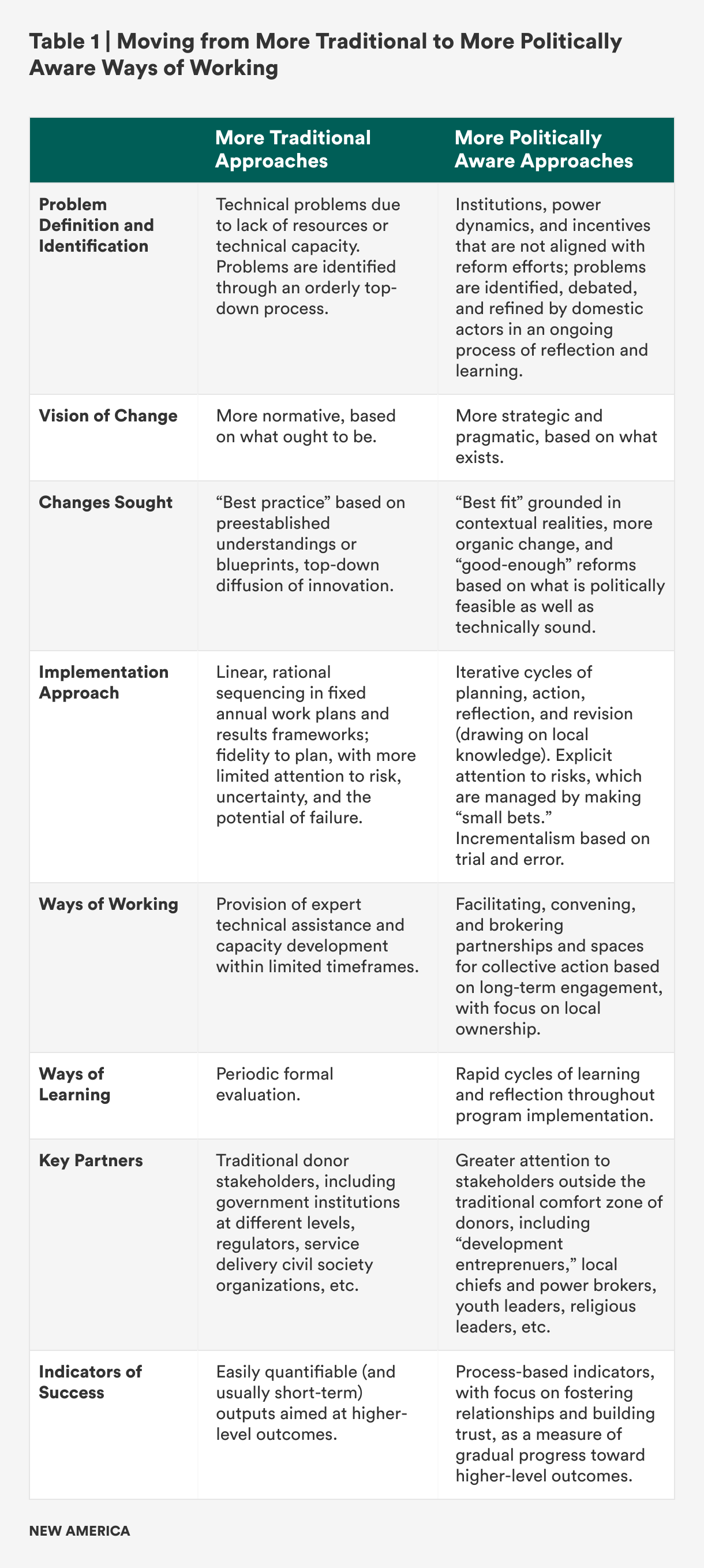
Table 1 below contrasts traditional methods and methods with increased political awareness as ways of working on program activities, from problem identification to program design, implementation, and evaluation. TWP points toward an orientation that seeks to include:
- Local definition of problems;
- Awareness and understanding of misalignments of power vis-à-vis desired reforms;
- Working within assessed political feasibility;
- Adaptive processes that improve implementation through frequent opportunities for reflection and learning;
- Convening, brokering, and facilitating alliances and coalitions for reform;
- Empowering previously excluded stakeholders; and
- Recognizing qualitative indicators of success like processes, relationships, and trust.5
The Relationship Between Thinking and Working Politically and Political Economy Analysis
Political economy analysis (PEA) and thinking and working politically (TWP) can work together and share common analytic lenses, but these frameworks have different functions and time frames. For example, USAID’s “Applied PEA” was a structured methodology to understand the power dynamics and the social, economic, and political factors and actors influencing program activities.6 The findings of PEAs are close-up snapshots of the current political landscape and inform TWP.
However, if PEAs are a snapshot, TWP is more like a movie, showing everyday political awareness with respect to ongoing program activities and their ever-changing political context. PEA is a methodology; TWP is a mindset and the actions that flow from that outlook.
TWP requires that development practitioners confront politics by virtue of designing and implementing program activities. Indeed, an examination of documents like quarterly reports of land tenure programs makes clear that implementing partners and donors are regularly devoting time and effort to navigating political issues, large and small. TWP addresses the concrete—how to incorporate political understanding into the ongoing stream of program design and implementation, emphasizing iterative learning, flexible adaptation, and a commitment to continuous adjustment based on changing political circumstances.
TWP does not engage politics in an intrusive manner, but rather recognizes and is sensitive to the inherent intersections of land programming with the political interests and values of those affected. TWP highlights and clarifies the political setting influencing program activities and equips project implementers to be more politically astute in their everyday work.
Citations
- USAID Office of Forestry and Biodiversity, “Thinking and Working Politically: Linkages and Lessons from Biodiversity Conservation,” USAID, 2020.
- Claire Mcloughlin, Political Economy Analysis: Topic Guide, 2nd ed., (GSDRC, University of Birmingham), source.
- USAID, “A Summary of Lessons Learned Using USAID’s Applied Political Economy Analysis Framework,” USAID, 6.
- See, for example, Thomas Carothers and Diane DeGramont, Development Aid Confronts Politics (Carnegie Endowment for International Peace, 2013), source.
- Alina Rocha Menocal et al., Thinking and Working Politically Through Applied Political Economy Analysis: A Guide for Practitioners (USAID’s Center of Excellence on Democracy, Human Rights, and Governance, 2022).
- See also “Implementation Tips for USAID Partners,” NGO Connect, 2020, source.