Thinking and Working Politically on Land Tenure
Abstract
Insecure land and resource tenure is widespread in the developing world, creating risks with far-reaching social, environmental, and economic consequences. Conflict over land and resources is already a significant driver of instability and violence. In the coming decades, the twin forces of demographic and climate change will exacerbate these challenges and precipitate a land crunch that researchers predict will be “one of the defining environmental challenges of modern times.”
This report draws on decades of experience from USAID and other development agencies to provide practitioners with strategies for strengthening and securing land and property rights. Together, these approaches are referred to as “thinking and working politically,” or TWP. Informed by interviews with land tenure specialists, the report synthesizes a diverse set of approaches to TWP on land and offers real-world case studies of successful reform efforts.
Downloads
Preface
Insecure land and resource tenure is widespread in the developing world, creating risks with far-reaching social, environmental, and economic consequences. Conflict over land and resources is already a significant driver of instability and violence. In the coming decades, the twin forces of climate change and population growth will exacerbate these challenges and precipitate a land crunch that researchers predict will be “one of the defining environmental challenges of modern times.”1
Robust, inclusive, and sustainable governance of land and natural resources is key to meeting these challenges and ensuring that the planet’s growing population not only survives, but thrives. Since its founding in 1961, the United States Agency for International Development (USAID) invested more than a billion dollars to strengthen land tenure and resource governance in its assistance around the world.
The cruel and shortsighted dismantling of USAID by the Trump administration in the spring of 2025 put a halt to USAID’s land tenure work, and thousands of other lifesaving USAID programs. A study published by medical journal The Lancet in July 2025 found that USAID saved 30 million lives in the last two decades, and that the dismantling of the agency will result in 14 million preventable deaths by 2030.2
Alongside the elimination of USAID’s programs, the Trump administration destroyed a vast trove of research, evaluations, and other knowledge resources that had been used by millions of people globally to design life-saving and opportunity-creating programs. USAID’s Integrated Natural Resources Management (INRM) program is one victim of this digital purge. New America was one of the implementers of INRM.
This report is a single crucial piece of knowledge—out of 250 resources within INRM and many thousands across USAID—that former USAID staff and contractors have managed to salvage. We cherish the chance to share this knowledge with the world, and grieve the loss of thousands of equally important pieces of work that will stay buried.
Citations
- Richard King et al., The Emerging Global Crisis of Land Use (Chatham House, 2023), source.
- Daniella Medeiros et al., “Evaluating the Impact of Two Decades of USAID Interventions and Projecting the Effects of Defunding on Mortality up to 2030: A Retrospective Impact Evaluation and Forecasting Analysis,” The Lancet, 2025. source.
Executive Summary
International development agencies globally have maintained a longstanding commitment to securing the land and property rights of people and communities. However, land tenure work is often politically fraught and challenging to undertake.
As a finite resource that constitutes a substantial part of both national and household wealth, land is, and always has been, inherently political. Politics encompass land governance and the exercise of power and the decision-making processes that affect the distribution of status and resources. Land control has long been the basis of political power, and differentiated access has always contributed to disparities between wealthy and less wealthy individuals. For instance, recent studies have found that 16 percent of the world’s farms operate 88 percent of the total farmland in production, and that land concentration has increased across major developing countries over the past 40 years.1
Because the allocation of land is critical to social, economic, and political health, corruption and elite capture are endemic in government-led land administration. Women, minorities, Indigenous peoples, youth, and other vulnerable groups especially suffer from unequal ownership, access, and control over land, and land continues to be used by the powerful as a tool for political control, patronage, and speculation. Often, despite all assurances to the contrary, national leaders refuse to change the status quo of land ownership and access.
However, development practitioners have developed strategies and approaches for navigating local political, social, and institutional realities to make progress on land tenure. These strategies and approaches reflect much of what has been called “thinking and working politically,” or TWP.
TWP on land begins with understanding the ecosystem of stakeholders who govern, control, and interact with land. They include national and local-level policymakers, judges and administrators, land service professionals, civil society organizations, banks and businesses, customary authorities, and, of course, household and community-level landowners and land users. Each of these stakeholders has their own motivations, interests, concerns, and constraints related to land use and allocation, which vary depending on national and cultural context, shifting national and local dynamics, and even personalities and interpersonal relationships. That said, there are several dynamics commonly seen within these stakeholder groups to be aware of, which are described in detail in this report.
TWP on land also requires an understanding of scenarios, events, and trends that tend to change the status quo of land-related politics. These forces may cause new stakeholders to enter the picture, or change the motivations and constraints of existing stakeholders, and can trigger land-related competition, conflict, or corruption, or can positively open moments of political opportunity for land reform. These land-related trends and shifts include sudden changes in land value, legal or policy changes that shift who owns or accesses land, population movement that results in increased demand for land, changes in land-related administrative decision-making, and mass land demarcation and registration.
TWP on land requires developing tools and strategies for adroitly engaging land-related stakeholders and responding to land-related shifts and trends.
During program design, TWP on land strategies include: conducting situational analysis with an explicit focus on land, initiating stakeholder engagement, recognizing and taking advantage of windows of opportunity, creating space for a diversity of voices in program design, testing and starting with a small program to build momentum, and making the case that secure land rights are foundational for other development objectives.
During program implementation, TWP on land strategies include: cultivating trusted local contacts at different levels of government and in civil society, getting out in the field to learn about local realities, unpacking the politics of commonly used terms, being cognizant of existing and emerging political risks, and continuously networking to maintain and grow stakeholder engagement.
During the program evaluation process, TWP on land is demonstrated through scheduling learning and adaptive management opportunities to pause and reflect, as well as providing openings for evaluation and learning at multiple points during and after an activity.
Citations
- Sarah K. Lowder, Marco V. Sánchez, and Raffaele Bertini, “Which Farms Feed the World and Has Farmland Become More Concentrated?,” World Development 142 (2021), source.
Introduction and Background
As a finite resource that constitutes a substantial part of both national and household wealth, land is and always has been inherently political. Control over land has long been the basis of political power, and competition over land and resources a driving force of both global and local politics. In some instances, these complex social and political realities may seem so daunting as to lead to a temptation to avoid engagement. However, over the last half century development cooperation agencies have developed strategies and approaches for navigating local political, social and institutional realities to make progress on land tenure. These strategies and approaches reflect much of what has been called “thinking and working politically” (TWP).
Utilizing TWP can play a pivotal role in fortifying the design and implementation of comprehensive land tenure governance programs and projects, in combination with Political Economy Analysis (PEA). These kinds of approaches rooted in political economy contribute significantly to land tenure programming. Despite the extensive experience of land tenure specialists employing TWP approaches for decades, there remains a notable scarcity of explicitly outlined approaches and tools detailing how to integrate critical political analysis into land tenure programming.
This practical document aims to fill this gap by bringing together various approaches to TWP on land, and providing examples of how and where these approaches work. It was developed through interviews with land tenure specialists, as well as the personal experiences of the authors based on decades of designing and implementing land tenure programs.
The outline of this report is as follows. Section I defines TWP. Section II elucidates why working on land tenure issues is so inherently political and identifies common land tenure stakeholders and political considerations. Section III provides tools and best practices for TWP on Land, based on the experiences of development cooperation agencies and implementing partners. Section IV highlights case studies from USAID describing how the TWP approach has led to instrumental programming. We end the report with conclusions and future considerations.
I. What Is Thinking and Working Politically?
Thinking and working politically (TWP) is an approach that emphasizes understanding and engaging with the political context when designing and implementing development interventions. It recognizes that politics and power (sociocultural, economic, institutional) play a crucial role in shaping the success or failure of development initiatives. TWP involves analyzing power structures, incentives, and the interests of key stakeholders in each context to inform strategies and decision-making. TWP encourages development practitioners to adapt their programs to the political realities on the ground, fostering collaboration and building relationships with key actors to address systemic issues. The aim is to create more effective and sustainable development outcomes by navigating and leveraging the political dynamics within a given environment.
TWP is not a specific methodology but rather the practice of cultivating awareness of the political environment and the spheres of power in which development programming occurs. TWP requires an understanding of the incentives and interests of key institutional actors and decision makers at all levels in the exercise of power, from national to regional to local. This is not unique to the land sector; in fact, much of development programming mitigates contested issues like resource allocation and behavioral change, which are central to politics and power relations.
TWP recognizes that in most countries receiving development assistance, power is asymmetrical and skewed. Reforms are contested, legal and policy implementation is uneven, and grievances about winners and losers persist. Technically sound project activities sometimes threaten vested interests. Political fault lines are not glitches but common features of the working environment that require consistent attention and adaptive responses.1
TWP incorporates and builds on the insights of political economy analysis, or PEA, which “aims to situate development interventions within an understanding of…the incentives, relationships, and distribution and contestation of power between different groups and individuals [to] support more politically feasible and therefore more effective development strategies.”2
Lessons learned from PEA suggest that politically informed approaches “help the development practitioner to more readily identify key actors and their incentives, relationships, and their capacity for collective action,” and thereby “help prevent errors of omission in program design.”3
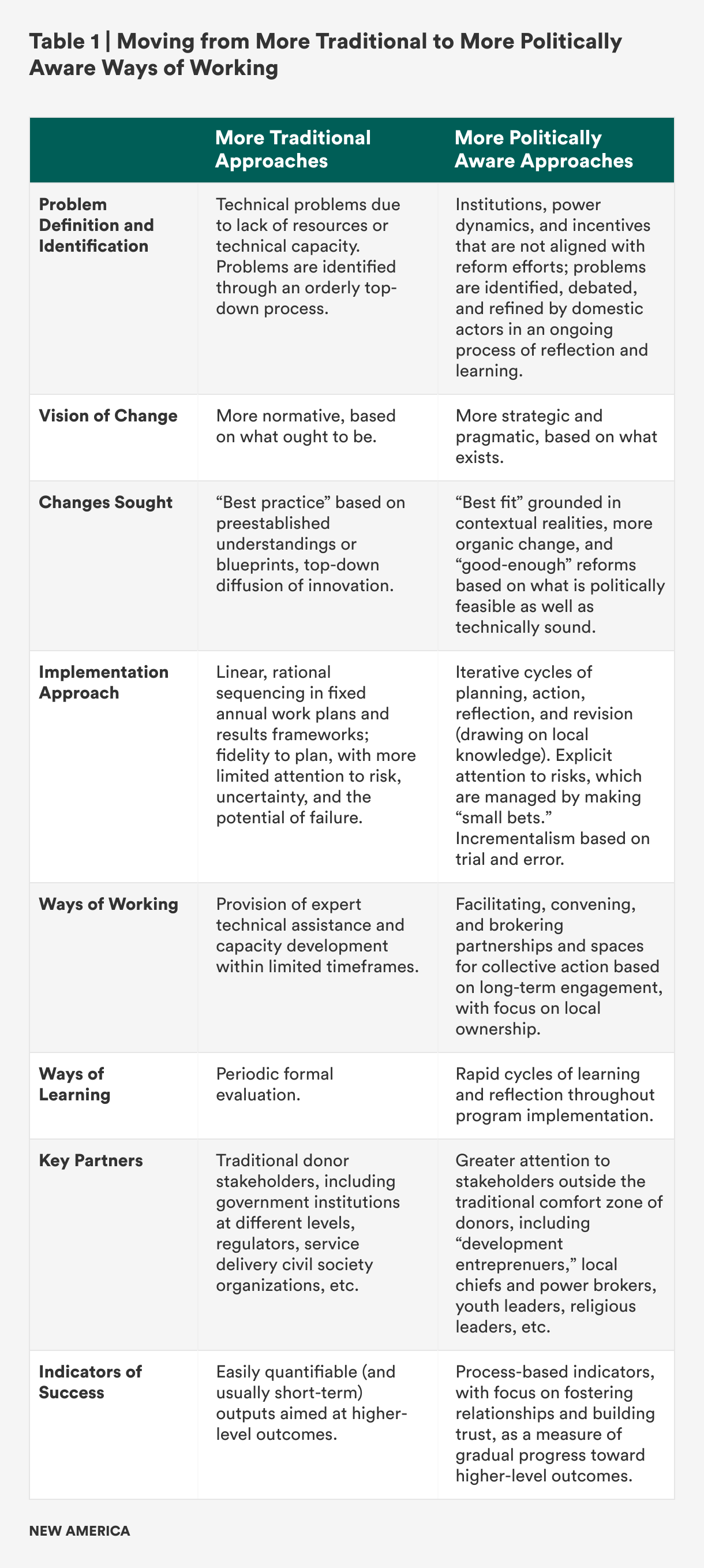
TWP arose from the study of past development project failures, and is itself an adaptive response.4 The analytic adjustments of TWP represent a qualitative shift in development thinking. Some past pitfalls that TWP seeks to avoid include:
- Relying on technical improvements or filling resource gaps as adequate solutions;
- Normative blueprints and dominant external expertise;
- Limited attention to risk and uncertainty;
- Conflating stakeholders with power holders in government, civil society, and the private sector;
- Unrealistically short project timelines; and
- Indicators focused on quantifiable outputs, with inattention to processes and relationships.
Table 1 below contrasts traditional methods and methods with increased political awareness as ways of working on program activities, from problem identification to program design, implementation, and evaluation. TWP points toward an orientation that seeks to include:
- Local definition of problems;
- Awareness and understanding of misalignments of power vis-à-vis desired reforms;
- Working within assessed political feasibility;
- Adaptive processes that improve implementation through frequent opportunities for reflection and learning;
- Convening, brokering, and facilitating alliances and coalitions for reform;
- Empowering previously excluded stakeholders; and
- Recognizing qualitative indicators of success like processes, relationships, and trust.5
The Relationship Between Thinking and Working Politically and Political Economy Analysis
Political economy analysis (PEA) and thinking and working politically (TWP) can work together and share common analytic lenses, but these frameworks have different functions and time frames. For example, USAID’s “Applied PEA” was a structured methodology to understand the power dynamics and the social, economic, and political factors and actors influencing program activities.6 The findings of PEAs are close-up snapshots of the current political landscape and inform TWP.
However, if PEAs are a snapshot, TWP is more like a movie, showing everyday political awareness with respect to ongoing program activities and their ever-changing political context. PEA is a methodology; TWP is a mindset and the actions that flow from that outlook.
TWP requires that development practitioners confront politics by virtue of designing and implementing program activities. Indeed, an examination of documents like quarterly reports of land tenure programs makes clear that implementing partners and donors are regularly devoting time and effort to navigating political issues, large and small. TWP addresses the concrete—how to incorporate political understanding into the ongoing stream of program design and implementation, emphasizing iterative learning, flexible adaptation, and a commitment to continuous adjustment based on changing political circumstances.
TWP does not engage politics in an intrusive manner, but rather recognizes and is sensitive to the inherent intersections of land programming with the political interests and values of those affected. TWP highlights and clarifies the political setting influencing program activities and equips project implementers to be more politically astute in their everyday work.
Citations
- USAID Office of Forestry and Biodiversity, “Thinking and Working Politically: Linkages and Lessons from Biodiversity Conservation,” USAID, 2020.
- Claire Mcloughlin, Political Economy Analysis: Topic Guide, 2nd ed., (GSDRC, University of Birmingham), source.
- USAID, “A Summary of Lessons Learned Using USAID’s Applied Political Economy Analysis Framework,” USAID, 6.
- See, for example, Thomas Carothers and Diane DeGramont, Development Aid Confronts Politics (Carnegie Endowment for International Peace, 2013), source.
- Alina Rocha Menocal et al., Thinking and Working Politically Through Applied Political Economy Analysis: A Guide for Practitioners (USAID’s Center of Excellence on Democracy, Human Rights, and Governance, 2022).
- See also “Implementation Tips for USAID Partners,” NGO Connect, 2020, source.
II. The Politics of Land
Land and land-based resources like soil, water, minerals, forests, and fossil fuels are finite and constitute a substantial part of both household and national wealth. The land that individuals use in a myriad of ways, such as building homes or businesses, is foundational to their survival. The minerals beneath that land and the vegetation that grow from it provide critical resources that fuel modern society and increasingly have the power to curb climate change and fuel the green energy transition. And yet, because land and resources are finite, anything that impacts the distribution of these resources will necessarily generate winners and losers, both in reality and in perception.
For all these reasons, control over land has long been the foundation of political power and contributes to differences between wealthy and less wealthy individuals. Recent studies have found that 16 percent of the world’s farms manage 88 percent of the total farmland in production, and that land concentration has increased across major developing countries over the past 40 years.1 Women, minorities, Indigenous peoples, youth, and other vulnerable groups especially suffer from unequal ownership, access, and control over land, and land continues to be used by the powerful as a tool for political control, patronage, and speculation.
Because the allocation of land is critical to social, economic, and political health, scholars Frank F.K. Byamugisha and Nancy Dubosse observe that corruption, elite capture, and inefficient allocation are endemic in government-led land administration. Byamugisha and Dubosse go on to note:
“Government is the custodian of the most critical (and limited) factor of production, namely, land. Assuring the security of tenure, arbitrating disputes, and facilitating the transfer or sales of titles renders the land market more efficient and less volatile, attracting investors and promoting sustainable urban development. Yet, one of the most underperforming parts of public administration in developing countries is land administration. This is borne out by the observed land conflicts, squatting in undesignated urban areas, non-compliance to land use planning and construction regulations, and lack of investment in housing and farms across the world.”2
Different world views on the purpose and importance of land contribute to these tensions. From the viewpoint of Indigenous peoples, for example, land, water, and other resources are each linked to deep cultural values and social relationships. Land is often viewed as sacred, and people are regarded as the custodians of the land for present and future generations, rather than owners. Conversely, in Western cultures, land is often seen as a productive asset and commodity, though individuals may harbor deep emotive attachments to it.
Land Politics in Fragile States
One of the principal challenges for land policies, law, and administrative structures is that many countries are marked by state fragility. Fragility refers to the difficulties that states face because of some combination of low legitimacy, ineffective governance, weak institutions, poor social cohesion, and vulnerability to instability, insecurity, and conflict. These problems often intersect with other well-known challenges such as corruption, factionalized elites, and longstanding group grievances. Many fragile states are also in vulnerable ecological zones or parts of the world at acute risk for climate impacts and loss of biodiversity.
In these fragile states, well-elaborated land policies and legislation may collide with the reality that there are few functioning governance structures and limited financial resources to implement and enforce these policies. In areas of high instability in the Sahel, for example, land offices providing opportunities for formalizing customary rights through land titles and certificates are no longer available because government functionaries have had to flee to safety elsewhere. The costs of land administration in financially strapped countries are often passed on to citizens seeking to formalize their rights. Depending on the level of a state’s fragility, the land intervention toolbox may be limited to recognizing locally led efforts to negotiate land use and access and stemming active displacement or other forms of harm.
Land Tenure Stakeholders, Interests, and Motivations
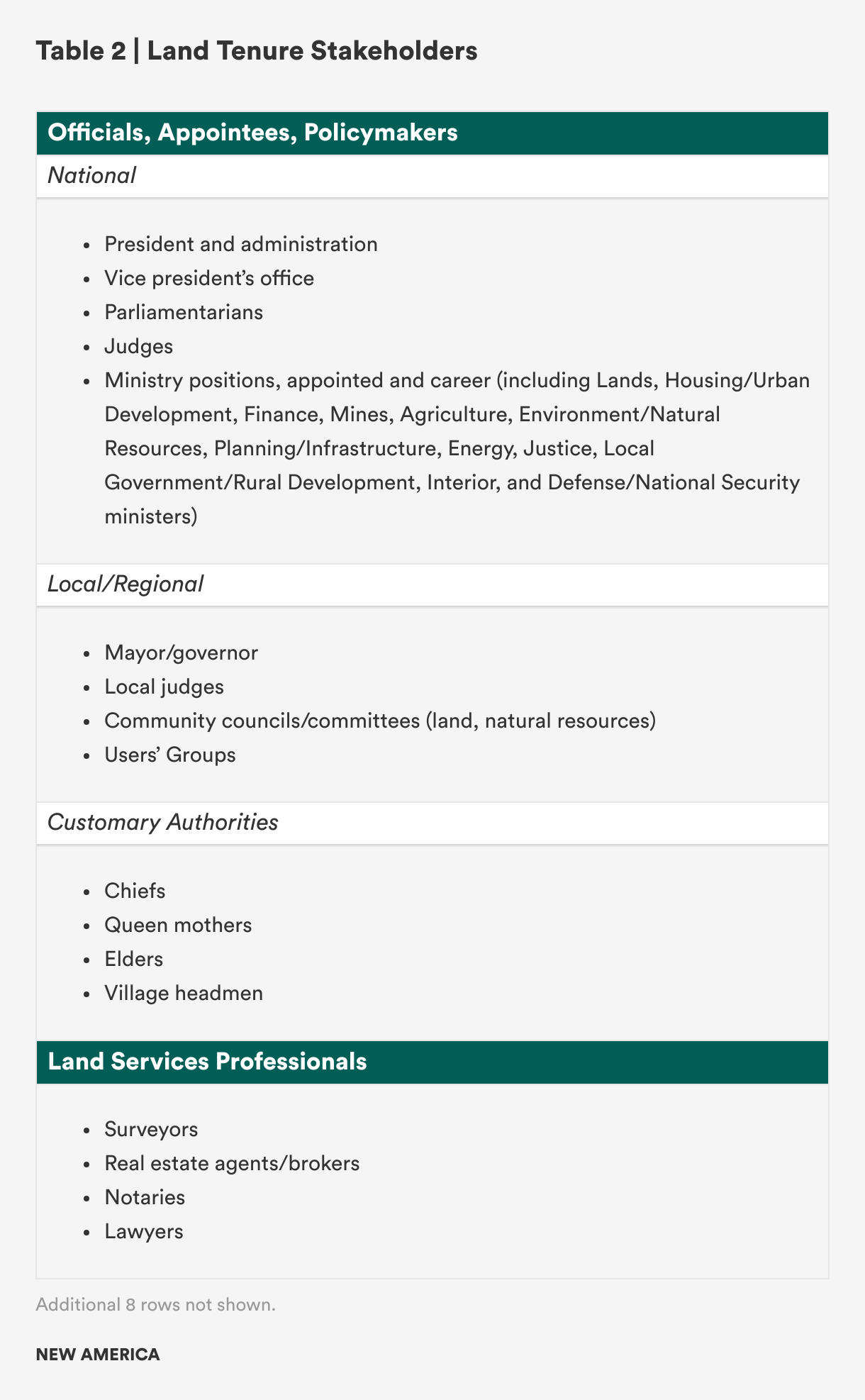
Land is governed, controlled, and interacted within an ecosystem of stakeholders who each have their own motivations, interests, concerns, and constraints (see Figure 1). Learning how stakeholder groups interact with land by engaging in stakeholder analysis—including other stakeholders who may not be captured in Table 2—is key to TWP on Land.
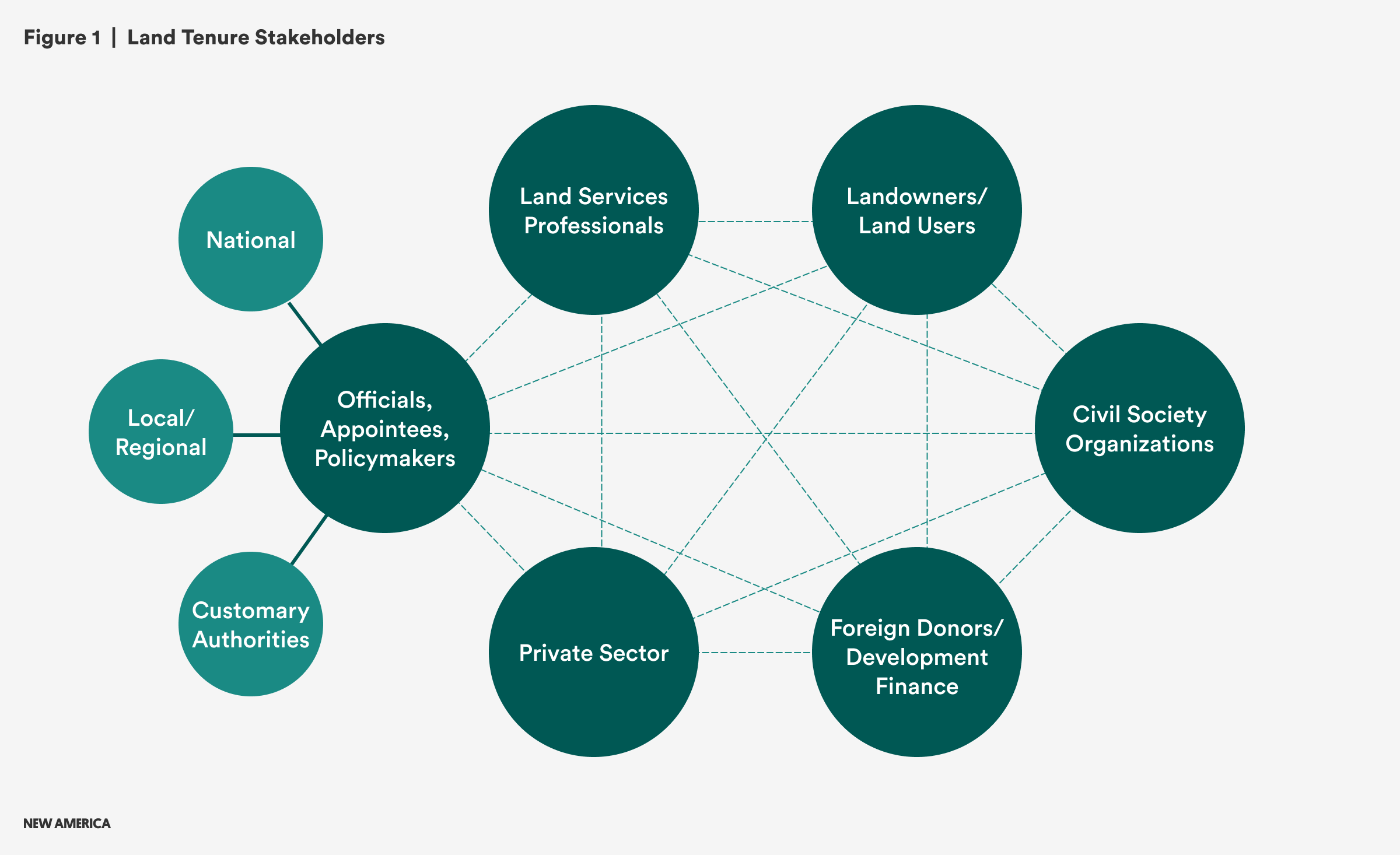
The motivations of stakeholders with vested interests in land governance can be very diverse. They vary over time depending on national and cultural context, shifting national and local dynamics, and the personalities and interpersonal relationships among the people who embody the stakeholder types above.
That said, there are several dynamics commonly seen within these stakeholder groups to be aware of at the outset of a land-related engagement. These dynamics are described in illustrative examples below.
National-Level Policymakers, Officials, and Appointees
Table 2 above identifies the principal elected or appointed officials at the national and local levels who engage directly or indirectly on land issues. At the national level, especially through the executive functions of government, land tenure, use, and administration are linked to higher-level development goals.
For most countries, economic growth is the first among equals of development priorities. Many countries set their visions for economic growth and national development through sweeping strategies that can carry significant political weight. This can be seen, for example, in countries like Nigeria (Vision 20:2020), Tanzania (Vision 2025), Kenya (Vision 2030), Uganda (Vision 2040), and Rwanda (2050), as well as in many other countries’ high-level strategies with similar purposes. Policies, programs, and plans for exploiting land-based natural resources and clarifying and formalizing land rights are often key components of these strategies. Identifying who owns the land is key to negotiating benefit distribution, as well as compensation for land takings. For this reason, governments are often interested in issuing deeds, titles, and certificates to clarify and confirm ownership.
National development strategies, however, may also reflect or mask deeper political crosscurrents relevant to thinking and working politically (TWP). For example, the prioritization by power holders of certain types of economic investments—like the extraction of minerals, timber, and promotion of industrial agriculture—often rests on a country’s relationship to the global economy and the incentives for political leaders to distribute resource revenues as a means to retain domestic political support. The imperative for growth and pressure to achieve national development strategies are often used by elected officials and government administrators as a guide and rationale for their actions on land, even when those actions may appear to be contrary to the interests and legal rights of large rural populations working in traditional agriculture or other locally based economic activities. The use of TWP can help to better understand the drivers of these contradictions.
The Influence and Interests of Ministries
Ministries responsible for land management and resource use are frequently caught in political crosscurrents. Oftentimes, these middle-level ministries need to be both upwardly accountable to central authorities concerned with national development strategies and the needs of their political supporters, and downwardly accountable to local government counterparts and local communities. These obligations are rarely symmetrical. Central authorities and local stakeholders equally have interests, but central authorities have the lion’s share of the power (and control over revenue). Repeated efforts at decentralization in resource management in many countries have shown some progress in ameliorating this imbalance, but the evidence to date indicates that decentralization is often incomplete, poorly implemented, and subject to reversals.3 The recurrent interplay between top-down decision-making and unresolved grievances about land inequality is one of the main dynamics for TWP on land.
Although many different ministries have mandates that bring them into contact with land issues, there are obvious differences in the intensity and nature of each institution’s interests and the level of political influence (and autonomy) held within the national government. For example, while land ministries and housing/urban development agencies are directly engaged in matters involving land demarcation, registration, and clarification and the formalization of land rights, they typically have comparatively low levels of political influence. Conversely, while the broad mandates of finance and planning ministries may result in comparatively weak institutional interest in most land-related issues (infrastructure development and taxation issues might be exceptions), their political clout within the national government is often substantial. From a strictly institutional point of view, a ministry of justice, whatever its larger political influence, may be principally interested in reducing longstanding backlogs of land-related court cases. The levels of institutional interest and political influence in ministries like environment, agriculture, local government, mining, and energy—who clearly have concerns related to land but are attuned to different core agendas—will also vary in accordance with specific national contexts.
Understanding these inter-ministerial power relationships, however, is an essential step in the everyday practice of TWP. Weaker bureaucracies like land ministries may look for shared interests with other ministries (and for champions among elected officials) to increase their political capital and budgets and achieve their institutional goals. They may also jump at opportunities to join sweeping national agendas and vision strategies. Finance ministries may lend support to land tenure advocates when convinced that land-related legal, tax, and regulatory reforms are likely to help to achieve their growth and budgetary objectives. A narrow focus on the technical aspects of land programming, without appreciation of these kinds of shifting political dynamics, can lead to unanticipated bottlenecks that negatively affect program outcomes.
Local/Regional Government and Customary Land Authorities
The legal, cultural, and power dynamics between customary and statutory government leaders (both at the local and national levels) are complex and dynamic. Understanding and tracking these shifting sands is crucially important to TWP on land. For this reason, development agencies need to rely on local experts to interpret these dynamics, instead of relying solely on foreign land tenure experts.
Local government officials working in everyday land administration in rural areas often operate in the context of community grievances, limited budgets, and low salaries. At the district level, local officials may feel motivated, obliged, or even justified to engage in petty corruption. This can take the form of bribes for land administrative services such as registration, titling, and land use plans, or preferential treatment for certain vendors or consultants who may be politically connected or otherwise advantageous to have as allies. Opaque and baroque administrative procedures can make seemingly straightforward land transactions complex and expensive. This tendency simultaneously creates a need and an opportunity for rent seeking (e.g., the payment of “expediting fees”) for those who can afford to pay, while excluding those who cannot. Yet, this further undermines the credibility and adherence to land laws and the vulnerability of land transactions to political and financial manipulation.
At the local level, land is often subject to the politics and power dynamics of legal pluralism. The coexistence of customary, religious, and statutory land laws is common in Africa and in parts of Asia and Latin America. Beyond the technical aspects of attempting to bridge or harmonize these different legal regimes and practices, there are often fundamental divergences in the understandings of stakeholders around land ownership, access, and use, as well as in the punitive or restorative aims of dispute resolution. Customary land laws may reflect notions of equity and justice that are more encompassing than statutory provisions on land management, and equally or more compelling for local groups. Here, too, there are often power asymmetries. While customary leaders in some countries yield immense power, the political (and enforcement) power of statutory government officials is sometimes (and increasingly) greater than that of customary authorities, at least at the national level. Statutory officials often have more resources to conduct systematic land registration. In fact, some scholars have found that national governments use land registration “as a strategy to reclaim territorial dominance in contested locations that lack state presence.”4
Customary leaders like chiefs, queen mothers, and other elders are, nevertheless, often viewed in their communities as more authoritative and responsive in their judgments than representatives of the formal government. Traditional leaders, therefore, may find themselves caught in the conundrum of holding deep community respect amid an erosion of their political power vis-à-vis formally constituted authorities. They remain deeply influential, but in ways that may easily be missed or insufficiently appreciated by cultural outsiders. Given the traditionally preeminent roles of customary authorities in matters involving intra- and inter-community conflict, awareness of the nuances of these kinds of power dynamics can be an important part of TWP.
Additionally, efforts in recent decades to implement decentralized and devolved resource governance structures have set up a variety of consultative bodies responsible for land use planning and land rights demarcation. While these kinds of local bodies have helped to empower new cohorts of locally selected leaders in rural areas, these bodies sometimes reflect and formalize cultural norms that discriminate against women, youth, and marginalized groups. Furthermore, as local bodies create new power dynamics, new opportunities for petty corruption may present, and thereby create complications for program activities with commitments to addressing gender inequality and social exclusion. The creation of new, more democratic bodies for land management is an important step in reducing land inequality and spurring new possibilities for economic growth, but it does not diminish the need for TWP. It merely recasts it in a new light.
Land Administration Professionals
The land services professionals listed in Table 2 are legally empowered to carry out land registration and other property rights-related functions. For instance, surveyors are engaged in mapping and documenting land boundaries and clarifying property rights that reduce conflicts and promote investment. Notaries perform an essential role in verifying identities, administering oaths and affirmations and certifying necessary documentation. Lawyers facilitate and navigate the legal processes and administrative steps that are required for land use plans to move forward. These technical services, however, are also an instrument of power that can be provided or withheld by these stakeholders, who often act as gatekeepers or veto players in land management. Local contexts may be complex, as well, with officials or power holders ambivalent about formalizing property rights or concerned about lingering community-level disagreements. Professionals like surveyors and lawyers are embedded in and knowledgeable about the political setting in which they work, including patterns of patronage and power. The value, cost, and performance of their services implicitly include their “political capital” in addition to their technical skills.
Over the last two decades, the proliferation of mapping, surveying, and e-filing technologies has disrupted the land administration sector, and these innovations have sometimes threatened the livelihoods and relevance of land administration service professionals. These professionals are responding either by wielding political capital to obstruct these shifts or by adapting to these changes, using their professional connections and know-how to be first movers and early adopters. For example, the increasing use of new technologies in surveying, such as mobile mapping systems that use global navigation satellite systems (GNSS) and global positioning systems (GPS), can allow non-surveyors to accomplish basic positioning tasks for land demarcation. These trends benefit the land sector by decreasing the cost and time it takes to register land, but also threaten the value and need for surveyors, reducing not just their incomes but also their relative power in the overall land management system. In some instances, surveyors may seek to advocate more complex and demanding requirements in land tenure legislation as a countervailing action against the effects of technological change. From the standpoint of TWP, the lesson is that the roles of stakeholders often appear to be “merely technical,” when in practice they are often political as well.
Landowners and Land Users
The inherently political nature of land is well reflected if one considers the categories of land stakeholders on a spectrum of power that descends from large landowners to small landholders (with or without documentation), to collective landowners/users (with or without legal recognition), to indebted land users (like renters and sharecroppers), to those who are landless. In some countries, ownership of all land is vested in the state, while in others, it is in the hands of customary land authorities. No matter the case, the government is often a large landowner (i.e., national parks, forest reserves, agricultural concessions). Other landed elites are typically well connected to (or part of) the dominant political groups, while those with little or no land often search for political patrons or have limited political engagement and expectations. While this pattern of highly divergent ownership, wealth, and power (from the strong to the weak) is evident, there are important regional differences resulting from distinctive historical experiences, such as the legacy of large estates in Latin America, collectivization and caste systems in parts of Asia, and the prevalence of communal land systems in Africa. Thus, the land–power relationship is strong but subject to modification through policies for regulation, taxation, and redistribution, as well as nonmarket-based social and cultural norms.
For example, in recent decades prime agricultural land has become increasingly concentrated in a “bimodal” pattern with corporate control or ownership and industrial production (often for export) controlling a large majority of farms and farmland, in contrast to a large majority of farmers composed of small-scale producers linked to local markets. Large landholders, companies, and enterprises have access to political elites and are highly influential in regulatory matters and land use decisions, while many citizens engaged in agriculture and other land-based economic activities lack an effective voice on land policies and how they are implemented. A more complex but not dissimilar pattern of control exists between industrial mining and artisanal mining, as well as between industrial and community-based logging and timber activities. In many countries, the distribution of land and productive assets is highly skewed in ways that are very likely to be reflected in political decision-making.5 Accounting for and addressing this uneven playing field, therefore, is a central concern for TWP.
Private Sector Investors
Similarly, given the ascendant position of economic growth in the priorities of national political leaders and policymakers, private sector investors in sectors like agribusiness, mining, infrastructure, tourism, and carbon reduction are politically powerful stakeholders in land use decision-making. While some investors may wish to adhere to good practices like those described in the UN’s Guiding Principles on Business and Human Rights and the OECD Guidelines for Multinational, all investors are principally focused on maximizing business opportunities and ensuring returns on investment. Toward that end, investors seek a reliable and predictable enabling environment.
Achieving those preferences and conditions, however, can be very challenging in what are frequently flawed governance systems with weak institutions and low transparency. Efforts to mitigate risks and increase rewards are further complicated by investors who may not initially have deep familiarity with or knowledge about the local politics and power brokers of the investment opportunity areas. Establishing trust and strong relationships with the local communities that are likely to be affected by projects takes sustained efforts. Since private sector investments are normally regulated (or solicited) and approved by the national government, it is often expedient for investors at the outset to develop favored relationships with high-level political leaders and decision-making bureaus relevant to their interests. Yet, as Transparency International has observed, “Weak governance and corruption can facilitate quick and cheap [land] deals, maximize profit and minimize red tape: all reasons why investors might be attracted to those contexts.”6 In addition to vetting companies for financial due diligence and reputational track records, TWP encourages awareness of the relationships between investors and host country power brokers.
The emerging field of climate finance introduces related TWP considerations for governments, climate finance enterprises, philanthropists, and others involved in compensating communities for preserving forests and engaging in climate-smart agriculture on their lands. These transactions rely on land demarcation, often for the first time. This also introduces the potential for significant financial benefits, which dually carries risks of corruption, misappropriation, and maldistribution.
Civil Society
Civil society organizations (CSOs) are key actors in efforts to reduce land inequality, overcome barriers to secure land tenure, and ensure legal rights to the regulation and control of land. Land rights advocates approach land-related issues through a variety of different lenses and hold a variety of political values and constituencies, including womens’ rights, Indigenous peoples’ rights, environmental protection, biodiversity conservation, food insecurity, conflict resolution, rural grievances, and community-based development. While these CSOs may vary widely in skills and organizational capacity, they represent a shifting and generally strengthening constellation of stakeholders whose main political efforts are directed toward enhancing land rights advocacy, facilitating alliances, and advancing reforms to increase the power of marginalized citizens, whether rural or urban.
The orientation, agendas, and comparative advantages of domestic CSOs often differ from international CSOs in important ways. In most instances, local CSOs can be expected to have deeper understandings of the needs and interests of local communities and local government, and have a greater direct commitment to meeting those needs. Experienced and effective local CSOs can play pivotal roles in convening dialogues, bridging relationships, and serving as “translators” between formal and customary authorities responsible for land management. International CSOs generally have more technical expertise, resources, organizational capacity, and experience and familiarity working with foreign donors and multilateral organizations. Nevertheless, as indicated in Table 1, one of the main lessons learned from TWP (and echoed in principles of locally led development) is the importance of continuous engagement with domestic stakeholders and organizations.
Foreign Donors and Development Organizations
The many international stakeholders working on land issues—including bilateral and philanthropic donors, UN agencies, multilateral financial institutions, and regional development banks—have specific institutional and programmatic differences but broadly similar and overlapping goals for increasing secure land tenure, improving land governance, generating greater economic benefits from land assets, reducing land conflicts, introducing new technologies for land administration, and promoting sustainable land use. As assistance partners, these stakeholders address or encounter all the political challenges discussed in the sections above. Both explicitly and implicitly, TWP plays a large role in the strategies and day-to-day operations of international stakeholders.
For foreign organizations, the complexity of TWP is particularly pronounced, given their involvement in the host country’s policy, legal, and administrative reforms. Working on land reforms risks entanglement in issues of national sovereignty, vested interests, historical controversies, and the deep vulnerabilities of those who occupy or seek to occupy land. International guidelines on land tenure often protect international donors from becoming embroiled in national politics. The Voluntary Guidelines on the Responsible Governance of Tenure of Land, Fisheries, and Forests in the Context of National Food Security (VGGT) are particularly helpful because it sets principles and internationally accepted standards for practices for the responsible governance of tenure.7 Other international agreements like the United Nations Declaration on the Rights of Indigenous Peoples (UNDRIP), the Convention on Biological Diversity (CBD), and the Sustainable Development Goals (SDGs) provide further normative frameworks that validate the strategies of foreign assistance stakeholders. There are many key land agreements that give further support and deepen these understandings.
Nevertheless, working in fragile states or illiberal regimes with low legitimacy means that international stakeholders will frequently encounter gaps between the preferences and actions of national political authorities and the preferences and needs of their programs’ intended participants. Here, the consensus derived from TWP is to balance meaningful reform efforts while working within national political realities. At the local level, these efforts may be further complicated by other normative commitments that international stakeholders have for gender equality, human rights, and social safeguards. The overarching challenge of TWP for these stakeholders lies in determining how to align program activities in the context of institutional, national, and international strategies, goals, and norms.
Media
Journalists in print, radio, television, and social media also raise awareness of the challenges of equity and justice in land access, use, and tenure. They identify and build narratives around trends like rising land values, shrinking land availability, land use changes, and land grabbing. Investigative journalism can dramatize cases of corruption, political malfeasance, impunity, and abuses by law enforcement and the military. However, in many countries, media may be directly aligned with or even paid for by specific political interests, parties, and power brokers, and the reliability and accuracy of media may be low. Mis- and disinformation can spread quickly and inflame local conflicts over land. Donors have recognized the need for training journalists to increase subject matter expertise and enhance professionalism in investigative reporting, including responsible coverage of politically sensitive topics.8
Land-Related Trends and Shifts: Implications for TWP on Land
While the politics of land vary from country to country, it is possible to identify a set of common scenarios, events, and trends that tend to change the status quo of land-related politics. These forces may cause new stakeholders to enter the picture or change the motivations and constraints of existing stakeholders. It is helpful to be mindful of the following changes that can trigger land-related competition, conflict, or corruption, or that open moments of political opportunity for land reform.
Land Suddenly Becomes More Valuable
A variety of factors can render land more valuable, and thus more desirable, raising demand. For example, the arrival of a large-scale, land-based investment related to sectors like agriculture, forestry, mining, infrastructure, or tourism can stimulate the land market and the local economy, thus increasing the price of surrounding land. This surge in demand can be felt even during the planning stages of a large project, as land-related stakeholders maneuver to position themselves as favorably as possible in the event a project materializes. The discovery of a valuable natural resource can have a similar effect.
When the value of land assets experiences a sudden increase, a renegotiation of rights and procedures related to access, transfer, and inheritance often ensues. This dynamic frequently leads to tensions and conflicts, as individuals with varying levels of wealth, power, and societal influence engage in a struggle for control. Large land-based investments can present opportunities for corruption at the highest levels of government; this dynamic is important to be aware of and can explain seemingly arbitrary decisions related to the siting and approval of large land-based investments. For local communities, the prospect of the sudden appreciation of land can lead to conflict and land grabbing by outsiders, and can cause particular harm to local landholders and land users who do not have formal rights to the land on or near the investment.
Political changes can also lead to greater demand for land. Regulatory changes in extractive industries that increase commodities’ commercial viability sometimes increase competition and land prices. Policy changes like tax reforms at the local, regional, or national levels can create the opportunity for a windfall for investors, resulting in a scramble for land.
The availability of information about the timing and nature of new investments and/or legal and regulatory changes is not equal among different stakeholders. Political and economic elites, including both government decision makers and foreign investors, often know much more and gain information more quickly about new developments affecting land values than local governments and communities. This sort of asymmetrical information and lack of transparency encourages rumors and misinformation and can be a further source of tension and grievances among stakeholders in land politics.
Climate Change, Biodiversity, and the Increasing Complexity of Land Politics
Global concerns about climate change and biodiversity have potentially large implications for land politics at the international, national, and local levels. Many countries have made commitments to land-based carbon dioxide removal (CDR) that would require land-use change through actions like forest protection and afforestation or reforestation. One study estimated that the global land-based CDR commitments made to 2060 are already larger than the landmass of the United States.9 While these commitments are still imprecise and uncertain, they raise questions about the effects of land-based carbon removals and the impact of carbon credit markets on the access, control, and stewardship of land by local communities with weak or absent tenure rights. Similarly, advocacy groups have expressed concerns about the impact of ambitious conservation targets on land use and land rights, particularly those of Indigenous peoples and local communities. These emerging global trends are creating a more diverse mix of stakeholders at multiple levels, with competing interests, differing perspectives on land values, asymmetric power relations, and limited reliable information. As a consequence, land politics may be fraught and are likely to require the adept use of TWP to resolve contentious issues. International environmental organizations, bilateral and multilateral donors, private sector investors, national governments, and local communities all have a stake in how land is to be valued and used in a post-carbon era that includes stronger norms for ecosystem protection.
Legal or Policy Changes Shift Who Owns or Accesses Land
Legal and policy changes can rapidly reshuffle land-related power dynamics and usher in new winners and losers when it comes to ownership and control over land.
A legal or policy change can involve a specific demographic or community, such as women, Indigenous peoples, or other traditionally marginalized groups. These changes sometimes grant, restore, or call into question land rights for these specific groups. Differently, a broad legal or policy change, including zoning reform, designation of conservancies or game management areas, or the taking of private property for public use, can alter the rules of access for all stakeholders.
A change in land rights usually means a change in power structures between men and women, farmers and pastoralists, rural and urban communities, and within various other relationships. As a result, there is risk of “blowback” and other negative consequences. The process of documenting women’s land rights, for example, can create resentment and increase disputes between spouses and conflict within families and communities, sometimes leading to gender-based violence. Indigenous peoples also experience disproportionate discrimination and violence when defending their traditional land and resource rights from encroachment and exploitation. In fact, in 2021, over 40 percent of fatal attacks against environmental defenders were directed at Indigenous people, even though they make up only 5 percent of the world’s population.10
Population Movements Result in Increased Demand for Land
Urbanization, conflict- and environmental-driven displacement, and other population movements can result in an influx of people in need of land and upset longstanding configurations of land supply and demand within a geography. Government policies sometimes favor certain groups over others in the allocation of land, spurring competition over land. Uneven access to land can exacerbate socioeconomic inequalities and can also lead to land-based grievances that increase the risk of violence and conflict.
Many individuals and households move to urban areas for greater economic opportunity; however, urban expansion can also generate serious conflict. Rapid and unplanned urbanization can also lead to increased competition for land and a range of other social issues, including the growth of informal settlements, health and sanitation crises, food insecurity, poor public service delivery, and economic exploitation.11 In low-lying coastal areas, rapidly growing populations in precarious housing are highly vulnerable to storm surges and flooding.
Developing additional infrastructure, housing, and commercial spaces often requires governments to acquire land through expropriation or compulsory acquisition. These practices can be highly controversial, inequitable, and susceptible to corruption.
A common source of tension in recent decades, especially across Africa, involves the movement of herders and their livestock into farming areas. A variety of factors, including climate change, population pressures, government policies, conservation efforts, and expansion of agricultural areas have reduced the availability of grazing land and water points for pastoralists’ herds. As a result, pastoralists increasingly resort to encroaching on farmland as they move their livestock, which can damage crops and eventually lead to disputes and violence.
These population movements can create or amplify grievances between the state and its citizens or between established communities and newcomers. Poor, high-density, and underresourced urban communities without legal land rights often lack both access to basic services and the political standing to advocate effectively for their household needs and security. Governments sometimes resort to forcible evictions. By the nature of their mobile livelihood, pastoralists do not form a recognized constituency, and their claims to traditional grazing routes often conflict with expanding farmlands and government plans for commercial development and agricultural intensification. As a general rule, population movements that result in increased and competing demands for land have high potential to reflect and dramatize the existing disparities of political power that are a foremost consideration for TWP.
Changes in Land-Related Administrative Decision-Making
Control over decisions involving land has long been a basis for political, social, and economic power, and is sometimes viewed as the prerogative of national-level decision makers. The decentralization of land administration from the national to the regional or local level, therefore, can significantly alter power dynamics within a country. National governments can be resistant to land decentralization projects, both because they can make it harder to control land-related initiatives and revenue streams, and because the reform can disrupt entrenched land-related corruption by national elites, where such corruption exists. In Kenya, for example, a constitutional change in 2010 devolved control over land from the national government to the county level. The reform met fierce resistance, in large part because of its intent to halt endemic corruption within the Ministry of Lands.12
In some areas, traditional or customary leaders, such as chiefs, village councils, elders, or headmen, may hold significant power over decisions related to land ownership and access, making them important actors. They may perceive hyperlocal devolution and democratization of land governance, especially through participatory, community-based approaches, as a threat to their power and may obstruct or delay these processes.
Finally, structural reforms within government may involve the creation or expansion of agencies or governing bodies with mandates over land governance, or a shifting of land governance mandates from one part of government to another. Because these shifts are often accompanied by budget and staffing allocations and power shifts vis-à-vis other agencies, they can cause friction and interpersonal grievances. The shifting of registries and cadasters between a government’s land ministry, justice ministry, and geospatial authority is a common example of this sort of shuffle.
Mass Land Formalization and Registration
Mass land formalization efforts often change the politics of land, both locally and at the national level.
Land demarcation projects often usher in significant investment, both to finance the mapping and land registration and via accompanying investments, since geographies slated for mass demarcation are often prioritized simultaneously for infrastructure and other development. Sudden large investments in relatively remote or undeveloped areas can create opportunities for corruption and rent seeking, but also create heightened visibility and accountability in geographies where local elites may have previously acted with impunity and can place (unwanted) visibility on powerful large landholders and other elites.
Large-scale formalization also moves land into the formal economic sector, which can increase its value, create opportunities for lending, and further develop rental and real estate markets. The dynamics surrounding land formalization can therefore mirror some of the political dynamics that occur when land suddenly becomes more valuable. In particular, land registration can build and consolidate the power of local government authorities who can use the prospect of land registration as a bargaining chip to achieve other objectives, whether legitimate or otherwise.
Land demarcation reflects the politics of hope for a more prosperous future, but stakeholders may be in broad agreement while lacking full understanding or consensus about what specific changes may entail. For established leaders, the erosion of cultural traditions and modifications of social roles—as well as the political prerogatives associated with them—may create incentives to resist changing norms around land and its legal status. Part of TWP is to be sensitive to and aware of these crosscurrents that may be explicit or implicit in day-to-day interactions.
The systematic registration of land rights, land demarcation, surveying, and mapping can help to empower individuals and communities politically, economically, and socially. For example, it may provide the first opportunity for women to formally own land. In this way, the politics resulting from land formalization and sudden changes in who owns and accesses land can have larger long-term effects. In the near term, demarcation and registration efforts can allow space for latent land-related conflicts to emerge and often be resolved. Yet, disputes between those with vested land interests and those who may benefit from the reallocation of land can be highly contentious and require the state to intervene to prevent physical violence. For these reasons, while systematic land mapping programs are often critical components of broad-based economic development, they can be highly disruptive, increase competition and tensions, and contribute to instability and conflict.
Citations
- Lowder, Sánchez, and Bertini, “Which Farms Feed the World?,” source.
- Frank F.K. Byamugisha and Nancy Dubosse, “The Investment Case for Land Tenure Security in Sub-Saharan Africa: A Cost–Benefit Analysis,” Journal of Benefit-Cost Analysis 14, no. S1 (2023): 1–29, source. While Byamugisha and Dubosse’s work focuses on statutory government structures, customary land administration bodies and processes as similarly susceptible to political pressures and headwinds.
- Jeffrey Stark et al., “Linkages Between Participatory Natural Resource Management and Democratic Outcomes: A Review of the Evidence,” USAID, 2022.
- Giorleny Altamirano Rayo, “State Building, Ethnic Land Titling, and Transnational Organized Crime: The Case of Honduras,” Latin American Research Review 56, no. 1 (2021): 50–66, source.
- Yuliya Neyman and Karol Boudreaux, Operational Guidelines for Responsible Land-Based Investment (USAID, 2015).
- Anti-Corruption Helpdesk, Land Corruption Topic Guide (Transparency International, 2018), source.
- Food and Agriculture Organization and Committee on World Food Security, Voluntary Guidelines on the Responsible Governance of Tenure of Land, Fisheries and Forests in the Context of National Food Security (2022), source.
- USAID previously supported programs in more than 30 countries to strengthen journalistic professionalism, establish media management skills, and promote free and independent media.
- Kate Dooley, Kirstine Lund Christiansen, Jens Friis Lund, Wim Carton, and Alister Self, “Over-Reliance on Land for Carbon Dioxide Removal in Net-Zero Climate Pledges,” Nature Communications 15 (2024), source.
- “Last Line of Defense,” Global Witness, September 13, 2021, source.
- Karol Boudreaux and Daniel Abrahams, Land and Conflict: A Toolkit for Intervention 2.0 (USAID, 2022).
- Ellen Bassett, “Reform and Resistance: The Political Economy of Land Planning Reform in Kenya,” Urban Studies 57, no. 6 (2019), source.
III. Tools and Strategies for Thinking and Working Politically on Land
The challenges of land work vary considerably, depending on the political, economic, social, cultural, and environmental context, as well as on a project’s scope, activities, and objectives. Nevertheless, within those differences, a common set of tools and strategies can be applied in thinking and working politically (TWP) on land. These are grouped below in relation to their dominant role in the program cycle, but given increasingly frequent iterations of learning and adaptation most of them can and should be repeated throughout the life of a program activity.
Program Design and Start-Up
Conduct Situational Analysis (Or a Political Economy Analysis) During Activity Design
Deep knowledge of the local context is indispensable for TWP. Each country possesses distinctive political, economic, social, and cultural structures and power dynamics. It is essential to develop a good working knowledge of the relevant stakeholders and key actors for the program activity, drawing on but not limited to the stakeholders listed in Section II. These are the individuals and groups who have a stake or stand to benefit or lose from change brought about by land governance reforms. It is important to assess the likely degree of alignment or divergence of each stakeholder with respect to program objectives, as well as their relative power and influence. TWP views the status and evolution of national, regional, and local land policies and legal frameworks through the lens of underlying power relationships and institutional realities. A good situational analysis provides the basis for developing the program activity’s theory of change and program design, which should incorporate TWP in scheduled program reviews from the outset to minimize obstacles and maximize opportunities for achieving program goals. Land specialists should be familiar with the main political and economic challenges, opportunities, and trends that inform a country’s development strategy and the potential role of land tenure in achieving its success.
Approach Stakeholder Engagement as Foundational
A critical first step in the design of land programming is identifying key entry points to engage with the host country government, particularly official land governance institutions. Entry points might exist through personal or professional networks or emerge through political windows of opportunity, like a new national development strategy or a presidential election in which land is a major voter concern. Second, development agency staff should seek out a variety of sources to develop informed contacts and triangulate information regarding a country’s land governance system. Experience demonstrates that in-depth discussions with a range of stakeholders, including government officials, academics, representatives of civil society and the private sector, peer donors, and grassroots actors, is key to developing a well-rounded understanding of land-related challenges and opportunities ahead of program design. Program start-up activities should encourage multi-stakeholder discussion of the program activity to generate understanding and buy-in.
These stakeholders can become constituents and sometimes champions of the program and their feedback can also help manage expectations and alleviate concerns. Up-front stakeholder discussions open lines of dialogue about relevant issues of land-related policy and legislative and regulatory reform for the duration of the program and beyond. In practice, early stakeholder engagement may also dovetail with ongoing baseline or background research, and subsequently provide shared learning opportunities with government officials, civil society advocates, private sector representatives, and community members. In cases where Indigenous Peoples are present on or around a project site, stakeholder engagement should follow protocols aligned with the principles of Free Prior and Informed Consent.
Create Space for a Diversity of Local Voices
In light of the growing land-related challenges associated with the climate and biodiversity crises—including the need for more active engagement with Indigenous peoples and local communities on whose lands critical resources often exist—it is more important than ever that development agencies and implementers create space for a diversity of local voices in program design. They must invest time and resources to learn about the realities of land governance at both national and local levels. Through inclusive conversations with an expanding range of stakeholders, with particular attention to women, youth, and other marginalized groups, practitioners can identify a better-targeted range of options for location-specific land governance programming. While staying mindful of local norms and power relationships, donors can use their convening power to create spaces and platforms that foster respectful dialogue among participants of equal standing and bridge perspectives across government, civil society, and the private sector. More inclusive approaches also enhance information gathering and bring greater attention to the possibilities for shared benefits from program activities.
Recognize and Take Advantage of Windows of Opportunity
There is often political inertia against land governance programming. But certain events and circumstances are transformative enough to move past such barriers. These include recovery periods following a conflict or disaster; political events, such as elections and major legislative initiatives; a change in development priorities by donors or the host country government; and technological and communications advances around land governance services. Sometimes, a “land champion” is elevated to a key decision-making position, which creates an opportunity for land programming. Alternatively, large initiatives on agriculture, food security, and rural development can create key entry points for land programming.
Consider Starting Small to Build Momentum
In situations where there is reluctance around tackling land issues at scale, smaller and incremental programs can help build trust and confidence and foster relationships with critical stakeholders. Assuming these small pilots and reforms show promise, they can provide a basis and justification for larger land tenure work by donors, host country governments, and other international development partners. Incremental successes can demonstrate the utility of land programming, encourage continued investment, and inform the design of larger initiatives. Focused programming, especially related to institutional, regulatory, or legal reform, can have a large and long-term impact on land administration. Engagement with host country officials to improve administrative capacity can help to ensure local ownership and the sustainability of land governance.
Make the Case That Secure Land Rights Are Foundational for Other Development Objectives
Research indicates that strong land governance is a fundamental precondition for the achievement of a range of other goals. During program design processes, technical staff should work to integrate land governance into other sectors. Cross-sectoral issue areas might include agriculture and food security, climate change mitigation and adaptation, biodiversity conservation, women’s empowerment, economic growth, conflict and peacebuilding, democracy and governance, and inclusive development. It is also critical to understand the host country’s government priorities—and how land is related to them—from the national to local level.
Implementation
Cultivate Trusted Local Contacts in Different Levels of Government and Civil Society
Deep local knowledge, networks, and trust are critical for land program implementation, as success depends in part on identifying local drivers of change, building consensus, and amplifying champions’ voices. It is always important to engage with host country officials, but many times land champions are journalists or in academia, the private sector, or civil society. Local Mission staff are also indispensable as advisors and “land champions,” as many have extensive experience and intuitively understand their country’s land issues and political dynamics. Local NGOs also can be key sources of information on local perspectives and often provide candid assessments of state–society relationships. Other donors often have relevant experience or ongoing activities related to land and may find informal discussions mutually beneficial. Multi-stakeholder dialogues during program design and start-up are a good way to cultivate local contacts. It is important to build in regular touch points with these contacts, both formally and informally, through the duration of a program. It is also possible to use research findings, case studies, workshops, and other communications opportunities to help create coalitions of political and social champions around land reform.
Hire Local Experts
The politics of land can be intensely local, often changing from region to region or even from town to town. In countries where customary and statutory governments coexist, the power dynamics between customary and statutory government leaders are complex and dynamic. Understanding and tracking these variations is crucially important to TWP on land. For this reason, it’s vitally important to hire local experts to interpret these dynamics, instead of relying solely on foreign land tenure experts.
Get Out to the Field
Field visits, political and cultural ceremonies, and other high-visibility events are important opportunities for political engagement. At such events, technical staff can likely engage with key stakeholders in attendance as well as key host country government representatives, civil society leaders, and influential community members. Additionally, donors can sometimes influence the progress of land programs and projects through field visits in tandem with government officials, or by active participation in workshops and conferences centered on political and institutional reform. Taking part in joint field visits with other development sector representatives can serve to highlight the centrality of land issues to overall development and identify cross-sectoral implementation opportunities. Field-based assessments like political economy analyses (PEAs) also may create opportunities to meet with local communities and deepen their understanding of on-the-ground realities. For TWP, time spent in the field is a valuable investment that contributes to better program outcomes.
Unpack the Politics of Commonly Used Terms
Commonly heard political terms used to characterize political obstacles faced by land governance program activities such as “lack of political will,” “weak governance,” and “corruption” serve more to point toward problems than to explain them. TWP involves efforts to unpack these familiar, but often not very useful terms, and move the conversation toward solutions. It poses questions that help better ground the analysis through a shift from factors to actors.
Questions to Ask About Political Obstacles and Constraints
- Whose “lack of political will” is in question? Is it individual or collective? Is the lack of will related to stakeholder interests, low capacity, or institutional constraints?
- How does “weak governance” involve the constitutive parts of governance? Is it a matter of policies, implementation, accountability, or enforcement? Which institutions, groups, and individuals are key actors in perpetuating or improving weak governance?
- Corruption is the abuse of entrusted power for personal or political gain. What is the personal or political gain and who benefits? Who is negatively affected by corruption? How are program activities impacted?
TWP means taking common political catch-all terms as starting points rather than endpoints in understanding day-to-day challenges in land programming. By converting these terms from factors to actors, TWP helps to clarify the possibilities and limits of program responses to political constraints.
Be Cognizant of Political Risks
Technical staff should understand how local stakeholders view the agency and its expressed priorities. TWP’s emphasis on localization means that staff should avoid the appearance of imposing land-related interventions on partner countries, and instead approach work as a collaborative effort to boost buy-in and ensure local ownership. In illiberal or unstable countries, especially, development practitioners should refrain from setting overly explicit political goals or mobilizing citizen concerns if the justice system has few ways of addressing grievances.
Network Everywhere
Technical staff should consider attending and actively participating in various national, regional, and international land rights conferences (such as the World Bank Land Conference), where new research, lessons learned, and best practices are shared. Such gatherings provide critical opportunities to learn how to improve land programs and also to strategically influence international development donors, technical experts and consultants, officials from host country governments, and representatives from regional organizations in Africa, Asia, Latin America, and the Middle East. These stakeholders are often important behind-the-scenes players in addressing political and institutional constraints at the national level, and they can provide valuable advice on how to address political sensitivities, as well as offer key points of engagement with senior government officials.
Evaluation, Learning, and Flexible and Adaptive Management
Make Evaluation and Learning Continuous and Schedule Opportunities to Pause and Reflect
The turn toward TWP arose from poor program outcomes caused by an inadequate understanding of local dynamics and political bottlenecks, the prioritization of technical fixes over political reforms, and a failure to make timely course corrections in program activities. Political change can happen steadily or suddenly at both the national and local levels, and should be monitored accordingly. TWP advocates for more rapid and frequent cycles of evaluation and learning, as well as greater flexibility in adaptive management, to mitigate adverse events and seize windows of opportunity. Regularly scheduled opportunities to pause and reflect can provide staff and implementers, as well as selected additional participants, an opportunity to step back and assess relevant land governance program developments, including political considerations. These kinds of discussions can also contribute to improved qualitative evaluation of important aspects of program activities such as advocacy, alliance-building, reform processes, and alignment of evolving national and local interests and stakeholder motivations. The scope, size, and formality of pause and reflect exercises can vary considerably, but resources need to be available to make them possible.
IV. Case Studies: Successes and Lessons Learned
Colombia’s Land for Prosperity Program
Colombia’s Land for Prosperity program was USAID’s largest land tenure program in agency history. But USAID/Colombia did not always include land interventions in its programming. Despite the fact that land was at the center of Colombia’s 50-year-long civil conflict, the Mission invested in only one land tenure program just 15 years ago, a small policy subcomponent of a USAID alternative livelihoods program called “More Investment for Sustainable Alternative Development,” or MIDAS.
Over the course of the last decade and a half, however, USAID/Colombia took advantage of multiple political and technical windows of opportunity, most notably the 2016 Peace Accords between the Government of Colombia and the Revolutionary Armed Forces of Colombia (FARC), to make significant advances in a sector often seen as too politically, socially sensitive, and complex to touch. USAID used multiple TWP strategies to carefully cultivate working relationships with Government of Colombia allies and leverage these relationships to seize opportunities for working on land. Internally, USAID/Colombia technical staff used TWP strategies to elevate the importance of land within USAID/Colombia’s national development strategy and make the case to Mission leadership that progress on land tenure was both feasible and worthwhile.
USAID/Colombia used the following TWP strategies to advance land tenure work:
- Recognize and take advantage of windows of opportunity: When Juan Manuel Santos’ government came to power in 2010, USAID/Colombia recognized the administration’s appetite to tack land tenure as a critical precondition to achieving peace with the FARC. USAID worked with the Santos administration to pass the 2011 Law on Land Restitution and Formalization for Victims of Violence. The law created an administrative unit tasked with land restitution as well as a register of abandoned land and of people who had been forced off their land, and is considered a centerpiece of Colombia’s framework for transitional justice.
- Get out to the field: USAID technical staff made a point of bringing Mission leadership to the field to see firsthand the impacts of land tenure work. Staff recalled that these visits helped Mission leadership see land as a fundamental aspect of justice and human rights, and bolstered its appetite for larger land tenure activities.
- Cultivate trusted local contacts at different levels of government and in civil society: In 2011 USAID funded a team of technical experts to work hand-in-hand with national government counterparts to stand up Colombia’s land restitution unit and develop a plan for how to return land to the millions of internally displaced persons. These experts won the trust of government officials, facilitating an effective partnership on a politically sensitive topic. The close collaboration allowed USAID to move the land rights conversation with the Government of Colombia beyond the narrow scope of land restitution to the broader question of how to secure land rights for all Colombians.
- Make the case that secure land rights are foundational for other development objectives: In 2006, USAID/Colombia launched its $180 million MIDAS program. USAID technical staff and implementing partners successfully made the case to Mission leadership that without land documentation, Colombian landowners and users were unlikely to invest in their land, and more likely to fall into conflict. By demonstrating that failure to address land tenure insecurity would jeopardize the success of the MIDAS project’s other development objectives, staff secured the inclusion of a land formalization and restitution component within the project.
In the case of Colombia, USAID staff and partners employed a range of TWP tactics to leverage a key political moment and window of opportunity to make progress on a critical issue that had previously been relegated to technical backwaters. While much land tenure work remains to be done nationwide, USAID’s efforts proved crucial in Colombia’s journey towards an efficient and functional national land tenure system.
Madagascar’s National Environmental Action Plan
Madagascar implemented its National Environmental Action Plan (NEAP) in three phases spanning 1990 to 2015. The primary objective of the NEAP was to foster harmony between the population and its environment, aiming for sustainable development. This entailed both conserving the nation’s critical biodiversity and enhancing the livelihoods of local communities reliant on natural resources. To support the NEAP, USAID spearheaded a series of flagship environmental programs, initially focused on establishing national parks and implementing integrated conservation and development strategies around them. In the third phase of the NEAP, USAID’s emphasis shifted towards ecoregional conservation and development along two forest corridors, which are integral components of the System of Protected Areas of Madagascar (SAPM). This approach gained substantial momentum in 2003 when the government of Madagascar pledged to triple the coverage of protected areas as part of the Durban Vision.
USAID/Madagascar used the following TWP strategies to advance land tenure work within the NEAP implementation in Madagascar:
- Approach situational analysis and stakeholder engagement as foundational: In the initial phase of the NEAP, field research on land governance and tenure was conducted around newly established national parks. This research utilized participatory tools, primarily rapid rural appraisals, and involved multidisciplinary teams comprising both Malagasy and expatriate land tenure specialists. Many Malagasy graduate students who participated in these teams have since risen to prominent positions within government, civil society, international nongovernmental organizations, and consulting firms. Leading USAID projects were Malagasy and expatriate personnel equipped with profound insights into the environmental and social dynamics of specific ecoregions in the country. These project leaders excelled as networkers at national, regional, and local levels, staying attuned to policy matters and political dynamics facilitated by initial participatory research.
- Create space for a diversity of local voices: USAID supported participatory field research and community dialogues that highlighted a persistent conflict: While international conservation interests aimed to protect globally significant endemic biodiversity, local communities prioritized food security, infrastructure (roads, railways, health facilities, schools, and markets), and, crucially, security of land tenure. Thanks to these assessments, USAID made the decision to involve customary tenure authorities, who wield substantial influence over land governance programs, and redirected its efforts towards establishing community-based forest conservation policy, law, and management structures along the newly created SAPM forest corridors. This strategic shift was motivated by the insistence of local communities that conservation of natural resources contributes to food security and livelihood improvements. For this reason, the mantra for conservation and development became the multiple uses of forests for the hydrological cycles vital for irrigated rice cultivation, which is the bedrock of local economies.
- Cultivate trusted local contacts at different levels of government and in civil society: USAID built trust across government and civil society by providing educational and outreach programs, which were well attended and continued through the course of NEAP implementation. Civil society representatives and leaders of newly established ecoregional governance structures actively engaged in environmental training programs, frequently joining study tours that encompassed walking through the diverse ecologies spanning the 5–25 km width of the forest corridor. Rural communities assumed a pivotal role in educating government officials and civil society about the challenges they faced. These discussions consistently centered on issues of land tenure and resource governance pertaining to both the newly established protected areas and the newly created forest corridors. Learning opportunities facilitated the development of contacts, trust, and networks essential for USAID and its implementing partners to collaborate effectively toward a shared vision for conservation and development in Madagascar.
- Get out to the field: A major challenge USAID navigated was that Malagasy government officials had a limited awareness of the environmental hurdles faced within the country. USAID continuously attempted to overcome this challenge by offering immersive educational and outreach programs to build the understanding of local leadership about local conservation and development challenges. At times, high-level government officials were flown via charter aircraft over the forest corridors to witness firsthand the rapid and extensive degradation of forests. On other occasions, study tours along the Fianarantsoa forest corridor on the Fianarantsoa–Côte Est railway provided government ministers and ambassadors with an immersive experience, including interactions with community members and project staff along the route.
But in the end, did thinking and working politically make a difference in Madagascar? One assessment of the 25-years of USAID environmental programming concluded that: “When governments sweep in and out of power on decennial breezes and people and policies sweep in and out with them, when the whole structure from top to bottom is shaken with every change in constitution, when the government is incapable of maintaining or restoring infrastructures and every cyclone wipes out dams and roads on which farmers depend for their livelihoods (with no systematic provision for rebuilding), it is almost impossible to build a program that will have sustainable results at the scale needed to protect Madagascar’s forests.”1
This experience points to the fact that TWP strategies are necessary but not always sufficient to ensure program success, and that pursuing the promotion of security of tenure requires strong change management skills and the flexibility to shift tactics to reflect political realities. Sometimes political volatility and local capacity challenges are simply too great. In these cases, employing TWP techniques helps donors position themselves to make meaningful progress on land tenure work, if and when a moment of opportunity presents itself.
Citations
- Karen Freudenberger, Paradise Lost: Lessons from 25 Years of USAID Environment Programs in Madagascar (International Resources Group, July 2010), source.
Conclusion: Land in a Changing World
The interwoven dynamics of population growth, urbanization, climate change, climate migration, biodiversity loss, and competition and conflict over scarce resources are upending the politics and power dynamics of land, and increasing the necessity of a thinking-and-working-politically (TWP) approach to land tenure programs.
For many years, land reforms were primarily within the purview of the state. But as democratic principles of inclusive participation and equity have flourished around the world, more actors have become involved in land tenure decisions, upending traditional power dynamics and expanding the set of actors involved in land programs.1
At the same time, responses to the climate crisis are upending land tenure arrangements, broadening the cast of land tenure stakeholders (and introducing new winners and losers), and expanding the potential for land-related corruption. These include calls for ambitious carbon removal targets for forests and other landscapes, the birth of land-based carbon market mechanisms, and initiatives like 30×30, which has promoted the goal of protecting at least 30 percent of the world’s lands and oceans by 2030. New conservation arrangements governing lands that combine environmental protection and commercial profit are now managed by a wide range of actors, including government agencies, communities, and the private sector. Many of the ecosystems that are crucial for both biodiversity and sequestering emissions are on lands sustainably managed by Indigenous peoples and local communities who have tenure rights to more than a quarter of the world’s lands, although much of their land is not legally recognized.2
Effective responses to the challenges and opportunities of climate change rely on secure land tenure, including strengthening women’s resource tenure. This includes legal recognition of Indigenous peoples’ and local communities’ rights to their land, territories, and natural resources as well as the formalization of community lands for sustainable landscape opportunities and community benefits from carbon payments. Land rights also can contribute to climate adaptation, resource sharing, and peacebuilding.
The centrality of land issues in a changing world also emerges in the race to extract critical minerals such as lithium, cobalt, copper, nickel, graphite, aluminum, and zinc to fuel the green energy transition. Given the prerogatives of the state with respect to mineral extraction and widespread dissatisfaction with the conduct of mining companies, disputes over mining concessions, land rights, displacement, and land degradation have made mining a politically fraught issue for decades. Nevertheless, improving industry standards and internationally recognized best practices such as Free, Prior, and Informed Consent offer opportunities to apply TWP to land use planning and conflict prevention.
These shifting tides and their political ripple effects create more urgency to implement TWP in land approaches. Hence, development practitioners cannot and should not shirk the politics surrounding land governance, especially since they have the tools and expertise to address these realities.
This report underscores the need for practitioners to engage with the complexities of local political contexts and to understand the power structures, interests, and incentives shaping the perspectives and behavior of both the powerful and powerless.
Experience from decades of implementing land tenure projects suggests that continuous learning, flexibility, and an openness to adapting implementation strategies based on evolving political landscapes are essential to aligning interventions with always evolving local political dynamics. Now more than ever, these time-tested approaches are also critical for the success of future land programs.
Citations
- Rights and Resources Initiative, Who Owns the World’s Land? Global State of Indigenous, Afro-Descendant, and Local Community Land Rights Recognition from 2015–2020, 2nd ed. (June 2023), source.
- Neil M. Dawson et al., “The Role of Indigenous Peoples and Local Communities in Effective and Equitable Conservation,” Ecology and Society 26, no. 3 (2021), source.
More About the Authors

Yuliya Panfil
Senior Fellow and Director, Future of Land and Housing

Jeffrey Stark
Political Economy Analyst

Mark S. Freudenberger
Former Chief of Party for USAID’s Property Rights and Resource Governance Project

Tim Robustelli
Senior Policy Analyst, Future of Land and Housing

Karol Boudreaux
Senior Director of Global Programs for Landesa