Table of Contents
How Often Are Different Groups Presented in Educational Materials?
Given the research on educational materials, characters, and students’ learning, are all students provided with enough windows to expose them to people and experiences that do not reflect their daily experiences? To explore this question, this report examines studies of character presentation in educational materials in two ways. First, what is the representation of groups? How many characters represent different racial, ethnic, and gender groups? Second, how are characters from different racial, ethnic, and gender groups portrayed?
While this report explores some social identity groups, there may be similar implications to be drawn for identity groups not listed. The studies included here will not be reflective of all materials used in each state, district, program, and classroom, nor capture every sub-group and cultural nuance. But the patterns and trends presented here in representation and portrayal in educational materials have implications for educators, policymakers, developers, and other stakeholders.
How Researchers Identify Racial, Ethnic, and Gender Groups When Reviewing Educational Materials and Other Media
While the articles, books, and studies cited in this report vary widely in scope and methodology, the authors use similar approaches to collecting data on the racial, ethnic, or gender identities of the characters they are analyzing.
How Researchers Determine Race and Ethnicity
When analyzing children’s media and educational materials, scholars may use the term “race,” “ethnicity,” or both, and base the categories on those of the U.S. Census Bureau, with modifications in some cases.1 These studies tend to use the similar categories regardless of the term 2. Physical traits and cultural attributes are coded and used to identify characters’ racial and ethnic groups, such as skin tone.3 Based on these features, characters are commonly associated with one identity group and in a few cases more than one (e.g., African American, biracial, etc.).4
How Researchers Determine Gender
Many studies that analyze character gender representation tend to do so in binary terms, with some characters being categorized as non-gendered or gender-neutral.5 To identify characters’ gender, scholars typically use physical traits traditionally associated with a particular group as well as other traits like name, voice, and clothing.6
How Researchers Determine Intersectionality7
Few quantitative studies of instructional and educational media have examined the intersections of race, ethnicity, and gender in characters. Quantitative studies that have investigated children’s media, generally, have used grammatical designation (he or she), character name, character voice, and gender-specific traits to identify gender and skin tone, hair color, and eye color to define race.8
Racial and Ethnic Groups Represented
Scholars have noted an underrepresentation of characters from diverse cultural groups in print books of all kinds, whether children’s picture books or textbooks.9 Several content analyses have indicated that, in children’s literature, White characters are presented in books significantly more (about 90 percent of books in Sandra Hughes-Hassell & Ernie J. Cox’s 2010 study on board books) than characters of BIPOC (Black, Indigenous, and People of Color) communities (i.e., African American, Asian American, Hispanic, Alaskan Native, American Indian, Native Hawaiian).10 Bilingual or Spanish language books have a similar trend, with concept books featuring a majority of White characters. Storybooks had a mixture of White and Hispanic characters.11 Scholars estimate that characters representing more than one race may be presented in about 1 percent of books.12
In a 2019 study, the Cooperative Children’s Book Center examined the frequency of children’s books by and about BIPOCs published in the United States. They found that of the 3,717 books they received from U.S. publishers, 451 (12 percent) were about Black people or those of African descent; 328 (8.8 percent) were about Asians; 5 (0.13 percent) were about Pacific Islanders; 235 (6.3 percent) were about Latinx individuals; 43 (1.2 percent) were about Indigenous people; and 32 (0.86 percent) were about Arabs.13 The remainder of those books were about White characters, brown-skinned characters with no identifiable cultural affiliation, or anthropomorphized characters, or they featured pictures of objects.
A study of middle-school health textbooks found 51 percent of images featuring BIPOCs (multiple racial groups) and 49 percent of images showing White people.14 A 2020 analysis of award-winning books showed this breakdown of the frequency of portrayals: 68.5 percent White, 8.7 percent Black, 8.7 percent Asian, 4.3 percent Latinx, 2.2 percent American Indian, 2.2 percent Island born, 2.2 percent Middle Eastern, 1.1 percent unknown, and 1.1 percent multiple.15
Additional studies of children’s books and young adult literature have indicated a similar pattern of disparities in racial and ethnic character representations in books.16 Research on U.S. history textbooks indicate White, European Americans are featured in over half of pictorials and illustrations. In some cases, it is more than 80 percent.17 Representation of people from BIPOC backgrounds are rarely featured, with some ethnic groups featured as low as 1 percent.
These racial and ethnic representations do not reflect demographics given in the 2020 U.S. Census, where 61.6 percent of the population is identified as White, 18.7 percent Hispanic or Latinx, 12.4 percent Black or African American, 6 percent Asian, 1.1 percent American Indian and Alaska Native, 0.2 percent Native Hawaiians and other Pacific Islanders, 8.4 percent some other racial population, and 10.2 percent multiracial.
There are fewer studies that quantify representation of different racial and ethnic groups in educational and instructional materials that are not books. One study examined classroom and school posters for purchase on websites and found that 13 percent of these were likely to be racially inclusive.18 While there are limited studies on a variety of instructional materials, many studies on non-educational television programming, films, and commercials designed for children, tweens, and teens have indicated disparities in racial and ethnic group representation similar to that seen in books.19
In sum, studies on books and other materials reveal that White characters are more prominent than BIPOC characters. The data suggest that it is likely that students who identify as White will see mirrors of themselves more often than students from BIPOC communities.
Gender Groups Represented
Before presenting an aggregate of findings, it is valuable to note that many studies of educational materials typically examine gender from a binary perspective (e.g., female and male), though there are a few studies that recognize gender diversity. Therefore, many of the studies included in this section may not provide findings for nonbinary gender groups.20
Since the late 20th century, scholars have indicated a gender disparity in character representation and limited representation of female characters.21 Lenore T. Weitzman and colleagues’ seminal study on 1967–1971 award-winning and runner-up children’s books revealed there were 11 times as many illustrated human males featured than female characters. Of gendered animal characters, the ratio of male to female was 95:1.22
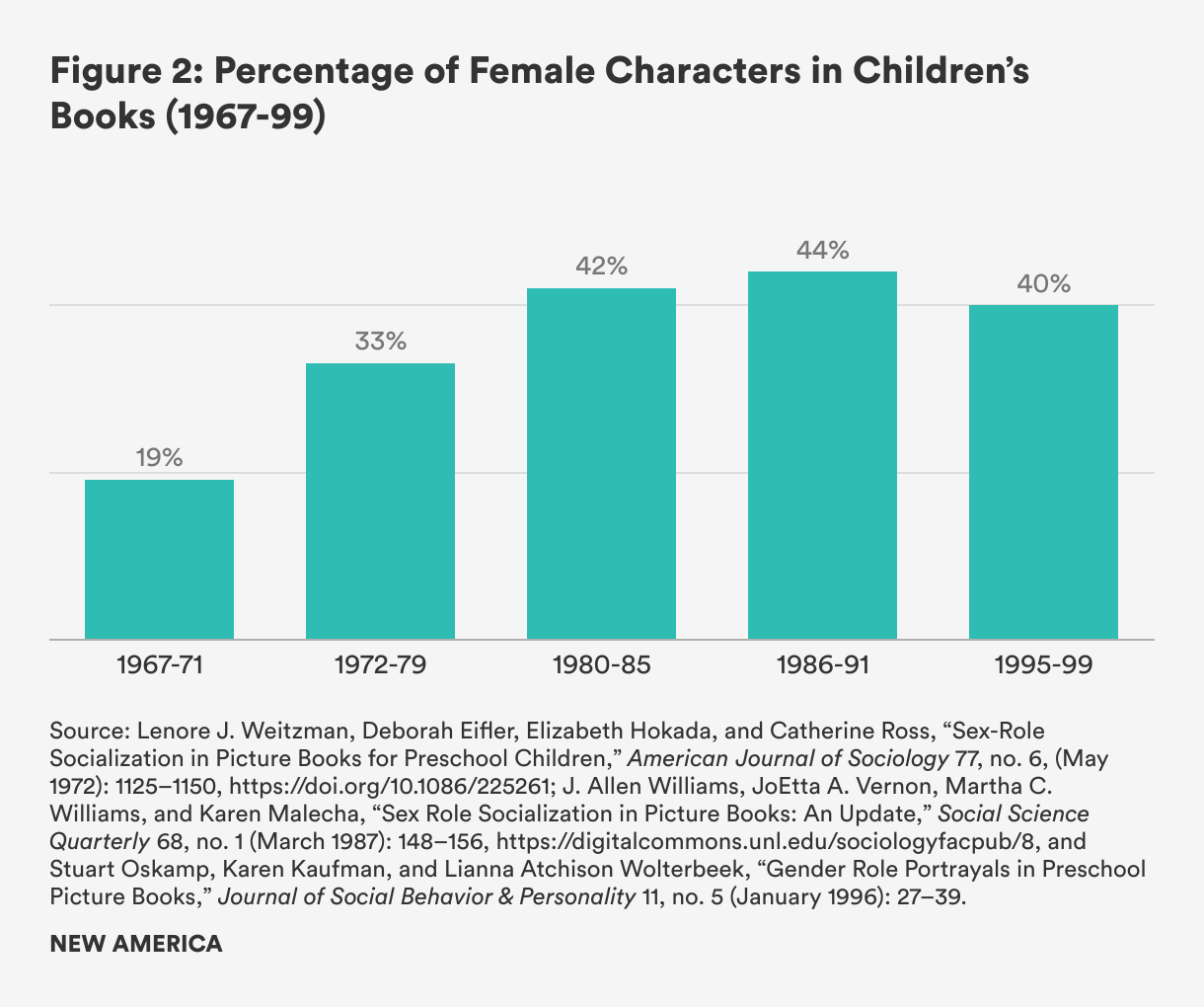
Scholars have built on Weitzman’s examination and typically studied a sample of books published in a five-year period. Findings indicate an increase in female, human representation: a 33 percent increase from books published between 1972 to 1979, a 42 percent increase from 1980 to 1985, and a 44 percent increase from 1986 to 1991.23 A sample of books from 1995 to 1999 shows an equivalence of female (40 percent) and male characters (39 percent) as main characters. There was a slight variation in illustrated characters, 24 percent female to 31 percent male.24 A 2006 study of popular children’s books from 1995 to 2001 suggests males were twice as likely to be adult characters than females, with 23 percent more male child characters than female.25
Ten years ago, one study examined gender representation from 1938 to the end of the 20th century and found a fluctuation of gender representation of child central characters. At some points, males and females are close to equal; at others, males are featured about twice as much as females. There are few instances of females presented more than males.26 Of the 120 main characters from these books, about 58 percent were male and 42 percent were female. In 2018, an analysis of more than 1,400 images in health textbooks, published in Educational Studies, showed men 46 percent of the time, compared to 54 percent for women.27
Studies show characters of gender-diverse communities are underrepresented and misrepresented, though little is known about the frequency of these characters within books published.28 A 2020 study of award-winning books revealed 97 percent of them included male and female characters and no instances of nonbinary representation.29 Scholars who have investigated LGBTQ-themed books found that 14 percent of primary characters in those books were transgender and 21 percent of secondary characters were transgender.30
Research into educational computer software identified a similar difference in gender representation. A study from the 1990s of gendered representation of characters in mathematical software for prekindergarten to high school grades showed 25 percent of the characters were female and 75 percent were male.31 There was a gradual decrease in female characters between pre-K (about 40 percent representation) to fifth grade (about 26 percent), then another decrease between fifth to eighth grade (about 17 percent), and an additional decrease between eighth to 12th grade (about 13 percent). Later studies of software for early childhood grades indicated an increase in female representation. A 2001 study on early childhood literacy software found that 42 percent were female characters. Of main characters, 47 percent had no identifiable gender, 37 percent were male, and 16 percent were female.32 An additional study examining main characters for three- to six-year-olds showed that 63 percent were male, 26 percent had no identifiable gender, and 11 percent were female.33
Scholars have also analyzed gender representation in other forms of educational and instructional materials. A 1999 study of major characters in educational television programming showed males had a higher percentage of representation (about 58 percent) than females (about 42 percent).34 And a recent study analyzing posters for classroom walls showed, of those that presented people, 16 percent included depictions of people from a marginalized gender group. However, specific gender groups were not listed.35
Intersectional Groups Represented
Various studies have quantified characters representing intersectional identities based on race, ethnicity, and gender. A 1970s study of reading materials revealed 4 percent were male and from racial or ethnic minorities and 3 percent were female and from racial or ethnic minorities. A later study of children’s literature by Melanie Koss of Northern Illinois University and Kathleen Paciga of Columbia College School examined the racial/ethnic and gender groups of 120 main characters and found that for White characters, 54 percent were male and 46 percent were female; for American Indian characters, 50 percent were male and 50 percent female; for Black characters, 80 percent were male and 20 percent female; and for Asian and Asian American characters, 75 percent were male and 25 percent female. At least one Latinx character was female. All Middle Eastern characters were male. The only Island-born character was female.36 It is more likely, therefore, for intersectional characters to be racially and ethnically White than any other group.
Citations
- Hugh Klein and Kenneth S. Shiffman, “Underrepresentation and Symbolic Annihilation of Socially Disenfranchised Groups (‘Outgroups’) in Animated Cartoons,” The Howard Journal of Communications 20, no. 1 (January 2009): 55–72, source; Sandra Hughes-Hassell and Ernie J. Cox, “Inside Board Books: Representations of People of Color,” The Library Quarterly: Information, Community, Policy 80, no. 3 (July 2010): 211–230, source; and Sharon Bramlett-Solomon and Yvette Roeder, “Looking at Race in Children’s Television,” Journal of Children and Media 2, no. 1 (February 2008): 56–66 source
- This report uses findings from studies on “race” and “ethnicity” due to their overlap in categories. However, scholars have examined these terms and noted distinctions between them. For further information, see Michael Omi and Howard Winant, Racial Formation in the United States, 3rd ed. (New York: Routledge, Taylor & Francis, 2014).
- Hughes-Hassell and Cox, “Inside Board Books.”
- Hughes-Hassell and Cox, “Inside Board Books.”
- Jane P. Sheldon, “Gender Stereotypes in Educational Software for Young Children,” Sex Roles 51, no. 7/8 (October 2004): 433–444, source; and Thomas Crisp and Brittany Hiller, “‘Is This a Boy or Girl?’: Rethinking Sex Role Representation in Caldecott Medal Winning Picturebooks, 1938–2011,” Children’s Literature in Education 42, no. 3 (March 2011): 196–212, source
- Deanne E. Drees and Gary D. Phye, “Gender Representation in Children’s Language Arts Computer Software,” The Journal of Educational Research 95, no. 1 (September/October 2001): 49–55, source; and Abigail Walsh and Campbell Leaper, “A Content Analysis of Gender Representations in Preschool Children’s Television,” Mass Communication and Society 23, no. 3 (September 2019): 331–355, source
- “Intersectionality” is a term coined by Black Feminist scholars to describe the multiple identities of a person and how those identities are interconnected and impact a person’s experiences and oppressions based on race, gender, class, sexual orientation, etc. For further information, see Patricia H. Collins, Intersectionality as Critical Social Theory (Durham: Duke University Press, 2019); and Sumi Cho, Kimberlé Williams Crenshaw, and Leslie McCall, “Intersectionality: Theorizing Power, Empowering Theory,” Signs 38, no. 5 (Summer 2013), 785–810.
- Maya Götz and Dafna Lemish, “Gender Representations in Children’s Television Worldwide: A Comparative Study of 24 Countries” in Sexy Girls, Heroes and Funny Flowers: Gender Representation in Children’s TV around the World, ed. Maya Götz and Dafna Lemish (Frankfort: Peter Lang, 2012): 9–48.
- Rebecca Harlin and Hani Morgan, “Review of Research: Gender, Racial and Ethnic Misrepresentation in Children’s Books: A Comparative Look,” Childhood Education 85, no. 3 (Spring 2009) 187–191, source
- Hughes-Hassell and Cox, “Inside Board Books”; and Harlin and Morgan, “Review of Research.”
- Hughes-Hassell and Cox, “Inside Board Books.”
- Amina Chaudhri and William H. Teale, “Stories of Multiracial Experiences in Literature for Children, Ages 9–14,” Children’s Literature in Education 44 (January 2013): 359–376, source
- Data set on books by and about Black, Indigenous and People of Color published for children and teens compiled by the Cooperative Children’s Book Center, School of Education, University of Wisconsin–Madison, last updated April 16, 2021, source
- Sherry L. Deckman, Ellie Fitts Fulmer, Keely Kirby, Katharine Hoover, and Abena Subira Mackall, “Numbers Are Just Not Enough: A Critical Analysis of Race, Gender, and Sexuality in Elementary and Middle School Health Textbooks,” Educational Studies 54, no. 3 (January 2018): 285–302, source
- Koss and Paciga, “Diversity in Newbery Medal-Winning Titles.”
- Melanie D. Koss, Nancy J. Johnson, and Miriam Martinez, “Mapping the Diversity in Caldecott Books from 1938 to 2017: The Changing Topography,” Journal of Children’s Literature 44, no. 1 (Spring 2018): 4–20, source; Melanie D. Koss and William H. Teale, “What’s Happening in YA Literature? Trends in Books for Adolescents,” Journal of Adolescent & Adult Literacy 52, no. 7 (April 2009): 563–572, source
- Bárbara C. Cruz, “Don Juan and Rebels under Palm Trees: Depictions of Latin Americans in U.S. History,” Critique of Anthropology 22, no. 3 (September 2002): 323–342, source
- Matthew C. Graham, Allison Ivey, Nicholette DeRosia, and Makseem Skorodinsky, “Education for Whom? The Writing is on the Walls,” Equity & Excellence in Education 53, no. 4 (November 2020): 551–568, source
- Kaysee Baker and Arthur A. Raney, “Equally Super? Gender-Role Stereotyping of Superheroes in Children’s Animated Programs,” Mass Communication & Society 10, no. 1 (December 2007): 25–41, source; Hugh Klein and Kenneth S. Shiffman, “Race-Related Content of Animated Cartoons,” The Howard Journal of Communications 17, no. 3 (November 2006): 163-182. source; Sharon Bramlett-Solomon and Yvette Roeder, “Looking at Race in Children’s Television,” Journal of Children and Media 2, no. 1 (February 2008): 56–66, source; The Geena Benchmark Report 2007–2017 (Rancho Cucamonga, CA: Geena Davis Institute on Gender in Media at Mount Saint Mary’s University, 2019), source; and Rogers, Mastro, Robb, and Peebles, The Inclusion Imperative.
- There is research of noneducational media that provide frequency of characters of nonbinary gender groups For example, see Alayna Cole, Adrienne Shaw, and Jessica Zammit, “Representations of Queer Identity in Games from 2013–2015,” in Proceedings of DiGRA 2017 International Conference, Digital Games Research Association, 1–5, source
- Stephanie LaDow, “A Content-Analysis of Selected Picture Books Examining the Portrayal of Sex-Roles and Representation of Males and Females,” ERIC Document Reproduction Service, No. ED123165 (May 1976): 1–59, source; Sharyl Bender Peterson and Mary Alyce Lach, “Gender Stereotypes in Children’s Books: Their Prevalence and Influence on Cognitive and Affective Development,” Gender and Education 2, no. 2 (1990): 185–197, source; and Gwyneth E. Britton, “Danger: State Adopted Reading Texts May Be Hazardous to Our Future (Racism and Sexism Perpetuated in Reading Series),” Reading Teacher 29, no. 1 (July 1974): 52–58, source
- Lenore J. Weitzman, Deborah Eifler, Elizabeth Hokada, and Catherine Ross, “Sex-Role Socialization in Picture Books for Preschool Children,” American Journal of Sociology 77, no. 6, (May 1972): 1125–1150, source
- J. Allen Williams, JoEtta A. Vernon, Martha C. Williams, and Karen Malecha, “Sex Role Socialization in Picture Books: An Update,” Social Science Quarterly 68, no. 1 (March 1987): 148–156, source; and Stuart Oskamp, Karen Kaufman, and Lianna Atchison Wolterbeek, “Gender Role Portrayals in Preschool Picture Books,” Journal of Social Behavior & Personality 11, no. 5 (January 1996): 27–39.
- Angela M. Gooden and Mark A. Gooden, “Gender Representation in Notable Children’s Picture Books: 1995–1999,” Sex Roles 45 no. 1/2 (July 2001): 89–101, source
- Mykol C. Hamilton, David Anderson, Michelle Broaddus, and Kate Young, “Gender Stereotyping and Under-representation of Female Characters in 200 Popular Children’s Picture Books: A Twenty-First Century Update,” Sex Roles 55 (December 2006): 757–765, source
- Janice McCabe, Emily Fairchild, Liz Grauerholz, Bernice A. Pescosolido, and Daniel Tope, (2011). “Gender in Twentieth-Century Children’s Books: Patterns of Disparity in Titles and Central Characters,” Gender & Society, 25, no. 2 (April 2011): 197–226, source
- Deckman, Fulmer, Kirby, Hoover, and Subira Mackall, “Numbers Are Just Not Enough.”
- Tony Kelso, “Still Trapped in the U.S. Media’s Closet: Representation of Gender-Variant, Pre-Adolescent Children,” Journal of Homosexuality 62, no. 8 (April 2015): 1058–1097, source; Nancy L. Malcom and Nicole Sheahan, “From William’s Doll to Jacob’s New Dress: The Depiction of Gender Non-Conforming Boys in Children’s Picture Books from 1972 to 2014,” Journal of Homosexuality 66, no. 7 (2019): 914–936, source
- Koss and Paciga, “Diversity in Newbery Medal-Winning Titles.”
- John H. Bickford III, “Examining LGBTQ-Based Literature Intended for Primary and Intermediate Elementary Students,” The Elementary School Journal 118, no. 3 (March 2018): 409–425, source
- Kelly K. Chappell, “Mathematics Computer Software Characteristics with Possible Gender-Specific Impact: A Content Analysis,” Journal of Educational Computing Research 15 no. 1 (July 1996): 25–35, source
- Drees and Phye, “Gender Representation in Children’s Language Arts Computer Software.”
- Sheldon, “Gender Stereotypes in Educational Software.”
- Mark R. Barner, “Sex-Role Stereotyping in FCC-Mandated Children’s Educational Television,” Journal of Broadcasting & Electronic Media 43, no. 4 (Fall 1999): 551–564, source
- Graham, Ivey, DeRosia, and Skorodinsky, “Education for Whom?”
- Koss and Paciga, “Diversity in Newbery Medal-Winning Titles.”