
Table of Contents
- Introduction (Mark Schmitt)
- Political Parties Are Essential Democratic Institutions (Didi Kuo)
- Do Americans Hate Political Parties? (Julia Azari and Jennifer Wendling)
- What Fusion Politics Could Mean for Third Political Parties Today (Lisa Disch)
- How Multiparty Coalition Governance Moderates Partisan Hostility (Will Horne)
- Fusion Voting in New York and Connecticut: An Analysis of Congressional Races From 1976–2022 (Oscar Pocasangre)
Fusion Voting in New York and Connecticut: An Analysis of Congressional Races From 1976–2022 (Oscar Pocasangre)
Introduction
Today, fusion voting is only legal in New York and Connecticut. This essay provides a descriptive analysis of how fusion has played out in these two states at the congressional level, focusing on how often fusion is used by parties, differences in electoral performance, and voter turnout. The main findings of this analysis are that fusion voting has historically been bipartisan—used as much by Democrats and by Republicans—but it has provided a greater boost to the vote shares of Republican candidates. The analysis also finds that votes from third parties on fused ballots are rarely decisive for the outcome of an election. From 1976 to 2022, votes from fusion lines changed the outcome of only 23 races for Congress in these states.
Fusion voting is thought to increase voter turnout by providing greater choice to voters, making elections more competitive, and creating incentives for third parties to mobilize voters to vote on their ballot line. By comparing the turnout rates over time of the same districts when they have fused ballots and when they have not, I find that fused ballots are associated with an increase in turnout when Democratic candidates run on fusion tickets, but these effects disappear once accounting for incumbency status for New York races.
The analysis in this essay uses electoral data from congressional elections in New York and Connecticut from 1976 to 2022 obtained from the MIT Election Lab. For estimating turnout rates, I complement this data with the voting age population for each congressional district in these two states since 1976 from the decennial census. This data comes from the National Historical Geographic Information System and the U.S. Census Bureau. For races in New York, I also included data on whether there was an incumbent running in each race. This data comes from Benjamin Kantack,1 who collected data on the incumbency for each race up to 2014, and I added data on incumbency from that year onward.
Fusion in New York and Connecticut
Fusion ballots in New York and Connecticut in recent years typically take the form of the Democratic Party candidate receiving the endorsement of the Working Families Party (WFP) and the Republican Party candidate receiving the endorsement of the Conservative Party in New York or the Independent Party in Connecticut. The endorsement of the WFP is thought to help Democrats garner more votes from the left and the support of more progressive constituencies, while the endorsement of the Conservative Party is thought to help Republicans get more votes from the right.
Historically, candidates from both the Democratic and Republican parties have received and accepted nominations from third parties. In this sense, fusion ballots are not a partisan strategy used only by parties on the left or only by parties on the right. The share of Democratic and Republican candidates who run on fusion tickets, however, has varied over time.
“Fusion ballots are not a partisan strategy used only by parties on the left or only by parties on the right.”
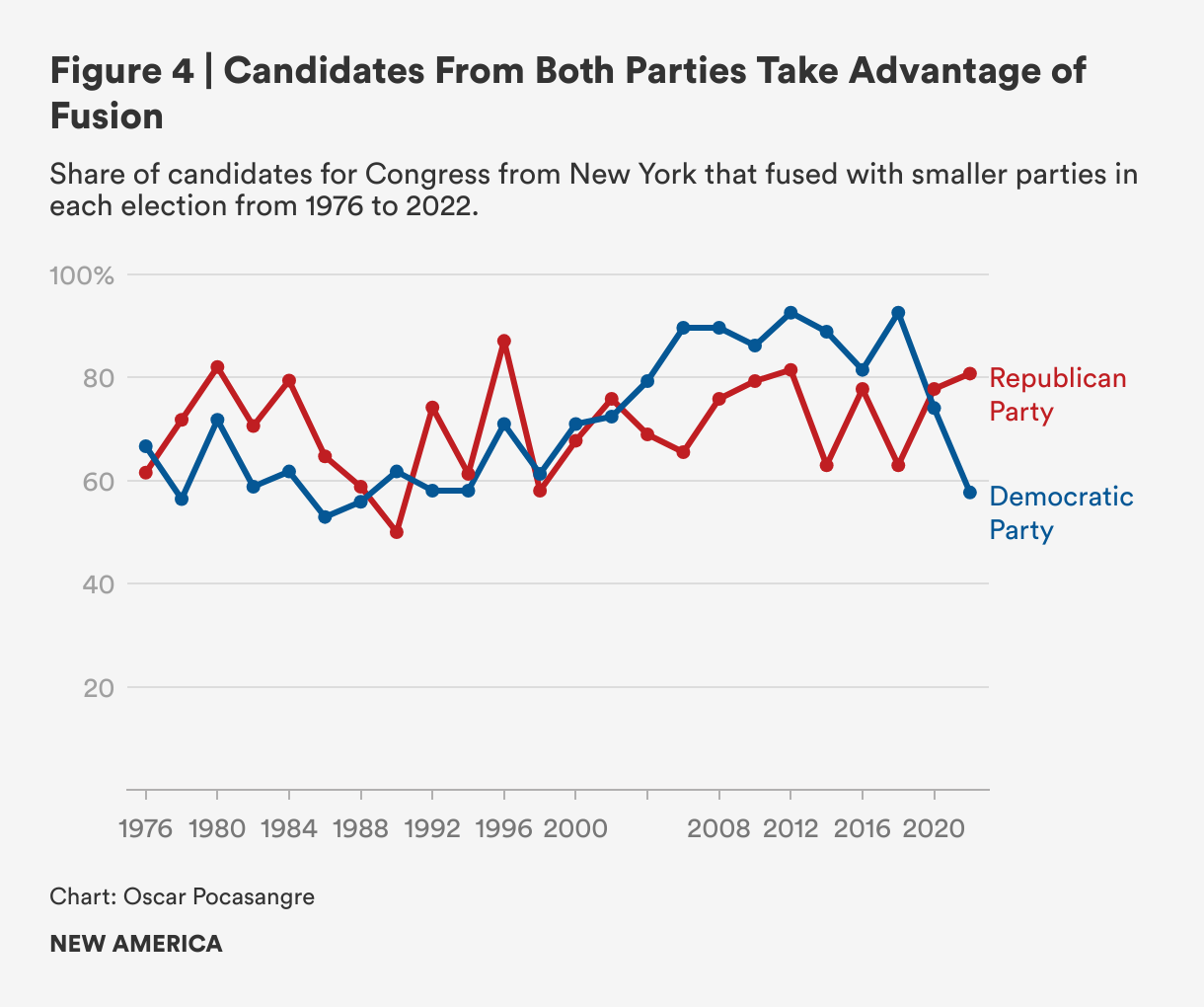
As seen in Figure 4 below, there are periods when Republican candidates have run on fusion tickets more often than Democrats and periods when the opposite occurs. In the 1980s and 1990s, with the exception of elections in 1988 and 1990, more Republican candidates were running on fusion tickets than Democratic candidates. This pattern flipped by 2004, and from that year on, Democratic candidates started running on fusion tickets far more often than Republican ones. By 2020, there were slightly more Republican candidates running on fusion tickets, and in the 2022 elections, 81 percent of Republicans running for Congress did so on a fused ticket. In contrast, 58 percent of Democratic candidates in 2022 appeared on a fusion ticket.
The use of fusion tickets looks quite different in Connecticut, where the small number of congressional districts—six up to 2002 and five since—does not allow for as much variation as in New York. In Connecticut, fused tickets were not used at all up until the 1990s, when three Democratic candidates ran on a fusion ticket in 1992 and 1994 and one Republican candidate ran on a fusion ticket in 1994. Fusion was not used by parties from 1998 to 2006, with the sole exception of one Republican candidate in 2000. From 2008 to 2014, all Democratic candidates were cross-endorsed by the WFP. In the 2022 elections, two of the five Democratic and Republican candidates for Congress ran on fusion tickets.
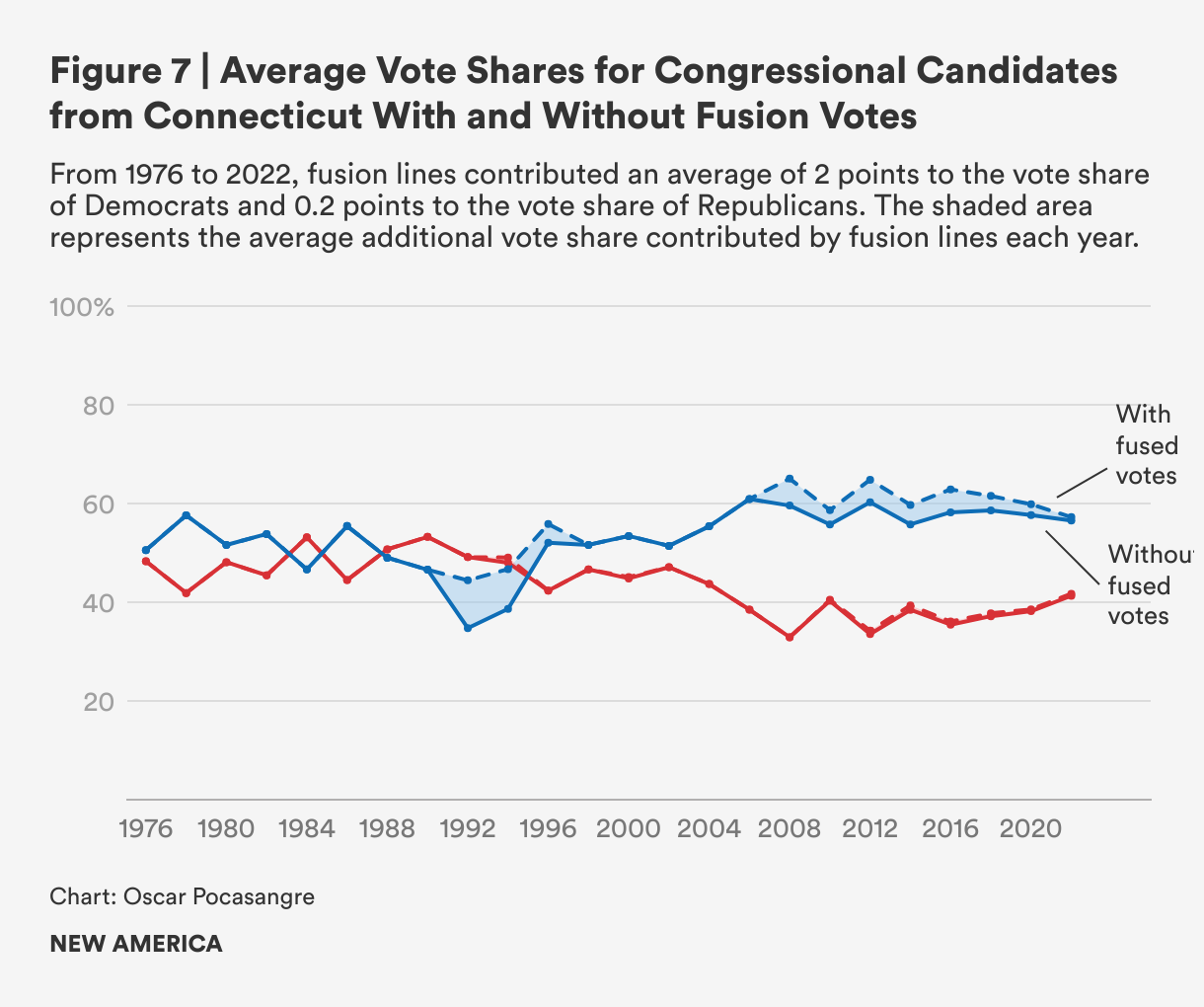
How often do elections flip thanks to the votes brought in by a smaller party on a fusion ticket? The answer is not often. From 1976 to 2022, the votes contributed by smaller parties on fusion tickets have only flipped an election in 2.6 percent of congressional races in New York and Connecticut. To be clear, this is not to say that fusion tickets do not matter. As explained before, fusion can increase the vote share of the main endorsed party by increasing turnout, a dynamic that wouldn’t be captured by comparing vote shares with and without the contributions of the smaller parties. Moreover, these are races happening in districts in New York and Connecticut, which include many safe Democratic districts that are easily won by Democratic candidates with or without fusion.
Where fusion does matter in the context of these states is in helping Republicans in competitive districts. Most of the times that fusion has made a difference in the outcome of an election, it has resulted in the Republican candidate winning an election instead of the Democratic candidate. In 2022, three congressional seats were won by Republican candidates in NY-04 (D’Esposito), NY-17 (Lawler), and NY-22 (Williams) once the votes of the Conservative Party were factored in. The question of whether the Democratic candidate would have won in a counterfactual where there had been no fusion tickets is, of course, difficult to answer. It’s possible that without fusion, voters would have voted directly for the Republican candidate since they had no other option and fusion just gave them the option of expressing their vote in a different way.
Analyzing the Effects of Fusion
What is the effect of fusion tickets on the vote share of Democratic and Republican candidates? How does fusion affect the margin of victory of parties? How does it affect turnout? Answering these questions is tricky because candidates are not randomly assigned to a fusion ticket. Rather, fusion can be endogenous to a variety of processes that are difficult to capture. For instance, higher quality candidates may be more likely to obtain cross-endorsements—in which case the effects of fusion would reflect the effects of candidate quality and not of fusion itself. Or maybe fusion is more used in highly competitive races or in years coinciding with a presidential election, both of which tend to see higher turnout—in which case the effects of fusion would be muddled with the impact of, say, a presidential election year.
For these reasons, comparing outcomes between a fused ticket and an unfused ticket can provide biased results. To address these issues, the analyses presented in this section take advantage of the temporal and cross-sectional variation in the use of fusion tickets and incorporate congressional district and decade fixed effects. Fixed effects help account for unobserved, fixed or slow-changing characteristics of districts. Maybe fusion has different effects in districts in New York City compared to districts upstate or it may have different effects in districts with higher shares of voters of color. Fixed effects account for this by restricting comparisons to tickets with and without fusion within the same district.
The decade fixed effect accounts for changes in the geography of districts from redistricting. As a result, the comparisons over time are limited to the same district within the same decade, which essentially means that the analysis treats, say, NY-14 from 2002 to 2010 as different from NY-14 from 2012 to 2020. While these techniques help ensure that comparisons are done across similar units, there may still be other sources of bias, so I do not make any causal claims about the effects of fusion. Rather, the analysis provides a descriptive analysis of the differences across elections, with and without fused tickets by party, that accounts for factors like district characteristics.
Results
I analyze the effects of fusion on several outcomes of interest: the Democratic margin of victory, the vote share of Democratic and Republican candidates, and turnout. I find evidence that fusion voting helps candidates from both parties in terms of increasing their margins of victories and vote shares. But, overall in New York and Connecticut, fused tickets tend to benefit Republican candidates more than Democratic ones. I also find that fusion tickets are associated with small increases in turnout rates, although these effects on turnout disappear once candidate incumbency is factored in.
“Fusion voting helps candidates from both parties in terms of increasing their margins of victories and vote shares.”
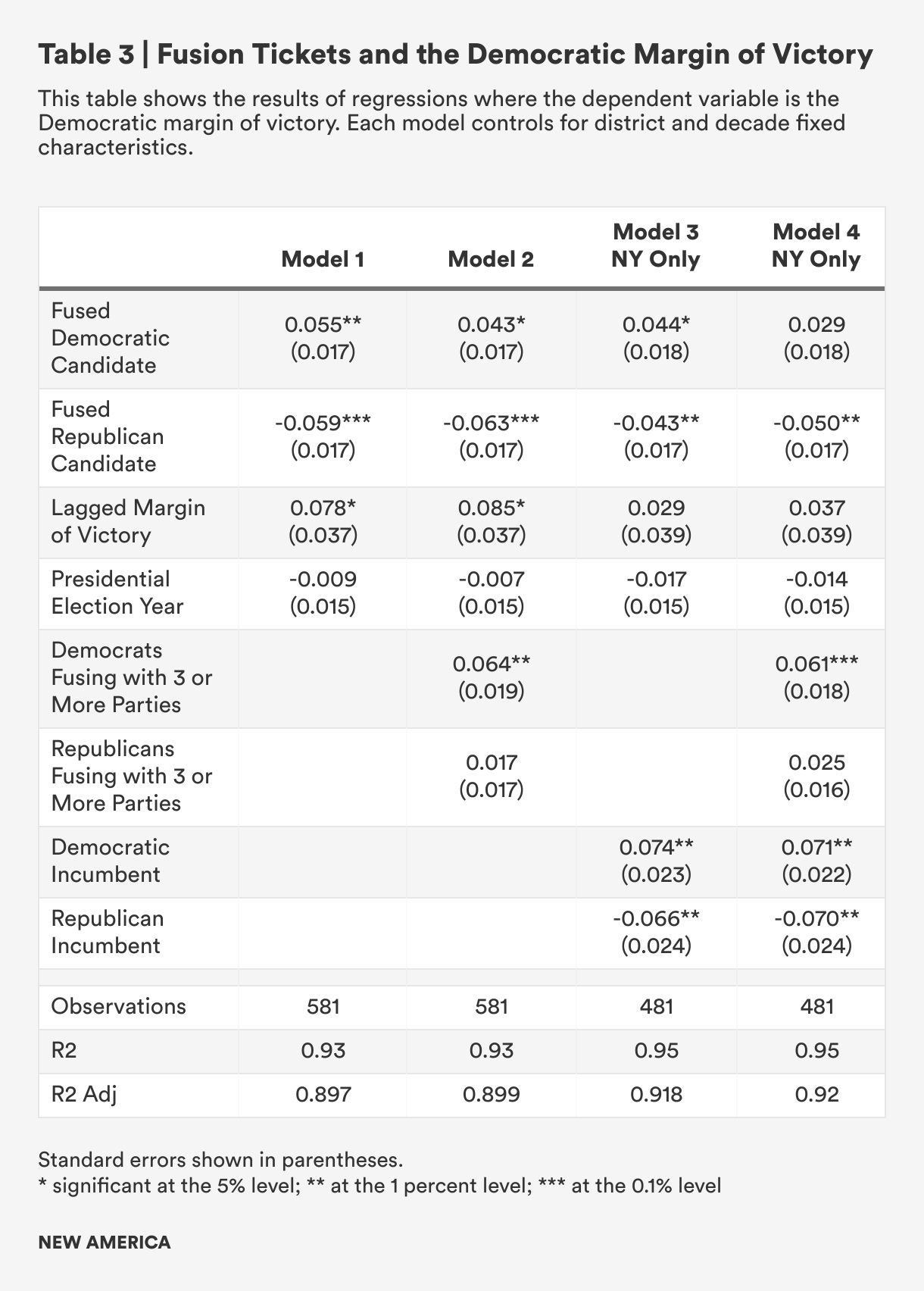
Table 3 below presents the results of fusion tickets for each party on the Democratic margin of victory. The different columns show different specifications of the regression models, incorporating different control variables. In races where Democratic candidates run on fusion tickets, the margin of victory of Democratic candidates is about 4.3 to 5.5 percentage points higher than in races where Democratic candidates do not run on fusion tickets. When Republicans run on fusion tickets, there is an associated reduction in the vote share of Democrats of between 4.3 to 6.3 percentage points, depending on the model specification.
Running a similar statistical analysis—but this time with the Democratic vote share as the dependent variable—shows that when Democrats run on a fusion ticket, compared to when they don’t, their vote share is about 2 percentage points higher. There is also an associated reduction in the vote share of Democrats when Republicans run on a fusion ticket. We see a similar dynamic when the outcome is the Republican Party vote share. In this case, when Democrats run on a fusion ticket they reduce the vote share of Republicans by about 2 percentage points, but when Republicans run on fusion tickets they are able to increase their vote share by around 5 percentage points. These findings suggest that fusion helps both parties draw in more votes through the smaller parties, although it is not possible to distinguish whether these are votes that would have gone to the main endorsed party either way or if fusion is drawing in voters that would have not voted otherwise. The output for these regressions is omitted for space considerations.
Finally, using a regression analysis, I also show that fusion tickets are associated with higher turnout rates when Democratic candidates fuse with a third party—but that does not seem to be the case when Republican candidates do so. Table 4 below shows the effects of fusion tickets on turnout. Democratic fusion tickets are associated with an increase in turnout of about 2 to 3 percentage points. The effects for Republican fusion tickets are not statistically significant, except in Model 2 where it is significant at the 0.1 level. Elections in which Democratic and Republican candidates fuse with more than one party are also associated with higher turnout rates. Fused tickets of three or more parties only happened 15 percent of the time among Democratic candidates and 22 percent of the time among Republican candidates.
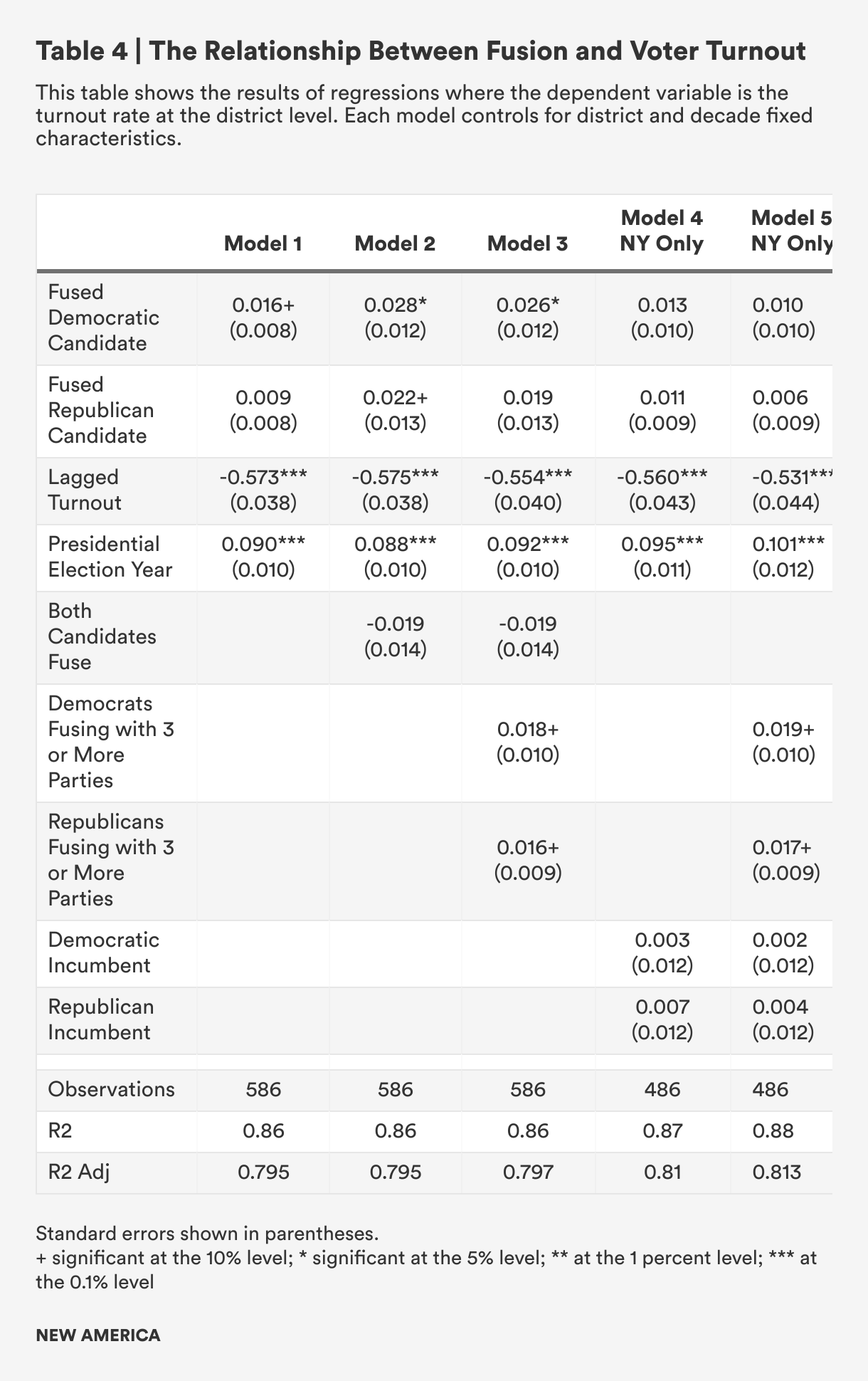
Overall, these effects on turnout are small. Other variables in the models have bigger and more significant effects on turnout than fused tickets. Turnout levels are higher in years that coincide with presidential elections by an average of about 9 to 10 percentage points and higher turnout in the previous election. The effects also disappear when accounting for incumbency in New York.
The analyses presented in this essay show that fusing ballots is a widely used electoral practice by both Democrats and Republicans that is able to garner additional votes for each party and increase electoral turnout in certain cases. The added votes from fusion lines are usually not enough to change an electoral outcome, but they allow minor parties to participate in races without spoiling elections. As such, fusion voting could be a useful first step in transitioning toward a multiparty democracy.
Citations
- Benjamin R. Kantack, “Fusion and Electoral Performance in New York Congressional Elections,” Political Research Quarterly 70, no. 2 (2017): 291–300, source.