Table of Contents
- Introduction (Mark Schmitt)
- Political Parties Are Essential Democratic Institutions (Didi Kuo)
- Do Americans Hate Political Parties? (Julia Azari and Jennifer Wendling)
- What Fusion Politics Could Mean for Third Political Parties Today (Lisa Disch)
- How Multiparty Coalition Governance Moderates Partisan Hostility (Will Horne)
- Fusion Voting in New York and Connecticut: An Analysis of Congressional Races From 1976–2022 (Oscar Pocasangre)
Do Americans Hate Political Parties? (Julia Azari and Jennifer Wendling)
That Americans bear a unique antipathy toward political parties is a familiar, uncontroversial idea. But what does it really mean? The classic and contemporary literature on this topic incorporates many different causes for skepticism about parties.
One persistent idea is that political parties create division and undermine the public good. Richard Hofstadter identifies three strains of anti-party political thought in the eighteenth century: that parties create conflict where it wouldn’t exist otherwise, preventing society from being governed by consensus; that the creation of parties and factions could allow for a narrow segment of society to impose tyranny on others; and that party politics would run counter to civic virtue and detract from the pursuit of the public good.1 John Hibbing and Elizabeth Theiss-Morse find that the American public “is ecstatically supportive” of reforms that include the disempowerment of party leaders in Congress.2 Also writing about public evaluations of Congress, Mark Ramirez observes, “the public perceives partisan conflict as a waste of time and resources that could be spent trying to solve the nation’s problems rather than trying to put the other party down for personal or partisan electoral gains.”3
In a study of political independents, Samara Klar and Yanna Krupnikov examined the psychological motivations of independents who are really “closet partisans”—consistent in their partisan behavior but attentive to social cues about the pitfalls of parties. Klar and Krupnikov observe that “individuals are more likely to perceive parties negatively when they believe partisanship as a whole is associated with negative traits.” They place these perceptions into a larger political context, arguing, “In recent years, parties have been portrayed by media less as principled representatives and more as cranky children who do not want to share.”4 In other words, the contemporary impression that parties are trivia-minded, divisive, and motivated by blind team loyalty appear to be both historically informed and prevalent in contemporary discourse about parties.
The second idea is what Nancy Rosenblum calls “progressive anti-partisanship.” Around the turn of the twentieth century, cartoonists pilloried “bosses” as corrupt fat cats who controlled politics and diverted public resources for their own benefit. The perception of parties as corrupt, devoid of meaningful ideas, and run by elites who are self-interested, unaccountable, and greedy has not only been the source of anti-party reforms of the kind seen in the early twentieth century. It has also spurred anti-party movements like Ross Perot’s Reform party. The idea that twenty-first century parties are too much alike seems beyond comprehension to all but the most committed ideologues. But the sense that parties are corrupt, unresponsive, and impenetrable institutions with goals other than serving the people has not fallen away from contemporary discourse.
The dynamics of the 2016 election refocused scholarly attention on parties as organizations. A recent body of scholarship has sought to illuminate how the parties and their nomination processes are perceived by both voters and party activists.5
There are two important points to take away from the existing literature on the anti-party question. First, there are many potential explanations for U.S. antipathy toward parties, each with very different theoretical implications, and implications for the attitudes about parties under conditions of hyper-partisanship. Second, recent studies about parties and nomination rules have mixed findings about how partisans and even party activists perceive the role of parties as institutions. By looking at how Americans answer open-ended questions about their level of confidence in parties, we can get more insight into some of these questions.
The Puzzle of Anti-Partyism
Despite the place of anti-party feelings in the conventional wisdom about American political culture, anti-party attitudes are not well-understood. A sweep of poll questions in the Roper iPoll archive reveals responses to poll questions about parties that vary widely and are vulnerable to the structure of question wording and options. Throughout the past fifty years, parties and party systems have received ambivalent reviews. Polls about the 2016 process revealed suspicion about excessive elite involvement in nominations. Yet when asked if they would like more political parties, U.S. respondents often say yes. In Stealth Democracy, Hibbing and Theiss-Morse found that a substantial number of Americans say they want to ban political parties—but an even higher percentage want to see a new party emerge.6 This pattern of responses reveals a puzzle: Americans want parties to offer lots of choice, yet not be too divisive. Taken together, these responses reveal an appreciation for the role of political parties, despite deep distrust of parties as institutions.
“A substantial number of Americans say they want to ban political parties—but an even higher percentage want to see a new party emerge.”
Our analysis of attitudes about political parties draws primarily from the Baker Institutional Confidence poll. This poll was conducted by the survey firm YouGov in 2018, when the project surveyed 5,400 respondents, with an oversample of Black, Latinx, and Asian Americans.7 The researchers asked about levels of institutional confidence in a variety of political, social, and economic institutions. These questions were also accompanied by open-ended responses for some of the institutions.
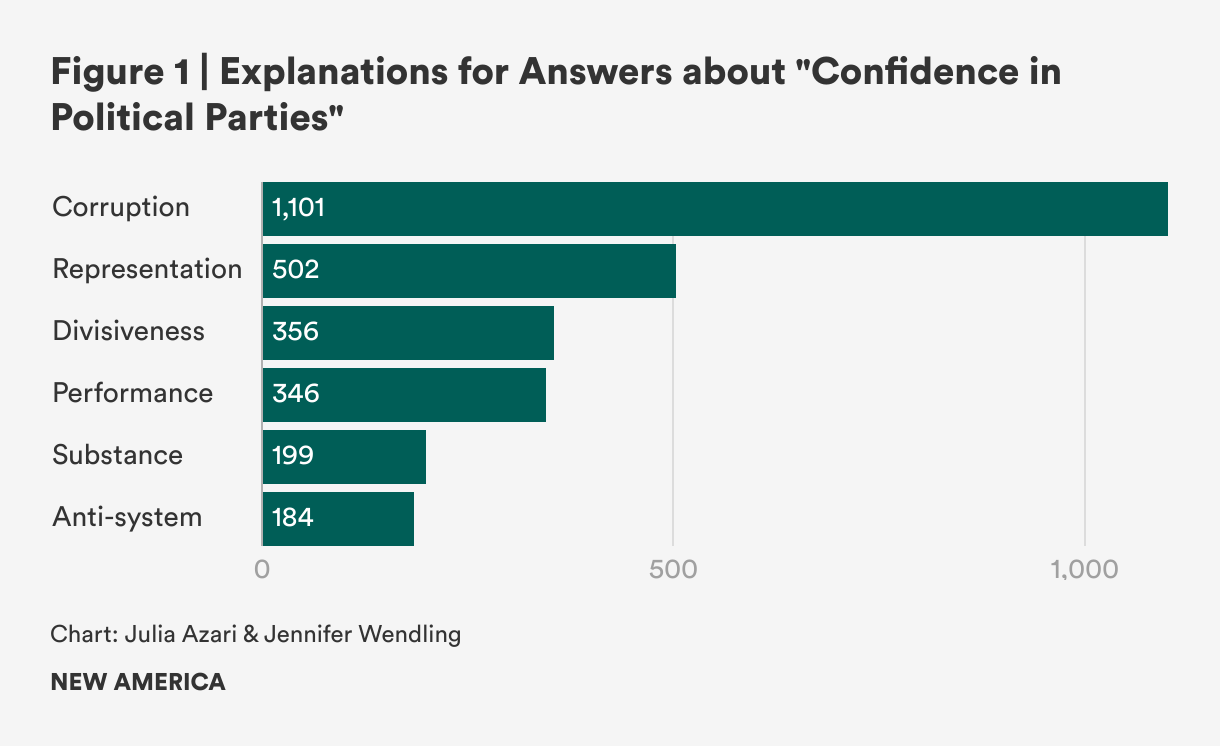
Below we examine responses to the question that asks respondents to explain their confidence in political parties. We coded the open-ended responses for six categories: money and corruption; lack of substance; performance; representation; anti-system; and divisiveness. These categories were based on the reasoning in the literature on both confidence and distrust, and party distrust specifically. The quotations below illustrate typical responses in each of the categories and indicate the partisan identification of the respondent.
Money and Corruption
Many respondents described parties as corrupt and beholden to large donors, such as corporations and lobbyist groups, to maintain their elite political status. One respondent wrote, “power hungry money grabbers not wanting to lose their elite status.” Another pointed to corruption as a recent development: “Lobbyists, millionaires, and corporations have turned a country built on laws and values into a country built on profits.”
Lack of Substance
Responses coded as “lack of substance” were those that indicated that political parties do not stand for anything or lack meaningful positions on issues.
“Political parties used to mean something. Nowadays, it seems as though the words ‘Republican’ and ‘Democrat’ are so far from what they originally meant, they have virtually no meaning.”—Strong Democrat
Performance
Responses in this category reflect one perspective in a long-standing debate about the causes of institutional distrust. Some of the classic works in the study of governmental trust suggest that, as Hetherington and Rudolph summarize, “governmental performance drives trust.”8 The crises of the twenty-first century might suggest that respondents would have many and detailed complaints about how the different institutions of government have performed.
“They get so stuck in the rhetoric that they DON’T DO ANYTHING!!”—Strong Democrat
Representation
As with corruption, responses that identify poor representation reflect respondents’ opinions that institutions failed to voice either the respondents’ own interests or those of the population in general. The difference is that these comments did not invoke wealth, institutional corruption, or economic inequality.
“All political parties are all promises. But they do nothing for the people. They do things in favor for themselves. Just so hard to trust one bit.”—Independent
“It doesn’t seem like politicians have as much desire to serve the people as they did in the past.”—Weak Democrat
Anti-System
Responses in this category differed from others in that their responses to a question about a single institution implicated the entire political system. These respondents expressed the belief that the two-party system is broken and only favors extremists from both parties, thus not representing true democratic processes.
“We have a bought-and-paid-for political system. They service their own power desires over the needs of the very public they claim to serve. There are talking points, and agendas…and no true love of country.…And a false picture constantly being created to get the masses to feel and think the way that the powerful wish them to feel and think… and they seek to support and protect their own power. Why would anyone feel confident in this?”—Independent
Divisiveness
Some respondents claimed that too often parties love to fight and disagree with one another. In addition, respondents argued that the pure hatred each party has for the other destroys any attempts of compromise and bipartisanship, while also fostering growing divisions.
“Their inability to work together to get things done. Their absolute hatred for those who disagree with them and their attempts to destroy those with whom they disagree.”—Strong Republican
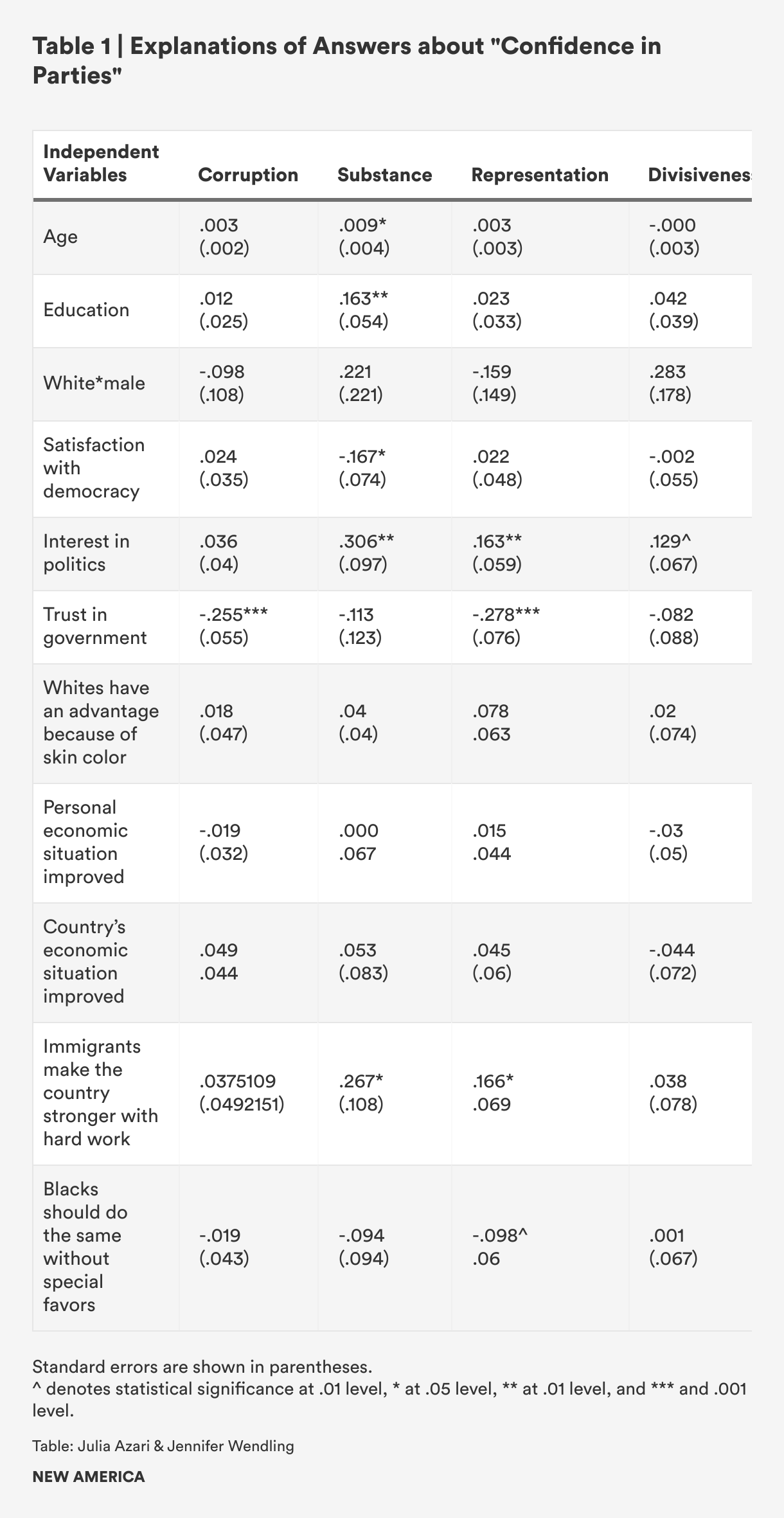
The models shown in Table 1 are logistic regressions assessing the impact of each variable on the likelihood of providing an answer in each of the six categories. As expected, there is a great deal of noise in these categories of responses, and our models do not explain much of the overall variation. However, they reveal something of a systematic logic behind different responses to the prompt to explain confidence in parties.
The analysis includes several demographic and attitudinal variables: race, gender, education, satisfaction with democracy, and interest in politics. The table also includes questions about whether the respondent perceived their personal and the country’s economic situation to have changed for the better. Finally, the model includes the responses to questions about whether the respondent agreed with the following statements: “white [Americans] have an advantage because of skin color”; “immigrants make the country stronger with their hard work and talents”; and “Black [Americans] should do the same without any special favors.” These were rated on a 1 to 4 scale, with “4” indicating strong agreement. The model also controlled for ideology and partisanship.
The Implications of Anti-Partyism
The analysis shown in Table 1 has several implications for understanding anti-party sentiment in the United States.
- Money and Corruption: Only one variable had a statistically significant relationship: trust in government. Unsurprisingly, higher trust in government meant that respondents were less likely to cite corruption as a reason for their confidence in parties.
- Lack of Substance: Several factors were associated with citing lack of substance as a reason for flagging confidence in parties. Being older, with a higher level of interest in politics, higher levels of education, greater support for immigration, and lower satisfaction with democracy were all associated with this response, at conventional levels of statistical significance.
- Performance: Interestingly, while no other variables were statistically significant, higher satisfaction with democracy was associated with the likelihood of giving a response related to the performance of parties.
- Representation: Like corruption, respondents who reported low levels of trust in government were more likely to respond with complaints about parties’ failures of representation. Positive attitudes about immigration were also statistically significant, as was Republican identification.
- Divisiveness: Republicans were more likely to cite divisiveness in their open-ended comments.
- Anti-System: Respondents who cited distrust or dislike for the entire political system also stood out in several ways. White men were more likely than other groups to provide these responses, and this response was associated with agreement with the statement that Black Americans should not expect “special favors.” Those who reported low levels of satisfaction with democracy, unsurprisingly, were more likely to offer an anti-system response.
Our findings have several implications for the theoretical questions posed at the start of the essay. First, corruption is by far the most cited reason for distrust in political parties, with no particular demographic or attitude patterns connected to that response. However, trust in government was related to responses about both corruption and representation, suggesting that we should think about anti-party attitudes in terms of broader questions about institutional and governmental trust.
Second, the types of variables related to critiques of party substance reveal another type of anti-partyism: the highly educated and engaged citizen who sees parties as lacking real commitments or ideological cores. This suggests that scholars of anti-partyism should also be attuned to the debates about the “diploma divide” and political attentiveness.
Finally, the relatively small number of anti-system responses nevertheless seems to represent a distinct brand of anti-partyism: Respondents who offered these kinds of comments were more likely to be white and male, to express racially resentful attitudes, and to be dissatisfied with democracy. The “angry white male” political archetype from circa 1994 may be relevant to a minor, but persistent, strain of anti-partyism as well.
Citations
- Richard Hofstadter, The Idea of a Party System: The Rise of Legitimate Opposition in the United States, 1780–1840 (Berkeley, CA: University of California Press, 1969): 12.
- John R. Hibbing and Elizabeth Theiss-Morse, Congress as Public Enemy: Public Attitudes toward Political Institutions (Cambridge: Cambridge University Press, 1995).
- Mark D. Ramirez, “The Dynamics of Partisan Conflict on Congressional Approval,” American Journal of Political Science 53, no. 3 (2009): 683, source.
- Samara Klar and Yanna Krupnikov, Independent Politics: How American Disdain for Parties Leads to Political Inaction (Cambridge: Cambridge University Press, 2016): 26–27.
- Zachary Albert and Raymond J. La Raja, “Who should decide the party’s nominee? Understanding public attitudes toward primary elections,” Party Politics 27, no. 5 (2021): 928–941, source; Caitlin Jewitt and Gregory Shufeldt, “A Rigged Game? How Candidate, Partisan, and Electoral Factors Shape Elite Support for the Party Nomination Process,” American Politics Research 49, no. 6 (2021): 681–694, source; Caitlin E. Jewitt, The Primary Rules: Parties, Voters, and Presidential Nominations (Ann Arbor, MI: University of Michigan Press, 2019).
- John R. Hibbing and Elizabeth Theiss-Morse, Stealth Democracy: Americans’ Beliefs about How Government Should Work (Cambridge: Cambridge University Press, 2002): 76.
- 2018 American Institutional Confidence Poll: The Health of American Democracy in an Era of Hyper Polarization (Washington, DC: The Baker Center, 2018), source.
- Marc J. Hetherington and Thomas J. Rudolph, “Priming, Performance, and the Dynamics of Political Trust,” Journal of Politics 70, no. 2 (April 2008), source.