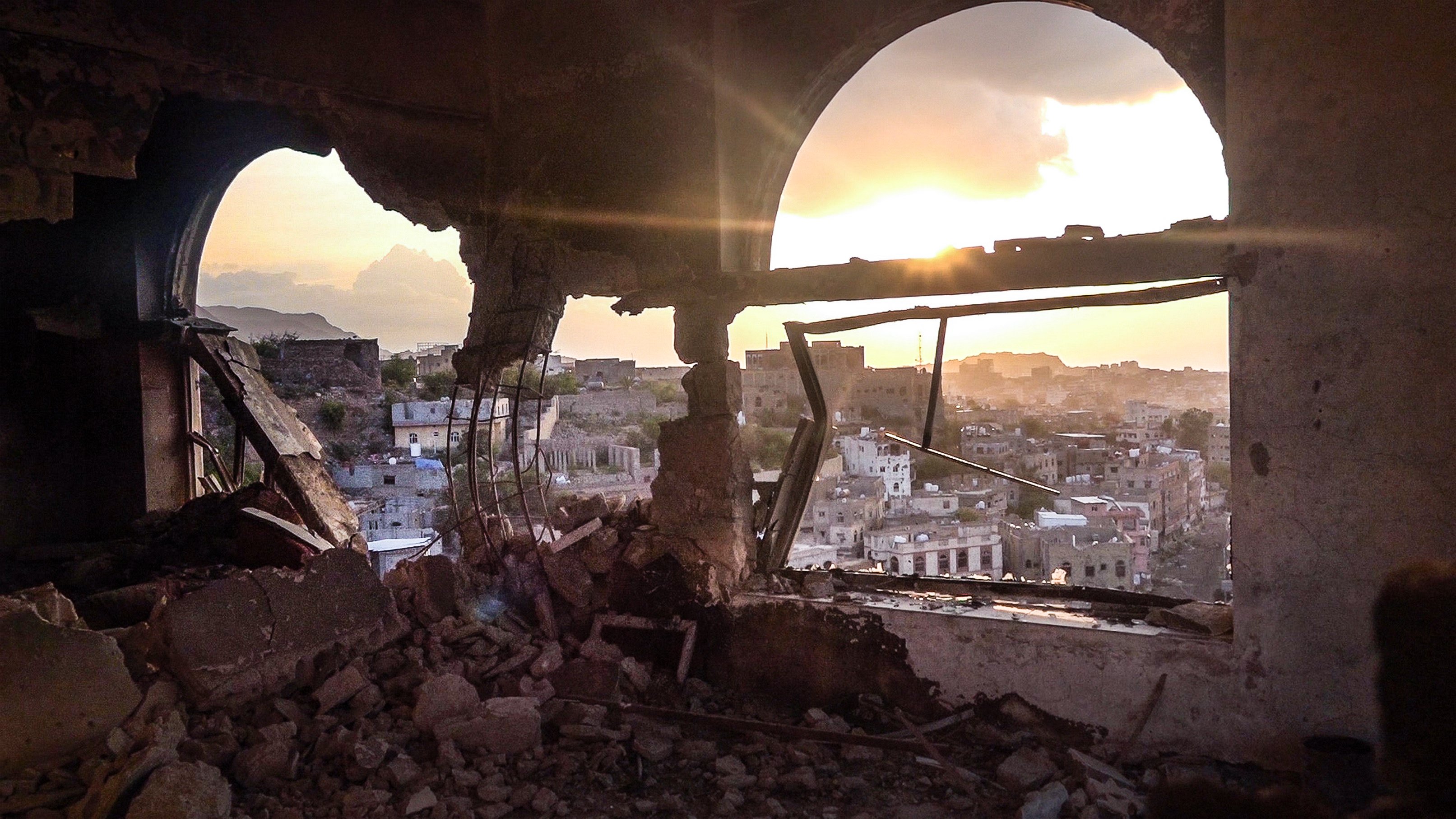
War Comes to Taiz
The city of Taiz has historically played a key role in Yemen’s political life. Long considered the cultural capital of Yemen, Taiz has occupied this space for roughly a millennium.1 Historically, Taiz was described as the “Damascus of Yemen” for its impressive agricultural and academic production. A cosmopolitan urban center in the 1960s, Taiz provided refuge for southerners agitating against British colonial rule and Republican revolutionaries fighting to oust the Zaidi isolationist Imamate, rendering it a strategic urban space for leftist movements to exchange ideas.2 Home to much of Yemen’s educated class, Taiz often functioned as the urban fulcrum of opposition to the political elite based in Sanaa, Yemen’s capital. In the 1980s, Taiz played a key role in the advancement of negotiations between the north and south in the lead up to national unification.3 Taiz was also a focal point of Yemen’s 2011 Arab Spring, which resulted in the ouster of longtime President Ali Abdullah Saleh. During the Arab Spring (between 2011 and 2012), Taiz was described as the “heart of the revolution.”4


Given its historical importance, foreign powers competed for influence in Taiz prior to the Houthi seizure of Yemen’s capital, with Gulf States in particular funding political parties within the city. Qatar, a major international player in the lead up to the current conflict, provided significant financial backing of Islah (particularly during the 2011 Arab Spring) and continued to back the party after the revolution.5 Iran, for its part, launched an influence campaign—albeit largely on the political front—early on, building ties with some Taizis both directly and through Lebanese networks—particularly disaffected leftists—and even (according to interviews conducted for this report) in some cases literally sponsoring trips to Iran.6 All the while, Saudi Arabia and the UAE have maintained decades-old ties with Taiz, including through key political figures, business families, and social and political networks.
Socio-Economic and Humanitarian Conditions in Taiz:
The governorate of Taiz is in southwest Yemen, about 160 miles south of the national capital, Sanaa. Technically located in Yemen’s geographic south, the governorate and its main city were both part of the Yemen Arab Republic (YAR), also known as North Yemen. Taiz remains the third largest city in the country in terms of population size, although its population is estimated to have declined from 600,000 to 200,000 due to displacement.7 The population of Taiz city is majority Shafe’i Sunni, with a handful of Taizi families belonging to the Zaidi sect.8
Already the poorest country in the Arab world before the current war, today Yemen is in a state of economic crisis. Yemen’s GDP contracted by 39 percent since the end of 2014; 80 percent of the country currently relies on some form of aid to survive. 9 Historically a bastion of the middle class, Taiz is not an exception to this dire situation. The conflict has harmed a staggering 95 percent of Taizi businesses.10 Agriculture dominates the area’s economy, with a focus on the growth of crops such as grains, vegetables, and fruits, as well as livestock cultivation and fishing along the Red Sea coast.11 Taiz is also rich in minerals, including copper, nickel, cobalt, and platinum,12 and endowed with many important historic sites. 13 Despite these resources, Taiz’s economic outlook today is dismal.
Taiz is the native home of many of Yemen’s most important business dynasties, most notably the Hayel Saeed Anam family. Hayel Saeed began operating in Taiz in 1938; the business today, which focuses on manufacturing and imports and exports, is a global conglomerate generating $8 billion dollars in annual revenue.14 The Hayel Saeed family remains the largest employer in Taiz, and it continues to be active in philanthropy and social welfare projects throughout the city. Despite being forced to lay off 40 percent of its workforce and reduce the salaries of remaining employees, the company maintains its day-to-day operations, and has even persisted in paying the salaries of employees at its semi-operational factories.15 Still, the ongoing siege of the city and internal fighting has devastated the city’s industrial sector. Many factories are shuttered and many more are damaged or destroyed from the fighting. For many Taizis, armed groups present some of the only available jobs.
The humanitarian situation in Taiz is also dire, with locals struggling to access basic services such as healthcare and education—even access to clean drinking water is limited. The Houthi siege of Taiz and the ongoing shelling and sniping from outside of the city has hindered access to basic supplies, and complicated the activities and responses of civil society and relief organizations. This has also made the rebuilding and stabilization process in Taiz difficult. Many homes and shops remain abandoned out of fear of leftover explosive munitions or mines. Despite the ongoing destruction and danger, desperate civilians who fled Taiz are returning home from rural areas of temporary refuge. Today, what used to be a 15-minute trip to the east of the city takes about five hours due to the partial blockage of roads by the Houthis. Freight truck drivers attempting to transport their cargo to residents of the southern neighborhoods in Taiz are forced to use a long stretch of dry riverbed—a path inaccessible during the monsoon seasons while all other roads into the city traverse daunting, unpaved rigid hills.
Finally, the governorate has absorbed the lion’s share of the violence in Yemen. According to a June 2019 report by the Armed Conflict Location and Event Data Project (ACLED), Taiz has experienced the most conflict-related violence of any governorate in Yemen since the war began in 2015.16 From 2015-2019, more than 18,400 people have died in Taiz, including 2,300 civilians killed in violence that targeted them specifically as civilians.17 Significantly, these figures do not include the conflict-related deaths from cholera and other preventable diseases, which proliferated throughout the four and a half years of siege-related hardship. The death toll for the current war in Yemen stands at a staggering 100,000 deaths;18 Taiz makes up a fifth of the national death toll.19
The Houthi Incursion into Taiz
The Houthi rebel movement, whose political branch is called Ansarullah, seized the Yemeni capital on September 21, 2014. The capture of Sanaa was the culmination of decades of Houthi resentment toward the Yemeni government. Former President Ali Abdullah Saleh fought six wars with the Houthis throughout the 2000s.20 The collective result of these wars was the almost wholesale destruction of Saada, the historic capital of the Houthis’ native region, and the lingering resentment of the Houthis toward the government in Sanaa, which they accuse of withholding resources and targeting them unfairly.21 The Houthis largely draw their support from elements of Yemen’s Zaidi community. A branch of Shia Islam, the Zaidi community predominates in north Yemen, representing about one-third of the Yemeni population.
The collective result of these wars was the almost wholesale destruction of Saada and the lingering resentment of the Houthis toward the government in Sanaa.
Upon capturing Sanaa, the Houthis spread outward attempting to conquer the rest of the north, including Taiz.22 They also went south, fighting their way almost into Aden before finally being repelled by the Popular Resistance, a series of militias that organized to resist the Houthi advances. At that time, this resistance was an amorphous collection of armed groups that emerged organically to push back against armed militants flooding into their towns, although the Saudi- and Emirati-backed coalition moved quickly to organize and support groups resistant to the Houthis as they formally intervened in Yemen.23
The Houthi presence in Taiz, however, predated their takeover of Sanaa. The Houthis first moved to establish an open presence in Taiz during the 2011 Arab Spring-inspired protests, in which men and women across the Middle East took to the streets in mass demonstrations against decades of authoritarian governance.24 The protests, which began in Tunisia and soon embroiled the region, quickly reached Yemen, where demonstrators targeted longtime Yemeni President Ali Abdullah Saleh.25 Calling for expanded rights and services from the government, poverty reduction, and an end to state corruption, protestors also called for Saleh to cede power, which he did, finally, in February 2012.26
The Houthis were active in the Yemeni Arab Spring, initially making themselves known largely through the Steadfast Youth (Shabab Al-sumud), a Houthi-affiliated youth group prominent in protest encampments across the country. During this period, tensions between Houthi-affiliated figures and other political groups occasionally turned violent, mainly in the form of scuffles with those youths who supported Islah and those who supported the Houthis in protest squares across the country.27
There were deeply local aspects to the Houthis early political efforts in Taiz. According to interviews conducted by the authors, several prominent Taizis rose through the ranks of the Houthis’ power structure, most notably, Mahmoud Al-Guneid, a Taizi poet and political activist who eventually served as a Houthi leader. Al-Guneid was appointed as Director of the Presidential Office during the tenure of Saleh al-Samad28 from 2015 through 2018.29 Other figures who aligned with the Houthis include Sultan al-Samei, a socialist member of parliament, Salah al-Dakak, a prominent leftist activist and journalist, Talal Aqlan, who served as the Houthi-affiliated government’s acting prime minister, and Salim Mughalis, a member of the Houthis governing Supreme Political Council in Sanaa and delegate to UN-sponsored peace talks. Many of these figures, who hailed from leftist political streams, framed their alignment with the Houthis as an outgrowth of their frustration with Islah and other traditional power centers. Islah’s dominance over the transitional process that emerged in the wake of the Arab Spring was one reported factor in uniting the Houthis with some on the left, but some Yemeni political activists also suggested that leftist support might have been financially motivated.30
The Houthis took control of parts of the Al-Mokha district in the Taiz governorate as early as March 2015.31 In their campaign, the Houthis often joined forces with groups loyal to ousted former Yemeni President Ali Abdullah Saleh, owing to their mutual aims of pushing back against various figures aligned with the transitional government. On March 22, 2015, a joint Houthi-Saleh army swept into the Taiz governorate capturing military bases and strategic spaces around the city of Taiz, including the town of Al-Turbah, 50 miles southwest of Taiz city and 70 miles east of the port of Mokha on the Red Sea coast. Initially, the Houthis faced little organized military resistance from local Taizis, and the joint Houthi-Saleh forces moved quickly through the governorate, capturing the airport and the local Central Security Forces (CSF) base in the capital city.
Local demonstrations against the Houthi incursion began almost immediately, with protests in Taiz and across Al-Turbah. Anti-Houthi demonstrators were met with violence, and were quickly suppressed where they occurred. On March 24, two days after the Houthis entered the Taiz governorate, six protesters were killed and dozens of others were wounded in Taiz and Al-Turbah.32 In reaction to the deaths, Taizi Governor Shawqi Hayel Saeed, grandson of Hayel Saeed Anam, Taiz’s wealthiest and most successful modern businessman, announced his intention to resign from office in protest against the security forces’ failure to implement his mandate and directives.33 Saeed was originally selected for this position because of his reputation as a capable technocrat and his family’s long history and influence in Taiz. However, his resignation announcement paved the way for a violent confrontation in the increasingly fractured city, spurring the wider conflagration that continues to embroil Taiz.
In response to Saeed’s resignation announcement, officers and members of the Thirty-Fifth Armored Brigade in Taiz, one of the most powerful military units in the city, declared their support for President Hadi. This announcement was prompted by then-Thirty-Fifth brigade head Major General Mansour Mohsen Mu’ajer’s alliance with the Houthis. General Mu’ajer handed over the Al-Arous air defense base on top of Jabal (mountain) Saber, and sent two battalions from the brigade to reinforce the joint Houthi-Saleh forces in their southern campaigns.34 The brigade camp is located to the west of the city of Taiz; the territory mandated under the control of the brigade radiates outward from the western entrance of Taiz to the port city of Al-Mokha near the Bab Al-Mandab Strait. Demonstrations denouncing the brigade’s anti-Houthi stance occurred at the city’s old airport, which was under the control of the Thirty-Fifth Brigade.
On April 2, 2015, President Hadi appointed General Adnan Al-Hammadi commander of the Thirty-Fifth Brigade.35 Al-Hammadi was later killed in Taiz on December 2, 2019, more than four years after his appointment. On April 9, 2019 President Hadi issued a decree appointing Brig. Gen. Sadiq Ali Sarhan commander of the Twenty-Second Armored Brigade, a move that was rejected by the brigade’s former commander, Hamoud Dahmash, who remained loyal to Saleh.36 On April 11, pro-Houthi and pro-Hadi soldiers dispersed throughout Taiz.37 On April 22, after 20 days of intense fighting, the Houthis captured the Thirty-Fifth Brigade headquarters at the old airport.38
In November 2015, seven months after he announced his intent to do so, Shawqi Hayel stepped down as governor of Taiz.39 This marked a watershed moment for Taiz; the end of technocratic governance and the disintegration of local authority.
The Saudi Coalition and the Proxy War Narrative
Shawqi Hayel’s resignation came only a few months after the official start of the Saudi-led coalition’s Operation Decisive Storm, which began on March 26, 2015.40 The war in Yemen became increasingly internationalized when the Saudi-led coalition officially began Operation Decisive Storm. The Saudi-led military operation aimed at ousting the Houthis and restoring Yemen’s internationally-recognized government to power. Decisive Storm was also framed by its proponents as pushing back against what they portrayed as an Iranian-backed threat to their national security. The UAE played a key role in the coalition from the beginning.
In the wake of the Saudi-led coalition’s military intervention in Yemen, the war has often been described as a proxy war between Iran and Saudi Arabia. This narrative takes different forms. Some cast the Houthis as proxies for Iran, while others frame the Yemenis fighting against the Houthis as mercenaries for Saudi Arabia or UAE.
Both narratives are oversimplifications. The Houthis are ultimately a locally-rooted group whose leadership’s decisions largely appear to be driven by Yemen-related concerns.41 Despite their local roots, the Houthis’ ties to Iran are undeniable. The group derives ideological influence from both the Iranians and Hezbollah, firmly placing itself in the so-called Resistance Axis, a transnational grouping allied with Iran and opposed to the hegemony of U.S. allies in the region.42 While the extent of Iran’s role in the war remains largely opaque, Western officials continue to highlight Iran’s deployment of ground advisors to Yemen, while UN expert reports point to Iranian technology transfers to the Houthis, particularly with regards to drone and missile technology.43 The Houthis receive logistical support from Iran, but this does not mean that they are a proxy over which Iran exercises substantial control. Despite shared ideological affinities, there is little evidence of firm Iranian command and control over the Houthis during the earlier rounds of warfare throughout the 2000s, though the relationship between Iran and the Houthis has clearly strengthened since the start of the war.44
Saudi Arabia has encouraged the grand proxy war narrative to garner both political and material support for its war efforts. By describing Iran’s involvement in Yemen as an existential threat to Saudi and regional security, Saudi Arabia has successfully persuaded Western governments of the necessity of its Yemen campaign, even in the face of declining international public support for the conflict.45 While the United States has scaled back its indirect involvement in the Saudi campaign—most visibly in November 2018, when it halted its mid-air refueling of Saudi military planes—the United States continues to provide weapons and logistical support to both the Saudis and their Emirati partners.46 The prevailing framing of the coalition is similarly reductionist. Houthi-aligned media often frames Yemeni soldiers fighting on the coalition’s side as mercenaries or extremists, often going so far as to portray them as traitors to Yemen.47
Saudi Arabia has encouraged the grand proxy war narrative to garner both political and material support for its war efforts.
For the Houthis, framing their battle as one against a foreign enemy has allowed the group to mobilize fighters, even as the battles are largely directed against fellow Yemenis. This messaging of the wider conflict as a “Saudi war in Yemen,” particularly in a significant portion of Western discourse, has also served to benefit the Houthis and their sympathizers, who have aimed to capitalize on some Western politicians’ and publics’ antipathy to Saudi Arabia—particularly after the death of Jamal Khashoggi—to generate international sympathy for their cause and opposition to Saudi Arabia’s military efforts.48
However, in the eyes of many Yemenis, not just in Taiz but also in areas like Marib and the formerly independent south, the Houthi incursion constituted a virtual invasion, leading them to frame their decision to take up arms in a locally rooted, defensive manner—regardless of whether they eventually linked up with powers outside of the country for financial and military support.49
Al-Qaida in turn benefits from both versions of the grand proxy warfare narrative. The group uses its propaganda to portray the war as defined by foreign intrusions, casting the Houthis as Shia tools of Iran and a reflection of a region-wide sectarian threat, while simultaneously mounting criticism of the UAE presence as a foreign tool of the United States.50 At the same time, al-Qaida seeks to burnish its ties to local tribes proclaiming its local rootedness, and when it has had success in Yemen, that success has largely come from its deft manipulation of local dynamics amidst the larger war.51
While a variety of local, national, and international actors invested in Taiz share an interest in battling the Houthis, there are differences at each level over how it should be done and who should be the force behind it.52 As the conflict and humanitarian crisis intensified, tensions over tactics and strategy broke out in the open, which in many ways reflected long-standing friction between political factions in Taiz.
Citations
- Taiz’s rise began in 1173 AD, with the arrival of Turan Shah, an emir of the Ayyubid dynasty. After the Ayubbids exited Yemen, the Rasulid Dynasty made the city its capital, from 1229 AD to 1454 AD. Taiz reached its civilizational height under the Rasulids, who developed a sophisticated administrative system, built fortresses and schools, and spread innovative agricultural techniques throughout the country, such as coffee production. In the 17th century, a maritime dispute with the Portuguese led the Ottomans to begin trading via the port of Al-Mokha instead of Aden. In 1918, after the collapse of the Ottoman empire, the Mutawakkilite Kingdom of Yemen selected Taiz as their capital until its overthrow in 1962. Historically characterized by its diversity and religious tolerance, Taiz was a notable center for Yemeni Jews for hundreds of years, beginning in 130 AD; the Shar’ab Assalam district boasted a vibrant and illustrious Jewish Quarter until the 1940s. Faisal Saeed Farea, Taiz: Faradat Al-Makan Wa ’adamat Al-Tarikh (Taiz: Al-Saeed Foundation for Sciences and Culture, 2012), 2.
- Prior to 1990, Yemen was divided into two countries, “North” Yemen with its capital in Sanaa, and “South” Yemen with its capital in Aden. The north was under the rule of the Zaidi imamate until its overthrow in the September 26th republican revolution in 1962; the south was ruled by the Marxist People’s Democratic Republic of Yemen (PDRY) following the withdrawal of the British in 1967. See: Noel Brehony, Yemen Divided: The Story of a Failed State in South Arabia, (London: I.B. Tauris, 2013).
- Charles Dunbar, “The Unification of Yemen: Process, Politics, and Prospects,” Middle East Journal 46, no. 3 (1992).
- Sasha Gordon, “Taiz: The Heart of Yemen’s Revolution,” Critical Threats Project, January 12, 2012, source
- Adam Baron, “Qatar’s Dispute with Neighbors Reverberates in Yemen,” The Arab Gulf States Institute in Washington, July 19, 2017, source ; Peter Salisbury, “Yemen and the Saudi-Iranian ‘Cold War’” (Chatham House, February 2015), 10, source
- In addition to evidence from our interviews in Taiz, this dynamic can be seen in Eric Schmitt and Robert F. Worth, “With Arms for Yemen Rebels, Iran Seeks Wider Mideast Role,” The New York Times, March 15, 2012, source
- Nasser Al-Sakkaf, “In Taiz, Some Yemenis Choose War – and Home – over Displacement,” The New Humanitarian, July 16, 2019, source
- Maysaa Shuja al Deen, “The Endless Battle in Taiz,” Atlantic Council, April 26, 2017, source
- These were the last reliable figures and they are considered to be “anecdotal.” “Yemen Economic Monitoring Brief” (World Bank Group, Winter 2019), 1, source ; Patrick Wintour, “More than Half of $2.6bn Aid to Yemen Pledged by Countries Involved in War,” Guardian, February 26, 2019, source
- “Caught in the Middle: A Conflict Mapping of Taiz Governorate” (DeepRoot Consulting, 2018), 29, source
- “The Republic of Yemen: Unlocking the Potential for Economic Growth” (World Bank, October 2015), 84, source
- “Al-Mawarid Wa Foras Al-Istithmar Fi Mohafadhat Taiz,” National Information Center Presidency of Yemen, 2014, source
- These sites include Al-Janad Mosque, Al-Qahira Citadel, and the Islamic schools such as Al-Modhafariah, Al-Ashrafiah and Al-Mu’tabiah.
- “In Yemen, A Different Kind of Battle: Getting People Trained and Finding Good Bureaucrats,” Knowledge@Wharton, September 18, 2012, source
- “Caught in the Middle: A Conflict Mapping of Taiz Governorate,” 29.
- “ Yemen War Death Toll Exceeds 90,000 According to New ACLED Data for 2015” (ACLED, June 18, 2019), source
- “Yemen War Death Toll Exceeds 90,000.”
- Sam Jones and Matthias Sulz, “Press Release: Over 100,000 Reported Killed in Yemen War,” ACLED, October 31, 2019, source
- “Yemen War Death Toll Exceeds 90,000.”
- Barak A. Salmoni, Bryce Loidolt, and Madeleine Wells, Regime and Periphery in Northern Yemen: The Huthi Phenomenon (Santa Monica, CA: RAND, 2010), 1.
- Salmoni, Loidolt, and Wells, 114.
- Saeed Al-Batati and Kareem Fahim, “Rebels Seize Key Parts of Yemen’s Third-Largest City, Taiz,” The New York Times, March 22, 2015, source
- Omar Said, “The View from Aden: A Shadow State between the Coalition and Civil War” (Arab Reform Initiative, April 19, 2019), source
- Helen Lackner, Yemen’s “Peaceful” Transition from Autocracy: Could It Have Succeeded? (International IDEA, 2016), 14.
- Lackner, 14.
- Lackner, 23.
- For general clashes, see: Laura Kasinof, “Yemeni City Feeds Unrest’s Roots,” The New York Times, February 25, 2011, source. For clashes between Islah-Houthi supporters, see: “Ishtibakat ’Anifah Bayn Al-Islah Wa Al-Huthiyein Fi Sahat Al-Hurryia,” Yemress, September 6, 2012, source
- Saleh Al-Samad served as President of ‘Yemen’s Supreme Political Council,’ which was the de facto executive body of the Houthis, until his death by a Saudi airstrike on April 19, 2018. Marwa Rashad and Sarah Dadouch, “Saudi-Led Air Strike Kills Top Houthi Official in Yemen,” Reuters, April 23, 2018, source
- “Al-Juneid Yo’akid Hirs Al-Dawlah Wa Ihtimamiha Bi Ri’ayet Osar Al-Shuhada,” Al-Thawra, February 28, 2016, source
- Author’s interviews held with Yemeni political activists in Beirut and Sanaa over 2012 and 2013.
- Al-Batati and Fahim, “Rebels Seize Key Parts”
- Ahmed Al-Haj, “Shia Rebels Kill Six in Clashes with Thousands of Protesters in Yemen,” AP, March 24, 2015.
- Ibid.
- Saleh Al-Diwani, “27 Yom’an Min Tahajom Al-Inqlabiyeen Wa Tahqiq Agradh Al-Tahalof,” Al-Watan Online, March 26, 2016, source
- Amr Al-Sabagh, “Ra’ees Al-Yemen Yo’aiyn Qa’id Jadid Lil Liwa 35,” DotMsr, April 2, 2015, source
- UNSCR, “7721st Meeting. Provisional Meeting, UN Doc S//PV.7721,” June 21, 2016, 5, source See also, “Annual Report of the United Nations High Commissioner for Human Rights and Reports of the Office of the High Commissioner and the Secretary-General. A/HRC/39/43,” United Nations Human Rights Council, 2018, source
- This was confirmed in field research interviews; also see: “The Conflict in Yemen: April 2015” (Stratfor, April 30, 2015), source; “Al-Yaman Thobadt Al-Liwa 35 Ya’linon Ta’yeedihim Lilraees Hadi,” Al-Arabiya, March 27, 2015, source
- “Houthis Take Control of Army Brigade in Yemen’s Taiz: Residents,” Reuters, April 22, 2015, source
- “Shawqi Hayel’ Yastaqil Niha’iyan Min Mansibeh,” Al-Ameen Press, November 16, 2015, source
- Dan Roberts and Kareem Shaheen, “Saudi Arabia Launches Yemen Air Strikes as Alliance Builds Against Houthi Rebels,” Guardian, March 26, 2015, source
- Jodst Hiltermann and April Longley Alley, “The Houthis Are Not Hezbollah,” Foreign Policy, February 27, 2017, source
- For more on the Houthi-Iranian relationship, see: Thomas Juneau, “Iran’s Policy towards the Houthis in Yemen: A Limited Return on a Modest Investment,” International Affairs 92, no. 3 (May 2016): 647-63, source
- Jon Gambrell, “AP Explains: How Yemen’s Rebels Increasingly Deploy Drones,” AP, May 14, 2019, source
- Hiltermann and Alley, “The Houthis Are Not Hezbollah”; Elisabeth Kendall, “Iran’s Fingerprints in Yemen: Real or Imagined?” (Atlantic Council, October 19, 2017), source
- Hiltermann and Alley, “The Houthis Are Not Hezbollah.”
- Wesley Morgan, “Pentagon: No More Refueling of Saudi Aircraft Bombing Yemen,” Politico, November 9, 2018, source
- This can be observed across Houthi media outlets see, for example: Honah AlMasirah, 2018, source. The narrative can also be seen in material from Houthi news agencies: “Update of Confrontations with US-Saudi Forces in Border Fronts, September 18th, 2019,” Almasirah Media Network, September 9, 2019, source
- Sarah Aziza, “Trump’s Veto on Yemen War Is a Sign That the Strongmen in the U.S. and Saudi Arabia Are Winning,” The Intercept, September 9, 2019, source
- Nadwa Al-Dawsari, “Yemen: A View from Marib,” Atlantic Council, May 1, 2015, source
- Adam Baron, “The Gulf Country That Will Shape the Future of Yemen,” The Atlantic, September 22, 2018, source ; “Yemen’s Al-Qaeda: Expanding the Base” (International Crisis Group, February 2, 2017), source
- Kendall, “Iran’s Fingerprints in Yemen: Real or Imagined?”
- Mustafa Naji, “Yemen: Taiz, Martyred and Forgotten City,” OrientXXI, May 14, 2019, source">source