Appendix 1: Detailed Summary of Armed Groups in Taiz
This appendix provides a detailed description of the various military groups involved in the Yemen war on the anti-Houthi side. The groups are broken down into the three main groupings: the Taiz Military Axis, armed groups outside the axis but part of the coalition, and al-Qaida. Within each large grouping, descriptions are provided of specific brigades that fall under the grouping, as well as of smaller units and groups that make up the brigades.
Taiz Military Axis
The leadership of the Taiz Military Axis, which is under the command of the Yemeni Army in Taiz, belongs to the Fourth Military Region. The first commander of the Axis was Brig. Gen. Yusuf Al-Sharaji, a military leader seen as close to the Islah Party, who was replaced in 2014 by Major General Khaled Fadel, who helped integrate various elements of the Popular Resistance (the bulk of which were allied with Islah) within the formal military structure.1 In December 2018, Fadel, despite being a member of the Islah party, was removed as part of a series of presidential decrees that led to his replacement by Major General Samir Sabri. The decrees also removed the governor of Taiz, Dr. Amin Mahmoud, due to fears that Mahmoud would threaten Hadi’s position by advancing UAE policy.2
Though understood to be one military grouping with ties to the Saudi-led coalition, the Taiz Military Alliance consists of a number of different brigades and groups that belie its representation as a stable force rather than a mutating set of individuals, networks, and brigades with their own local roots and identities. These constitutive parts are described below.
Twenty-Second Mechanized Infantry Brigade
The Twenty-Second Mechanized Infantry Brigade follows the Taiz Military Axis. Its commander, Major Sadiq Sarhan, is a veteran military figure and was one of the leaders of the First Armored Brigade before the current war. During the 2011 battles in Taiz, he mobilized fighters to stand against Saleh’s forces. Since the reorganization of the armed groups in Taiz and the incorporation of the popular resistance militia groups into the Yemeni armed forces, the Twenty-Second Brigade has incorporated four key groups, all of which are broadly seen by locals as belonging within Islah’s network.
Yahya Al-Raymi group:
Yahya Al-Raymi led fighters in the eastern front axis and the Republican Palace in May 2017.3 Al-Raymi is also a local Islah leader and former Quranic teacher. His fighters merged into the Twenty-Second Brigade in February 2017,4 and in 2018, the government replaced him with Ahmed Al-Baadani.5 Despite being sacked as leader of the brigade, Al-Raymi reportedly continues to lead battles in the eastern parts of the city under the official title of “Moral Guidance Officer” in the Taiz Military Axis. There are whispers that Al-Raymi is one of the Yemenis who returned to Yemen from fighting alongside the Mujahideen in Afghanistan. Although unsubstantiated, these rumors add to his mystique and credibility on the battlefield.
Wahib Al-Hawri group:
Wahib Al-Hawri is a local Islah leader and former military officer in the First Armored Brigade of Ali Muhsin. His group, which he named Brigade of the Storm, was officially active on the eastern front and fought in the axis of Hassanat near Thaabat, as well as in the north and west of the city. The Al-Hawri group was integrated into the forces of the Twenty-Second Brigade within the second sector in February 2017, alongside Al-Raymi’s fighters.
Nabil Al-Adimi group:
Nabil Al-Adimi is a commander of groups on the northern front, also known as the Zunoj Front.6 He also carries out offensive missions, including missions against the Houthis in different areas as a military commander, and is aligned with Islah.
Tawfiq Abdulmalik group:
A local Islah leader and a teacher, Tawfiq Abdulmalik led assaults on the eastern front axis near the school of Muhammad Ali Othman. In 2017, Abdulmalik was replaced by another commander, Mahfoudh Thabet often referred to as Sheikh Mahfoudh (also a local Islah leader). Their forces were jointly merged into the Twenty-Second Mechanized Infantry Brigade. Despite lacking an official military rank, Mahfoudh continues to play a significant role in leading the efforts in the eastern front via the Twenty-Second Brigade.
Seventeenth Infantry Brigade
The Seventeenth Infantry Brigade is another military brigade under the umbrella of the Taiz Military Axis. The commander of the brigade, Brig. Gen. Abdulrahman Thabet Al Shamsani, is a veteran army figure who has often had tense relations with the Islah military network despite frequently coordinating with it on the battlefield.7 Media reports alleged that Islah-allied elements attempted to assassinate Shamsani in November 2018.8 The brigade's operations are focused to the west of the city. Abdo Hamoud Al-Saghir, the commander of operations for the Seventeenth Brigade, is also the commander of the western battlefront.
The Seventeenth Brigade is ultimately a hybrid, pulling in both career military forces and irregular forces mobilized after the start of the Houthi siege in Taiz. The integration of these forces has helped Islah affiliates increase their sway in this area of the city. As with the Twenty-Second Brigade, incorporation of irregular forces has often been more symbolic than material. Fighters and civilians in Taiz speak of tensions between veteran and newer military leadership, as well as the resentment of what are seen as political interests by military brass.
Abdo Hamoud Al-Saghir group:
Abdo Hamoud Al-Saghir was a teacher and director of a public school in Taiz and served two terms as an Islah member in the local council of Al-Qahira. Al-Saghir was the first to lead the fighting west of the city of Taiz, and was considered the commander of the western front until his forces integrated into the Seventeenth Infantry Brigade. Following the integration, he was appointed commander of the brigade's operations and continues to command his followers.
The so-called Students’ Brigade, a group of university students who joined the popular resistance, also falls under the leadership of Abdo Hamoud Al-Saghir. The group continues to fight on the western front, and is also broadly viewed by Taizis as being composed largely of Islah sympathizers.
170th Air Defense Brigade
The 170th Air Defense Brigade is adjacent to the Tariq Air Base in Taiz as part of the Fourth Military Region Operations. President Hadi appointed Brig. Gen. Abdul Aziz Al-Majidi commander of the brigade in 2017.9 Al-Majidi is a veteran member of the YSP. During the conflict, he became closer to political figures from Islah, such as Thya Al-Haqq Al-Ahdal (a prominent Islah leader) and Salem. Abdul Aziz Al-Majidi’s ties to the YSP have often complicated his relations with Islah-affiliated figures, owing to the two party’s ideological differences. The 170th Air Brigade’s relevance has diminished due to its lack of bases in the north, and the fact that most of the command units are Islah affiliated, according to interviews conducted for this report.
Al-Hamza Brigade:
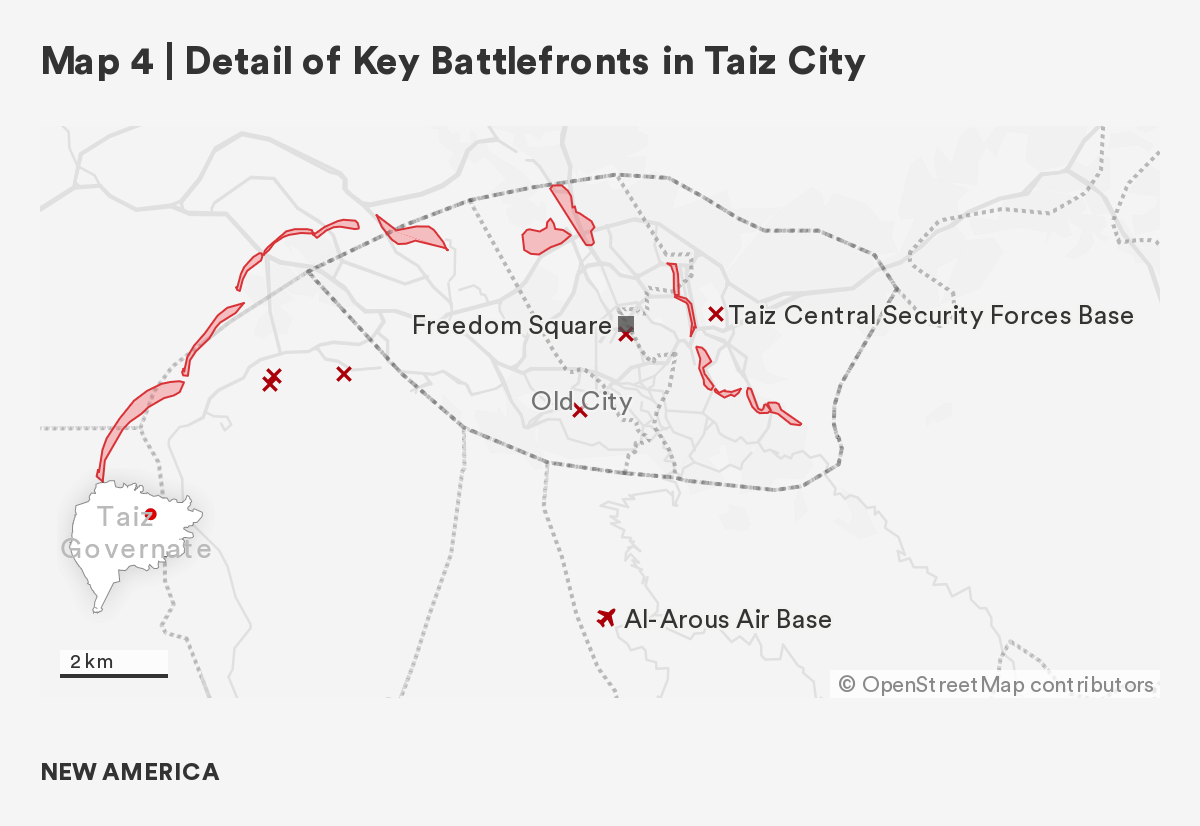
The Al-Hamza Brigade is the descendant of groups initially formed by Sheikh Hamoud Al-Mekhlafi, the original founder—and, according to his backers, still current leader—of the Popular Resistance. Sources on the ground reported that the Al-Hamza group merged with the 170th Air Defense Brigade under the command of Brig. Gen. Abdul Aziz Al-Majidi. Post-merger, Hamoud Al-Mekhlafi’s son Hamza was appointed within the 170th Brigade’s General Staff of the War,10 where his operational mandate is to oversee the northeastern fronts in Kalabah, Zahraa, and Fortieth Street.
In 2015, expanding his presence at the Central Security Forces headquarters and the district of Usaifra, Hamoud Al-Mekhlafi began training his militants to fight against the Houthis from the east of the city to the north. Although his resistance was small, it was one of the first to actively take to the streets against the Houthis. He is therefore hailed by many locals as the military leader and spiritual father of the anti-Houthi resistance in Taiz. In April 2016, Hamoud Al-Mekhlafi’s relations with both Hadi and the coalition frayed, owing in part to his personal frustration with what he perceived as their lackluster support for the battle in Taiz and their focus on fronts elsewhere.11 In 2016, Hamoud Al-Mekhlafi visited Marib, Shabwa, and Saudi Arabia to rally fighters and acquire weapons, ammunition, and money for the liberation campaign for Taiz.12 In retaliation for this and previous public criticism of its liberation efforts, the coalition pushed President Hadi to pressure Al-Mekhlafi to cease his political and military activities in Taiz and leave the city—all of which he did.
According to locals, Hamoud Al-Mekhalfi’s departure created a vacuum in Taiz that was partially filled by his son, Hamza, who took over his political and military responsibilities and maintained his relationships through the eponymous Hamza Brigades.
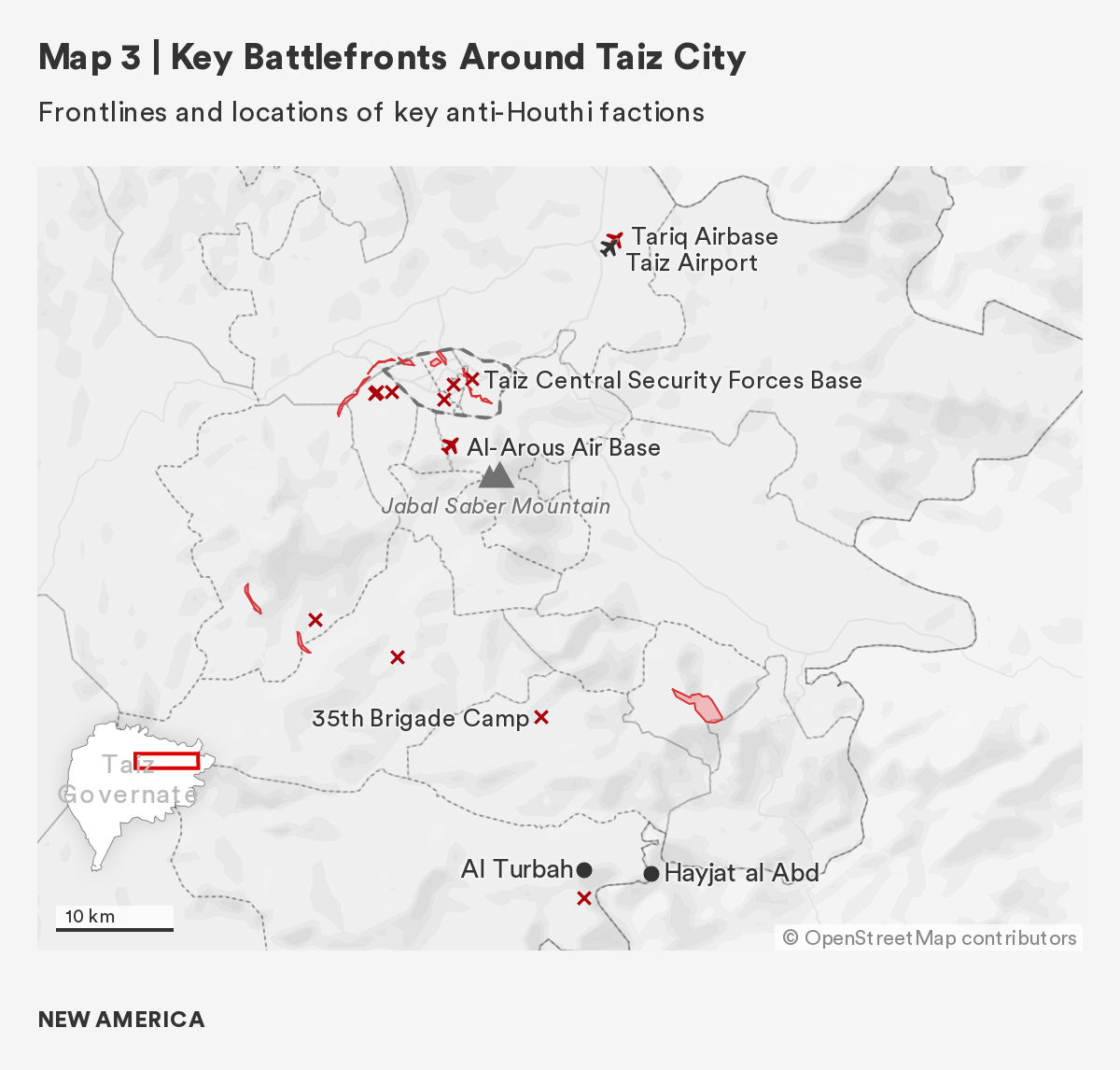
The Hamza brigade contains the remnants of Hamoud Al-Mekhlafi’s forces after his forced ouster from Taiz by Hadi and the coalition. The brigade is based at the front of the district of Kalabah, adjacent to the Central Security Forces camp. Today, many Taizis consider the Al-Hamza brigade an inactive group, due to its lack of progress or retreat from the territory it gained at the beginning of the war. While they have mobilized groups as reinforcements on other fronts, according to field observations, they remain near the battlefield without directly engaging in combat. The brigade employs a strategy to appear more directly engaged in the fighting than they actually are. The brigade possesses a large arsenal of equipment and weapons, but ultimately lacks the manpower to launch battlefield operations.
Fourth Infantry Mountain Brigade
According to interviews conducted for this report, the Fourth Infantry Mountain Brigade is a relatively new brigade established in 2018 by the leadership of the Taiz Military Axis to counter the UAE-backed Thirty-Fifth Brigade in Al-Turbah, Al-Hujariyah and other rural areas in the southwestern suburbs of the city of Taiz. According to these interviews, Hadi appointed Abu Bakr Al-Jabouli, an Islah ally, as the brigade’s commander (he is also an in-law of the former Taiz Military Axis commander, Khaled Fadel). The Yemeni government reportedly directed the Fourth infantry to a training camp in the Al-Masabih area near the town of Al-Turbah, which also received more than 300 recruits from within Taiz, apparently to prepare for confrontations with the Thirty-Fifth armored brigade.
In 2019, a turf war unfolded due to the Taiz Military Axis’s transfer of 500 members of the Thirty-Fifth Brigade to the Fourth Brigade in order to have more soldiers under the government’s control. However, confrontations between the two brigades swiftly ensued due to their collective refusal to accept the executive decisions of Hadi. A number of local contacts tied this to tensions between the Taiz Military Axis and the UAE, connecting it to the UAE’s support of Brig. Gen. Adnan Al-Hammadi in supplying armored vehicles to the Thirty-Fifth Brigade.
145th Infantry Brigade
A fairly new unit, the 145th Brigade falls under the direct leadership of the Taiz Military Axis. Its leader is the same as the leader of the Taiz Military Axis: Samir Al-Sabri. The brigade integrated the former Al-Sa'alik Brigade and other reserve battalions with the intention of unifying the security forces. The 145th is yet another brigade essentially operating under the control of Islah. Sources on the ground indicated that the brigade was preparing to support Hadi’s forces in Aden against the STC, but failed to mobilize.
Al-Sa'alik Brigade:
The Al-Sa’alik Brigade includes groups under the leadership of Azzam Al-Farhan, the son of Abdo Farhan (Salem), who has emerged as one of the most powerful figures in Taiz and an advisor to his father.13 The brigade’s name, which derives from local derogatory usage and means “mischievous outlaws,” was chosen by its young members and is meant to inspire fear on the battlefield. The Al-Sa’alik Brigade is a tactical group of former Popular Resistance fighters tasked with launching offensive attacks on various fronts. They continue to enjoy strong relations with Saudi Arabia, which has provided them with weaponry, including multiple armored vehicles—boldly emblazoned with the words “145th Brigade Command and Al-Sa’alik”—and modern equipment considered superior to that possessed by other groups. According to interviews, most of the members of this brigade are also the sons of Islah members who have previous combat experience. After their integration into the army, they became part of the 145th Brigade of the Taiz Military Axis, though they retain a significant amount of autonomy.
Fifth Brigade (Presidential Guard)
The Fifth Brigade sits under the umbrella of the Taiz Military Axis. The Fifth Brigade was created to formalize the Hasm Brigades as well as strengthen Hadi’s influence in Taiz. Adnan Ruzayq leads the collective brigade, whose work as part of the Presidential Guard directly involves it in confrontations with the Houthis. It maintains a number of sites in the western part of the city, including Al-Sayahi and Hadhran. Interviewees claimed that support for the Fifth Brigade comes directly from the office of the president, especially from Nasser Hadi, the president’s son, and the figure responsible for the Presidential Protection Forces. Reports based on interviews with fighters on the ground indicate that prior to the creation of this force, the Hasm Brigades received substantial support from the UAE.
Hasm Brigades:
Led by Salafist Adnan Ruzayq, a native of the southern governorate of Shabwa who grew up in Taiz, the Hasm Brigades are an armed group that came to prominence through its participation in the battles of Aden. After the liberation of Aden, the Hasm Brigades coordinated with one of the prominent field leaders in Taiz, Ammar Al-Jandabi. The transfer of Ruzayq’s weapons (used previously in Aden), made it possible for the brigade to quickly expand its activities in Taiz. The brigade has a strong record of participating in battles for the liberation of the city. Interviews confirm that Ruzayq merged his forces with those of the Taiz Military Axis, and in 2017, he was promoted to commander of the Fifth Presidential Guard, under the direct command of President Hadi. According to these interviews, Hadi chose Ruzayq mainly because of his good ties with Islah, which he maintains despite not personally being a member of the political party.
While Ruzayq maintains a firm relationship with the Islah networks, he is also known for adopting a balanced approach to adversaries. Ruzayq acted as an intermediary to help calm the situation between Islah and the Abu Al-Abbas Brigades in the city of Taiz during the fighting between the two groups throughout 2017.14 He has also been accused of having ties to al-Qaida;15 a number of fighters from Hasm, including Ammar al-Jundubi,16 are alleged members of the group.
Armed Groups Outside the Taiz Military Axis
While the bulk of armed groups in Taiz have been subsumed and incorporated into the Yemeni military via the Taiz Military Axis (and fall under the Fourth Military Region command of the Army), some have remained effectively outside of its chain of command. In other words, while they are officially and technically contained within the same structure, there is a de facto split between them. Chief among these armed groups operating outside of the Taiz Military Axis are the Thirty-Fifth Armored Brigade and the Abu Al-Abbas Brigades, which ostensibly have been integrated into the Thirty-Fifth Armored Brigade. Both of these forces are led by figures who view themselves as rivals to the wider Islah-aligned network; they have each benefited from support from both Saudi Arabia and the UAE, though in the wider public sphere, they are seen as being aligned with the UAE.
Thirty-Fifth Armored Brigade:
The Thirty-Fifth Armored Brigade announced its support for the internationally recognized government under the leadership of Brig. Gen. Adnan Al-Hammadi,17 alleged by Islah supporters in Taiz to be connected with Nasserist Party leader Abdullah Noman at the onset of the war. Locals mentioned that in response to the Thirty-Fifth Brigade’s declaration of support, the Houthis seized the brigade headquarters, displacing its soldiers, who fled to Al-Thabab district. There, the soldiers regrouped, and after several months returned to fight the Houthis across Taiz. The brigade opened new battlefronts against the Houthis and eventually regained control of several military sites. The Thirty-Fifth Brigade is now the most powerful military force in Al-Hujariyah, the western rural area of Taiz.
The brigade is officially under the Fourth Military Region, and the Hadi government pays the soldiers’ salaries. That being said, there are de facto divides that grant the brigade autonomy. There are sharp differences between the Thirty-Fifth Brigade and the military leadership structures of Islah. Many locals have accused Islah-affiliated officials of aiming to reduce the brigade’s power by redistributing members of the brigade to other military units more directly under Islah’s control within the Taiz Military Axis, something that, as of yet, has proven relatively unsuccessful.
The UAE, anxious about Islah’s dominance in Taiz, has sought to bolster the Thirty-Fifth Brigade, providing financial and military support to Brig. Gen. Adnan Al-Hammadi.18 The significant amount of armored vehicles and other military and financial resources provided by the UAE has allowed General Al Hammadi to expand his foothold in areas already under his control. Simultaneously, civilians in Taiz reported that the UAE has launched a surge of UAE Red Crescent Projects in these same brigade-controlled areas, aimed at winning the hearts and minds of locals.
Tensions between the Taiz Military Axis and Adnan Al-Hammadi have frequently surfaced. Most of this tension has played out across spaces in close proximity to both the Axis’ established military brigades and areas controlled by the Thirty-Fifth Brigade. In Al Turbah, for example, the Axis established the Fourth Mountain Infantry Brigade (Islah-backed) adjacent to the Thirty-Fifth Brigade. Reports of further confrontations between the two sides continue, including over the Thirty-Fifth Brigade’s detention of arms shipments bound for the Fourth Brigade.
These tensions led to occasional skirmishes beginning in 2017. Multiple attempts by the local authorities to unify the factions and reduce tensions have failed.19 In late 2018, representatives of the GPC, YSP, Islah and NUPO held a meeting in China and called on the military factions to implement Al-Khayami agreement (signed by the leadership of both the Axis and Thirty-Fifth Brigade) to dismantle the new posts and return occupied areas to a joint security committee.20 However, local civilians are doubtful that the agreement will ever be implemented.
On December 2, 2019, Al-Hammadi was killed in Taiz.. His death, amidst some unconfirmed rumors of Islah involvement, illustrates the continued fragmentation of the war in Taiz and the role of local politics.
Abu Al-Abbas Brigades
The Abu Al-Abbas Brigades are armed groups collectively led by Adel Abdo Farea Al-Thabhani, who calls himself Abu Al-Abbas (the father of Abbas). The brigades have ostensibly been integrated into the Thirty-Fifth Brigade. A 48-year-old local from the old city district of Taiz, Al-Abbas describes himself and his followers as Salafiis from Dammaj.21 However, local observers counter that as much as 90 percent of his armed forces are ordinary people. Moreover, they recall that he has also incorporated and aligned himself with a number of figures who were originally members of the GPC and historically felt animus toward Islah. Abu Al-Abbas's fighters were included in the Thirty-Fifth Armored Brigade when Yemen’s Popular Resistance was merged into the chain of command of the Yemeni military, but despite integration into the payroll, full structural command and control did not follow.
The rise of Abu Al-Abbas is emblematic of the means by which various, once unknown individuals have managed to rise to prominence during the conflict. Abu Al-Abbas began as a financial officer to a military leader named Abu Al-Sadouq.22 He used this position to build his own independent channels with funders, eventually forming an armed group and making the Old City his stronghold. Concentrating his forces on eastern areas of the city, Al-Abbas liberated much of city of Taiz from Houthi control. With the support of the coalition, Abu Al-Abbas seized many of the government institutions from the Houthis and their allies, in addition to garnering significant sway on financial channels to anti-Houthi armed groups in Taiz.
According to local contacts, Abu Al-Abbas’s fighters have benefitted from UAE support since 2015. This has often resulted in a difficult balancing act. In one telling event in November 2015, after receiving four armored vehicles from the UAE, Abbas festooned them with Emirati and Yemeni flags and paraded them around the city of Taiz. Al-Abbas’s flaunting of its relationship with the UAE angered Saudi leaders, who were also supporting Al-Abbas, and resented the absence of the Saudi flag. Attempting to diffuse the situation and demonstrate his loyalty to both sides. Al-Abbas again paraded the vehicles, this time with Saudi flags waving alongside those of the UAE.
According to interviews, Abu Al-Abbas seized sensitive institutions such as the buildings of the Political Security Organization, responsible for gathering intelligence led by military officers, and the Military Police base, a longstanding law-enforcement institution. By 2017 Abu Al-Abbas controlled much of the Old City, as well as economic institutions such as Yemen’s Tobacco and Matches Company, a major source of income for the state.
As Abu Al-Abbas’s strength grew, his relations with Islah networks deteriorated. Islah groups engaged in proxy battles with Abu Al-Abbas via affiliated parties, such as the 170th Brigade. Opponents of Abu Al-Abbas waged a media campaign against him; Islah continued to claim that he was a terrorist and spread rumors about underground prisons where he personally tortured and executed his opponents.23 Consistent negative media attention caused local and regional public opinion to turn against Al-Abbas.
In October 2017, the U.S. Treasury Department added a number of individuals and groups to the terrorist list, including Abu Al-Abbas or Adel Abdo Farea Al-Thabhani, who was accused of financing terrorist elements affiliated with al-Qaida.24 Abu Al-Abbas categorically denied the accusation, and blamed the United States’s decision on malign influence from Islah and Qatar. According to interviews, in the lead up to the terrorist listing, Saudi Arabia allegedly asked Abu Al-Abbas to leave Yemen and withdraw from the political and military scene (he refused).25
According to sources, in late 2017, rhetorical hostilities between Abu Al-Abbas and Islah simmered into armed conflict. By 2018, the conflict had intensified, with sporadic fighting radiating outward from the city center. Despite a tentative ceasefire, clashes between the two sides continued intermittently until the beginning of April 2019. These violent confrontations killed tens of civilians and fighters, paralyzing Taiz and further demoralizing its long-suffering population (the siege of the Old City, Abu Al-Abbas's stronghold, was particularly brutal). Although the pretext for ongoing hostilities changed by the day, the Taiz Military Axis ultimately sought to kick Abu Al-Abbas and his forces out of Taiz. After rounds of talks by meditative military committees and several orders from President Hadi, Abu Al-Abbas finally agreed to leave the city.
Al-Qaida in the Arabian Peninsula (AQAP) and Ansar al-Sharia
While the anti-Houthi coalition mostly consists of the two major alignments described above, a third force is also active in Taiz. Portrayals of Taiz as an extremist haven are exaggerated, but the conflict has—or at least had—proven a boon to AQAP’s presence in the city. The Yemen war marks the first time that AQAP has maintained an open presence in Taiz, where it took advantage of the wider dynamics of the conflict, positioning itself as an effective anti-Houthi fighting force.
Historically, while AQAP has recruited from disaffected urban youth in cities like Sanaa, Hudayda, Aden, and Taiz, the balance of their activity has been elsewhere in the country, mostly in more sparsely populated and isolated areas in governorates, like Marib, Abyan, and Shabwa.26 The rise of the Houthis—and the accompanying collapse of the state—allowed AQAP and its front group, Ansar al-Sharia, to capitalize on power vacuums across the country. They simultaneously cast themselves as vanguards of Sunni Islam in an aim to capitalize on anti-Houthi feeling and the accompanying rise in sectarian sentiment.27
According to locals, al-Qaida established a military presence in Taiz at the outset of the war, operating in now-defunct jails and military bases. At first, the al-Qaida presence on the battlefield in Taiz was scattered across different fronts. Diverse AQAP members and groups eventually united into one force: the Ahl Al-Sunnah Brigades, now known as the Ansar Al-Sharia of Taiz. The group soon began documenting and photographing their battles in Taiz. In early November 2015, they began to release videos of the so-called Ansar Al-Sharia in Taiz, highlighting their role in the two-year long battle for the neighborhood of al-Jahmaliya, a fight that also pulled in members of the Abu Al-Abbas Brigades.28
In an effort to win support, Ansar Al-Sharia launched a savvy digital media campaign, filming their battles with modern equipment such as Go-Pro cameras, which appealed to young followers. Other films they produced portrayed the Houthis as terrorists and Iranian stooges and contained distressing scenes of violence and brutality.29 Locals mentioned that they also launched a variety of recruitment operations, including distributing propaganda, a (short-lived) weekly newsletter, mobile recruitment centers and, in one case, a memorization competition.
However, under the governorship of Amin Mahmoud, security campaigns forced the militants to depart from Taiz and relinquish the areas under their control. Furthermore, AQAP’s activities in Taiz have appeared to decline following their loss of the Yemeni port city of Mukalla in April 2016; while Mukalla is distant from Taiz, it robbed the group of a safe haven, one that provided both financial resources and operational space.30 As with elsewhere in Yemen, AQAP also appears to have been forced to reduce their activities in Taiz owing to their loss of critical revenues from Mukalla. While local contacts say that AQAP-aligned fighters can still be found in Taiz, since the middle of 2018, they appear to have largely withdrawn from the city. This withdrawal does not entirely remove the possibility of al-Qaida sleeper cells, but it did eliminate the open presence of al-Qaida in Taiz, which locals previously observed riding around in marked vehicles distributing propaganda pamphlets.
While hardened al-Qaida and ISIS fighters have mostly fled Taiz (largely to the governorates of al-Bayda, Hadramout, Shabwa and Lahj), local sources say that other AQAP fighters have moved to an area near Jabal Habashi, al-Kadaha, and Al-Shuraja in Taiz’s rural west, where they continue to clash with Abu Al-Abbas fighters. Most notably, veteran AQAP leader Bilal Al-Wafi sought refuge in Al-Shuraja until his arrest on May 18, 2019 by the Seventeenth Brigade.31 Local Taizis who previously fought for extremist groups have largely either defected from these groups and gone into hiding or been arrested. This demonstrates the ephemeral nature of allegiances in the conflict: Many joined up with AQAP-aligned groups more for practical, rather than ideological, reasons.
Citations
- “Wazir Al-Difa’ Yuqil Qaid Al-Liwa 35,” Mareb Press, October 27, 2014, source ; “Caught in the Middle: A Conflict Mapping of Taiz Governorate,” 20.
- “Caught in the Middle: A Conflict Mapping of Taiz Governorate,” 21; “Hadi Sacks Taiz Governor under Islah Pressure,” Aden Press, December 31, 2018, source
- “Colonel Al-Raimi Confirms the Liberation of the Republican Palace in Taiz,” SeptemberNet, June 13, 2017, source
- “Qa’id Al-Mujahideen Ila Al-Dhawo: Senario Aden Yahoom Fawq Taiz!”
- Wi’am Al-Sufi, “Kaif Istaqbal Nashitoon Qarar Hadi,” Al-Mawqea Post, January 1, 2018, source ; “Ta’arif Ala Jaysh Al-Doha Fi Taiz Wa Abraz Qit’atih Al-Askriyah,” Anba Yemeniah, September 18, 2018, source
- Wi’am Al-Sufi, “Qayid Aljabhat Alshamaliat Fi Taezin Yuakid ’Iihraz Almuqawamat Taqadumaan Kabiraan Ealaa Almlyshyat,” Al-Mawqea Post, June 10, 2016, source
- “17 Infantry Brigade Commander Survives Assassination Attempt at South Taiz,” Al Masdar Online, November 18, 2018, source
- “Second ‘Hadi’ Forces Commander Survives An Assassination in Taiz Within 24 Hours,” Debriefer, November 18, 2018, source
- “Qarar Jamhowry Bitayeen ‘Almajidi’ Qayidaan Lilwa’ 170,” AlHarf28, February 20, 2018, 28, source
- “Akad Tawafuq Aljamie Alaa Taeyin Najl ,” Yemen Now, October 18, 2016, source
- Wi’am Abdulmalik, “Ma Wara’ Tahrokat Al-Sheikh Al-Mekhlafi Tijah Marib Wa Al-Mamlakah?,” Al-Mawqea Post, April 3, 2016, source
- Ibid.
- Hanan Al-Hakry, “Yemen: Blood and Fire in Taiz,” Ahram Online, March 28, 2019, source
- “Lajnat Wasata Tukhmid Ishti’al Al-Mowajahat Fi Taiz,” Asharq Al-Aswat, April 28, 2019, source
- Maggie Michael and Trish Wilson, “U.S.-backed coalition cuts deal with al Qaeda in Yemen,” AP, August 7, 2018, source
- According to local sources, Amar Al-Jundubi attended Al-Eman University, a Sunni religious school founded by Abdulmajid Al-Zindani, a ‘Specially Designated Terrorist’ and cofounder of Islah. For more, see: Laura Kasinof and Scott Shane, “Radical Cleric Demands Ouster of Yemen Leader,” The New York Times, March 1, 2011, source
- “War in Yemen: Taiz on the Frontline,” The New Arab, April 20, 2015, source
- Fernando Carvajal, “Anatomy of Chaos: Yemen’s Taiz,” Gulf State Analytics, April 9, 2019, source
- “Ahzab Yemeniyah Tado’o Tanfeeth Itifaq Al-Khayami,” AlHarf28, November 26, 2018, source
- “Ahzab Yemeniyah Tado’o Tanfeeth Itifaq Al-Khayami.”
- Dammaj is a city home to Dar Al-Hadith, a Salafi school, that was besieged by the Houthis in 2011 and 2014 until the Salafi population was forced to leave after multiple ceasefire attempts, resulting in a Salafi exodus. Maysaa Shuja al Deen, “The Houthi-Tribal Conflict in Yemen,” Carnegie Endowment for International Peace, April 23, 2019, source
- Abdulhakim Hilal, “Fi Awal Hiwar Lah.. Al-Shaykh Al-Salafi ‘Abu Al-Sadouq’: ‘Abu Al-Abbas’ La Yomathilna,” Yemen Shabab Net, September 17, 2018, source
- “Maqabir Sirryah Tabi’ah Li’ Katayeb Abu Al-Abbas B’Taiz,” Al Jazeera, October 22, 2018, source ; “Tensions Heighten between Pro-Hadi Groups in Yemen’s Taiz,” Middle East Eye, August 30, 2018, source
- “Counter Terrorism Designations,” Office of Foreign Assets Control U.S. Department of the Treasury, October 25, 2017, source
- Raghavan, “The U.S. Put a Yemeni Warlord on a Terrorist List”; “Abu Al-Abbas Battalion Leave Taiz, End Infighting,” Debriefer, April 27, 2019, source
- Michael Horton, “Fighting the Long War: The Evolution of Al-Qaida in the Arabian Peninsula,” CTC Sentinel 10, no. 1 (2017).
- Ibid.
- Walid Al-Amri, “Al-Qaeda Yabith Tasjilat Hiya Al-Oula To’wathiq Hodhooroh Al-Qitaly Fi Taiz,” Khabar News Agency, November 11, 2015, source
- “Al-Yemen: Al Qaeda Tunshir Videohat Lihajamat Ala Qiyadat Houthiyeen Wa Tohatheraho,” CNN Arabic, August 7, 2016, source
- Yara Bayoumi, Noah Browning, and Mohammed Ghobari, “Special Report – Al Qaeda Emerges Stronger and Richer from Yemen War,” Reuters, April 8, 2016, source
- “Regional Overview – Middle East 29 January 2019,” ACLED, January 29, 2019, source ; “Yemen’s Government Forces Arrest Key Al-Qaida Leader,” AP, May 19, 2019, source