The Pre-K Pinch and the Middle Class

Most parents have eighteen years to save up for their child’s college tuition. Now imagine having only three or four years to save up for the same amount. Actually, you’re not imagining – it is a reality for many parents of young children who are struggling to pay for the cost of high-quality preschool. In a majority of states, the average annual of costs of early childhood care and education for a four-year old exceed the costs of tuition and fees at a four-year public university. And, like college costs, increases in the cost of preschool have outpaced inflation in recent years.
Toss in a sagging economy, and the fact that many young families have more than one child, and the costs of childcare are a huge burden, especially for low-income families. A new report by Pre-K Now’s Albert Wat shows that preschool costs are a sometimes unaffordable for middle-income families too.
Twenty of the thirty-eight states that have public pre-kindergarten programs have income eligibility requirements that limit enrollment to only the neediest of students. Wat calculates that some 700,000 three- and four- year olds are in families that earn too much to qualify for public pre-k (anywhere from 265 to 450 percent of the poverty threshold, depending on the state) but not enough to afford rent, bills, etc. and preschool. In many states, preschool and childcare alone eat up nearly a third of a typical middle-class family’s monthly income.
In
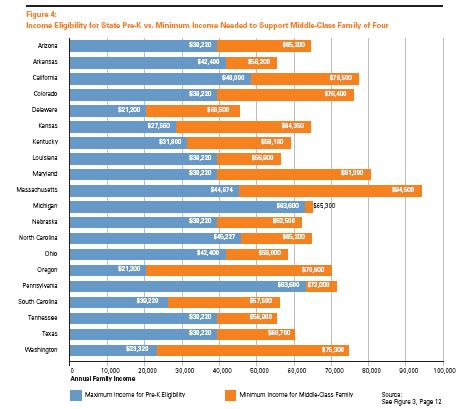
These disparities underscore the need for universal preschool programs that will benefit the middle class and act as a source of stability for children during periods of family financial turmoil. However, quality is a foremost concern, so states should start small, get it right, and then scale up. In a conference call with reporters on Wednesday, Douglas Besharov of the American Enterprise Institute also made another important point: Many children who do make it into state pre-k are only in half-day programs, leaving their parents struggling to find “wrap around” care for the rest of the day. Besharov advocates targeting dollars and effort towards creating comprehensive, full-day programs for the neediest of children before expanding the number of children served.
This is a timely report. In fact, because this report was researched and written before the most recent tumble in the markets, the number of middle class families feeling the pre-k pinch may actually be bigger and growing. Legislatures at the state and federal level have been taking steps to make sure students can afford the cost of higher education in the midst of the economic downturn, but this report suggests that early education needs some attention too. Take a look at the Pre-K Now data and recommendations here.
Graph from “The Pre-K Pinch: Early Education and the Middle Class” by Albert Wat.
More About the Authors
Issues
Programs/Projects/Initiatives
Related
Confronting Harmful Federal Disability Policy in Health and Human Services

Federal Early Education Update: March 2026
A Bureaucratic Shakeup Threatens Future Child Care Research