
Table of Contents
The Need and Precedents for Indoor-Only Use Rights
Wireless Data Consumption Occurs Predominantly Indoors
It has become clear in recent years that the surging demand and need for high-capacity wireless broadband and data connectivity is increasingly indoors. As Google’s Preston Marshall observes in his new book Evolving to 6G: “Cellular technology dominates outdoors, but wireless is dominated by indoor usage. The proposed needs for 5G and 6G technology are mostly indoor applications.”1 He observes that the very high-capacity applications most frequently offered as the rationale for investments in 6G connectivity—such as robotics, Industrial Internet of Things (IIoT), virtual reality, telepresence, immersive gaming, and more—will operate almost entirely indoors. Further, Wi-Fi may not provide the capacity and reliability to meet all of these needs. Many, if not most, of these private networks are layered on top of Wi-Fi, which is often needed to serve other needs and may be less reliable for certain critical Internet of Things (IoT) applications.
The rapidly increasing need for indoor wireless connectivity has been most evident in the evolution of Wi-Fi offload. Americans spend more than 90 percent of their time—and consume more than 80 percent of their data—indoors.2 As of 2022, the average U.S. household owned 16 connected devices.3 We are even more likely to use high-bandwidth applications at home or at work, where devices automatically connect to Wi-Fi and to the lower-cost data supplied by our fixed internet connections. A decade or more ago, the throughput provided by a Wi-Fi router typically far exceeded the typical home or business internet connection. But the proliferation of fiber and Data Over Cable Service Interface Specification 3.0 reversed the wireless internet bottleneck. The concurrent emergence of mobile 4G and now 5G applications brought additional demand indoors as smartphones and other mobile devices routinely switch to Wi-Fi.
“Americans spend more than 90 percent of their time—and consume more than 80 percent of their data—indoors.”
As broadband data consumption indoors continues to rapidly grow, both in absolute and relative terms, the share of mobile device data traffic offloaded to Wi-Fi (and thus bypassing cellular networks) exceeds 80 percent in the United States and reportedly exceeds 90 percent in Europe.4 In fact, the economics of indoor use over shared spectrum allows Comcast, Charter, and Cox to support more than 15 million subscribers with a high-capacity mobile service that relies principally on Wi-Fi and, for use ‘on the go,’ mobile connectivity via Verizon. For example, Comcast reports that “today 90 percent of the mobile data traffic on Xfinity Mobile devices travels over Wi-Fi, not cellular” and delivers mobile download speeds up to 1 gigabit per second (Gbps).5
A separate surge in demand that is just beginning and more relevant here derives from private Internet of Things (IoT) networks that are not offloading personal communication but connecting and controlling an increasing share of everything else. While IoT devices each generally use a small amount of bandwidth, they must do so continuously and reliably, and aggregate bandwidth use can quickly expand as more devices are added to the same connection.6 Indoor data consumption is expected to grow as IoT devices continue to proliferate. Enterprises are similarly expected to see a massive increase in their data needs, especially as the frequency of videoconferences increases.7 The World Broadband Association estimates that even a 10 percent penetration rate of virtual reality teleconferencing in a typical enterprise could require 10 Gbps per access point within the next few years.8
Novel and upcoming applications are also rendering higher data use the norm. Depending on the type and quality of content, streaming virtual reality (VR) video can take 700MB to 1.5GB per hour, VR gaming can take 4GB to 8GB per hour, and application updates can require some 100MB to 500MB.9 Multi-sensory extended reality will enable activities like virtual drone racing and other realistic interactive sports that could include a 360-degree spherical display and extremely high-resolution images (e.g., 2x16K resolution could require an uplink data rate of around 4 Gbps).10 Holographic-type communication uses 3D holograms for use cases like telepresence, education, and remote assistance; it is expected to require 100 Gbps in the next few years and potentially more than 1 terabyte per second in the next decade with the growth of 6G.11
There are also particular venues and events where the aggregate demand for data is already massive and growing fast. This will include not only large performance and sports venues but also interactive events where, for example, children meet holiday or other special characters in an immersive environment.12 Today, venues that host major sporting competitions already handle vast amounts of data. The recent Super Bowl LVIII, for example, handled 34.8 TB of data transfer throughout the event, and aggregate data use at events like these is only trending up.13
“The recent Super Bowl LVIII, for example, handled 34.8 TB of data transfer throughout the event, and aggregate data use at events like these is only trending up.”
While the full scope and nature of our future 6G wireless ecosystem remains hypothetical, descriptions of the very high-capacity use cases are overwhelmingly indoors. In his book, Marshall creates a taxonomy of the list of candidate 5G and 6G use cases put forth by the Next G Alliance and by the Next Generation Mobile Networks Alliance. For 6G, seven of 12 distinctive use cases identified are indoor-only (e.g., telepresence and immersive VR), and three are outdoor-only (field robots, drones, and remote sensing).14 His taxonomy shows that Wi-Fi is currently dominating high-capacity applications, particularly indoors and in commercial settings. Wi-Fi’s dominance will only expand, bandwidth permitting, unless private network operators have an alternative. And expanding indoor-only access to large blocs of spectrum is one alternative.
Unlicensed Indoor-Only Use
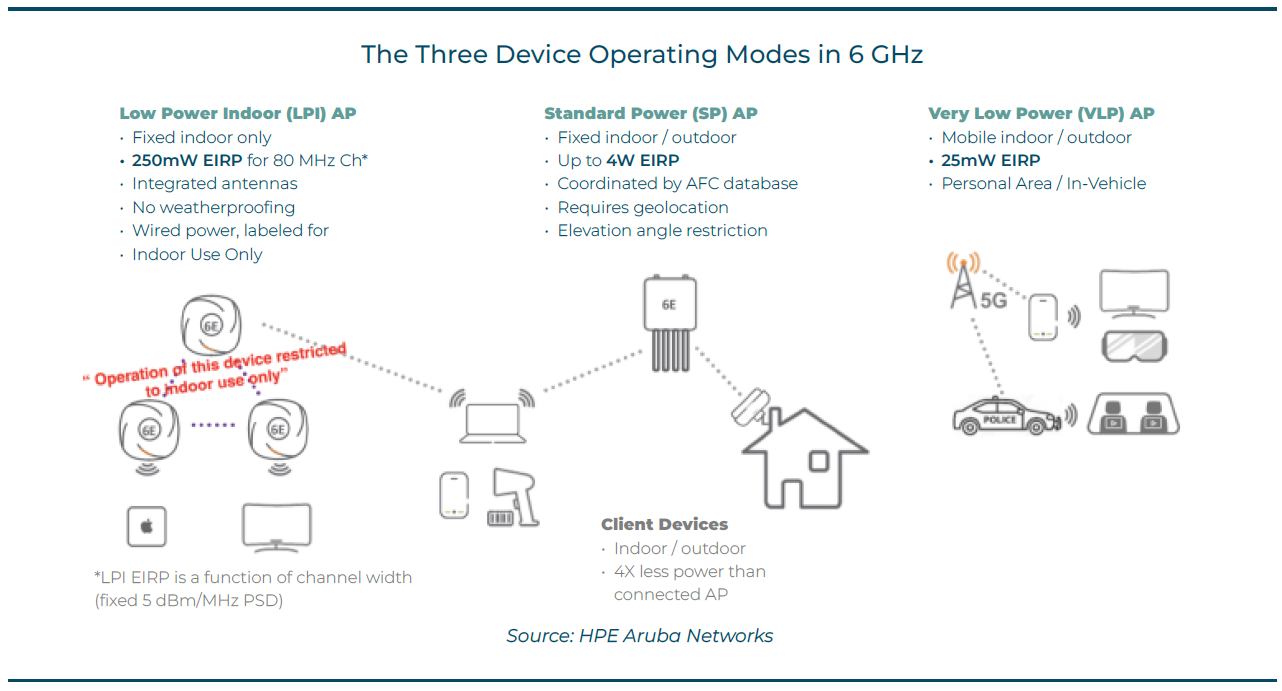
As noted above, the FCC’s 2020 6 GHz Order included a landmark innovation in authorizing indoor-only underlay rights. The order authorized low-power, indoor-only (LPI) use across 1,200 megahertz (5925–7125 MHz), as well as standard power use both indoors and outdoors on 850 megahertz subject to control by an Automated Frequency Coordination system. The Commission noted that in defining a separate LPI authorization, it was resurrecting and building upon a since-repealed indoor-only condition on unlicensed use of the U-NII-1 band in the lower 5 GHz band (5150-5250 MHz). In the course of rejecting CTIA’s contention that an indoor-only limitation would be ineffective, the FCC stated that its experience to date has demonstrated that “outdoor operation of indoor[-only] devices has not been a problem.” It stated: “The Commission’s Part 15 rules prohibited outdoor operation in the [Unlicensed National Information Infrastructure] U-NII-1 band from 1997 until 2014 and currently prohibit outdoor operation for unlicensed devices in the 92–95 GHz band and many ultra-wideband devices.”15
Michael Calabrese, “Solving The Spectrum Crunch,” Dynamic Spectrum Alliance, October 2023, https://www.dynamicspectrumalliance.org/solving-the-spectrum-crunch.pdf.
The 6 GHz Order authorizes LPI to be subject to three overall safeguards: “Devices are: (1) limited to indoor operation; (2) required to use a contention-based protocol; and (3) subject to low power operation.”16 “By restricting such devices to low power, indoor use, we anticipate that incumbent licensed services would be protected from harmful interference, in part due to significant building attenuation and clutter losses for transmissions originating from indoor devices.”17
The primary means of keeping LPI devices indoors—and thereby protecting band incumbents (the most numerous and sensitive of which are fixed microwave links)—include three form-factor requirements that access points (e.g., Wi-Fi routers) must incorporate in order to be certified to operate in the 6 GHz band without being under the control of an Automated Frequency Coordination (AFC) system:
- Battery power prohibited: Indoor devices must require a direct connection to a wireline power outlet, which inherently limits mobility and, thus, outdoor use.
- No weather resistant casing: Indoor devices cannot be weatherized, waterproofed, or have any special shielding from outdoor weather conditions.
- Must have integrated antennas: An LPI access point must have no external antenna and no capability to attach external antennas, which could be used to boost the effective strength of the signal.18
In addition, LPI access points also must be explicitly marketed as “for indoor-use only” and include a label attached to the equipment stating that “FCC regulations restrict to indoor use only.”19 In addition, to better protect electronic news gathering (ENG) receivers from harmful interference, the Order requires that both LPI access points and their associated client devices (e.g., laptops or smartphones) employ a contention-based protocol, such as the listen-before-talk protocol already built into Wi-Fi’s 802.11 standard.20 Because broadcast ENG devices are mobile and can operate indoors, there is concern about significant risk of harmful interference to ENG receivers operating indoors at locations where broadcasters may not control the venue.
The third type of restriction on LPI devices is power. Because “the signals transmitted by these unlicensed devices will be significantly attenuated when passing through the walls of buildings,”21 the FCC adopted a power limit (5 dBm/megahertz power spectral density) that is far lower than the “standard power” limit afforded to unlicensed devices that operate in the band under AFC control (and therefore operate only outside protection areas calculated for each fixed microwave receive link in the 850 megahertz where they are authorized). The agency derived the LPI limit by factoring in the typical signal attenuation attributable to building entry loss (BEL) and the signal interference threshold proposed by the operators of fixed microwave links.22 Although the Monte Carlo simulation analysis the FCC relied on assumed an LPI power spectral density (PSD) of 8 dBm/megahertz, the FCC decided to adopt the substantially lower limit of 5 dBm/MHz PSD, “a precaution we take at this time to protect incumbent operations given the state of the record.”23 The higher power level remains an open and contested issue in the 6 GHz Further Notice of Proposed Rulemaking.
Notably, in 2017, the same FCC under Chairman Ajit Pai that authorized 1,200 megahertz of unlicensed LPI use in 6 GHz declined to authorize an indoor-only unlicensed underlay in the 70 and 80 GHz spectrum that is coordinated for high-capacity point-to-point links under a license by rule framework for both federal and non-federal use.24 The FCC concluded that “our decision to delay introducing unlicensed indoor use at this time furthers the public interest by protecting existing operations and successful services in the 70 GHz and 80 GHz bands without foreclosing future innovations in these bands.”25 However, as the Order also stated, “the current availability of 14 gigahertz of contiguous spectrum for unlicensed operations immediately below the 70 GHz band reduces the urgency to introduce unlicensed indoor use in the 70 GHz and 80 GHz bands.”26
“Contained Access Facilities” in Citizens Broadband Radio Service
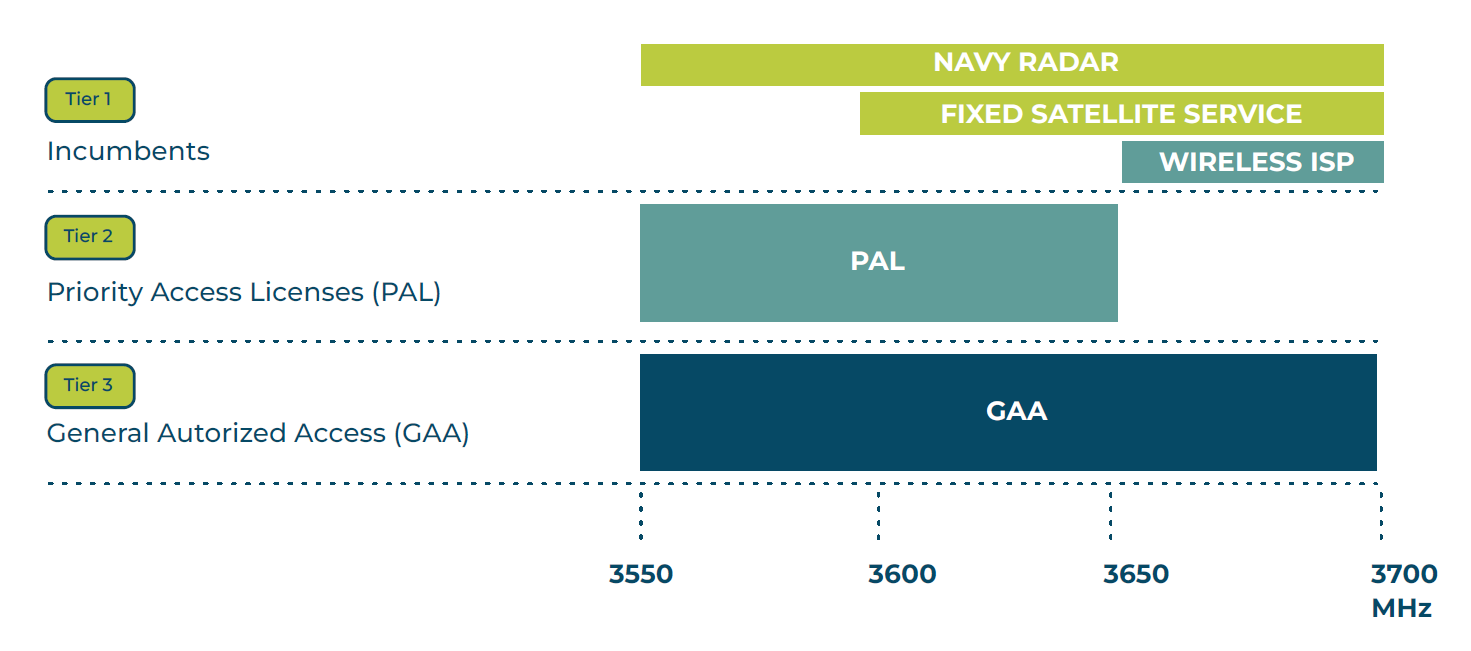
As the introductory chapter notes, in August 2024 the FCC released a Notice of Proposed Rulemaking that revisits the “Contained Access Facilities” concept it proposed but declined to adopt in the original 2015 Citizens Broadband Radio Service (CBRS) three-tier sharing framework.27 At that time, the FCC asked whether it should “allow critical users—such as hospitals, public safety organizations, and local governments—to receive interference protection, akin to Priority Access licensees, within a limited portion of the General Authorized Access (GAA) pool for indoor use within their own buildings.”28 Under the proposal, facilities that applied and qualified as Contained Access Facilities (CAFs) would receive a reservation for exclusive use of a portion (e.g., 20 megahertz) of the GAA portion of the band indoors, yet they would still “be required to accept interference from GAA transmissions originating outside of their buildings and to undertake reasonable efforts to safeguard against harmful interference from those transmissions.”29 The original FCC proposal also required that, like any other GAA user, they would need to protect against harmful interference to incumbents (e.g., Navy radar) and priority access licensees.
Michael Calabrese, “Solving The Spectrum Crunch,” Dynamic Spectrum Alliance, October 2023, https://www.dynamicspectrumalliance.org/solving-the-spectrum-crunch.pdf.
Although left unstated, we can only imagine that the FCC’s proposal to allow selected facilities to “reserve some amount of GAA spectrum for private, low-power indoor operations” reflects a desire to find a means to allow the CAFs to effectively preclude others from transmitting on those CBRS channels inside their buildings. Since CBRS is a flexible use band that is increasingly incorporated in mobile devices, including newer model iPhones and iPads,30 and the contemplated “critical users” are generally public facilities (e.g., hospitals), coordination by a CBRS Spectrum Access System could prove necessary to minimize the risk of interference to the CAF IoT networks. This highlights the idea that the viability and rules governing indoor-only use are likely to vary band by band, an issue considered further in the final chapter.
United Kingdom, European Union, and China
The rest of the world is generally far behind the United States in authorizing shared underlays or automated sharing in bands already occupied by primary licensees or government users. Both the European Union and the United Kingdom quickly followed the U.S. in authorizing low-power, indoor-only (LPI) license-exempt operations, but so far, only in the bottom 500 megahertz of the 6 GHz band (5925–6425 MHz). Allocation of the remainder of the band remains subject to ongoing study and a contentious debate among proponents of IMT (International Mobile Telecommunications, or mobile carriers) and Wi-Fi.31
There has been some innovation over the last few years, spurred primarily by the FCC’s adoption of CBRS, with its unique three-tier sharing and use-it-or-share-it ethos. In June 2021, the European Union’s Radio Spectrum Policy Group (RSPG) issued an opinion urging more innovation and experimentation in opportunistic spectrum sharing: “The RSPG seeks to nudge a change of mindset: All considerations in the field of spectrum by policymakers, spectrum managers, users, and industry should be done by pursuing better spectrum efficiency through more spectrum sharing, including by following the principle of ‘use-it-or-share-it.’”32
Local Shared Licensing
Led by the United Kingdom, an increasing number of European nations are authorizing a limited version of CBRS for the purpose of providing small operators and enterprises with local access to shared spectrum bands, typically in the upper 3 GHz band (3800–4200 MHz). As part of its framework to enable shared spectrum use and encourage a “wide range of local wireless connectivity applications,” the U.K.’s regulator, Ofcom, offers a shared access license in four spectrum bands that support private mobile and fixed networks, primarily in 3800–4200 MHz.33 Both very low-power and medium-power licenses are available by application. Low-power licenses are available for either indoor or indoor/outdoor use but seem designed primarily for indoor use as they constrain access points to a 50-meter radius coverage area. Ofcom suggests that “the low-power license product could be suitable for industrial and enterprise users looking to deploy their own private networks.”34
In July 2024, Ofcom released a consultation and guidance document that explicitly aimed to “improv[e the] spectrum supply for indoor users” by factoring into the coordination calculation a building and entry loss (BEL) value of 14 dB for coordination in 3.8–4.2 GHz.35 Licensees can connect fixed, mobile, or nomadic terminals to base stations operating within the licensed area. Ofcom also intends to further expand usage with the implementation of its new “User-Led” application framework, which allows rejected applicants to deploy if they can coordinate agreement among affected incumbents.36
Ofcom has also decided to expand its shared access framework by adding 20 MHz of spectrum between 2320–2340 MHz for indoor-only use.37 This decision was made based on collaboration with the band’s incumbent, the Ministry of Defence (MOD), and deployment is pending final approval by the MOD. The parties determined that allowing low-power, indoor-only use would protect military operations while opening up the valuable band to more users. The newly available spectrum will be licensed, subject to registration and the same fee (£80 per 10 MHz) that Ofcom charges for other low-power shared access licenses.38
Other European nations have been steadily adopting their own versions of the U.K.’s local shared licensing approach for the same purpose of providing local enterprise and small broadband providers with direct access to mid-band spectrum on a highly localized basis. Like the Ofcom framework, although there seems to be an expectation that many individual enterprises (e.g., factories) will use the spectrum indoors, there are generally (though not always) no explicit indoor/outdoor distinctions yet in the rules. In Germany, for example, 100 MHz between 3.7–3.8 GHz have been opened to vertical use both indoors and outdoors.39 At 26 GHz, however, Germany allows indoor-only spectrum usage that remains within property boundaries (which depends in part on the electromagnetic shielding of the building) and in areas that are already covered by a larger spectrum assignment.40 These local assignments are subject to agreement by the affected licensed operators.
In Denmark, the Mobile Networks Operation (MNO) with the license to 3740–3800 MHz is obligated to lease out the frequencies upon request to enterprises and public institutions intending to create a private network.41 The private networks must meet technical requirements that allow them to coexist with the public network.42 And Finland’s 3.6 GHz spectrum band is similarly assigned to MNOs subject to leasing requirements: If the spectrum holders fail to offer a service that meets the needs of customers within a certain geographical area (such as a port, hospital, or shopping center), that frequency must be licensed out to an entity able to provide that service in the location.43
Hybrid Sharing
More recently, Ofcom has also taken the lead in considering hybrid sharing between mobile network operators and Wi-Fi networks in the upper 6 GHz band (6425–7025 MHz). This arrangement is largely premised on the natural separation between the former’s outdoor and the latter’s indoor use—otherwise known as an “indoor/outdoor split.”44 Ofcom anticipates that low-power indoor Wi-Fi combined with this natural geographic separation should provide enough protection to both types of users that each can be prioritized in its own respective location. The EU has also approved a work item to study this same hybrid indoor/outdoor sharing approach between cellular (IMT) and Wi-Fi (Radio Local Area Networks, or RLANs) in the 6425–7125 MHz band.45
China’s Pooled Indoor-Only Allocation
To serve a very different purpose, China assigned indoor-only use of the 3300–3400 MHz band jointly to its largest mobile carriers (China Telecom and China Unicom) and to the China Broadcasting Network. The indoor-only use rights were granted on a shared basis to promote co-investment and sharing of 5G indoor access networks.46 This marked the first time China’s Ministry of Industry and Information Technology has taken such a shared approach.47 Chinese press reports did not disclose the nature of outdoor operations in the band.
Citations
- Preston Marshall, Evolving to 6G: The Case for a New Approach to 6G and Beyond (Seattle, WA: Amazon Publishing, May 2024), 95.
- See, for example, Diana Adams, “5 Ways Indoor 5G Will Change Your Life (and Mine),” Ericsson (blog), July 26, 2023, source.
- NCTA, “Broadband Stats: A World of Wi-Fi,” Internet & Television Association, June 22, 2023, source.
- OpenSignal data for 2022 shows between 78 percent and 80 percent of Verizon, AT&T, and T-Mobile mobile subscriber data traffic is carried by Wi-Fi networks. See, for example, “Advancement of 6G Telecommunications Technology,” National Telecommunications and Information Administration, August 21, 2024, 2, source; Dynamic Spectrum Alliance, How Do Europeans Connect To The Internet? (Dynamic Spectrum Alliance, 2022), 4, source (reporting that Wi-Fi represents about 90 percent of fixed broadband traffic in Europe); Claus Hetting, “Report: US cable MVNOs Extract Big Value from Wi-Fi Offload,” Wi-Fi NOW, October 17, 2019, source.
- A year earlier, Charter reported 87 percent offload. See Kohposh Guda, “Comcast Lights Up Wi-Fi Boost Delivering Gig Speeds to Xfinity Mobile Customers on Millions of Wi-Fi Hotspots,” Comcast (blog), April 23, 2024, source; Linda Hardesty, “Charter, Comcast Share Their Wi-Fi Networks for MVNO Services,” Fierce Wireless, May 10, 2023, source.
- Mark Mahle, “Optimizing IoT Networks In An Increasingly Smart, Interconnected World,” Forbes, April 24, 2024, source.
- World Broadband Association, Next Generation Broadband Roadmap 2023–2030 (London: World Broadband Association, June 2024), source.
- World Broadband Association, Next Generation Broadband Roadmap 2023–2030, 17, source.
- Victor Marquez, “How Much Internet Data Does VR Use? – A Detailed Guide,” Tech Tyche, June 4, 2023, source.
- Next G Alliance, 6G Applications and Use Cases (Washington, DC: Next G Alliance, May 2022), 14, source.
- Ian Akyildiz and Hongzhi Guo, “Holographic-Type Communication: A New Challenge for the Next Decade,” ITU Journal on Future and Evolving Technologies 3, no. 2 (Sept. 2022): 425–428, source.
- In these scenarios, bandwidth would be needed to support 8K video for each eye, for a total of 16K. Next G Alliance, 6G Applications and Use Cases, 16, source.
- Cammy Perry, “The Unsung Hero of Super Bowl LVIII – The Network!,” Extreme Networks, February 21, 2024, source; Paul Kapustka, “Super Bowl LVIII Sees Big Jump in Per-Device Wi-Fi Data Used en route to New Total Record of 34.8 TB,” Stadium Tech Report, February 22, 2024, source.
- Marshall, Evolving to 6G, 104–108.
- Federal Communications Commission, Unlicensed Use of the 6 GHz Band, Report and Order and Further Notice of Proposed Rulemaking, ET Docket No. 18-295, 35 FCC Rcd. 3852 at ¶ 148 (rel. Apr. 24, 2020). Also see Federal Communications Commission, Amendment of the Commission’s Rules to Provide for Operation of Unlicensed NII Devices in the 5 GHz Range, 12 FCC Rcd 1576, 1595, para. 44 (1997); Federal Communications Commission, Revision of Part 15 of the Commission’s Rules to Permit Unlicensed National Information Infrastructure (U-NII) Devices in the 5 GHz Band, 29 FCC Rcd 4127, 4237, para. 34 (2014); 47 CFR §§15.257, 15.517(a). Because the U-NII-1 band was only 100 megahertz and subject to extremely low power limits, it wasn’t used extensively until the FCC removed indoor-only restrictions and raised the power limits in 2014. The ultra-wideband and 92–95 GHz devices that are restricted to indoor use must have a warning label and be capable of operating only indoors, which is satisfied if the transmitter must be connected to AC power lines.
- Federal Communications Commission, Unlicensed Use of the 6 GHz Band, Report and Order and Further Notice of Proposed Rulemaking, ET Docket No. 18-295, 35 FCC Rcd. 3852 at ¶ 99 (rel. Apr. 24, 2020).
- Federal Communications Commission, Unlicensed Use of the 6 GHz Band, Notice of Proposed Rulemaking, ET Docket No. 18-295, 33 FCC Rcd 10496, at ¶ 61 (2018).
- Federal Communications Commission, Unlicensed Use of the 6 GHz Band, Report and Order and Further Notice of Proposed Rulemaking, ET Docket No. 18-295, 35 FCC Rcd. 3852 at ¶ 107 (rel. Apr. 24, 2020).
- Federal Communications Commission, Unlicensed Use of the 6 GHz Band, Report and Order and Further Notice of Proposed Rulemaking, ET Docket No. 18-295, 35 FCC Rcd. 3852 at ¶ 107 (rel. Apr. 24, 2020).
- Federal Communications Commission, Unlicensed Use of the 6 GHz Band, Report and Order and Further Notice of Proposed Rulemaking, ET Docket No. 18-295, 35 FCC Rcd. 3852 at ¶ 101 (rel. Apr. 24, 2020).
- Federal Communications Commission, Unlicensed Use of the 6 GHz Band, Report and Order and Further Notice of Proposed Rulemaking, ET Docket No. 18-295, 35 FCC Rcd. 3852 at ¶ 100 (rel. Apr. 24, 2020).
- “The median signal loss from a traditionally constructed building is 17 dB, and newer, highly efficient buildings provide even higher signal attenuation. No commenters disagreed with the ITU median signal loss value for traditional construction.” Federal Communications Commission, Unlicensed Use of the 6 GHz Band, Report and Order and Further Notice of Proposed Rulemaking, ET Docket No. 18-295, 35 FCC Rcd. 3852 at ¶ 100 (rel. Apr. 24, 2020).
- Federal Communications Commission, Unlicensed Use of the 6 GHz Band, Report and Order and Further Notice of Proposed Rulemaking, ET Docket No. 18-295, 35 FCC Rcd. 3852 at ¶ 110 (rel. Apr. 24, 2020).
- Federal Communications Commission, Use of Spectrum Bands Above 24 GHz For Mobile Radio Services, et al., Second Report and Order, GN Docket No. 14-177, at ¶¶ 202-297 (rel. Nov. 22, 2017).
- Federal Communications Commission, Use of Spectrum Bands Above 24 GHz For Mobile Radio Services, et al., Second Report and Order, GN Docket No. 14-177, at ¶ 207 (rel. Nov. 22, 2017).
- Federal Communications Commission, Use of Spectrum Bands Above 24 GHz For Mobile Radio Services, et al., Second Report and Order, GN Docket No. 14-177, at ¶ 207 (rel. Nov. 22, 2017).
- See Federal Communications Commission, Amendment of the Commission’s Rules with Regard to Commercial Operations in the 3550-3650 MHz Band, Report And Order And Second Further Notice Of Proposed Rulemaking, GN Docket No. 12-354, 30 FCC Rcd at 4012-14, paras. 164-69 (rel. Apr. 21, 2015).
- Federal Communications Commission, Promoting Investment in the 3550-3700 MHz Band, Notice of Proposed Rulemaking and Declaratory Ruling, GN Docket No. 17-258, at ¶ 75 (rel. Aug. 16, 2024).
- Federal Communications Commission, Promoting Investment in the 3550-3700 MHz Band, Notice of Proposed Rulemaking and Declaratory Ruling, GN Docket No. 17-258, at ¶ 75 (rel. Aug. 16, 2024).; Federal Communications Commission, Amendment of the Commission’s Rules with Regard to Commercial Operations in the 3550-3650 MHz Band, Report And Order And Second Further Notice Of Proposed Rulemaking, GN Docket No. 12-354, at ¶ 60 (rel. Apr. 21, 2015).
- See “Apple Device Support for Private 5G and LTE Networks,” Apple Platform Development, accessed August 2024, source. Note as well that Verizon was the largest buyer of PALs in CBRS.
- The EU and U.K. also continue to study an authorization for license exempt operations outdoors, which the U.S. and Canada have already implemented, subject to control by an Automated Frequency Coordination System. European Communications Office (ECC), “Higher Power WAS/RLAN in 5945-6425 MHz, SE45_05 Work Item Details,” ECC Work Programme Database, July 10, 2022, source.
- Radio Spectrum Policy Group, RSPG Opinion on Spectrum Sharing—Pioneer Initiatives and Bands (Brussels: European Commission, June 21, 2021), source.
- The bands authorized for local shared licenses include the 1800 MHz band, the 2300 MHz band, the 3800–4200 MHz band, and the 24.25–26.5 GHz band. See “Shared Access Licences,” Ofcom, December 9, 2019, source.
- Ofcom, Shared Access License Guidance Document (London: Ofcom, 2024), 7, source.
- Ofcom, Expanding Access to Shared Spectrum: Statement and Further Consultation on Enhancing the Shared Access Licence Framework (London: Ofcom, 2024), 20, source.
- Ofcom, Expanding Access to Shared Spectrum, 23, source.
- Ofcom, Expanding Access to Shared Spectrum, 27, source.
- Ofcom, Expanding Access to Shared Spectrum, 35, source.
- Radio Spectrum Policy Group, RSPG Opinion on 5G Developments and Possible Implications for 6G Spectrum Needs and Guidance on the Rollout of Future Wireless Broadband Networks (Brussels: European Commission, October 25, 2023), 19, source.
- Bundesnetzagentur, Administrative Rules for Spectrum Assignments for Local Broadband Spectrum Usages in the 24.25–27.5 GHz Band (Bonn: Bundesnetzagentur Federal Network Agency, May 15, 2023), 9, source.
- Radio Spectrum Policy Group, RSPG Opinion on Spectrum Sharing, 19, source.
- Radio Spectrum Policy Group, RSPG Opinion on Spectrum Sharing, 14, source.
- Radio Spectrum Policy Group, RSPG Opinion on Spectrum Sharing, 14, source.
- Ofcom, Mobile and Wi-Fi in Upper 6 GHz: Why Hybrid Sharing Matters, (London: Ofcom, 2024), 5, source.
- “The ECC agreed on a new Work Item to study possible technical conditions for potential shared use of the band 6425-7125 MHz between MFCN and Radio Local Area Networks.” See Electronic Communications Committee, “61st ECC Plenary Meeting, 7–10 March 2023,” European Conference of Postal and Telecommunications Administrations, March 14, 2024, source.
- Xinhua, “China Grants Spectrum Licenses for 5G Indoor Coverage,” China Daily, February 11, 2020, source.
- Xinhua, “China Grants Spectrum Licenses for 5G Indoor Coverage,” source.