
The Next Frontier in Spectrum Policy: Indoor-Only Sharing of Federal Bands
Abstract
Most spectrum licenses (including federal spectrum assignments) confer exclusive or primary rights to transmit on designated frequency bands over defined areas, including inside buildings that are owned and controlled by others. This traditional form of licensing precludes property owners from using the spectrum inside their own buildings, even if the contained transmissions would not cause harmful interference to the primary licensee’s operations outdoors. While unlicensed operations have been authorized, until recently the rules have not differentiated access rights based on indoor-only use. The Federal Communications Commission’s (FCC) recent authorization of low-power, indoor-only use across the entire 6 GHz band highlights the potential to authorize indoor-only use in many other bands, particularly federal bands, where users comply with requirements necessary to protect the primary licensees from harmful interference.
This concept is particularly relevant now, as the National Telecommunications and Information Administration (NTIA) and FCC implement the National Spectrum Strategy by studying alternative means to expand private sector use of underutilized federal bands, particularly bands occupied by U.S. military systems. In addition to exploring key technical and policy considerations in expanding indoor-only authorizations to share more bands, the report suggests five federal bands that may be prime candidates for indoor-only authorizations.
An earlier version of this report was presented by one of the authors, Michael Calabrese, on September 20, 2024, at TPRC52, the 52nd Research Conference on Communications, Information, and Internet Policy.
Acknowledgments
Editorial disclosure: The views expressed in this report are solely those of the author(s) and do not reflect the views of New America, its staff, fellows, funders, or board of directors.
Downloads
Executive Summary
This report explores a tension in spectrum policy that is unnecessarily limiting public access to the airwaves and the benefits of more intensive spectrum sharing and connectivity. Most spectrum licenses (including federal spectrum assignments) confer exclusive or at least primary rights to transmit on designated frequency bands at specific locations or over defined geographic areas, including inside factories, office buildings, and other facilities owned and controlled by others. This traditional form of licensing precludes property owners from using the spectrum inside buildings under their own control, even if the transmissions are contained and would not cause harmful interference to the primary licensee’s operations outdoors. While unlicensed operations have been authorized, until very recently the rules have not been crafted to distinguish between how access rights could vary based on indoor-only use.
This report explores the policy and technical considerations related to expanding indoor-only authorizations to share more bands, particularly federal bands or sub-bands. For example, controlling the spectrum inside a facility is more practical at higher frequencies where transmissions do not readily penetrate building materials or travel long distances. This concept is particularly relevant now, as the National Telecommunications and Information Administration and Federal Communications Commission (FCC) collaborate to implement the National Spectrum Strategy, which is premised on studying alternative means to expand private sector use of underutilized federal bands, particularly bands occupied by U.S. military systems. Five federal bands that may be prime candidates for indoor-only authorizations—1,675 megahertz in total—are discussed in the concluding chapter.
The potential benefits of different rules for indoor-only use are becoming more evident. In 2020, the FCC adopted an order authorizing low-power, indoor-only (LPI) use of 1,200 megahertz on an unlicensed basis across the entire 6 GHz band (5925–7125 MHz), which was already in use by incumbent licensees that include more than 50,000 high-power fixed microwave links. LPI use of this spectrum indoors is limited to roughly one-fourth the standard power of Wi-Fi, yet is considered extremely useful since the vast majority of internet data (including at least 80 percent of mobile device data traffic) is transmitted indoors and over Wi-Fi.
LPI highlights the potential to authorize indoor-only use in many other bands where users comply with power, device form factor, database coordination, or other technical requirements necessary to protect the primary licensees from harmful interference. And while LPI in 6 GHz is authorized under Part 15 of the Commission’s rules (viz., available for use without a license to anyone meeting specified technical requirements), LPI can be adopted as part of a licensed-by-rule framework or licensed exclusively to select categories of facilities (such as factories and schools). LPI underlays also provide another way to expand on the “use it or share it” approach to spectrum sharing, but without the need for control by a geolocation database.
Introduction and Overview
This report discusses the potential to expand the concept of indoor-only rights to use available radio frequency spectrum on a non-interfering basis. More specifically, we explore how indoor-only underlays of unlicensed (or licensed by rule) use rights could promote spectrum access and innovation in many additional bands, thereby providing massive additional bandwidth for private networks and other forms of wireless innovation to a wide variety of enterprises and institutions. This will be increasingly important as spectrum grows more congested and as the overwhelming need for wireless data connectivity is indoors. In this respect, we suggest that the traditional policy of not distinguishing between outdoor and indoor spectrum use unnecessarily limits public access to the airwaves and fails to maximize the benefits of more intensive spectrum sharing and connectivity.
This concept is particularly relevant in the immediate future as the National Telecommunications and Information Administration (NTIA) and Federal Communications Commission (FCC) collaborate to implement the National Spectrum Strategy, which is premised on studying alternative means to expand private sector use of underutilized federal bands, particularly bands occupied by U.S. military systems.1 The precedent of a low-power, indoor-only (LPI) underlay across the entire 6 GHz and the success of dynamic sharing at low power with military radar in Citizens Broadband Radio Service (CBRS) suggest that an indoor-only allocation should be at the forefront of the band studies that are just getting underway as part of the U.S National Spectrum Strategy. For example, in its initial 2023 study and report to Congress on the feasibility of sharing the lower 3 GHz band with the private sector, the Department of Defense stated that “even with stringent adherence to a coordination framework and associated conditions, spectrum sharing between federal and non-federal users in the 3100–3450 MHz band [would] remain challenging.”2
Similarly, large portions of the 7 GHz band currently used by sensitive military systems in the United States and in Europe (e.g., NATO operations in 7250–7750 MHz) may be far more conducive to private sector use indoors in locations, or at power levels, that will not be feasible for commercial use outdoors (and especially not for very wide area mobile networks). With these constraints in mind, LPI authorizations provide an additional way to expand on the “use it or share it” approach to spectrum sharing pioneered in CBRS, but without the need for control by a geolocation database (which requires scale, is costly, and is limited today to just a few frequency bands). Five federal bands that may be prime candidates for indoor-only authorizations—1,675 megahertz in total—are discussed in the concluding chapter.
Most spectrum licenses (including federal spectrum assignments) confer exclusive or at least primary rights to transmit on designated frequency bands at specific locations or over defined geographic areas, including inside factories, office buildings, and other facilities owned or controlled by others. This traditional form of licensing precludes property owners from using licensed spectrum inside their own facility even if the transmissions are contained and would not cause harmful interference to the primary licensee’s operations. Currently, only frequency bands designated for unlicensed use, under Part 15 of the FCC’s rules, allow the public to transmit inside buildings under their control. This leaves enormous wireless capacity fallow indoors, which is precisely where the need and demand for wireless connectivity is predominant and growing most rapidly.
Of course, the concept of an indoor-only underlay has a recent and powerful precedent: The FCC’s 2020 Report and Order authorized LPI use of 1,200 megahertz across the entire 6 GHz band (5925–7125 MHz) on an unlicensed basis.3 While the FCC also authorized unlicensed operations outdoors up to the maximum (standard) Part 15 power level, such use is subject to obtaining a list of available channels and permissible power levels from an FCC-certified Automated Frequency Coordination system designed to protect incumbent microwave fixed links from harmful interference. As described further in the next chapter, the FCC determined that by imposing low-power and form-factor restrictions on LPI access points (e.g., no battery power, no weatherized container, and no external antennas) it could reasonably ensure that indoor-only transmissions posed no significant risk of harmful interference to the higher-power fixed microwave, fixed satellite, and broadcast auxiliary services that operate almost entirely outdoors in one or more of the four 6 GHz sub-bands.4 Later in 2020, the FCC adopted the same indoor-only restrictions for the lower portion of the 5.9 GHz band (5850–5895 MHz) reallocated from the Intelligent Transportation Service to unlicensed use, along with a Further Notice of Proposed Rulemaking proposing to add an authorization of outdoor use at a later date.5
As the FCC ultimately concluded in the 6 GHz Order, at a sufficiently low-power level, incumbent licensed services operating outdoors in 6 GHz would be protected from harmful interference “due to significant building attenuation and clutter losses for transmissions originating from indoor devices.”6 Although the FCC’s focus was on protecting the outdoor operations of licensed incumbents from harmful interference, in practice, the LPI rights it authorized belong to whoever controls the venue. While most of us rarely stop to think about it, the transmission of wireless broadband connectivity indoors effectively requires permission to use the site, access to fixed backhaul (typically high-capacity wireline service), and electrical power. This is particularly true for LPI use of the 6 GHz band since the FCC requires that even client devices (e.g., smartphones) must operate at an even lower power and be under the control of a conforming indoor-only access point (router).
A related consideration is that building owners (or their lessees) are already completely free to use building materials, including the increasingly common energy-efficient windows (Low-E glass) that block (intentionally or not) most ordinary radio transmissions from entering (or escaping) the structure.7 A well-known example is the massive Amazon fulfillment centers, which run their army of autonomous robots to track inventory and do other tasks.8 Since they are forced to rely on unlicensed spectrum, Amazon’s motivation to turn its fulfillment centers into the enterprise equivalent of Faraday cages is to protect its own operations from external transmissions; yet under different rules, it could use additional bands while completely avoiding interference with other authorized services outside its walls.
Despite all this practical control over wireless within their structures, prior to the 6 GHz Order venue, owners were limited to using only those frequency bands authorized for unlicensed public use outdoors and indoors. There were few significant indoor/outdoor distinctions in rules governing spectrum use.9 Not even the 6 GHz Order explicitly recognizes that the authorization for indoor-only use of a band already licensed for other uses could be defined in relation to control of the structure and compliance with whatever restrictions are necessary to protect the primary operations beyond its four walls. In the 6 GHz Order, the FCC wisely took the more established and inclusive approach of authorizing LPI under the Part 15 rules for use by anyone, but with restrictions tailored to keep the devices (and potentially interfering transmissions) strictly indoors.
The comparison to other real property rights is made here not to advocate private “ownership” of spectrum rights indoors (which would, in any case, require an unlikely amendment to the Communications Act),10 but to highlight that the distinction between rights for indoor- and outdoor-shared use can be extended and generalized to many other bands, in part because of the ability to control indoor emissions. Whether the authorization is unlicensed under Part 15 (viz., available to anyone meeting specified technical requirements, as LPI is), adopted as part of a licensed-by-rule framework, or licensed exclusively to select categories of facilities (such as factories and schools), an indoor underlay of unlicensed (or licensed by rule) spectrum could promote spectrum access and innovation in many additional bands.
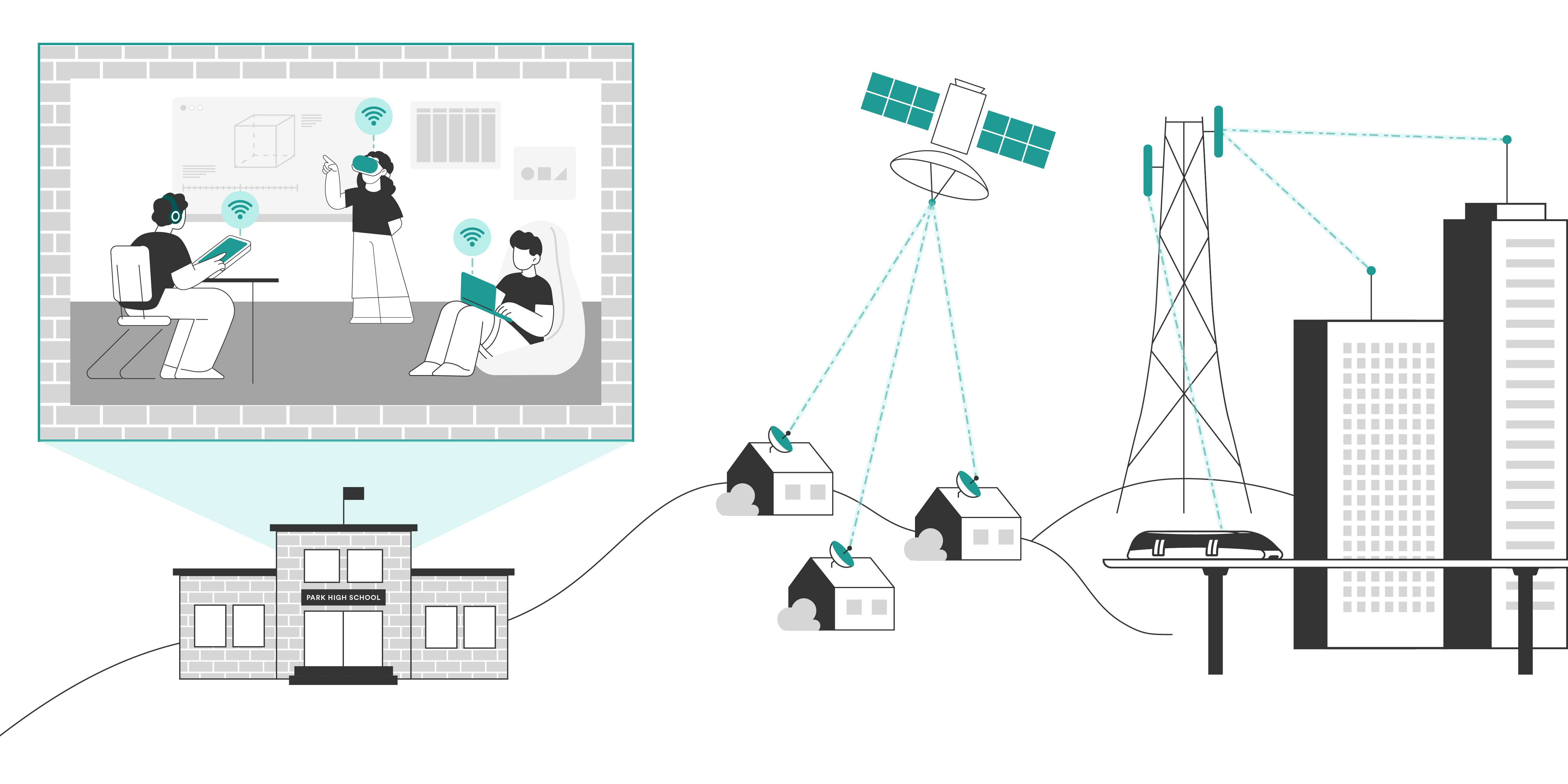
Alex Briñas/New America
More immediately, the FCC recently requested comment on the option of conferring some form of priority indoor-only rights as part of its update of the rules for the Citizens Broadband Radio Service (CBRS). Before the Commission first adopted CBRS in 2015, it proposed giving priority indoor-only use rights to specific categories of what it called “Contained Access Facilities” (e.g., hospitals, critical infrastructure, and public safety users), but it ultimately did not include this approach. In its new Notice of Proposed Rulemaking—released August 16, 2024—the FCC is again seeking comment on the Contained Access Facility (CAF) concept, stating that “growing industry interest in private wireless networks may support a reassessment of how the Part 96 rules [that govern CBRS] treat low-power indoor operations.”11 The agency asks whether it “should allow operators to reserve some amount of GAA [General Authorized Access] spectrum for private, low-power indoor operations—akin to the CAF approach.”12 We discuss this further in a later chapter, where we question why any “reservation” in the GAA portion of the band is needed, particularly if the indoor-only user can certify that its out-of-building emissions are below a level that adequately protects primary U.S. Navy and Priority Access licensees.
As described by the FCC, the CAF concept also highlights how indoor-only use rights might vary from the unlicensed LPI approach authorized across the entire 6 GHz band. LPI use is predicated on power level and device restrictions (e.g., no battery power) that focus solely on protecting licensed operators outdoors.13 In contrast, the FCC’s concept of a CAF in CBRS seems predicated on identifying indoor-only use cases that could receive a degree of protection from other general authorized access users operating outside its walls. This is presumably possible in CBRS because all commercial users must receive permission to transmit by a geolocation database (Spectrum Access System) that knows the user’s precise location. But it also suggests a possible model where indoor use in certain bands is limited to users that meet specified qualifications (e.g., certified professional installation), register their location, and meet other requirements for non-interfering indoor use. This is discussed further in the key policy considerations chapter.
Because indoor-only use rights can and likely will vary based on a variety of factors, this chapter describes some of the key considerations that regulators should consider as they seek the right balance between opening additional spectrum for property holders and protecting other co-frequency users beyond those four walls from harmful interference. For example, controlling the spectrum inside a facility is more practical at higher frequencies, where transmissions do not readily penetrate building materials or travel long distances. Other considerations include the degree of signal attenuation (building and entry loss), device and operational restrictions, whether coordination by a geolocation database is appropriate, and a potential requirement to certify that the indoor-only transmissions do not exceed a particular threshold outdoors.
Finally, it is important to think about indoor-only authorizations as part of a larger trend toward enabling what we call a “use it or share it” approach to unlocking wireless communications capacity in underutilized bands. In a paper presented at the Research Conference on Communications, Information, and Internet Policy (TPRC) in 2021, one of this report’s authors documented how the FCC has increasingly taken this approach to both increase the intensity of spectrum use and to increase the availability of prime spectrum, at lower power, for a very diverse range of local users and use cases.14 In some cases, use-or-share authorizations have been enabled by dynamic spectrum coordination systems, most notably the CBRS three-tier spectrum sharing framework enabled by FCC-certified Spectrum Access Systems.15 In CBRS, not only do Priority Access License (PAL) and GAA users operate when and where the U.S. Navy is not operating its radar systems in this formerly exclusive military band, but GAA users can also operate on vacant PAL spectrum in local areas where the licensees have not commenced operations.
In contrast, LPI represents a different “use or share” approach that effectively unlocks all of the nation’s indoor 6 GHz spectrum for low-power use, a capacity that the long-time licensees in the band were not using. We believe that whether or not geolocation database coordination is appropriate, there is enormous untapped bandwidth inside all of our homes, businesses, schools, and other structures.
Citations
- National Telecommunications and Information Administration (NTIA), National Spectrum Strategy (Washington, DC: NTIA, 2023), 4–6 (rel. Nov. 13, 2023), source.
- “DoD concluded from the analysis that without a reliable mechanism for reducing or eliminating 5G emissions, USG systems will experience interference when operating in the same frequency band as 5G systems, putting missions at risk.” The report observed, however, that potential interference mitigation factors include “clutter loss due to buildings and foliage” and “building entry/exit loss.” See U.S. Department of Defense, Emerging Mid-Band Radar Spectrum Sharing (EMBRSS) Feasibility Assessment Report (Washington, DC: U.S. Department of Defense, 2023), 208–19, source.
- “These [indoor low-power] access points will be ideal for connecting devices in homes and businesses such as smartphones, tablet devices, laptops, and Internet-of-things (IoT) devices to the Internet.” Federal Communications Commission, Unlicensed Use of the 6 GHz Band, Report and Order and Further Notice of Proposed Rulemaking, ET Docket No. 18-295, 35 FCC Rcd. 3852 at ¶¶ 2, 18, 98 (rel. Apr. 24, 2020). More generally, the FCC has authorized “underlay” technologies, such as Ultra Wideband (UWB), to operate at the same frequency as a primary service, but in a way that does not impermissibly interfere.
- “Because building attenuation is a key factor in minimizing the potential for harmful interference from indoor low-power access points to licensees’ receivers, we are adopting reasonable and practical measures that will restrict low-power access points to indoor operations.” In addition, the 6 GHz Order required that the access points be marketed as “for indoor use only” and include a statement that “FCC regulations restrict to indoor use only” on both a label attached to the equipment and in the device’s user manual. Federal Communications Commission, Unlicensed Use of the 6 GHz Band, Report and Order and Further Notice of Proposed Rulemaking, ET Docket No. 18-295, 35 FCC Rcd. 3852 at ¶¶ 98, 107 (rel. Apr. 24, 2020).
- Federal Communications Commission, Use of the 5.850-5.925 GHz Band, First Report and Order, Further Notice of Proposed Rulemaking, and Order of Proposed Modification, ET Docket No. 19-138, 35 FCC Rcd 13440, at ¶¶ 13, 60-67 (2020). The rules allow unlicensed indoor operations across the reallocated 5850–5895 MHz portion of the 5.9 GHz band by setting specific power and technical limits to protect incumbent ITS and federal radar operations from harmful interference.
- Federal Communications Commission, Unlicensed Use of the 6 GHz Band, Notice of Proposed Rulemaking, ET Docket No. 18-295, 33 FCC Rcd 10496, at ¶ 61 (2018); see also Federal Communications Commission, Unlicensed Use of the 6 GHz Band, Report and Order and Further Notice of Proposed Rulemaking, ET Docket No. 18-295, 35 FCC Rcd. 3852 at ¶ 100 (rel. Apr. 24, 2020). “This attenuation is key to providing the necessary signal reduction to prevent harmful interference from occurring to incumbents.” Clutter includes the trees, shrubbery, neighboring buildings and other physical obstacles that further attenuate any portion of an indoor transmission that does leak outdoors.
- Low-emissivity (Low-E) glass coatings conserve energy but also cause up to 1,000 times (30 dB) more propagation loss to mid-band radio signals (1–6 GHz range) than typical plate glass windows or doors. Commercial structures are more likely to have double-pane and coated glass—or easily could if the location had an incentive to do so. See, for example, Jie Zhang, Samantha Lay-Flurrie, and Kan Lin, “How Does Low-E Glass Affect 5G/4G Wireless Coverage in Buildings?,” Ranplan Wireless, August 21, 2023, source.
- Amazon uses over 750,000 mobile robots in its warehouses around the world. See Cosette Jarrett, “12 Cool Facts about the AI-Powered Robots that Help Deliver Your Amazon Packages,” About Amazon, December 11, 2023, source; Pablo Valerio, “Amazon Robotics: IoT In The Warehouse,” Information Week, September 28, 2015, source.
- The FCC initially imposed, and later repealed, an indoor-only condition on unlicensed use of the U-NII-1 band in the lower 5 GHz band (5150–5250 MHz). This is discussed further below.
- The very first provision of the Communications Act declares that the U.S. government shall control the “channels of radio communication” and “provide for the use of such channels, but not the ownership thereof, by persons for limited periods of time.” See 47 U.S.C. §301, “License for Radio Communication or Transmission of Energy,” Cornell Law School Legal Information Institute, source.
- Federal Communications Commission, Promoting Investment in the 3550-3700 MHz Band, Notice of Proposed Rulemaking and Declaratory Ruling, GN Docket No. 17-258, at ¶ 78 (rel. Aug. 16, 2024).
- Federal Communications Commission, Promoting Investment in the 3550-3700 MHz Band, Notice of Proposed Rulemaking and Declaratory Ruling, GN Docket No. 17-258, at ¶ 78 (rel. Aug. 16, 2024).
- The 6 GHz LPI rules also remind us that the term “unlicensed” is a bit of a misnomer. Wi-Fi, Bluetooth, or other devices operating under Part 15 of the Commission’s rules must be certified (licensed) for use by the FCC. It is more accurate to say that the operation of Wi-Fi devices—and microwave ovens—are license exempt, since individual users need no separate authorization so long as the device itself is certified as FCC compliant.
- Michael A. Calabrese, “Use it or Share it: A New Default Policy for Spectrum Sharing,” presented at 48th Research Conference on Communication, Information, and Information Policy (TPRC), 2021, source. See also Michael A. Calabrese, “Use it or Share it: Unlocking the Vast Wasteland of Fallow Spectrum,” presented at 39th Research Conference on Communication, Information, and Information Policy (TPRC), 2011, source.
- Michael A. Calabrese, Solving the Spectrum Crunch: Dynamic Spectrum Management Systems (Arlington, VA: Dynamic Spectrum Alliance, 2023), source.
The Need and Precedents for Indoor-Only Use Rights
Wireless Data Consumption Occurs Predominantly Indoors
It has become clear in recent years that the surging demand and need for high-capacity wireless broadband and data connectivity is increasingly indoors. As Google’s Preston Marshall observes in his new book Evolving to 6G: “Cellular technology dominates outdoors, but wireless is dominated by indoor usage. The proposed needs for 5G and 6G technology are mostly indoor applications.”1 He observes that the very high-capacity applications most frequently offered as the rationale for investments in 6G connectivity—such as robotics, Industrial Internet of Things (IIoT), virtual reality, telepresence, immersive gaming, and more—will operate almost entirely indoors. Further, Wi-Fi may not provide the capacity and reliability to meet all of these needs. Many, if not most, of these private networks are layered on top of Wi-Fi, which is often needed to serve other needs and may be less reliable for certain critical Internet of Things (IoT) applications.
The rapidly increasing need for indoor wireless connectivity has been most evident in the evolution of Wi-Fi offload. Americans spend more than 90 percent of their time—and consume more than 80 percent of their data—indoors.2 As of 2022, the average U.S. household owned 16 connected devices.3 We are even more likely to use high-bandwidth applications at home or at work, where devices automatically connect to Wi-Fi and to the lower-cost data supplied by our fixed internet connections. A decade or more ago, the throughput provided by a Wi-Fi router typically far exceeded the typical home or business internet connection. But the proliferation of fiber and Data Over Cable Service Interface Specification 3.0 reversed the wireless internet bottleneck. The concurrent emergence of mobile 4G and now 5G applications brought additional demand indoors as smartphones and other mobile devices routinely switch to Wi-Fi.
“Americans spend more than 90 percent of their time—and consume more than 80 percent of their data—indoors.”
As broadband data consumption indoors continues to rapidly grow, both in absolute and relative terms, the share of mobile device data traffic offloaded to Wi-Fi (and thus bypassing cellular networks) exceeds 80 percent in the United States and reportedly exceeds 90 percent in Europe.4 In fact, the economics of indoor use over shared spectrum allows Comcast, Charter, and Cox to support more than 15 million subscribers with a high-capacity mobile service that relies principally on Wi-Fi and, for use ‘on the go,’ mobile connectivity via Verizon. For example, Comcast reports that “today 90 percent of the mobile data traffic on Xfinity Mobile devices travels over Wi-Fi, not cellular” and delivers mobile download speeds up to 1 gigabit per second (Gbps).5
A separate surge in demand that is just beginning and more relevant here derives from private Internet of Things (IoT) networks that are not offloading personal communication but connecting and controlling an increasing share of everything else. While IoT devices each generally use a small amount of bandwidth, they must do so continuously and reliably, and aggregate bandwidth use can quickly expand as more devices are added to the same connection.6 Indoor data consumption is expected to grow as IoT devices continue to proliferate. Enterprises are similarly expected to see a massive increase in their data needs, especially as the frequency of videoconferences increases.7 The World Broadband Association estimates that even a 10 percent penetration rate of virtual reality teleconferencing in a typical enterprise could require 10 Gbps per access point within the next few years.8
Novel and upcoming applications are also rendering higher data use the norm. Depending on the type and quality of content, streaming virtual reality (VR) video can take 700MB to 1.5GB per hour, VR gaming can take 4GB to 8GB per hour, and application updates can require some 100MB to 500MB.9 Multi-sensory extended reality will enable activities like virtual drone racing and other realistic interactive sports that could include a 360-degree spherical display and extremely high-resolution images (e.g., 2x16K resolution could require an uplink data rate of around 4 Gbps).10 Holographic-type communication uses 3D holograms for use cases like telepresence, education, and remote assistance; it is expected to require 100 Gbps in the next few years and potentially more than 1 terabyte per second in the next decade with the growth of 6G.11
There are also particular venues and events where the aggregate demand for data is already massive and growing fast. This will include not only large performance and sports venues but also interactive events where, for example, children meet holiday or other special characters in an immersive environment.12 Today, venues that host major sporting competitions already handle vast amounts of data. The recent Super Bowl LVIII, for example, handled 34.8 TB of data transfer throughout the event, and aggregate data use at events like these is only trending up.13
“The recent Super Bowl LVIII, for example, handled 34.8 TB of data transfer throughout the event, and aggregate data use at events like these is only trending up.”
While the full scope and nature of our future 6G wireless ecosystem remains hypothetical, descriptions of the very high-capacity use cases are overwhelmingly indoors. In his book, Marshall creates a taxonomy of the list of candidate 5G and 6G use cases put forth by the Next G Alliance and by the Next Generation Mobile Networks Alliance. For 6G, seven of 12 distinctive use cases identified are indoor-only (e.g., telepresence and immersive VR), and three are outdoor-only (field robots, drones, and remote sensing).14 His taxonomy shows that Wi-Fi is currently dominating high-capacity applications, particularly indoors and in commercial settings. Wi-Fi’s dominance will only expand, bandwidth permitting, unless private network operators have an alternative. And expanding indoor-only access to large blocs of spectrum is one alternative.
Unlicensed Indoor-Only Use
As noted above, the FCC’s 2020 6 GHz Order included a landmark innovation in authorizing indoor-only underlay rights. The order authorized low-power, indoor-only (LPI) use across 1,200 megahertz (5925–7125 MHz), as well as standard power use both indoors and outdoors on 850 megahertz subject to control by an Automated Frequency Coordination system. The Commission noted that in defining a separate LPI authorization, it was resurrecting and building upon a since-repealed indoor-only condition on unlicensed use of the U-NII-1 band in the lower 5 GHz band (5150-5250 MHz). In the course of rejecting CTIA’s contention that an indoor-only limitation would be ineffective, the FCC stated that its experience to date has demonstrated that “outdoor operation of indoor[-only] devices has not been a problem.” It stated: “The Commission’s Part 15 rules prohibited outdoor operation in the [Unlicensed National Information Infrastructure] U-NII-1 band from 1997 until 2014 and currently prohibit outdoor operation for unlicensed devices in the 92–95 GHz band and many ultra-wideband devices.”15
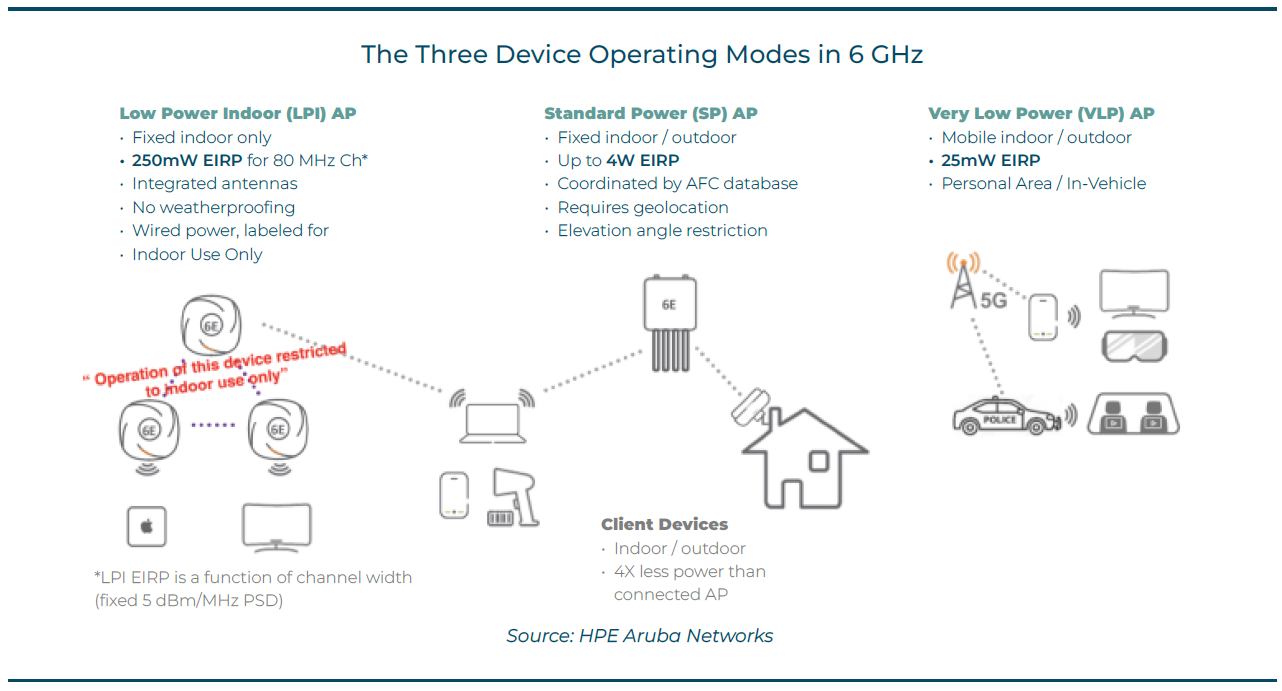
Michael Calabrese, “Solving The Spectrum Crunch,” Dynamic Spectrum Alliance, October 2023, https://www.dynamicspectrumalliance.org/solving-the-spectrum-crunch.pdf.
The 6 GHz Order authorizes LPI to be subject to three overall safeguards: “Devices are: (1) limited to indoor operation; (2) required to use a contention-based protocol; and (3) subject to low power operation.”16 “By restricting such devices to low power, indoor use, we anticipate that incumbent licensed services would be protected from harmful interference, in part due to significant building attenuation and clutter losses for transmissions originating from indoor devices.”17
The primary means of keeping LPI devices indoors—and thereby protecting band incumbents (the most numerous and sensitive of which are fixed microwave links)—include three form-factor requirements that access points (e.g., Wi-Fi routers) must incorporate in order to be certified to operate in the 6 GHz band without being under the control of an Automated Frequency Coordination (AFC) system:
- Battery power prohibited: Indoor devices must require a direct connection to a wireline power outlet, which inherently limits mobility and, thus, outdoor use.
- No weather resistant casing: Indoor devices cannot be weatherized, waterproofed, or have any special shielding from outdoor weather conditions.
- Must have integrated antennas: An LPI access point must have no external antenna and no capability to attach external antennas, which could be used to boost the effective strength of the signal.18
In addition, LPI access points also must be explicitly marketed as “for indoor-use only” and include a label attached to the equipment stating that “FCC regulations restrict to indoor use only.”19 In addition, to better protect electronic news gathering (ENG) receivers from harmful interference, the Order requires that both LPI access points and their associated client devices (e.g., laptops or smartphones) employ a contention-based protocol, such as the listen-before-talk protocol already built into Wi-Fi’s 802.11 standard.20 Because broadcast ENG devices are mobile and can operate indoors, there is concern about significant risk of harmful interference to ENG receivers operating indoors at locations where broadcasters may not control the venue.
The third type of restriction on LPI devices is power. Because “the signals transmitted by these unlicensed devices will be significantly attenuated when passing through the walls of buildings,”21 the FCC adopted a power limit (5 dBm/megahertz power spectral density) that is far lower than the “standard power” limit afforded to unlicensed devices that operate in the band under AFC control (and therefore operate only outside protection areas calculated for each fixed microwave receive link in the 850 megahertz where they are authorized). The agency derived the LPI limit by factoring in the typical signal attenuation attributable to building entry loss (BEL) and the signal interference threshold proposed by the operators of fixed microwave links.22 Although the Monte Carlo simulation analysis the FCC relied on assumed an LPI power spectral density (PSD) of 8 dBm/megahertz, the FCC decided to adopt the substantially lower limit of 5 dBm/MHz PSD, “a precaution we take at this time to protect incumbent operations given the state of the record.”23 The higher power level remains an open and contested issue in the 6 GHz Further Notice of Proposed Rulemaking.
Notably, in 2017, the same FCC under Chairman Ajit Pai that authorized 1,200 megahertz of unlicensed LPI use in 6 GHz declined to authorize an indoor-only unlicensed underlay in the 70 and 80 GHz spectrum that is coordinated for high-capacity point-to-point links under a license by rule framework for both federal and non-federal use.24 The FCC concluded that “our decision to delay introducing unlicensed indoor use at this time furthers the public interest by protecting existing operations and successful services in the 70 GHz and 80 GHz bands without foreclosing future innovations in these bands.”25 However, as the Order also stated, “the current availability of 14 gigahertz of contiguous spectrum for unlicensed operations immediately below the 70 GHz band reduces the urgency to introduce unlicensed indoor use in the 70 GHz and 80 GHz bands.”26
“Contained Access Facilities” in Citizens Broadband Radio Service
As the introductory chapter notes, in August 2024 the FCC released a Notice of Proposed Rulemaking that revisits the “Contained Access Facilities” concept it proposed but declined to adopt in the original 2015 Citizens Broadband Radio Service (CBRS) three-tier sharing framework.27 At that time, the FCC asked whether it should “allow critical users—such as hospitals, public safety organizations, and local governments—to receive interference protection, akin to Priority Access licensees, within a limited portion of the General Authorized Access (GAA) pool for indoor use within their own buildings.”28 Under the proposal, facilities that applied and qualified as Contained Access Facilities (CAFs) would receive a reservation for exclusive use of a portion (e.g., 20 megahertz) of the GAA portion of the band indoors, yet they would still “be required to accept interference from GAA transmissions originating outside of their buildings and to undertake reasonable efforts to safeguard against harmful interference from those transmissions.”29 The original FCC proposal also required that, like any other GAA user, they would need to protect against harmful interference to incumbents (e.g., Navy radar) and priority access licensees.
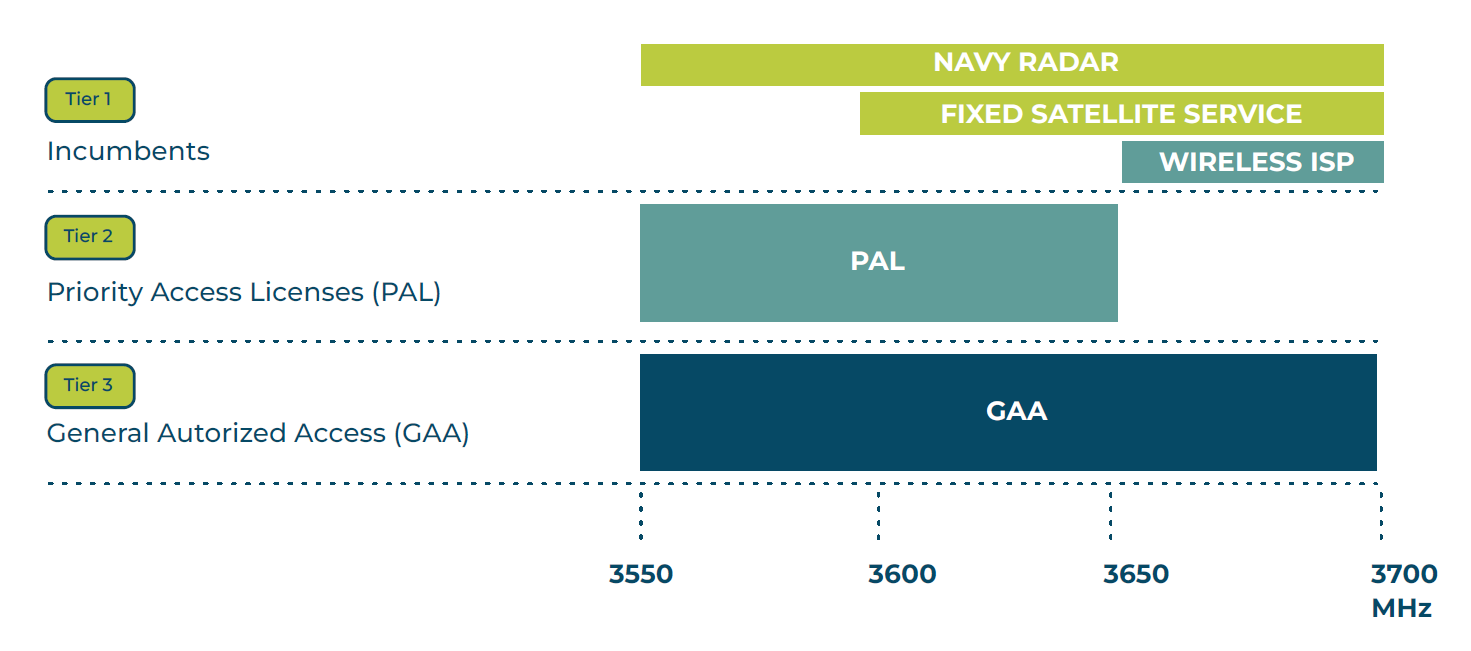
Michael Calabrese, “Solving The Spectrum Crunch,” Dynamic Spectrum Alliance, October 2023, https://www.dynamicspectrumalliance.org/solving-the-spectrum-crunch.pdf.
Although left unstated, we can only imagine that the FCC’s proposal to allow selected facilities to “reserve some amount of GAA spectrum for private, low-power indoor operations” reflects a desire to find a means to allow the CAFs to effectively preclude others from transmitting on those CBRS channels inside their buildings. Since CBRS is a flexible use band that is increasingly incorporated in mobile devices, including newer model iPhones and iPads,30 and the contemplated “critical users” are generally public facilities (e.g., hospitals), coordination by a CBRS Spectrum Access System could prove necessary to minimize the risk of interference to the CAF IoT networks. This highlights the idea that the viability and rules governing indoor-only use are likely to vary band by band, an issue considered further in the final chapter.
United Kingdom, European Union, and China
The rest of the world is generally far behind the United States in authorizing shared underlays or automated sharing in bands already occupied by primary licensees or government users. Both the European Union and the United Kingdom quickly followed the U.S. in authorizing low-power, indoor-only (LPI) license-exempt operations, but so far, only in the bottom 500 megahertz of the 6 GHz band (5925–6425 MHz). Allocation of the remainder of the band remains subject to ongoing study and a contentious debate among proponents of IMT (International Mobile Telecommunications, or mobile carriers) and Wi-Fi.31
There has been some innovation over the last few years, spurred primarily by the FCC’s adoption of CBRS, with its unique three-tier sharing and use-it-or-share-it ethos. In June 2021, the European Union’s Radio Spectrum Policy Group (RSPG) issued an opinion urging more innovation and experimentation in opportunistic spectrum sharing: “The RSPG seeks to nudge a change of mindset: All considerations in the field of spectrum by policymakers, spectrum managers, users, and industry should be done by pursuing better spectrum efficiency through more spectrum sharing, including by following the principle of ‘use-it-or-share-it.’”32
Local Shared Licensing
Led by the United Kingdom, an increasing number of European nations are authorizing a limited version of CBRS for the purpose of providing small operators and enterprises with local access to shared spectrum bands, typically in the upper 3 GHz band (3800–4200 MHz). As part of its framework to enable shared spectrum use and encourage a “wide range of local wireless connectivity applications,” the U.K.’s regulator, Ofcom, offers a shared access license in four spectrum bands that support private mobile and fixed networks, primarily in 3800–4200 MHz.33 Both very low-power and medium-power licenses are available by application. Low-power licenses are available for either indoor or indoor/outdoor use but seem designed primarily for indoor use as they constrain access points to a 50-meter radius coverage area. Ofcom suggests that “the low-power license product could be suitable for industrial and enterprise users looking to deploy their own private networks.”34
In July 2024, Ofcom released a consultation and guidance document that explicitly aimed to “improv[e the] spectrum supply for indoor users” by factoring into the coordination calculation a building and entry loss (BEL) value of 14 dB for coordination in 3.8–4.2 GHz.35 Licensees can connect fixed, mobile, or nomadic terminals to base stations operating within the licensed area. Ofcom also intends to further expand usage with the implementation of its new “User-Led” application framework, which allows rejected applicants to deploy if they can coordinate agreement among affected incumbents.36
Ofcom has also decided to expand its shared access framework by adding 20 MHz of spectrum between 2320–2340 MHz for indoor-only use.37 This decision was made based on collaboration with the band’s incumbent, the Ministry of Defence (MOD), and deployment is pending final approval by the MOD. The parties determined that allowing low-power, indoor-only use would protect military operations while opening up the valuable band to more users. The newly available spectrum will be licensed, subject to registration and the same fee (£80 per 10 MHz) that Ofcom charges for other low-power shared access licenses.38
Other European nations have been steadily adopting their own versions of the U.K.’s local shared licensing approach for the same purpose of providing local enterprise and small broadband providers with direct access to mid-band spectrum on a highly localized basis. Like the Ofcom framework, although there seems to be an expectation that many individual enterprises (e.g., factories) will use the spectrum indoors, there are generally (though not always) no explicit indoor/outdoor distinctions yet in the rules. In Germany, for example, 100 MHz between 3.7–3.8 GHz have been opened to vertical use both indoors and outdoors.39 At 26 GHz, however, Germany allows indoor-only spectrum usage that remains within property boundaries (which depends in part on the electromagnetic shielding of the building) and in areas that are already covered by a larger spectrum assignment.40 These local assignments are subject to agreement by the affected licensed operators.
In Denmark, the Mobile Networks Operation (MNO) with the license to 3740–3800 MHz is obligated to lease out the frequencies upon request to enterprises and public institutions intending to create a private network.41 The private networks must meet technical requirements that allow them to coexist with the public network.42 And Finland’s 3.6 GHz spectrum band is similarly assigned to MNOs subject to leasing requirements: If the spectrum holders fail to offer a service that meets the needs of customers within a certain geographical area (such as a port, hospital, or shopping center), that frequency must be licensed out to an entity able to provide that service in the location.43
Hybrid Sharing
More recently, Ofcom has also taken the lead in considering hybrid sharing between mobile network operators and Wi-Fi networks in the upper 6 GHz band (6425–7025 MHz). This arrangement is largely premised on the natural separation between the former’s outdoor and the latter’s indoor use—otherwise known as an “indoor/outdoor split.”44 Ofcom anticipates that low-power indoor Wi-Fi combined with this natural geographic separation should provide enough protection to both types of users that each can be prioritized in its own respective location. The EU has also approved a work item to study this same hybrid indoor/outdoor sharing approach between cellular (IMT) and Wi-Fi (Radio Local Area Networks, or RLANs) in the 6425–7125 MHz band.45
China’s Pooled Indoor-Only Allocation
To serve a very different purpose, China assigned indoor-only use of the 3300–3400 MHz band jointly to its largest mobile carriers (China Telecom and China Unicom) and to the China Broadcasting Network. The indoor-only use rights were granted on a shared basis to promote co-investment and sharing of 5G indoor access networks.46 This marked the first time China’s Ministry of Industry and Information Technology has taken such a shared approach.47 Chinese press reports did not disclose the nature of outdoor operations in the band.
Citations
- Preston Marshall, Evolving to 6G: The Case for a New Approach to 6G and Beyond (Seattle, WA: Amazon Publishing, May 2024), 95.
- See, for example, Diana Adams, “5 Ways Indoor 5G Will Change Your Life (and Mine),” Ericsson (blog), July 26, 2023, source.
- NCTA, “Broadband Stats: A World of Wi-Fi,” Internet & Television Association, June 22, 2023, source.
- OpenSignal data for 2022 shows between 78 percent and 80 percent of Verizon, AT&T, and T-Mobile mobile subscriber data traffic is carried by Wi-Fi networks. See, for example, “Advancement of 6G Telecommunications Technology,” National Telecommunications and Information Administration, August 21, 2024, 2, source; Dynamic Spectrum Alliance, How Do Europeans Connect To The Internet? (Dynamic Spectrum Alliance, 2022), 4, source (reporting that Wi-Fi represents about 90 percent of fixed broadband traffic in Europe); Claus Hetting, “Report: US cable MVNOs Extract Big Value from Wi-Fi Offload,” Wi-Fi NOW, October 17, 2019, source.
- A year earlier, Charter reported 87 percent offload. See Kohposh Guda, “Comcast Lights Up Wi-Fi Boost Delivering Gig Speeds to Xfinity Mobile Customers on Millions of Wi-Fi Hotspots,” Comcast (blog), April 23, 2024, source; Linda Hardesty, “Charter, Comcast Share Their Wi-Fi Networks for MVNO Services,” Fierce Wireless, May 10, 2023, source.
- Mark Mahle, “Optimizing IoT Networks In An Increasingly Smart, Interconnected World,” Forbes, April 24, 2024, source.
- World Broadband Association, Next Generation Broadband Roadmap 2023–2030 (London: World Broadband Association, June 2024), source.
- World Broadband Association, Next Generation Broadband Roadmap 2023–2030, 17, source.
- Victor Marquez, “How Much Internet Data Does VR Use? – A Detailed Guide,” Tech Tyche, June 4, 2023, source.
- Next G Alliance, 6G Applications and Use Cases (Washington, DC: Next G Alliance, May 2022), 14, source.
- Ian Akyildiz and Hongzhi Guo, “Holographic-Type Communication: A New Challenge for the Next Decade,” ITU Journal on Future and Evolving Technologies 3, no. 2 (Sept. 2022): 425–428, source.
- In these scenarios, bandwidth would be needed to support 8K video for each eye, for a total of 16K. Next G Alliance, 6G Applications and Use Cases, 16, source.
- Cammy Perry, “The Unsung Hero of Super Bowl LVIII – The Network!,” Extreme Networks, February 21, 2024, source; Paul Kapustka, “Super Bowl LVIII Sees Big Jump in Per-Device Wi-Fi Data Used en route to New Total Record of 34.8 TB,” Stadium Tech Report, February 22, 2024, source.
- Marshall, Evolving to 6G, 104–108.
- Federal Communications Commission, Unlicensed Use of the 6 GHz Band, Report and Order and Further Notice of Proposed Rulemaking, ET Docket No. 18-295, 35 FCC Rcd. 3852 at ¶ 148 (rel. Apr. 24, 2020). Also see Federal Communications Commission, Amendment of the Commission’s Rules to Provide for Operation of Unlicensed NII Devices in the 5 GHz Range, 12 FCC Rcd 1576, 1595, para. 44 (1997); Federal Communications Commission, Revision of Part 15 of the Commission’s Rules to Permit Unlicensed National Information Infrastructure (U-NII) Devices in the 5 GHz Band, 29 FCC Rcd 4127, 4237, para. 34 (2014); 47 CFR §§15.257, 15.517(a). Because the U-NII-1 band was only 100 megahertz and subject to extremely low power limits, it wasn’t used extensively until the FCC removed indoor-only restrictions and raised the power limits in 2014. The ultra-wideband and 92–95 GHz devices that are restricted to indoor use must have a warning label and be capable of operating only indoors, which is satisfied if the transmitter must be connected to AC power lines.
- Federal Communications Commission, Unlicensed Use of the 6 GHz Band, Report and Order and Further Notice of Proposed Rulemaking, ET Docket No. 18-295, 35 FCC Rcd. 3852 at ¶ 99 (rel. Apr. 24, 2020).
- Federal Communications Commission, Unlicensed Use of the 6 GHz Band, Notice of Proposed Rulemaking, ET Docket No. 18-295, 33 FCC Rcd 10496, at ¶ 61 (2018).
- Federal Communications Commission, Unlicensed Use of the 6 GHz Band, Report and Order and Further Notice of Proposed Rulemaking, ET Docket No. 18-295, 35 FCC Rcd. 3852 at ¶ 107 (rel. Apr. 24, 2020).
- Federal Communications Commission, Unlicensed Use of the 6 GHz Band, Report and Order and Further Notice of Proposed Rulemaking, ET Docket No. 18-295, 35 FCC Rcd. 3852 at ¶ 107 (rel. Apr. 24, 2020).
- Federal Communications Commission, Unlicensed Use of the 6 GHz Band, Report and Order and Further Notice of Proposed Rulemaking, ET Docket No. 18-295, 35 FCC Rcd. 3852 at ¶ 101 (rel. Apr. 24, 2020).
- Federal Communications Commission, Unlicensed Use of the 6 GHz Band, Report and Order and Further Notice of Proposed Rulemaking, ET Docket No. 18-295, 35 FCC Rcd. 3852 at ¶ 100 (rel. Apr. 24, 2020).
- “The median signal loss from a traditionally constructed building is 17 dB, and newer, highly efficient buildings provide even higher signal attenuation. No commenters disagreed with the ITU median signal loss value for traditional construction.” Federal Communications Commission, Unlicensed Use of the 6 GHz Band, Report and Order and Further Notice of Proposed Rulemaking, ET Docket No. 18-295, 35 FCC Rcd. 3852 at ¶ 100 (rel. Apr. 24, 2020).
- Federal Communications Commission, Unlicensed Use of the 6 GHz Band, Report and Order and Further Notice of Proposed Rulemaking, ET Docket No. 18-295, 35 FCC Rcd. 3852 at ¶ 110 (rel. Apr. 24, 2020).
- Federal Communications Commission, Use of Spectrum Bands Above 24 GHz For Mobile Radio Services, et al., Second Report and Order, GN Docket No. 14-177, at ¶¶ 202-297 (rel. Nov. 22, 2017).
- Federal Communications Commission, Use of Spectrum Bands Above 24 GHz For Mobile Radio Services, et al., Second Report and Order, GN Docket No. 14-177, at ¶ 207 (rel. Nov. 22, 2017).
- Federal Communications Commission, Use of Spectrum Bands Above 24 GHz For Mobile Radio Services, et al., Second Report and Order, GN Docket No. 14-177, at ¶ 207 (rel. Nov. 22, 2017).
- See Federal Communications Commission, Amendment of the Commission’s Rules with Regard to Commercial Operations in the 3550-3650 MHz Band, Report And Order And Second Further Notice Of Proposed Rulemaking, GN Docket No. 12-354, 30 FCC Rcd at 4012-14, paras. 164-69 (rel. Apr. 21, 2015).
- Federal Communications Commission, Promoting Investment in the 3550-3700 MHz Band, Notice of Proposed Rulemaking and Declaratory Ruling, GN Docket No. 17-258, at ¶ 75 (rel. Aug. 16, 2024).
- Federal Communications Commission, Promoting Investment in the 3550-3700 MHz Band, Notice of Proposed Rulemaking and Declaratory Ruling, GN Docket No. 17-258, at ¶ 75 (rel. Aug. 16, 2024).; Federal Communications Commission, Amendment of the Commission’s Rules with Regard to Commercial Operations in the 3550-3650 MHz Band, Report And Order And Second Further Notice Of Proposed Rulemaking, GN Docket No. 12-354, at ¶ 60 (rel. Apr. 21, 2015).
- See “Apple Device Support for Private 5G and LTE Networks,” Apple Platform Development, accessed August 2024, source. Note as well that Verizon was the largest buyer of PALs in CBRS.
- The EU and U.K. also continue to study an authorization for license exempt operations outdoors, which the U.S. and Canada have already implemented, subject to control by an Automated Frequency Coordination System. European Communications Office (ECC), “Higher Power WAS/RLAN in 5945-6425 MHz, SE45_05 Work Item Details,” ECC Work Programme Database, July 10, 2022, source.
- Radio Spectrum Policy Group, RSPG Opinion on Spectrum Sharing—Pioneer Initiatives and Bands (Brussels: European Commission, June 21, 2021), source.
- The bands authorized for local shared licenses include the 1800 MHz band, the 2300 MHz band, the 3800–4200 MHz band, and the 24.25–26.5 GHz band. See “Shared Access Licences,” Ofcom, December 9, 2019, source.
- Ofcom, Shared Access License Guidance Document (London: Ofcom, 2024), 7, source.
- Ofcom, Expanding Access to Shared Spectrum: Statement and Further Consultation on Enhancing the Shared Access Licence Framework (London: Ofcom, 2024), 20, source.
- Ofcom, Expanding Access to Shared Spectrum, 23, source.
- Ofcom, Expanding Access to Shared Spectrum, 27, source.
- Ofcom, Expanding Access to Shared Spectrum, 35, source.
- Radio Spectrum Policy Group, RSPG Opinion on 5G Developments and Possible Implications for 6G Spectrum Needs and Guidance on the Rollout of Future Wireless Broadband Networks (Brussels: European Commission, October 25, 2023), 19, source.
- Bundesnetzagentur, Administrative Rules for Spectrum Assignments for Local Broadband Spectrum Usages in the 24.25–27.5 GHz Band (Bonn: Bundesnetzagentur Federal Network Agency, May 15, 2023), 9, source.
- Radio Spectrum Policy Group, RSPG Opinion on Spectrum Sharing, 19, source.
- Radio Spectrum Policy Group, RSPG Opinion on Spectrum Sharing, 14, source.
- Radio Spectrum Policy Group, RSPG Opinion on Spectrum Sharing, 14, source.
- Ofcom, Mobile and Wi-Fi in Upper 6 GHz: Why Hybrid Sharing Matters, (London: Ofcom, 2024), 5, source.
- “The ECC agreed on a new Work Item to study possible technical conditions for potential shared use of the band 6425-7125 MHz between MFCN and Radio Local Area Networks.” See Electronic Communications Committee, “61st ECC Plenary Meeting, 7–10 March 2023,” European Conference of Postal and Telecommunications Administrations, March 14, 2024, source.
- Xinhua, “China Grants Spectrum Licenses for 5G Indoor Coverage,” China Daily, February 11, 2020, source.
- Xinhua, “China Grants Spectrum Licenses for 5G Indoor Coverage,” source.
Key Policy Considerations in Fashioning Indoor-Only Use Rights
Authorizing indoor-only access to frequency bands already in use by one or more incumbent services, whether federal or non-federal, involves weighing a variety of factors, some band-specific and some more generic. The Federal Communications Commission’s authorization of unlicensed indoor-only (LPI) device use across the entire 1,200 megahertz of the 6 GHz band included both types of considerations. For example, while the signal attenuation of the typical structure is generic (and the FCC used a conservative International Telecommunication Union, or ITU, value for building entry loss, or BEL), the FCC also set the maximum power level based on the outdoor signal threshold that the most vulnerable incumbents reported needing to protect the performance of fixed microwave links at a “five 9s” (99.999 percent) level of reliability. In contrast, the form factor restrictions imposed on LPI access points (e.g., no battery operation or no weatherized containment) are more generic in the sense that they will quite possibly characterize future indoor-only authorizations in any band since what’s most crucial is ensuring the transmitting devices only operate indoors.
Frequency bands that can accommodate additional uses indoors without undue risk of harmful interference to band incumbents offer the equivalent of a spectrum ‘free lunch’ that can potentially spur innovation and meet the rapidly growing demands of venues and enterprises for direct access and control of wireless bandwidth. Most recently, in its proposal to revisit the concept of authorizing Contained Access Facilities (CAFs) for low-power, indoor use in Citizens Broadband Radio Service (CBRS), the FCC’s new Notice of Proposed Rulemaking (NPRM) (released in August 2024) observes that “industry forecasts indicate that the private [Long Term Evolution] market is continuing to expand.”1 As Internet of Things networks proliferate and artificial intelligence makes wireless connectivity even more valuable, the need for more spectrum resources at a variety of frequencies will only grow. More generally, America’s “5G” and future “6G” wireless ecosystems will rely on a combination of big national or regional carrier networks for truly “mobile” connections (for use ‘on the go’) and a far larger number of high-capacity and customized networks deployed by individual enterprises, households, and community anchor institutions to meet their particular needs at a lower cost.
The imperative to identify bands where a sharing framework can unlock fallow spectrum has its roots in the 2012 report of the President’s Council of Advisors on Science and Technology (PCAST), which recommended that a three-tier sharing framework in the Navy’s then-exclusive use of the 3.5–3.6 GHz band for radar could offer enormous localized and low-power spectrum access for commercial use.2 President Obama’s subsequent 2013 Executive Memorandum stated in its preamble that: “Where technically and economically feasible, sharing can and should be used to enhance efficiency among all users and expedite commercial access to additional spectrum bands, subject to adequate interference protection for federal users, especially users with national security, law enforcement, and safety-of-life responsibilities.”3 The PCAST report and Executive Memorandum led directly to the FCC’s collaboration with the National Telecommunications and Information Administration (NTIA) and Department of Defense—and, ultimately, to the 2015 Order adopting CBRS.
Picking up again where the PCAST report and the Obama NTIA left off, the National Spectrum Strategy released in late 2023 acknowledged the need for new and more dynamic spectrum-sharing efforts to accommodate the rapidly growing needs of both the private sector and federal users. “Next-generation wireless technologies such as 5G, 6G, and Wi-Fi necessitate additional spectrum resources with the capacity for wider channels, resulting in benefits beyond increased capacity, including enhanced energy efficiency, improved reliability, and reduced latency,” the report stated.4 The National Spectrum Strategy is currently studying the degree to which certain federal bands—most notably the 3.1–3.45 GHz and 7125–8400 MHz bands, both of which are primarily occupied by military systems—can be reallocated or shared with the private sector.
Earlier in 2023, the FCC reinforced its intention to promote more spectrum sharing by adopting a policy statement, Principles for Promoting Efficient Use of Spectrum, that embraces the principle of reciprocal obligations for transmitters and receivers (and of incumbents and entrants) to facilitate shared and more intensive spectrum use.5 Concerning interference realities, the policy statement clarifies the FCC’s recognition that: “The electromagnetic environment is highly variable, and zero risk of occasional service degradation or interruption cannot be guaranteed.”6 Indeed, the FCC noted that “the likelihood of harmful interference should be assessed under a range of operating conditions, but not on an expectation of 100% service availability, or in contemplation of exceptional events. The level of interference protection afforded to particular services under the Commission’s rules may vary, and some may require higher levels of service reliability than others.”7
All of this lays the groundwork for more innovative and aggressive efforts to achieve wireless bandwidth abundance, rather than scarcity, by authorizing the use of fallow spectrum capacity wherever feasible. Because of its emphasis on sharing, the National Spectrum Strategy studies of large bands currently occupied by the military and other federal users should, at a minimum, identify substantial opportunities for indoor, LPI-type commercial use. The FCC’s 2023 policy statement, for its part, helps lay to rest the traditional objection to shared or opportunistic use by incumbents claiming they are entitled to near-zero risk of interference or that they are not obligated to help accommodate new entrants. For example, in the 6 GHz Order, the FCC had to address and reject claims by AT&T and other incumbents that “the Commission’s rules generally prohibit the Commission from authorizing a service or type of unlicensed operation that can cause harmful interference, regardless of whether the probability of such interference is low.”8 The FCC disagreed, concluding that the agency “may authorize operations in a manner that reduces the possibility of harmful interference to the minimum that the public interest requires, and it will then authorize the service or unlicensed use to the extent that such authorization is otherwise in the public interest.”9
On a practical level, the FCC will need to examine proposals for LPI underlays on a band-by-band basis. Doing so can make bands with far more data capacity and diverse frequency characteristics available to enterprises, schools, factories, venues, office buildings, and many other locations that will need more and more wireless bandwidth in the future. This is no small thing. For example, there are nearly 130,000 K–12 schools in the United States,10 and there are more than 620,000 manufacturing facilities.11 Still, crafting the right rules will involve some difficult trade-offs, some by necessity and others in the service of creating a sort of “portfolio” of options for direct local spectrum access.
The LPI approach adopted as a contiguous underlay across 1,200 megahertz in 6 GHz is just one possible approach—one that leans heavily toward unlicensed access by any household, business, or other facility with low-cost, off-the-shelf equipment. In contrast, the CAF concept outlined in the pending new CBRS NPRM suggests that only select categories or public or quasi-public (“critical”) facilities may be eligible for protected access for their indoor-only operations—and, given the CBRS sharing framework that will presumably entail a registration and approval process. The following are a few of the most basic (and overlapping) policy considerations and trade-offs that will need to be balanced to authorize additional LPI underlays in new bands.
Unlicensed Versus Licensed
The FCC can authorize indoor-only use of any frequency band on an unlicensed, licensed, or licensed-by-rule basis. The Commission’s choice is likely to be primarily a function of the intended use indoors (particularly the desired power level) and the nature of the incumbent licensees (or federal users) in the band. The propagation characteristics of the frequency band influence both of these. So, for example, even at a substantial power level, indoor-only use of a millimeter wave band (above 24 GHz) in a band used only or predominantly for satellite uplinks would seem to easily allow for an unlicensed authorization similar to LPI in 6 GHz. On the other hand, in a satellite downlink band—and especially where consumer dishes could be in almost any location—even at a much lower power, the Commission would be more likely to require the indoor facility to apply for a license, or at least register the location, as part of a coordinated, license-by-rule framework.
We have few precedents to inform this choice, but the 6 GHz band is illustrative. The FCC concluded it could make LPI Wi-Fi available inside any structure and at a power level sufficient for Wi-Fi (if only barely) while keeping any signal leakage comfortably below the lowest claimed threshold of harmful interference to an incumbent beyond the walls (namely, fixed microwave links). This has the benefit of allowing any home, business, or venue to continue doing what they have been doing with unlicensed devices (i.e., purchasing access points off the shelf or gateway routers from their internet service provider) without any need to get a license, register, or sign up or pay for coordination by the automated frequency coordination systems certified to control outdoor and full power operation. It’s also important to note that a Part 15 authorization (unlicensed) means that anyone can operate an LPI access point in a home, business, or other venue, but, in practice, the prohibition on battery power effectively gives the owner or manager exclusive rights to operate LPI on site.
In contrast, the FCC’s pending proposal to revisit the option of granting priority access “reservations” to specified categories of “Low-Power Indoor Facilities” would presumably be on a licensed-by-rule basis, consistent with the framework that applies to all Priority Access License (PAL) and General Authorized Access (GAA) users under Part 96 of the Commission’s rules. If the FCC decides to limit this to specific types of locations (e.g., hospitals, utilities, and schools) it will be walking a fine line with respect to the statutory obligation to assign spectrum by auction when “mutually exclusive applications are accepted for any license.”12 Under the current CBRS framework, all users are required to register and operate only on channels granted by a Spectrum Access System (SAS). But while GAA users receive no protection from interference, PAL users had to purchase their rights at auction since they have mutually exclusive interference protection within the county they licensed. Although it’s not our intention here to go into this issue in depth, the Commission would likely be on firm grounds to establish qualifications for a Low-Power Indoor Facility (e.g., control of the facility or professional installation) that only the facility’s owner or lessee could satisfy. In that event, qualifying applicants would never be “mutually exclusive.”
Database or Manual Coordination
A coordination requirement can be added to any of the options above (unlicensed, licensed, or licensed-by-rule) and used to give the indoor-only user either more flexibility (e.g., higher power or higher out-of-building emissions) or possibly even protection from at least some outdoor operators. Coordination could give indoor-only users—and perhaps even geographically remote campuses or multi-building facilities—far more latitude to deploy a private network. Depending on the frequency band (and hence the propagation), coordination could allow an indoor-only user that is sufficiently distant from incumbent licensees or federal users to take advantage of higher power, to transmit higher above ground level, or to avoid what might be expensive measures to completely contain the signal indoors (such as replacing or applying a special coating to windows).
This type of coordination would not require an automated geolocation database, such as the SASs certified to coordinate users in CBRS or the Automated Frequency Coordination (AFC) in 6 GHz. Indeed, by far, the largest number of licenses granted by the FCC are manually coordinated in shared bands. For example, tens of thousands of users hold licenses to locate a fixed link under Part 101, which requires the applicant to complete a manual coordination process prior to filing an application for authorization.13 And whether the coordination process is automated or manual, it could be used to authorize a hybrid indoor-outdoor private network. The Commission acknowledges this in its new CBRS 2024 NPRM, where it asks whether “a CAF-like GAA spectrum reservation system [can] be used to support some outdoor private networks in geographically contained areas (e.g., corporate campuses or manufacturing facilities)?”14 Depending on the nature of the incumbent service—and the location of the secondary user—this approach could give thousands of industrial, agricultural, military, Tribal, and other sites substantially more spectrum access and flexibility.
Priority or Protected Use
The possibility of using coordination (such as a SAS) to give indoor-only users interference protection is one option the FCC seems to suggest in its pending CBRS 2024 NPRM, which asks: “Should we allow operators to reserve some amount of GAA spectrum for private, low-power indoor operations—akin to the CAF approach . . .?”15 A “reservation” of rights to transmit on certain GAA channels and to interference protection on those channels within an approved facility would almost necessarily require a geolocation database (in CBRS, a SAS) to deny all other user requests to operate on those channels within a calculated protection area around the CAF. In theory, because the 6 GHz band similarly employs AFCs able to grant or deny channels for use in very specific locations, this same sort of reserved use and interference protection for a qualifying CAF—at a higher power than LPI—could be grafted onto the multi-tier framework for unlicensed operation in the 6 GHz band. It’s a better fit for a licensed-by-rule authorization, but it suggests the FCC has the tools to craft a wide variety of user environments.
Citations
- Federal Communications Commission, Promoting Investment in the 3550-3700 MHz Band, Notice of Proposed Rulemaking and Declaratory Ruling, GN Docket No. 17-258, at ¶ 78 & note 214 (rel. Aug. 16, 2024). See, for example, “Businesswire, United States Private LTE & 5G Network Market Analysis Report 2022: A $13.6 Billion by 2030 – Focus on Upcoming Trends in Various Spectrums, Numerous Private 5G Use Cases, and Regulatory Scenario,” Research and Markets, September 6, 2022, source (reporting projections that the private LTE and 5G Network market will reach $13.6 billion by 2030, growing at a rate of 24.1 percent from 2022 to 2030 and that the global private LTE market size is expected to reach $10.77 Billion in 2028); SNS Telecom and IT, LTE & 5G NR-Based CBRS Networks: 2023–2030 Opportunities, Challenges, Strategies & Forecasts (Dubai: SNS Telecom and IT, September 2023), source. Estimating that annual investments in LTE and 5G NR-based CBRS RAN (Radio Access Network), mobile core and transport network infrastructure will account for nearly $900 million by the end of 2023 and grow at a CAGR of approximately 20 percent over 2023 to 2026 to surpass $1.5 billion in annual spending by 2026.
- PCAST stated that a new sharing paradigm can “unlock the data-carrying capacity of spectrum in an unprecedented way.” President’s Council of Advisors on Science and Technology, Report to the President: Realizing the Full Potential of Government-Held Spectrum to Spur Economic Growth (Washington, DC: Executive Office of the President, July 2012), 11, source.
- White House, “Presidential Memorandum: Expanding America’s Leadership in Wireless Innovation,” White House Office of the Press Secretary, June 14, 2013, source.
- NTIA, National Spectrum Strategy, 4, source.
- Federal Communications Commission, Principles for Promoting Efficient Use of Spectrum, Policy Statement, ET Docket No. 23-122, at 1 (rel. Apr. 21, 2023), 1, source.
- Federal Communications Commission, Principles for Promoting Efficient Use of Spectrum, Policy Statement, ET Docket No. 23-122, at 2 (rel. Apr. 21, 2023), source.
- Federal Communications Commission, Principles for Promoting Efficient Use of Spectrum, Policy Statement, ET Docket No. 23-122, at 17 (rel. Apr. 21, 2023), source.
- Federal Communications Commission, Unlicensed Use of the 6 GHz Band, Report and Order and Further Notice of Proposed Rulemaking, ET Docket No. 18-295, 35 FCC Rcd. 3852 at ¶ 146 (rel. Apr. 24, 2020).
- Federal Communications Commission, Unlicensed Use of the 6 GHz Band, Report and Order and Further Notice of Proposed Rulemaking, ET Docket No. 18-295, 35 FCC Rcd. 3852 at ¶ 146 (rel. Apr. 24, 2020). The Commission cited to several of its past decisions that balanced the public interest in greater spectrum access with the risk of interference. For example, American Radio Relay League, Inc. v. FCC, 524 F.3d 227, 234-35 (D.C. Cir. 2008) recognized longstanding Commission interpretation of section 301 “to allow the unlicensed operation of a device that emits radio frequency energy as long as it does not ‘transmit enough energy to have a significant potential for causing harmful interference’ to licensed radio operators.”
- National Center for Education Statistics, “Number of Educational Institutions by Level through Academic Year 2020–2021,” NCES, accessed August 21, 2024, source.
- IBIS World, “Manufacturing in the US – Number of Businesses,” IBIS World, accessed July 2024, source.
- The Communications Act requires the Commission to use competitive bidding to assign licenses when “mutually exclusive applications are accepted for any initial license,” subject to specified exemptions not applicable here. 47 U.S.C. §§ 309(j)(1)-(2), (j)(6)(E).
- See frequency coordination procedures: 47 C.F.R. § 101.103. Incumbent licensees in the area must be notified and given 30 days to object before the FCC staff reviews and approves the new site license. The Fixed Service and Fixed Satellite Service users similarly coordinate through notice and, as needed, negotiation. See also U.S. Federal Register, Fixed Satellite Service and Terrestrial System in the Ku-Band, Summary, FCC First Report & Order, ET Docket No. 98-206 (rel. Dec. 8, 2000), source.
- Federal Communications Commission, Promoting Investment in the 3550-3700 MHz Band, Notice of Proposed Rulemaking and Declaratory Ruling, GN Docket No. 17-258, at ¶ 80 (rel. Aug. 16, 2024).
- Federal Communications Commission, Promoting Investment in the 3550-3700 MHz Band, Notice of Proposed Rulemaking and Declaratory Ruling, GN Docket No. 17-258, at ¶ 78 (rel. Aug. 16, 2024), (emphasis added).
Key Technical Considerations for Indoor-Only Authorizations
In authorizing low-power, indoor-only (LPI) unlicensed use in 6 GHz, as well as in Citizens Broadband Radio Service (CBRS) and some other proceedings, the Federal Communications Commission (FCC) has had to weigh assumptions and trade-offs inherent in a number of factors impacting propagation and, ultimately, the risk of harmful interference to other licensees or band incumbents (e.g., U.S. Navy radar in CBRS). These factors are typically interactive and include, most notably, maximum power levels, propagation loss (particularly building entry loss, or BEL, and clutter loss), antenna characteristics, height above average terrain, device form factors, and other operational restrictions. The FCC’s analysis in the 6 GHz Order considered a few additional factors (e.g., bandwidth mismatch) that added to or subtracted from the risk of an LPI signal causing harmful interference to a fixed microwave receiver. The primary considerations are discussed further in this chapter.
More generally, it’s important to realize that because propagation varies widely by frequency band, all of these factors will be of greater or lesser concern in different bands. As a generalization, the higher the frequency (e.g., above 24 GHz compared to below 3 GHz), the less likely it is that a signal will penetrate into (or out of) buildings or propagate over long distances (as even air and water molecules attenuate millimeter wave transmissions).
Power Level
As the outcome and ongoing debate over the maximum allowable LPI power level in 6 GHz suggests, the nature of the primary outdoor use—in particular the incumbent’s vulnerability to interference—is the starting point. For example, if the primary (protected) use is satellite uplink, it’s very likely that the maximum power level for indoor-only use can be quite a bit higher than the FCC adopted to protect terrestrial fixed link receivers (which can be almost anywhere) from LPI unlicensed use.
In the 6 GHz Order, after examining studies submitted by both proponents and opponents of LPI,1 the FCC relied primarily on a probabilistic analysis (based on data taken from 500,000 Wi-Fi access points) demonstrating that at a power level of 8 dBm power spectral density, LPI Wi-Fi access points would rarely emit outdoors at an interference threshold (signal to noise ratio) that exceeds “the conservative -6 dB I/N threshold” suggested by the fixed link incumbents.2 Notably, the FCC stated that it was “not making a determination that any signal received with an I/N greater than -6 dB would constitute ‘harmful interference.’”3 Rather, it simply concluded that the LPI power limit it adopted would clearly protect all incumbents in the band. The DC Circuit upheld this approach.4 And, perhaps understandably, the Commission took extra caution because many of the incumbent fixed links are used for public safety and critical infrastructure.
Attenuation from Building Entry Loss
The allowed power level factors in the degree to which the indoor-only signal is attenuated by the structure, called the building entry loss (BEL), as well as a potential allowance for ground clutter (see below). The Monte Carlo simulation analysis the FCC relied on to authorize LPI used the traditional International Telecommunication Union (ITU) value for BEL, which is between 10 dB and 30 dB, weighted based on data indicating an assumed 70/30 percent distribution of traditionally constructed buildings and thermally efficient buildings.5 A recent academic study of actual outdoor signal leakage from 16,000 LPI hotspots at the University of Michigan found that this BEL is, if anything, overly conservative.6 Overall, the study concluded that only about 5 percent of LPI access points were detectable at all outside (detectable mainly near glass doors), but none at a level that seemed strong enough to risk harmful interference to incumbent fixed links.7
Clutter Loss
Clutter models take surrounding structures, foliage, and topography into account. A CableLabs simulation study assumed a statistically average amount of signal loss from ground clutter, based in part on assumptions about the typical location of access points in a building (e.g., they are rarely mounted in front of a window).8 In the 6 GHz Order, the FCC accepted this ground clutter loss as part of the probabilistic risk analysis and rejected “AT&T’s use of a free-space propagation model [that] ignores clutter that often surrounds the transmitter and receiver sites (and that may significantly reduce the risk of harmful interference).”9 However, it also did not accept as much loss from clutter as the technology company coalition proposed.10
More recently, ground clutter played a far more dramatic role when the National Telecommunications and Information Administration (NTIA) and Department of Defense (DoD) agreed that rather than assume line of sight between CBRS devices and Navy ships, the Spectrum Access Systems (SASs) could use a standard clutter model and assume that lower-power CBRS devices below 6 meters posed no risk of harmful interference to Navy radar operations. Accordingly, CBRS devices very close to ground level would never need to interrupt operations unless they were within a kilometer or two of the coastline. Along with other changes, the NTIA, DoD, and FCC announced in June 2024 that “CBRS 2.0” would allow far more commercial use due to a radical reduction in the size of the Dynamic Protection Areas that determine if CBRS devices must temporarily vacate one or more channels to avoid interfering with incumbent operations.11
Device Form Factors and Operational Restrictions
As described in a previous chapter, the authorization of LPI ultimately heavily relied on the FCC’s confidence that Wi-Fi access points would remain indoors and rarely transmit on a line-of-sight basis outdoors. Accordingly, the Commission imposed the three primary equipment-related restrictions on LPI access points that, together, ensure this intended outcome. These are (1) a prohibition on battery power, (2) a prohibition on weather-resistant containers or casings, and (3) a prohibition on external antennas or “the capability of connecting other antennas to the devices, which will prevent substituting higher gain directional antennas.”12 Moreover, the FCC noted that “the non-continuous nature of the transmissions of the most widely used unlicensed systems today, like Wi-Fi, makes the occurrence of harmful interference even less likely.”13 That is, because Wi-Fi in the band is required to employ the Institute of Electrical and Electronics Engineers (IEEE) 802.11 contention-based protocol—which is a non-continuous, listen-before-talk protocol designed for sharing—the unlicensed devices will not transmit continuously (and generally have a very low activity factor).14
Professional Installation or Certification
Implementation of dynamic sharing in the CBRS band introduced a professional installer program that could be an option in bands (like CBRS) where the FCC sees a heightened need to ensure indoor signals are not exceeding a particular interference threshold outdoors. As part of the CBRS ecosystem, more than 5,600 certified installers help to ensure the protection of incumbents in the band, which adds “belts and suspenders” to a license-by-rule framework coordinated by certified SASs.15
Citations
- “Assumptions that vary between the models [include] building entry loss and propagation loss, with incumbents generally assuming line of sight free space propagation and unlicensed device proponents applying industry standard models that either inherently include clutter loss or treat such loss as an additive factor determined by a separate statistical clutter model appropriate for the environment.” See Federal Communications Commission, Unlicensed Use of the 6 GHz Band, Report and Order and Further Notice of Proposed Rulemaking, ET Docket No. 18-295, 35 FCC Rcd. 3852 at ¶ 109 (rel. Apr. 24, 2020).
- Federal Communications Commission, Unlicensed Use of the 6 GHz Band, Report and Order and Further Notice of Proposed Rulemaking, ET Docket No. 18-295, 35 FCC Rcd. 3852 at ¶ 117 (rel. Apr. 24, 2020).
- “Because -6 dB is a ‘conservative’ threshold, the Commission noted that it was ‘not making a determination that any signal received with an I/N greater than -6 dB would constitute harmful interference.’” Brief for Federal Communications Commission and United States of America, AT&T Servs. Inc. v. FCC, DC Circuit Court of Appeals (No. 20-1190), at 28 n.7 (Apr. 16, 2021). Also see Federal Communications Commission, Unlicensed Use of the 6 GHz Band, Report and Order and Further Notice of Proposed Rulemaking, ET Docket No. 18-295, 35 FCC Rcd. 3852 at ¶ 146 (rel. Apr. 24, 2020).
- AT&T Services, Inc. v. Federal Communications Commission, 21 F.4th 841, 847-848 (D.C. Cir. 2021).
- “The CableLabs study selects a building entry loss between 10dB and 30 dB, which is consistent with ITU recommendation P.2109.” Federal Communications Commission, Unlicensed Use of the 6 GHz Band, Report and Order and Further Notice of Proposed Rulemaking, ET Docket No. 18-295, 35 FCC Rcd. 3852 at ¶¶ 117-118 (rel. Apr. 24, 2020).
- “We conclude that (i) outdoor RSSI levels do not pose a threat to incumbent fixed links and (ii) construction material plays a vital role on outdoor RSSI with highest levels observed immediately in front of glass doors and windows.” Letter from Professor Monisha Ghosh, Department of Electrical Engineering, University of Notre Dame, to Marlene H. Dortch, Secretary, FCC, OET Docket No. 18-295, at 4 (filed Oct. 25, 2023), submitting to the record Seda Dogan-Tusha et al., Indoor and Outdoor Measurement Campaign for Unlicensed 6 GHz Operation with Wi-Fi 6E (finding 25-33 dB BEL, due to solid brick walls).
- “Our overall conclusion is that the probability of interference to incumbent fixed links is low . . . Our detailed measurements under various conditions show median outdoor RSSI between -75 dBm and -85 dBm, BEL between 12 Db and 16 dB through double-pane low-emission windows, and only 5 percent of indoor Basic Service Set Identifiers (BSSIDs) observed outdoors.” See Seda Dogan-Tusha, Muhammad I. Rochman, Armed Tusha, et al., Evaluating the Interference Potential in 6 GHz: An Extensive Measurement Campaign of A Dense Indoor Wi-Fi 6E Network (New York: ACM, 2023), source.
- CableLabs, “Low Power Indoor (LPI) Wi-Fi Will Not Cause Harmful Interference or Impact Availability of 6 GHz Fixed Service (FS) Incumbents,” attachment to Ex Parte Comments by Charter Communications Inc. and Comcast Corp (January 17, 2020), Unlicensed Use of the 6 GHz Band, Report and Order and Further Notice of Proposed Rulemaking, ET Docket No. 18-295, 35 FCC Rcd. 3852, Appendix E, 130 (rel. Apr. 24, 2020).
- Because “each of these factors can take on a range of values and that it is unlikely that each will be worst case at the same time and location, AT&T overstates the potential for harmful interference.” Federal Communications Commission, Unlicensed Use of the 6 GHz Band, Report and Order and Further Notice of Proposed Rulemaking, ET Docket No. 18-295, 35 FCC Rcd. 3852 at ¶ 124 (rel. Apr. 24, 2020).
- “We disagree with their assumed figure of 25 dB value and base a more realistic value on standard clutter model (ITU-R P.452) to derive an 18.4 dB clutter loss.” Federal Communications Commission, Unlicensed Use of the 6 GHz Band, Report and Order and Further Notice of Proposed Rulemaking, ET Docket No. 18-295, 35 FCC Rcd. 3852 at ¶ 128 & Table 4 (rel. Apr. 24, 2020).
- See Letter from Charles Cooper, Associate Administrator, Office of Spectrum Management, NTIA, to Ronald T. Repasi, Chief, Office of Engineering and Technology, FCC, and Joel Taubenblatt, Chief, Wireless Telecommunications Bureau, FCC, GN Docket Nos. 17-258 and 15-319 (filed June 11, 2024). See also Open Technology Institute, “CBRS 2.0 Frequently Asked Questions”, Open Technology Institute, June 18, 2024, source.
- Federal Communications Commission, Unlicensed Use of the 6 GHz Band, Report and Order and Further Notice of Proposed Rulemaking, ET Docket No. 18-295, 35 FCC Rcd. 3852 at ¶ 107 (rel. Apr. 24, 2020).
- Federal Communications Commission, Unlicensed Use of the 6 GHz Band, Report and Order and Further Notice of Proposed Rulemaking, ET Docket No. 18-295, 35 FCC Rcd. 3852 at ¶ 141 (rel. Apr. 24, 2020).
- “The data that CableLabs submitted collected from 500,000 Wi-Fi access points shows that 95 percent of access points have an activity factor of less than 2 percent and only 1 percent of access points are active more than 7 percent of the time.” Federal Communications Commission, Unlicensed Use of the 6 GHz Band, Report and Order and Further Notice of Proposed Rulemaking, ET Docket No. 18-295, 35 FCC Rcd. 3852 at ¶ 141 (rel. Apr. 24, 2020).
- Federal Communications Commission, Promoting Investment in the 3550-3700 MHz Band, Notice of Proposed Rulemaking and Declaratory Ruling, GN Docket No. 17-258, at ¶ 73 (rel. Aug. 16, 2024).
Recommendations and Conclusions
An overwhelming majority of internet data is consumed indoors, including at least 80 percent of the data traffic over personal mobile broadband devices. Private local networks and uses, especially large venues and enterprise Internet of Things (IoT) networks, will require an enormous increase in wireless bandwidth going forward. The evidence from low-power, indoor-only (LPI) unlicensed use across the full 6 GHz band (1,200 megahertz) suggests that LPI operations can be authorized in many more bands without a significant risk of harmful interference to incumbent operations outside the user’s walls. Further, as the list of technical considerations and policy trade-offs discussed above indicates, the specific bands that are most conducive to a new LPI authorization, as well as the allowed power levels and licensing framework, will depend heavily on frequency propagation and the vulnerability of the primary service. For those reasons and others, we expect that proposals and Federal Communications Commission (FCC) proceedings will continue to be undertaken on a band-by-band basis.
As noted at the outset, the precedent of unlicensed LPI in 6 GHz and the success of dynamic sharing at low power with military radar in Citizens Broadband Radio Service (CBRS) suggest that an indoor-only allocation should be at the forefront of the band studies that are just getting underway as part of the U.S National Spectrum Strategy. The two largest frequency ranges that will be subject to studies co-led by the National Telecommunications and Information Administration (NTIA) and Department of Defense (DoD) are the 3100–3450 MHz and 7125–8400 MHz bands, each of which is currently allocated to, and used primarily by, military operations.1 Military systems are, by their nature, outdoors (or at least outside private sector buildings), and publicly available information suggests that most—if not all—of the current use includes many different radar systems (air, sea, or land), as well as other airborne and satellite operations.
To the extent that the federal government concludes that segments of these bands cannot be reallocated for primary commercial use—or cannot be shared for outdoor commercial use at all, or at least not at a sufficiently useful power level—there would still be the option of indoor-only use. Indeed, in some band segments, the military and other federal incumbents may conclude it’s possible to authorize LPI sharing in the short term, even if the development of new dynamic spectrum sharing technologies might allow sharing with outdoor commercial operations in the future. Several particular band segments within the frequency ranges being studied for sharing as part of the National Spectrum Strategy could be particularly valuable for LPI because of their proximity to the primary band for next-generation Wi-Fi (e.g., 6 GHz) and for private network sharing (e.g., CBRS).
Based on publicly available information, the following federal bands (representing a total of 1,675 megahertz) appear be prime candidates for sharing on at least an LPI basis:
7125–7250 MHz: This sub-band at the bottom of the 7125–8400 MHz range is immediately adjacent to current LPI use at the top of the unlicensed 5925–7125 MHz band. The Department of Energy and other federal fixed-link incumbents in this band segment can have exactly the same protection from LPI use that commercial fixed links do in the U-NII-5/7 band segments (e.g., very low power and indoor-only device restrictions). There appears to be no military radar or other specific DOD allocation here. Extending unlicensed access up to 7250 MHz would enable an additional 80 and an additional 160-megahertz channel for Wi-Fi 6E devices already in use. It would also add an additional 320-megahertz channel for Wi-Fi 7, which is expected to be widely available in 2025, and Wi-Fi 8, which is already in development. Any outdoor commercial use (e.g., mobile broadband outdoors) would likely require the relocation of federal use and, possibly, protection areas around Earth Exploration Satellite Service uplinks (earth-to-space direction) on 7190–7250 MHz,2 making this a logical next allocation for Wi-Fi.
7250–7750 MHz: The next 500 megahertz above 7250 MHz also appears to be best suited for sharing on an LPI basis, at least initially. It is primarily a military band often referred to as the “NATO band.” In fact, when the World Radio Conference (WRC-23) last December adopted a future agenda item premised on studying the 7125–8400 MHz band for a possible allocation to IMT—viz., possible use for full-power commercial cellular use outdoors—this sub-band was carved out and put off limits even for study in Region 1, which includes Europe and the United Kingdom.3 In the United States, the band is also a primary military band allocated for both fixed- and maritime-satellite use in the space-to-earth direction.4 These uses make coexistence with outdoor and high-power commercial use extremely challenging—an option that is apparently off the table, at least in Europe if not also in the U.S. (which sells NATO and individual member nations systems that operate in the band).
Although the full scope of military or other national security systems operating in the band is not public information, it seems that LPI operations (such as indoor-only Wi-Fi) in all or portions of that 500 megahertz could coexist most easily with federal operations. If so, the proximity to the primary band for LPI unlicensed use, which is currently authorized up to 7125 MHz—and especially in combination with the 7125–7250 MHz sub-band discussed just above—would be an immediately valuable way to expand capacity for the potential multi-gigabit throughput and higher quality of service that will be offered once Wi-Fi 7 becomes commercially available in 2025.
3100–3450 MHz: During the year prior to the National Spectrum Strategy (NSS), as required by Congress under the Infrastructure Investment and Jobs Act of 2021, DoD convened a multi-stakeholder group to study the possibility of sharing this 350-megahertz band, or portions of it, with the private sector. DoD concluded that the band cannot be cleared for high-power and wide-area exclusive licensing but “determined that sharing is feasible if certain advanced interference mitigation features and a coordination framework to facilitate spectrum sharing are put in place.”5 Currently, as part of the NSS, the NTIA and DoD are co-leading a follow-up to the Emerging Mid-Band Radar Spectrum Study aimed at exploring additional options and, according to the NSS Implementation Plan, a dynamic spectrum-sharing demonstration and “any other mechanisms and possibilities with the potential to allow for expanded or more efficient uses of the spectrum.”6 The study group is in its formative stage at this writing; its final report is not due until October 2026 under the NSS timeline.7 Although a dynamic coordination system should enable DoD to share at least portions of the band for low-power use outdoors—as the U.S. Navy does currently with CBRS on 3550–3650 MHz—a broader underlay authorization for LPI use should be considered as an option for this band. It would complement the CBRS ecosystem, and, to the extent geolocation database coordination is needed, Spectrum Access Systems are already in place.
2900–3100 MHz: Even lower in 3 GHz is the 2900–3100 MHz sub-band allocated to federal and commercial shipborne radars required on most passenger and cargo ships for safety under an international maritime treaty, as well as for weather monitoring.8 The upper 100 megahertz of the band appears to be used entirely for maritime radio navigation. The lower half of the band is the upmost portion of a 300 megahertz band (2700–3000) that is used for weather monitoring.9 According to the Department of Commerce (National Oceanic and Atmospheric Administration), NEXRAD consists of relatively few (160) fixed sites.10 All of the primary uses of this 200 megahertz, while valuable and potentially vulnerable to interference from secondary use outdoors, may be sufficiently remote and protected by attenuation from a future authorization of LPI use.
10–10.5 GHz: This 500 megahertz of upper mid-band spectrum is principally a federal radar band that DoD clearly does not believe can be shared for commercial outdoor use. The WRC-23 adopted a resolution to allow a number of specified nations in Region 2 (the Americas) to allocate this band for International Mobile Telecommunications, a proposal the United States initially opposed at the regional level.11 Although Resolution 219 limits use to lower-power microcell base stations, the U.S. is not among the countries listed, and the band is not among the federal bands identified for study in the National Spectrum Strategy. In the U.S., a coalition of rural broadband advocates filed a petition for rulemaking in 2022 asking the FCC to make the 10–10.5 GHz band available for point-to-point fixed use on a nationwide non-exclusive basis, with interference protection governed by an Automated Frequency Coordination system.12 After consulting with NTIA, the Commission declined to even put the petition out for comment. In short, every indication is that the military opposes sharing with even lower power or coordinated commercial use outdoors. However, if the primary use is radar, the FCC and NTIA should consider whether either unlicensed or licensed-by-rule LPI could coexist in all or a substantial portion of the 500 megahertz band.
While each of the five bands above presents challenges for outdoor-shared use that adequately protects federal and other incumbents, they all appear to be viable options for a low-power, indoor-only scheme where built-in geographic separation and physical barriers protect incumbents from harmful interference. They are all good candidates for further study in the short term—and certainly, the National Spectrum Strategy studies just getting underway should specifically consider the option of LPI in the first three bands described above.
In the longer term, the FCC should promote the public interest in spectrum access and innovation and meet the burgeoning data needs of emerging technologies by more readily adopting indoor-only underlays of spectrum use wherever feasible. While authorizations of additional bands for unlicensed LPI is the best way to meet the needs of the general public in the widest variety of locations, the Commission should also consider allowing registered users (on a licensed-by-rule basis) to operate freely indoors across additional bands, provided that they can certify that emissions are contained and not detectable outdoors above a threshold that protects other band licensees or users. Extending authorizations of indoor-only underlays to additional bands is another variation on the “use it or share it” ethos that promises to take spectrum policy from a mindset of scarcity to one of wireless bandwidth abundance.
Citations
- See Alan Davidson, National Spectrum Strategy Implementation Plan (Washington, DC: National Telecommunications and Information Administration, March 12, 2024), 6–7, A-6, A-9, source.
- See U.S. Department of Commerce Spectrum Management Advisory Committee (CSMAC), Final Report of the Subcommittee on 6G, Spectrum Allocations in 7145 – 8500 MHz, (Washington, DC: NTIA, December 2023), Table 8, 69, source.
- Resolution 256 adopted a future agenda item for WRC-27 “to consider, based on results of studies, the identification of frequency band(s)…7 125-7 250 MHz and 7 750-8 400 MHz, or parts thereof, in Region 1” for IMT. See International Telecommunication Union, “Resolution 256, at 499-501,” in Final Acts WRC-23 (Geneva: International Telecommunication Union, August 2024), source.
- See U.S. Department of Commerce Spectrum Management Advisory Committee (CSMAC), Final Report of the Subcommittee on 6G, Spectrum Allocations in 7145 – 8500 MHz, Table 8, 69 source.
- NTIA, National Spectrum Strategy, 6, source.
- NTIA, National Spectrum Strategy Implementation Plan, A-6, source.
- Alan Davidson, National Spectrum Strategy Implementation Plan, A-7, source.
- See National Telecommunications and Information Administration, “Federal Government Spectrum Use Report: 2900–3100 MHz,” National Telecommunications and Information Administration, December 1, 2015, source. The International Convention for the Safety of Life at Sea (SOLAS) is an international maritime treaty that sets minimum safety standards in the construction, equipment, and operation of merchant ships.
- A network of Next Generation Weather Radar (NEXRAD) systems operating in the 2700–3000 MHz band “provide quantitative and automated real-time information on (rainfall amounts/rates, wind velocity, wind direction, hail, snow, etc.) with higher spatial and temporal resolution than previous weather radar systems.” See NTIA, “Federal Government Spectrum Use Report: 2900–3100 MHz,” at 1, source.
- National Oceanic and Atmospheric Administration, “NEXRAD,” National Oceanic and Atmospheric Administration, National Centers for Environmental Information, source.
- Resolution 219 applies only to a list of specific countries in Region 2 (the Americas) “wishing to implement IMT [can] consider use the frequency band 10-10.5 GHz identified for IMT,” but “only . . . for microcell base stations” and subject to a number of technical limitations. The countries added to the ITU’s table of allocations for this purpose are Brazil, Colombia, Costa Rica, Cuba, the Dominican Republic, Ecuador, Guatemala, Jamaica, Mexico, Paraguay, Peru and Uruguay. International Telecommunications Union, World Radio Communications Conference (WRC-23) Final Acts (Geneva: ITU, Aug 19, 2024), 34, 427–428, source.
- See Coordinated Sharing Coalition, Petition for Rulemaking, Amendment of Part 101 of the Commission’s Rules to Enable Greater Commercial Use of the 10.0-10.5 GHz Band (filed Oct. 4, 2022); Ex Parte Letter of 242 Wireless ISPs, Amendment of Part 101 of the Commission’s Rules to Enable Greater Commercial Use of the 10.0-10.5 GHz Band (Dec. 8, 2022).
More About the Authors

Michael Calabrese
Director, Wireless Future, New America; Senior Advisor, Technology & Democracy, New America

Jessica Dine
Policy Analyst, Open Technology Institute and Wireless Future, New America
Issues
Programs/Projects/Initiatives
Related