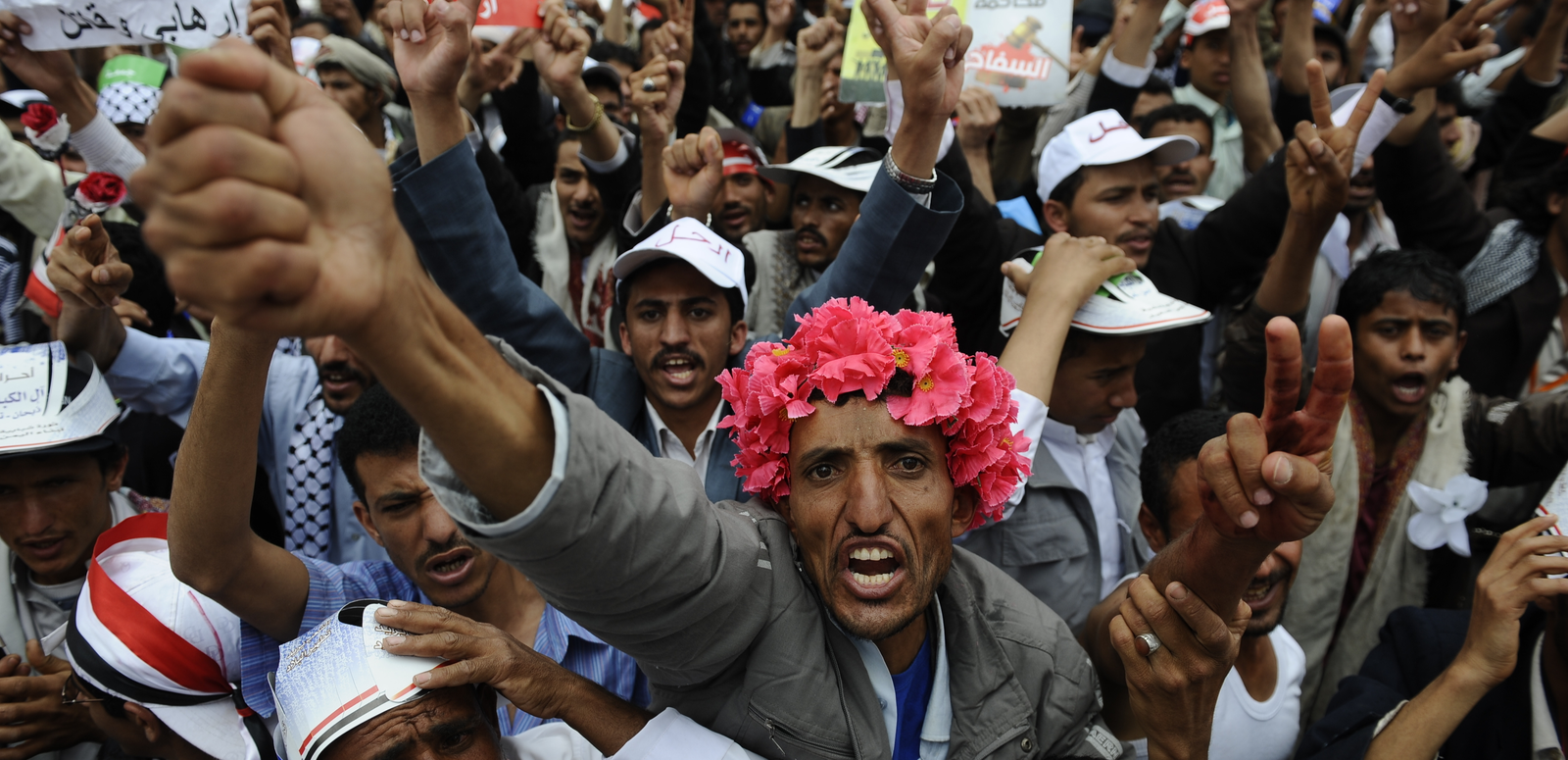
Early Arab Spring Strategic Concerns and Possibilities (2011 - Mid-2014)
Saudi Arabia, the UAE, and Qatar’s proxy strategies since 2011 can be viewed through two broad strategic lenses. In the earliest years of the Arab Spring and its aftermath, the Gulf states adopted opportunistic and revisionist strategies aimed at revising the regional order. Later on, the Gulf states took a more conservative approach to crises, downgrading their proxy ambitions from shifting the regional balance of power to maintaining the status quo.
From 2011 through approximately mid-2014, all three Gulf monarchies largely took an opportunistic approach to the instability wrought by the Arab Spring. They saw weakness and conflict in Libya, and later Syria, as an opportunity to revise the regional balance of power by replacing opponents with allies or friendly regimes.
Notably however, of the three Gulf states, Qatar was by far the most optimistic, while both Riyadh and Abu Dhabi took a more conservative approach to the Arab Spring revolutions, especially with regards to instability on the Arabian Peninsula itself. In Bahrain, Saudi Arabia and the UAE deployed forces to quash a grassroots protest movement and prop up a neighboring Sunni monarchy.
The rest of this section examines the Gulf states’ strategic assessments of the Arab Spring. It then analyzes the interventions in Libya, Syria, and Bahrain through this lens.
Opportunity or Threat: Gulf Monarchy Strategic Perceptions of the Early Arab Spring
All three Arab Gulf monarchies were largely insulated from the destabilizing effects of the Arab Spring. Due to their monopoly on domestic security services, as well as their prodigious oil and gas wealth, these countries were able to use different combinations of violent repression, increased welfare spending, and the deployment of sectarian narratives to stave off more widespread protest movements.
Thanks to their relative insulation, the monarchies perceived the Arab Spring as an opportunity to take advantage of instability in other parts of the Middle East and North Africa to use proxy warfare to reshape the Greater Middle East to favor their interests. Of the three states, Saudi Arabia perceived the Arab Spring as most threatening due to its revolutionary nature, while Qatar viewed the Arab Spring as more of an opportunity, with the UAE sitting between the two in its perceptions.
Saudi Arabia
Saudi Arabia initially saw the transnational Arab Spring movement as cause for concern, and saw potential instability on the peninsula itself as particularly threatening.1 This concern about instability, and the Saudi regime’s anti-revolutionary posture, meant that Saudi strategy was the closest to status quo maintenance of the three Gulf monarchies during the early post-Arab Spring period.
Riyadh also saw itself as both coordinator and leader of the GCC since its founding in 1981. Riyadh therefore felt responsible for taking the lead in countering the effects of the Arab Spring on the Arabian Peninsula, particularly where protests could threaten the GCC regimes themselves.
Saudi Arabia itself saw some domestic opposition organizing and protest in response to the initial wave of the Arab Spring. In February 2011, a number of leading Saudi intellectuals with different ideological backgrounds, including a human rights lawyer and Islamist leadership, signed a petition titled “Towards a State of Rights and Institutions” calling for freedom of speech, independent association, and an elected national assembly, among other rights; another petition articulating the political and economic demands of Saudi youth drew over 10,000 signatures.2 Calls surfaced on Facebook for a Day of Rage on March 11 that paralleled organizing in other parts of the region.3
But Saudi Arabia quickly shut such efforts down through a combination of violent repression, increased welfare spending, and sectarian narratives designed to paint reformers as Shia “terrorists” who were secretly supported by Iran. The monarchy announced major new spending packages in response to the protests, including a $93 billion aid package, an increase in state subsidies, and the introduction of employment benefits.4 The National Guard was deployed across the country to prevent protests, protests in Qatif were violently quelled, and the monarchy painted its opponents in a sectarian light, claiming that the opposition was part of Iran’s conspiracy to destabilize Saudi Arabia from within.5
Despite the revolutionary threat Saudi Arabia perceived from the Arab Spring movements, the effective suppression of protest at home, allowed Saudi Arabia to also look towards the opportunities the protests opened up elsewhere.
Saudi Arabia asserted its authority to lead the region’s response to the Arab Spring. In part, this meant preventing the spread of protest movements close to home on the Arabian Peninsula and against allies like Egypt, objectives that align with status quo maintenance.6 However, it would also open space for Saudi Arabia to pursue opportunist policies with regards to its major regional rival, Iran, and other states that challenged its vision of regional order, like Libya.
The UAE
Like Saudi Arabia, the UAE initially took a cautious approach to the unrest generated by the Arab Spring. The de facto leader of the UAE, Crown Prince Mohammed bin Zayed (MbZ), viewed the rise of Muslim Brotherhood parties in Tunisia and Egypt as threatening to the security of the Emirati regime, initiating a domestic crackdown that targeted the small Muslim Brotherhood movement within the UAE.7 The Emirati Brotherhood affiliate, Islah, “voice[d] concerns about political freedoms more broadly, thereby leading to restrictions from the regime,” according to Courtney Freer, an expert on the domestic politics of the Gulf states.8
The Emirates’ leadership was concerned by the potential for Islah to draw on themes of economic disparity and lack of economic opportunities in parts of the Emirates that had resonated in places like Tunisia, Egypt, and Syria, particularly by highlighting economic disparities between the wealthiest emirates, Abu Dhabi and Dubai, which accounted for about 90 percent of the UAE’s GDP, and the more rural, less wealthy emirates, which had significantly lower GDP per capita and higher unemployment.9 According to a U.S. embassy diplomatic cable, Emirati political scientist Ebtisam Al Ketbi warned in the mid-2000s that “backward economic conditions and extremism in certain parts of the UAE could present a potent threat.”10 In 2011, the Gulf States Newsletter referred to the five poorer emirates as a “ticking time bomb,” since these emirates “have the least to lose by rocking the boat.”11
The Emirati leadership had other reasons to resent the Brotherhood’s domestic influence that were rooted in the state’s values and regime stability, as well as its international image. The movement’s advocacy “for the implementation of conservative social policies [is] a source of embarrassment for rulers, who hope to project an image of a modern and largely secular society,” according to Freer.12 Islah had the potential to contest the regime’s claims to legitimacy.13 Crown Prince Mohammed bin Zayed has long seen the Brotherhood and other Islamist groups, which he tends to conflate with each other, as critical threats to the Emirati regime: he reportedly told a U.S. delegation in 2004 that “we are having a culture war with the Muslim Brotherhood in this country.”14 The instability that followed the Arab Spring appeared to empower Muslim Brotherhood-affiliated groups across the region, from the Emirati perspective. In 2012, the UAE’s Foreign Minister Abdullah bin Zayed called the Muslim Brotherhood “an organization which encroaches upon the sovereignty and integrity of nations” while calling for a coordinated crackdown on the Brotherhood across the Gulf.15
Nevertheless, while Abu Dhabi’s leadership saw the spread of Muslim Brotherhood influence in the region as a threat to the stability of the Emirati regime, they did not experience significant domestic mobilization at home.16 Where the UAE perceived even the potential for mobilization, it cracked down, arresting 94 people in 2012, known as “the UAE 94,” with suspected ties to the Brotherhood.17 The leadership of Abu Dhabi also announced $2 billion in housing loans for Emiratis.18
The lack of a clear and direct domestic threat, despite UAE perceptions of Arab Spring movements as indirectly threatening regime stability, opened the space for an Emirati strategy of opportunistic intervention abroad.
Qatar
Compared to Saudi Arabia and the UAE, Qatar viewed the Arab Spring as posing fewer threats and more opportunities—a perception that would promote its adoption of revisionist aims.
Qatar had long sought for itself a more significant role in the region, and the Arab Spring provided an opportunity to garner greater influence. Starting in the late 1990s, Qatar’s leadership began to invest resources in expanding Doha’s regional profile. It led mediation efforts in Lebanon, Darfur, and Yemen, and promoted an alternative vision of Islamic and Arab identity different from that of the other Gulf monarchies, a touchstone of many Middle Eastern states’ efforts to achieve regional power status. Doha also invested in soft power initiatives, including hosting campuses of American universities in Education City and submitting the winning bid to host international sports events like the 2022 FIFA World Cup.19
These efforts to build a network of external relationships in the region were part of the regime’s strategy of linking Qatar’s economic well-being and security to more powerful states like the United States.20
In comparison to Saudi Arabia and the UAE, Qatar was the least concerned with the destabilizing potential of the Arab Spring. While Qatar has positioned itself firmly under the U.S. security umbrella, its leaders have also pursued a policy of balancing between the two largest regional powers, Saudi Arabia and Iran, since the 1990s. This “strategic hedging” approach led Qatar to develop relationships with non-state Islamist organizations including the Muslim Brotherhood, and to maintain cautiously cordial relations with Iran.21
Qatar has also never experienced Muslim Brotherhood affiliates as a direct threat to domestic stability, in part because its small population and unitary state system allowed its rulers to develop a strong welfare state with less internal inequality (at least among official citizens), and in part because the Qatari regime has invested over the past several decades in building relationships with Brotherhood-affiliates both domestically and abroad.22 Doha welcomed Muslim Brotherhood exiles like Yusuf al-Qaradawi and gave them a platform in exchange for the understanding that they would not weigh in on Qatar’s domestic politics.23 These relationships helped insulate Qatar from Arab Spring-related instability.
In contrast to the Emirati Brotherhood, the Qatari Muslim Brotherhood movement “has favored the ideological and social elements of its platform over pursuing structural or institutionalized power,” according to Freer, thereby posing less of a direct threat to the monarchy’s political authority.24
As part of Doha’s strategic hedging approach to the region, Qatari Emir Hamad bin Khalifa Al Thani also invested in creating a role for Qatar as a key diplomatic mediator in the region from the mid-1990s, a foreign policy reorientation facilitated by the Emir’s decision to invest in infrastructure to exploit the country’s natural gas reserves, leading to a rapid accumulation of wealth that could be invested in regional diplomatic initiatives.25 Qatar maintained a cordial relationship with Iran in part because of the shared North Field/South Pars gas field.26
Whereas Saudi Arabia and the UAE initially held concern regarding the risks of the Arab Spring, Qatar—with its different relationship with and orientation toward key Islamist groups and toward Iran—was the most willing to lean into the protests’ potential for revising the regional balance. In the early months of the Arab Spring, Qatar took advantage of its existing network of relationships and the good will they generated. Qatar’s state-aligned media company, Al Jazeera, provided extensive coverage of the Arab Spring protests in places like Egypt’s Tahrir Square, and therefore played an important role in broadening the Arab Spring’s reach. Notably, however, while Al Jazeera extensively covered protests in places where Doha supported the opposition, including Egypt, Libya, and Syria, it failed to give similar attention to protests in Bahrain, where Qatar tacitly supported the Saudi-led efforts to quash protests.27
Gulf Interventions (2011 - 2014)
In the early years following the Arab Spring protests, the Gulf monarchies intervened in Bahrain, Libya, and Syria. In two of these three interventions, the monarchies embraced an opportunist and revisionist strategy. However, the character of their strategies within these revisionist interventions differed depending on their threat perceptions.
In Bahrain, Saudi Arabia and the UAE—the two states that perceived the Arab Spring protests as more threatening—intervened directly to quash protests and maintain the status quo. Compared with subsequent interventions in Libya and Syria, the intervention in Bahrain was the most status quo-oriented of the GCC states’ interventions during the early years of the Arab Spring. Qatar, which of the three was least concerned about the strategic threat of revolution and therefore had the most opportunistic orientation, went along with the intervention in Bahrain without offering full-throated support.
Yet despite splits in their interpretation of the Arab Spring’s relative provision of opportunities, and their intervention in Bahrain, all three monarchies saw conflict in both Libya and Syria as an opportunity to revise the regional balance of power by partnering with proxies. As a result, the overall strategic character of Gulf monarchy proxy strategy in this period was opportunist and revisionist.
Bahrain (2011): Maintaining the Status Quo
While the Gulf monarchies’ approach to the early Arab Spring tended towards opportunism, the intervention in Bahrain stands out as an important exception where status quo maintenance dominated. The Gulf states’ approach to the intervention in Bahrain also foreshadowed the way differing threat perceptions would lead to more significant divisions later on.
For Saudi Arabia, the protest movement that erupted in Bahrain, led by Bahrain’s Shia-dominated opposition movement, cut too close to home by threatening the stability of an ally, neighbor, and fellow Sunni monarchy. The Saudi government’s relationship with its domestic Shia population, especially in its oil-rich Eastern Province, has been securitized since the Iranian revolution in 1979.28 The Iranian government’s revolutionary-oriented foreign policy drove the Saudi government to perceive organizing by its Shia population as a potential threat to regime survival, linked to Iran as well as Shia movements elsewhere. Protests that spread from Bahrain to Saudi Arabia’s Eastern Province in mid-February 2011 heightened concerns that successes achieved by the protestors in Bahrain would encourage opposition movements within Saudi Arabia.29
Saudi Arabia also shared the Bahraini monarchy’s view that the protests were somehow encouraged by Iran to help it gain a foothold on the Arabian Peninsula. A Saudi official told a reporter at the time that “there is no doubt Iran is involved” in the Bahrain protest movement, without providing evidence for this claim.30 Whatever the truth and extent of Iranian involvement, Saudi Arabia perceived the Bahrain intervention as an effort to defend the status quo from external and internal revisionist threats and not as an opportunity for its own revision.
On March 14, 2011, Saudi Arabia and the UAE sent 2,000 of their own security forces under the aegis of the GCC’s joint Peninsula Shield Force to Manama, alongside a Kuwaiti naval contingent, to quell the protests and shore up the government of Bahrain’s King Hamad bin Isa Al Khalifa.31
Like Saudi Arabia, the UAE was concerned about the optics of the fall of a Sunni monarchy on the peninsula to opposition protests.32 Anwar Gargash, the UAE’s Minister of State for Foreign Affairs, said in a statement about the Emirates’ contribution, “the security and stability in the region requires all of us to stand united in one rank so as to safeguard our national gains and prevent any strife for a better future.”33 The Bahrain intervention held such importance for the Emirati leadership that after Secretary of State Hillary Clinton expressed public criticism of the intervention, the UAE reportedly threatened to withdraw from the NATO-led coalition in Libya unless Secretary Clinton issued a statement pulling back on criticism of the intervention. The statement was not only issued, but was also vetted by Emirati officials before it was put forth as an official communiqué.34
While Qatar supported protest movements elsewhere in the region in early 2011, the prospect of the fall of a fellow monarchy close to home was concerning. Qatar supported the intervention with “a symbolic troop detachment,” according to scholar Toby Matthiesen.35
The Saudi government had already violently put down street protests in Saudi Arabia itself, with police opening fire on protestors in Qatif, wounding at least three.36 The Peninsula Shield Force was intended as an additional anti-revolutionary message to Saudi Arabia’s own Shia population in the Eastern Province that they would continue to experience violent repression by the regime in response to any public protest or opposition organizing.37 It was also a message to the region that Saudi Arabia would be a counter-revolutionary force wherever its interests were threatened. A Saudi official noted at the outset of the intervention that “this is the initial phase. Bahrain will get whatever assistance it needs. It’s open-ended.”38
Libya (2011 – 2014)
If the intervention in Bahrain exhibited the existence of status quo maintenance aims among the Gulf monarchies, the NATO intervention in Libya exhibited the Gulf monarchies’ opportunistic, revisionist aims in the wider region. Qatar and the UAE, in keeping with their lower perceptions of threat from the Arab Spring, played more active roles while Saudi Arabia took a more conservative approach.
On March 19, 2011, a NATO-led coalition that also included Qatar, the UAE, Jordan, and Sweden, implemented a no-fly zone in Libya in response to a violent crackdown on nation-wide protests by Libya’s long-time leader Colonel Muammar al-Gaddafi.39 The Obama administration’s decision to intervene was based, in part, on the regime’s violent attacks on protestors and warnings from human rights organizations that the regime’s offensive on Benghazi could lead to an imminent massacre of civilians.40
Both Qatar and the UAE saw intervention in Libya as an opportunity to replace Gaddafi, an erratic actor, with a more sympathetic government. The Libyan uprising also provided an opportunity to expand their influence generally.41 According to Frederic Wehrey, an analyst of Libya’s civil war and Gulf politics, both states saw Gaddafi’s fall as an opportunity “to project influence beyond their borders, to refashion the shifting political landscape to their will.”42
Qatar’s foreign minister Hamad bin Jassim Al Thani played a key role in getting the Arab League to vote unanimously in favor of the NATO-led intervention.43 Qatar contributed six Mirage fighter jets that flew sorties as part of the no-fly zone mission,44 while the UAE contributed six F-16 Fighting Falcons and six Mirages to the operation.45 Their support also provided NATO with political cover.
During the NATO-led intervention, Qatar and the UAE also provided support and training to Libyan opposition militia groups on the ground, deploying their own Special Forces in Libya to aid these efforts. Qatar supplied fighting groups with Belgian FN rifles and French Milan anti-tank missiles, as well as small arms shipments that amounted to 20,000 tons of weapons. Qatari Special Forces also played an important role in the August Battle of Tripoli, when Libyan rebel forces captured Libya’s capital from the Gaddafi regime.46 The sight of Qatar’s flag flying side-by-side with the free Libya flag over the ruins of Gaddafi’s compound in October 2011 quickly came to symbolize Qatar’s contributions to the Libyan rebels.47 Likewise, the UAE transferred weapons to Libyan militias and its Special Forces participated in the rebel advance on Tripoli.48 While Qatar reportedly tended to support militia commanders with Islamist ties like Ismail al-Salabi of the Rafallah al-Sahati Companies and Abdelhakim Belhadj, commander of the Tripoli Brigade, the UAE leaned towards regionally—and tribally—oriented militias.49
While playing a more passive role in Libya than either Qatar or the UAE, Saudi Arabia supported the NATO-led no-fly zone in Libya. After hours of closed-door deliberations among the 21 foreign ministers, the Arab League called for a no-fly zone in March 2011 at the same time as it officially recognized the rebel movement as Libya’s official government.50 Because NATO had announced that Arab support was a precondition for the execution of a no-fly zone, the support of Saudi Arabia and the rest of the Arab League took on added significance.51
The seemingly quick victory in Libya, which saw Qatar and the UAE working side-by-side with their proxy forces on the ground while rallying the international community, encouraged the flourishing sense of optimism among the Gulf countries that they could take advantage of the Arab Spring-generated instability to re-align the regional balance in their favor via proxy wars. Representing this view, in an early 2012 interview, then-Qatari Prime Minister Hamad bin Jassim asserted that the change wrought by the Arab Spring “is positive in my opinion. And the medium and long-range will be possible…I’m not worried from [sic] the change. I think it will be healthy change for the people and for all of us.”52
This optimism was reflected on the ground: a reporter described a “hero’s welcome” for fighters returning to Benghazi in October 2011 from fighting the remnants of the regime in its last holdout in Sirte, that included crowds of flag-waving Benghazians dancing and ululating in the streets.53
After this initial sense of optimism, however, Qatar and the UAE failed to translate their military victory into influence in the post-Gaddafi political landscape. The National Transitional Council (NTC), the alliance of rebel forces that overthrew Gaddafi’s regime, struggled to exert political authority in the post-Gaddafi state and got caught up in factional fighting as more than 300 militias continued to operate.54
The international sponsors quickly got caught up in the cross-fire and recriminations: in November 2011, Ali Tarhouni, deputy chief of the NTC’s executive committee, publicly criticized Qatar’s ongoing role in Libya, saying “they have brought armaments, and they have given them to people that we don’t know—I think paid money to just about anybody. They intervened in committees that have control over security issues;” NTC chairman Mustapha Abdul-Jalil, whose faction had received support from the UAE, also criticized Qatar’s lack of consultation with the NTC.55
As an anonymous UN official bluntly put it, in Libya, “the Emirates and Qatar were really awful…They didn’t give a damn about Libya, they were always worried that the other would come out on top.”56
In July 2012, Qatar’s preferred political party Al-Watan, an Islamist party established by Abdelhakim Belhadj, the leader of an anti-Gaddafi rebel militia, only won one seat in constituent assembly elections.57 The UAE also continued to play a behind-the-scenes role in the ongoing conflict in Libya, hosting some of the key figures of the NTC who relocated to the UAE as factional infighting wore on.58
By that time, however, the optimism shared by the Gulf monarchies—and expressed perhaps most sharply by bin Jassim in his early 2012 interview—had already translated into opportunistic intervention in another country—Syria.
Syria (2011 – 2014)
In the earliest phases of the Syrian conflict, the Gulf Arab states—led by Saudi Arabia and Qatar—pursued a diplomatic approach, working through the League of Arab States to bring about a negotiated settlement and post-Assad transition process through the summer of 2011.59 Such a strategy could be seen as status quo maintenance. However, by January 2012, it had become clear that this strategy would not suffice to resolve the Syrian crisis.60 Despite shared incentives for the three monarchies to pursue leadership change in Syria, disagreements over who should lead a post-Assad government led to strategies of intervention that were at odds with each other.
In contrast with Tunisia, Egypt, and other countries in the region, the Assad regime did not fall in response to widespread protest. Meanwhile, Qatar, the then-chair of the Arab League, was still riding the optimism of the Libyan intervention, and leveraged its role to diplomatically isolate Assad’s regime and hosted conferences to provide support for the opposition.61 Qatar was energized by a “sense of triumphalism” after Gaddafi’s fall and hoped to just as quickly replace the Assad regime with a friendlier, likely Muslim Brotherhood-affiliated government headed by rebel militias.62 The Emir of Qatar called for an armed intervention in Syria in early 2012.63
The other Arab Gulf monarchies also believed they could quickly and easily achieve results similar to the Libya intervention in Syria. Replacing the Iran-aligned Assad regime with friendlier forces would extend the Gulf monarchies’ influence in the region while dealing a significant blow to Iran’s regional ambitions. Journalist Kim Ghattas writes that “the Saudis wanted Assad gone so they could contain Iran’s ambitions in Syria. In private, Saudi officials began to describe Assad as an occupier, a man with no legitimacy who was oppressing the majority with help from outside forces.”64 The 2003 U.S. intervention in Iraq had shifted the balance of power in the region, essentially creating a zone of uninterrupted Iranian influence from Iran to Lebanon by empowering Iraqi Shia militias and politicians with ties to Iran. Saudi Arabia in particular had tried to pull Syria away from Iran’s orbit in 2009 and 2010 with a diplomatic approach. For the Gulf monarchies, therefore, removing Assad via armed proxies gave them another bite at the apple, and would give them a greater foothold again in the sub-region: “when the uprising first began, Gulf leaders felt that the time was ripe to finally pull Syria into their orbit,” writes journalist Hassan Hassan.65
The Assad regime was a key—indeed, the only—Arab state openly allied with Iran in the region, and a vital partner in Iran’s “axis of resistance.” Iran’s leadership committed “significant resources to shoring up Assad” as a result, according to Iran scholar Ariane Tabatabai.66 An analysis by Iranian politician Amir Mohebbian published on the website of Supreme Leader Ayatollah Khamenei in October 2011, illustrated Iran’s perspective on the dangers posed by the Syrian opposition in presenting an opportunity for others to intervene against Iranian interests: “Westerners considered the Syrian opposition as an opportunity to limit Hezbollah and cut relations between Iran and Syria, and they tried to…destroy Iran’s supportive bridge to Hezbollah through the toppling of Bashar Assad, thus putting Hezbollah under pressure.”67 Hezbollah itself provides a critical “strategic asset that extends Iranian influence to the Mediterranean,” as Jeffrey Feltman, former State Department assistant secretary of state for Near Eastern affairs put it.68
Despite its intervention in Bahrain and greater fear of the Arab Spring movements, Saudi Arabia’s leadership was assertive when it came to Syria: Saudi King Abdullah was the first senior leader in the Arab world to openly condemn the Assad regime’s repression of protestors—and the first to publicly call for the arming of the Syrian opposition.69 In a February 2012 speech described by the New York Times as unusually blunt, King Abdullah condemned Russia and China’s UN Security Council vetoes of a resolution on Syria.70 The UAE, like Saudi Arabia, saw the violence in Syria as an opportunity to oust Assad, although the Emirates played a less prominent role in Syria than it did in Libya. The Emirates joined the rest of the GCC in closing its Syrian embassy in 2012 and declaring support for the Syrian people while denouncing the regime’s violence against protestors.71 The UAE also joined various international coalitions opposing the Assad regime, including the Friends of Syria which first met in February 2012,72 and played host to anti-Assad Syrian businessmen expatriates living abroad, organizing a 2012 conference in Dubai with UAE-based Syrian businessmen to discuss post-Assad investment opportunities.73 In addition to this, the UAE also provided support to some Free Syrian Army (FSA) affiliated Syrian militias via alleged CIA programs, including to the Southern Front coalition, and supported the Syrian Elite Forces (SEF), established in 2016.74
Saudi Arabia, Qatar, and Kuwait began providing funding to the political and military opposition.75 Saudi Arabia and Qatar cultivated relationships with competing political factions within the Syrian National Council (SNC), the coordinating body for the Syrian opposition based in Istanbul, Turkey. Qatar also began shipping light weapons acquired in Libya to the Syrian opposition in mid-2012 via Turkey, where they were distributed by Qatari and Turkish intelligence officials.76 While the largest factions received support from both Qatar and Saudi Arabia, outside states facilitated support to a diverse array of factions within the opposition so that no one faction was able to solidify control. Instead, Syrian opposition groups competed with each other for external support, further driving factionalization rather than cohesion.77
In Syria, as in Libya and elsewhere, two axes of competition gradually emerged amongst proxy sponsors: Qatar provided support to Muslim Brotherhood-affiliates and other Islamist groups.78 In contrast, Saudi Arabia and the UAE, concerned with pushing back against the Muslim Brotherhood’s growing regional influence, given their greater perception of the movement’s domestic threat, supported proxies that opposed the Muslim Brotherhood affiliates. The Saudis wanted the Assad regime gone, but according to Hassan, backed insurgent groups that were either moderate and backed by Western actors, or “Salafi-leaning forces, not seen as politically radical because their teachings call for loyalty to Muslim rulers,” and therefore perceived by Saudi Arabia as less threatening than Muslim Brotherhood-affiliated groups.79 This rift between the three Gulf Arab countries’ strategic priorities grew over the course of these proxy interventions.
These axes of competition repeatedly undermined efforts to unify and create cohesion amongst the Syrian political and military opposition. While the SNC was intended to coordinate with insurgent groups on the ground, it was in reality removed from them. As a result, in January 2013, western states pressed for the formation of the Supreme Military Command (SMC) under General Salim Idris to coordinate the military opposition. Both Saudi Arabia and Qatar publicly supported the formation of the SMC. However, in practice, both competed to appoint their preferred officials to leadership roles, even as they bypassed the SMC altogether to provide support to their preferred Syrian rebel factions. This competition undermined the SMC’s legitimacy and eroded any connections it had to the forces that were doing the actual fighting in Syria.80
Despite the early factionalization, hope remained that the policy could be salvaged. The United States allegedly launched a classified weapons and training program by 2013, led by the CIA and supported by Gulf intelligence services, called Timber Sycamore. The effort was in large part motivated by a desire to minimize the risk of uncoordinated Gulf support for Syrian rebels, although it ultimately did not succeed in doing so, and successive coordination efforts also failed.81
While Timber Sycamore initially provided non-lethal assistance, by the end of 2013, the White House had approved amending the operation to provide lethal assistance. This program worked through two operations rooms: one in Turkey called the “MOM,” an acronym of its Turkish name, the Müşterek Operasyon Merkezi, and one in Jordan called the “MOC,” short for its English name, the Military Operations Command. These command centers were staffed by representatives from the United States as well as Saudi Arabia, Qatar, the UAE, Turkey, Jordan, and France. According to journalist Rania Abouzeid’s account, “The CIA chose, vetted, and trained select Syrian armed groups, while the MOM/MOC provided them with money and weapons, including—for the first time—US-made TOW [Tube-launched, Optically tracked, Wire-guided] antitank missiles from Saudi stockpiles.”82
However, the operations rooms suffered from the same sources of dysfunction, as patrons side-stepped the coordinating mechanisms to continue supporting their preferred factions.83 The proliferation of political and military coordinating bodies was itself symptomatic of the underlying problem—that the state sponsors of Syrian proxies had fundamentally different strategic objectives. While Saudi Arabia, the UAE, and Qatar all wanted to reshape conditions in Syria by toppling the Assad regime, they disagreed on what should come after Assad.
These strategic divisions led to “a highly competitive bidding war for arms by fighters…[that] accelerated their radicalization,” according to journalists Michael Weiss and Hassan Hassan—or at least their willingness to behave as though they had been radicalized— in order to win external support.84 As more extreme forces won increasing external support, they also became more effective on the ground, drawing individual fighters and units away from less extreme factions. While western policymakers sought to provide support for moderate rebels while eschewing extremist or terrorist-affiliated groups, in reality, according to Syria scholar Christopher Phillips, “many militias were fluid in their composition and professed ideology, made easier by their local and personalized nature. Whole katibas [battalions] might suddenly change identity.”85
By 2012, the symbolism and rhetoric of Syrian rebel brigades had shifted away from secular nationalism and towards extremist Islamist rhetoric. Qatar began to establish tenuous associations with increasingly extreme groups: Ahrar al-Sham reportedly received support from Qatar and Turkey, and there were reports of increased contact with Jabhat al-Nusra, an AQ affiliate, over the course of 2013.86 Qatar also looked to deal with Syrian military defectors, but chose interlocutors besides the FSA’s leadership.
Saudi Arabia and the UAE initially focused their support on non-Islamist elements of the FSA, a military organization established in July 2011 by officers who had defected from the Syrian military.87 By 2012, however, Saudi Arabia had sidelined these defectors altogether and instead helped to form the Istanbul Room to distribute its support. However, when supplies did arrive via the Istanbul Room, they “were inconsistent and insufficient, prompting fighters to look elsewhere. Rebels found private sponsors, bought weapons from inside Syria, smuggled them from abroad, manufactured their own, or joined non-FSA Islamist groups that generally had stronger support.”88 In an effort to push Qatar aside, Saudi Arabia reportedly took over the “military file” and became the main external sponsor of the FSA in May 2013.89
As the FSA faltered due in part to internal divisions, “the Saudis shifted some of their backing to more overtly sectarian Salafi fighting groups, supporting the formation of the Islamic Front” or al-Jabhat al-Islamiya, an alliance of Islamist groups including Jaysh al-Islam, al-Tawhid Brigade, and Ahrar al-Sham, in 2013.90 Riyadh also pushed the United States to intervene on behalf of more moderate rebel forces and provide them with arms and training.91 These initial tensions between the Gulf states and the factionalization of the conflict would contribute to the emergence of a turning point in Gulf state approaches to proxy warfare. However, in the early stage, optimism regarding the potential for revision managed to live on—even if on life support—whether that took the form of reorganizations of Gulf state sponsorship or calls for greater U.S. direct involvement.
Citations
- Rosie Bsheer, “A Counter-Revolutionary State: Popular Movements and the Making of Saudi Arabia,” Past & Present 238, no. 1 (February 1, 2018): 233–77, source
- Madawi Al-Rasheed, Muted Modernists: The Struggle over Divine Politics in Saudi Arabia, 2016, 36–37.
- Michael Birnbaum, “Saudi Arabia Calm on Planned ‘Day of Rage,’ but Protests Spark Violence Elsewhere,” Washington Post, March 11, 2011 source
- Dilip Hiro, Cold War in the Islamic World: Saudi Arabia, Iran and the Struggle for Supremacy (Oxford ; New York, New York: Oxford University Press, 2018), 244–45.; Jason Benham, “Saudi King Orders More Handouts, Security Boost,” Reuters, March 18, 2011 source
- Hiro, 244–45.
- Kamrava, “The Arab Spring and the Saudi-Led Counterrevolution,” 99.
- A U.S. diplomatic cable noted that since 2009, the Crown Prince has been “the man who runs the United Arab Emirates… [and is] the key decision maker on national security issues;” quoted in David B. Roberts, “Qatar and the UAE: Exploring Divergent Responses to the Arab Spring,” The Middle East Journal 71, no. 4 (October 15, 2017): 556.
- Courtney Jean Freer, Rentier Islamism: The Influence of the Muslim Brotherhood in Gulf Monarchies (New York: Oxford University Press, 2018), 175.
- Kristian Ulrichsen, The United Arab Emirates: Power, Politics and Policymaking, The Contemporary Middle East (London ; New York: Routledge Taylor & Francis Group, 2017), 192.
- Quoted in Roberts, “Qatar and the UAE,” 555.
- Quoted in Ulrichsen, The United Arab Emirates, 192–93.
- Freer, Rentier Islamism, 177.
- Mazhar al-Zo’by and Birol Başkan, “Discourse and Oppositionality in the Arab Spring: The Case of the Muslim Brotherhood in the UAE,” International Sociology 30, no. 4 (July 2015): 401–17.
- Robert F. Worth, “Mohammed bin Zayed’s Dark Vision of the Middle East’s Future,” The New York Times, January 9, 2020, source
- Ulrichsen, The United Arab Emirates, 191.
- Yom and Gause, “Resilient Royals,” 80; Ulrichsen, The United Arab Emirates, 192; Ulrichsen writes that “there was virtually no prospect of any mass protest in the UAE.”
- Ulrichsen, The United Arab Emirates, 191.
- Elizabeth Broomhall, “Arab Spring has Cost Gulf Arab States $150bn,” Arabian Business, September 8, 2011, source
- Kristian Ulrichsen, Qatar and the Arab Spring (Oxford ; New York: Oxford University Press, 2014), 77–79.
- David B. Roberts, “Securing the Qatari State,” (Arab Gulf States Institute in Washington, Issue Paper No. 7, June 23, 2017), source
- Kamrava, Qatar, p. 41.
- Roberts, “Qatar and the UAE,” 557–58.
- Kamrava, Qatar, 41.
- Freer, Rentier Islamism, 175.
- Ulrichsen, Qatar and the Arab Spring, 2.
- Steven Wright, “Foreign Policy in the GCC States,” in Mehran Kamrava, ed., International Politics of the Persian Gulf, Modern Intellectual and Political History of the Middle East (Syracuse, N.Y: Syracuse University Press, 2011).
- Kamrava, Qatar, 76.
- Shahram Akbarzadeh, “Iran and the Gulf Cooperation Council Sheikhdoms,” in eds. Khalid S. Almezaini and Jean-Marc Rickli, The Small Gulf States: Foreign and Security Policies Before and After the Arab Spring, (Taylor & Francis, 2016), p. 91.
- Matthiesen, Sectarian Gulf.
- Ethan Bronner and Michael Slackman, “Saudi Troops Enter Bahrain to Help Put Down Unrest,” The New York Times, March 14, 2011, source
- Bronner and Slackman 2011.
- Deutsche Welle, “Saudi intervention in Bahrain increases Gulf instability,” March 16, 2011 source
- Quoted in Al Arabiya, “GCC Troops dispatched to Bahrain to maintain order,” March 14, 2011 source.
- Helene Cooper and Robert F. Worth, “In Arab Spring, Obama Finds a Sharp Test,” The New York Times, September 24, 2012 source
- Matthiesen, Sectarian Gulf, 117.
- Nada Bakri, “Saudi Police Open Fire to Break Up a Protest,” The New York Times, March 10, 2011 source
- Matthiesen, Sectarian Gulf.
- Quoted in Rory Miller, Desert Kingdoms to Global Powers: The Rise of the Arab Gulf (New Haven: Yale University Press, 2016), 211.
- NATO, “Operation UNIFIED PROTECTOR Protection of Civilians and Civilian-Populated Areas & Enforcement of the No-Fly Zone,” October 2011 source
- Samantha Power, The Education of an Idealist: A Memoir, 2019, 288–301.; Gaddafi’s public statement that “I and the millions will march in order to cleanse Libya inch by inch, house by house, home by home, alley by alley, person by person, until the country is cleansed of dirt and scum” seemed like a prescient warning of imminent atrocities to Power and the administration; quoted in Power, 295.
- Of Qatar in Libya, David Roberts writes “Never before had the state taken such direct and combative action to unseat a regional leader. Indeed, in the case of Libya, it moved straight to the role of actor and activist, with almost no attempt at arbitration at all;” David B. Roberts, Qatar: Securing the Global Ambitions of a City-State (London: Hurst & Company, 2017), 129; of the UAE in Libya, Ulrichsen writes “Along with their counterparts in Qatar, officials in the UAE were instrumental in rallying the international community to action against Gaddafi and in securing Arab support for what otherwise might have seemed another example of a Western intervention in the region;” Ulrichsen, The United Arab Emirates, 195.
- Frederic M. Wehrey, The Burning Shores: Inside the Battle for the New Libya, First edition (New York: Farrar, Straus and Giroux, 2018), 52.
- Roberts, Qatar, 129.
- Roberts, 129.
- PRI, “UAE sends warplanes to Libya as NATO takes command,” March 25, 2011, source
- Toby Matthiesen, “Renting the Casbah: Gulf States’ Foreign Policy Towards North Africa Since the Arab Uprisings,” in The Changing Security Dynamics of the Persian Gulf, ed. Kristian Coates Ulrichsen, (Hurst & Company, 2017), 53.
- Ulrichsen, Qatar and the Arab Spring, 2.
- Ulrichsen, The United Arab Emirates, 198.
- Ulrichsen, 197–98.
- Richard Leiby and Muhammad Mansour, “Arab League Asks U.N. for No-Fly Zone Over Libya,” Washington Post, March 12, 2011, source
- Leiby and Mansour.
- Charlie Rose, Interview with Prime Minister Hamad bin Jassim Al-Thani, February 2, 2012, source
- Mary Beth Sheridan, “For Libyan fighters Who Finished Off Gaddafi’s Forces, a Hero’s Welcome in Benghazi,” Washington Post, October 22, 2011, source
- Mary Beth Sheridan, “Libya Struggles to Create Army Out of Militias,” Washington Post, October 31, 2011 source
- Ulrichsen, Qatar and the Arab Spring, 129.
- Wehrey, The Burning Shores, 193.
- Ulrichsen, The United Arab Emirates, 198.
- Ulrichsen, 198.
- Samer Nassif Abboud, Syria (Cambridge, UK ; Malden, MA: Polity, 2015), 121.
- Abboud, 121.
- Ulrichsen, Qatar and the Arab Spring, 135–37.
- Christopher Phillips, The Battle for Syria: International Rivalry in the New Middle East (New Haven ; London: Yale University Press, 2016), 135.
- Khaled Yacoub Oweis, “Qatar Emir Suggests Sending Arab Troops to Syria,” Reuters, January 13, 2012, source
- Kim Ghattas, Black Wave: The Saudi-Iran Wars on Religion and Culture That Destroyed the Middle East, First edition (New York, NY: Henry Holt and Company, 2020), 282.
- Hassan Hassan, “The Gulf States: United Against Iran, Divided Over Islamists,” in eds. Julien Barnes-Dacey and Daniel Levy, The Regional Struggle for Syria (European Council on Foreign Relations, 2013), p. 20
- Ariane M. Tabatabai, “Syria Changed the Iranian Way of War,” Foreign Affairs, August 16, 2019, source
- Translated by and cited in Hassan Ahmadian and Payam Mohseni, “Iran’s Syria Strategy: The Evolution of Deterrence,” International Affairs 95, no. 2 (March 1, 2019): 351.
- Jeffrey Feltman, “Hezbollah: Revolutionary Iran’s Most Successful Export,” Brookings Institution, January 17, 2019, source.
- Yehuda U. Blanga, ‘Saudi Arabia’s Motives in the Syrian Civil War’’, Middle East Policy Council Journal XXIV(4), Winter 2017, source
- Rick Gladstone, “In Rare, Blunt Speech, Saudi King Criticizes Syria Vetoes,” New York Times, February 10, 2012, source
- France 24, “Gulf Cooperation Council countries to expel Syrian envoys,” July 2, 2012, source
- Steven Lee Myers, “Nations Press Halt in Attacks to Allow Aid to Syrian Cities,” New York Times, February 24, 2012 source
- Dubai Chamber of Commerce and Industry, “’Partnership to Invest in Future Syria’ Conference Held in Dubai,” November 22, 2012 source
- Joseph Daher, “The Dynamics and Evolution of UAE-Syria Relations: Between Expectations and Obstacles,” (European University Institute, 2019), source
- Ulrichsen, Qatar and the Arab Spring, 130–38.
- Abboud, Syria, 125.
- Abboud, 125.
- Cinzia Bianco, “A Gulf Apart: How Europe Can Gain Influence with the Gulf Cooperation Council,” (European Council on Foreign Relations, February 2020), source; Roberts, Qatar, 134.
- Hassan, “The Gulf States,” 21.
- Abboud, Syria, 126.
- Mark Mazzetti and Ali Younes, “C.I.A. Arms for Syrian Rebels Supplied Black Market, Officials Say,” New York Times, June 26, 2016, source
- Rania Abouzeid, No Turning Back: Life, Loss, and Hope in Wartime Syria (New York: W. W. Norton & Company, 2018), 259.
- Nate Rosenblatt and David Kilcullen, “The Tweet of Damocles: Lessons for U.S. Proxy Warfare” (New America, April 6, 2020), 22, source
- Michael Weiss and Hassan Hassan, Isis: Inside the Army of Terror, (New York, NY: Regan Arts, 2015).
- Phillips, The Battle for Syria, 135.
- Roberts, Qatar, 134.
- Abouzeid, No Turning Back, 147.
- Abouzeid, 147.
- Abouzeid, 213.
- F. Gregory Gause III, Beyond Sectarianism: The New Middle East Cold War, (Brookings Doha Center Analysis Paper, No. 11. July 2014), 7, source
- Hassan Hassan, “The Gulf States: United against Iran, Divided Over Other Islamists,” in The Regional Struggle for Syria, eds. Julien Barnes-Dacey and Daniel Levy, (European Council on Foreign Relations, London, 2013), p. 22, source