But Have Our Narratives Changed?
While national security threats have evolved significantly over the past decade and especially over the past year, we wanted to know whether our narratives around these threats have also evolved to meet this challenge. The newness and complexity of these transnational and domestic-foreign nexus threats demand original and innovative frameworks for talking about and addressing these challenges. Has the national security community risen to the task of developing these frameworks over the past year?
To investigate whether public narratives about security and ideas for addressing these security challenges have changed over the same period, we conducted a quantitative and qualitative media analysis specifically around health and national security. The COVID-19 pandemic was the threat most often identified as critical in the 2020 Chicago Council Survey, and health security is a concept that has gained credence over the past decade or so. By digging deeper into narratives around COVID-19 and health security, we can build a picture of whether and how our conversations around health and the pandemic have evolved to propose a comprehensive security framework that offers policy solutions to this emerging set of challenges.
Quantitative Media Analysis
To begin our assessment of whether our narratives have changed in response to the COVID-19 pandemic, we first look to understand how media coverage of the pandemic as a national security issue changed over the course of 2020. We use MIT Media Lab’s Media Cloud tool, an open-source text corpus of online media stories from thousands of news sources.1 By tracking the number of stories published each month on these topics since March 2020, we are able to study how the media ecosystem around the pandemic and national security has changed over the course of the year.
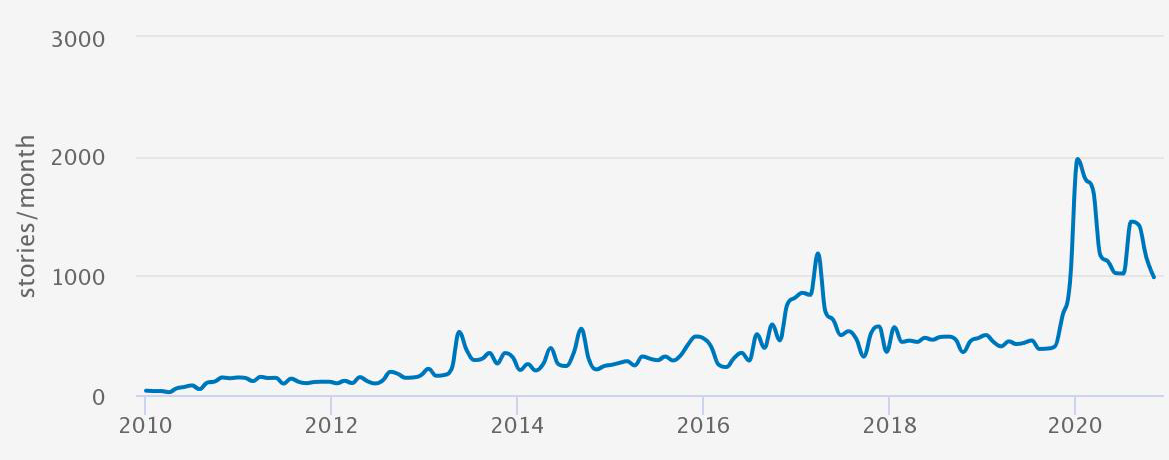
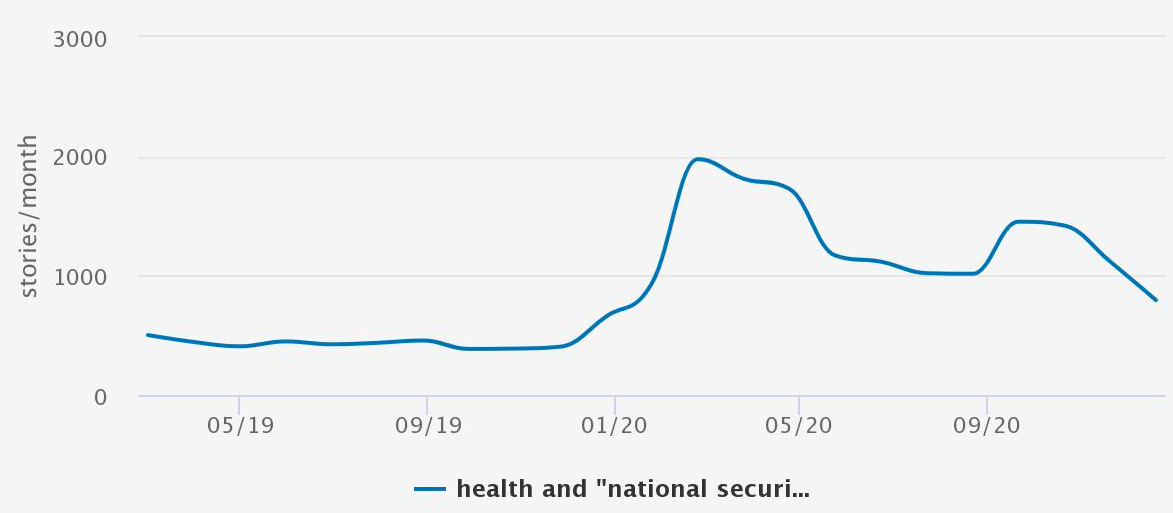
Our findings suggest that U.S. news media coverage of health and national security jumped dramatically at the start of the pandemic. The figure below shows the number of media stories published per month including health and national security. These numbers remained relatively low prior to March 2020—despite warnings from the intelligence community that health security was an important issue and experience with prior pandemics like the swine flu—although they did increase steadily since 2010.
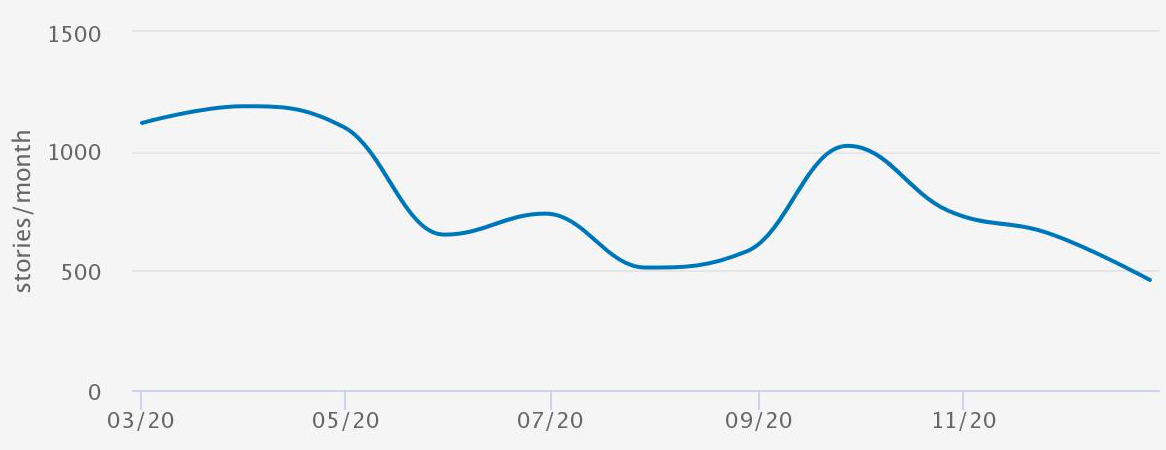
However, despite a large jump in approximately March through May 2020, over the course of 2020, the number of stories that mentioned health, the pandemic, and national security has steadily declined, aside from a spike in coverage in October 2020, likely due to the rising number of cases in the United States and coverage of the issue in the lead-up to the November elections. This suggests that coverage viewing health through the lens of national security threat has declined after a brief surge in interest in the spring of 2020. Further research is needed, however, to develop a deeper understanding of these trends.
Content Analysis
While the quantitative analysis provides a broad overview of coverage of the pandemic as a national security issue, we next dig deeper into the substance and framing of this coverage. We conducted content analysis of opinion pieces in major media sources’ coverage of security and the COVID-19 pandemic. This qualitative analysis sought to identify the most important debates about how the United States should respond to the pandemic as a national security threat.2
We identified three conceptual paradigms encapsulating how the national security community is publicly wrestling with what the COVID-19 pandemic is and what it means for how we think about national security.
Paradigm 1: Will the Pandemic Fundamentally Alter the International Order?
The first paradigm we identified assesses the potential effects of the pandemic on international order and the United States’s place in it. Debates within this paradigm centered on China’s rise and the United States’s relative decline.
A debate emerged within the first few months of the pandemic around what the pandemic will mean in terms of great power competition and whether and how it will affect the rise of China vis-à-vis the United States. Analysts pointed to China’s suppression of information about the virus in the beginning of the year, both countries’ failure to cooperate with the World Health Organization (WHO), and rising tensions between U.S. and Chinese leadership over how to confront the pandemic as potential accelerants of great power rivalry between the two countries.
Some authors thought that the pandemic would fundamentally change the international order, while others argued that it would either accelerate existing trends or not change much at all. Henry Kissinger wrote in the pages of the Wall Street Journal that the United States must “begin the urgent task of launching a parallel enterprise for the transition to the post-coronavirus order.”3 Likewise, Thomas Wright wrote in the Atlantic, “COVID-19 is the fourth major geopolitical shock in as many decades. In each of the previous three, analysts and leaders grossly underestimated the long-term impact on their society and on world politics.”4
Many, however, saw COVID-19 as an accelerant of existing trends in a changing international order, arguing, for example, that “although the pandemic does not appear to be reshaping the regional order in fundamental ways, it could well accelerate preexisting trends and bolster China’s position.”5 Joseph S. Nye Jr. asked in the National Interest, for example, in an article titled “Why the Coronavirus Is Making U.S.-China Relations Worse,” whether the United States and China will be able to cooperate to deal with transnational threats like the pandemic while competing in other areas.6 Likewise, Richard Haas argued in Foreign Affairs that “the pandemic will accelerate history rather than reshape it,” positing that the pandemic will accelerate the United States’s relative decline and the rise of challengers like China. Several authors considered what a new Cold War with China might look like and how it would differ from the twentieth century’s Cold War.7 Others thought that worries about the acceleration of China’s rise were overblown and that the pandemic would have little effect on the international order.8
Many of these articles viewed the pandemic through the lens of the United States and China’s struggle for global leadership, underscoring the difference in the Chinese and U.S. reactions to the virus and pointing to the Trump administration’s very public fumbles in controlling the virus, while China appeared to be using vaccine diplomacy to its advantage. Many lamented the lack of U.S. leadership during the global crisis, and argued that by failing to rise to the occasion, the United States would underscore that it is no longer the indispensable nation when it comes to addressing global crises. As Kori Schake put it in Foreign Policy, “The United States will no longer be seen as an international leader because of its government’s narrow self-interest and bungling incompetence.”9 Robert Zoellick lamented that “the Trump administration, which has conducted narrow transactional diplomacy, has not conveyed an impression of international leadership.”10
Several authors, including Stacey Abrams, Nicholas Burns, Samantha Power, Michael H. Fuchs, and Frank L. Smith III, sketched out how the United States could take the lead in coordinating a global response to the pandemic—and how it failed to do so under the Trump administration. Kurt Campbell and Rush Doshi argued in Foreign Affairs, “As Washington falters, Beijing is moving quickly and adeptly to take advantage of the opening created by U.S. mistakes, filling the vacuum to position itself as the global leader in pandemic response.”11 Others, however, cautioned that despite the United States’s missteps, “The pandemic won’t make china the world’s leader,” noting that “there are real limits to China’s capacity to take advantage of the current crisis—whether through disingenuous propaganda or ineffective global action.”12
Paradigm 2: Is the Pandemic Killing Globalization?
The second paradigm that we identified concerns the status of globalization in the wake of the pandemic, with authors debating whether and to what degree globalization will be shaped significantly by COVID-19. Several articles argued that the pandemic is killing—or at least substantially re-wiring—globalization.13 As early as March 2020, Henry Farrell and Abraham Newman argued that COVID-19 is “shaping up to be an enormous stress test for globalization,” as the interconnected global economy makes countries and firms more vulnerable to shocks.14 Philippe Legrain argued that COVID-19 is likely to “deal a blow to fragmented international supply chains, reduce the hypermobility of global business travelers, and provide political fodder for nationalists who favor greater protectionism and immigration controls,” thereby leaving a lasting impact on globalization.15 Some argued that the pandemic would call into question many western companies’ reliance on China-centric supply chains, while others proposed the opposite—that the pandemic would heighten United States overdependence on this supplier.16
In response to these massive shifts, pundits argued, countries and firms will need to “diversify suppliers to be less dependent on one country such as China and build stockpiles against future disruptions.”17 The United States can also guard against future disruptions by “selectively decoupl[ing]” in high-priority areas.18 Countries are likely to turn inward, some predicted, renationalizing supply chains or at least creating a robust backup capacity to backstop global supply chains.19 Some writers also suggest alternate forms of globalization that will emerge post-pandemic. Michael Klare predicted that deglobalization will lead to the “emergence of semi-autonomous regional blocs.”20 Others predicted a grimmer future, seeing attempts to divide the global economy “into self-reliant ‘bubbles’” that will limit growth and increase tensions among global powers.21
In spite of the challenges, some authors argued that globalization would not be substantially altered by the pandemic. For example, Raphael Cohen argued in Lawfare that “globalization will persist” because the fundamentals of the global economic system remain the same: “Countries still need goods and services from one another, just as they have for thousands of years.”22
Paradigm 3: Confronting the Human Impacts of the Pandemic
The third paradigm speaks to the human impacts of the pandemic, addressing questions about governance, health security, pandemic-related disinformation, vaccine distribution, and a variety of questions related to how the pandemic could affect the lives and well-being of most people.
One conversation within this paradigm looked at how this health crisis is affecting peoples’ everyday lives, and how we ought to change our notions of security accordingly. Notably, several of these pieces were authored by public health experts who might not normally be featured in the pages of foreign policy journals.
In Foreign Affairs, for instance, Jennifer Nuzzo argued that the pandemic should lead to “a fundamental change in the way that countries think about global health security,” and that countries must prepare for the next pandemic by cooperating with one another via international institutions like the WHO.23 Joia Mukherjee, a doctor trained in infectious disease and public health, made the case even more directly, writing that the “pandemic has demonstrated that the national security of the U.S. depends on the country reckoning with its outdated health-care architecture.”24 Mark Lagon and Rachel Sadoff wrote that the United States has the opportunity to build relationships in Africa via health diplomacy.25
In addition to the health security conversation, several analytical threads touched on the human rights impacts of COVID-19. In the early months of the pandemic, some also worried that lockdowns and contact tracing could become excuses for authoritarian regimes to consolidate authority and increase repression of their own people. Authors worried that the pandemic could accelerate existing trends towards authoritarianism in countries like Hungary or Tanzania. Countries’ success in managing this potential crisis in governance “will be measured by their ability to galvanize political will, to demonstrate transparency in the collection and sharing of data, and to avoid politicizing the crisis.”26 By late 2020, some had concluded that fears that the pandemic could accelerate democratic backsliding were unfounded,27 with some even arguing that “the pandemic has eroded the power of authoritarians and the authoritarian-inclined.”28 On the other hand, Freedom House’s 2021 report found that “COVID-19 has exacerbated the global decline in freedom…the changes precipitated by the pandemic left many societies—with varied regime types, income levels, and demographics—in worse political condition; with more pronounced racial, ethnic, and gender inequalities; and vulnerable to long-term effects.”29
Some authors began to link problems with our democracy at home and the effects of COVID-19 to national security. Susan Rice wrote in the New York Times in April that the United States must seize the COVID-19 crisis to ask “how we can emerge a more just, equitable and cohesive nation,” and in another piece in September that domestic political polarization is a force multiplier that makes threats like the pandemic more difficult to address.30
A team of co-authors wrote about the gendered effects of the pandemic, which has damaged economic sectors that are dominated by women “while increasing the unpaid caregiving responsibilities that women disproportionately shoulder.”31 Early on in the pandemic, Vera Zaken drew attention to the potential for pandemic-related disinformation campaigns and conspiracy theories.32 And Thomas Bollyky and Chad Bown pointed to inequities in global vaccine distribution, and how this collective action problem could be addressed through international cooperation.33
Finally, several articles pointed the way towards reimagining security in the wake of the pandemic. Pieces in Just Security argued that the pandemic demonstrates how U.S. national security priorities do not address the most critical threats. Oona Hathaway wrote, for example, that the hundreds of thousands of COVID-19-related deaths show “that the fundamental goal of a national security program should be to protect American lives, then we clearly have our priorities out of place.”34
At the same time, several analysts warned against securitizing the COVID-19 crisis, even as it is increasingly viewed as a national security threat. Brett Rosenberg and Mark Hannah warned in Foreign Policy, for example, that the United States must avoid the mistakes of the post-9/11 period even as we reorient to address new threats like the pandemic.35 As Robert Malley and Stephen Pomper note in Just Security, “Pouring more resources into confronting threats shared by humanity as a whole—like infectious disease—is a welcome idea. But doing so chiefly by emphasizing the national security dimension of these challenges is a perilous strategy.”36
Gap Between Threats and Our Ability to Talk About Them
Our analysis suggests that, a year into the pandemic, the substantial challenges posed by emerging security threats related to the COVID-19 pandemic are not being met by new frameworks for thinking about and addressing them. If we are unable to develop new ways of talking about and understanding these challenges, we will also be unable to develop innovative policy solutions—and we will fail to include the communities most affected by these challenges in policy conversations.
While analysts and broader national audiences see the pandemic as a critical security threat, the expert discourse on the pandemic has until now been primarily focused on debates around whether or not the pandemic will accelerate shifts in the international order and in globalization that many had already predicted. About half of the articles we analyzed in our content analysis fell into the first paradigm, and looked at questions like whether relative U.S. power is declining as a result of failed U.S. leadership in combating the pandemic, whether and how the United States should engage cooperatively with the rest of the world to address the pandemic, and what potential shifts in the international order could mean for competition with China. Approximately an additional 20 percent of articles addressed what the pandemic will mean for globalization.
In contrast, only a third of the articles we analyzed addressed the human impacts of the pandemic and confronting global challenges to health security. Of these articles, many pointed to the lack of frameworks and policy remedies to address these problems—a necessary step in generating new frameworks for policy thinking, but nonetheless a preliminary one. In other words, almost 70 percent of the articles we reviewed used existing frameworks to talk about an emerging challenge. While the questions these articles debated are important and worthy of conversation, they do not move the national security community towards challenging our current framings and conceptualizing new national security challenges in different ways. Additionally, while the first two paradigms were more coherent debates, and saw authors in conversation with one another, the third paradigm encompassed a much broader set of issues and was relatively inchoate.
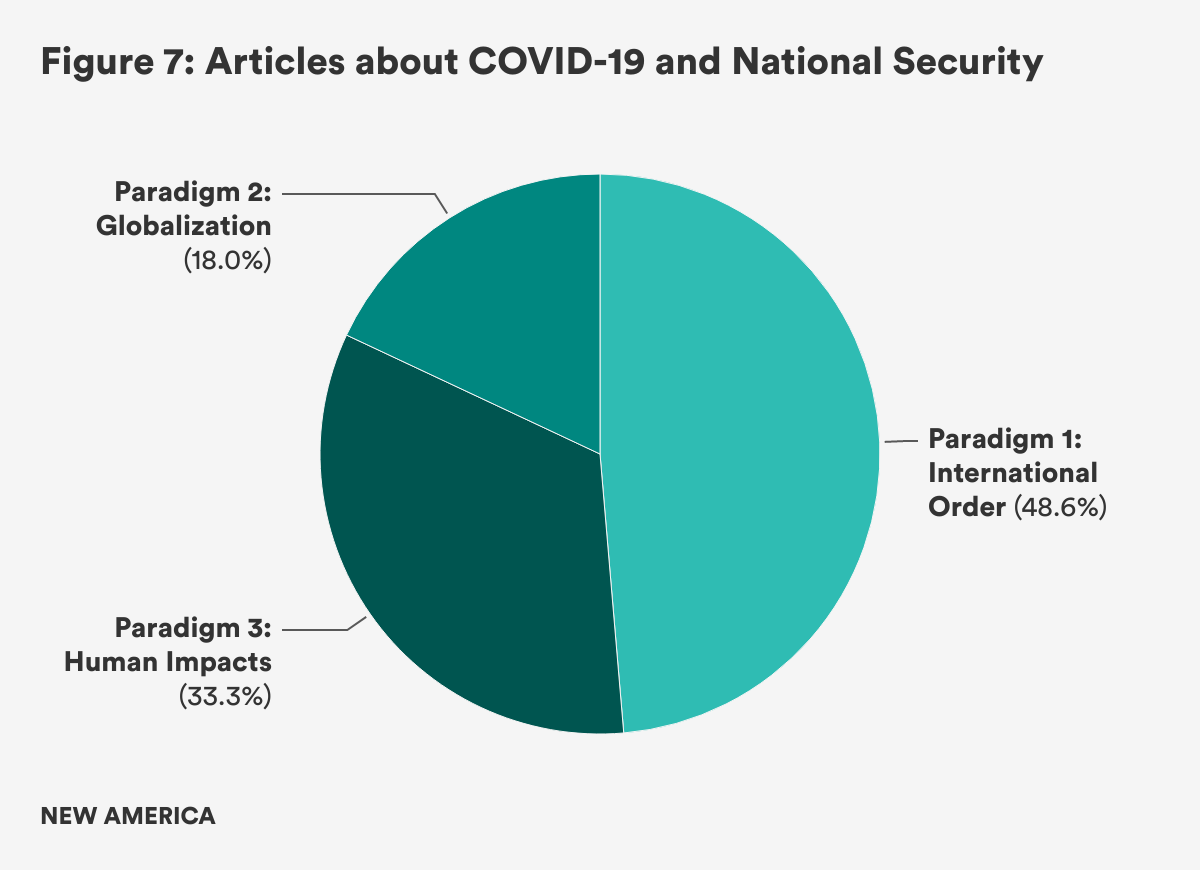
Additionally, the character of pieces varied significantly by media outlet. For example, all of the pieces from Just Security fell into the third paradigm; many of the pieces we reviewed from Foreign Policy spoke to the second paradigm; and the pieces from Foreign Affairs were mostly in the first paradigm. Articles from the Wall Street Journal opinion section tended to have more traditional conceptions of security and many were written by long-standing members of the national security elite, such as Robert Zoellick, Henry Kissinger, and Walter Russell Mead, while the New York Times opinion section tended to feature younger but still very established voices, like Susan Rice and Samantha Power.37 This suggests that the selection of media outlets matters when assessing both the character and quality of these conversations.
Finally, while the set of articles that fell within the third paradigm began conversations about crucially important issues, these conversations are not yet fully-formed debates. Questions remain to be addressed such as, how has pandemic-related disinformation spread and what should the national security do about it? How will the disparate impacts of the pandemic on women and communities of color affect national security? What will vaccine diplomacy interact with shifts in the global order in terms of who has access to the vaccine?
Most importantly, how do we put together these pieces to reimagine what security should look like?
Findings
- U.S. society’s definition of national security threat is shifting, highly-politicized, and closely tied to identity. The dynamics of the 2017-2020 period clarify a trend which was already present; the post-Cold War United States has failed to develop a durable consensus understanding of what constitutes a national security threat. Instead, the notion of security threat, which was always a tool in U.S. politics, has also become a political prize, and public views swing very rapidly in response to elite partisan cues. Legacy national security institutions and modes of thinking persist, and have become a source of power for political factions contending over what constitutes a threat against which they may be turned.
- Existing international security narratives are insufficient to address threats that affect and are in turn affected by choices in domestic, international and transnational (i.e. involving non-governmental actors) arenas. Similarly, challenges that are classed as purely domestic—polarization, political violence, or the functioning of internal institutions, such as public health systems—are also both affected by and potentially weapons in cross-national conflict.
- The national security narrative has not caught up with either the shifts or the reification of threat perception. While writers initially grappled with the potential for massive change as a result of the COVID-19 pandemic, within a couple of months the debate had settled towards conventional framings, such as how the pandemic will affect China’s rise, the international order, and globalization. Analysis of interlocking developments, such as the economic crises, issues with vaccine distribution, political violence, and the divergent effects of these crises on communities of color and women, remained largely absent from the security/foreign policy discourse.
- The national security narrative is reactive, and may be reverting to the mean. While early coverage of the pandemic in relation to national security soared, this framing has since declined in the media landscape. Since we have not developed significant new frameworks for talking about these national security challenges over the past year, it is likely that our national security conversation will simply revert to something similar to its pre-2020 state. This trend means it is diverging further from U.S. domestic politics as it considers, contests, and in some instances incorporates conceptual frameworks such as systemic racism and gender class lenses.
- The national security narrative is not people-centered. What does it mean to have a national security discourse that is largely focused on systems, not people, during a pandemic? Has a national security community that has failed to protect people from a pandemic failed at its task? What would it even look like to develop a people-centered national security narrative? We have largely failed to acknowledge the importance of these questions, let alone address them.
Citations
- “Project Media Cloud,” MIT Media Lab, source.
- To identify a corpus of relevant articles, we searched the following media sources for articles related to COVID-19 and national security that were published between March 2020 and January 2021: Foreign Affairs, Foreign Policy, Lawfare, Just Security, the National Interest, War on the Rocks, the Wall Street Journal (opinion section), and the New York Times (opinion section). While the articles in our corpus are not exhaustive of public conversations among foreign policy experts about COVID-19 and national security, we believe they represent a reasonably accurate sample of these conversations in key outlets, including different mainstream ideological orientations. To add external validity, our analysis here also cites articles from other outlets (e.g., the Atlantic) on similar themes.
- Henry A. Kissinger, “The Coronavirus Pandemic Will Forever Alter the World Order,” Wall Street Journal, April 3, 2020, source.
- Thomas Wright, “Stretching the International Order to Its Breaking Point,” The Atlantic, April 4, 2020, source.
- Jonathan Stromseth, “U.S.-China Rivalry After COVID-19: Clues and Early Indications from Southeast Asia,” Lawfare, May 21, 2020, source.
- Joseph S. Nye Jr., “Why the Coronavirus Is Making U.S.-China Relations Worse,” The National Interest, April 3, 2020, source.
- Spencer Bokat-Lindell, “What Would a Cold War With China Look Like?” New York Times, July 28, 2020, source.
- Richard Haass, “The Pandemic Will Accelerate History Rather Than Reshape It,” Foreign Affairs, April 7, 2020, source.
- John. R. Allen et al, “How the World Will Look After the Coronavirus Pandemic,” Foreign Policy, March 20, 2020, source.
- Robert B. Zoellick, “The World Is Watching How America Handles Coronavirus,” Wall Street Journal, April 7, 2020, source.
- Kurt M. Campbell and Rush Doshi, “The Coronavirus Could Reshape Global Order,” Foreign Affairs, March 18, 2020, source.
- Michael Green and Evan S. Medeiros, “The Pandemic Won’t Make China the World’s Leader,” Foreign Affairs, April 15, 2020, source.
- Ian Bremmer, “Why COVID-19 May be a Major Blow to Globalization,” Time, March 5, 2020, source.
- Henry Farrell and Abraham Newman, “Will the Coronavirus End Globalization as We Know It?” Foreign Affairs, March 16, 2020, source
- source.
- Elisabeth Braw, “Don’t Let China Steal Your Steel Industry,” Foreign Policy, May 19, 2020, source.
- John R. Allen et al, “The World After Coronavirus,” Foreign Policy, January 2, 2021, source.
- Howard J. Shatz, “COVID-19 and Economic Competition With China and Russia,” War on the Rocks, August 31, 2020, source.
- John R. Allen et al, “The World After the Coronavirus.”
- Michael T. Klare, “From Globalization to Regionalization?” The Nation, March 22, 2020, source.
- John R. Allen et al, “The World After the Coronavirus.”
- Raphael S. Cohen, “The Coronavirus Will Not Stop Globalization,” Lawfare, April 12, 2020, source.
- Jennifer Nuzzo, “To Stop a Pandemic,” Foreign Affairs, January/February 2021, source.
- Joia Mukherjee, “Global Health Is National Security,” Just Security, September 30, 2020, source.
- Mark P. Lagon and Rachel Sadoff, “Health Diplomacy in Africa: Competition and Opportunity,” Lawfare, June 7, 2020, source.
- Travis L. Adkins and Jeffrey Smith, “Will COVID-19 Kill Democracy?” Foreign Policy, September 18, 2020,source.
- John R. Allen, “The World After the Coronavirus.”
- Ivan Krastev, “The Pandemic Was Supposed to Be Great for Strongmen. What Happened? New York Times, September 8, 2020, source.
- Sarah Repucci and Amy Slipowitz, “Freedom in the World 2021: Democracy Under Siege (Freedom House, 2021), source.
- Susan E. Rice, “A Divided America Is a National Security Threat,” New York Times, September 22, 2020, source.
- Jamille Bigio et al, “COVID-19 Could Undo Decades of Women’s Progress,” Foreign Affairs, January 5, 2021, source.
- Vera Zakem, “Pandemic Propaganda Is Coming. Be Ready for It.” New York Times, April 22, 2020, source.
- Thomas J. Bollyky and Chad P. Bown, “Vaccine Nationalism Will Prolong the Pandemic,” Foreign Affairs, December 29, 2020, source.
- Oona Hathaway, “COVID-19 Shows How the U.S. Got National Security Wrong,” Just Security, April 7, 2020, source.
- Brett Rosenberg and Mark Hannah, “After the Coronavirus, Don’t Repeat 9/11’s Mistakes,” Foreign Policy, April 29, 2020, source.
- Robert Malley and Stephen Pomper, “The Perils of Hyping Pandemic Response as a National Security Issue,” Just Security, May 4, 2020, source.
- Several of these authors, including Susan Rice, Samantha Power, and Rob Malley, have subsequently joined the Biden-Harris administration.