Lisa Guernsey
Senior Director, Birth to 12th Grade Policy; Co-Founder and Director, Learning Sciences Exchange
Tackling Wicked Problems and Catalyzing Creativity


“The [late 20th century] belonged to a certain kind of person with a certain kind of mind— computer programmers who could crank code, lawyers who could craft contracts, MBAs who could crunch numbers. But the keys to the kingdom are changing hands. The future belongs to a very different kind of person with a very different kind of mind—creators and empathizers, pattern recognizers and meaning makers.” — Daniel Pink, A Whole New Mind (2005)
These lines from psychologist Daniel Pink’s landmark book, A Whole New Mind, presaged the past two decades of the paradigm shift we see all around us. We are at the precipice of a new Age of Creativity. The age of crunching numbers and organizing information is no longer enough to help society move forward, especially as artificial intelligence agents like ChatGPT and OpenArt can synthesize data to write Shakespearean prose and produce replicas of Picasso’s paintings in seconds. As mind-boggling as these technologies are, writing recaps of already-existing information or reproducing art will not solve society’s most wicked problems.[1]
Synthesis and production must give way to innovation. Originality—the ability to create something new—will become the valued currency of our time, especially in the face of the increasing chaos and complexity caused by things like pandemics, natural disasters, climate change, political instability, rising inequality, and structural racism.
Can we help people become brilliant innovators? Yes—once we also recognize that creativity is unleashed by collaborating across diverse domains. Too often, brilliant minds work within the confines of their own knowledge, worldview, and walls. This approach misses critical opportunities to provide spaces and experiences for people to gain new mindsets and perspectives by working on solutions with experts they might not otherwise encounter.
The Learning Sciences Exchange (LSX) fellowship program was built to spark new mindsets and become a platform for collaboration.[2] Launched in 2018, LSX was designed to bring together high-achieving, mid-career professionals from different cultural backgrounds and sectors[3] to give birth to new approaches for solving problems in education. By stimulating creativity through collaborative design and problem-solving, initiatives like LSX can catalyze innovation and help highly motivated problem-solvers lose their “blinders” by seeing through different lenses, beyond what their own sectors can offer.
This paper reflects on what we have learned from five years of developing this unusual approach to collaboration and describes the program's origins, design, and challenges and opportunities. We believe the LSX model has huge potential for fostering the innovation and creativity needed in this new age—a model that could work beyond the realm of education and bring positive change to many other fields as well. The results we are seeing include an ever-growing network of innovators whose ideas intersect, creating emergent solutions that could not be borne of any single sector.
How the Learning Sciences Exchange (LSX) Works
LSX is a two-year fellowship program that promotes virtual and in-person collaboration among professionals who do not typically intersect. Among its features:
Fellows and advisors speak at the biannual LSX Summit, describing their experiences from working together. They also present video stories about the building of their prototypes, which so far have featured live-action videos, picture books, animations, infographics, social-media campaigns, and games that promote learning in new ways.
For more, see our video overview here and our site at learningsciencesexchange.org.
“Two heads are better than one,” C. S. Lewis wrote, “not because either is infallible, but because they are unlikely to go wrong in the same direction.”[4] Collaboration is becoming more and more necessary in an interconnected world whose problems demand creative solutions. Global pressures force organizations to face many problems that lack a simple answer. According to Barbara Gray, professor emerita at Pennsylvania State University, these pressures create turmoil and complications because they impact stakeholders in increasingly unpredictable ways. Since each stakeholder has a unique perspective on the problem and its solutions, the greater this difference between perspectives and the more complex and potentially chaotic—or wicked—the problem becomes.[5]
Today, few, if any, stakeholders possess the knowledge and resources needed to understand and act on these problems independently. Peter Drucker, one of America’s most prominent thinkers in business management, cautioned against the tendency to act alone amid chaos when he issued this dire statement: "Isolation is corporate death."[6] According to Drucker, if organizations do not break their tendency for isolation in favor of cooperation and collaboration, "they'll go the way of pterodactyls."[7]
Scientists are pointing to the power of collaboration too. As author and LSX alum Annie Murphy Paul describes in her book The Extended Mind, solving complex problems requires the activation of multiple minds coming together. Paul cites research suggesting that humans “have unequaled capacity for coordinating thought and behavior with other members of their species.” As group members attend to something together, she writes, they produce “greater overlap in…‘mental models’ of a problem, and therefore smoother cooperation while solving it.”[8] In other words, collaboration between people can begin to establish some common ground between them.
Yet establishing common ground is not easy. It requires going below the surface of a particular event or topic to understand individuals’ mental models, such as the assumptions and beliefs that affect the way they live their lives.[9] Our competitive world does not prioritize opportunities and spaces to plumb those depths and develop the skills for collaborating effectively. When COVID-19 hit in 2020, for example, efforts to curtail the virus to safeguard public health soon received pushback from individuals and groups who saw the world differently and had received different information about the nature of the threat. Because robust networks had not been established and there had been little opportunity for dialogue among these different groups, distrust increased—and the virus continued to rage.
Collaboration among diverse players can transform the sometimes adversarial nature of problem-solving into a mutually beneficial search for information and solutions. This search requires stakeholders to establish a common vocabulary and a commitment to revealing and resolving their differences through dialogue and conflict resolution. This way, richer understanding and more creative solutions emerge than could be produced by any single stakeholder.
The LSX fellowship program started in 2017, focusing on the problems of child development and education. We wanted to know: Why are findings from developmental science often locked away in publications that are foreign to those who make decisions about educational practices, policies, or products?
One major contributor to this problem, we hypothesized, is that stakeholders from diverse sectors, such as journalists, entertainment producers, education policy influencers, entrepreneurs, and learning scientists, have little incentive to take the time to listen to each other, grapple with problems together, and gain a deeper understanding of each other’s mission and work.
The world of higher education offers an example. Although interdisciplinarity is a favored buzzword, few papers are written together by people in different disciplines. The reward structure in many academic fields is to work within your sector, which does not include sharing findings with the press. Academics who are learning scientists, for example, often avoid talking to journalists. Journalists, for their part, see their role as disentangling the meaning of the scientific stories they hear, keeping their ears open for controversy, and highlighting when concepts are in dispute. And people in the entertainment industry, while often eager to incorporate scientifically based information, rarely speak to journalists or scientists. These scientists, journalists, entertainment executives—not to mention policymakers and entrepreneurs—all live in different worlds. This lack of interaction dims prospects for good translation from the world of science to the mainstream media.
To address this lack of interaction, we tried a new approach: prioritizing collaboration through a convergence of sectors and cultures at the start of a project, not as an afterthought or final phase to elicit feedback. We called on mid-career experts to join the program as fellows for two years. These were individuals who had many accomplishments to their names and who worked in areas related to education, families, and children, from varied sectors and fields. They had reached a point in their careers in which they saw value in learning from people outside their own bubbles.
Our goal was to facilitate opportunities for these experts to get to know each other (both in person and online). We encouraged them to introduce the special terms and jargon from their respective sectors. Sometimes this elicited a sense of discomfort, as colleagues challenged each other’s assumptions and felt compelled to clarify their ideas. This process culminated in the creation of a shared vocabulary and a deeper understanding of each other’s fields, fostering the emergence of innovative ideas.
Our approach acknowledged that individuals from diverse backgrounds and cultures have their own goals, expectations, and processes for experiencing the world. Often, these systems of knowing fundamentally differ. We recognized that colliding different systems of knowing would create disagreements and discomfort. People often cannot agree because they do not have the same vocabulary or knowledge base. They are wearing lenses (or maybe even blinders) that cause them to see problems and solutions in a certain way. Even the very definition of a problem can affect different people in different ways.[10] So we focus on building relationships, broadening perspectives, and helping our program fellows create shared definitions to problems from which innovative solutions could arise.
Our aim is to help these mid-career, well-established, and respected individuals work together, be able to write about problems and potential solutions for audiences outside their fields, generate a common vocabulary, and establish a network for dealing with future problems. Our theory of change argues that bringing together experts from different perspectives, and giving them the space to develop trusting relationships and a common language, leads to creative solutions that would not have been generated otherwise.
Implicit to the model is that these networks will not only create a one-time solution but they will also have developed a way of thinking about future issues, an LSX mindset. This LSX mindset, which starts with an open mind and desire for learning from individuals who are different from oneself, enables cross-fertilization and allows participants to escape their mental silos. It also creates a network of thinkers who can quickly mobilize to address key issues around children and families. They can become a mobile think tank, built on an ever-expanding international network of talent and expertise.
LSX emerged from the education space, but it was designed to tap expertise in sectors beyond education. To set the foundation for the program, we gathered a group of advisors—leaders in their fields who share a passion for solving societal problems and who have already experienced the value of cross-sector collaboration. We also formed a steering committee (which now meets at least monthly) to develop webinars, talk through goals for dissemination of the fellows’ ideas, and consider partnerships with organizations that provide coaches for design-thinking, offer communications support, and conduct research and evaluations.
The four steps below describe the LSX model and how we help spur collaboration among each two-year cohort of LSX fellows and among LSX alums as well. We hope these steps inspire other institutions. Components of this model could be applied to other fellowship programs. It could also be used to drive public-private partnerships, help break through logjams on city and state task forces, and create platforms for bringing diverse voices into community foundations or other leadership organizations.
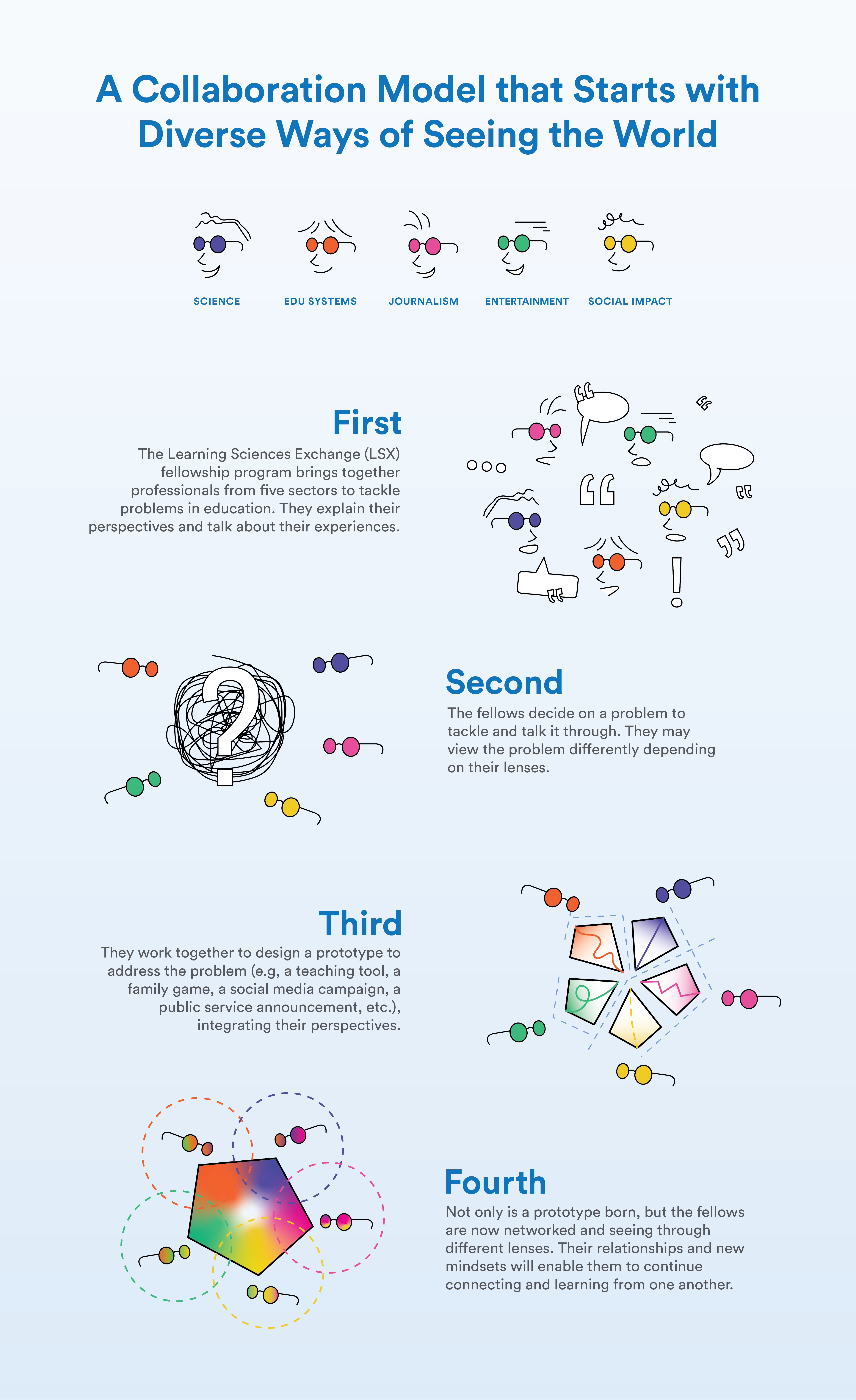
STEP 1: Put connecting and sharing first, with problem-solving second.
STEP 2: Assign participants to teams.
STEP 3: Give opportunities for dialogue about differences.
STEP 4: Enable ideas to be shared across teams, program-wide, and with the public.
Now that the LSX program has been in place for five years, we are starting to understand the results. The most tangible outcomes are the prototypes the LSX fellows develop and present to their peers and the public after 18 months of brainstorming and collaboration. The prototypes that have emerged so far present scientific nuggets of information in entertaining and innovative ways that spark learning, helping children and families build skills and knowledge (see videos here and more information in Prototypes and New Ideas below).
Even more lasting, however, are several less tangible outcomes. Elizabeth Shuey, an LSX policy fellow from the 2018–20 cohort, puts it this way: “There is enormous potential for these small-scale collaborations to create something even more meaningful as the LSX program evolves to a broader expanse of networked people bonded by this shared experience."
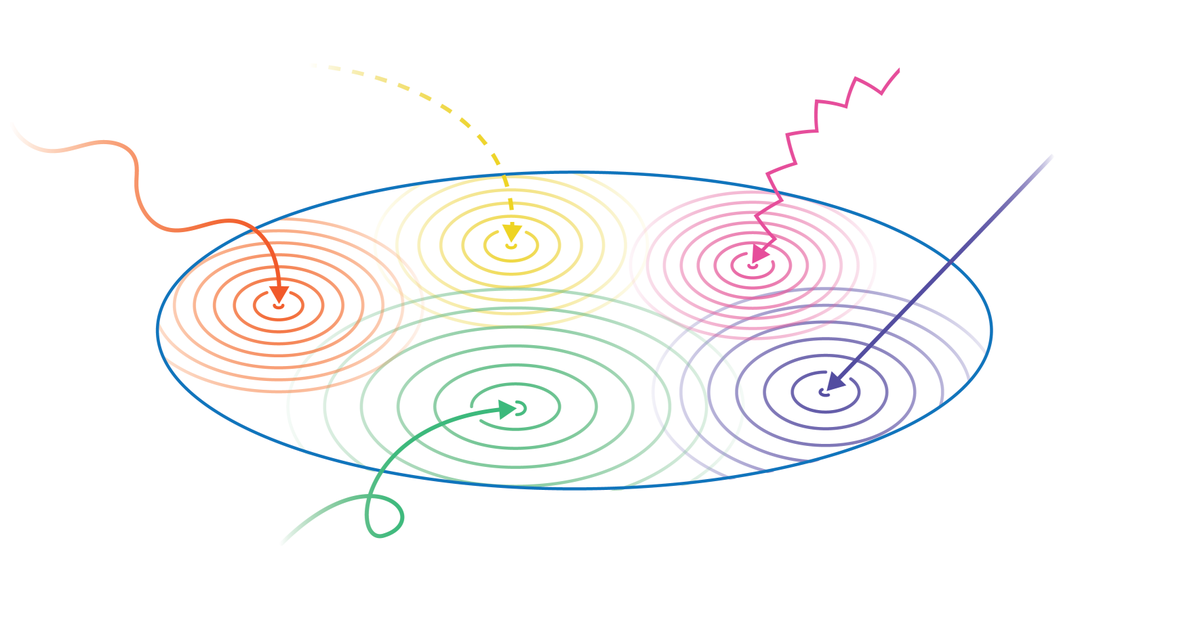
Strong networks built from months of working together are like the ripples that result from a stone thrown into a pool, with ideas increasingly overlapping and expanding as the number of participants in the LSX program increases. Fellows share ideas with others in their cohort, across sectors and countries. Former fellows continue to be involved, returning to share insights with the new cohort and with other participants, who in turn share those insights with their own communities, and so on. This creates an expanding multidisciplinary group with the expertise to meet rising challenges and respond quickly.

“I am starting to get a sense of how other people learn or work or think in ways I would never have otherwise,” says Jeff Kleeman, an LSX fellow in the 2020–22 cohort who works in the entertainment space. He said he now sees value “in bringing an eclectic group of people together who might not ever be in the same place and to have an exchange of ideas, to have something to discuss and look at from each other in our different circumstances.”
Judith Danovitch, a scientist also from the 2020–22 cohort, describes the experience as having “a major impact on the way I think about my research and what I want to do in the future.” She is starting to expand beyond her lab. She says, “I’ve been thinking about: how can I write a grant that incorporates things like the community, how can I incorporate other disciplines?”
Prototypes and New Ideas
To help foster collaboration, LSX fellows form teams and are given 18 months, as well as a small budget, to develop prototypes to help solve a problem in education. The following prototypes and projects have emerged from the first two program cohorts:
In 2021, we began to talk with Phillip Ellis, then a doctoral student at the University of Pennsylvania, who was interested in assessing how the program worked (and who is a co-author of this white paper). By then, LSX had already enrolled two cohorts of fellows from the years 2018–20 and 2020–22. Ellis conducted a qualitative research project[11] to examine how each sector displayed a variety of aims, ideals, and processes for viewing a problem and defining the solutions. Ellis observed how the interaction of systems of knowing created an environment where collaborators may disagree not only on what they know but how they know.
Ellis discovered that these disagreements could either foster creativity and adaptation or trigger intense emotions and a sense of not being heard or valued. To optimize creativity and minimize emotions that might derail the collaboration, he determined that participants must be given opportunities to increase their awareness of how these systems of knowing play out in the collaboration, even if it means addressing uncomfortable disagreements. To foster this awareness, fellows must feel safe expressing the strengths and limits of how they know and view the problem and solutions.
These findings confirmed the LSX theory of change and helped us improve. We offer five insights from Ellis’s research that could be applied to other collaborative cross-sector approaches. These lessons align with previous research on cross-sector collaboration.
The world needs models and platforms that set conditions for effective collaboration and problem-solving, instead of feeding into increased fracturing, siloing, and polarization. Other forward-thinking organizations are also trying to remove silos and set up models for bringing different, even divergent, perspectives together. The Brookings’ Center for Universal Education and the Stanford Accelerator for Learning are experimenting with new models for co-creation to advance what seem like intractable global education debates. The Convergence Accelerator model, developed by the National Science Foundation, aims to bring cohorts from different disciplines together, “synergizing their work through facilitated collaboration.”[12] In the early learning space, Promise Venture Studio brings together entrepreneurs, funders, researchers, experts, and policymakers to build and scale up promising programs.[13] And the Jacobs Foundation, our funder and our partner in building LSX, has been running innovative fellowship programs that bring journalists, entrepreneurs, and scientists together for many years.[14]
The LSX model is synergistic with these new approaches and charts a path forward for any institution seeking to catalyze innovation. We are leaving the Knowledge Age, where accumulating and synthesizing information was key. In the next era, the Age of Creativity, innovation and originality will allow us to solve problems far beyond any bot’s capacity. We will need new ways of educating and thinking, of appreciating varied perspectives, and of melding individual expertise into a more powerful, holistic approach. LSX offers one vision of that approach. We encourage other institutions and organizations to borrow and adapt the ideas laid out here to build even more collaborative creative networks to help solve the problems that will shape our world and our society in the future.

We would like to thank our colleagues at New America and the Brookings Institution who have provided important feedback through various stages of this white paper, including Rebecca Winthrop and Elise Franchino, as well as Sabrina Detlef for expert editing and Mandy Dean and Fabio Murgia for their communications support. We are grateful to the following education experts who reviewed an earlier draft and provided critical insights for improving the paper: Isabelle Hau, Pam Grossman, and Sharon Ravitch. Finally, we thank Cathrin Jerie of the Jacobs Foundation for her helpful comments and the Jacobs Foundation itself, without whose support this paper—and the last five years of the LSX program itself—would not have been possible.
[1] Throughout the paper, we use the term "wicked problems" to describe complex and difficult-to-solve issues. The term originated from urban planners in 1973 who were frustrated with solely using science to address social problems. Although scholars debate the validity of “wicked” as a separate category of problems, the term evokes a natural curiosity and highlights the active discovery and negotiation of problems in society as we strive to understand their impact.
[2] LSX is administered by New America, funded by the Jacobs Foundation, and steered by a committee that includes the co-founders of the program (Roberta Golinkoff of the University of Delaware, Lisa Guernsey of New America, and Kathy Hirsh-Pasek of Temple University) as well as Jacobs Foundation officials (from 2017–22, this has included Urs Arnold and Cathrin Jerie) and the LSX coordinator at New America (Sabia Prescott until 2020 and now Elise Franchino). When we started the program in the fall of 2017 (we made the first call for applications in November 2017), our advisory board included Rebecca Winthrop of the Brookings Institution. Hirsh-Pasek is also affiliated with Brookings as a senior fellow. For these reasons, New America and Brookings are co-publishing this white paper.
[3] We use the term “sector” to mean one’s professional sphere. In the LSX program, we draw applicants from five sectors: journalism, entertainment, the science of learning, social entrepreneurship, and education leadership (denoted in the first four years as “policy” and “systems”). Another term for “sector” could be “discipline” or “specialization.”
[4] C. S. Lewis, “Introduction,” in St. Athanasius, De Incarnatione Verbi Dei (Crestwood, NY: St. Vladimir’s Seminary Press, 1944/1993), 4–5.
[5] For more on the complexity of these kinds of problems, see Gray’s book, Collaborating: Finding Common Ground for Multiparty Problems (San Francisco: Jossey-Bass Publishers, 1989).
[6] Elizabeth Haas Edersheim, The Definitive Drucker (New York: McGraw-Hill, 2007), 23.
[7] Edersheim, The Definitive Drucker, 27.
[8] Annie Murphy Paul, The Extended Mind: The Power of Thinking Outside the Brain (Boston: Houghton Mifflin Harcourt, 2021), 222.
[9] The concept of “mental models” may be familiar to those who study systems thinking and who have seen what is known as the “iceberg” infographic. The tip of the iceberg represents what is visible (an event, for example), but there are larger, invisible parts under the surface that are the systemic issues leading to that event, including the mental models that include people’s assumptions and beliefs. For a recent discussion of these elements of systems thinking, see keynote remarks at the Education Systems Transformation Symposium led by the Brookings Institution's Center for Universal Education on February 17, 2023, at https://www.brookings.edu/events/education-systems-transformation-symposium/.
[10] In fact, as authors of this paper with research backgrounds, we realize that our systems of knowing come through the methods of science. Others may be less sure about science for finding answers. So we, too, needed to work to see our approach through others’ eyes.
[11] Phillip N. Ellis, "Epistemic Thinking's Role in Collaborating on a Wicked Problem" (PhD diss., University of Pennsylvania, 2022).
[12] See this website for the Convergence Accelerator, a major initiative of the National Science Foundation: https://beta.nsf.gov/funding/initiatives/convergence-accelerator.
[13] As described on the firm’s website, Promise Venture Studio supports “nonprofit and for-profit ventures and organizations at any stage of development that reach (directly or indirectly) children, prenatal to age 5 in the U.S., and their families and communities who are facing the greatest adversities.” For more, see https://www.promisestudio.org/.
[14] For more on the Jacobs Foundation’s programs, see https://jacobsfoundation.org/programs/.
Senior Director, Birth to 12th Grade Policy; Co-Founder and Director, Learning Sciences Exchange
External Author