The Inevitable Conclusion: More Research

It’s rare to get a room full of education researchers to agree on any one point. From phonics to small school reform, everyone has a different take and several studies to back up their opinion. However, you would be hard pressed to find a single peer reviewed journal article that doesn’t come to the one conclusion that finds unanimous support from researchers across the spectrum: the need for more research and the funding to support it.
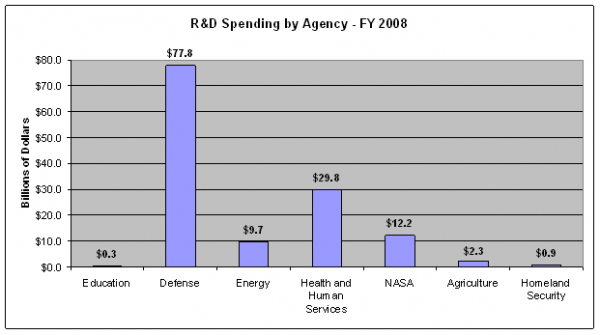
Despite the continuous call for more and better education research and development (R&D), the Department of Education’s R&D budget remains limited in comparison to that of other agencies and the private sector. For FY 2008, the Department of Education budget allotted $321 million for R&D out of a total budget of $59.2 billion. That means that R&D accounts for just over one half of one percent of total federal education funding today. The FY 2009 budget includes just a three million dollar increase in R&D funding for education for a total of $324 million.
In contrast, the FY 2008 budget for the Department of Defense allotted $77.8 billion, or 13% of its total budget, for R&D, while the Department of Energy allotted $9.7 billion or 40% of its total budget for R&D. Of the $142.7 billion in federal funds allotted for various R&D efforts in FY 2008, the Department of Defense accounted for 55% of that spending while the Department of Education accounted for a mere one fifth of one percent of that spending. The meager levels of federal funding for educational R&D are particularly problematic because, in contrast to other industries where there is substantial private R&D investment, the feds are the primary source of funding for education R&D. States and local school districts lack the infrastructure or economies of scale to make substantial R&D investments, and while private philanthropy picks up some of the slack, the $5.2 million philanthropic groups invested in education R&D in FY 2006 is tiny compared to the need.
Overall, the education sector (both public and private, pre-K through college) spends less on R&D than most industries. In FY 2005, private industry spent $204 billion on R&D alone. The sectors with highest R&D spending included manufacturing ($44.2 billion or 6.1% of net sales) and pharmaceuticals ($34.8 billion or 12.7% of net sales). In that year, federal and non-federal R&D spending combined reached over $323 billion, while federal spending on education R&D was only $297 million – less than one tenth of one percent of total US spending on R&D.
This lack of support for R&D is particularly problematic because current federal education legislation stresses making decisions and implementing education policies based on rigorous, scientifically based research. The No Child Left Behind Act (NCLB)‘s emphasis on results and research-based practice has sparked demand for new, research-proven models that address major educational challenges, such as improving curricula or turning around low-performing schools. But research investments haven’t kept pace with the demand.
The 2002 Education Sciences Reform Act (ESRA), sought to improve the quality of federally-supported educational research by creating the Institute of Education Sciences and demanding more rigorous standards for the conduct and evaluation of federally funded education R&D. Those were positive changes. Since the creation of IES, however, funding for education R&D, as a percentage of the total Department of Education budget, has actually fallen. In FY 2001, R&D funding accounted for three-fifths of one percent of the total Department of Education budget – $265 million out of a total budget of $42.2 billion.
That’s a shame – one of the happy consequences of NCLB is the growing number of states with accessible, student-level data that make rigorous education R&D possible in a way it never was before. For example, states and researchers could use currently available student-level data to rigorously evaluate the efficacy of various educational reform strategies-but taking advantage of that opportunity requires funding.
New data capabilities and the increasing emphasis on scientifically-based practice in education provide an environment ripe for rigorous and relevant research and development on any number of school interventions, reforms, and curricula. This research has the potential to improve education for all students and guide policymakers towards more effective use of education funds. Perhaps it’s time for the Department of Education to really increase the emphasis on rigorous education research and development by making more of it possible.
More About the Authors
Issues
Related

Representation Matters for Women of Color in Youth Apprenticeships

Meet the Commissioners

New America & ACCT Invite Community Colleges to Apply for Work-Based Learning Capacity-Building Cohort