Table of Contents
Part 2. Gender Tax: The Experience of Being a Female Nuclear Policy Professional
Women who worked for years or decades in nuclear policy—and had the opportunity to compare across sectors and subspecialties—described a consistent, challenging set of expectations they needed to meet and experiences they were forced to navigate. Some, like harassment, assault, and discrimination, were explicitly gendered. Others seemed gender-neutral on their face but intersected in problematic ways with societal norms around femininity. Interviewees had much positive news to share about their own experiences surmounting prejudice, supporting other women, seeing norms change over time, and gaining the power to lead in changing norms and practices for the field. But few doubted the persistence of problems that drive some people out of the field, limit innovation, and impose extra burdens on those who remain—the “gender tax.”
Ultimately, to be successful in the field, women had to pay a “gender tax”1 in varying forms. In other words, on top of the job’s inherent complications and high stress, women also had to perform the constant mental and emotional calculus that comes with implicit sexism; explicit sexism and discrimination; gender and sexual harassment; and gendered expectations.
Traits Expected and Rewarded
Our interviewees consistently cited the same traits as necessary to succeed in the field, including specific kinds of knowledge, professional skills, and personal qualities. Of these, “technical expertise” was the most common trait mentioned. Respondents noted the exact knowledge required differed over time and by administration—for example, the 1990s saw a specific emphasis on denuclearization. Examples encapsulated everything from historical knowledge to regional knowledge to the particulars of different weapons systems and thrust-to-weight ratios. While many of our interviewees had successfully used technical expertise to enter or advance in the field, some noted that this high demand for technical knowledge was also used to exclude people from the nuclear elite. As former Under Secretary of Defense for Policy Christine Wormuth said, “it’s harder for people who have good ideas about those kinds of issues who don't have the technical fluency to have their voices heard, I think.”
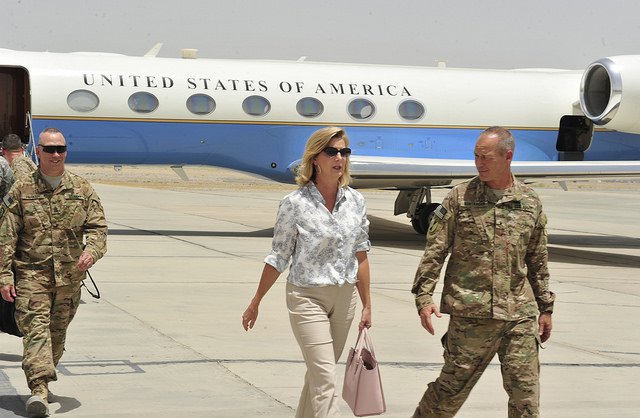
Lt. Kristine Volk, Resolute Support Public Affairs
Women also referenced specific skills as crucial, including being able to summarize complex information, speak to a broad audience and to a particular decision-maker, and work quickly and effectively under pressure. Spending a lot of time at work was also commonly cited as an expected, and rewarded, behavior.
Other answers, however, featured characteristics that social science research has defined as being stereotypically gendered. These included having a warm but firm demeanor, being a strong negotiator, and consistently speaking up in meetings. Other respondents told us that adopting stereotypically masculine traits was crucial to success.
Some interviewees emphasized other traits that were more stereotypically “female”: having strong emotional intelligence (EQ), building relationships with foreign counterparts, being a team player, and being able to get buy-in from all relevant stakeholders. One practitioner suggested that, because women are often socialized to prioritize and develop EQ, it can provide them with an important industry skill. Negotiators, in particular, need to be sensitive and able to read their foreign counterparts. As one interviewee told us:
Maybe there’s a certain word that in your language seems perfectly appropriate but in their language through a translator it’s not going to work, or it’s more politically charged for them than it is in your own culture. We have found situations where women have both the IQ and EQ to succeed in those environments, not to belittle their male counterparts who can also have the EQ and IQ, but women sometimes can bring a very nuanced understanding and can pick up on things that are occasionally missed by the men around the table.
Many interviewees noted that this duality was extremely complicated to balance. Appearing too feminine in the national security world was a problem, because some might think you were not serious enough for the subject matter. Acting too masculine could be interpreted as “bossy” or “bitchy.”
On top of the job’s inherent complications and high stress, women also had to perform the constant mental and emotional calculus that comes with implicit sexism; explicit sexism and discrimination; gender and sexual harassment; and gendered expectations.
Participants’ observations aligned strikingly with how social science defines two baskets of characteristics with associated gender stereotypes. Agentic characteristics are commonly seen as masculine—being assertive, independent, decisive, competent, and strong.2 In contrast, social scientists describe stereotypically feminine characteristics as communal; these traits include being patient, kind, helpful, and sensitive.
Importantly, while individuals’ personalities do not exist in a gendered binary and can possess both agentic and communal characteristics, these traits carry different values in the workplace, and can affect an individual’s ascendance and position regardless of his or her gender. Role congruity theory, which describes the tension that is created when an individual is perceived to be violating gender role expectations, predicts significant challenges for women in leadership positions. If others perceive a “mismatch between the agentic traits ascribed to the prototypical leader and the communal traits associated with the female gender,”3 the response is likely to be a host of behaviors intended to put women back in their place, including sexism and harassment, gendered expectations, and the “gender tax.”
Implicit Sexism
Even within the supposed meritocracy, female policymakers could not help but notice implicit sexism in the field throughout their careers. Men would interrupt women more. They would take ideas that a woman had raised earlier in the meeting without giving credit. Women were asked to make copies or get coffee, regardless of their organizational status. While many women noted that their original solution was to work extremely hard, develop their expertise, and become hyper-competent, some felt over time that their differential experiences could not be explained away by rank, age, or lack of experience. One woman explained, “as I grew more senior, just frankly there were many fewer people who could have plausible alternative explanations as you grew in competence to exceed that of many other people—men, meaning.”
Many women described experiencing intimidation, along with the sense that they did not belong or had gotten to their position by some kind of a fluke—also known as imposter syndrome. They were also more likely to censor themselves. As the only woman in the room, one respondent said, “I have to pick my timing and what I would say carefully, and I do feel that expectation. I have to be right and say something right and pretty interesting and insightful straight away, because I don't get a second chance.” Ambassador Bonnie Jenkins, the coordinator for threat reduction programs in the State Department’s Bureau of International Security and Nonproliferation from 2009 to 2017, remembers being concerned early in her career about making mistakes because she felt she was “carrying the entire gender on her shoulders” when she spoke.
Explicit Sexism and Discrimination
The history of sexism in the security field, though little-known, is extreme. For example, a recent history of the Vietnam War depicts military-strategist-turned-peace-activist and Pentagon Papers leaker Daniel Ellsberg as a rising professional, “passing around the RAND office nude photos of the women he had slept with.”4
Explicit sexism and discrimination shape the work experience for women in nuclear security domestically and abroad, across departments and time periods. According to one woman working in the Pentagon in recent decades, “it was routine” to be discriminated against. One policymaker said, “it’s so endemic that the whole town would fall down if people actually reported their experiences at this point.”
Women reported enduring sexist comments from male colleagues about themselves, other women, or being forced to view inappropriate photos. They became accustomed to outsiders assuming they were secretaries or assistants, rather than key policymakers. Women with children heard offensive comments, especially about whether they would come back to work, and, in some cases, saw others with children re-assigned to less prestigious desks. Julianne Smith, who served as the deputy national security advisor to the vice president between 2012 and 2013 and as the principal director for European and NATO policy in the Office of the Secretary of Defense from 2010 to 2013, noted that, though it is illegal, some women are still asked during the hiring process whether they are planning to have children.
Women also faced egregious sexism from foreign counterparts. Although some women said representing the United States offered some protection and gravitas, overt sexism, bordering on harassment, was still extremely common. Wormuth noted that in international situations, “in the early years, I certainly had lots of the whole kind of ‘are you the administrative assistant or are you the mistress?’ [Because] certainly you couldn't be there for substantive reasons.” Staying in hotels with other delegations sometimes meant men trying to get into women’s rooms. Men would kiss hands, talk about women’s attractiveness, and proposition female staff. In heavy-drinking cultures, men pushing women to drink more took on a different tone. Another woman remembered a banquet she attended where a man giving a speech noted that having women present “was really helpful because we all know that women help the men to perform at their best.”
On top of doing their jobs, these women had the extra tax and mental calculation of navigating these situations safely and tactfully. Wormuth recounted her reaction to being asked out to dinner by a high-ranking foreign representative:
I remember having a mini panic attack thinking, ‘Oh my gosh, how do I handle this?’ I don’t want to embarrass my boss….I don’t want to cause a diplomatic incident. I was young. And then I remember thinking, ‘How do I politely turn this man down?’ It was so deflating because I realized, oh, he wasn't paying any attention to what I was saying, he was paying attention to how I looked. And it was just really deflating.
These kinds of situations are an extra stressor—a tax—that women in all industries face on a daily basis. But for women in the nuclear and arms control fields, getting it wrong—“missteps” like saying no too clearly (or not clearly enough), offending a high-powered man, or landing in a bad photo-op—could create an international incident or unravel weeks or years of work.
Sexual and Gender Harassment
It is no surprise, then, that almost every woman interviewed said they had either experienced harassment or had seen it happen to others. Experiences of harassment ranged from what Wormuth described as “low-grade elevator eyes,” to incidents where other interviewees remembered women quitting their jobs. One interviewee remembered a man who was an expert at walking the line of sexual harassment without legally crossing it.
Women also struggled with whether to report incidents or handle them alone. Jennifer Miller said that in the #MeToo era, there is extra pressure knowing that reporting could end an offender’s career, so she prefers to address interpersonal problems herself. At the same time, she also said she has encountered more “ignorant” and “asinine” comments than ones she would define as sexual harassment.
Race and Intersectionality
As social science predicts, these negative experiences were amplified for women of color.
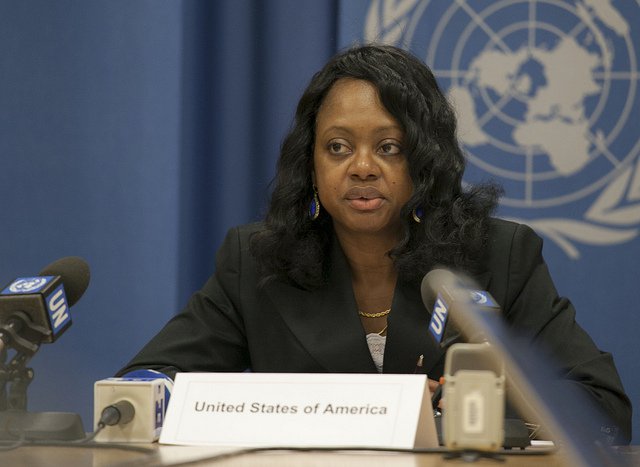
Eric Bridiers / United States Mission Geneva
Jenkins reported that she often dealt with specific acts of discrimination, whether from her age, race, and/or gender. She also stressed the structural discrimination, found in organizational culture, she saw as she watched people of color, and women of color, leave because there are not many opportunities for advancement. When she was working at the Arms Control Disarmament Agency, she was one of the youngest, if not the youngest, professional staff members in her division, and the only woman of color. She remains one of a small number of women of color. Jenkins noted that:
You have two things that you have on your mind when you are part of policy discussions and you are one of a few, if not the only person representing your gender or racial group: that I might not adequately represent women and that I might not adequately represent people of color? And also, did I do a good job representing African Americans? These issues do not concern me much anymore since I choose not to carry on my shoulders someone else’s stereotypes. I have a job to do and that is what gets my focus.
In addition to this pressure, social science has shown that women of color in other fields are more likely to experience discrimination, and sexual, racial,5 and gender harassment.6 As a result, there are extra pressures placed on women of color that white women do not experience. We do not deal at all with the pressures experienced by LGBT and gender non-conforming individuals, because until recent years those identities were grounds for denial of employment and security clearances.
Consequences of Sexual Harassment and Hostile Work Environments
One of the first cases to bring workplace sexual harassment into the legal spotlight originated in the nuclear field. In 1974, Carmita Wood, an administrative assistant to a nuclear physicist at Cornell University, quit her job because of her boss’s repeated sexual harassment and the university’s refusal to transfer her. When she applied for unemployment, the Department of Labor denied her on the grounds that she resigned for “personal non-compelling reasons.”7
"It was so deflating because I realized, oh, he wasn't paying any attention to what I was saying, he was paying attention to how I looked."
Forty years later, the RAND Corporation reported in 2014 that 26 percent of active-duty women, compared to 7 percent of active-duty men, experienced sexual harassment or gender discrimination.8 More broadly, hostile work environments—the term used to describe an environment that becomes difficult or impossible to work in, due to discriminatory or harassing behavior—are common, affecting one in five Americans.9 Such environments come at a high cost10 to both employees and employers, for whom consequences include higher absenteeism, increased alienation between leaders and staff,11 lower morale and self-esteem, and decreased productivity overall.12 Employees in hostile work environments are more likely to feel embarrassment, shame, and guilt, and are more likely to experience depression, anxiety, confusion, sleep problems, and even to commit suicide.13
Even in a work environment that may not qualify as hostile, working as a woman in a male-dominated field comes with its own stressors. One recent study measured higher levels of cortisol, the body’s stress hormone, in women working in such industries.14 Women often feel more stigmatized and less satisfied at work,15 are more likely to have higher turnover intentions, and experience more gender discrimination and harassment.16 And, of course, the competing and gendered expectations for how a woman should act can also lead to lower perceptions of her performance.17 Studies have also found that high-performing women are less likely to choose to participate in competitive environments than their male colleagues, highlighting this self-censorship dynamic.18
Such conditions have an unavoidable impact on the work itself: one study found that 50 percent of targets lost productive time worrying about the individual who instigated harassment or discriminatory behavior, and 25 percent spent time avoiding the instigator.19
Interpersonally, teams are less cohesive and the relationship between leader and employees is corroded. In some cases, bad workplace relationships can escalate to workplace violence. These consequences can have high costs for any workplace, but within the nuclear field, there are extremely high stakes and little room for error.
Impacts of Gendered Expectations
Beyond sexism and harassment, some interviewees also mentioned being unsure of how to adopt successful traits in the field because of their gendered implications and their position as a minority in a male-dominated space. Some were hyperaware of the gender disparity. Others said they did not notice.
Yet meeting these gendered expectations can and does have a cost for women. Research suggests that if women in male-dominated leadership roles adopt “too many” masculine traits, they are more likely to get negative performance evaluations.20 We also know that women who are seen as power-seeking in politics often evoke negative emotional reactions in voters.21
Women were not always clear whether this forced choreography and balancing act was because of gender, or some other factor. Many discussed other overlapping identities, such as being more junior, or civilian, or a person of color.22 Flournoy explained that in her first government role as an office director in the Pentagon, she was “29 years old, a civilian female, and a Democratic appointee. That's about as many strikes against you [that] you can have walking into the Pentagon.”
Another woman recalled that rank made a big difference. As a member of the military with a doctorate, she was not yet a major, and therefore her views were not valued the same way as an officer with a higher ranking and more experience would be. To her, that had nothing to do with gender. Nevertheless, because there were relatively few women at senior levels across the civilian and military sectors of the nuclear policy world, this dynamic raises important questions around the long-term impact of intersectional identities on career progression.
The same woman identified a division between civilian theorists on the one hand, and military “implementers” on the other. In her experience, the only way to become a member of the priesthood was to have experience as an implementer, someone who actually worked around nuclear weapons earlier in his or her career. To her, the gap between implementers and theorists reflected a civilian-military divide, rather than a senior-junior divide.23
Of course, the military itself is also male-dominated, partially due to the previous ban on women in combat roles. (The preference for veterans in federal hiring, then, unintentionally prefers men and reinforces unequal gender ratios.24) However, women often felt that the military’s focus on rank and meritocracy actually helped them, even if they had not served. For some women, however, this belief changed dramatically over time.
The Gender Tax
The elements of a gender tax, then, range from identity performance, to slights, to sustained undermining and major harassment. These burdens made it more difficult to enter the field and rise up the ranks. Terminology like “graybeards” and “silverbacks” may intimidate and exclude, and also act as barriers to new and diverse practitioners.
Sometimes these practices are unintentional, but sometimes they are intentionally weaponized. One woman cited one case where the harassment was a “team effort,” where “a number of men collaborated together to create this unwelcoming environment” until their target quit. She explained, “it wasn’t so much that [the instigator] was interested in her as that he was weaponizing sexual harassment as a distractor from what she needed to do.”
“…it wasn’t so much that [the instigator] was interested in her as that he was weaponizing sexual harassment as a distractor from what she needed to do.”
In this way, colleagues can make it clear they believe individual women are not welcome in their positions or, perhaps, in the field itself. That highlights a broader phenomenon known to researchers as gender harassment, which need not be sexual in nature, but consists of behavior that conveys hostile and derogatory attitudes about one’s gender, and may create a hostile work environment.25 As Drezner commented when we first wrote about the national security gender tax in 2017, “I can only imagine just how less productive I would have been coping with this additional layer of challenges.”26
The Field’s Impact on Women
Tactics and Coping Mechanisms
In response to these challenges, women developed a long list of tactics, ones that they had very consciously adopted, seen others use, or discussed with other women. The most commonly cited coping mechanism in the interviews was still based in the meritocracy mythology: to work extremely hard and be hyper-competent. Ambassador Laura Kennedy, who was U.S. permanent representative to the Conference on Disarmament in Geneva from 2010 to 2013 as well as Deputy Assistant Secretary of State for European and Eurasian Affairs with responsibility for southern Europe, the Caucasus and Central Asia under Defense Secretary Colin Powell, cited this strategy as one of her approaches. Kennedy said that when she was beginning her career in arms control, she met a notoriously demanding boss’s standards by staying up until 4:00 a.m. while on foreign trips to write out longhand copies of her notes from that day to slip under his door. That way, he would have them when he woke up at 6:00 a.m.
Other reported ways of working around sexism included laughing off insults, adopting technical vernacular, choosing more masculine clothes and hairstyles, ignoring interpersonal issues, and making sure not to convey weakness. While some women reported turning down positions that felt like “quota hires,” others saw tokenism and stereotyping as opportunities they could exploit.
Other tactics included asking for help, reclaiming their points and adamantly noting when they hadn’t finished talking, cursing strategically, “giving” attitude “back,” using Twitter as a means of self-expression, and both getting a PhD and deliberately pointing to that degree to reassert their status.
Changes in Personality and Society
Women also noticed changes in themselves over time, whether from their own age, or increased expertise. Many said that now in senior positions, they were more confident and willing to be assertive when they would not have before. They worried less about how others perceived them and were more willing to openly challenge sexism.
Interviewees noted that the culture and industry, though still very conservative in some places, have loosened. New accommodations, like the Family and Medical Leave Act, and technical innovations like teleworking have made it easier to balance work-life demands. And now, where the old model was to avoid calling out sexism, society has placed more attention on gender issues, and younger women are less willing to accommodate the current system, or outdated and sexist practices.
Over the decades and as individual women advanced in their careers, fears around personal appearance tended to decline. Many senior women recalled the shapeless suits of the 1980s, like “cardboard boxes,” as if to “completely disguise our gender” and look as masculine as possible. Over time, many said that they decided to simply dress like themselves. In general, self-expression at work has become more permissible in recent decades, and this field is no exception. As Schulman put it, dressing in “turquoise silk vintage suits and crazy shoes” was a way of “keeping ownership of [her] own soul.” She noticed other women did the same, as well. For them, it was a way to say, “you can make me work 20 hours a day, but I am still myself.”
Lastly, some women cited specific tactics aimed at not just surviving in the system but changing it. They specifically mentioned lifting up other women by mentoring them, putting others on panels and citing them, planning ahead to amplify colleagues in meetings,27 creating a positive leadership climate, and supporting a good work-life balance.
Citations
- The “gender tax” concept has economic origins, as many everyday products, such as razors, are more expensive when marketed to women instead of marketed to men. See Sapna Maheshwari, “’The "Gender Tax’ Study Shows Women Are Charged More for Being Women,” BuzzFeed News, December 22, 2015, source. Tufts University professor Daniel W. Drezner extended this idea to his writing on the extra pressures and obstacles that women in the national security world face. See “The Tax on Women in National Security,” Washington Post, November 9, 2017, source.
- Ashleigh Shelby Rosette and Leigh Plunkett Tost, “Agentic Women and Communal Leadership: How Role Prescriptions Confer Advantage to Top Women Leaders,” Journal of Applied Psychology 93, no. 2 (2010): 221–235,source.
- Ibid
- Max Boot, The Road Not Taken: Edward Lansdale and the Tragedy of Vietnam (New York: W.W. Norton, 2018). Quoted in Heather Hurlburt, “The Still-Ugly American,” Washington Monthly, January–March 2018, source.
- NiCole T. Buchanan and Louise F. Fitzgerald, “Effects of Racial and Sexual Harassment on Work and the Psychological Well-Being of African American Women,” Journal of Occupational Health Psychology 13, no. 2 (2008): 137–151, source.
- Emily A. Leskinen, Veronica Caridad Rabelo, Lilia M. Cortina. “Gender stereotyping and harassment: A ‘catch-22’ for women in the workplace.” Psychology, Public Policy, and Law 21, no. 2 (May 2015): 192-204. source.
- Alieza Durana, Amanda Lenhart, Roselyn Miller, Brigid Schulte, and Elizabeth Weingarten, Sexual Harassment: A Severe and Pervasive Problem (Washington, DC: New America, September 2018), source.
- National Defense Research Institute, Sexual Assault and Sexual Harassment in the U.S. Military: Top-Line Estimates for Active-Duty Service Members from the 2014 RAND Military Workplace Study (Santa Monica, CA: RAND Corporation, 2014), source.
- Jana Kasperkevic, “One in Five U.S. Workers Are Exposed to a Hostile Work Environment,” Marketplace, August 17, 2017, source.
- ElyseShaw, Ariane Hegewisch, and Cynthia Hess, Sexual Harassment and Assault at Work: Understanding the Costs (Washington, DC: Institute for Women’s Policy Research, October 2018), source; and Lilia M. Cortina and Jennifer L. Berdahl, “Sexual Harassment in Organizations: A Decade of Research in Review,” chapter 25 in Julian Barling, Cary L. Cooper, Stewart R. Clegg, and Cary L. Cooper, eds., The SAGE Handbook of Organizational Behavior (Thousand Oaks, CA: SAGE, 2009), source.
- Ali Abdulhassan Abbas, Adel Abbas, and Hussein Huraija Khali, “The Effect of Hostile Work Environment on Organizational Alienation: The Mediation Role of the Relationship between the Leader and Followers,” Asian Social Science 13, no. 2 (January 2017): 140–158, source
- Amna Anjum, Xu Ming, Ahmed Faisal Siddiqi, and Samma Faiz Rasool, “An Empirical Study Analyzing Job Productivity in Toxic Workplace Environments,” International Journal of Environmental Research and Public Health 15, no. 5 (May 2018): 1035, source.
- Brad Estes and Jia Wang, “Integrative Literature Review: Workplace Incivility: Impacts on Individual and Organizational Performance,” Human Resource Development Review 7, no. 2 (2008): 218–240,source.
- Alexandra Sifferlin, “Women in Male-Dominated Jobs Have More Stress,” TIME, August 25, 2015, source.
- Deborah Hicks-Clarke and Paul Iles, “Climate for Diversity and Its Effects on Career and Organisational Attitudes And Perceptions,” Personnel Review 29, no. 3 (June 2000): 324–345, source.
- Phyllis Kernoff Mansfield, Patricia Barthalow Koch, Julie Henderson, Judith R. Vicary, Margaret Cohn, and Elaine W. Young, “The Job Climate For Women In Traditionally Male Blue-Collar Occupations,” Sex Roles 25, no. 1–2 (July 1991): 63–79, source.
- Alice H. Eagly, Mona G. Makhijani, and Bruce G. Klonsky, “Gender and the Evaluation of Leaders: A Meta-Analysis,” Psychological Bulletin 111, no. 1 (January 1992): 3–22, source.
- Muriel Niederle, Carmit Segal, and Lise Vesterlund, “How Costly is Diversity? Affirmative Action in Light of Gender Differences in Competitiveness,” Management Science 59, no. 1 (2013): 1–16, source.
- Christine M. Pearson, Lynne M. Andersson, Christine L. Porath, “Assessing and attacking workplace incivility,” Organizational Dynamics 29 (2000). 123-137.
- Alice H. Eagly, Mona G. Makhijani, and Bruce G. Klonsky, “Gender and the Evaluation of Leaders: A Meta-Analysis,” Psychological Bulletin 111, no. 1 (January 1992): 3–22, source.
- Tyler G. Okimoto and Victoria L. Brescoll, “The Price of Power: Power Seeking and Backlash Against Female Politicians,” Personality and Social Psychology Bulletin 36, no. 7 (June 2010): 923–936, source.
- Our 2018 New America study, National Security: What We Talk About When We Talk About Gender, found that female national security practitioners were highly ambivalent about naming behavior as sexist and saw the likeliest causes of workplace conflicts as first personality, then age, then gender. That uncertainty over which part of their identity was prompting differential treatment was particularly salient when women recalled their experiences in junior roles. Find the report at source.
- Anecdotally, a number of women have told interviewers that they found mixed or all-civilian security environments more sexist than fully military ones. See Drezner, “The Tax on Women in National Security,” Washington Post, November 9, 2017, for example.
- Katherine Kidder, Amy Schafer, Philip Carter, and Andrew Swick, From College to Cabinet: Women in National Security (Washington, DC: Center for a New American Security, 2017).
- See a discussion of harassment definitions and categories in “Introduction” of Alieza Durana, Amanda Lenhart, Roselyn Miller, Brigid Schulte, and Elizabeth Weingarten, Sexual Harassment: A Severe and Pervasive Problem (Washington, DC: New America, September 2018), source.
- Daniel W. Drezner, “The Tax on Women in National Security,” Washington Post, November 9, 2017, source.
- Juliet Eilperin, “White House Women Want to Be in the Room Where it Happens,” Washington Post,September 13, 2016, source.