Table of Contents
A Net Assessment of Wagner Group’s Networked Effects in Libya
When Russian military contractors with Wagner Group joined Haftar’s LNA forces on the frontlines of the assault on Tripoli in the spring of 2019, expectations were mixed. While Wagner contingents proved relatively successful in Ukraine and Syria, their performance in Mozambique ended in a rout.1 Still, with vast amounts of oil and gas money to be made in Libya’s embattled eastern half and the tantalizing promise of vast gold and other mineral resource stores in Libya’s Kufra Basin, the Kremlin’s hope was that Russian operatives would help turn the tide in favor of Haftar’s forces.2 Along with its bases in Syria, the Wagner Group’s presence in Libya also would gift Russia with another strategic outpost on the Mediterranean, positioning that could, in theory, give Russia an edge over NATO competitors, such as Turkey and France, and allow for deeper forays into Africa.
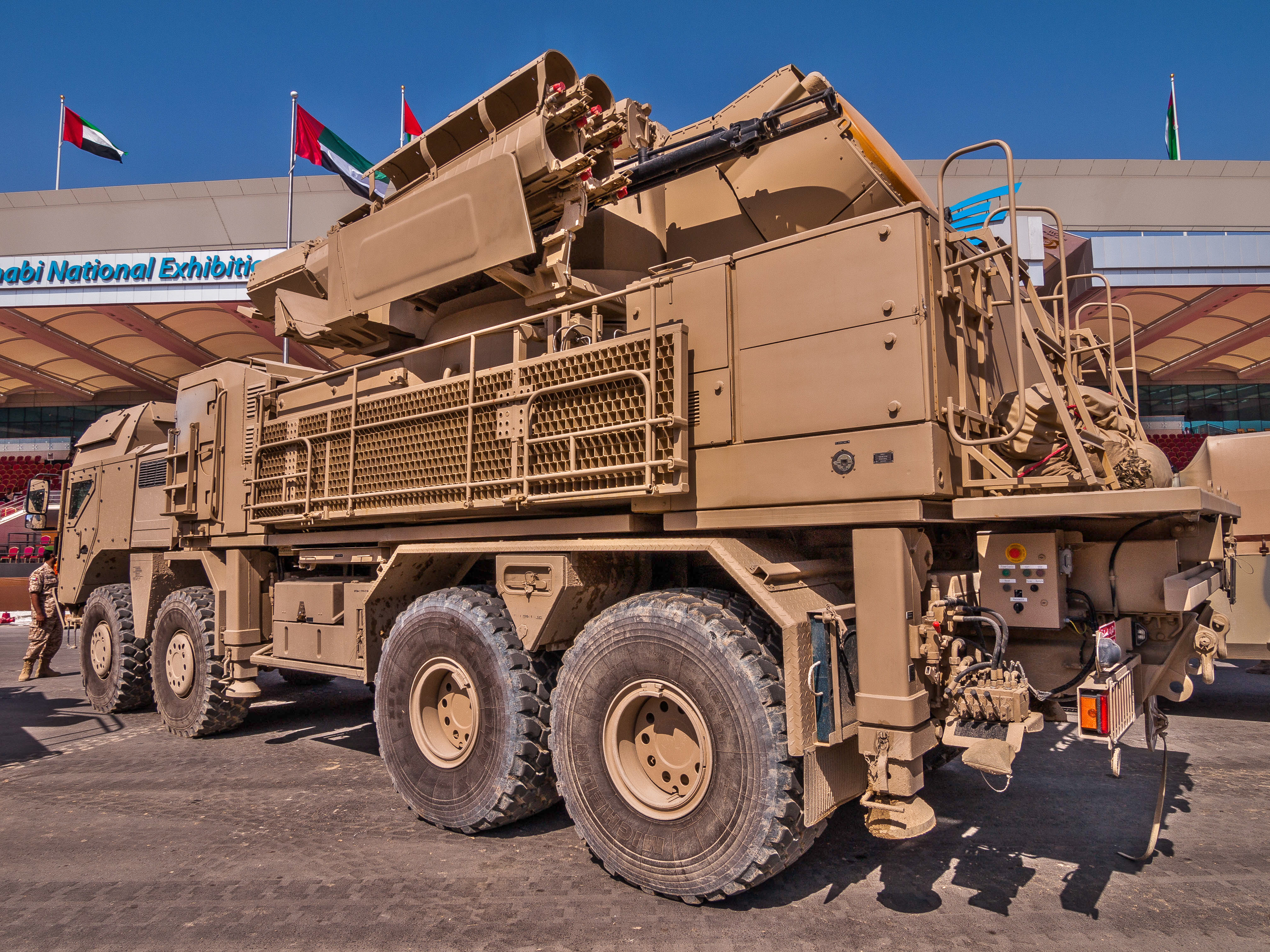
Indeed, the Russians quickly helped secure control of a major strategic airbase near the southeast town of al-Jufra in the early summer of 2019, and in a flash, Russian and LNA forces seemed to be at Tripoli’s doorstep.3 A key part of the Wagner Group’s early success in its supporting role to the LNA was the defensive shield provided by Russian-made Pantsir S1 anti-aircraft missile batteries.
The Pantsir S1’s high degree of mobility makes it very desirable for the kind of light footprint expeditionary force maneuvers typical of Wagner Group operations, while its relatively compact size makes it easy to transport as air cargo. A large-sized armored vehicle, the Pantsir S1 carries 12 highly maneuverable missiles capable of shooting down enemy missiles at extremely low altitudes within a radius of 20 km, and it is designed to take out low flying planes, helicopters, and drones.4 It can also engage up to four targets simultaneously at any given time, making it optimal for object protection in high-tempo battles.
The Tula-based KBP Instrument Design Bureau, a Rostec subsidiary, developed the first prototype of the Pantsir S1 in the 1980s, according to Ruslan Pukhov, director of the Centre for Analysis of Strategies and Technologies (CAST), a Moscow defense think tank.5 Pantsir technology was repeatedly updated throughout the 1990s, and some consider the Pantsir S1 to be among the most advanced mobile anti-aircraft missile and cannon systems.6
The Pantsir S1 requires a three-person team for operation, and a single system is often accompanied by a separate command and control vehicle.7 Anywhere from seven to 10 crew members might typically be deployed as part of a full-package deal for Pantsir includes operation, maintenance, and repair for a single unit.8 The mobile truck-mounted system can detect and engage aircraft, missiles, and drones at a distance of 20 km, while rockets launched from the system can reach altitudes of up to 40,000 feet, according to the RAND Corporation.9 Reports of Pantsir systems damaged or seized in Libya indicate the presence of two distinct models; one kind had a made Russian Kamaz chassis, and another kind had a German-made truck chassis, the MAN SX45, which was only made for export to the UAE.10
For a brief time, Wagner Group and LNA forces looked poised to enter the Libyan capital, but their fortunes reversed after Turkey increased its military support to the GNA, which was then operating under the leadership of GNA Prime Minister Fayez al-Sarraj. Almost at the same moment that things seemed to be going Haftar’s way, Turkey began to contemplate giving more military aid to Sarraj's faltering government in Tripoli. It was then, in the summer of 2019, that the conflict in Libya became what the UN’s former special envoy to Libya, Ghassan Salame, called "possibly the largest drone war theatre now in the world.”11 Our analysis indicates that is also when the Wagner Group began to sustain its heaviest losses.
Analysis of open-source data indicates that the Wagner Group’s Pantsir S1 operations may provide clues about how the UAE and Russia collaborated during the LNA offensive on Tripoli. It also suggests that a string of costly airstrikes on Pantsir S1’s likely operated by a combination of Wagner Group and Emirati operatives in cooperation with the LNA not only led to major battlefield reversals in Libya, but along with similar losses in Syria, has since forced Russia to modify and upgrade the Pantsir to be more resistant to drones and to revamp its approach to air defense deployments.
Russia’s rapid integrated force deployment to the Middle East since the start of the conflicts in both Syria and Libya is a fairly reliable indicator of just how critical Moscow’s pre-existing historic relationships with clients of its military enterprises are to the forward operations of both official Russian military units and state-backed proxies with the Wagner Group network. Indeed, as at least one analyst has noted, in 2019, the UAE apparently supplied Wagner Group and Haftar’s LNA forces with several of its upgraded Pantsir S1M platforms.12
The findings come on the heels of two reports separately released by the Pentagon and the UN over the last year suggesting that the UAE co-financed Wagner Group operations in Libya. In March 2021, the UN issued a report implicating the UAE in backing the joint operations of Wagner Group fighters and Haftar’s LNA forces.13 If proven true, UAE support to state-backed Russian paramilitaries could represent a potential violation of existing UN arms embargoes against Libya and standing U.S. sanctions against the Wagner Group, and its chief financier, Prigozhin.
In theory, any evidence that a U.S. ally like the Emirates, or UAE, cut deals with Prigozhin, the Wagner Group, or individuals or organizations involved in supporting the Russian mercenary network could be grounds for American sanctions, or worse—the loss of a militarily powerful ally. Indeed, in late 2020, media coverage of obscure findings in a Pentagon report suggested that the UAE and Russia were co-financing joint operations between the Wagner Group operatives working for Prigozhin and Libyan strongman Gen. Khalifa Haftar almost blew up a $23 billion U.S. arms sales deal with the UAE in December 2020.14
The package includes sophisticated weaponry like F-35 aircraft and armed drones.15 The U.S. State Department, however, put a temporary hold on the deal in January after Congress raised objections over the UAE’s conduct and use of U.S.-made weapons in the conflict in Yemen. The fresh allegations about Emirati support for the LNA and the Wagner Group in Libya only inflamed the tensions between Congress and the Biden administration over the deal—not to mention the anxieties it has raised among Libyan factions once allied with the GNA in Tripoli.
The GNA’s ambassador to the UN was among the first to openly accuse the UAE of breaching the arms embargo on Libya.16 The next, more substantial, however cautious hint that the UAE could be linked to the financing of the Wagner Group surfaced in the November 2020 Pentagon report.17 In that report, the Pentagon indicated that the DIA had assessed that the UAE “may provide some financing for the group’s operations.” Emirati and Russian cooperation then became more apparent after a January 2021 story from the Times of London revealed that a Pantsir system had been purchased by the UAE from Russian and was later sent to Libya to support the LNA.18 Since then, allegations have swirled about the close collaboration between the UAE and Russia in the financing and deployment of thousands of Russian Wagner Group operatives in Libya. Emirati officials have denied having any involvement and pushed back against the notion that the UAE has a close defense partnership with Russia.19
In April, the Biden administration said, nonetheless, that it would move forward with the deal though the actual transfer would only take place in 2025, and it would be conditioned on evidence that the UAE would not use U.S.-made weapons in contravention to the law of armed conflict and international human rights law.20
Yet, the question of Emirati support for the LNA and the Wagner Group in Libya in breach of existing UN embargos remains unresolved. Moreover, recent allegations indicating that the very same support the Emriatis provided to the Wagner Group and LNA suggests at minimum inconsistency—if not outright incoherence—in the White House decision to transfer weapons to the UAE. At a minimum, the Biden administration should consider reevaluating whether the UAE is truly adhering to the conditions it has just set out for brokering the arms transfer deal.
With the U.S.-UAE arms sale now set to go forward, it will also likely provide more grist for Turkey, a NATO ally and regional rival of the UAE that has complained bitterly about uneven and unfair treatment after the U.S. imposed sanctions against Turkey in December 2020 for its purchase of Russian-made S-400 surface-to-air missile batteries.21 The United States says the S-400, a defensive weapon that has highly sophisticated signals sensing technology, is incompatible with NATO systems and poses a risk to NATO personnel. While it would be difficult to make a straight comparison between Turkey’s dealings with Russia and that of the UAE, it is worth noting that even circumstantial evidence that a key American ally like the UAE has coordinated with Russia to support off-book operations by quasi-governmental Russian paramilitaries is certainly worthy of closer scrutiny.
Our assessment of the Wagner Group’s ground operations during the Tripoli offensive, a review of flight and procurement data, and military-technical agreements between the UAE and Russia suggest there are grounds for additional inquiry into Russia’s defense logistics pipeline to the UAE, and its potential onward connections to Libya. The UAE has shelled out at least $734 million for the production, deployment, and maintenance of a fleet of Russian-made Pantsir S1 anti-aircraft batteries over the course of a series of military-technical agreements that span 30 years.22
Analysis of social media data and customs data for shipments of Pantsir-related equipment from Russia to the UAE during the 2019–2020 period brought to the surface links between Russian citizens and companies tied to a Wagner Group contingent that has been spotted across Africa and the Middle East. The network of Russian firms behind the Pantsir-related shipments appear to form the backbone of a sprawling military supply and logistics chain that spans from central Russia to the General Headquarters of the Armed Forces in Abu Dhabi in the UAE.
Although no conclusive evidence showing direct UAE financing for the Wagner Group has surfaced, our review of customs data found significant numbers of shipments of Pantsir-related equipment from Russia to the UAE during the period spanning the start of Haftar’s offensive on Tripoli in the spring of 2019 up to the signing of the ceasefire between LNA and GNA forces in the fall of 2020.
The period of increased shipments of Pantsir equipment coincided closely with heavy losses sustained by LNA forces in Libya and reports of Turkish drone strikes on several Pantsir batteries. Customs records we reviewed indicated a substantial number of shipments containing Pantsir related equipment from the central Russian city of were delivered to the UAE army headquarters in Abu Dhabi from 2019 to 2020. Analysis of flight data provided by C4ADS also identified suspect flight patterns for dozens of cargo planes that appeared to provide an illicit airbridge from the UAE into Libya during roughly the same period.
Evidence we found further revealed that the Russian logistics company that managed those shipments also is implicated in the illicit transfer of Russian military material to Russian-backed separatists in the disputed Ukrainian territory of Donbas. Publicly available records indicate that a logistics transfer station managed by a subsidiary of United Cargo Solutions, or UCS, a Moscow-based Russian shipping and logistics firm, arranged the shipment of Pantsir-related equipment via a temporary storage site in Tula.23 Reporting by Myrotvorets, a Ukrainian NGO, indicates that UCS was also allegedly involved in the transfer of material into Donbas.
An assessment of customs data for 122 shipments from Russia to the UAE during the 2019 to 2020 period shows that the Russian logistics company, which has also been linked by Ukrainian researchers to shipments of military goods to Russian-backed separatist fighters in the contested region of Donbas, was integral to the shipment of Pantsir-related materials to the UAE that were valued at an estimated $7.99 million dollars.24
Goods shipped as part of the flow of material from Russia to the UAE during the peak of Haftar’s offensive in Libya include computer components for Pantsirs; parts for a phased array antenna for Pantsirs; optical-electrical sensors for Pantsirs; hydraulic cylinders for the antennae of target detection station of Pantsirs; and a processing and control unit for Pantsir radar, according to customs data we reviewed.
Figure 1: A web page for United Cargo Solutions indicates that it provides support for shipments to and from the Donetsk People’s Republic, or DPR, in the contested eastern territory of Donbas, Ukraine.

The data also indicates that the UCS subsidiary, Rossfera LLC, handled the shipments for the KBP Instrument Design Bureau, the primary manufacturer of Pantsir weapons systems. Additionally, the company website for UCS lists the KBP Instrument Design Bureau, the Russian manufacturer of Pantsir systems, as a key client and partner, and indicates that UCS handles shipments for Rossfera.25
Figure 2: Customs data for shipments of Pantsir related equipment lists the customs registry license number for Tula based Rossfera LLC as the primary point of contact for KBP Instrument Design Bureau shipments to the UAE armed forces headquarters in Abu Dhabi.
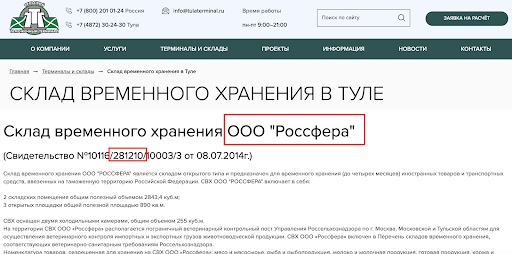
Figure 3: A web page for UCS indicates it uses the temporary storage site registered to Rossfera LLC for shipments from Tula, Russia and lists the KBP Instrument Design Bureau as a key client and partner.26
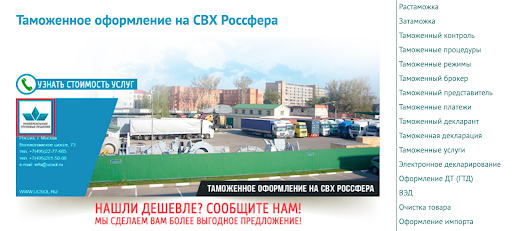
While the alleged illicit transfer of goods to eastern Ukraine via the UCS logistic pipeline reportedly sprang to life after the start of the Russian-separatist putsch in 201427 and appears to be part of a separate illicit arms pipeline, the chain of Russian logistics companies and transit stations is clearly integral to covert Russian arms transfers and PMSC operations. Although Russia has been laboring under extensive U.S. sanctions for years, and dozens of firms that have had business dealings with Russian defense firms have been sanctioned under the 2017 U.S. Countering America’s Adversaries Through Sanctions Act (CAATSA), neither United Cargo Solutions nor Rossfera shows up in the U.S. Treasury Department’s sanctions database. Better known by its acronym, CAATSA, the 2017 sanctions law aims to impose costs on organizations or individuals that conduct significant transactions with Russian defense and intelligence sector-related entities on the sanctions list.28
Whether the omissions of two key Russian logistics firms from the sanctions registers is a mere oversight or there are other reasons Treasury has not listed them, their notable absence from the sanctions registry points to serious design flaws in the legal architecture of CAATSA. As analyst Jarod Taylor points out, for mid-sized states such as the UAE with large discretionary budgets, uneven implementation of the law—and we would argue poor intelligence about Russia’s new semi-privatized defense industry model—means that U.S. allies have few incentives to cooperate in the imposition of sanctions on Russia.29
That much is clear from the large size of expenditures funneled into the transfer of Pantsir platforms to the Libyan theater. Priced at roughly $15 million each, the dozen Russian made Pantsirs transferred into Libya and ultimately destroyed in battle represented potentially more than $100 million in military equipment; and that very rough cost estimate likely does not fully account for shipping, training, maintenance, and support expenses. Nor does it necessarily account for the cost of replacement parts.
Financial costs for Pantsir-related military equipment supplied to the Wagner Group and LNA fighters, however, pales in comparison to the heavy toll taken on the lives of Libya civilians from Pantsir missile fire and the high price paid by scores of Russian contractors who spearheaded the LNA’s air defense maneuvers on the ground in Libya. There were strategic costs too. While the Wagner Group succeeded in briefly giving Haftar’s forces the upper hand in 2019, once they reached the southern suburbs of Tripoli that summer, Russian and LNA forces were unable to hold their territorial gains. After Turkey increased its military support to the embattled GNA government almost a year after the start of the LNA offensive, Haftar’s forces and Wagner operatives beat a hasty retreat eastward to the LNA’s main strongholds near Benghazi.
Citations
- Sergey Suhankin, “Russian Mercenaries Pour Into Africa and Suffer More Losses (Part One),” Jamestown Foundation, January 21, 2020. source
- Gus H. Goudarzi, “Geology and Mineral Resources of Libya Reconnaissance,” Geological Survey, U.S. Department of Interior, 1970 source; Guido Meinhold, Daniel P. Le Heron, et.al., “The Search for “Hot Shales” in the Western Kufra Basin, Libya,” 2018. source
- Giancarlo Ella Valpri, “Haftar’s Latest Declarations,” Modern Diplomacy, May 6, 2020. source
- For a detailed description of specifications for the Pantsir S1 see the manufacturer website of KBP Instrument Design Bureau: source; archived version: source
- DefenseWorld.net, “Russian Pantsir Air Defense System- Sitting Duck or Top Dog?” June 19, 2020. source
- Centre for Analysis of Strategies and Technologies (CAST), “Russian Arms Deliveries to the Arab Countries of the Persian Gulf Region,” Moscow Defense Brief, 4: 14, 2008. source
- Center for Strategic and International Studies (CSIS)t, “Pantsir S1,” Missile Defense Project, last updated July 6, 2021. source
- Center for Strategic and International Studies (CSIS)t, “Pantsir S1,” Missile Defense Project, last updated July 6, 2021. source
- Gordon, John IV, John Matsumura, Anthony Atler, Scott Boston, Matthew E. Boyer, Natasha Lander, and Todd Nichols, Comparing U.S. Army Systems with Foreign Counterparts: Identifying Possible Capability Gaps and Insights from Other Armies. Santa Monica, CA: RAND Corporation, 2015. source.
- Joseph Trevithick, “The United States Smuggled A Russian-Made Pantsir Air Defense System Out Of Libya: Report,” The Drive, January 27, 2021. source
- BBC, “UAE Implicated in Lethal Drone Strike in Libya,” August 28, 2021.source
- Oryx, “Tracking Arms Transfers by The UAE, Russia, Jordan And Egypt To The Libyan National Army Since 2014,” March 23, 2021. source
- United Nations Panel of Experts on Libya report, March 8, 2021. source
- Amy Mackinnon, “Pentagon Says UAE Possibly Funding Russia’s Shadowy Mercenaries in Libya,” Foreign Policy, November 30, 2020. source; Joe Gould, “Senate to Vote on Banning $23 billion UAE Arms Sales Next Week,” Defense News, December 3, 2020.source
- Patricia Zengerle, “Biden Administration Proceeding with $23 billion Weapon Sales to UAE,” Reuters, April 13, 2021.source
- Abdulkader Assad, “Libyan Ambassador to UN at Security Council: UAE, France Breached Libya's Arms Embargo,” Libya Observer, January 30, 2020.source
- Lead Inspector General for East Africa And North And West Africa Counterterrorism Operations, Quarterly Report to the United States Congress July 1, 2020 – September 30, 2020, November 23, 2020, 37. source
- Samer al-Atrush, “Russian Missile System Spirited Out of Libya by U.S.”, The Times, January 28, 2021. source
- Twitter post by @UAEEmbassyUS, Dec.30, 2020: source
- Michael Crowley and Edward Wong, “U.S. Is Expected to Approve Some Arms Sales to the UAE and Saudis,” New York Times, April 14, 2021. source
- BBC, “U.S. imposes Sanctions on Turkey over Russia Weapons,” December 14, 2020.source
- Anthony H. Cordesman and Khalid R. Al-Rodhan, “Gulf Military Forces in an Era of Asymmetric Warfare,” Working Paper for Review, Center for Strategic and International Studies (CSIS), June 28, 2006, p. 10. source
- New America reviewed customs and shipping data for KBP Instrument Design Bureau for the 2019-2020 period provided by C4ADS. Customs data for Pantsir-related equipment shipped from Tula to Abu Dhabi included the registry number for Rossfera LLC (10116/281210/10003/3), which is also listed as the operator of a temporary storage site by the Tula Customs Terminal on its webpage here: source; archived version: source A separate website for UCS Holdings refers to Rossfera LLC as an affiliate.
- Myrotvorets expressly names the one-time director general of UCS Holdings, Sergey Alexandrovich Martyanov, as culpable in the illicit transport of goods into Donbas; the listing for Martyanov and UCS Holdings can be found here: source
- United Cargo Solutions (Универсальные Грузовые Решения) homepage: source; archived web page referencing United Cargo Solutions ties to Rossfera LLC, the primary, logistics hub manager for transfer of KBP Instrument Design Bureau export shipments can be found here: source
- Archived USC webpage: source
- Myrotvorets expressly names the one-time director general of UCS Holdings, Sergey Alexandrovich Martyanov, as culpable in the illicit transport of goods into Donbas; the listing for Martyanov and UCS Holdings can be found here: source
- U.S. Federal Register, ”Notice of Department of State Sanctions Actions Pursuant To Section 231(a) of the Countering America's Adversaries Through Sanctions Act of 2017 (CAATSA) and Executive Order 13849 of September 20, 2018, and Notice of Additions To the CAATSA Section 231(d) Guidance,” October 5, 2018. source
- Jarod Taylor, “An American Failure: CAATSA and Deterring Russian Arms Sales,” FPRI, November 26, 2019. source