Table of Contents
- I. Introduction
- II. Asset Allocators, Principles, and Criteria
- III. The RAAI Index and Leaders List
- IV. Why the Leaders Matter
- V. Key Findings: Are Global Asset Allocators Becoming More Responsible?
- VI. What’s New? Comparing the 2021 and 2019 RAAI Leaders List
- VII. Methodology
- VIII. Glossary of Terms
- IX. Scorecards
- X. Previous and Current Award Winners
- XI. Appendix: Ten Recommendations for Success in Responsible Investing
V. Key Findings: Are Global Asset Allocators Becoming More Responsible?
This is the third biannual RAAI Index, rating and ranking the world’s largest asset owners, (in 2021 comprising 251 institutions with $26 trillion in AUM), on their responsible investing practices. The RAAI index is the only comprehensive rating system in the world that monitors and measures the progress of global sovereign wealth and pension funds in deploying their capital responsibly and sustainably.
In this edition of the index, we have expanded our coverage from 197 to 251 asset owners, and raised the bar on performance by expanding the rating system from 20 to 30 criteria. Through the selection of the Leaders List and the top quintile performers, the RAAI provides a benchmark of excellence that supports asset owners to become effective responsible investors and to invest in the SDGs, including climate change, one of the greatest challenges our planet has ever faced.
Here are five key findings from this year’s RAAI Index:
- Responsible investing is advancing across the world but from a low base. There is scope for substantial improvement.
- The world’s largest asset allocators are driving progress globally on responsible investing.
- Among developed economies, Europe, particularly Denmark, the U.K., and the Netherlands, are leading the way, with Australia/New Zealand and Canada not far behind.
- The leaders and finalists continue to set the bar for responsible investing, widening the gap with the rest of the world.
- The world’s two biggest economies, the United States and China—comprising 40 percent of global GDP—are lagging dangerously behind on responsible investing.
1. Responsible Investing is Advancing Steadily Around the World
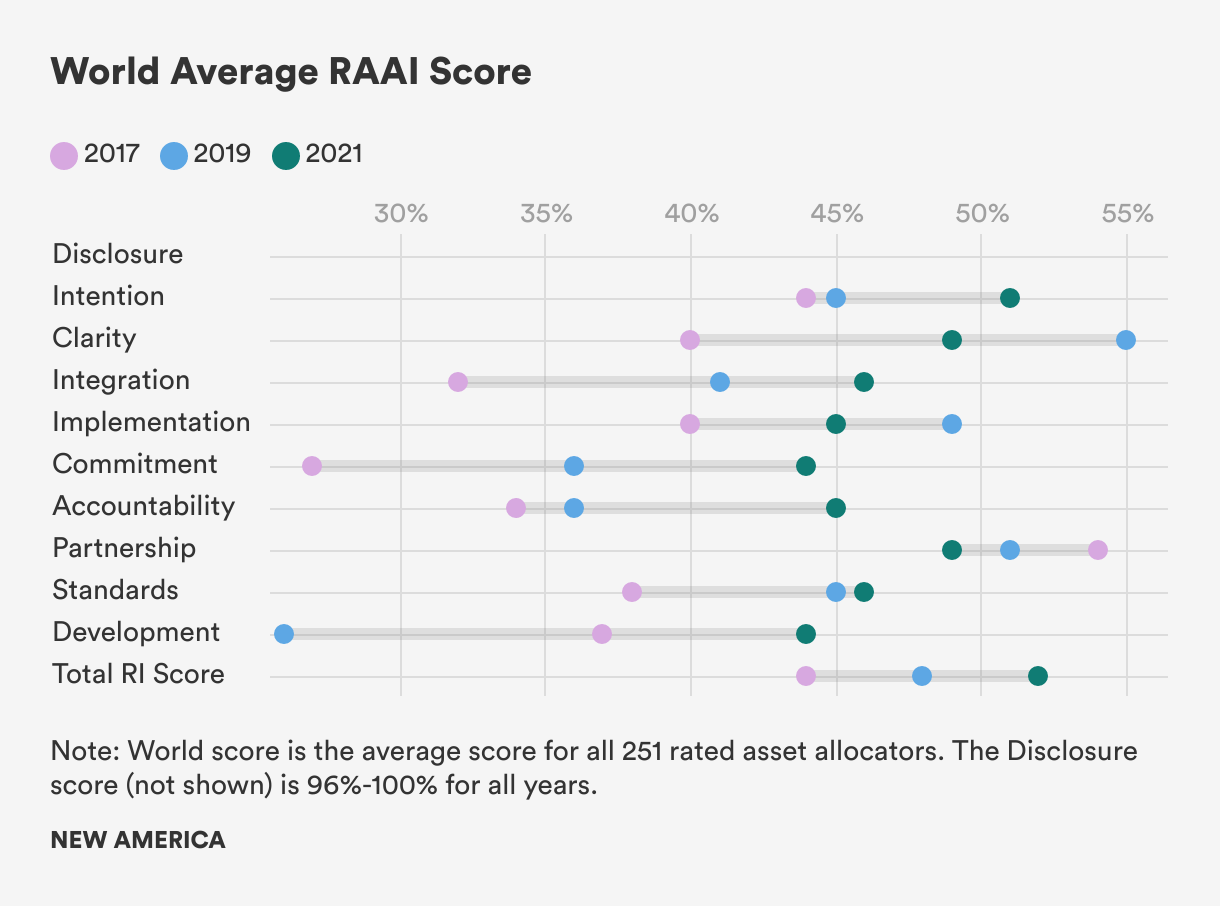
At the RAAI, we calculate the average responsible investing score for all rated funds (the world average) and track progress over the last five years to determine trends. We find that since the RAAI launched in 2016, global asset owners have been upping their game on ESG, with the average World RAAI score reaching 52 percent in 2021, up from 48 percent in 2019 and 44 percent in 2017. In other words, responsible investing by world asset owners has been advancing steadily across the globe, but progress is coming from a low base, and many institutions remain below potential.
To put this in perspective, if the world were an asset allocator, it would have the same average score today as the Nigeria Sovereign Investment Authority, placing 121 out of 251 all rated funds. If it were a region, the world would have the same score as the average asset allocator in South East Asia.
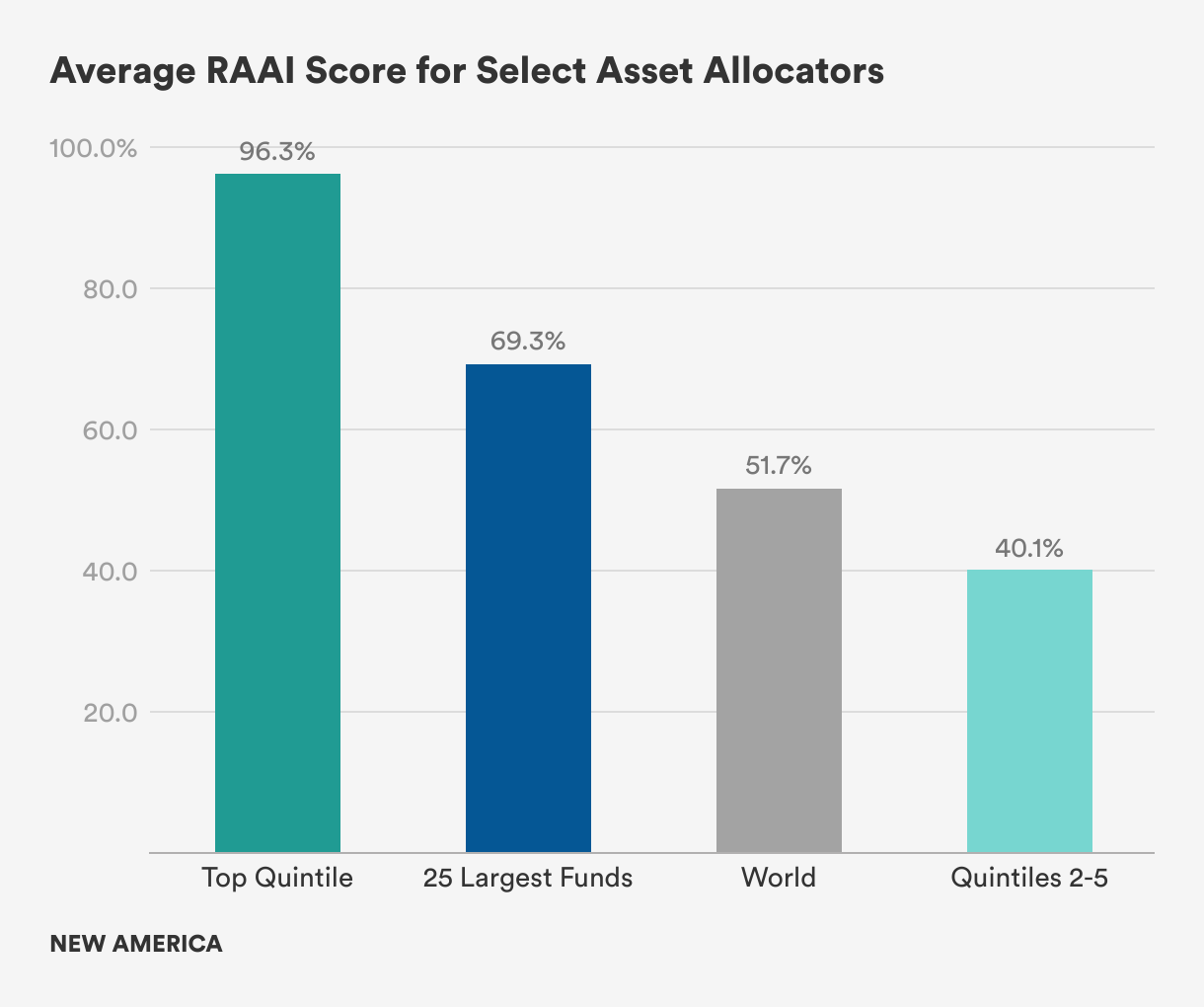
The improving score trend over time for world asset allocators is good news, but the level remains disappointingly low. For example, comparing the world average score of 52 percent with the average score for the top quintile performers (top 50 in the RAAI Index) of 96 percent, it is clear that the 200 asset allocators in the lower quintiles have a long way to go.
World asset allocators improved in six responsible investing principles in 2021 versus 2019, including intention (for example, issuing a statement on responsible investing policy, publishing a downloadable report on responsible investing practices), integration (integrating ESG throughout the portfolio), commitment (hiring dedicated staff, socializing responsible investing principles), accountability (monitoring and reporting performance in hitting ESG targets), standards (adopting uniform external ESG reporting standards), and development (reflecting the SDG, investing responsibly in smaller emerging markets). Scores for disclosure (publishing a detailed annual report or website) have been maintained at high levels for years, with average scores of 96-100 percent, and there is little scope for improvement.
In contrast, average scores declined in 2021 versus 2019 for three principles including clarity (publishing measurable goals for responsible investing across asset classes), implementation (providing examples of responsible investments for stakeholders across the portfolio), and partnerships (taking a leadership role in partnership organizations and collaborating with others). This decline in scores can be attributed to the introduction of the tough new criteria noted for each of these principles.
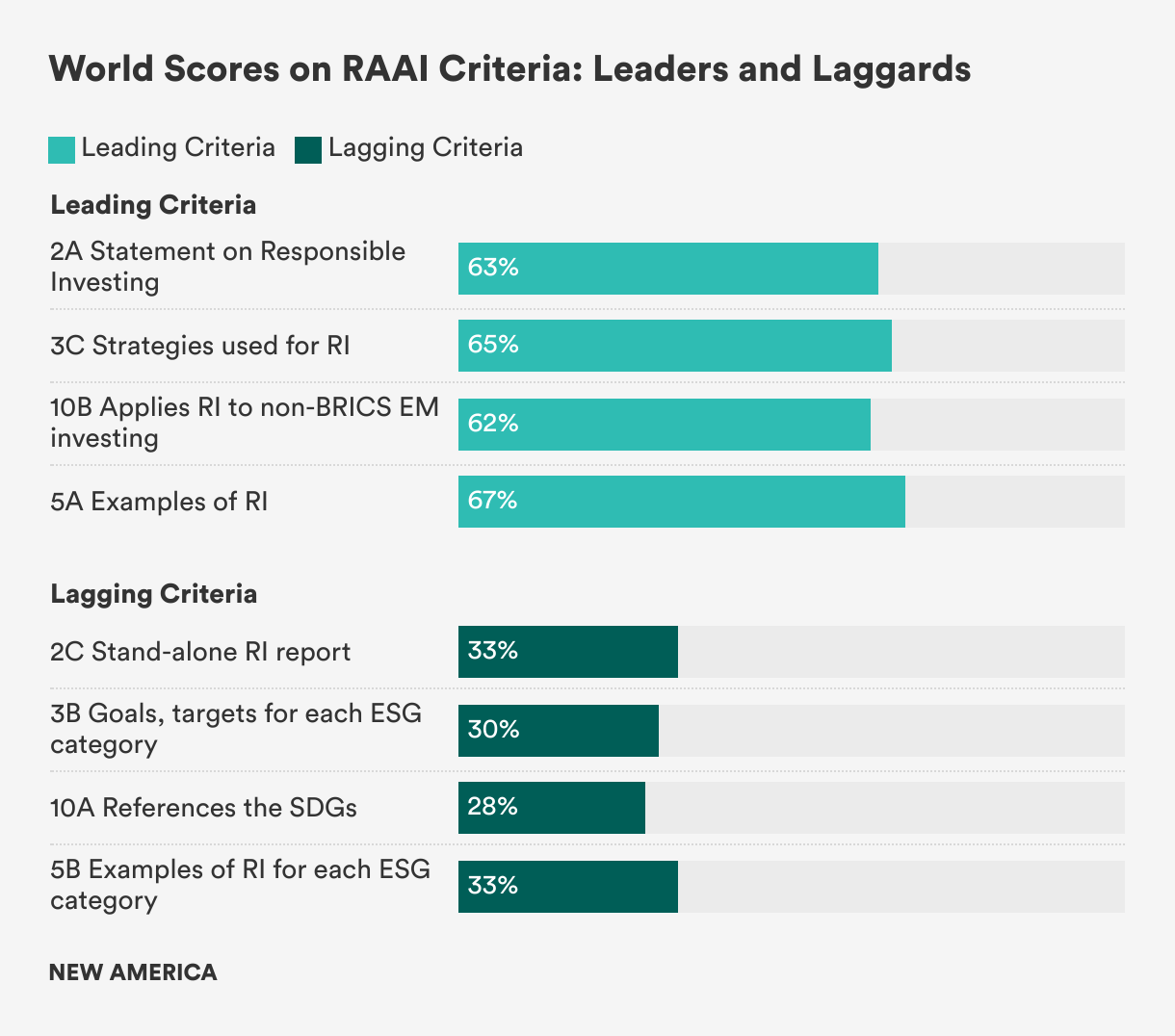
Looking more closely at individual criteria, we find that global asset allocators outperform in several areas relative to the total world average score. For example, over 60 percent of all rated asset allocators now issue a statement on their responsible investing policies, explain and describe strategies they use for responsible investing (such as active voting, engagement, and ESG integration), invest responsibly and sustainably in frontier markets, and provide examples of responsible investments for their stakeholders.
At the same time, we see that low scores in select criteria are dragging down world average RAAI scores and need attention. For example, only 33 percent of world asset allocators issue a stand-alone, downloadable report (or major section in the annual report) on their responsible investing practices, or provide examples of responsible investing across asset classes in the portfolio. Only 30 percent have goals and targets for all environmental (E), social (S), and governance (G) investing categories, including climate change, diversity and inclusion, and responsible supply chains. Finally, less than 30 percent make any reference to the SDGs.
2. The Largest Allocators are Driving Progress on Responsible Investing
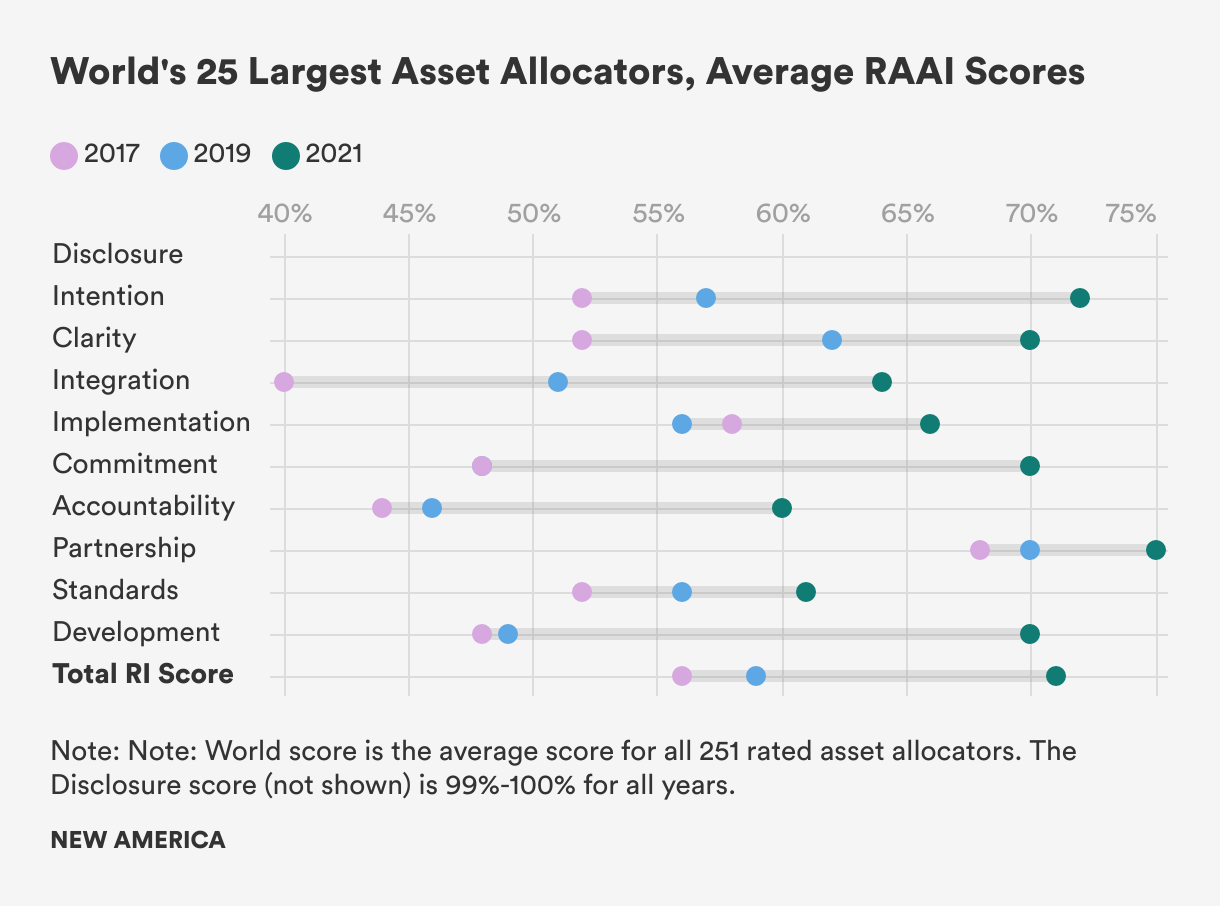
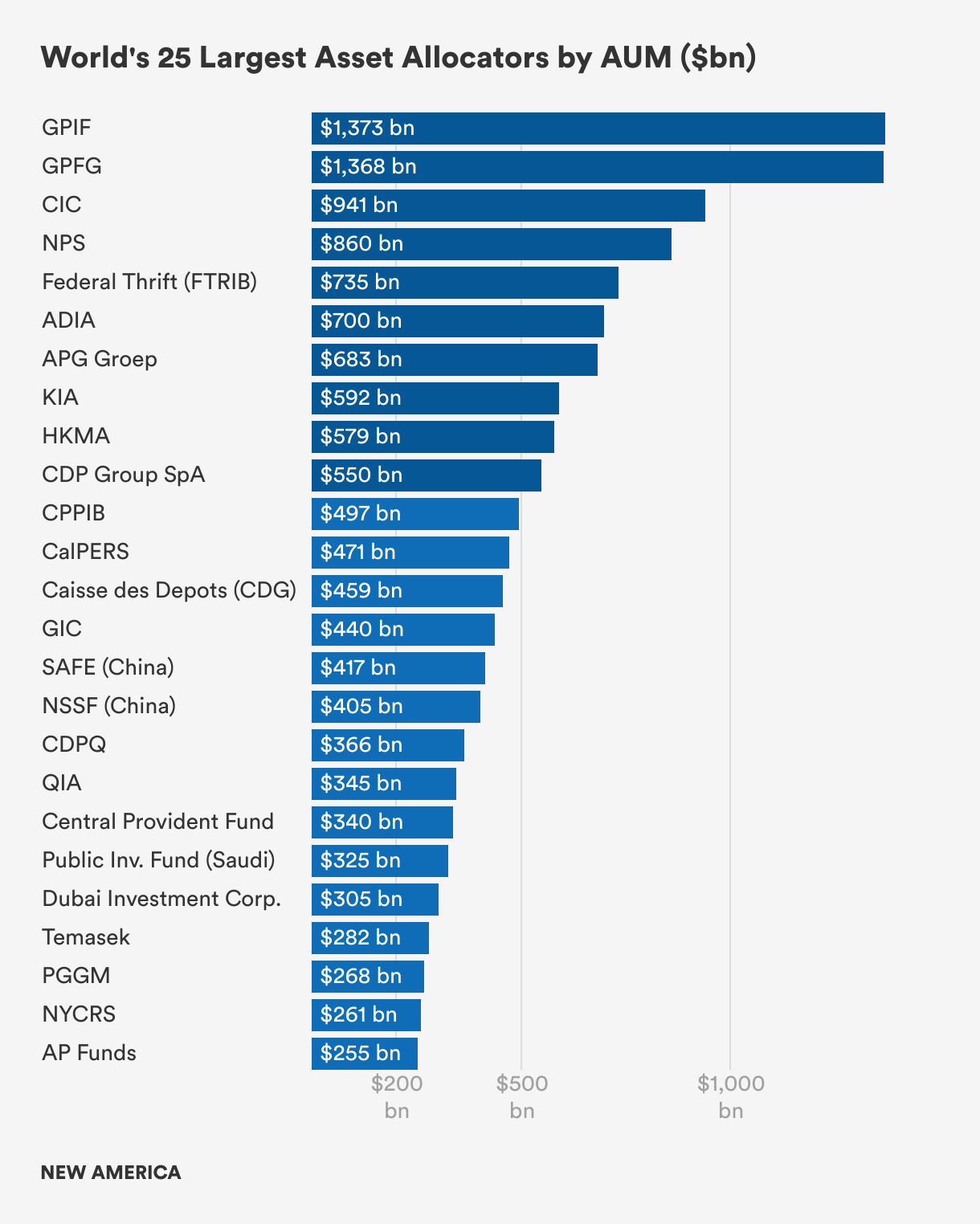
In contrast to the gradual improvement shown in world average RAAI scores, the 25 largest asset allocators (top 10 percent by AUM) have shown remarkable progress, recording an average RAAI score of 69 percent in 2021 versus 59 percent in 2019 and 56 percent in 2017. The rapid advancement in responsible investing by this cohort, comprising $13.8 trillion in AUM, is significant as they have enormous influence in global capital markets and can drive hundreds of billions of dollars into solutions for some of the world’s biggest challenges such as reducing carbon and greenhouse gas emissions, building renewable energy and clean water resources, and improving access to education and healthcare in the developing world.
3. Europe, particularly Denmark, the U.K., and the Netherlands, lead the way with Australia/New Zealand and Canada not far behind
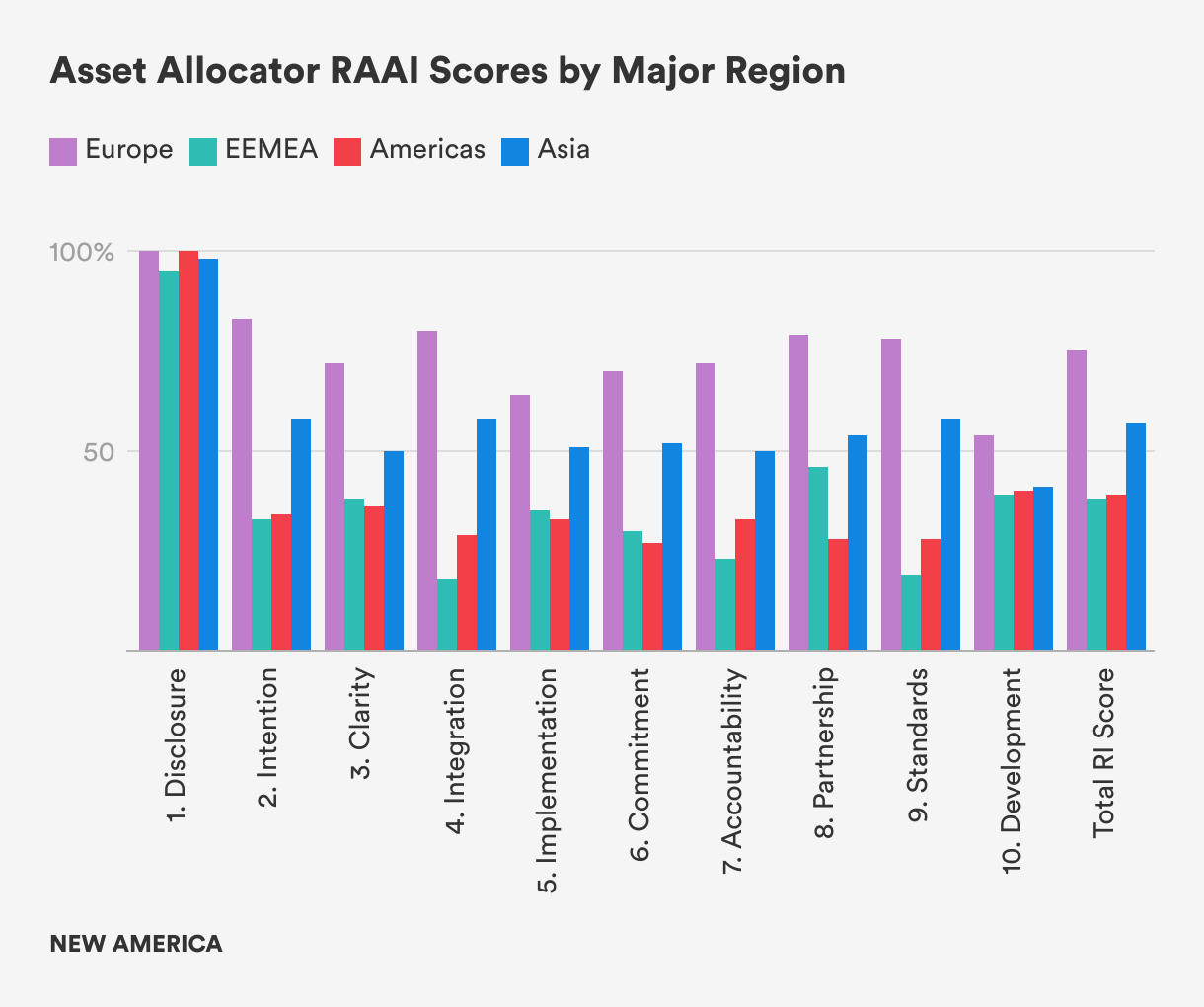
The RAAI divides rated asset allocators into four geographic regions: Europe (including Scandinavia, the U.K., Western Europe, and Global Institutions), Asia (including Australasia, Central Asia, East Asia, South Asia, and South East Asia) Americas (including Canada, Latin America, and the United States) and EEMEA (including Eastern Europe, Middle East, and Africa).
The RAAI rated 62 asset owners in Europe, and it is by far the best performing region, with an average aggregate RAAI score of 78 percent. This compares with second place Asia (52 asset owners rated), with an average score of 57 percent, and a virtual tie for last place between the Americas (104 asset owners rated) and EEMEA (33 asset owners rated), with scores of 39 percent each.
Within Europe, Denmark is the standout, with an average RAAI score of 94.8 percent, the highest aggregate score for any sub-region or country where five or more asset allocators are rated. The U.K. and the Netherlands are second and third, with scores of 82.5 percent and 80.0 percent, respectively.
Asia’s scores are boosted by Australasia, where 19 asset allocators are rated, receiving an aggregate average score of 78.6 percent. On the other hand, Asia is weighed down by low responsible investing practices in South Asia (RAAI score of 27 percent) and China (RAAI score of 25 percent) in particular.
The Americas region is lifted by Canada, where 13 asset allocators are rated, and show an average score of 81.8 percent. However, the region is hurt by poor performance among Latin American and U.S. asset owners, recording lowly aggregate RAAI scores of 20 percent and 34 percent, respectively
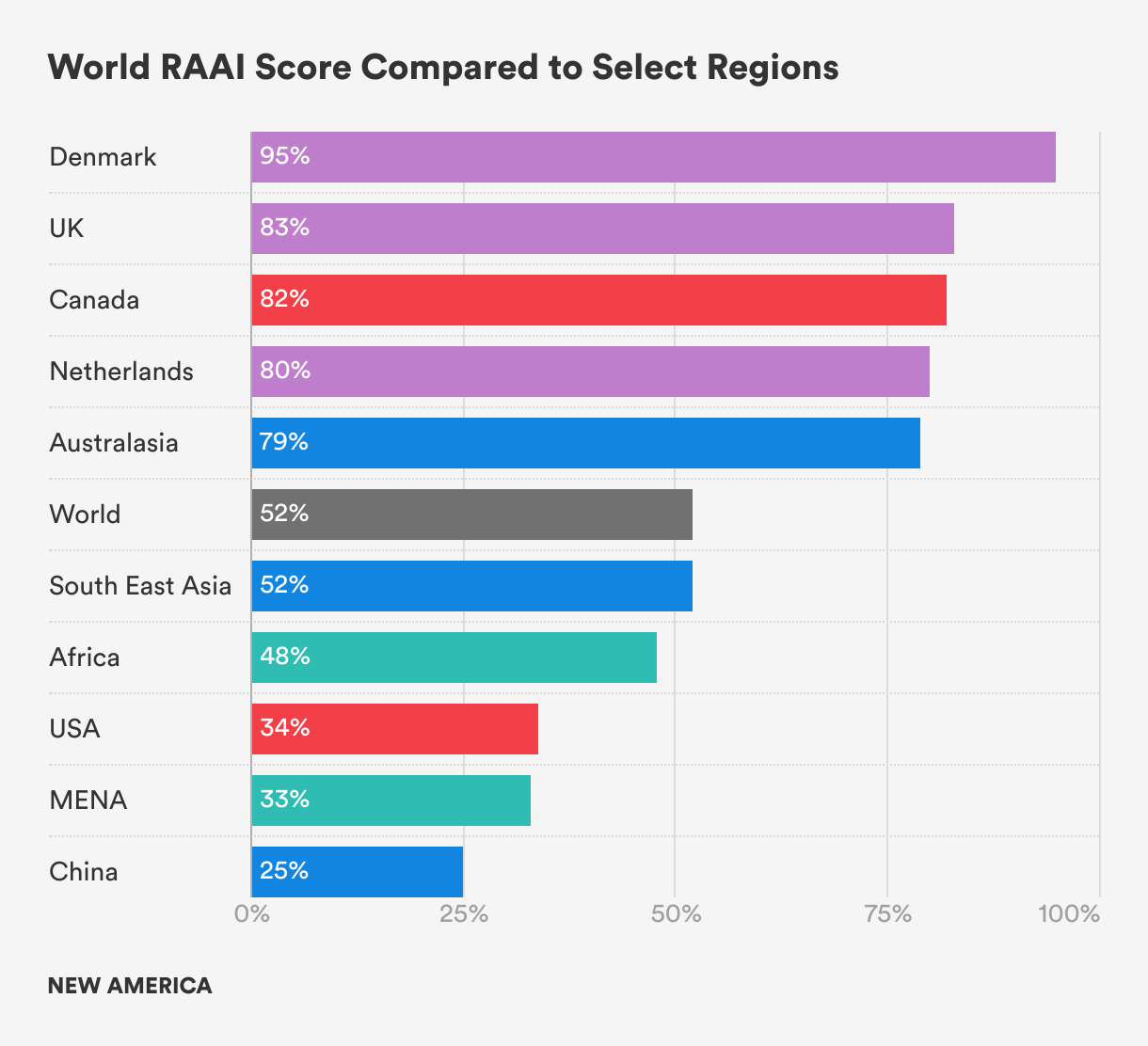
The average RAAI score for regions and countries in developing economies is generally below the total world average. For example, the average RAAI score for Latin America is 20 percent and for MENA countries (Middle Eastern and Northern African nations) the score is 33 percent. As asset allocators in these parts of the world continue to develop and diversify their approach to managing national savings, there is ample scope to introduce more sophisticated responsible investing programs. In particular, with $3.8 trillion in AUM, MENA asset allocators could make an enormous difference in advancing environmental and social goals, benefitting the people of their states as well as global citizens.
4. The Leaders and Finalists continue to set the bar for responsible investing, widening the gap with the rest of the world.
With an average score of 96 percent, the leaders and finalists (the top quintile), are far ahead of the average score for the rest of the world, asset allocators that rank in quintiles 2-5. Further information on this performance gap, and on areas of responsible investing that need further attention, can be found in Chapter III of this report,The RAAI Index and Leaders List, under the section Performance Analysis of the Leaders and Finalists. One of the main objectives of the RAAI Index and the Leaders List is to establish a benchmark of excellence that peers can use as a guide to lift responsible investing performance. Asset allocators earning scores that rank them in the top quintile are deservedly the most responsible investors in the world, and they help to create a “race to the top” for the broader investment community.
5. The world’s two biggest economies, the United States and China—comprising 40 percent of global GDP—are lagging dangerously behind the rest of the world on responsible investing
The poor performance of U.S. asset owners on responsible investing is particularly concerning. With an average total score of just 34 percent, the United States ranks lowest among developed Western economies and is low even by developing economy standards. For example, the United States ranks below Africa (48 percent) and Southeast Asia (52 percent). The RAAI analyzed 82 U.S. asset allocators with AUM of $5.8 trillion (22 percent of total rated fund’s AUM), and while collectively these investors have the potential to advance critical solutions for challenges such as climate change, less than ten are trying to make a difference.
Eight out of 82 U.S. asset allocators rated by the RAAI (10 percent) are global leaders on responsible investing, versus 10 out of 22 (45 percent) in the U.K., six out of 13 (46 percent) in Canada, nine out of 19 (47 percent) in Australia/New Zealand, and six out of 12 (50 percent) for Scandinavia. Nearly two-thirds of U.S. asset allocators rank in the bottom two quintiles of the RAAI Index.
China ranks even lower than the United States on responsible investing, with an average total RAAI score of just 25 percent, placing it in the fourth quintile just ahead of Latin America. With 1.4 billion people, China accounts for 18 percent of the global population and with a GDP of $15 trillion, it also accounts for 18 percent of the world economy. It’s influence on global economic and energy trends is enormous. The government in China has pledged to go carbon neutral, and the country does have the largest installed capacity of renewable energy in the world, accounting for 26 percent of domestic energy consumption. However, the transition to a carbon neutral economy is complicated by the fact that the rest of China’s energy needs are met mostly through coal-fired power plants. In fact, in 2020, China added 38.4 gigawatts of coal-fired power to its capacity, more than three times the amount added by the rest of the world combined, and plans remain in place to continue adding capacity going forward.
On a global scale, without leadership from the United States and China, the world’s two biggest economies, together accounting for 40 percent of global GDP, it will be difficult to overcome the biggest ESG challenges facing our planet today.