The 2009 NAEP Reading Scores and the Need to Learn from New Jersey’s Literacy Program

Reading scores for American students have not budged much since two years ago, according to the Nation’s Report Card released yesterday by the Institute of Education Sciences. The report is based on the National Assessment of Educational Progress, a test administered to samples of students nationwide to measure reading comprehension across literary and informational texts.
The scores remain underwhelming. A third of students, the report shows, are unable to read at basic levels in the fourth grade.
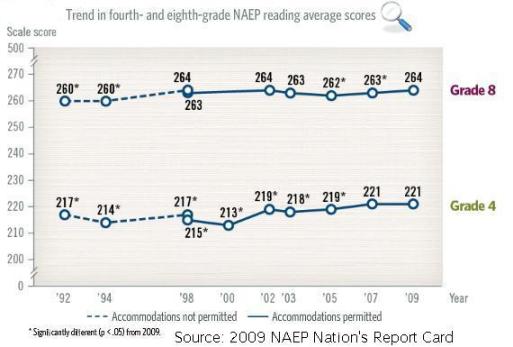
For fourth graders, the average score was unchanged from 2007, but slightly higher than in any year from 1992 to 2005. For eighth graders, the average score has risen since 1992 and rose slightly between 2007 and 2009, but has dipped up and down between 1992 and today.
Additional findings from the Report Card:
- Two thirds of fourth graders performed at the “basic” reading level or higher. At the basic level, a 4th grader can “recognize a main idea not explicitly stated in an article,” or “use information across text” to infer a character trait in a story.
- One third of 4th grade students performed at the “proficient” reading level or higher. At this level, a student can “use information from an article to provide and support an opinion,” and “provide cross-text comparison of two characters’ feelings” in a story.
- Racial and ethnic gaps persist in the 2009 scores. Gaps in achievement between racial and ethnic groups didn’t narrow or widen between 2007 and 2009, nor did the gap between students who are and are not eligible for free- or reduced-price lunch.
- Between 2007 and 2009, scores increased in three states (DC, Kentucky, and Rhode Island) and decreased in four states (Alaska, Iowa, New Mexico, and Wyoming).
To Early Ed Watch, these stagnating reading scores further highlight to the need to focus more attention on policies and practices that support pre-literacy and early literacy programs.
We need to remember the impressive gains that have been made in several districts in New Jersey that have adopted what leaders there called an “Intensive Early Literacy” program. This program includes a reading curriculum based on the latest research, small class sizes, a library in every classroom, regular opportunities for teachers to collaborate and discuss individual students’ work, and an extended literacy block in the early grades. The literacy block includes time for teacher-led, large-group instruction, small-group instruction and writing. Teachers receive extensive professional development in how children learn to read and how to use assessments and select appropriate materials for their students. For a fuller description of this program and the results gained so far, see our recent report, Education Reform Starts Early: Lessons from New Jersey’s PreK-3rd Reform Efforts. (Details start on page 16.)
More About the Authors
Issues
Programs/Projects/Initiatives
Related
Confronting Harmful Federal Disability Policy in Health and Human Services

Federal Early Education Update: March 2026
A Bureaucratic Shakeup Threatens Future Child Care Research