
What Is the Threat to Europe?
While the jihadist threat in the United States has receded, the threat in Europe is more severe, consisting of a mixture of attacks directed by ISIS and its affiliates as well as homegrown ISIS-enabled and ISIS-inspired attacks.
While the United States has experienced no attacks directed by foreign terrorist organizations since 9/11, there have been five ISIS-directed attacks in Europe since 2014. These five ISIS-directed attacks in Europe since 2014 killed 188 people, more than the death toll of all deadly jihadist attacks in the United States since 9/11.1
Europe may have turned the corner regarding the immediate threat of ISIS-directed attacks. It has not seen an ISIS-directed attack since May 2017. With the demise of ISIS’ territorial state in Syria and Iraq, attacks in Europe are increasingly likely to be ISIS-enabled or ISIS-inspired but not ISIS-directed.
In its 2019 report, Europol stated that in 2018: “All jihadist terrorist attacks were committed by individuals acting alone,” and noted that “the diminished sophistication in the preparation and execution of jihadist terrorist attacks contributed to a lower number of casualties in completed attacks.”2 This assessment echoes Europol’s 2018 report, which also cited a “decrease in sophistication” in attack plots in the European Union.3 Additionally, according to Europol, the number of arrests for jihadist terrorism in Europe declined for the second year in a row to 511 in 2018 from 705 in 2017 and 718 in 2016, after increasing every year from 2013 through 2016.4 The number of failed, foiled, and completed attacks in 2018 declined from 33 in 2017 to 24 in 2018.5 Data on launched and foiled attacks in Europe collected by Petter Nesser, a senior researcher at the Norwegian Defence Research Initiative, also shows a decline from 2017 to 2018.6
Despite these promising signs, Europe faces a continued and substantial threat. While Europe may be turning the corner with regard to attacks, the 33 foiled, failed, or successful attacks in 2017 represented a doubling of the number in 2016 by Europol’s count.7 Likewise, Nesser notes that the number of foiled and launched attacks in 2018 was still higher than in any year prior to 2015.8
New America’s research, which tracks failed and successful attacks, suggests a similar trend of declining attacks and sophistication in the past couple of years. The number of attacks per year grew through 2016 while staying stable in 2017. This growth was driven by a steady increase in the number of attacks inspired by jihadist ideology in Europe but not known to have been directed or enabled by ISIS, even as attacks known to have closer ties to ISIS tapered off. The number of attacks then substantially decreased in 2018; as of September 11, 2019 is on track to end with a slightly lower number of attacks than occurred in 2018.
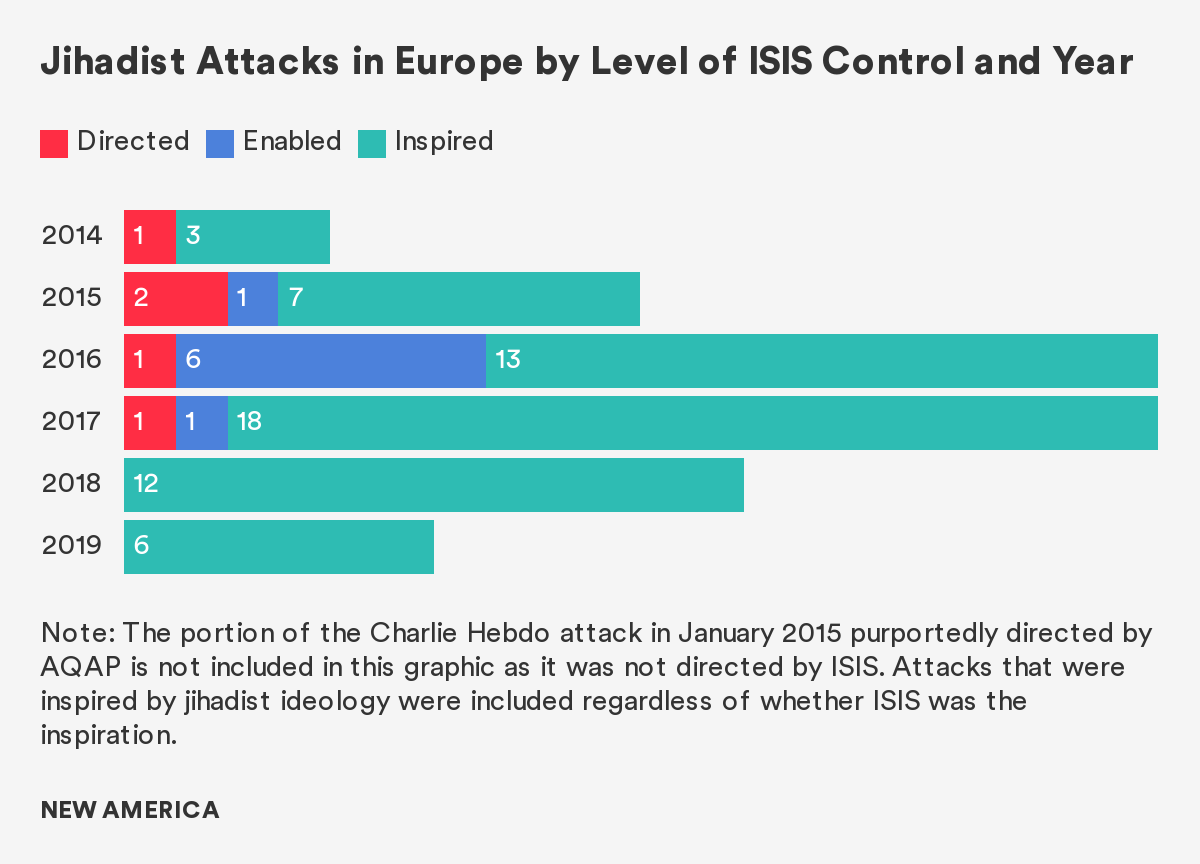
Europe has experienced eight ISIS-enabled attacks since 2014,9 compared to one in the United States. Twenty people have died in ISIS-enabled attacks in Europe, while no one other than the perpetrators has died in an ISIS-enabled attack in the United States. The last10 ISIS-enabled attack in Europe occurred in April 2017, when Rakhmat Akilov drove a truck into a crowd in Stockholm, Sweden, killing five people. Before the attack, Akilov shared images of his target and received a green light for the attack from his contacts in ISIS via encrypted message.11 While Akilov’s attack is the last enabled attack recorded in New America’s data, it is worth noting that the UN Sanctions Monitoring Team’s January 2019 report cited a “recent re-emergence of communication between ISIL command and control, and individuals in different European countries.”12
Finally, there have been 59 attacks inspired by jihadist ideology in Europe that have not been directed or enabled by ISIS or other foreign terrorist organizations since 2014. These inspired attacks have killed 149 people in Europe since 2014, more than jihadist terrorists have killed in the United States during the 18 years since the 9/11 attacks.
Europe faces a more severe threat than the United States in large part due to four major factors: the large number of European foreign fighters, the larger and more developed nature of European jihadist networks, the marginalization of Muslims within Europe, and Europe’s geographic proximity to conflict zones.
Foreign Fighters
The first factor is the far larger number of foreign fighters who left for Syria and Iraq from Europe and the correspondingly large number of returnees. In its 2019 report, Europol estimated that about 5,000 Europeans had traveled to conflict areas in Syria and Iraq and put the number of Europeans still in the region at less than 2,000.13 In its 2018 report, Europol estimated that those in Syria numbered 2,500, with 1,500 having returned home and 1,000 having died.14 It is not clear from the latest Europol report the relative extent to which additional returnees, additional deaths, or other factors account for the decline from 2,500 to less than 2,000 believed to remain in the region.
These numbers are far greater than the number of Americans who have traveled to fight in Syria and Iraq. According to the FBI, 300 Americans have “traveled or attempted to travel to Syria and Iraq to participate in the conflict,” a number that appears to include those who fought with any group.15 In addition, many of these Americans were arrested before setting foot in the conflict zone. Even with such caveats, the number of American “fighters” is more than 16 times smaller than the number of European fighters who actually traveled to Syria or Iraq.
The far larger number of European fighters is confirmed by ISIS’ own records. A set of 3,577 ISIS personnel records examined by New America contained 34 times as many fighters reporting residence in Western Europe than fighters reporting residence in the United States. Correspondingly, the number of American returnees is also far lower than the 1,500 European returnees.
The large number of European foreign fighters increases the threat to Europe in several ways. First, such fighters were behind the far deadlier and more sophisticated set of directed attacks that hit Europe. With the demise of ISIS’ territory in Iraq and Syria, this is less likely to be a driver of major attacks in the immediate future.
However, the impact of returned European fighters is not limited to such directed attacks. Returnees can also act as organizers and facilitators, using their experience and knowledge to help build jihadist networks—whether to enable attacks by others or to enable terrorist travel, propaganda, and fundraising activity.16
Beyond the threat of returnees from Syria conducting directed attacks or coordinating homegrown attacks by building networks, many of the returnees remain potential sources of inspired violence without direction from ISIS itself. The large radicalized population will remain a concern regardless of the state of ISIS control over operations.
The contours of the foreign fighter and returnee problem in Europe have shifted over time. For now, the flow of fighters to ISIS has been cut to, at most, a trickle. According to Europol’s 2019 report, “the number of EU [foreign fighters] travelling to the Iraq and Syria conflict zone in 2018 was very low.”17 This echoes similar statements of a substantial decline in travel in Europol’s 2018 and 2017 reports.18
In May 2017, then-National Counterterrorism Center Director Nicholas Rasmussen commented: “The good news is that we know that the rate of foreign fighters traveling has steadily declined since its peak in 2014.”19 Today, the flow to Syria and Iraq is close to zero.
That said, there are signs that there is still interest on the part of some militants for travel to conflict zones. Europol’s 2019 report cited a small number of attempted journeys to the Iraq and Syria conflict zone citing cases, and also stated that Spain reported that two individuals successfully traveled to Syria and Iraq.20 This resembles the Europol assessment in 2018, where it reported that in June 2017, a Dutch man successfully reached ISIS in Syria (the first known case at the time since November 2016).21 Similarly a search warrant in Minnesota alleged that an American attempted, but failed, to reach Syria via Europe in 2017.22 In its 2019 report, Europol also reported that a “relatively small” number of Europeans have traveled to conflict zones other than Syria and Iraq, departing from either Europe or Syria and Iraq.23
Such cases do not provide a reason to contest the finding that the number of travelers has declined precipitously. They do, however, warrant continued attention, particularly as the flow of fighters may increase again if another conflict becomes a popular field of jihad.
The flow of foreign fighter returnees back to Europe has also declined substantially. In its 2019 report, Europol stated that the number of returnees, “remained very low.”24 In its 2018 report it stated that, in 2017 there was a “diminishing number of returnees,” in part due to the difficulty of leaving ISIS territory as a result of military actions against ISIS.25 In July 2017, Rasmussen noted: “I look at the problem now as not so much as one of quantity but as one of quality,” emphasizing not the number of returnees but the skills that the small number of those who might return have obtained and how they might use them.26
There is a wild card with regard to European foreign fighter returnees: the unclear fate of the reportedly large number of Europeans currently imprisoned or detained in Syria and Iraq or otherwise remaining in the conflict zone. European countries have so far—on the whole—refused to take back hundreds of detained European fighters.27 This has resulted in some detained European fighters held in Syria reportedly being released.28 This produces the possibility that such fighters may return without being arrested at a later date, increasing the threat in Europe.
Jihadist Networks
The second factor compounding the threat in Europe is the existence there of stronger, more developed jihadist networks than those that exist in the United States. One reason ISIS was able to successfully conduct the November 2015 Paris attacks was that the attackers relied on a support network of at least 20 other people.29 Similarly, Belgium tried 46 members of the radical group Sharia4Belgium who traveled to fight in Syria or helped others to do so.30 Those 46 are only a small portion of the larger Sharia4Belgium network. These large networks are not things of the past. In its 2019 report, Europol noted that “terrorist networks continue to be detected in Europe,” citing the identification of 25 inmates across 17 prisons in Spain in which individuals were radicalizing in prison.31As noted above, according to Europol, European states arrested 511 people for jihadist terrorism crimes in 2018, 705 in 2017, and 718 in 2016.32 That is more jihadist terrorism-related arrests each year than have been made in the United States since 9/11.33 Over the three-year period from 2016 through 2019, European states arrested more people for jihadist terrorism-related crimes than the FBI reports having open investigations of ISIS-related crimes.34
Marginalization and Anti-Muslim Feeling
The third factor is that Europe faces more substantial challenges in successfully integrating its Muslim population than does the United States, and is thus likely to continue to struggle with a significant homegrown threat rooted in these challenges. In particular, the lack of opportunities and the identity challenges facing second-generation Muslim immigrants in Europe will likely continue to radicalize some for the foreseeable future.35
As a result of war, revolution, and poor economic and social conditions in the Middle East and North Africa, there has been an unprecedented wave of immigration from Muslim-majority countries into Europe in recent years. Germany alone took in more than 1 million refugees and asylum seekers.36 In 2019, and more broadly since the height of the crisis in 2015 and 2016, the number of migrants reaching Europe fell substantially.37 According to Frans Timmermans, the European Commission’s first vice-president, “Europe is no longer experiencing the migration crisis we lived in 2015, but structural problems remain.”38
European countries lack the ideological framework the United States has in the shape of the “American Dream,” which has helped to successfully absorb wave after wave of immigration, including Muslim Americans who are generally well integrated into American society.
There is no analogous French Dream or German Dream. The proportion of the French prison population that is Muslim is estimated to be around 60 percent, yet Muslims account for only about 8 percent of France’s total population.39 Muslim citizens in France are 2½ times less likely to be called for a job interview than similar Christian candidates, according to researchers at Stanford University.40 Many French Muslims live in grim banlieues, the suburbs of large French cities (similar to housing projects in the United States), where they find themselves largely divorced from mainstream French society. According to the Renseignements Généraux, a police agency that monitors militants in France, half the neighborhoods with a high Muslim population are isolated from French social and political life. The French term for these neighborhoods is equivalent to “sensitive urban zones,” where youth unemployment can be as high as 45 percent.41 In Belgium there is a similar story: 20 to 30 percent of the prison population is Muslim, yet Muslims make up only 6 percent of the overall population.42
It is not surprising that many of the perpetrators of attacks in Europe come from these economically marginalized communities or have spent time in French and Belgian prisons, which can function as universities of jihad. The members of the ISIS cell responsible for the November 2015 attacks in Paris that killed 130 and the March 2016 attacks in Brussels that killed 32 had bonded through criminal activities or in prison.43 Abdelhamid Abaaoud and Salah Abdeslam, the cell’s masterminds, were childhood friends who grew up in the impoverished Brussels neighborhood of Molenbeek. In 2010, the men were arrested and spent time in the same prison. Ibrahim Abdeslam, Salah’s brother, also spent time in prison with Abaaoud.44 He would go on to be one of the terrorists in the Paris attacks. Khalid and Ibrahim El Bakraoui, both suicide bombers in the Brussels attacks, had served lengthy prison sentences for armed robbery and assault on police.45
The marginalization of European Muslims and its role in jihadist radicalization is likely to be exacerbated by anti-Muslim and anti-immigrant feeling in Europe. Anti-immigrant, ultranationalist and anti-Muslim parties once played a marginal role in European politics. In recent years, their political power has increased, though the extent of their power is still contested. In the 2019 European Parliament elections, centrist parties lost ground while the far-right gained ground.46 Marine Le-Pen’s far-right National Rally (formerly the National Front) party slightly outperformed French President Emmanuel Macron’s party and in Italy, the far-right populist party scored a more substantial victory.47 The far-right gains in the election appear to have not translated into meaningful parliamentary power, however they demonstrate the continued relevance of far-right politics in Europe.48
This situation mirrors the political situation that was apparent last year, where far-right parties made their power known. Marine Le Pen made it to the runoff in the French presidential race with the second strongest showing in the first round race. Far-right parties had also expanded their power in Germany, the Czech Republic, Austria, the Netherlands, Italy and Poland, while left-wing parties have collapsed and center-right parties have moved rightward on immigration.49
In April 2018, anti-immigrant nationalist Viktor Orbán was reelected as prime minister in Hungary with overwhelming support.50 Orbán’s government proceeded to criminalize providing assistance to undocumented migrants.51 Before the election, Orbán called for a global anti-migrant alliance and stated that “Christianity is Europe’s last hope,” warning that, with mass migration, “our worst nightmares can come true. The West falls as it fails to see Europe being overrun.”52 In 2019 the Hungarian government was set to sponsor a festival hosted by a far-right movement, members of whom were convicted for a bomb plot in Romania, before backing off and withdrawing support.53
In 2018, Denmark’s government proposed new laws that would radically restrict the behavior of people living in ghettoized neighborhoods that are predominantly Muslim; they include doubling the sentences for certain crimes committed in the listed neighborhoods and criminalizing taking children on extended trips to their countries of origin that could damage their “schooling, language and well-being.”54 In Denmark’s 2019 elections, anti-immigrant feeling found expression not just on the right but among Denmark’s liberal and social democratic parties.55As anti-immigrant parties and agendas exert strength, they risk escalating the sense of alienation among Europe’s already marginalized Muslim population, potentially contributing to further radicalization.
In some cases, anti-immigrant and anti-Muslim politics have been expressed through terrorism. In June 2019, Germany saw the murder of Walter Lübcke, a regional politician who supported Merkel’s policies of accepting refugees. The suspect in the case had a long history of ties to Germany’s neo-Nazi scene and had been involved in previous attempts at violence, including an attempted bombing for which he did prison time. According to Germany’s domestic intelligence agency, there are 12,700 potentially violent right-wing extremists in the country.56 The agency reported a 50 percent increase in the number of extremists over the past two years.57
Britain, which saw its own political assassination in recent years—that of anti-Brexit MP Jo Cox in 2016—is also noticing warning signs regarding a rise in far-right terrorism. British Home Secretary Sajid Javid noted a “marked shift in the nature of extreme right-wing activity” towards actual terrorist violence.58
Europol only identified one far-right terrorist attack that took place in Europe in 2018. The attack occurred in Italy and injured six people who the perpetrator believed to be Africans. The perpetrator had previously unsuccessfully run for local office with an anti-migrant party.59 However, Europol reported that an “escalation of right wing sentiments across Europe resulted in an increase in arrests” for the third year in a row.60 2018 saw some serious terrorist plots foiled including one in June 2018, where France arrested 10 people suspected of plotting a terrorist attack against Muslims who had acquired rifles, handguns, and grenades.61 While this far-right violence poses a significant threat on its own, it should also raise concerns about the potential for homegrown cycles of violence driven by polarization in European politics.
Geographic Proximity
The fourth factor that results in Europe facing a more severe threat is that Europe is simply closer in geography to the parts of the world where revolution and war have opened opportunities for jihadist organizing, while the United States is separated from these areas by thousands of miles and two oceans. As a result, the repercussions of instability in the Middle East and North Africa have more impact on Europe than on the United States.
Citations
- In addition, AQAP conducted a directed attack on the offices of Charlie Hebdo in 2014, killing 12 people, though the extent of its direction beyond providing training for the attackers years before the attack is not clear.
- “Terrorism Situation and Trend Report 2019 (TE-SAT).”
- “European Union Terrorism Situation and Trend Report 2018,” Europol, 2018, source
- Europol 2019; Europol 2018.
- Europol 2019 p. 14.
- Peter Nesser, “Military Interventions, Jihadi Networks, and Terrorist Entrepreneurs: How the Islamic State Terror Wave Rose So High in Europe,” CTC Sentinel 12, no. 3 (March 2019), source
- Europol 2019; Europol 2018.
- Nesser, “Military Interventions, Jihadi Networks, and Terrorist Entrepreneurs: How the Islamic State Terror Wave Rose So High in Europe.”
- Those attacks are: the April 2017 Stockholm, Sweden, truck attack that killed five people and injured 14; the December 2016 Berlin, Germany, Christmas market attack that killed 12 and wounded 56; the July 2016 music festival suicide attack in Ansbach, Germany, that injured 12 people; the July 2016 ax attack on a train in Wurzburg, Germany, that injured four; the July 2016 killing of two people in Magnanville, France; the stabbing attack in February 2016 of a police officer by a 16-year-old girl in Hanover, Germany, that injured one; and the April 2015 church attack in Villejuif, France, that killed one.
- Tracking ISIS-enabled attacks is particularly susceptible to undercounting when it comes to more recent cases, as details on online ties to ISIS often become confirmed only later in the course of investigations.
- “Stockholm attacker appears baffled over lack of Isis claim,” AFP/The Local, February 21, 2018, source
- “Twenty-Third Report of the Analytical Support and Sanctions Monitoring Team.”
- Europol 2019
- Europol 2018.
- Hollie McKay, “Almost All American ISIS Fighters Unaccounted For, Sparking Fears They Could Slip Through Cracks and Return,” Fox News, October 26, 2017, source
- See discussion in the following: Alastair Reed, Johanna Pohl, and Marjolein Jegerings, “The Four Dimensions of the Foreign Fighter Threat,” International Centre for Counter-Terrorism – The Hague, June 2017, source; Europol, 2018.
- Europol 2019
- Europol, 2018; EU Terrorism Situation and Trend Report (TE-SAT) 2017, (The Hague: Europol, 2017), source
- Nicholas Rasmussen, “Director Rasmussen Opening Remarks CNAS Keynote Policy Address” (National Counterterrorism Center, May 3, 2017), source
- Europol 2019.
- Europol, 2018.
- Stephen Montemayor, “Affidavit Reveals Twin Cities Man's Aborted Attempt to Join ISIS Last Year,” Star Tribune, May 31, 2018, source
- Europol 2019.
- Europol 2019
- Europol 2018.
- Nick Rasmussen, “Tour d’Horizon,” (Session, Aspen Security Forum, Aspen, Colorado, July 19-22, 2017).
- Stacy Meichtry and Julian E. Barnes, “Europe Balks at Taking Back ISIS Fighters,” Wall Street Journal, February 13, 2018, source
- Josie Ensor and Brenda Soter Boscolo, “European ISIL Jihadists Released under Secret Deals Agreed by UK’s Allies in Syria,” Telegraph, June 15, 2018, source
- Peter Bergen, David Sterman, Alyssa Sims, and Albert Ford, ISIS in the West: The Western Militant Flow to Syria and Iraq (Washington, DC: New America, 2016), source
- Bergen, Sterman, Sims, and Ford, ISIS in the West.
- Europol 2019.
- Europol 2019.
- Bergen, Sterman, Ford, and Sims, “Terrorism in America.”
- Lisa Rose, “US has 1,000 Open ISIS Investigations but a Steep Drop in Prosecutions,” CNN, May 16, 2018, source
- Scott Shane, Richard Perez-Pena, and Aurelien Breeden, “‘In-Betweeners’ Are Part of a Rich Recruiting Pool for Jihadists,” New York Times, September 22, 2016, source; Peter Bergen, “A Pattern in Terror — Second Generation, Homegrown,” CNN, May 24, 2017, source
- Patrick Donahue and Arne Delfs, “Germany Saw 1.1 Million Migrants in 2015 as Debate Intensifies,” Bloomberg, January 6, 2016, source
- Demetrios Papademetriou, “The Migration Crisis Is Over: Long Live the Migration Crisis,” Migration Policy Institute (blog), March 2017, source; Jennifer Rankin, “EU Declares Migration Crisis over as It Hits out at ‘Fake News,’” Guardian, March 6, 2019, source
- Ibid.
- Christopher de Bellaigue, “Are French Prisons ‘Finishing Schools’ for Terrorism?” Guardian, March 17, 2016, source
- This draws on: Peter Bergen and Emily Schneider, “How the Kouachi brothers turned to terrorism,” CNN, January 9, 2015, source ; Claire L. Adida, David D. Laitin and Marie-Anne Valfort, “Identifying barriers to Muslim integration in France,” Proceedings of the National Academy of Sciences of the United States of America 107 (December 2010), source
- Steven Erlanger, “A Presidential Race Leaves French Muslims Feeling Like Outsiders,” The New York Times, April 4, 2012, source
- Steven Mufson, “How Belgian prisons became a breeding ground for Islamic extremism,” Washington Post, March 27, 2016, source
- “Unraveling the Connections Among the Paris Attackers,” The New York Times, March 18, 2016, source
- Ibid.
- “Ibrahim and Khalid el-Bakraoui: From Bank Robbers to Brussels Bombers,” New York Times, March 24, 2016, source
- Meg Anderson, “4 Takeaways From The European Parliament Election Results,” NPR, May 27, 2019, source
- Anderson; David M. Herszenhorn and Maia De La Baume, “Mainstream Parties Block Euroskeptics from Top Parliament Posts,” Politico, July 11, 2019, source
- Valentina Pop, “Nationalists Fail to Join Forces in European Parliament,” Wall Street Journal, June 13, 2019, source
- William Galston, “The Rise of European Populism and the Collapse of the Center-left,” Brookings, March 8, 2018, source
- Marc Santora, “Hungary Election Gives Orban Big Majority, and Control of Constitution,” The New York Times, April 8, 2018, source
- Patrick Kingsley, “Hungary Criminalizes Aiding Illegal Immigrants,” The New York Times, June 20, 2018, source
- Marton Dunai, “Hungary's Orban Calls for Global Anti-Migrant Alliance with Eye on 2018 Elections,” Reuters, February 18, 2018, source
- Lili Bayer, “Orbán Government Withdraws Support for Extreme-Right Festival,” Politico, June 17, 2019, source
- Ellen Barry and Martin Seloe Sorensen, “In Denmark, Harsh New Laws for Immigrant ‘Ghettos,’” The New York Times, July 1, 2018, source
- Stine Jacobsen, “Danish Muslims Feel Backlash as Immigration Becomes Election Issue,” Reuters, May 31, 2019, source; Vanessa Gera and Jan M. Olsen, “Nordic Liberals Take Harder Line On Migrants To Win Votes,” AP, June 26, 2019, source; Lisa Abden/Vordingborg, “An Island for ‘Unwanted’ Migrants Is Denmark’s Latest Aggressive Anti-Immigrant Policy,” Time, January 16, 2019, source
- Katrin Benhold, “A Political Murder and Far-Right Terrorism: Germany’s New Hateful Reality,” New York Times, July 7, 2019, source
- Austin Davis, “Far-Right Extremism on Rise in Germany, Report Warns,” Telegraph, April 28, 2019, source
- Jamie Dettmer, “European Security Chiefs Alarmed at Threat From Far-Right Terrorism,” Voice of America, May 3, 2019, source
- Europol 2019.
- Europol 2019.
- Angelique Chrisafis, “Ten Face Charges in France Over Suspected Far-Right Terror Plot,” Guardian, June 27, 2018, source