Tech Is Fueling Unprecedented Price Gouging
Lindsay Owens, author of "Gouged," calls for a Consumer Bill of Rights
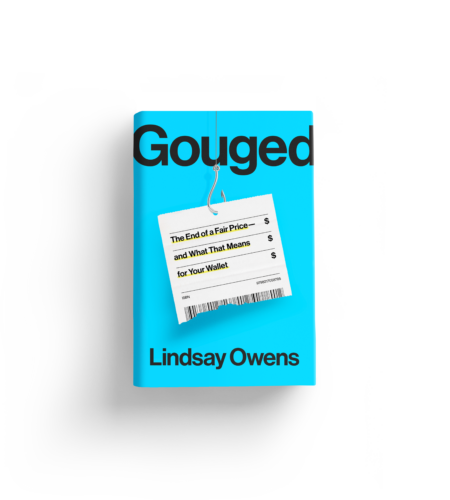
In 1924, says Lindsay Owens, author of the new book Gouged, the Swiss light bulb manufacturing company Osram brought together a group of its competitors in Geneva, Switzerland to address a problem: Light bulb technology was getting too good, so durable and long-lasting that consumers would be buying fewer and fewer light bulbs and thus, reducing the manufacturers’ profits. Together, the companies agreed to a set of new standards, reducing the average life of a bulb from 2,000 hours to 1,000 hours. To go to market, new bulbs had to pass through a laboratory run by the group’s own scientists, who would ensure that existing companies’ products wouldn’t be undercut. This price-fixing conspiracy called itself The Phoebus Cartel after the Greek God of light, and it succeeded in wielding God-like power over the industry, reducing the average bulb life from “1,800 hours in 1926 to just over 1,200 hours by 1933.”
In Gouged: The End of a Fair Price and What That Means for Your Wallet, Owens, executive director of the consumer watchdog and think tank Groundwork Collaborative, says the Phoebus Cartel was a “master class” in the corporate tactics of gouging customers, using the three C’s of “coordination, collusion, and cartels.” Today, she argues, corporations have a bevy of new technologies to do the work of the three Cs for them, and do it more covertly and more precisely than the Phoebus Cartel could have dreamed. From the home rental industry to airline prices and online retail, software and increasingly sophisticated algorithms are exacting ever-higher prices from consumers, threatening to bankrupt individuals and families, and undermining basic ideas of fairness. As a Groundwork Collaborative report on a pricing experiment run by Instacart said, “At a time when food price inflation outpaces overall inflation, and Americans report that the price of groceries is their number one cost concern, pricing experiments used by companies like Instacart are making the situation worse.”
I spoke with Owens about the most worrying of these new technologies, surveillance pricing, where companies use your personal data to set the maximum price they think you will pay, and agentic commerce, where an autonomous AI agent will shop for the best price and product for us, and what consumers can do to push back. Our conversation has been edited and condensed.
Haley Swenson: What made you write Gouged: The End of a Fair Price and What It Means for Your Wallet?
Lindsay Owens: I wasn’t planning to become an author, but like many Americans, I’m really fed up with pricing in this country. I’m fed up with high prices, of course, but I’m also fed up with how pricing is increasingly opaque and volatile, which makes it so hard to budget and to know what something will cost from one day to the next.
I’m fed up with the fact that you and I could be shopping for the exact same item at the exact same time from the exact same store, and we could be charged different prices. At the mall I worked in growing up, we put a price tag on stuff, and if you came into the store that day, you got it for the same price that I did. This change has happened kind of quietly, without a lot of fanfare, but it’s starting to really add up.
Haley Swenson: Tell us about your Instacart experiment and what you found out about grocery pricing.
Lindsay Owens: Late last year, Groundwork Collaborative teamed up with Consumer Reports (a non-profit research and testing organization) and More Perfect Union (a non-profit advocacy and journalism organization) to run an experiment using volunteer, secret shoppers on Instacart that exposed an even larger experiment that Instacart was running on millions of Americans as they shopped for groceries. Volunteers at the exact same pickup location bought the exact same basket of 23 items: cereals, pastas, and deli meat, the regular stuff that you and I buy every week to feed our families. We put screenshots of their basket totals into a big Excel sheet and crunched the numbers. And that’s when things got very, very strange.
For about 75% of the items, they were being offered at different prices to different people at the same time, at the same pickup location. Some people were being charged 23% more than others for the exact same item. The average difference in basket totals was about 7%. That’s double inflation. Using Instacart’s own estimate of what a household of four spends on groceries in a year, the “Instacart tax” totaled about $1,200.
About two weeks after the report was released, Instacart announced they would stop allowing retailers to use Eversight, the AI company they acquired in 2021, which gave them the infrastructure to run these secret experiments on us.
Haley Swenson: So this is a good example of what is being called “surveillance pricing.” What are they trying to maximize with an experiment like this?
Lindsay Owens: Very simple. They’re trying to figure out exactly how much they can charge you for every single item in your cart. What is the maximum price they can stick on each item before you close your browser and go to the grocery store?
Haley Swenson: You write about the Phoebus cartel, light bulb makers who conspired to limit how long their bulbs would last. How does that connect to what we’re seeing today?
Lindsay Owens: The book really is a study in corporate America’s reinvention of the ripoff. These impulses to overcharge you, to circumvent the laws of supply and demand, to put together a cartel, none of them are new. But new technologies have supercharged them.
New technologies allow companies to do something economists used to dream about but never thought possible: first-degree price discrimination, the idea of setting a price just for you based on exactly what they think you would be willing to pay. Companies can track your purchase history, your location, your device type. Maybe your confessions, if you’re talking to Walmart’s Sparky or Google’s Gemini. They use all of that not only to advertise something they think you might like, but now to send the item back to you at a price they think you might be willing to pay. This is personalized or surveillance pricing.
Haley Swenson: When I was looking for child care for my son, I couldn’t find prices on any providers’ websites. How do families fight back when this pricing game is applied to things they need? Should we be worried about
Lindsay Owens: There are areas of the economy, like child care, where it is very often difficult to find out what the price is, and that makes comparison shopping really hard. And budget shopping isn’t just important for you personally. Budget shoppers are the mechanism through which pricing competition is disciplined in the market. It is the budget shopper going to store A saying, “That seems a little high,” then walking over to store B. Enough people do that, store A says, “Nobody’s in my store today, I better lower my prices.” When that mechanism is eroded, it’s a problem for the market writ large.
In the book, I propose a shopper’s bill of rights. We had a consumer’s bill of rights under JFK. It got us the Consumer Product Safety Commission. In the age of e-commerce and agentic commerce, it is time to rebalance the scales between consumers and retailers. There are some rights that we’re owed: a right to a refund, a right to cancellation, a right to repair, a right to unit labeling, and a right to one price. Products should be priced, instead of people being priced.
The other thing I really recommend is for consumers to raise their voices. There are so many examples in the book of consumers successfully batting back some of the most nefarious pricing practices just by calling them out. Backlash ensues, and the company realizes they’ve touched the stove.
Haley Swenson: Any final thoughts on where we’re at with AI and its impact on prices?
Lindsay Owens: We’re at an inflection point, and we are on the precipice of deciding if this technology will be pushed out on our terms or if we will just be on the receiving end. Agentic commerce will upend shopping as we know it. Will these agents shop on our behalf, or will they shop for Mark Zuckerberg’s wallet?
You’re so embattled as a shopper these days. Who wouldn’t want the help? But the question is, who are these agents working for? In the rest of the economy, when we bring an agent on to do something on our behalf, there’s a best interest standard, a fiduciary standard. We don’t yet have that in the agentic commerce space. There are lots of opportunities to harness this technology for good for consumers, but also lots of peril ahead.
Issues
Programs/Projects/Initiatives
Related

Why isn’t summer camp free?

Siemens had a wildly popular childcare center. Then it shut it down.