Table of Contents
- Executive Summary
- Introduction: What Drives the Need for New Skills?
- What Do We Mean By Cyber Citizenship And What Skills Contribute To It?
- What Does Research Say About Building These Skills?
- What are the Challenges to Implementation in the U.S. Education System?
- New Instructional Materials Developed for Educators, But Also A New Problem
- A First Step: The Cyber Citizenship Portal
- Recommendations
- Conclusion: What Would Success Look Like?
- Appendix: Diagram of Emerging Network
What Do We Mean By Cyber Citizenship And What Skills Contribute To It?
The concept of Cyber Citizenship brings together the various components of what is needed to thrive in an increasingly online world and defend against the new threats within it. As such, it brings together facets of literacy, civic engagement and citizenship, and threat awareness.
Our definitions and concepts of “literacy” have always evolved to match the technology and politics of the time. Initially literacy was viewed as the ability to read and write, but also meant the ability to do so at the level required to engage in the key power dynamics of the era. In the ancient Roman Republic, for example, there was no governmental requirement for education, but it was expected that the paterfamilias (head of family) of wealthy and landed families would provide this skill to sons and even daughters via tutors. By the Middle Ages, however, these skills were primarily the domain for court scribes and monks.
The rise of the printing press and then the modern democratic state changed this expectation. Soon, greater and greater portions of society were expected to be literate. Soon after the Massachusetts Bay Colony was established in early 17th century America, for instance, its governing General Court created a series of schools “to teach children Puritan values and how to read the Bible.”1 As these colonies became the United States of America, Thomas Jefferson argued that the new nation required a new system of education to maintain and guard it from tyranny. In his 1779 "A Bill for the More General Diffusion of Knowledge,"2 Jefferson called for public education for "all the free children, male and female."
There was a catch, which goes back to the connection of literacy with power and politics. By definition, these skills of literacy were to be withheld from those who were not free and not considered citizens—enslaved and indigenous peoples. Indeed, after Nat Turner’s rebellion in 1831, Southern states declared illegal any meetings to teach enslaved people to read and write, showing both the power and instrumentality of literacy.3 This dynamic between power, concepts of citizenship, and literacy continued throughout our history, from the very first provision of public education in the U.S., starting in 1830s Massachusetts, to the way that poll taxes and literacy tests were used to exclude African American voters from voting in the Jim Crow South.
Thus, new configurations of technology, social and political activity, and information have always brought with them new forms for inclusion and exclusion. They can also open opportunities for attack and abuse, threatening long-standing institutions and individuals alike. That is, each and every new form of communications technology has created not just new powers, but new vehicles for stories to be told—including ones that are not truthful. For example, only a few years after the printing press was invented, it was used to push conspiracy theories and anti-Semitic “blood libel” stories that led to the bishop-prince of one Italian city to order its entire Jewish community arrested and tortured.4
Even our most vaunted historic figures engaged in media manipulation. Consider the case of The New England Courant, one of the first newspapers published in America. In 1722, it featured a series of witty letters by a “Mrs. Silence Dogood.” They were actually false accounts written by a 16-year-old apprentice at the newspaper named Benjamin Franklin (making him, among other things, the founding father of “fake news” in America).5 Franklin would later deploy this same technique to concoct and distribute fake letters as news “supplements” to gin up support for America declaring independence from Britain.6
The 20th century’s invention of new communications beyond the printed form created new tools for information sharing, but also power and influence, sometimes in the most pernicious ways possible. For example, “it would not have been possible,” said Nazi Minister of Propaganda Joseph Goebbels, “for us to take power or to use it in the ways that we have without the radio.”7 The subsequent rise of television then drove a new conversation around the power of mass media and how audiences could be steered into what seemed like any fad or belief.
In the wake of World War II and the competition of ideas in the Cold War, as well as the explosion of new communications technologies, concepts of literacy and education needs broadened. Educators began to recognize that helping students become “literate" required more than simply teaching them to read and write. To produce not just good students, but good citizens, students also needed ways to critically inquire about the texts they read, the images they see, and the messages they hear. Asking who is behind these stories (“Who wrote this and why?”) has become a key part of what is termed “media literacy,” a concept that originated in part as an approach for helping students deconstruct commercial advertising.
In the 1990s, the arrival of the World Wide Web and personal computing spawned yet more forms of communication technologies and powers, as well as new types of literacies to be taught. These are often grouped now under the heading of “digital literacy,” “digital media literacy,” or “digital and media literacy.” Underneath this “digital” moniker fell the ability to operate a computer. But it was more than that. Individuals could now participate in the world of publishing, producing and sharing their own ideas, images, and text online.8 They thus needed to learn how media was made and what tools enabled message-making. And they needed to grasp concepts such as news literacy, data literacy, and information literacy. Donald J. Leu, a literacy and technology professor at the University of Connecticut, has called these “new literacies.”9 They may also increasingly include “social literacy,” the ability to tap social-emotional skills while navigating through social media and other communications platforms.10 The National Association for Media Literacy Education (NAMLE), an organization of more than 6,500 educators and researchers, is aiming to make space for these many literacies. It defines being media literate as the ability to access, analyze, evaluate, create, and act using all forms of communication.11
As notions of literacy have been expanding, so have notions of a second type of skills, those required to be a responsible citizen, or what is often called “digital citizenship.”
At first, schools focused less on the political aspects of citizenship, and more on the new modes of good behavior on the internet itself, such as “netiquette.” That is, the concept of “digital citizenship” emerged largely as a normative framework in the late 2000s, emphasizing the responsibility of youth to adhere to digital copyright regulations and to accurately assess the credibility of online information.12 As one of the co-authors Nate Fisk noted in a report for the International Society for Technology in Education, these original concepts of digital citizenship emerged “as the norms of behavior with regard to technology use”13 and largely responded to concerns over student “abuse” of classroom technologies. Concerns over cyberbullying and online incivility would drive further development of the concept into the 2010s—emphasizing the personal responsibility and accountability of students as itself a form of “citizenship.”14
To be sure, the term has been used to include broader ideas of citizenship, civic engagement, media literacy, and participatory practice in academic literature. However, in classroom practice, “digital citizenship” for many educators remains centered on this older, normative framework, emphasizing personal accountability and protecting oneself from harm as opposed to social action and civic responsibility. For example, in a survey of U.S. K–12 teachers by Common Sense Media, participants reported that the most commonly taught elements of digital citizenship were “digital drama, cyberbullying, and hate-speech” (46 percent) and “privacy and safety” (43 percent).15 These are important elements, but they do not focus on the full challenges of social media weaponization.
It is for this reason that many leaders in the field, like the Youth and Media team at the Berkman Klein Center for Internet & Society and the 15-organization coalition known as DigCit Commit led by the International Society for Technology in Education (ISTE), have begun to mobilize around the concept of what is called “Digital Citizenship+” by offering up a wealth of new curricula and resources developed for educators. As ISTE puts it, “digital citizenship goes beyond conversations about personal responsibility. It’s about being active citizens who see possibilities instead of problems, and opportunities instead of risks as they curate a positive and effective digital footprint.”16
The third area of education’s intersection with online power and skill-building emerged over the past two decades in the field of cybersecurity. While the internet started as a means to connect researchers at various educational institutions, it soon became a space in which individuals worked to “hack” the emergent computer networks. The first known example was in 1967, by a group of young people. Students at Evanston Township High School were given access to IBM's nascent APL network and, upon learning the code, began to “bomb the system" by penetrating different parts of the network.17 These early forays led to the realization that networks needed to be secured from more malicious hackers, which, in turn, led to a new field of education designed to train up dedicated specialists in cybersecurity.
By the 2000s, cybersecurity was being taught both in the military and in certain universities, typically in computer science and engineering schools. These programs became more formally supported through efforts like the 2009 Comprehensive National Cybersecurity Initiative (CNCI), which laid out goals across the U.S. government workforce, as well as the creation across Fortune 500 companies of business units dedicated to network defense, often led by a new executive known as a chief information security officer (CISO).18
But the realization quickly came that this was insufficient. Not everyone could or should be a cybersecurity specialist, but there was a wider need for cybersecurity awareness. There was a need to prepare for threats of a different sort than the cyberbullying that captivated attention a decade ago. Instead this was about threats to democracy in the form of malign use of information. This led to short education primers and training programs being woven into both adult workforce programs and even K–12 schools.
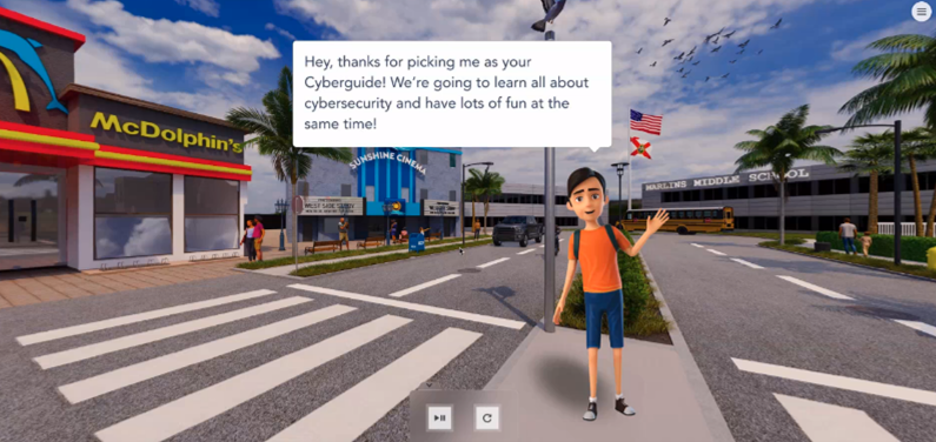
These range from textual papers and books to camps and immersive games. One example is Teaching Digital Natives, a Florida-based nonprofit founded in 2017 that provides coding camps and training to teachers and kids in the Miami area. (See screen shot below.) 19
This track emphasizes the importance of understanding the environment of online threats. It typically presents the forms of computer network attack and scenarios for how a computer user might unwittingly download malware or allow a threat actor into a network. In recent years, it has begun to add in awareness raising of broader information threats, along the lines of deliberate disinformation and manipulation campaigns. This has mirrored both the broadening threats discussed earlier and the broadening responsibilities of network defender organizations in both government and the private sector.
What is evident is that each of these valuable approaches have evolved over the last decades in each of their realms. But they also increasingly connect and cross in what they care about and teach towards. We have chosen the term “cyber citizenship” to capture this concept.20 It marks the intersection of the critical thinking within media literacy, the positive sense of ethics and responsibility in digital citizenship and civics, and the cybersecurity field’s awareness of deliberate online threats and tactics that are used to target us all.
This concept thus focuses on what is needed to allow people to responsibly and effectively use these new technologies, while also defending against societal challenges that arise from the combination of the viral spread of (mis-/dis-/mal-) information, everyday reliance on algorithmically supported social media platforms, and organized (and frequently well-resourced) attackers working to destabilize political institutions.
While the concept appears new, it actually builds on some of the earliest thinking on the challenges of our online world and online threats. In its 2010 report to Congress, the Online Safety & Technology Working Group (formed by the Protecting Children in the 21st Century Act) called for universal instruction in media literacy, digital citizenship, and “computer security” in K–12 schools.21 However, we recognize that the concept will likely continue to develop—ideally as a more inclusive community of practice forms to address the challenges described above.
Cyber Citizenship
Cyber Citizenship is at the intersection of media literacy, digital citizenship and civics, and cybersecurity awareness. It entails the knowledge, skills, and responsibility to participate meaningfully and safely in civil society in the 21st century, as well as to build resilience against online manipulation and threats.
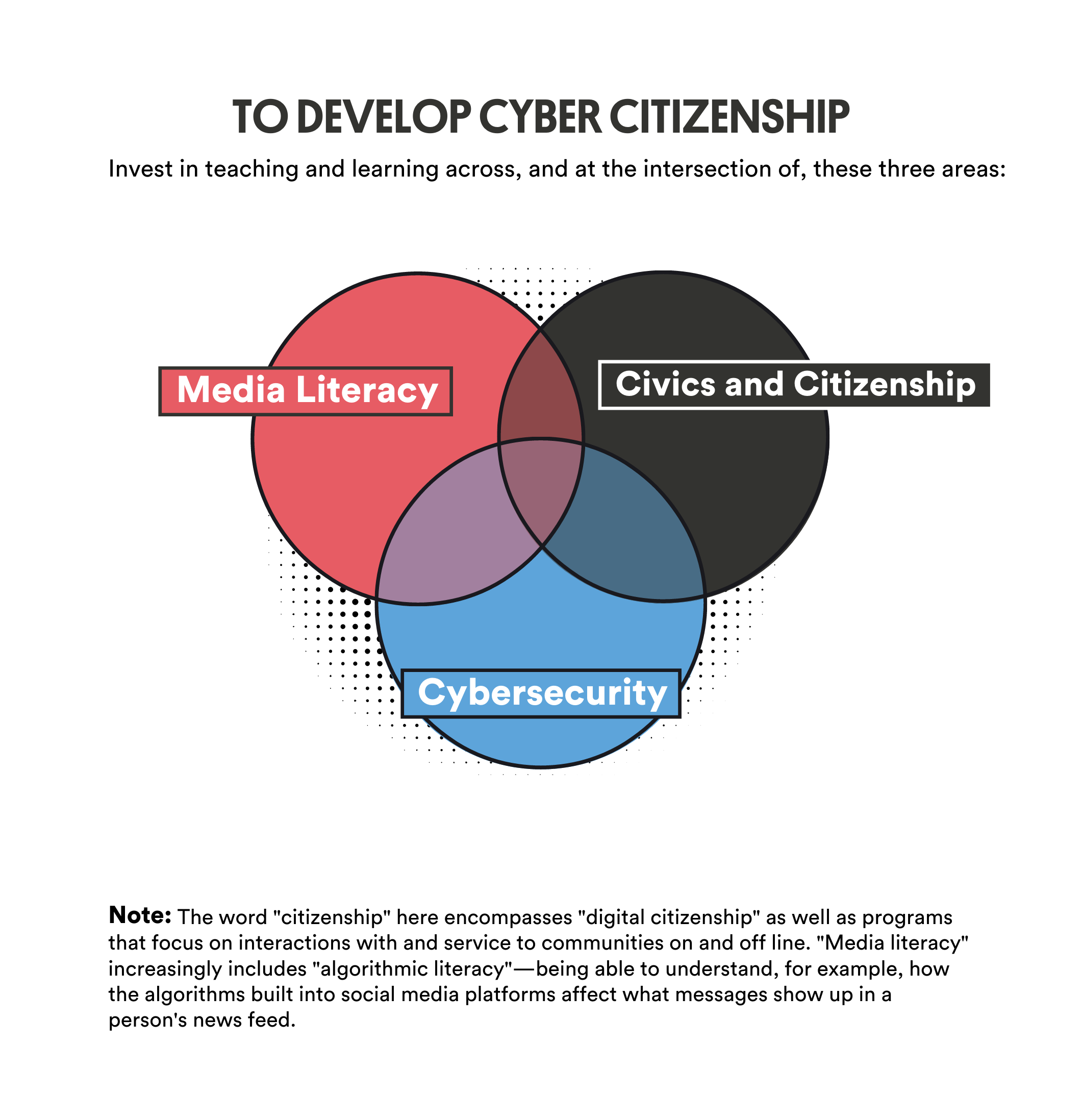
To provide an example of how these areas cross, take the issue of algorithms. Understanding how social media platforms use algorithms is a requirement of digital media literacy, but also connects to the problem of information threats because algorithms drive misinformation virally across networks. And the power of algorithms will only grow as technology advances. In realms that range from business and entertainment to politics and information warfare, the use of algorithms, artificial intelligence, and machine learning will increasingly predict and shape human interaction.22 These (often deliberately hidden) tools are a built-in feature of the digital platforms’ very design, used to collect and leverage data to guide attention and encourage behaviors as part of their profit model.
And yet, too few of those targeted by algorithms are even aware of how they work, while algorithms and algorithm bias shape everything from buying habits to criminal justice. This issue becomes significantly more complex as the developers of such algorithms themselves frequently do not fully understand how they operate—invisibly “moving fast and breaking things,” to borrow from the historical parlance of Silicon Valley.
Cyber citizenship also involves facing the cross-cutting challenge of epistemological imagination, or how people know what they know. It involves recognizing that people come at facts from different perspectives, not to mention working to understand who is behind a message, what their motivations are for writing that message, and what emotions may be stirred up by that message. For example, a 2019 Common Sense study asked K-12 teachers about their concerns related to these issues. The most common was that “students lack skills to critically evaluate online information.”23
This has become not just a bug, but a feature of our world, as it becomes increasingly shaped by online networks. And it is connected to many of the most pernicious trends in our society. As aptly described by the technology and social media researcher danah boyd, “the idea that there could be multiple histories, multiple truths blew my mind….But the hole that opens up, that invites people to look for new explanations….That hole can be filled in deeply problematic ways. When we ask students to challenge their sacred cows but don’t give them a new framework through which to make sense of the world, others are often there to do it for us.”24
Today’s initiatives must seek to provide students with the capacity to understand these new dynamics as well. Students have to be able to comprehend not only the many new ways in which information might be produced and distributed, but also the many new ways in which various groups might be led to believe it to be legitimate or not.
Citations
- For further reading on the history of the public education system of the U.S., see A Relevant History of Public Education in the United States by Grace Chen, education researcher for Public School Review, February 2021,source
- For further reading on Thomas Jefferson’s bill on education, see A Bill for the More General Diffusion of Knowledge by Thomas Jefferson Encyclopedia, source
- To read the full primary document, see An Act to Amend the Act Concerning Slaves, Free Negroes and Mulattoes passed by the General Assembly on April 7, 1831, source
- Jacob Soll, “The Long and Brutal History of Fake News,” Politico Magazine, December 18, 2016,source
- Singer and Brooking, LikeWar, 29.
- As described by Jennifer LaGarde and Darren Hudgins in Fact vs. Fiction: Teaching Critical Thinking Skills in the Age of Fake News (ISTE, 2018), 1–160.
- As quoted in LikeWar, 32.
- See Henry Jenkins, et al., in “Confronting the Challenges of Participatory Culture: Media Education for the 21st Century,” (MacArthur Foundation, 2006), source
- Donald J. Leu, Lisa Zawilinski, Elena Forzani, and Nicole Timbrell, “Best Practices in Teaching the New Literacies of Online Research and Comprehension,” in Best practices in literacy instruction, ed. Lesly Mandel Morrow and Linda B. Gambrell (New York, NY: Guilford Press, 2015), 343-364.source
- See, for example, the social and emotional learning skills outlined by the Collaborative for Academic, Social, and Emotional Learning at source; For more on this concept, also see Anne Collier, “So where are we with digital citizenship now?” Net Family News, November 2, 2018, source
- For more about NAMLE and its definition of media literacy and media literacy education, see source
- Sandra C. Cortesi, Andres Lombana, Alex Hasse and Sonia Kim, “Youth and Digital Citizenship+ (Plus): Understanding Skills for a Digital World,” ResearchGate (January 2020),source
- Mike E. Ribble, et al., “Digital Citizenship: Addressing Appropriate Technology Behavior,” International Society for Technology in Education (September 2004): 7.
- For further reading, see “Citizenship Digital and Otherwise: The Responsibility Lies with Our Students and Ourselves” written by Thomas Douglas of International Society for Technology in Education, December 28, 2018.
- Vanessa Vega and Michael B. Robb, The Common Sense Census: Inside the 21st-Century Classroom (San Francisco, CA: Common Sense Media, 2019), source
- As quoted by ISTE in Digital Citizenship in Education: Bring Digital Citizenship to the Classroom in Meaningful Ways (ISTE, 2021), source
- A. D. Falkoff, "The IBM Family of APL Systems," in IBM Systems Journal 30, no. 4, 416–432,source
- For further reading on the proclaimed “historical material,” see The Comprehensive National Cybersecurity Initiative published by The White House under former president Barack Obama, source
- More on Teaching Digital Natives is available at source
- The Merriam-Webster Dictionary places the origin of the word cybercitizenship (there written as one word, not two) in 1994. See source; Some of early uses of the term appear in the late ‘90s and early 2000s. See for example: Michael J. Berson and Ilene R. Berson, “Developing Thoughtful ‘Cybercitizens,’” Social Studies and the Young Learner 16, no. 4 (March–April 2004): 5–8, source
- Hemanshu Nigam and Anne Collier, “Youth Safety on a Living Internet,” Report of the Online Safety and Technology Working Group, June 4, 2010, pages 31 and 32, source
- See Shoshana Zuboff, The Age of Surveillance Capitalism: The Fight for a Human Future at the New Frontier of Power (New York: PublicAffairs, 2019).
- Vega and Robb, The Common Sense Census, 2, source
- danah boyd, “You Think You Want Media Literacy… Do You?,” Data & Society: Points, March 9th, 2018.