Table of Contents
- Executive Summary
- Introduction: What Drives the Need for New Skills?
- What Do We Mean By Cyber Citizenship And What Skills Contribute To It?
- What Does Research Say About Building These Skills?
- What are the Challenges to Implementation in the U.S. Education System?
- New Instructional Materials Developed for Educators, But Also A New Problem
- A First Step: The Cyber Citizenship Portal
- Recommendations
- Conclusion: What Would Success Look Like?
- Appendix: Diagram of Emerging Network
New Instructional Materials Developed for Educators, But Also A New Problem
Digital tools have increasingly become a requirement for engaging students in classroom instruction as well as the expectation for teachers to embed them in curricula. A range of new cyber citizenship tools of all kinds are cropping up—either whole curricula or smaller units—as well as games and videos to embed in classroom lessons.
According to a New America analysis of survey data from RAND, the shift toward digital tools for instruction began even before the pandemic. YouTube, Kahoot!, BrainPOP, Quizlet and other platforms had gained popularity with teachers before the shift to online learning.1 For instance, when English language arts teachers were asked to select from a Likert scale how frequently they used YouTube and BrainPop for instruction, there was an increase by 20 percent of teachers reporting regular usage in 2019 compared to the prior year.
The data are not yet available, but digital educational tool use can be assumed to have drastically surged during the pandemic and the massive shift to remote schooling.2 And, like so much else, the long-term effect of greater use and comfort with digital teaching tools will be felt after full return to the physical classroom. It is likely, for example, that teachers will increasingly reach for digital instructional materials and use them to supplement and enhance their lessons, no longer relying solely on textbooks or workbooks mandated by districts. A 2020 RAND survey found that most teachers used digital materials as supplemental resources, adopting resources like YouTube, Khan Academy, and ReadWorks that provided specific content.3
This shift to digital materials is another reason why new and timely digital tools that are specific to particular content areas tend to hold much stake—especially those instructional materials and training that focus on these combined need areas of cyber citizenship.
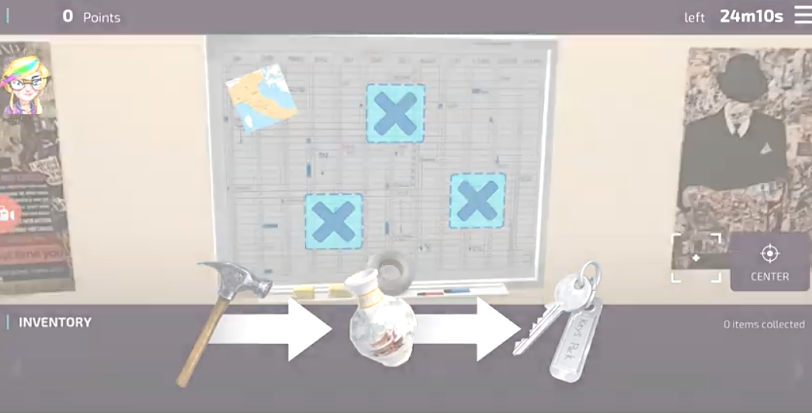
A quick tour of content-specific materials that have emerged in the past few years is impressive, especially given how new the field is. Earlier, we mentioned Harmony Square, a new game that puts students in the role of disinformation spreaders. Another entrant is Escape Fake, a free app-based game for teens and developed in Austria; it puts players in an augmented reality escape room where they have to collect evidence to show what is real and what has been fabricated (see screen shot below).4
More extensive curricular materials and information exchanges are emerging too. For example, as of mid-2021, Common Sense Education’s curriculum on digital citizenship has been implemented in 2,561 schools and 72 school districts.5 The DigCit Commit coalition, organized by ISTE, has similarly engaged 15 national organizations with connections to educators, to host summits, workshops, develop social media campaigns, and provide updated lists of resources.6 In turn, the National Media Literacy Alliance formed by NAMLE is working to bring together organizations such as the National Council on Social Studies and the American Association of School Librarians to share resources across disciplines.7 And the Media Education Lab, founded by Renee Hobbs at the University of Rhode Island, provides an annual summer institute for K–12 teachers around the country to build and share their own tools and strategies in digital literacy.8 These various examples show the emerging network, and demonstrate the exciting possibilities that come from bringing groups together into a larger community of practice around such programs.
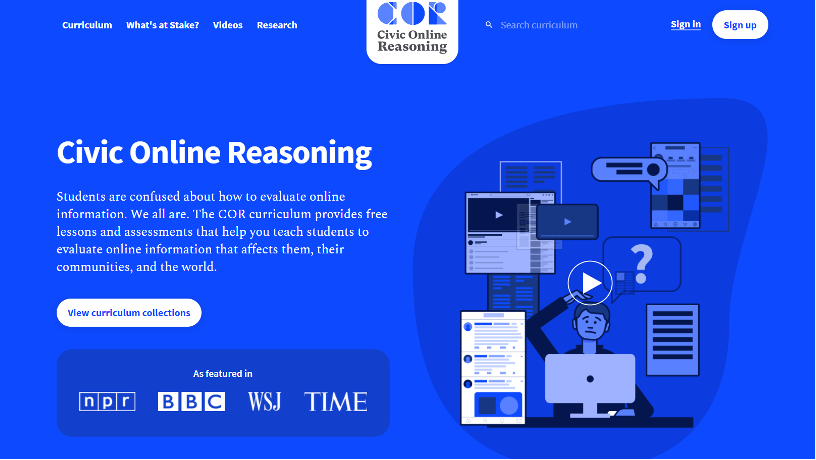
Other organizations such as Civic Online Reasoning (COR) and the News Literacy Project have become go-to platforms for educators to access resources that teach the skills needed to combat misinformation and disinformation. In fact, examining these two platforms shows the growth in tools and resources becoming available in this space.
Founded in 2015 by the Stanford History Education Group, COR is an initiative and free online resource that allows educators to access lesson plans and assessments. The focus of COR is to teach students how to analyze online content through skills such as lateral reading. There are over 16 videos focused on skill development and multiple crash courses. Additionally, over 25 lessons and 22 assessments, on topics ranging from evaluating sponsored content to verifying claims on social media, are provided in its curriculum index. The materials are based on research conducted by Stanford scholars and educators can view numerous articles on the COR website to connect research with practice on every lesson they teach.
The News Literacy Project, a nonpartisan national nonprofit, is another place for educators seeking to teach students how to evaluate online information. Initiatives such as News Lit Nation are focused on building community among educators. The organization offers its online Checkology curriculum platform that teaches news literacy skills to students. Accessibility to the Checkology platform is similar to COR, with videos available to freely view and use. Resources available through the site explore a gamut of topics, from understanding algorithms, global press freedoms, and conspiratorial thinking. Teachers can see standards alignment across states and search by difficulty level. Recently, the News Literacy Project has partnered with the creators of the Trust Me documentary, to provide a curriculum that accompanies the film for use in schools and community spaces.
However, while there are a growing number of content-specific resources and platforms available digitally, there is variance in the field. Some are free and some require payment. This, of course, shapes which tools that school systems and individual teachers can access and use, as there are varied budgets. Even more, not all of the tools are vetted by scholars or field experts. And of those that are evaluated, many are evaluated through less than rigorous research means, with a particular issue being internal versus external evaluation.9 This means that the quality and effectiveness of tools can vary. It is thus challenging even for experts to tell which tools are effective for student learning, and which are just well packaged.
This relates to a second problem. Rather than being gathered in one place, these resources are spread out across the growing universe of nonprofit and for-profit organizations that either make or seek to deliver them to educators. This creates an irony: for a space that is all about networks and virality, online materials to teach about it are not easy to find and compare.
This has been found in both quantitative and qualitative research. A 2019 NAMLE survey of more than 300 media literacy educators uncovered that they were using more than 500 different educational resources. “There is a lack,” the report states, “of a central, online repository of comprehensive, quality curriculum materials and lesson plans available for free to teachers and other professional educators.”10
Similarly, when our research team gathered a series of educator focus groups in 2020-21, a topic of discussion was the challenges of locating quality online resources. When asked how they tried to locate effective resources for classroom instruction, one teacher responded, “I do a lot of Googling.”
Educators need a place where they can easily search, filter, sort, and find vetted quality materials that match the needs of their classrooms. They need a place to search for supplementary materials, such as videos or games, to be embedded in a short lesson, and for comprehensive curricular materials designed to be taught over a month, semester, or a year. They also need a place to learn from each other’s experiences and insights and hear from researchers.
A recent study of educators in Washington State reinforces this need and points to one key answer. It pulled insights from teacher-librarians, principals, and technology directors at 1,111 Washington state schools, “to understand how they are currently integrating digital citizenship and media literacy education in their curriculum.”11 The responses showed that educators would benefit from something like a portal—“a web-based location to recommend successful practices and resources and work with the K–12 community and other stakeholders to identify and develop additional Open Educational Resources to support digital citizenship, media literacy and Internet safety in schools.”
Citations
- Sabia Prescott and Jasmyn Gilmore, “Digital Resources and Pandemic Pedagogy: Part 1,” a blog post published on New America’s EdCentral blog on March 10, 2021 as part of a series unpacking the RAND data. source
- As noted in Prescott and Gilmore’s analysis in their March 10, 2021 blog post, “while the spring 2020 data [from RAND] was collected based upon material use before the pandemic, these persistent challenges expressed in the fall 2020 COVID-19 data may suggest an even greater reliance on digital materials and resources over the course of the 2020–2021 school year.”
- For all the reports emerging from RAND’s American Instructional Resources Survey (AIRS) project, see source
- See source
- These are schools and districts that have pledged deep implementation of the curriculum as part of becoming Common Sense Schools and Common Sense Districts. Other schools and districts may be also using the curriculum in a comprehensive way, but are not officially part of the Common Sense program. This information comes from email correspondence with Kelly Mendoza, senior director of education programs at Common Sense Media, in May 2021.
- To further explore DigCitCommit, visit source
- For more on the National Media Literacy Alliance, see source
- To further explore Media Education Lab, visit source
- One exception may be the Be Internet Awesome materials developed and disseminated by Google, which were under review by an independent evaluator at the time of this report’s printing and not yet published in a peer-reviewed journal.
- Snapshot 2019: The State of Media Literacy Education in the U.S. (New York: National Association for Media Literacy Education, 2019) 9, source
- For more information, visit the Digital Citizenship and Media Literacy pages of the Office of the Superintendent of Public Instruction for the state of Washington, at source