

Meegan Dugan Adell
Director, New America Chicago
The Child Tax Credit can be a lifeline for hard-working families, but filing even simple taxes can be unnecessarily confusing and fear of making errors is common. A free, direct e-file tool, similar to those tested during the pandemic, could greatly simplify the process for millions of low- and middle-income taxpayers. However, any solution must work for the people who need tax credits the most: parents and guardians earning low wages, but doing essential work. Based on work over the last three years in Illinois, including interviews with low- and middle-income Illinois residents and nonprofits helping thousands of people access tax credits each year, this series of personas illustrates often overlooked user needs and behaviors. These personas can help inform better-designed state or federal tax filing tools that work for everyone.
Editorial disclosure: This report is produced by the team at New America Chicago. New America’s work covers a wide range of policy perspectives and this publication reflects the views of the authors. Further, New America is guided by the principles of full transparency, independence, and accessibility across its activities and publications.
While the Child Tax Credit and other income-based credits such as the Earned Income Tax Credit can be a lifeline for struggling families, the process for claiming them can have arbitrary obstacles. Although most low-income filers have deduction-free tax returns that should take minutes, tax language and processes can be unnecessarily confusing.1 As a result, low-income families often fear making expensive errors and as a result avoid claiming credits they are eligible for.
Most people we interviewed,2 regardless of income, do not understand which tax credits they can get or how much they should receive, yet they must determine the amount they should claim on their own. Some low-income families simply don’t claim their state tax credits because some free tax filing programs charge a fee to file state taxes. Despite hiring a professional tax preparer and paying hundreds of dollars, several people we interviewed found out later the preparer made an error. Others made an error themselves using a tax preparation software that cost them money they didn’t have. In addition, people with annual incomes under $25,000 are five times as likely to be audited as other Americans.3 So it’s not surprising that fear of making minor errors and owing hundreds or thousands of dollars or getting in trouble with the government is common.
Fortunately, there are a number of steps the Internal Revenue Service (IRS) and state revenue agencies can take to remove the pain points from the process. Potential plans to create a free, direct e-file solution within the IRS have the potential to take much of the burden off of taxpayers, if done well. Creating an e-file solution that also has an option for state filing could be hugely beneficial to low-income taxpayers.
But to truly work for the people who need tax credits the most, any new solution has to also work for the working poor—people working in grocery stores, daycares, and delivery services, including those without computers or struggling to find housing. Any solution must be designed for the many different circumstances low- and middle-income people face when trying to claim their Child Tax Credit and Earned Income Tax Credit. Recent advances such as the IRS non-filer tool and GetCTC.org have come closer to meeting needs, but need additional refinements to work for more workers doing essential, but low-wage work.
The following personas are combined with elements of user archetypes and are based on actual interviews and many research sources. While these do not represent all potential users, they do represent important users whose needs are often overlooked. These can be used to ensure that any simplified filing solution is designed in a way to meet the needs of many people who need the Child Tax Credit and Earned Income Tax Credit, not just one common, average user.
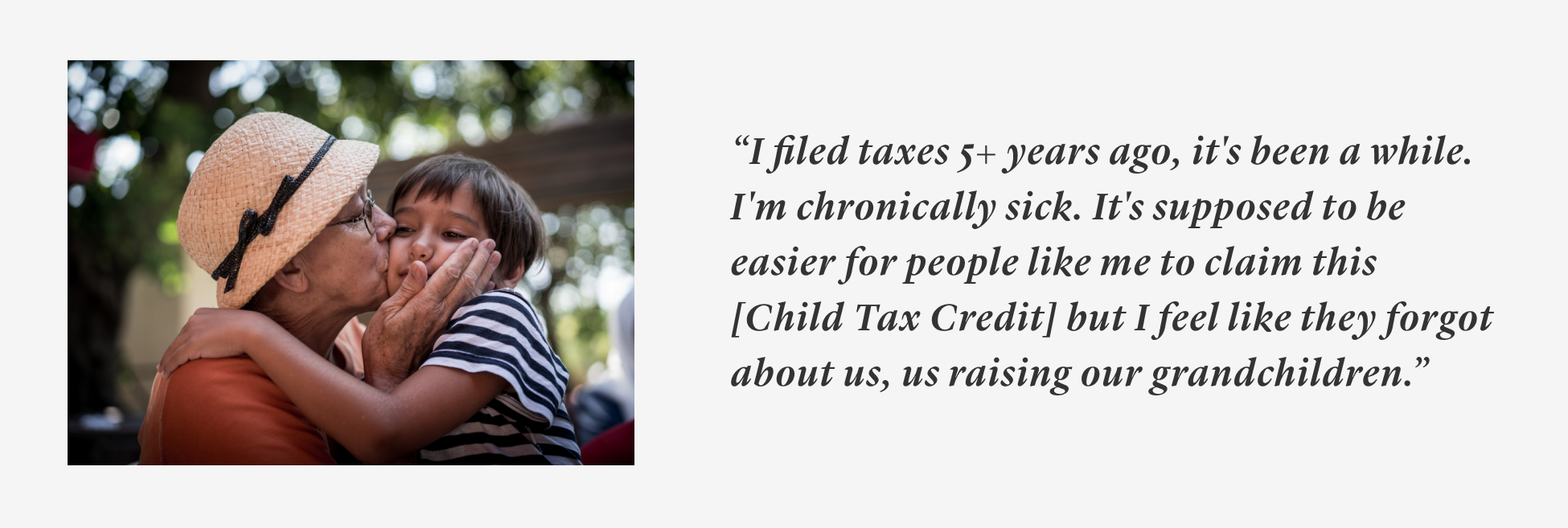
Sylvia used to work full time at a business in her town until she started having debilitating health problems. She’s now working just 10 hours a week and taking a class at the local community college. She has always been the primary caregiver for her grandchild, whose mother lives in another state. This has created confusion around who should claim the child. She did her taxes for years, but they are more complicated now and her disability makes it difficult for her to go in-person to a Volunteer Income Tax Assistance (VITA) site.
She wishes IRS instructions were more catered towards non-parental guardians. She needs more direct one-on-one phone assistance. A simpler process and someone to answer her questions and help her when she runs into dead-ends would be incredibly useful. Options for people with disabilities are high on her list.
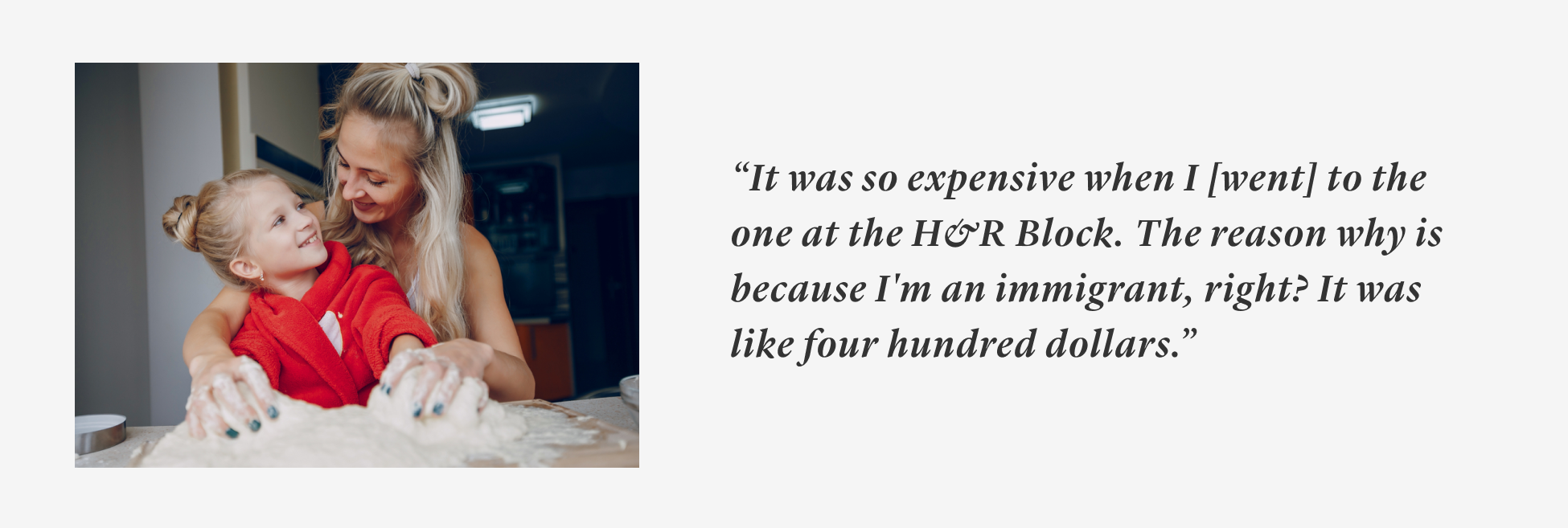
Waldina has been living in the U.S. for 10 years now and has limited English proficiency. She and her husband live with their five children in the suburbs. Her husband was born in the U.S. She’s been using an Individual Tax Identification Number (ITIN) the last few years but she usually makes less than $15,000 a year. She is new to the tax system and English is her second language. Because of her complex situation, she and her husband sometimes worry about making errors and getting into trouble when filing taxes.
Waldina is willing to do what she needs to figure out her taxes, but English is her adopted language. She needs materials that are in her first language and easy to understand. It’s not easy to figure out which tax credits she and her U.S.-born children are eligible for, so she needs a simpler process that makes it clear. She’s often worried she made an error, so having someone review her returns would be helpful. A guarantee to help her work out any discrepancies between her records and the IRS would ease her mind.
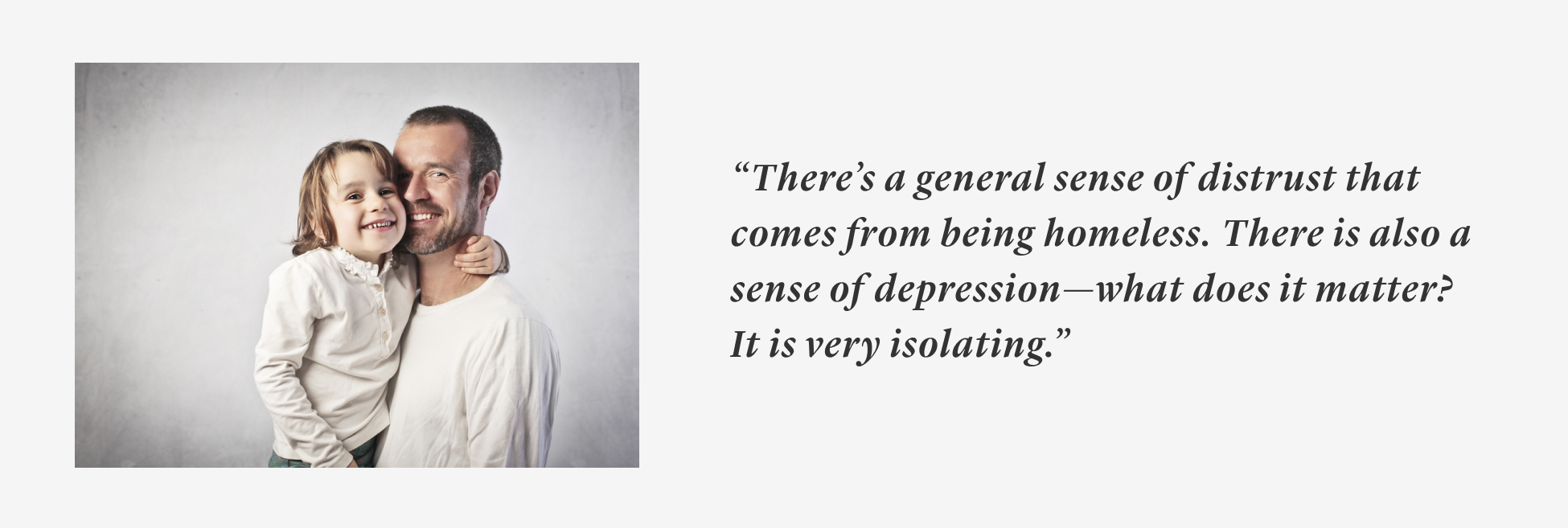
Tim has faced many challenges in his life but has found ways to carry on. He experienced homelessness for a period of time and is still staying with a family friend. He works at a retail store 18 to 33 hours a week. He is separated from his partner, but his son stays with him the majority of the time. He is distrustful of the government and is hesitant to interact with institutions because of their lack of support while he was homeless. He isn’t sure if he is allowed to file taxes or whether he is eligible for the CTC and EITC since his income is below the filing threshold.
Tim is distrustful of government and isn’t sure about claiming his CTC given his custody arrangement and confusion about eligibility. Simplified or automatic tax filing that shows him exactly how much he is eligible for would help financially and make it clear whether it is worth his time to file or not. This needs to include ways to prove his identity without a long-term address and a clear pathway for those missing some identifying paperwork.
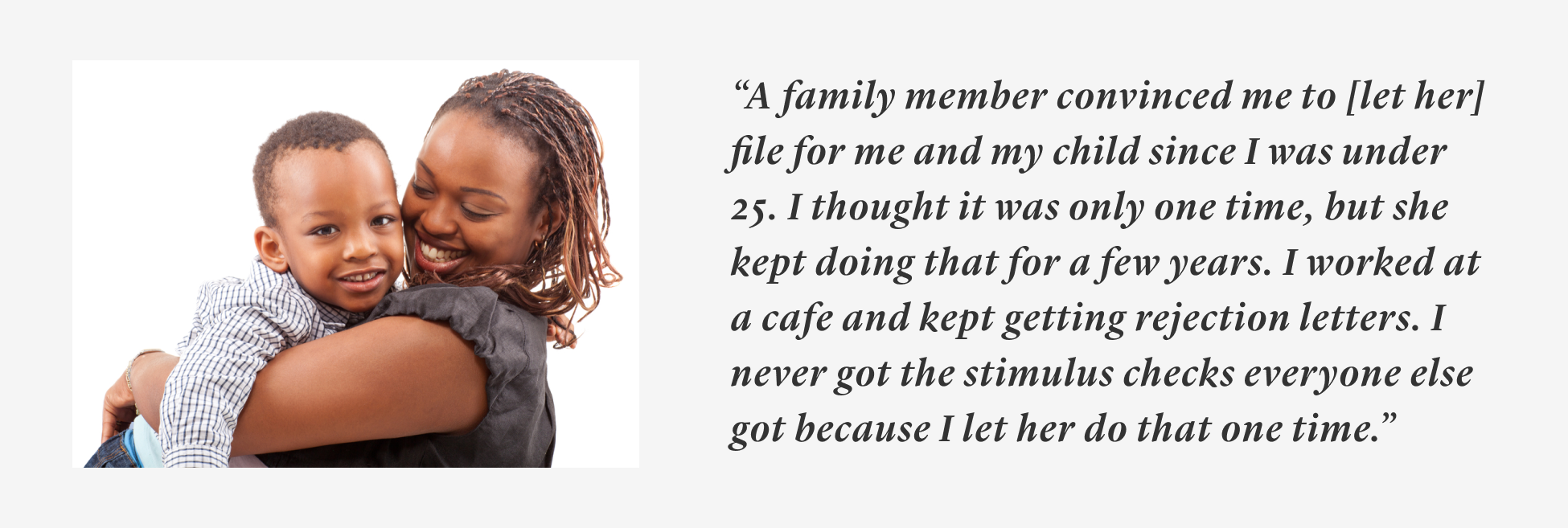
After her mother died, aspiring social worker Valerie lived with several family members. One family member talked her into letting them claim her and her toddler on their taxes as dependents and still does so even though Valerie doesn’t live with them. A bad experience with a national tax preparation company left her afraid to file. Despite earning low wages at her first W-2 job, the tax preparer made errors, so she received a huge tax bill. She finds IRS language extremely confusing and hard to understand. When the CTC was temporarily increased, she first doubted it. After confirming, she tried to prove that her relative is claiming her fraudulently. As a busy mom of a toddler, she gave up when she saw the pile of paperwork required to prove her daughter is her sole responsibility.
Valerie needs someone to sit down with her and walk her through each step to fix her complicated situation. Once that is resolved, a simpler process with clear instructions would help her file and receive her credits each year. An app that saves her income documents and past tax information would be very helpful.
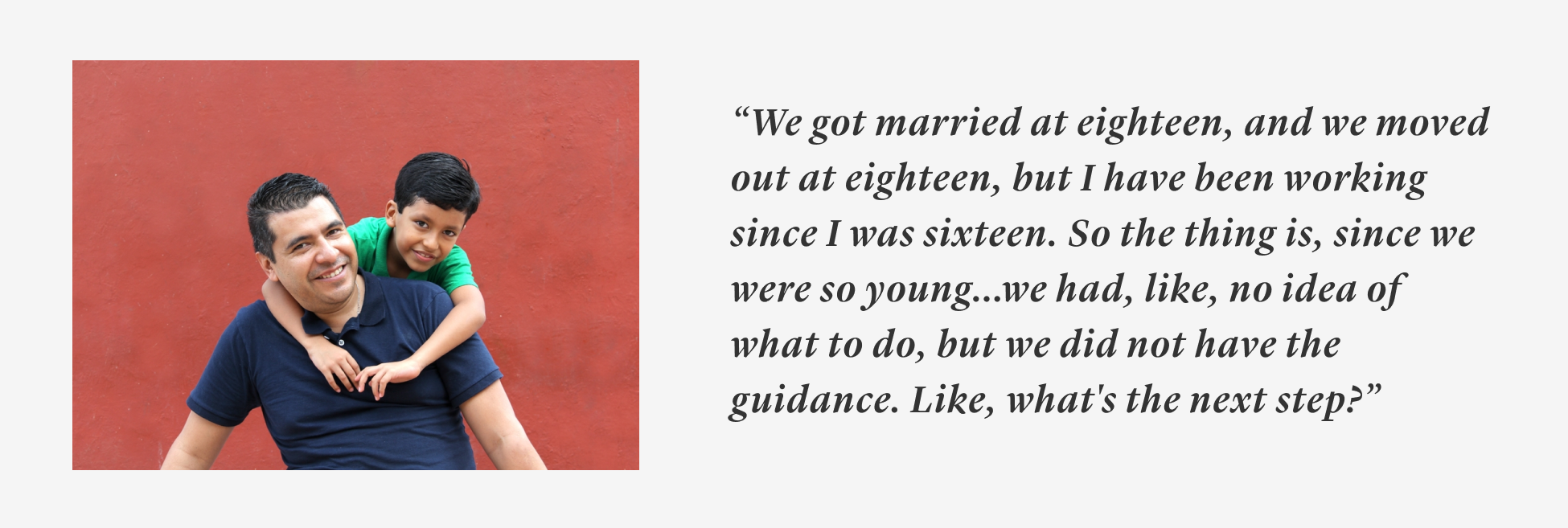
Tomas lives in the city with his family and works in manufacturing. During the pandemic, his wife left her teaching job and now stays home with their kids and runs a tiny home business. They both get 1099s from several out-of-state employers for a few hours of part-time work. Both he and his wife were skeptical that the government would give out CTC payments. When they got a smaller refund check, they felt like they had been required to pay the monthly CTC back. He felt confident doing his own taxes until they started doing side work. He thinks he can figure out how to claim the right business expenses and their credits, but he is nervous about doing it right. He hopes to get an accountant when the business grows.
Filing taxes has gotten more complicated despite the fact that Tomas and his wife are only earning small amounts of money from side businesses. Having a simpler process that makes it easier for people with self-employment income and having someone to review his taxes to make sure they are correct would be helpful. A “live chat” function in an online app is appealing to him. A guarantee to help resolve any issues that arise would ease his mind.
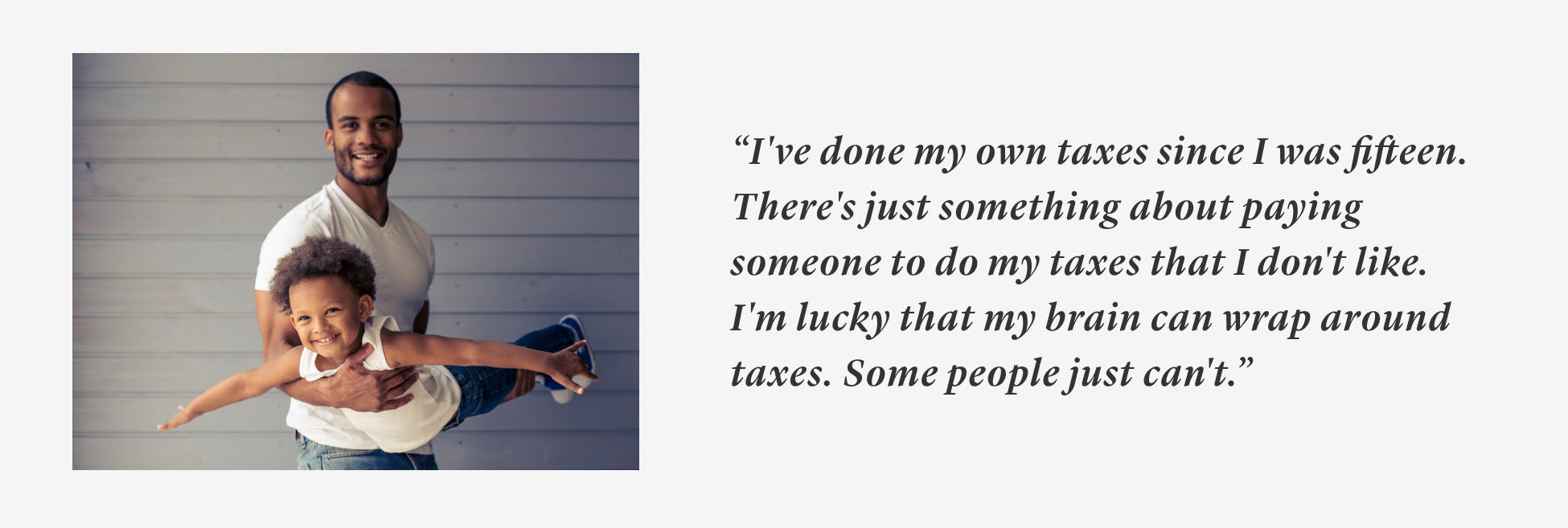
A manager at a big box store, Matthew lives with his wife and three children in the suburbs. He feels very confident in his ability to do his own taxes and currently doesn’t see the need for a paid accountant. His father was an accountant and he’s done his own taxes since an early age. He’s never had any major problems with his taxes and usually receives a decent-sized refund. Although Matthew is confident in his own abilities, he thought he could use GetCTC.org when he technically shouldn’t have.
An online tool that walks him through the process and a “live chat” function for questions are useful for him. Seeing how much he’ll get back as he fills out the form is helpful. Despite his confidence, some doubts about his ability still linger. Eventually, he’d like to get a paid accountant to make sure he is doing everything correctly.
The following include recommendations federal and state taxing authorities can use to ensure direct e-filing is widely accessible to the public. In particular, these recommendations identify solutions to barriers low- and middle-income families and individuals faced when attempting to claim their Child Tax Credit, stimulus checks (Economic Impact Payments or Recovery Rebate Credits), and Earned Income Tax Credits over the last few years.

In 2021 and 2022, the New America Chicago team worked with partners at Heartland Alliance to listen to low- and middle-income tax filers, people who earn poverty wages and don’t need to file, as well as Volunteer Income Tax Assistance (VITA) programs and social service agencies helping people claim their Child Tax Credits and stimulus checks, sometimes for the first time.
The New America Chicago team interviewed 20 participants from around the state of Illinois about their experiences claiming the enhanced Child Tax Credit during the pandemic, as well as asking them to review past experiences with the IRS non-filer tool or GetCTC.org. Those that had not used those tools were asked to review GetCTC.org and give their responses to different aspects of the tool. The majority of our interviewees completed user experience exercises on GetCTC.org. We also asked four participants to complete a four-part user experience exercise, where they searched for options for filing taxes free and reviewed GetCTC.org and shared their understanding of each page and their reactions. Our team also received de-identified quotes from 11 additional interviews from other research projects. In addition, we compiled data from meetings and surveys with 15 nonprofits and three local governments who provided information about filing for the Child Tax Credit and stimulus checks to low- and middle-income communities across the state during the COVID-19 pandemic in 2020 and 2021. Finally, the New America Chicago team reviewed quotes from 11 experts around the country who help low-income individuals and families complete their taxes.
For the purposes of our research, the New America Chicago team attempted to focus on people who are normally not required to file taxes and as a result may miss out on tax credits owed to them, as well as parents of young children, to learn more about their specific barriers. Among our interviewees and bloggers, just over half (56.5 percent or n=13) earned too little money to be required to file, approximately less than $25,000 per year for a married couple filing jointly and half that for a single filer. Over half (52.2 percent or n=12) were raising a child or family member age three or younger. Interviewees came from urban, suburban, and rural areas with 60.9 percent from the city of Chicago, 21.7 percent from suburban areas, and 17.4 percent from central or southern rural Illinois. For this project, we were also particularly interested in learning how accessible tax credits are to Black and Latino communities, so we attempted to oversample those taxpayers. Just over half (56.5 percent or n=13) were African-American or Black, just over a quarter (26 percent or n=6) were Latino, and 17 percent were White (n=4). One was multiracial. The personas also include information from nonprofits serving a wide variety of races including some serving primarily White or Latino populations. Our results also include information from de-identified quotes from eight people who normally earn too little to be required to file taxes (also known as non-filers) interviewed by Heartland Alliance, where relevant.
This research is based on three years of work in Illinois to ensure hard-working, low-wage Illinoisans received the stimulus checks and tax credits they so desparately needed. As such, it wouldn't be possible without the hard work of the Get My Payment Illinois Coalition and the nonprofits and local governments working to help the people hit hardest by the pandemic. Thank you to Christine Cheng, Jody Blaylock Chong, Tracy Frizzell, Barbara Martinez, Katherine Socha, and Andrés Serrano for all you did to make the Get My Payment Illinois project a success and to help us translate what we learned from the people we served into policy lessons. Special thanks to Irais Flores, Danielle Chynoweth, and Ryan Spangler for your hard work on behalf of struggling families and for sharing those lessons with us. Thank you to Suniya Farooqui, Dora Elias McAllister, and Bhargavi Thakur for being patient and helpful research partners. Special thanks to Dylan Bellisle and Brad Fruhauff for their support in editing this paper. Thanks, as always, to our generous supporter The Chicago Community Trust for all they have done over the years. Thanks also to the Irving Harris Foundation for making this project possible. The views expressed in this report are those of its authors and do not necessarily represent the views of the funders, their officers, or their employees.
Director, New America Chicago

Senior Program Associate, New America Chicago