
State Policy: Queer Inclusion and OER
Although openly licensed, queer-inclusive professional learning materials might not yet exist, people around the country are working toward both better supporting LGBTQ students and creating more open pedagogy. As more states move toward inclusive curricula, the need for educator support is growing rapidly. Inclusive curriculum laws and policies should be thought of as a bellwether for the need for inclusive professional learning.
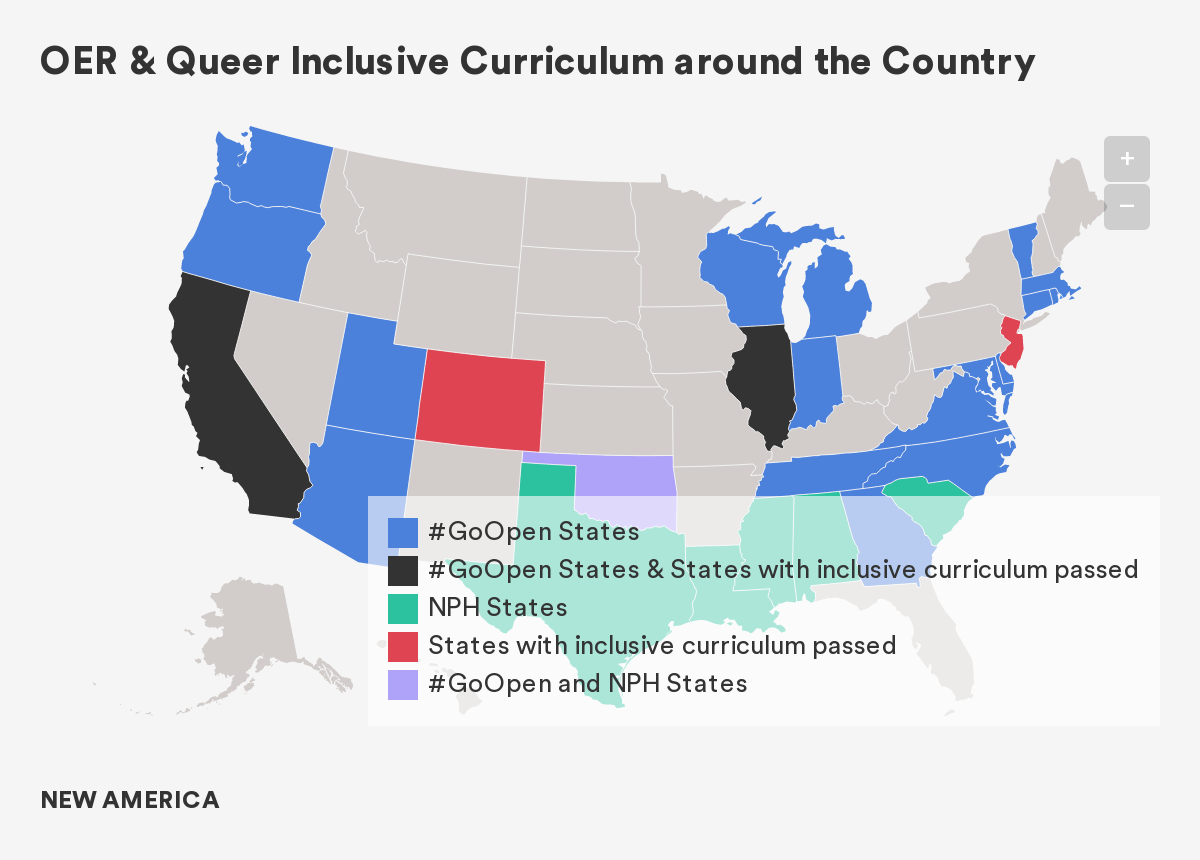
Four states—California, New Jersey, Colorado, and Illinois—have mandates requiring LGBTQ inclusion in PreK–12 curricula. The state legislature in New York has made recent movement in the same direction.
On the opposite end of the spectrum, six states—Texas, Oklahoma, Louisiana, Mississippi, North Carolina, and South Carolina—maintain education laws forbidding teachers from portraying LGBTQ people or identities in a positive light, if at all.1 These laws, known as “no promo homo” (NPH) laws, are in stark contrast with the five states working toward statutorily-mandated inclusion. Teachers in states with NPH laws may still work toward engaging and supporting their queer and trans students, but it neccessarily looks different than in states that support this work.
At the same time, there are 20 #GoOpen states and dozens of districts committed to open pedagogy and professional learning.2 Of these states, two—California and Illinois—have also passed inclusive curriculum laws, paving the way for queer-inclusive OER. As the first state to pass an inclusive curriculum and a #GoOpen state to boot, California has an immense opportunity to create openly licensed inclusive learning materials that could then be used by folks around the country. But even with the stars aligned, state education leaders have yet to leverage OER in their efforts. Instead, California is in the costly and arduous process of updating textbooks—a fair indicator that updated teacher professional learning will also come in the form of proprietary materials, if at all.
Of the 20 #GoOpen states, Oklahoma is the only remaining state with NPH laws. This means that state education leaders maintain harmful, anti-LGBTQ laws on the books while actively working to increase access to high-quality instructional materials for students. This contradiction implies that (1) “quality” is not synonymous with “inclusive” when it comes to instructional materials, and (2) OER in this state is an effort for only some students, not for all. In Oklahoma, which is ranked very low on the LGBTQ equality index,3 OER is a way to increase the number of students with access to possibly biased and certainly incomplete curricular content, rather than a way to diversify the types of content students can access.4 When writing their own story, Oklahoma officials are choosing to perpetuate the exclusionary practices reported by GLSEN’s survey respondents.
The map below shows #GoOpen states, as well as those with NPH laws and those which have passed inclusive curriculum laws.
In the handful of states—and many more districts—pushing for inclusive curriculum, parallel professional learning is likely to follow. Without it, the paradigm will not shift; resources will be available, but with little awareness and little knowledge of how to implement them. Particularly for educators who have not before engaged in conversations around gender and sexuality, have not taught the history of the fight for queer liberation, or simply are not aware of the implications of pronoun use, jumping into this content will be difficult without the support of adequate time, space, and resources.
What is more, they will be unlikely to do it unless inclusion is state-mandated and materials are openly licensed. Even if states with inclusive curricula create parallel teacher professional learning materials, teachers in other states will not have access. This means each state will have to both require teachers to teach this content, and create or purchase its own professional learning materials. This is a prime opportunity for OER, not only so states do not have to reinvent the wheel each time a new mandate is passed, but also so teachers in states without mandates can access guidance and support. As more and more states take on queer inclusion, and as the PreK–12 OER movement spreads, there is a clear and growing opportunity to use every available tool.
Citations
- GLSEN (website), “‘No Promo Homo’ Laws,” source
- U.S. Department of Education, Office of Educational Technology (website), “#GoOpen States,” source
- Mapping LGBT Equality in America (Denver, CO: Movement Advancement Project, May 28, 2015).
- Sabia Prescott, “Leveraging Open Educational Resources for Queer Students,” Education Policy (blog), New America, June 24, 2019, source