Supporting LGBTQ-Inclusive Teaching
Abstract
This report is aimed at opening up a new line of dialogue about today’s teacher experiences so that efforts to make lessons inclusive of LGBTQ students are embraced instead of squashed. The first report of its kind to examine the possibilities inherent in LGBTQ-inclusive materials for training classroom teachers, it explores the biggest challenges to creating, implementing, and scaling up this kind of PreK–12 teacher professional learning. It is also the first to consider the opportunities in harnessing digital materials, particularly open educational resources, as tools for helping to overcome those challenges and enabling queer inclusion. Situated within the broader context of culturally responsive teaching, this report aims to help set a research and practice agenda for education leaders that envisions ways to combine lessons learned from both the LGBTQ advocacy and open education fields.
Acknowledgments
Special thanks to Mo Nyamweya and Zac Chase for reviewing drafts of this paper. I also appreciate New America colleagues Sabrina Detlef, Lisa Guernsey, Kristina Ishmael, and Elena Silva for their editorial support, as well as Riker Pasterkiewicz, Julie Brosnan, Maria Elkin, and Naomi Morduch Toubman for their graphics and communications support. This report would not have been possible without the William and Flora Hewlett Foundation, which is a generous supporter of the work of New America's Teaching, Learning, and Tech team. The views expressed here are those of the author and do not necessarily reflect the views of the foundation.
Downloads
Introduction
Anna is a seventh grade teacher in a small town outside Fort Worth, Texas and the mother of a transgender kid. Between teaching in a deeply conservative district and supporting her own family, Anna has seen firsthand the effects that hostile school environments can have on student well-being. Wanting to better support LGBTQ students in her own classroom, Anna took to the internet for guidance. Her search led her to free resources from the Gay, Lesbian, and Straight Education Network (GLSEN), a nonprofit organization supporting LGBTQ students and educators. She found free lesson plans centered around young adult novels with queer protagonists—exactly what she was looking for.
Excited and wanting to share them with others, but also nervous about how they would be received, she ultimately decided to bring the resources to a teachers’ meeting the following week. The conversation was quickly shut down, but not for the reasons she’d anticipated. The other teachers told Anna that while they think supporting all students is important, the principal would never go for it, and neither would parents. And even if they did, the teachers themselves would not know how to begin talking about queer characters or identities. Even with the resources available, Anna’s efforts were dead in the water.
This report is aimed at opening up a new line of dialogue about today’s teacher experiences so that efforts like Anna’s* are embraced instead of squashed. The first report of its kind to examine the possibilities inherent in LGBTQ-inclusive materials for training classroom teachers, it explores the biggest challenges to creating, implementing, and scaling up this kind of PreK–12 teacher professional learning. It is also the first to consider the opportunities in harnessing digital materials, particularly open educational resources (OER),1 as tools for helping to overcome those challenges and enabling queer inclusion.2 Situated within the broader context of culturally responsive teaching (CRT), this report aims to help set a research and practice agenda for education leaders that envisions ways to combine lessons learned from both the LGBTQ advocacy and open education fields.
This work is, in part, the result of a cross-sectoral working group that came together to pool resources, knowledge, and insights around LGBTQ advocacy, inclusive teaching, and OER. Participants in the group, listed in the Appendix, contributed heavily to the report’s framing and content, and I am extremely grateful for their thoughtful participation.
*Anna's name has been changed to protect her privacy.
Citations
- New America published a blog series earlier this year on leveraging OER for queer-inclusive curriculum and student-facing materials. This report provides an in-depth follow-up exploration of teacher-facing materials. For the blog series, see Sabia Prescott, “Leveraging Open Educational Resources for Queer Students,” Education Policy (blog), New America, June 24, 2019, source
- In this context, “queer inclusion” refers to the practice of using instructional materials that include LGBTQ characters, stories, histories, or include some dicussion and recognition of gender and sexual identity. The term “queer” is sometimes used as a standalone sexuality marker and sometimes as shorthand for anyone who falls broadly under the LGBTQ umbrella. “Trans” refers to people who are transgender or gender-noncomforming. This report will use the phrases “queer and trans” and “LGBTQ” interchangeably to reference anyone and everyone belonging to a gender or sexual minority.
Why Queer Inclusion?
In recent years, there has been a growing push among educators toward CRT, or that which recognizes students’ particular strengths in the classroom and leverages them to make learning experiences more relevant and effective.1 Countering the notion that teachers should cover only what is in the assigned texts regardless of students or context, CRT seeks to explore narratives beyond those that have historically been told in classrooms. It aims to offer a variety of perspectives, experiences, and lenses to students for understanding content.
But one group of students has not yet been explicitly included in the push toward CRT: LGBTQ students. Like most minority groups, lesbian, gay, bisexual, transgender, and queer students face a number of challenges in school, not limited to a severe lack of representation and support. In response to these challenges and parallel to the CRT movement, there has been greater focus in recent years on better engaging and supporting queer and trans students. But with little data, few educator resources, and a complicated legal landscape, many barriers still exist.
A 2017 national survey of LGBTQ students from GLSEN paints the picture: When polled, only one in five LGBTQ students reported that they were taught positive representations of LGBTQ people, history, or events in their classes; and more than half (64.8 percent) of students reported that they did not have access to information about LGBTQ-related topics in their school library, through the internet on school computers, or in their textbooks or other assigned readings. At the same time, over a quarter of students (25.9 percent) said their administration was very or somewhat unsupportive of LGBTQ students; and 42.3 percent said they would be somewhat or very uncomfortable talking with a teacher.2 Because the National Center for Education Statistics (NCES) does not report on gender and sexuality in schools, self-reported data from the GLSEN survey is the most robust information available.
Only one in five LGBTQ students reported that they were taught positive representations of LGBTQ people, history, or events in their classes.
While headlines about queer and trans students point to bullying policies and bathroom laws,3 much of this complicated landscape also has to do with teaching and learning practices.4 While more and more inclusive student content has become available in recent years, there remains little guidance for teachers and virtually no time or funding for implementation. In the few instances where schools and districts do have the will and the way to better support queer and trans students, the majority of resources to which educators have access are often similar versions of the same content and almost always student-facing. With so much new curricular content and so few resources to support teachers in teaching it, it is difficult to know where to begin.
Despite this, the picture for LGBTQ students is not all bad, especially compared to just a few years ago, when there was hardly a vocabulary for or recognition of this problem among the majority of education leaders. Where resources from GLSEN, Teaching Tolerance, and others are less well-known, many individual teachers and librarians have taken the work on themselves, creating their own resources. Queer inclusion has grown in recognition around the country, with signs of more districts considering inclusive curricula than ever before—evidence ranging from the existence of books on the subject to Twitter chats for sharing ideas. But three challenges remain: preparing teachers to teach inclusive content and create inclusive learning environments; providing them the resources to do so; and supporting them in these efforts.
The results from GLSEN’s student survey could also be the result of another challenge often unconsidered in educational equity: opaque copyright laws. When, how, and to what extent content sharing is legal can be difficult to understand for folks without expertise in copyright law, and misuse, intentional or not, can come with harsh consequences.5 Most of the inclusive resources that exist are student-facing, and all are copyrighted, preventing teachers from sharing resources by, say, copying and pasting sections into their school’s teaching toolkits, even when they are free. These laws also prevent teachers from editing or adapting content to meet their own needs. The result is a growing number of inclusive curricular materials to distribute to students, but very little guidance for teachers looking to teach them, few opportunities for sharing them, and therefore little awareness of the few that exist.
At the same time, with so little data-backed knowledge of LGBTQ students’ experiences and only nascent awareness of the importance of inclusive learning environments, schools and districts put very little focus on supporting educators trying to do this work. Even if teachers like Anna have knowledge of and access to inclusive, adaptable resources, many do not have the support they need from their school administration to take on this work. This complicated web of structural challenges may account for just as much of the barrier to inclusive teaching and learning as does personal bias against the LGBTQ community.
With the push toward CRT has come a wider understanding of the value of representation among educators, in the classroom and in the curriculum, as well as growing popularity of the concept of windows and mirrors. Rudine Sims Bishop, professor emerita of education at The Ohio State University, first developed this idea in 1990. She suggested that curricula should both offer students a window to lives and experiences different from theirs and hold up a mirror so they can see themselves reflected in the material.6 The latter is particularly important for students who belong to one or more minority groups: By no coincidence, students of color, those with disabilities, and LGBTQ students seldom see themselves reflected or represented in PreK–12 curriculum.
The growing support for cultural competence and representation as corrective action is situated between this single-narrative paradigm—wherein existing curricula teaches through the lens of only one identity—and current knowledge of what it takes for students to succeed. We know that students must feel a sense of safety, respect, and belonging in schools in order to learn.7 We know validation from teachers and space to develop inquiry into their own identities is critical to their social-emotional development.8 And yet, many schools are falling short of meeting these needs by either failing to address them, or by addressing basic safety instead of pedagogy, rather than both.9
Northwestern University Professor Sally Nuamah argues in her book, How Girls Achieve, that educating young girls takes more than simply forging paths in schools that are not designed for them.10 Rather, it takes active and intentional unteaching of harmful lessons ingrained in them long before they ever arrived in the classroom. It takes teaching specific skills—such as strategy and transgression—to prepare them to navigate a world that relies on their lack of these skills.11 This idea should be extended to reframe teaching and learning for LGBTQ students. Queer students as a group face similar challenges in regard to the lack of representation they see in curricula and the unconscious bias with which they are often taught. Teaching and engaging them will require teachers and school leaders alike to actively unlearn tired stereotypes and interrogate their own understanding of what is normal and given.
Though it may seem like a formidable challenge, queer inclusion does not have to be an all-or-nothing effort. By examining the features of inclusive learning environments and educators' ongoing roles in creating them, and by combining that knowledge with the possibilities inherent in openly licensed materials, innovators can consider new approaches.
Citations
- Jenny Muñiz, Culturally Responsive Teaching: A 50-State Survey of Teaching Standards (Washington, DC: New America, March 2019), source
- Joseph G. Kosciw, Emily A. Greytak, Adrian D. Zongrone, Caitlin M. Clark, and Nhan L. Truong, The 2017 National School Climate Survey: The Experiences of Lesbian, Gay, Bisexual, Transgender, and QueerYouth in Our Nation’s Schools (New York: GLSEN, 2018, 56-59), source
- For more, see: Lisa F. Platt and Sarah R. B. Milam, “Public Discomfort with Gender Appearance-Inconsistent Bathroom Use: The Oppressive Bind of Bathroom Laws for Transgender Individuals,” Gender Issues 35, no. 3 (September 2018): 181–201, source
- For more, see: Lauren Barack, “Diverse Role Models Shape the Futures Students Envision,” Education Dive, May 29, 2019, source
- One example of the ramifications of this misuse is a case from Houston ISD, in which school leaders used copyrighted materials and were subsequently sued for $9.5 million from the publisher. For more, see: Carpenter, Jacob. “Federal Jury: HISD Staff Repeatedly Violated Copyright Laws, Owe Company $9.2M.” Houston Chronicle, May 24, 2019. source
- Rudine Sims Bishop, “Mirrors, Windows, and Sliding Glass Doors,” Perspectives 1, no. 3 (1990): ix–xi, source
- Amy Edmondson, “Psychological Safety and Learning Behavior in Work Teams,” Administrative Science Quarterly 44, no. 2 (June 1999): 350–383.
- Kristen Loschert, Science of Learning: What Educators Need to Know About Adolescent Development (Washington, DC: Alliance for Excellent Education, September 2019).
- For more, see: Michael Sadowski, Safe Is Not Enough: Better Schools for LGBTQ Students (Cambridge, MA: Harvard Education Press, 2016).
- Sally A. Nuamah, How Girls Achieve (Cambridge, MA: Harvard University Press, 2019).
- Ibid.
What are Inclusive Professional Learning Materials?
The term “inclusive learning environments” has grown more popular in recent years alongside the push for LGBTQ acceptance in schools and the movement toward culturally responsive teaching. “Inclusive,” in this sense, refers to classrooms or other learning environments in which educators, librarians, and school staff recognize their own levels of privilege as starting points for difficult conversations; are willing and prepared to use affirming language; and support a variety of narratives that challenge students to open lines of inquiry into cultural assumptions.
When it comes to queer and trans students specifically, an inclusive learning environment is one in which educators take steps to understand straight and cisgender privilege,1 how it overlaps with other types of privilege, and what dynamic it creates in a classroom. It is one in which educators are open to learning about different identities, so they have context and language to talk about them. It is also one in which educators have the time, space, and school support to understand LGBTQ history, at least at a basic level, and how it informs current understanding of queer identities.
While this all might sound like a heavy load to put on teachers who are already notoriously short on time and resources, the barrier of entry to inclusion work is low. For example, educators can start by making small but intentional changes to the way they address groups of students, by using gender-neutral phrases such as “folks,” “everyone,” or “y’all” instead of “boys and girls,” “ladies and gentlemen,” or “you guys.” This type of change is minimal but meaningful, and signals to students who do not identify as male or female, or are questioning their own gender identity, that they belong. It also models and normalizes inclusive language for all students, regardless of identity. For smaller content changes such as this, having editable materials, rather than textbooks, can be especially useful.
Inclusive professional learning materials are those that prepare educators to create learning environments in which inclusion is normal and expected. Such resources could be texts on relevant and contextual queer history; an explanation of some of the challenges that queer and trans people face more broadly; or simply information on language, pronouns, and why they matter. Ideally, these resources recognize nuance and diversity within queer communities and engage teachers around intentionally anti-racist queer inclusion.2 For early and elementary educators, this might look like resources that explain the importance of including black and brown same-sex families in a lesson on family trees. For secondary teachers, it might look like adding to the class library seminal writings by black and brown authors, such as Audre Lorde or Gloria Anzaldúa.3 Exposure to a diversity of queer ideas and narratives is important, both for students who may see themselves represented in these stories and for students who do not, to disrupt the single-story narrative.4
While some inclusive, teacher-facing resources already exist, teachers seldom know where to find them, how to access them, or if they can share them. Additionally, they may be unfamiliar with the concept of queer inclusion or their school may not support them in pursuing it. On top of this, logistical challenges, like time and cost of updating current teacher professional development, are prohibitive.
In short, simply creating more resources for students is not a solution to creating more inclusive classrooms. Instead, teachers and school leaders need professional development resources to understand why and how to make this happen. They need time, space, and support to take steps toward inclusion. While intentional language use is a good starting point, it should not be the end goal: Creating queer inclusion in the classroom is an ongoing effort and one that requires teachers to understand their own identities as a starting point for brave conversations.5
While intentional language use is a good starting point, it should not be the end goal.
School administration is critical to these efforts. School leaders and administrators should provide both base-level support—ensuring teachers know their jobs are not in jeopardy if they take this work on—but also active and ongoing support. To do this, administrators could reallocate some of the time during professional learning circles or weekly staff meetings to allow teachers to engage in this type of learning and with the resources to create it in the classroom. They could think critically about leveraging all the tools available to make this possible. One of the biggest logistical challenges to creating inclusive student learning is the rising cost of proprietary textbooks. Teacher professional learning is no different. Updating professional learning materials can be costly and time-consuming.
Together, the obstacles to inclusive professional learning and the shifts required to make it happen present a ripe opportunity for OER. By openly licensing professional learning materials for PreK–12 teachers, schools and districts could reduce costs, open opportunities for many more teachers, and create a dynamic environment to foster queer and trans inclusion.
Citations
- “Cisgender” is a term used to describe those whose gender identity aligns with the sex they were assigned at birth. Cisgender people make up the majority of the population and as such, hold automatic privileges having to do with bodily autonomy and social interactions. “Cis” is a Latin-derived prefix meaning “on this side of.” Conversely, “trans,” as in transgender, is a prefix meaning “on the other side of.”
- Christopher DeLuca, “Toward an Interdisciplinary Framework for Educational Inclusivity,” Canadian Journal of Education 36, no. 1 (2013): 305–48.
- Gloria Anzaldúa was perhaps most famous for her book Borderlands/La Frontera, which documents and explores the intersectionality of her Chicana and lesbian identities at the U.S.-Mexico border. See the Poetry Foundation website, source
- The idea of the single story narrative was developed by author Chimamanda Ngozi Adichie, and refers to the danger of learning about concepts and people through only one narrative or viewpoint. With only one story to represent a complex idea or group, it is easy to lose nuance and diversity. Exploring queer identities through only the stories of the most privileged will result in a poor understanding of the breadth of challenges the LGBTQ community faces.
- Brave conversations are those which take place in brave spaces, an idea first coined by Brian Arao and Kristi Clemens in their 2013 book From Safe Spaces to Brave Spaces. They describe brave spaces as places in which participants are aware of their intentions and impacts, can process controversy civilly, and have the option to step in and out of challenging conversations.
What is OER and How Could it Help?
Creative Commons defines open educational resources as “teaching, learning and research materials in any medium that reside in the public domain or have been released under an open license that permits no-cost access, adaptation and redistribution by others.''1 Simply put, they are resources that are free to access, download, adapt, and share. Openly licensed materials are often described as having “5R permissions,” meaning anyone is free to retain, reuse, revise, remix, and redistribute them.2 Their adaptability and shareability, in particular, distinguishes them from resources that are simply free.
Though OER is perhaps best known in the context of higher education, where textbooks are infamous for their rising costs, the movement around OER in PreK–12 education is growing rapidly. Around the country, states and districts have committed to #GoOpen, an effort supported by the U.S. Department of Education to facilitate schools transitioning from offering courses that use traditional copyright-bound and typically printed textbooks to offering one or more courses in which instructional materials are openly licensed, and typically available digitally.3 At the same time, many individual districts and schools are making the transition themselves, participating in networks and hosting summits to support other systems in learning about open resources. Unlike in higher education, the push toward PreK–12 OER has already been focused on teacher-facing resources and curricular materials, so creating inclusive materials would not present a substantially different approach to OER.
To understand what it can look like to harness OER for teacher-facing materials, take Garnet Valley School District (GVSD), in Pennsylvania, as an example. GVSD is a #GoOpen district that has created a four-stage, student-centered process for designing courses and has published it on the district’s website.4 As a hub for professional learning in the district, the site includes resources for teachers around curriculum design and instructional design, among other topics. Because the materials available through the hub are openly licensed, any educator in—or outside of—the district can access them for free, tailor them to meet their own needs, and share them. One of the content areas available is an introduction to OER for educators who may be unfamiliar with it. This model is in contrast to traditional, proprietary professional learning materials, which can be costly, repetitive, and restricted to the individual districts or schools that have purchased them.
As the movement for using OER has grown, so too has the number of available resources, repositories, and toolkits. The International Society for Technology in Education has a course for educators on getting started with OER, created by practitioners and OER experts. The growing number of available resources is making it easier than ever for educators to understand the benefits of OER. However, very few PreK–12 educators are aware of OER in the first place, as open licensing remains a relatively new alternative to proprietary materials and initially can be hard for educators to conceptualize. What is more, even with all these available resources, none are specifically queer-inclusive, teacher-facing materials.5 The context for the problem is a dichotomy of sorts: there exist free and paid queer-inclusive educator resources that are not openly licensed, and openly licensed educator resources that are not queer-inclusive, but it appears that no resources exist to meet both needs.
To bridge this gap and position OER as a viable tool for queer inclusion, educators will need to gain exposure to and a deeper understanding of the opportunities it presents. The biggest selling points of OER are often logistical: cost, time, and customization. These benefits are important and alone make OER worth considering. But these benefits go beyond simply saving schools time and money; they present unique opportunities for individualized, inclusive, and dynamic teacher professional learning that often go unnoticed. Below are some of the ways OER could be useful in building queer equity.
Cost
Because OER are typically digital, though they are sometimes printed for classroom use as well, one of the biggest misconceptions about PreK–12 OER is that the resources are completely free. It is understandable that those unfamiliar with OER might assume that it zeros out the costs involved with printing and delivering boxes of textbooks and teacher workbooks. However, while already-existing open resources are indeed free for educators to access and use, and they do eliminate printing and shipping costs, transitioning a school or district to OER is a reinvestment of time and resources, not a total cost elimination. Teacher training around the discovery and use of these materials is one part of this reinvestment.
When schools create resources under an open license, educators everywhere can access and use them. Given the preponderance of PreK–12 educators who want to better engage queer and trans students but do not know how, this is a key benefit. Openly licensing queer-inclusive professional learning resources would allow educators in every school—not just those in schools that can afford to purchase new materials—the chance to better serve queer and trans students.
The long-term cost savings of OER could also be a powerful lever in the argument for queer-inclusive classrooms. Even more than personal bias or myths about LGBTQ identities, the cost of new materials is most commonly cited in arguments against inclusive materials. And, even when districts modernize textbooks, they quickly become outdated again as our understanding of queer identities and the language we have to describe them change. Using OER, schools could easily customize and update resources to ensure relevance.
Adaptability
The adaptability of OER refers to the flexibility they offer teachers and school leaders to customize and update materials. While it is useful for teachers to have current and individualized content in all areas of professional learning, it is especially important in this context, because our understanding of queer identities and the language we have to describe them is constantly evolving. The words that members of the LGBTQ community used to describe themselves 50 years ago are not the same ones they use today; some have been dropped, some have become popular, and others have been reclaimed. Using the preferred language to describe a group of people is necessary for recognizing and respecting historically-marginalized people, and understanding the diversity and evolution of a community. Preparing educators to do this shows respect and understanding to all students.
Where proprietary materials quickly become outdated, OER allows for anyone to update or correct content within them and then republish under a similar license, giving attribution to the original author. By creating or using materials under an open license, not only would schools be free from the burden of using outdated content, but they would also be able to tailor the material to their needs and context. One of the most salient benefits of OER for culturally responsive teaching is the ability to customize the content to a particular geographical region, school make-up, or historical context. The same could be true for teacher professional learning. If, for example, teachers at a particular school using OER wanted extra resources for engaging trans students of color, school leaders could simply add them to preexisting materials, or edit them to include more background on trans identities. With an open license, these resources could easily be adapted to include important moments in trans history, such as Compton’s Cafeteria Riot, or gender-neutral pronouns across languages, such as the Spanish ellx. Many of the free resources currently available cover the same touch points of the LGBTQ community broadly, while others narrow down to a specific set of lessons or information.
Not a wholesale solution for all the challenges that arise from proprietary teacher training, OER also presents some challenges when it comes to adaptation. If editing resources is a possibility, the question arises, whose role is it to customize these resources? And how can teachers be sure that those customizing them have the necessary knowledge, information, and good intentions to do so? These questions and others should remain at the forefront of these efforts.
With quality content, educators could use OER to both seek out general information where needed, and build relevant and individualized materials based on their specific learning needs, classroom, or level of comfort with the topic—an opportunity especially important for those looking to include voices from multiple marginalized identities. These benefits could and should extend to updating professional learning materials to include other groups and populations as well, allowing educators to highlight the intersections between various identities and cultural backgrounds.
Shareability
Finally, the ability to share openly licensed materials is a benefit of OER in all contexts, but especially when it comes to queer inclusion. Anyone can openly license content using a Creative Commons license. The organization even has a tool for understanding which CC license is right for you.6 Different licenses denote different permissions, whether, for example, something can be used commercially or whether derivatives of the original content can be re-published.
When it comes to queer-inclusive materials and teacher professional learning, there are more resources available than educators might think. Organizations such as GLSEN, Teaching Tolerance, and Gender Spectrum all have materials on engaging and supporting queer and trans students that are free but not open. This means that educators anywhere can access and use them for their own purposes, but cannot legally adapt or share them around without consent from their creators. With this limitation, educators can only share links to the resources on the website where they originally appear, but cannot share the content on teacher websites, networks, or portals. Copyright laws also prevent educators from sharing versions of the original content, should they add to it, with others who might be looking for that same content. These restrictions mean that the few educators with the time, support, will, and resources to engage in queer-inclusive professional learning are limited in their ability to share this knowledge with others.
Though OER may be a useful tool for addressing these challenges, it is not a panacea. Skeptics of OER have cited quality assurance as a challenge in creating materials, and it remains the case for queer-inclusive materials. How can we be sure material that educators or school leaders develop is accurate, timely, and framed with as little bias as possible? There is also a question of whose voice is heard when the queer community relies on members of the education system or the general public, who may not fully grasp the needs of queer individuals, to create content. Given the disparities in broadband access and availability, would only those with the privilege of technology and time to produce content have a voice? How could we ensure that OER remains a tool not only for the most privileged and resourced educators, but for all? Historically, only the least marginalized LGBTQ people—those with race, socioeconomic, and cisgender privilege—have had a voice in framing and representing the community. While OER holds exciting possibility, education leaders should remain mindful of barriers to access so it does not become a tool for sustaining inequities.
Citations
- Creative Commons (website), “Education/OER,” source
- OpenContent (website), “Defining the ‘Open’ in Open Content and Open Educational Resources,” source
- U.S. Department of Education, Office of Educational Technology (website), “#GoOpen Districts,” source
- GVSD Course Development HUB (website), Garnet Valley School District, source
- Even with the growing number of OER for professional development, a scan of repositories turned up no examples, and no members of this paper's working group had ever heard of teacher-facing materials that are both queer-inclusive and that meet the defintion of OER.
- Creative Commons (website), “License Features,” source
State Policy: Queer Inclusion and OER
Although openly licensed, queer-inclusive professional learning materials might not yet exist, people around the country are working toward both better supporting LGBTQ students and creating more open pedagogy. As more states move toward inclusive curricula, the need for educator support is growing rapidly. Inclusive curriculum laws and policies should be thought of as a bellwether for the need for inclusive professional learning.
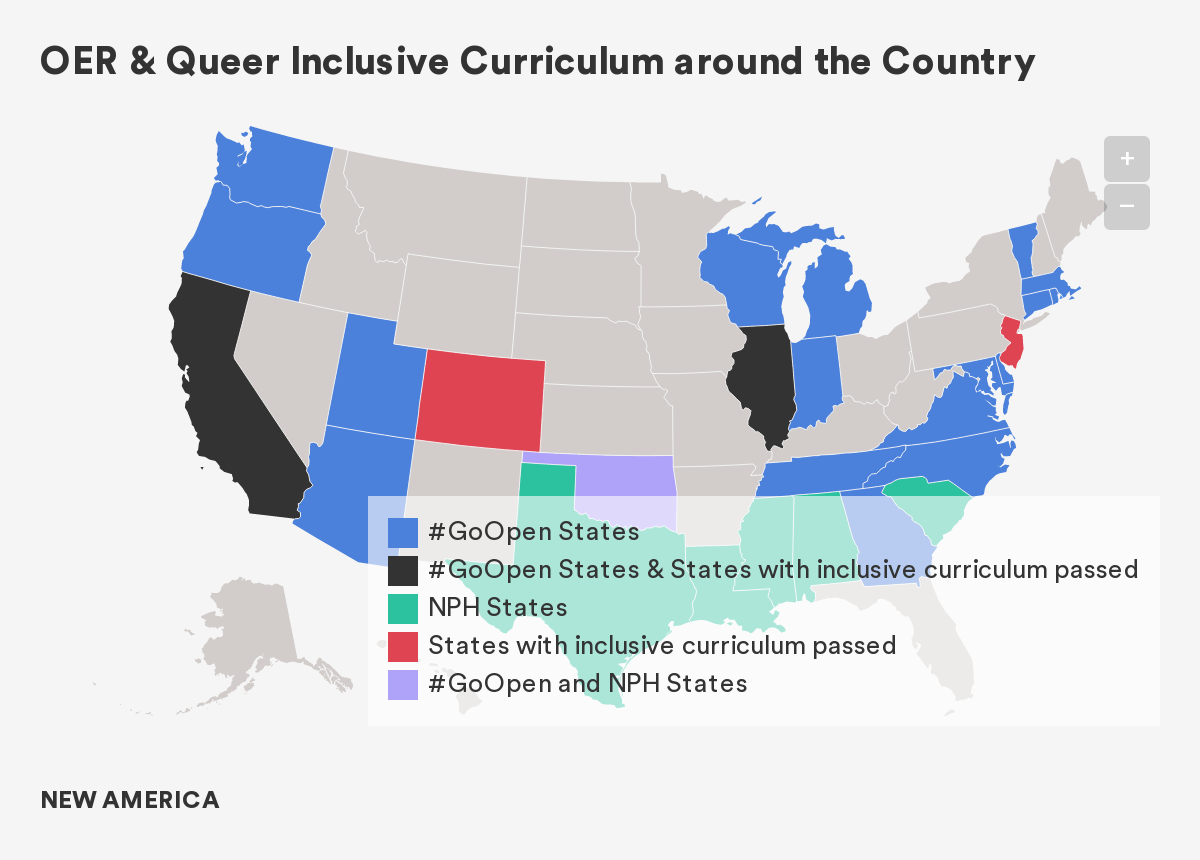
Four states—California, New Jersey, Colorado, and Illinois—have mandates requiring LGBTQ inclusion in PreK–12 curricula. The state legislature in New York has made recent movement in the same direction.
On the opposite end of the spectrum, six states—Texas, Oklahoma, Louisiana, Mississippi, North Carolina, and South Carolina—maintain education laws forbidding teachers from portraying LGBTQ people or identities in a positive light, if at all.1 These laws, known as “no promo homo” (NPH) laws, are in stark contrast with the five states working toward statutorily-mandated inclusion. Teachers in states with NPH laws may still work toward engaging and supporting their queer and trans students, but it neccessarily looks different than in states that support this work.
At the same time, there are 20 #GoOpen states and dozens of districts committed to open pedagogy and professional learning.2 Of these states, two—California and Illinois—have also passed inclusive curriculum laws, paving the way for queer-inclusive OER. As the first state to pass an inclusive curriculum and a #GoOpen state to boot, California has an immense opportunity to create openly licensed inclusive learning materials that could then be used by folks around the country. But even with the stars aligned, state education leaders have yet to leverage OER in their efforts. Instead, California is in the costly and arduous process of updating textbooks—a fair indicator that updated teacher professional learning will also come in the form of proprietary materials, if at all.
Of the 20 #GoOpen states, Oklahoma is the only remaining state with NPH laws. This means that state education leaders maintain harmful, anti-LGBTQ laws on the books while actively working to increase access to high-quality instructional materials for students. This contradiction implies that (1) “quality” is not synonymous with “inclusive” when it comes to instructional materials, and (2) OER in this state is an effort for only some students, not for all. In Oklahoma, which is ranked very low on the LGBTQ equality index,3 OER is a way to increase the number of students with access to possibly biased and certainly incomplete curricular content, rather than a way to diversify the types of content students can access.4 When writing their own story, Oklahoma officials are choosing to perpetuate the exclusionary practices reported by GLSEN’s survey respondents.
The map below shows #GoOpen states, as well as those with NPH laws and those which have passed inclusive curriculum laws.
In the handful of states—and many more districts—pushing for inclusive curriculum, parallel professional learning is likely to follow. Without it, the paradigm will not shift; resources will be available, but with little awareness and little knowledge of how to implement them. Particularly for educators who have not before engaged in conversations around gender and sexuality, have not taught the history of the fight for queer liberation, or simply are not aware of the implications of pronoun use, jumping into this content will be difficult without the support of adequate time, space, and resources.
What is more, they will be unlikely to do it unless inclusion is state-mandated and materials are openly licensed. Even if states with inclusive curricula create parallel teacher professional learning materials, teachers in other states will not have access. This means each state will have to both require teachers to teach this content, and create or purchase its own professional learning materials. This is a prime opportunity for OER, not only so states do not have to reinvent the wheel each time a new mandate is passed, but also so teachers in states without mandates can access guidance and support. As more and more states take on queer inclusion, and as the PreK–12 OER movement spreads, there is a clear and growing opportunity to use every available tool.
Citations
- GLSEN (website), “‘No Promo Homo’ Laws,” source
- U.S. Department of Education, Office of Educational Technology (website), “#GoOpen States,” source
- Mapping LGBT Equality in America (Denver, CO: Movement Advancement Project, May 28, 2015).
- Sabia Prescott, “Leveraging Open Educational Resources for Queer Students,” Education Policy (blog), New America, June 24, 2019, source
Next Steps for Research and Practice
While queer inclusion is gaining traction around the country, it is still a nascent concept to many. There is much more work to do, and much more that could be done to support states, districts, and teachers taking it on. Depending on your role in the education system, here are suggestions for moving forward.
For Researchers
Before we can consider policy recommendations to advance queer inclusion, we need much more data on queer and trans students, their experiences in the classroom, and the educators who support them. This is easier said than done, as collecting data on queer and trans students is difficult because there are a number of sensitivities that must be considered. Gender and sexual identities may change over time and so too does the language we have to describe and categorize them. Similarly, the taxonomy itself—how we functionally group queer identities for tracking purposes—can be extremely complicated. Tracking these identities and experiences of young students in particular, who may be just starting the process of orienting themselves to the world, can be futile. Nevertheless, quantitative information about academic and social-emotional outcomes, not to mention student health and well-being, is needed to make a strong case for the importance of this work.
For District and School Leaders
Regardless of the number of available resources—and of the quality of those resources—there is a limit to what teachers can do without explicit, active, and ongoing support from district and school leaders and administrators. With this critical support, queer and non-queer teachers alike would have job security when thinking about this work, as well as the time and resources to actually invest in it. A next step for district leaders is to assess the professional-learning workload of their teachers and set priorities for learning about queer inclusion. Leaders can start by integrating queer inclusion into current trainings on culturally responsive teaching, many of which are already underway around the country. District leaders could also partner with LGBTQ groups and developers of professional learning materials to produce new training materials. District leaders could then share those materials under an open license, train educators on how to use them, and set standards for continuously improving them. Leaders could track the effectiveness of these initiatives by setting up systems to gather feedback from teachers about how well they worked to improve students’ engagement and sense of belonging in the classroom.
For Educators
Educators should consider ways in which the current materials and practices they use in the classroom may be sending messages—negative or positive—to queer students. Even for the teacher who is heavily invested in this work, there is always room for greater inclusion, deeper conversations, and investigation about what content will be of the highest quality and relevance for their students. Educators seeking LGBTQ-inclusive content and teaching strategies can begin by identifying what types of content—for instance, passages from a lawmaker’s speech or plans for opening a class dialogue about LGBTQ rights—would be most valuable for their classroom. They can then determine if it is available under an open license, which would enable them to adapt it to be more inclusive, by providing gender-neutral prompts for writing assignments when needed, as just one example. The ability to adapt and customize content for classrooms and students and to share materials hold benefits for educators and students alike. Flexible tools like OER seem more important than ever, given the newly recognized importance of providing students with learning environments that are relevant and responsive to their strengths, needs, and identities.
With more information, leadership engagement, and easily accessible resources, teachers could be better able to support and engage queer students regardless of context. Instead of feeling alone and disheartened, teachers like Anna could see a path forward.
Appendix
Contributors to the Working Group
Christopher Cuevas, QLatinx
Ian Siljestrom, Equality Florida
Jess Mitchell, Inclusive Design Research Centre, OCAD University
Laura Scheidt, Prince George’s County Public Schools
Maribel Martínez, Office of LGBTQ Affairs, Santa Clara County
Samantha Carwyn, Carwyn Collaboration
Will Coghill-Behrends, University of Iowa College of Education
More About the Authors

Sabia Prescott
Policy Analyst, Education Policy