
Suggestions for the Stimulus: State Higher Ed Funding

Members of the U.S. House of Representatives and the Senate are reportedly close to striking a deal to reconcile their competing versions of the American Recovery and Reinvestment Act. Though both bills come with a price tag in the hundreds of billions of dollars, there are substantial differences between the House and Senate stimulus bills — especially with respect to higher education. Yesterday, we outlined where the two bills diverged. Today at Higher Ed Watch, we will offer our own advice, suggestions, and important points to remember for the conference committee as it meets to forge a compromise acceptable to both chambers.
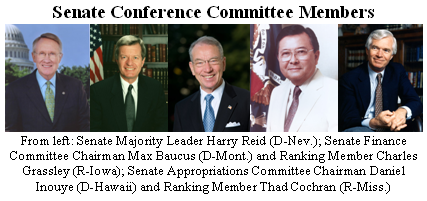
In this post, we will focus on provisions in the legislation that go directly to states so they can help their higher education systems weather the fiscal crisis. Later today, we will shift our attention to the student aid proposals in the bills.
The following are higher education spending provisions in the stimulus that go directly to states, which then have discretion over how they are disbursed to institutions.
School Construction
Fighting over: Whether or not to fund the program at all and what restrictions to apply
Providing money for postsecondary construction would arguably do more to help the economy than any other education component of the stimulus bill. Contractors and construction workers would need to be hired so that schools could upgrade, renovate, rebuild, or create new buildings, classrooms, and research facilities. Improved or new facilities could also help schools that serve displaced workers to increase capacity, helping retraining efforts. Finally, spending money on higher education construction results in a tangible product that does not need continued funding. This means there is no need for additional obligations after the stimulus money ends in two years — an important point for politicians who do not want to increase long-term spending.
For those reasons, we believe that the Senate erred in stripping out school construction funding from its version of the bill. While we do not have an exact funding amount recommendation, we do believe that the conference committee should include money for higher education construction. The panel should also incorporate a provision that was in the initial version of the Senate bill that required states to give community colleges a representative share of construction funds. This will prevent governors from shortchanging the institutions that are the most crucial for providing worker retraining. Finally, we would like to see the conference committee specifically direct these funds to public institutions — as these schools enroll the majority of students, are more tailored toward serving the specific economic needs of the state, and are the ones most hurt by state budget cuts.
State Fiscal Stabilization
Fighting over: Funding levels, whether to keep a maintenance of effort provision
As we’ve written numerous times, when state budgets struggle, governors and legislatures are all too willing to cut higher education funding and let tuition rise at their public college and university systems. These policies can make college unattainable for students from struggling low- and moderate-income families. To limit the damage, it is important that the federal government provide states some money to stave off planned cuts in higher education funding.
While there is currently a discrepancy of $40 billion between the House and Senate versions of the state fiscal stabilization fund, the gap is only $14.8 billion for the education funding components. In turn, over half of this gap arises from how the bills finance state incentive grants, a new program that would provide additional money to states that improve their elementary and secondary data collection systems and assessments, and more equitably distribute teachers among schools. While New America strongly supports improved data collection and the equitable distribution of teachers, such reforms are best addressed through the regular appropriations process. Meeting these goals will be time-consuming to implement and will require additional oversight as well as an increase in capacity and the state and local levels. Simply put, the nature of stimulus funding does not provide the time or the structure needed to successfully ensure that these goals are met. Moreover, the legislative language already asks for assurances that states receiving this money will meet these goals.
If the conference committee decides to work off the Senate’s stabilization funding level, we suggest that they redirect the incentive grant money into the general pool of education funds available to states. If this were done, then the difference between the general education funds included in the House and Senate bills would be only $430 million — a far smaller gap. The committee could then strengthen the assurances language in the legislation to hold states more accountable for the incentive grants’ aims.
No matter what funding amount the conference committee selects, we strongly oppose the Senate’s waiver for the state fiscal stabilization maintenance of effort (MOE) clause. The MOE provision requires states receiving stabilization funds to keep their elementary, secondary, and postsecondary funding at or above the 2006 fiscal year level. This is important because the goal of the stabilization fund is to help states restore education support to the fiscal year 2008 level. Forcing states to keep funding at the 2006 level means less money will be needed to achieve this goal. Allowing states to reduce spending further could mean that the stabilization fund is insufficient for this aim.
The committee’s discussion of the stabilization fund should also take into account the question of what’s going to happen in two years. At that point, states will no longer be receiving this additional education funding. Therefore, if they used stabilization dollars to redirect education funding elsewhere, they will now have to transfer those funds back. If they don’t, schools and colleges are going to be in for a rude awakening. To prevent a substantial drop in funding in two years, the conference committee should consider a provision requiring states in fiscal year 2011 to return their aggregate education funding to at least the 2008 fiscal year level.
Come back this afternoon when we will provide our commentary and suggestions for stimulus provisions dealing with student financial assistance.
Issues
Programs/Projects/Initiatives
Related

State Legislatures Weighing in on Workforce Pell
A Trump Official’s Thin Legal Case Against Accreditors’ DEI Policies