Jason Delisle
Director, Federal Education Budget Project

With the future of the Federal Family Education Loan (FFEL) program on the line, student loan industry officials are trying to raise doubts about federal budget estimates that show the government would save tens of billions of dollars by providing loans exclusively through the Direct Lending program. As part of this effort, industry officials are starting once again to perpetuate one of the more misleading arguments in this debate: that official cost estimates for the Direct Loan and FFEL programs do not account for “economic costs,” or “market risk.” While the argument is partially correct, industry officials and their supporters have abused and twisted the concept to confuse policymakers and the public.
 Their most recent victim appears to be Andrew Gillen of the Center for College Affordability and Productivity. In a June 4 Inside Higher Ed article (Apples and Oranges on Student Loans) he resurrects a 2006 paper written by former Congressional Budget Office (CBO) director Douglas Holtz-Eakin as evidence beyond a reasonable doubt that something must be amiss with official costs estimates. And he takes the “market risk” bait, hook, line, and sinker.
Just to back up a bit, the market cost (sometimes termed “market risk” or “economic cost”) of a government program refers to the price private entities would charge taxpayers to offer the same benefits and services currently funded by the government. In the case of government-subsidized student loans, the market cost reflects the price private entities would charge taxpayers to fund low interest rates for borrowers, the government’s administrative costs, and the subsidies it pays to private lenders, among other things. Loan industry officials argue that by failing to take into account the market cost of Direct Loans, federal budget officials have made the program appear to be much less expensive for the government to run than it really is.
Readers should bear in mind a few key points when confronted with the market risks and costs argument over federal student loan costs estimates. Although there is no mention of it in Gillen’s article, the National Bureau of Economic Research (an organization with at least as good of a reputation for academic rigor and impartiality as Holtz-Eakin) published a 2007 paper estimating the costs of the two federal loan programs taking market risk into account. What did the authors find? They found that both loan programs cost quite a bit more than official estimates suggest, but… a loan made through the FFEL program still costs a lot more than one made under the Direct Loan program. “Even after adjusting for the market cost of capital, asymmetric treatment of administrative costs, and other inconsistencies in how the programs are budgeted for, the guaranteed [FFEL] program appears to be fundamentally more expensive than the direct program,” state the authors. Unlike Holtz-Eakin’s paper (which was prepared for the Consumer Bankers Association and Sallie Mae, among others), the NBER report was not funded by the student loan industry and as far as we know, it is the only serious academic paper to actually model both program costs using the theoretical arguments the former CBO director makes.
Regardless of the actual work that has been done on the topic, simple logic should lead one to the same conclusions as those in the paper. The risks and obligations borne by taxpayers under the Direct Loan program and the FFEL program are very similar. So any adjustment for market risk must have symmetrical effects on the costs of both programs. Taxpayers are subject to both interest rate risk and default risk on loans in both programs. This is because the FFEL loans provide lenders a 97 percent guaranteed against default losses, and direct loans effectively carry a 100 percent guarantee. Taxpayers are also on the hook for interest rate risk on the FFEL loans, just like Direct Loans, because lenders are guaranteed a quarterly interest rate that is backed by taxpayer dollars. If the market demands greater compensation for taking on risk, then that should apply to both programs in similar ways, as the risks are nearly identical.
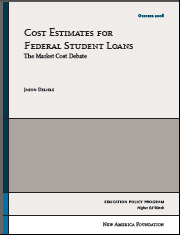
Other misleading arguments about market risks and student loan costs are discussed in a 2008 New America Foundation report, Cost Estimates for Federal Student Loans: The Market Cost Debate.
To be sure, the market risks concept has merit, and a growing body of policy research is helping to bring it into actual use (such as official cost estimates for the Troubled Asset Relief Program, TARP). Policymakers and the public should, however, be wary of the confusion and half-truths the student loan industry has spread about this legitimate and important budget concept.
Director, Federal Education Budget Project