
Strategies Used by States
Individual institutions or community college districts can implement initiatives to welcome adults back to community college, but colleges may lack the capacity to develop and operate such initiatives on their own. States engaging in adult re-enrollment work can use these initiatives to expand and sustain effective work across institutions. And when adult learners re-enroll, the state’s workforce—and tax base—stand to benefit from additional credentials earned, which provides a return on the state’s investment in higher education.
We reviewed state initiatives to bring adults back to community colleges over the years to identify trends in strategy, funding, sustainability, and implementation successes and challenges. In addition to document review and desk research, we interviewed individuals at four state higher education agencies and two colleges about their experiences with state-level adult re-enrollment efforts.
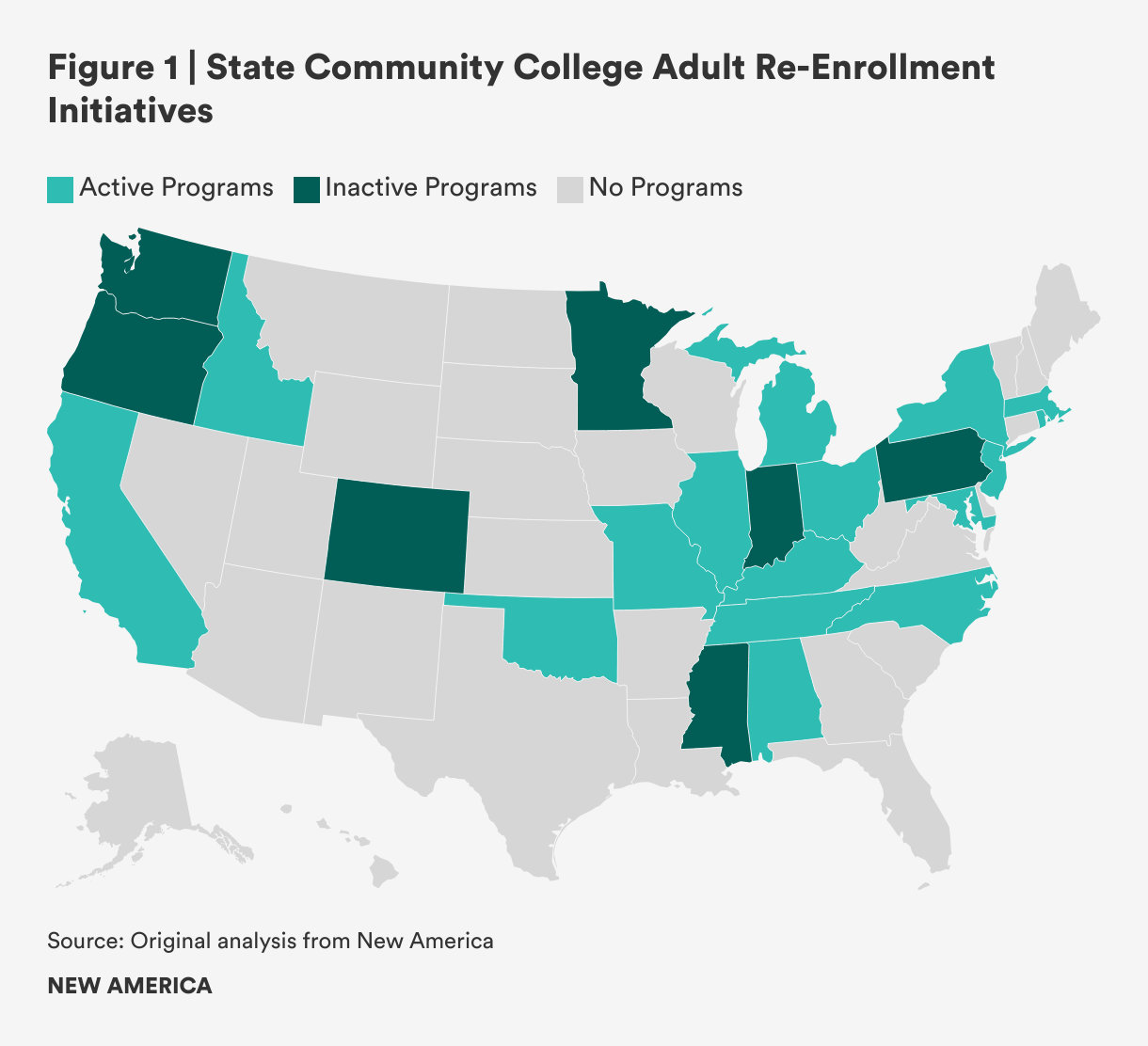
We identified re-enrollment initiatives that include community colleges and adult learners in 22 states. Some of these include other institutions of higher education. Others include younger students as well as adults. In addition to these 22 states, several other states reference adult re-enrollment in their strategic plans but do not appear to have active initiatives addressing this priority. We also found states that provide adult learners with landing pages emphasizing the importance of returning to college and directing them to re-enrollment and financial resources; however, these are not included in our count. For our analysis, we only count initiatives that somehow involve state government and are open to adults who could re-enroll in community colleges. Of the initiatives we identified, seven have been sunset or are scheduled to end by the close of 2025.
Our analysis identified four main components of state adult re-enrollment strategies. States generally focus on providing financial resources to returning learners and/or institutions, providing streamlined support for navigating college, communicating the value of re-enrolling, and providing technical assistance to colleges. Some states implement only one component, while others combine two or more as part of their adult re-enrollment strategy.
Funding for Institutions and Adult Learners
Many state-level initiatives focused on reducing the cost burden on adult students who could or have re-enrolled in college. Strained financial resources are a common barrier for adult learners, as time spent in class or studying is time not spent working and earning, which is an especially high opportunity cost for students with dependents. Although the short-term costs can be high, evidence points to a strong return on investment in the longer term.
Examples of this kind of state subsidy include MassReconnect, funded by the Massachusetts legislature, which provides last-dollar financial aid to learners 25 and older at public community colleges.1 MassReconnect recipients with significant financial need may access supplemental assistance through the program for books, supplies, and other education-related expenses.2 In Alabama, residents 25 and older who have not been enrolled in higher education for at least two years and are close to earning their first degree can apply for a last-dollar award through (Re)Engage Alabama to support their direct higher education expenses.3 As with MassReconnect, (Re)Engage Alabama is funded by appropriations from the state legislature.4
Rather than providing financial aid, initiatives in Ohio offer relief from institutional debt for eligible individuals who return to college. Launched in 2022 as a pilot, the Ohio College Comeback Compact incorporated eight public institutions of higher education in northeast Ohio, all committed to reducing barriers to re-enrollment.5 Students who previously stopped out of a participating institution can re-enroll at any participating college. After successfully re-enrolling and completing a semester, they are eligible to have some or all of their institutional debt forgiven.6
Many stakeholders collaborated to make this agreement happen. Three foundations provided financial support.7 The Ohio Department of Higher Education provided guidance.8 Ithaka S+R provided technical assistance, and ReUp was brought in during the second year to scale up outreach efforts. In the first two years of the Comeback Compact, Ithaka S+R reported that participating colleges forgave approximately $400,000 of institutional debt, yet brought in nearly $1.6 million in tuition from students who re-enrolled thanks to the initiative.9 The College Comeback Compact offers an example of a re-enrollment effort with a light touch from the state that yielded a strong return on investment.
Some states offer grants to support re-enrollment, which gives institutions considerable latitude in how funds can be used. In these initiatives, the state either provides or secures resources and manages distribution to institutions and compliance with grant requirements. Maryland’s One Step Away grant, for example, provides two to three colleges and universities per year with a small grant—most recently, $60,000—to carry out approved activities to support near-completers’ path to a degree.10 Missouri has recently provided some of its institutions of higher education grants using philanthropic resources, and it offers recipient institutions considerable latitude in carrying out re-enrollment initiatives that best suit their institution and students.
Support for Adults Navigating Re-Enrollment
Research indicates that adult learners prefer to have one contact person to help them manage a return to college, from re-enrolling to completing a credential. Several states have incorporated this intervention into their adult re-enrollment strategies. This role—often called a navigator—builds a connection with a prospective adult learner and supports their path through college.
In Mississippi, the state’s Complete 2 Compete (C2C) initiative included financial aid and navigation for eligible residents 21 and over who had not been enrolled for at least two years but were close to earning their first degree.11 Each participating institution designated a campus lead for the program and a C2C Coach to support adults navigating re-admission. Coaches received training on the C2C initiative and how to manage the program data dashboard for their institution.12
In Tennessee, Navigate Reconnect provides institution-agnostic information about higher education opportunities and support to adults interested in returning to or enrolling in college. The program’s 2024 annual report shows that between 2019–21, almost 11,000 residents received re-enrollment support from a navigator.13 Navigate Reconnect began in 2016, based on the Graduate Memphis model. The Tennessee Higher Education Commission (THEC) launched it through an application process that built Tennessee Reconnect Communities, and navigation services were distributed through these Reconnect Community hubs. Before 2019, Reconnect Communities were responsible for hiring and training Reconnect Advisors for their respective areas with the idea that people rooted in the community would help build trust with potentially returning adults. In 2019, THEC assumed leadership of Navigate Reconnect completely so that the program would be disseminated across the state.
Outreach and Marketing to Adult Learners
It is much easier for community colleges to market themselves to young students preparing to leave high school than it is to locate and communicate with working adults about enrolling. This pool of prospective and returning learners is dispersed. Launching a statewide marketing strategy for working adults is a common way states engage in adult re-enrollment work, including texting campaigns, traditional mailers, broadcast media ads, and social media posts. Standardized, premade messaging can help establish a brand and ease the burden on individual institutions to create their own marketing content.
Many states have partnered with vendors to identify, contact, and support adults who could benefit from re-enrolling in college rather than developing and disseminating messaging themselves. California Reconnect, a philanthropically funded pilot program of approximately 30 colleges, leverages InsideTrack to provide navigation support to adult learners.14 ReUp has contracted with numerous states, including Illinois, Michigan, and North Carolina, to reach prospective adult students and provide initial navigation support. And states like Michigan and Missouri are working with CollegeApp to analyze data and identify adult residents most likely to re-enroll in college, allowing for targeted messaging.15
Technical Assistance for Colleges
States have also used various measures to deliver technical assistance to colleges as they work to welcome adult learners back to college. Whether state governance structures and reconnect financing lend themselves more to top-down or bottom-up approaches to collaboration, sharing lessons in a coordinated way among institutions is something states should consider as they design or hone their reconnect efforts.
In Pennsylvania, Ithaka S+R partnered with the Pennsylvania Department of Education to facilitate a philanthropically funded learning community.16 Comprised of representatives from institutions of higher education across the state, this learning community focused on adult re-enrollment. Participants shared what they learned as they worked to increase re-enrollment over a year. Institutions focused on initiatives like redesigning their websites to be clearer and more welcoming for returning adults and right-sizing their institutional adult re-enrollment goals using available data.17 The group wrapped up in November 2025, and participants hope to sustain the work they began through this initiative.
In some states, adult re-enrollment efforts can lead to inter-institutional support and coordinated technical assistance. How this peer learning happens varies. For example, Missouri is developing coordinated technical assistance for institutions participating in the Department of Higher Education and Workforce Development’s adult re-enrollment initiative. Agency leaders hope this technical assistance will enhance institutions’ capacity to engage and serve adult learners and foster cross-institutional learning.
In North Carolina, “what we’ve done very successfully,” says Carrie Lockhert of InsideTrack, is create “a cohort of schools that become connected to one another. They’re learning from one another. They’re now advocating for each other. Instead of trying to do it top-down, the bottom-up approach and the coalition-building [works], instead of just trying to go after everyone all at once.”
Integrating Diverse Funding Sources
Public funding for specific initiatives, like adult reconnect efforts, is inconsistent. Given fluctuating priorities and varied funding levels, states have employed creative strategies to secure the money needed to carry out this work. Often, this entails resources from private philanthropy, sometimes combined with state support. Several re-enrollment initiatives have been launched, implemented, and then discontinued, sometimes within just a few years. This section details how states have—or have not—managed to fund adult re-enrollment initiatives.
For many states, the initial funding source for adult re-enrollment was private philanthropy. For example, Lumina Foundation provided grants to 15 states through its Adult Promise initiative from 2017 to 2019.18 Grantees used resources to enhance or expand efforts to enroll and support adult learners through graduation. A different grant from Lumina allowed the Tennessee Higher Education Commission to build a vision and plan to improve recruitment and retention of adults. In Missouri, resources from ECMC foundation fund the state Department of Higher Education and Workforce Development’s (DHEWD) work on adult re-enrollment and support. The grant supports DHEWD as it implements communications strategies that reach communities across the state, and colleges in Missouri’s four largest metropolitan areas were able to apply for grants of approximately $20,000 to support adult re-engagement work tailored to their community.
NC Reconnect has also been philanthropically funded, but in a much more consistent way than the previously described initiatives, relying on startup grant funding from philanthropy. The John M. Belk Endowment in North Carolina has provided resources to NC Reconnect since 2021, when the first cohort of participating colleges launched, growing to include more institutions in NC Reconnect over time.19 The Belk Endowment has, in addition to providing support to returning adults, supported regular evaluation of NC Reconnect and peer learning for participating colleges.
In Mississippi, the Complete 2 Compete (C2C) launched in 2017 as a multi-pronged strategy engaging at the institutional and student level. Eligible learners 21 and older with some college credit but no degree could access tuition assistance and navigation to support their progress.20 Institutions could receive grants to provide additional tuition assistance to eligible students, as well as facilitate prior learning assessment, provide coaching, or market college opportunities. The program was funded through a blend of grants from state agencies (Mississippi Department of Human Services and the Mississippi Department of Employment Services21) and philanthropic resources.22 As of summer 2025, though, C2C had completely ended after first excluding community college students from receiving grants in fall 2024.23
In Minnesota, legislatively appropriated funds proved unpredictable in ways that hampered the MN Reconnect Scholarship. A bill that included funding for the program did not move forward in the 2017–18 legislative cycle, so leaders had to consider more limited resources when it launched in 2018. These resources included Lumina’s Adult Promise grant.24 MN Reconnect received appropriated funds in the next state budget cycle,25 which allowed the program to more than double participating institutions in the second and third years. However, the end of the Adult Promise initiative and lack of appropriated funding in the subsequent biennial state budget spelled the end of the program in 2021.
Maryland’s One Step Away grant has proved more sustainable but has operated on a relatively small scale.26 Each year since the program started in 2013, there have been two or three recipient colleges given considerable latitude for how they use resources to support adult learners’ re-enrollment and progress toward a credential. In total, 17 colleges and universities have received at least one One Step Away grant, including eight community colleges.27 The grants are approximately $60,000 per year, but the longevity of this program is remarkable, given that it relies on legislative funding. For Maryland, small and steady seems to have kept this grant program operating and benefiting students, a few institutions at a time.
Balancing State Coordination and Local Nuance
State higher education structures vary widely, from having no governing or coordinating body to closely coordinated systems within and across education sectors. These structures influence how states engage in adult re-enrollment efforts. It is often challenging to balance allowing colleges autonomy in how they re-enroll adults and implementing a re-enrollment campaign for institutions across the state.
The four components most commonly found in adult re-enrollment initiatives—financial support, navigation support, marketing/communications, and technical assistance—depend on whether institutions or states manage them. Our interviews explored how different states approach finding this balance and highlighted factors that can help other states tailor re-enrollment strategies to their organizational and geographic contexts.
Where a governor or state agency has set a goal for state higher education attainment, this goal can provide the foundation for a coordinated effort to reach adults who could benefit from re-enrolling in college. In many cases, state communications campaigns about adult re-enrollment make it easy for returning adults to enroll at the institution that best fits their current needs, rather than directing them back to the campus they most recently attended.
Taking a state-level approach that pools adults interested in re-enrolling can nudge colleges to collaborate more effectively. Terah Crews of ReUp spoke of the impact of coordinated state messaging campaigns, saying, “Individual institutions are often not incentivized to collaborate with each other. But when a state comes in and says, ‘We are going to sponsor this, and we are going to manage this as a state,’ then those barriers to collaboration really begin to disappear and outcomes improve.” Working as a group of institutions within a state can encourage colleges to align on welcoming back adult learners.
Ideally, a statewide adult re-enrollment program enhances colleges’ capacity to engage working adults in their service areas. On the other hand, it can be helpful to allow space for the local and institutional nuance needed to effectively engage adults and encourage them to enroll in community college.
For example, Minnesota provided financial and navigation support to help adults re-enroll and support them across several community colleges in the state. However, student eligibility requirements for the MN Reconnect Scholarship were unclear, and data systems made it difficult for college staff to determine a prospective student’s eligibility. These challenges led to confused students who discovered they were not eligible for program support. Enthusiasm and resources at the state level made the program’s launch possible. Yet, institutional implementation proved difficult in ways that college leaders could have helped the state avoid, had there been a more collaborative relationship as the program was developed. One interviewee described the challenges of top-down re-enrollment initiatives: “The state doesn’t have all the answers, a lot of times not even centralized data points. How [are colleges] going to navigate this? Is it going to be campus agnostic? And is there a transfer pathway? All of those different questions come into play.” Coordinated communications strategies across a state are one matter, and managing eligibility and implementing state-directed student supports are another.
Tennessee provides an example of how effective coordination at the state level, in partnership with institutions of higher education, can be successful. When the state began its adult re-enrollment work through TN Reconnect in 2014, the Tennessee Higher Education Commission (THEC) analyzed institutional data to identify former students aged 25–64 who had not been enrolled for at least two years and had not earned a credential elsewhere but had earned at least half the credits needed for an associate or bachelor’s degree. In addition to lists of these adult learners, THEC offered colleges and universities marketing materials with messaging that would be consistent across the state. Institutions were responsible for sending out mailers, provided by THEC, to these former students and following up via phone and email.
Additionally, in early 2016, the state launched advertising campaigns with the same messaging about college re-enrollment for adults on broadcast media across Tennessee.28 THEC also clearly delineated its own role and that of institutions in TN Reconnect through an institutional guidebook and regular meetings of designated campus representatives.29 By providing resources, materials, and guidance, THEC expanded colleges’ capacity to reach out to and re-enroll adult learners while leveraging the strength of each college’s local brand and presence.
Some states have adult re-enrollment programs that provide grants on a competitive basis to institutions in the state. Maryland has offered the One Step Away grant since 2013 to support institutional efforts to recruit and retain individuals who are close to earning a degree. Recipients can use the grant for various activities, including marketing to prospective students, offering additional financial aid to students, and providing navigator support. Over the years, community college recipients of One Step Away have ranged from Harford Community College, a rural-serving institution with approximately 5,000 students, to the Community College of Baltimore County, serving over 15,000 students. Harford, for example, has used its grants over the 10 years it has received them to provide incentive scholarships for re-enrolling students and offer “concierge advising” that connects incoming students with a navigator from recruitment to program completion. The sustainability of this grant program and the fact that institutions can direct funds toward their specific needs have allowed the state to provide a lighter touch in encouraging adult re-enrollment.
Missouri is supporting a subset of institutions working to re-enroll adults. Participating colleges received grants, and leaders at the Missouri Department of Higher Education and Workforce Development indicated that many institutions are using these grants to expand work they had already set in motion to re-engage adult learners. Rather than pushing institutions to change course and adopt a state-imposed strategy, Missouri allows each participating college to use resources in ways that suit its institution and community best.
Sustaining Adult Re-Enrollment Strategies
Launching adult re-enrollment initiatives is a complex undertaking, and sustaining these initiatives presents an even greater challenge. Even if states initially provide resources, continually securing those funds can be challenging. And sustainability is not limited to the question of funding. Once the initial push to re-enroll adults is over, states must find ways to embed the importance of adult students’ access and success in the culture of their agency and the state’s institutions of higher education. We learned through our research that states have employed various strategies to solidify adult re-enrollment efforts within community college operations, both within the state and beyond the sector, to reach and serve the state’s working adults.
Some states may compel all institutions to participate in adult re-enrollment initiatives, while others limit participation to specific colleges or select participants through a competitive process. Institutions that participate are likely to have a champion on campus committed to adult re-enrollment work. For Harford Community College, a vice president brought vision and enthusiasm to the goal of supporting returning adult learners when the state launched One Step Away. The college applied for the grant in the program’s first year and has since received 10 One Step Away grants—more than any other college in Maryland except one.30 In Missouri, institutions applying for grant funds through the state’s adult re-engagement initiative were required to submit plans to sustain funding after the sunset of the grant. The state has prioritized engaging institutions with an eye to the future alongside plans to do good work in the near term.
Minnesota’s efforts to re-enroll adults in higher education have faced numerous challenges, particularly in sustaining resources for these initiatives. Changing priorities among policymakers has made funding unreliable and, after a few short years, the MN Reconnect program ended. MN Reconnect was highly coordinated across the state, well-funded, and ramped up quickly. Despite its short life, one change that Lake Superior College (LSC) made during the Reconnect era has stuck and continues to benefit students. Additional resources for advising and navigation enabled LSC to place an experienced advisor at the college’s smaller campuses, in addition to the main campus. Advising available at campuses that many adult students use—and the familiarity of a friendly face—continues to support these learners today, six years after the close of Reconnect. In this case, despite the loss of state funding and coordination, expanded services were sustained on an institutional level.
Tennessee has taken an innovative approach to sustaining and expanding the reach of Tennessee Reconnect. The state operates an “ambassadors” program, which engages individuals outside of higher education who interact with adults who may benefit from enrolling in community college.31 State employees outside of THEC can serve as ambassadors. For example, THEC staff train ambassadors who work in the state Department of Human Services, Department of Labor, and Department of Corrections to present information about enrolling in community college and the support they could receive to pursue education and training. When resources are scarce, this strategy helps the state distribute the responsibility of sharing education and training opportunities available to residents.
Making the case for sustained resources and attention, especially when money is tight, requires evidence that adult re-enrollment initiatives provide a return on investment. For this reason, it is crucial to consider the time and cost of rigorous evaluation before re-enrollment efforts begin. Program evaluations should, at the very least, indicate where strategies are effective and where there is either room for improvement or a component of re-enrollment work where the costs outweigh the benefits.
Citations
- Massachusetts Department of Higher Education, “Free Community College,” source.
- Massachusetts Department of Higher Education, “Free Community College Program–MassReconnect,” source.
- Alabama Commission on Higher Education, “(Re)Engage Alabama Grant Program,” source.
- Alabama Commission on Higher Education, 2024 Annual Report: Advancing Higher Education in Alabama (ACHE, 2025), source.
- Ohio College Comeback Compact (website), source.
- Ohio Department of Higher Education, “College Comeback,” source.
- Martin Kurzweil, Elizabeth Looker, and Brittany Pearce, After Successful Pilot, the Ohio College Comeback Compact Moves to Full Implementation (Ithaka S+R, September 2023), source.
- Ohio Department of Higher Education, College Comeback: A Summary of Ohio Law and Policy on Outstanding Student Balances Owed and Debt-Forgiveness Models that Can Be Applied in Ohio, source.
- Brittany Pearce and Joanna Dressel, Turning Debt into Credentials:The Ohio College Comeback Compact Continues to Benefit Adult Learners, Institutions, and Northeast Ohio (Ithaka S+R, October 2024), source.
- Maryland Higher Education Commission, “One Step Away Grant Program,” source.
- “MS Complete 2 Compete Initiative,” State Higher Education Executive Officers Association, January 2018, source.
- Lexi Anderson, State Innovations for Near-Completers (Education Commission of the States, September 2017), source.
- Celeste K. Carruthers and Emily Pratt, Navigate Reconnect 2024 Annual Report (University of Tennessee-Knoxville Boyd Center for Business & Economic Research, January 2025), source.
- InsideTrack, “California Reconnect,” source.
- CollegeAPP, Case Study: Michigan Reconnect Campaign (CollegeAPP, 2025), source.
- Elena Crosley, Reflections from the Pennsylvania Adult Learner Re-Engagement Community of Practice (Ithaka S+R, September 2025), source.
- Toni-Anne Richards, Goal Refining and Progression within the Pennsylvania Adult Learner Re-Engagement Community of Practice (Ithaka S+R, May 2025), source.
- Ann Person et al., Supporting Adult Learners from Enrollment to Completion: Implementation Findings from the Adult Promise Evaluation (Mathematica, November 2020), source.
- Belk Center for Community College Leadership and Research, “NC Reconnect,” NC State University Belk Center, source.
- “MS Complete 2 Compete Initiative,” State Higher Education Executive Officers Association, January 2018, source.
- Ashley F.G. Norwood, “First Student Earns Degree Through Complete 2 Compete,” Mississippi Today, September 14, 2017, source.
- Kelsey Davis Betz, “$3.5 Million Grant Awarded to Help Mississippians Get Degrees,” Mississippi Today, November 16, 2017, source; “Kellogg Foundation Provides Grant to Help Students Complete Degrees,” University of Southern Mississippi, October 6, 2021, source.
- Mississippi Office of Student Financial Aid, “Complete 2 Compete Grants,” source.
- Erin Hinrichs, “MN Reconnect: New Adult Learner Program at 4 Minnesota State Campuses Aims to Help Those With Prior Credits Cross the Finish Line,” MinnPost, October 18, 2018, source.
- Mel FitzGibbon and Jacquelynn Mol Sletten, State Financial Aid Manual: MN Reconnect Scholarship (Minnesota Office of Higher Education, June 2020), source.
- Maryland Higher Education Commission, “One Step Away Grant Program,” source.
- Maryland Department of Legislative Services Office of Policy Analysis, Higher Education Fiscal 2025 Budget Overview (January 2024), source.
- Tennessee Higher Education Commission, Scaling the Graduate! Network Model in Tennessee: Delivering High-Touch, Community-Based, Institution-Neutral Advising and Navigation Services to Adult Learners Throughout the State (THEC, July 2017).
- Tennessee Higher Education Commission, Tennessee Reconnect + Complete Guidebook & Toolkit for Institutions (THEC, September 2015).
- Maryland Department of Legislative Services Office of Policy Analysis, Higher Education Fiscal 2025 Budget Overview (January 2024), source.
- Tennessee Higher Education Commission, Tennessee Reconnect Ambassador Guidebook + Resources (THEC, January 2018), source.