
Strategic Distraction: America, China, and Japan in the 21st Century Competitive Space
The only way to be sure of winning a third world war is to prevent it.
George C. Marshall, in George C. Marshall: Soldier and Statesman.
The surest way to prevent war is to be prepared to win one.
U.S. Secretary of Defense Jim Mattis, Statement for the Record for the House Armed Services Committee, June 12, 2017
We could make no more tragic mistake than merely to concentrate on military strength. For if we did only this, the future would hold nothing for the world but an Age of Terror…We must never become so preoccupied with our desire for military strength that we neglect those areas of economic development, trade, diplomacy, education, ideas and principles where the foundations of real peace must be laid.
Dwight David Eisenhower, State of the Union Address, January 9, 1958.
A defining question of the 21st century is this: Can China and the United States find a way to coexist—or is a third world war inevitable? These two adversaries are already locked in low-intensity cyber skirmishes and the occasional proxy poke in the eye in the South China Sea and elsewhere, but the fact is that an actual “shooting war” is in no country’s best interests, given the potential scale and scope of destruction.
So, an equally compelling question, then, is whether there is a way to avert a kinetic World War III. Both countries are clearly pursuing strategies for prevailing in the event that there is a conflict, though neither seems to have a strategy for achieving peaceful coexistence. At this juncture, the United States is hyper-focused on one end of the spectrum with lethal military means, and China is like a fledgling just out of the superpower nest, with a taste for dominion and disdain for coexistence with a peer.
In this inauspicious moment for great power comity, there may be an opportunity for other countries to play a constructive and catalytic role. Japan, in particular, has a part to play. The United States has long pushed Japan to bring more conventional military capability to the bilateral alliance, but the alliance may benefit even more from Japan’s strengths as a security builder. In playing to those strengths, Japan also has an opportunity to improve global readiness for the great security challenges of the later part of this century, which are not all military in nature.
Tectonic Shifts in the Security Landscape
Today, the global security landscape is shifting in ways that are significant, and in the near term, that shift reflects the struggle for predominance between the United States and China. “Great power competition,” U.S. Secretary of Defense Jim Mattis declared in a July 2018 speech, “is now the primary challenge.”1 If the United States is now openly preparing for armed conflict with China, that is in no small measure because China itself is openly preparing for armed conflict with the United States.2 China is building up its military capability even as it is engaging in more provocative strategic behavior, from constructing artificial cantonments in the South China Sea to situating a naval base practically on the fenceline of a U.S. military position in Djibouti.
While the U.S. National Defense Strategy also names Russia as a great power, Russia is more of a spoiler, what the U.S. National Intelligence Council has called a “veto player,”3 rather than a great power. Russia, however, has become malignant in its diminishment. From the invasion of Crimea to interference in democratic elections, the use of nerve agent in the United Kingdom, and now allegedly sonic weapons in Cuba, the Russians are harnessing the unacceptable risk of escalation in a conflict between two nuclear states in an impunitous approach to statecraft. President Putin is turning the concept of deterrence inside out. Even more problematic for the United States and its allies, Russia and China are cooperating with each other, increasing bilateral trade in energy and technology, high-level visits, and military sales and exercises. Whether Russia and China, which share a long border and a history of enmity, can be lasting allies is by no means clear, but a focus on a common American adversary certainly seems to help.
Even as U.S.-China competition (with the Russian sidecar) heats up, other geostrategic challenges loom. Lesser states, such as North Korea and Iran, linger on the margin of this great power contest and draw strength from the friction like thunderclouds on the horizon. These totalitarian states abuse their own populations and suborn terrorism; there is not much evidence either country is truly prepared to play a constructive role in the community of nations. The Middle East and North Africa, meanwhile, are awash in devastating proxy fights, violent anarchic groups, and the destabilizing influence of both ambitious and broken states. Venezuela is collapsing, with the potential to disrupt shaky governments across the Western Hemisphere. Europe is in political disarray, with aging populations and a patchwork of economic decay, while the United Kingdom self-inflicts geopolitical wounds.
At the same time, new technologies are reshaping the character of war. Robotics, artificial intelligence, machine learning, unmanned systems, hypersonic missiles that can cross oceans in seconds, miniaturization, and cyber warfare are changing how militaries target adversaries, how they attack the targets, and even what the targets are. The end result is destructive power that is faster, more precise, more pervasive, sometimes much cheaper, and stealthier with nearly unlimited reach. This is a geostrategic proximity in which physical distance has less meaning, there are no defined front lines, and the distinction between “counter-force” military targets and “counter-value” civilian targets is increasingly blurry. In 2015 and 2016, for example, unseen combatants in Russia shut down the Ukrainian civilian electricity grid with a cyber virus, cloaked under a shield of official denial, as part of a coordinated military attack.
If civilized society survives the risk of a techno-world war, there will be additional drivers of insecurity by the end of the century. The U.S. National Intelligence Council has described a troubling convergence of trends, including global economic weakness, demographic shifts, and natural resource degradation and competition.4 Many nations in Africa have young populations that are growing far faster than their economies, for example, a demographic time bomb that will shake the continent and the world if it cannot be defused through education, good governance, economic growth, empowerment of women and girls, and opportunity at home and through global engagement. This is a profound risk of destabilization that cannot be solved through force of arms.
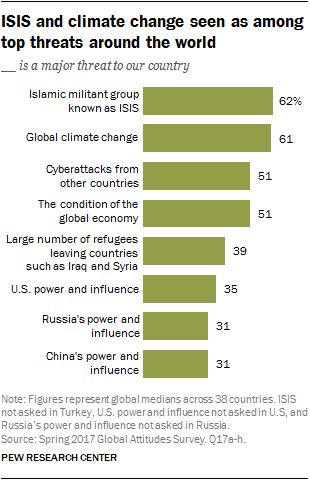
International public opinion seems to echo that broader threat perception. A Pew Research Center poll, for example, found that low-tech terrorism (and the so-called “Islamic State” specifically), climate change, the global economy, and refugees were seen worldwide as top dangers to international security.5 Some of these "threats" are actually symptoms of underlying, deeper divides between nations that have successfully industrialized and those that have not yet done so. Moreover, in the second half of the century, the industrial age bill for climate change will come due, particularly if the largest emitters fail to significantly stem greenhouse gases in the near term, which seems likely. These nations may not be able to use hypersonic missiles to defeat floods or anti-satellite weapons to stem the flow of desperate people, but they may well have to use their armed forces to deal with the consequences.
Why America Is Not Winning (If We Can’t Pull Together)
The United States is confronting this complicated security landscape largely through a more aggressive military posture. The U.S. National Defense Strategy emphasizes great power competition as the defining threat and “lethality” as the top priority for addressing that threat. Despite the rhetorical focus, however, the United States remains deeply embroiled in expensive regional fights,6 and may even be escalating.
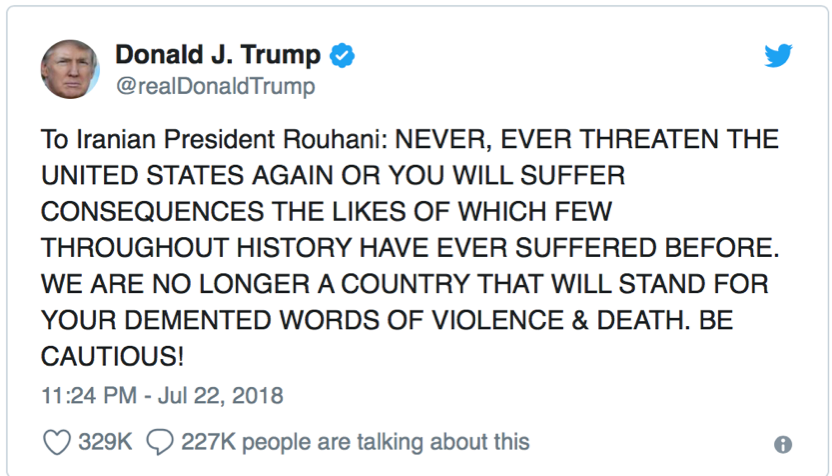
The 2018 U.S. National Defense Strategy also identified a concept of a global “competitive space.” Presumably, this concept goes beyond gray and hot battlefields and lethality in all its forms (“contact, blunt, surge, homeland,” in the words of the National Defense Strategy) to include other elements of national power that translate to domestic prosperity and security. The strategy mentions diplomacy, information, economics, finance, and intelligence, but natural resources, scientific and technological innovation, political and social values, and cultural presence all matter. The overall menu would certainly be consistent with past, successful American strategy, particularly during the Cold War.
Competitive space may also refer to the unpalatable concepts (at least to the pawns on the chessboard) of “spheres of influence” and “balance of power.” Throughout history, nations have rarely won war or peace by standing alone, and the U.S. National Defense Strategy does, in fact, emphasize the importance of global relationships and alliances, on par with lethality. Some of the Administration’s policies, such as levying tariffs against the nation’s closest partners in North America and Europe, as well as Japan itself, and confrontational diplomacy even with treatied allies, seem counterproductive. If the National Defense Strategy is referring only to military-to-military relationships, those are certainly important but insufficient without the foundation of a broader political, economic, and societal engagement.
To be fair to U.S. Secretary of Defense Jim Mattis, he himself has long emphasized the importance, and even the primacy, of non-military tools of national power, most recently in remarks to Pacific leaders in Singapore.7 He has also acknowledged that other long-term challenges, such as climate change, are national security concerns, even if they are not strictly military concerns.8 Following the money, however, belies his words: The Trump Administration requested more than US$700 billion for the Pentagon, with a focus on lethality, and record cuts to the foreign aid budget in 2019.9 In the first eight months of the Administration, the State Department lost some 12 percent of its workforce,10 which in 2017 was already less than three percent the size of the Department of Defense workforce.11 The number of civilian defense personnel alone is ten times that of the entire State Department staff, a longstanding imbalance. The Administration has vitiated national policies and programs to deal with climate change12 and global refugees13 and is tearing up international agreements. Even the Administration's signature non-military policies, such as sanctions on Russia and tariffs on China, are economic weapons, meant to compel behavior changes. These can be tools of necessity, of course, but using them is a hostile act. Moreover, these weapons require civilian governance capacity, including at the State Department, in order to wield them effectively and toward strategic ends. The furtive rebranding of the Overseas Private Investment Corporation, with a $60 billion infusion of funds, is surely one step in the right direction, though there is little information available about what the new funds entail. As it stands now, the new effort seems more a reaction to China's Belt and Road Initiative than a part of a proactive and coordinated approach. On the other hand, if a race to see who can make the best investments in global infrastructure projects is how the United States decides to define the competitive space, the new great power competition might not be such a bad turn of events.
Of course, that program is less than a tenth of defense spending. Within the defense budget, the balance of materiel spending is on major weapons platforms and legacy systems, rather than on game-changing next-war technologies.14 There are important increases and improvements, such as the new Joint Artificial Intelligence Action Center or the recent addition of $2 billion for artificial intelligence research. For these changes to be meaningful, though, there also needs to be a coherent strategy, doctrine, and organizational approach to AI, or the additional funds may end up being more contractor bait than new capability.15
Put another way, America’s national power is being undermined from within, rather than enhanced through the clarity of a comprehensive national strategy. The country is tearing itself apart at home, magnifying frictions and divisions that are weakening the rule of law, governance across the federal system, and social cohesion. The economy is showing signs of weakness in its foundations – income inequality is the highest it has been since the decade before the Great Depression, for example – just as the normal business cycle may well be headed toward recession.16 The current Administration is rolling back regulations, cutting taxes, and imposing tariffs without due diligence, with no credible examination of whether these measures will lead to long-term economic growth, or just a short-term infusion of cash into an economy already burdened with sky-high debt (with China and Japan as the top foreign creditors). Pointing to the private sector as America’s non-military national power is not a viable alternative, either: their primary driver, after all, is profit — as it should be — not national security. The two are not always mutually reinforcing in a free society. Hollywood’s voluntary surrender to Chinese censors, in pursuit of the lucrative Chinese market and financing, is a case in point.17 Silicon Valley has relentlessly pursued Chinese money, as well, in spite of political concessions to an autocratic government and risks to their own intellectual property.18 High tech and entertainment are not alone: industries ranging from agriculture to education have become addicted to Chinese resources.

Via Warner Bros.
If the Trump administration has ideas other than lethality about how to win the competitive space, they aren’t investing much in the way of words or dollars in those ideas. If anything, they are helping to strip away the investments, such as foreign aid and domestic consensus, which have translated to power in the competitive space in the past.
Why China Is Winning (If They Don’t Fall Apart)
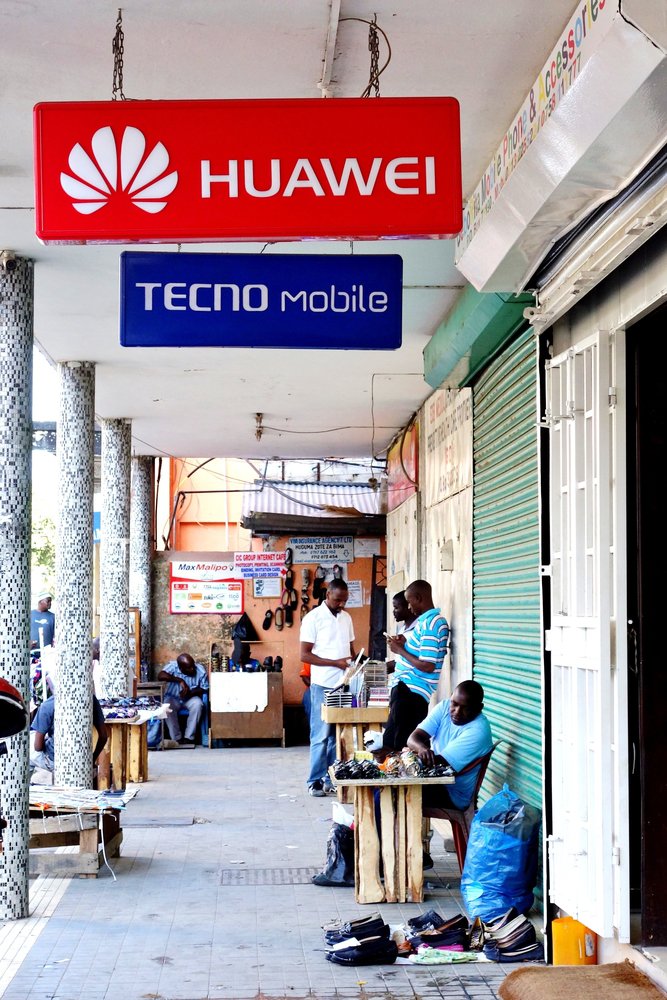
China, for its part, has been aggressively seeking to shape and perhaps even define the 21st century competitive space for some time. This activity includes everything from hypersonics and a sharply escalating military budget to Hollywood and aggressive cultural public diplomacy.19 China is investing extensively in an information age economy and military, from the raw resources in Africa, Australia, and South America to research and development for domestic high-tech industrial production. All of that progress remains perched, however, on the shaky foundation of an autocratic government, which is under tremendous pressure to meet the needs of its population—the world’s largest, with the fastest growing middle class.
EQRoy / Shutterstock.com
A signature competitive space effort, in terms of not only China’s own economic strength but also its global relationships, is the “Belt and Road Initiative” (BRI). President Xi Jinping first launched the program as an “economic belt along the Silk Road” in a 2013 speech in Kazakhstan.20 Today, the BRI is enshrined in the Chinese Constitution and is something of a catchall for an estimated US$150 billion annual investment in global infrastructure, reportedly touching 65 countries from the western Pacific to the Baltic Sea and from the Horn of Africa to the Panama Canal.21 According to the Chinese government, BRI will total up to US$8 trillion in financing and loans over its lifetime.22 A recent RAND analysis suggested that these investments really may be “win-win,” as President Xi has described them.23
The China-Pakistan Economic Corridor (CPEC) is an exemplar of BRI, capitalizing on a longstanding bilateral relationship and comprising more than 73 energy, transportation, communications, and other projects worth more than US$60 billion, according to the Government of Pakistan.24 Indeed, the Port of Gwadar, in one of Pakistan’s poorest and most restive provinces, is a hallmark Chinese “competitive space” investment. Billed as an economic development project, Gwadar is also a strategically significant location, and there are allegations (which China denies, though the country is not transparent) that China is, in fact, building a naval base there. Many of the port development initiatives are directly related to physical upgrades to promote trade and commerce through the area, such as overland roads, dredging, and construction of berths. Other projects are aimed at cultivating local support, such as the proposed Pak China Friendship Hospital or Gwadar Livelihood Project. 91 percent of the revenues from the port, however, will go to the Chinese Overseas Port Holding Company, which has a 40-year concession.25
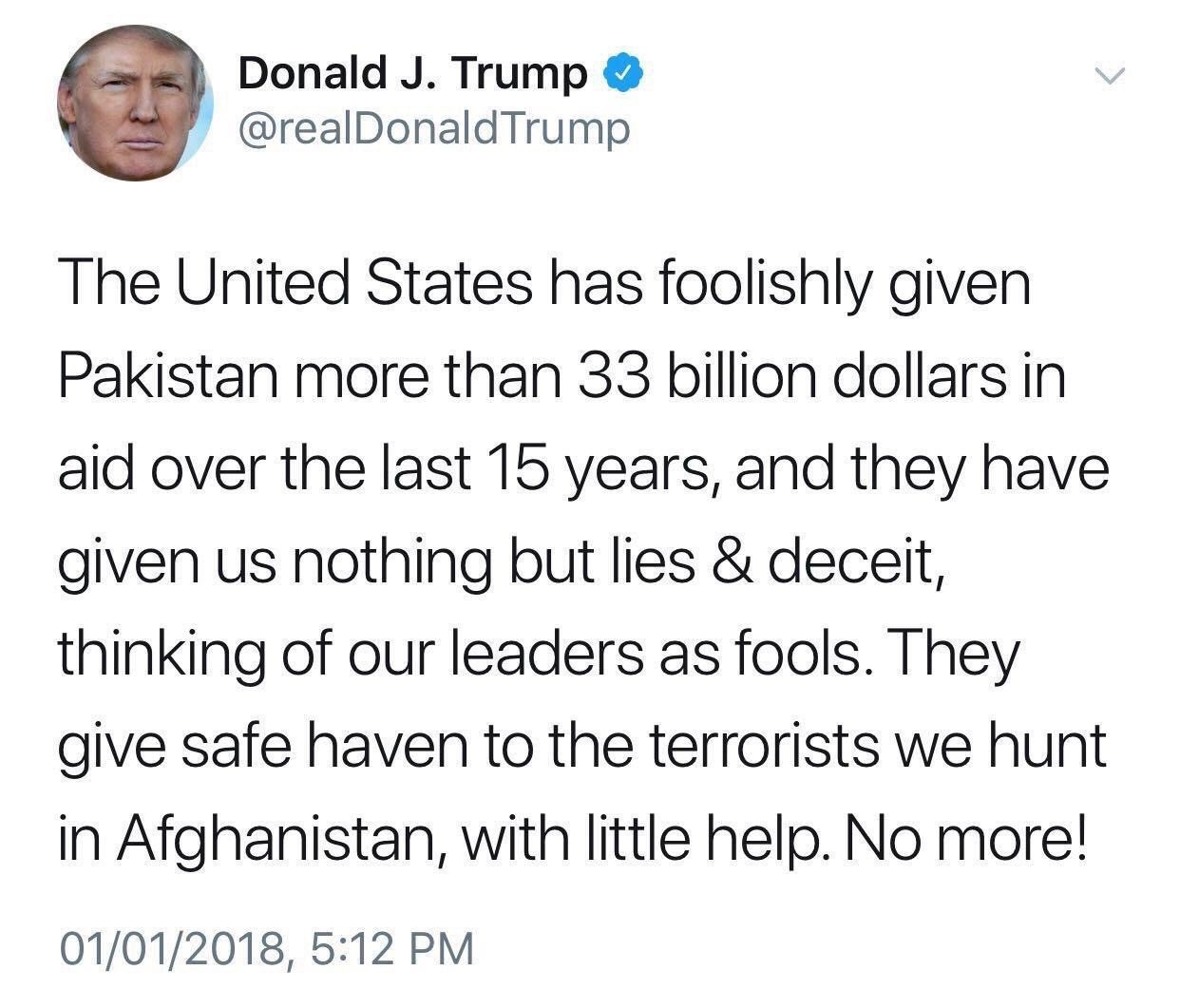
In contrast, Western donors are less sanguine about Pakistan. The International Monetary Fund (IMF), for example, has extended 12 loans to Pakistan since 1982, festooned with conditions, including those related to macroeconomic stabilization. Given the precarious state of Pakistan’s economy today, these loans arguably have proven ineffectual, though successive Pakistani governments certainly share the blame. 26 Indeed, the IMF or other international banks tend to be reluctant to lend to countries such as Pakistan with poor regulatory regimes, dysfunctional economies, and corrupt governance. The United States announced in 2018 that it would eliminate $800 million in military funds for Pakistan, pointing to the country’s support for terrorism.27 China does not appear to share any of those reservations, however, leaving recipient governments in Pakistan and elsewhere particularly grateful for Chinese support – and possibly nowhere else to go.
Even so, China’s financing of major projects and direct investment in other countries have met with mixed public reaction at times. The Gwadar Port project, for example, has stirred local protests over everything from water to jobs.28 In Sri Lanka, China’s Hambantota Port project has saddled the country with significant debt, contributing to the ouster of the previous government and violent protests.29 Most recently, a similar situation unfolded in Malaysia, where outrage over Chinese investments helped return reformist President Mahathir to office.30 Even before the Belt and Road Initiative was official, popular discontent forced the government of Myanmar, practically a Chinese client, to cancel the Myitsone Dam project, situated at a culturally significant site in an area in conflict with the state. The dam would have delivered much of its electricity to China.
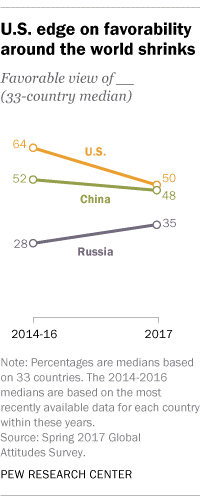
The Chinese do not exactly have a light touch with their mercantile policies. Indeed, the distaste for China is not limited to Baluchistan, Sri Lanka, Malaysia, and Myanmar. Much of the rest of the world may like Chinese money, but they do not necessarily like China – or the United States, for that matter. Russia is even less popular. The Pew Research Center’s 2017 global favorability ratings showed falling numbers for the United States and China, while a 2018 worldwide Gallup poll found that the United States and China tied for low approval ratings of 25 percent, with Russia just behind at 21 percent.31 If cultivation of friends and allies is one of the cards to hold in the competitive space, none of the so-called great powers seems to have a winning hand at the moment.
Where Does Japan Fit? An Alternate Approach to the Competitive Space
Japan, however, does have a winning hand. In a BBC/GlobeScan poll, Japan was the third most liked country in the world, behind Canada and Germany. While China was seventh in the same poll, the United States 12th, and Russia 13th, all three had relatively low favorability ratings.32 Moreover, if the overwhelmingly positive ratings from their own nationals were taken out, those favorability numbers would be even lower. US News and World Report rated Japan fifth in its annual international poll (conducted in 2017) of “best countries,” with the United States at eight, China at 20, and Russia at 26.33 Even in South Korea, there are signs of improvement in public opinion of Japan, albeit from a low base.34
The generally positive worldwide views of Japan (China, unsurprisingly, is a notable exception) reflect a remarkable, swift ascent. In just two generations, Japan has gone from the disastrous culmination of centuries of a martial culture, with all the moral, economic, and physical wreckage of World War II, to an ostensibly pacifist nation in a position of global trust.
Japan, more specifically, may well be in a position to translate that trust into a different kind of geopolitical leadership. This is all the more important in a time when America may no longer be an entirely reliable – or at least predictable – security partner, if the U.S. withdrawal from the Trans-Pacific Partnership, quixotic statements about North Korea, provocative tariffs, and relative underinvestment in non-military tools of engagement are anything to go by.
On the 71st birthday of Japan’s Constitution, in May 2018, Prime Minister Shinzo Abe suggested that the venerable document could use an update, basically repeating his Constitution Day message from the year before. It was time, he said, to clarify Article 9, which outlaws war, and legitimize the country’s considerable “Self-Defense Forces” (SDF). Japan’s choices today, however, do not have to be binary: pacifism does not have to mean passivity and military strength does not have to mean militarism. The country’s true comparative advantage may well lie in something between those two poles: a facility for building security, as opposed to fighting (or not fighting) wars.
Building security requires using both military and non-military means of protecting national interests and projecting national power—including diplomacy, development, and trade—to address the root causes of conflict and shape the strategic landscape. Building security means being prepared for war, while creating the conditions for peace at home, in the Asia-Pacific region, around the world in Japan's partners, and by investing resources and authority into multilateral institutions.
Japan, therefore, should be pragmatic about the military threat China, North Korea, and Russia pose, as well as about the need to invest in the means to create a secure coexistence with the great powers. Prime Minister Abe has articulated a concept of “active pacifism,” which is more focused on the military part of the equation but seems to be gaining some ground in public opinion.35
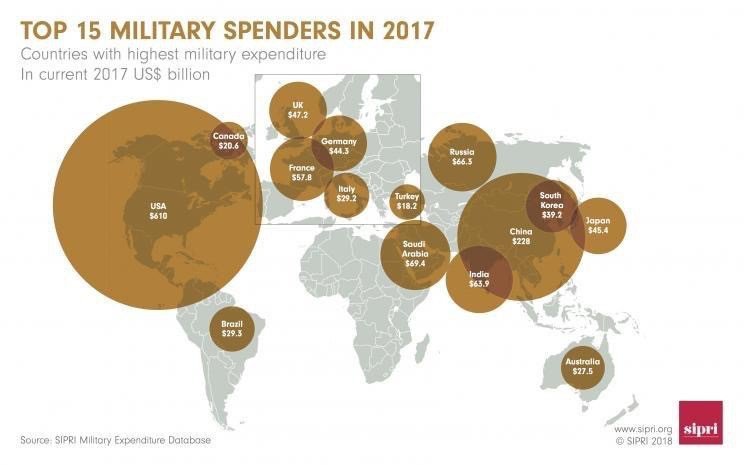
For Japan to compete militarily, directly, and on its own with China and Russia, however, would require a very significant investment. According to the Stockholm International Peace Research Institute, China spent US$228 billion on defense in 2017, albeit a distant second to the United States, while Russia spent $66.3 billion.36 Neither Russia nor China is transparent about its defense spending, however, so those numbers are likely understated. According to the U.S. Department of Defense,37 China has a military force of more than two million people, 300 ships (including 56 submarines), more than 2,700 military aircraft (not counting unmanned aerial vehicles), at least 1,200 short-range ballistic missiles, 75-100 intercontinental ballistic missiles, and an estimated 200-300 nuclear warheads. There is also a pattern of aggressive Chinese behavior in the region, including territorial expansion38 and retaliatory trade practices.39
Although Russia has fewer personnel in its armed forces than does China, it is still a significant force at 650,000.40 Moreover, the country has a strong comparative advantage over any nation—save the United States—in terms of strategic strength. In its last New START Treaty declaration, for example, Russia declared 1,765 nuclear warheads on 523 deployed intercontinental ballistic missiles, submarine launched ballistic missiles, and heavy bomber aircraft.41 Russia has both biological and chemical weapons, and the United States has alleged in the past that China does, as well. Both Russia and China also invest considerably in military modernization, including space capabilities, cyber, unmanned systems, electronic warfare, precision strike, and hypersonics, among other advanced technologies.
In terms of its current force structure, Japan’s US$45.4 billion defense budget puts the country in the respectable company of the United Kingdom and Germany, though as a percent of GDP, it is closer to Fiji and Mongolia, both with a fraction of Japan’s wealth and population.42 Japan has about 159,000 people in the Self Defense Force (active and reserve), 1,500 military aircraft, around 131 naval vessels, as well as formidable intelligence, surveillance and reconnaissance assets, and ballistic missile defense.43
Given Japan’s technological sophistication and industrial base, the country might be better off focusing its defense investments on “next war” technologies, rather than pricey conventional capabilities, such as the Joint Strike Fighter. Indeed, given that the United States seems locked into so many legacy programs, a high tech-focused SDF may be an important complementary capability Japan can bring to common security challenges. This investment can serve to discourage discrete adventurism by potential adversaries, raise the cost of and thus undermine “impunitous offense” aimed against Japan, and defend the nation, including from low-intensity, high-tech political warfare.
On the other hand, for Japan to truly be competitive with its neighbors in offensive military might, at least outside of the U.S. alliance, the country would have to consider nuclear weapons and the means of delivery. Japan certainly has the industrial and scientific heft to quickly build nuclear weapons, as well as to reconstitute its shuttered chemical and biological programs, which the country deployed extensively against China in World War II. But it is hard to see how a public with a bookended history of military and civil nuclear catastrophe in Hiroshima and Fukushima would support such acquisitions (and opinion polling suggests the majority of Japanese would not), nor truly how the presence of such weapons in Japan would make the country safer. On top of that, it is unlikely that an unconventional arsenal in Japan would deter China, Russia, and North Korea from acting as they see fit in the region and beyond, and settling differences through nuclear exchanges is not an attractive option for a country with limited territory and in very close range of its potential adversaries.
There are other ways Japan proactively exercises national power, of course, and those means arguably make better use of the country’s comparative advantage in positive global public opinion. Indeed, a more militant Japan could cut into the country’s support; there is unique moral authority in the commitment to non-aggression.
For a non-military focused power, Japan has much to offer. Indeed, Japan remains one of the world’s largest economies and top four exporters, with vehicles being the number one product. The Observatory of Economic Complexity finds that Japan generally punches above its weight economically, with a comparative advantage in hundreds of products, disproportionate to the country’s size.44 The country also has a distinctive global cultural presence, from sushi to emojis to street fashion. Anime alone is an $18 billion/year (US) business,45 which reaches 87 percent of the global population, according to an industry association.46

Moreover, Japan is increasingly translating its economic leverage into geopolitical diplomatic power. After the U.S. withdrawal from the Trans-Pacific Partnership, for example, Prime Minister Abe announced that Japan would take the lead in negotiating the multilateral deal.47 Japan has brokered a Regional Comprehensive Economic Partnership and has its own US$200 billion regional infrastructure plan, which focuses on a partnership with Chinese rival, India.48 The country has a pointed engagement with Sri Lanka, investing in deep-water ports, a liquefied natural gas project, and donating coast guard vessels, all without generating local animus. South Korea remains a sore spot, and the relationship is in many ways an important bellwether for Japan's ability to be a constructive regional presence. A better relationship with South Korea is critical to balancing China and the threat from North Korea.
Beyond bilateral relationships, Japan is a very active participant in multilateral institutions as one of the top donors to the United Nations, along with the United States, Germany, and China, and the second largest shareholder in the World Bank. The country contributes regularly to global peacekeeping and humanitarian and disaster relief efforts. At a time when a global wave of populism threatens multilateral instititions and global collective action, Japan’s unwavering support for these institutions may have a catalytic effect, maintaining the concerted means for promoting international peace and stability.
Japan is also one of the top five foreign aid donors in the world, which both bolsters and complements its diplomacy and multilateralism. While this investment was originally born of necessity, with roots in reparations to Japan’s World War II victims, Overseas Development Assistance (ODA) has become an expression of modern Japanese values.49 Today, the country provides around US$9 billion per year in grants, finance and investment, technical cooperation, and support for multilateral institutions.50 This contrasts sharply with Chinese assistance, which is mostly in the form of non-concessional financing,51 and American assistance, which is both declining and concentrated in security assistance. Another key difference is that there is strong public support in Japan for “helping other countries deal with their problems,” according to the Pew Research Center, and very little such support in China. Indeed, there is less public support for foreign aid in India, the European Union, and the United States, as well.52 The operational arm for Japanese foreign aid, the Japan International Cooperation Agency, oversees a range of development and human security building projects in developing countries around the world, in everything from maternal health to water access to capacity improvements in national police forces.
According to Japanese officials,53 most ODA projects are based on requests from recipient countries, filtered through Japanese diplomats and development officials based overseas. They tend to be investments in long-term development or partnerships with host countries, rather than a more transactional, extractive Chinese approach. And while Japanese defense experts have no problem recognizing China’s Belt and Road Initiative as an extension of China’s national security strategy, they may not see their nation’s own considerable ODA in the same light.54 Prime Minister Abe has worked to shift the emphasis of ODA, including by stressing Japan’s longtime commitment to building “quality infrastructure,” a slap at China’s BRI, and the “Proactive Contribution to Peace” concept. The latter appears to be largely aimed at building military capacity in partner countries, rather than leveraging other kinds of investments for strategic benefit.55
Ultimately, Japan’s purposes do not have to be mutually exclusive. Japan can pursue a win-win foreign aid strategy that meets the development priorities of other countries and leverages Japan’s commitment to human security in a way that builds influence and prosperity in the competitive space. Allegedly, the Ministry of Foreign Affairs has prepared a new white paper that reframes and prioritizes ODA in just those terms, though it has not yet been publicly released.56
The return on the Japanese investment in aid and global relations is evident. This is, after all, a country with the 10th largest global population, a relatively small land mass, few natural resources, a relatively homogenous population, a language spoken by almost no one outside of Japan, and a shrinking population with little in or out migration. And yet Japan has the third largest global economy, almost entirely a product of trade with and investment in and by other countries, and significant international influence. That success reflects Japanese ingenuity and productivity, of course, but also the investment in positive global relationships and multilateral institutions.
More to the point, a more strategic approach to foreign aid may posture Japan to deal better with future challenges. Climate change, for example, is already affecting human security around the world. Just in the last two years, Hurricane Harvey dropped a record amount of rainfall – more than 51 inches – on the city of Houston, killing more than 80 people and leading to more than 120,000 emergency water rescues. Heavy rains in Japan this year led to more than 100 deaths and 1.9 million evacuation orders. Cape Town, South Africa, came within days of running out of water altogether.57 By 2050, the effects of climate change are expected to be more severe, displacing as many as one billion people,58 turning up to 25 percent59 of the globe’s land mass into arid, drought-prone territory, and exposing many millions more people to more floods, higher disease rates, declining access to drinking water, and lower crop yields.60 These pervasive effects may be what the U.S. Department of Defense has called an “instability accelerant”{{62}} that touches off other social, governmental, and economic weakness and leads to more humanitarian and disaster relief or combat missions for militaries around the world. Ultimately, however, climate change is inherently a civil society and governmental challenge, in that redressing it requires investments in clean energy, infrastructure, agriculture, and human health and safety. These investments are important both in cutting greenhouse gas emissions and improving societal resilience to changes in the natural world already locked in. Japan’s current emphasis on development assistance and technical cooperation are well matched to building security for a changing climate.
As the host of the 1992 United Nations Framework Convention on Climate Change, Japan (or at least Kyoto) became synonymous with global leadership on reducing greenhouse gas emissions—for a time. After the 2011 Tohuku earthquake and Fukushima nuclear disaster, Japanese emissions rose again, as fossil fuel generation replaced the country’s shuttered nuclear power plants. An important question going forward is whether Japan can reclaim a mantle of global climate security leadership — currently worn by China, despite its penchant for consuming and exporting coal technology — by improving its energy mix and commitment to climate security at home and around the world.
Avoiding the Self-Fulfilling Prophecies
The force of arms is an important part of a nation’s strength, but it is inherently a derivative strength, drawn from a nation’s economy, resources, political system, and society. For that matter, overwhelming military advantage does not necessarily guarantee victory in a conflict, as the United States has seen in two decades of war in Afghanistan and Iraq. Prime Minister Abe’s focus on building military power in Japan is not necessarily wrong, but if it is uncoupled with other forms of national power, it will not be enough. Nor does it play to global perceptions of Japan as a peaceful society, a geopolitical advantage only a slim generational margin away from much darker memories. Moreover, a sole strategic focus on warfighting may well be a self-fulfilling prophecy.
In that regard, the United States also needs a broader strategy. While a strong and modernized military is an important deterrent and counter to discrete aggression, the United States should have a strategy to achieve an end state other than World War III. If it turns out that World War III really is inevitable, then the United States will also need more than military means to prevail. Investments in a strong economy and polity are crucial. The industrial base, from natural resources to research and development to good jobs in an automated future, is a core strategic strength, which China clearly recognizes. In war or peace, and in all the shades of gray in between, the United States should be looking to cooperate with global partners, whether that means building on mutual interests or facing common foes and challenges. Such cooperation requires a positive engagement with the world through development, trade, culture, investment, and political and military alliances and partnerships. While economic weapons, such as sanctions, have their place, they are a means to an end, and that end — security, stability, and prosperity — requires mutually productive engagement, as well. In particular, the United States should look to its closest partners in the most contested region, such as Japan.
The United States will come through the current social and political turbulence at home; the democratic-republican form of government ultimately remains more resilient than the autocratic, personality-based alternatives. The United States also will remain a stalwart ally for Japan, especially in a worst-case, existential scenario, but it may not be much help right now in building toward a best-case scenario of global peace and prosperity. Japan’s leaders should take seriously the potential consequences of American strategic distraction, both on the home front and in regional wars.
Japan is not without problems of its own, of course, but the country has an opportunity not only to make its own way in building toward that best-case scenario, but to lead the way. Indeed, there is some urgency to filling the leadership vacuum the other great powers are leaving (or trying to fill in ways that may be inimical to Japan’s interests). Indeed, in stepping up, Japan could be more than a constructive influence. Japan may be able to catalyze other countries into focusing on non-military means of exercising power and help broker coexistence between the "great powers." To that end, Japan’s recent diplomatic overtures toward China and freedom of navigation exercise in the South China Sea could be a promising sign of a new geopolitical confidence – or a sign that Japan is giving up on the United States. Hopefully, it is the former, and Japan is willing and able to take a global leadership role in avoiding the unacceptably high costs of another great power war and also meeting the security challenges of our age, such as global climate change, which cannot be met through force of arms. Indeed, Japan’s relative strengths in building security may be important for salvaging a stable and cooperative global system in the 21st century.
Citations
- U.S. Department of Defense, Annual Report to Congress: Military and Security Developments Involving the People’s Republic of China 2018, Office of the Secretary of Defense, May 16, 2018. Retrieved at source
- U.S. National Intelligence Council, “Global Trends: Paradox of Progress,” Office of the Director of National Intelligence, retrieved at source
- U.S. National Intelligence Council, “Global Trends: Paradox of Progress,” Office of the Director of National Intelligence, retrieved at source
- Jacob Poushter and Dorothy Manevich, “Globally, People Point to ISIS and Climate Change and Global Security Threats,” August 1, 2017, Pew Research Center. Retrieved at source
- See Congressional Research Service report stating that U.S. wars have cost US$1.5 trillion since September 11, 2001. Published courtesy of the Federation of American Scientists at source.
- Remarks by U.S. Secretary of Defense James Mattis at Plenary Session of the 2018 Shangri-La Dialogue, June 2, 2018. Retrieved at source
- Andrew Revkin, “Trump’s Defense Secretary Cites Climate Change as a National Security Challenge,” ProPublica, March 14, 2017. Retrieved at source
- Carol Morello, “Head of USAID Defense Big Cuts to Foreign Aid Budget,” The Washington Post, March 21, 2018. Retrieved at source
- Jack Corrigan, “The Hollowing Out of the State Department Continues,” The Atlantic, February 11, 2018. Retrieved at source
- Cory R. Gill, “U.S. Department of State Personnel: Background and Issues for Congress,” Congressional Research Service report, May 18, 2018, courtesy of the Federation of American Scientists at source. Also, defense personnel numbers for December 2017, which include active duty, reserve, and National Guard forces and civilian personnel, are at the U.S. Department of Defense Manpower Data Center source
- Michael Greshko et al, “A Running List of How President Trump is Changing Environmental Policy,” National Geographic, August 21, 2018. Retrieved at source
- The non-governmental organization, Refugees International, gives the Trump Administration a grade of “F” in its handling of refugee policy. source
- Susanna Blume, “What’s Wrong with the Defense Department’s 2019 Budget Request – and What Congress Can Do to Fix It,” War On the Rocks, May 15, 2018. Retrieved at source
- Sydney J. Freedberg, Jr., “Google Helps Chinese Military, Why Not US?” Breaking Defense, June 26, 2018. Retrieved at source
- Ben Leubsdorf, “Economists Think the Next Recession Could Begin in 2020, Wall Street Journal, May 10, 2018. Retrieved at source
- Eric Handy and Stef W. Knight, “How China is Building its Own Hollywood,” Axios, June 15, 2018. Retrieved at source
- Josh Horwitz, “In 2017, Silicon Valley Got Cozier with China; In 2018, Washington Will Get Frostier,” Quartz, December 26, 2017, retrieved at source
- For an excellent overview of China’s public diplomacy and its effectiveness, see Samantha Custer et al, The Ties that Bind: Quantifying China’s Public Diplomacy and its Good Neighbor Effect, AidData, CSIS, Asia Society, and the U.S. State Department. Retrieved at source
- H.E. Xi Jingping, President of the People’s Republic of China, Nazarbayev University, Astana, Kazakhstan, September 7, 2013. Retrieved at source
- Helen Chin and Winnie He, “The Belt and Road Initiative: 65 Countries and Beyond,” Fung Business Intelligence Centre, May 2016. Retrieved at source
- “One Belt, One Road, One Trillion Dollars – Everything You Need to Know in One Essay,” The State Council Information Office of the People’s Republic of China, January 20, 2017. Retrieved at source
- Hui Lu et al, China Belt and Road Initiative: Measuring the Impact of Improving Transportation Connectivity on Trade in the Region, RAND Corporation, 2018. Retrieved at source
- China-Pakistan Economic Corridor Projects Progress Updates, Government of Pakistan. Retrieved at source
- Adnaan Amir, “China’s Belt and Road Plan Dismays Pakistan’s Poorest Province,” Financial Times, June 14, 2018. Retrieved at source
- Aisha Ahmad, “Pakistan Will Be Going to the IMF for the 13th Time. Will PTI’s Asad Usar Fare Better Than Past Ministers?” Dawn, August 6, 2018. Retrieved at source
- Nancy W. Youssef, “U.S. Freezes Aid to Pakistan, Citing Inadequate Action on Militants,” The Wall Street Journal, September 2, 2018, retrieved at source
- See Mariyam Suleman, “Gwadar’s Water Crisis,” The Diplomat, May 1, 2018. Retrieved at source or Adnaan Amir, “China’s Belt and Road Plan Dismays Pakistan’s Poorest Province,” Financial Times, June 14, 2018. Retrieved at source
- Wade Shepard, “Violent Protests against Chinese ‘Colony’ in Sri Lanka Rage On,” Forbes, January 8, 2017. Retrieved at source
- Hannah Beech, “’We Cannot Afford This’: Malaysia Pushes Back Against China’s Vision,” The New York Times, August 20, 2018. Retrieved at source
- Gallup, Rating World Leaders 2018: The U.S. vs. Germany, China, and Russia, 2018.
- “Sharp Drop in World Views of US, UK: Global Poll,” GlobeScan, Jul 4, 2017. Retrieved at source
- Deidre McPhillips, “The 25 Best Countries in the World,” US News and World Report, January 23, 2018. Retrieved at source
- “The Japan-South Korea Joint Opinion Poll 2017: How can Japanese and South Koreans Cooperate in Future for the Sake of Peace in Northeast Asia?” The Genron NPO, July 25, 2017. Retrieved at source
- Motoko Rich, “A Pacifist Japan Starts to Embrace the Military,” The New York Times, August 29, 2017. Retrieved at source
- Stockholm International Peace Research Institute, “Military Expenditures,” retrieved at source
- U.S. Department of Defense, Annual Report to Congress: Military and Security Developments Involving the People’s Republic of China 2018, Office of the Secretary of Defense, May 16, 2018. Retrieved at source
- Asia Maritime Transparency Initiative, Center for Strategic and International Studies, source
- See, for example, Yuko Inoue, “China Lifts Rare Earth Export Ban to Japan: Trader,” Reuters, September 28 2010. Retrieved at source or “South Korea is Making Up with China, but a Sour Taste Remains,” The Economist, November 9, 2017. Retrieved at source or Gabriel Collins, “Russia’s Use of the ‘Energy Weapon’ in Europe,” Rice University’s Baker Institute Issue Brief, July 18, 2017. Retrieved at source
- U.S. Defense Intelligence Agency, Russia Military Power: Building a Military to Support Great Power Aspirations, 2017, p. 50 for ground forces, p. 58 for aerospace forces, p. 66 for naval forces, and p. 71 for special operations forces. Retrieved at www.dia.mil/Military-Power-Publications.
- U.S. Defense Intelligence Agency, Russia Military Power: Building a Military to Support Great Power Aspirations, 2017, p. 31. Retrieved at www.dia.mil/Military-Power-Publications.
- U.S. Central Intelligence Agency, The World Factbook, source
- Global Firepower, “2018 Japan Military Strength,” source and Ministry of Defense of Japan, 2017 Defense of Japan, source
- The Association of Japanese Animations, “Anime Industry Report 2017.” Retrieved at source
- Kazuaki Nagata, “Anima Makes Japan Superpower,” The Japan Times, September 7, 2010. Retrieved at source
- Observatory of Economic Complexity, “Japan’s Economic Complexity,” MIT. Retrieved at source
- Yoichi Funabashi, “In America’s Absence, Japan Takes the Lead on Asian Free Trade,” The Washington Post, February 22, 2018. Retrieved at source
- Keith Johnson, “Japan’s Own Belt and Road,” Foreign Policy, February 9, 2018. Retrieved at source
- Saori N. Katada, “Japan’s Foreign Aid after the San Francisco Peace Treaty,” The Journal of American-East Asian Relations, Vol. 9, No. 3/4 (Fall-Winter 2000), pp. 197-220.
- “White Paper on Development Cooperation 2016,” Ministry of Foreign Affairs, Japan, November 2017. Retrieved at source
- AidData, “By the Numbers: China’s Global Development Footprint,” A Research Lab at William & Mary College. Retrieved at source
- Bruce Stokes, “Japanese Back Global Engagement Despite Concern about Domestic Economy,” Pew Research Center, October 31, 2016. Retrieved at source
- Personal interviews with Japanese officials in February 2018.
- Based on personal interviews in Japan at the Ministry of Defense, Ministry of Foreign Affairs, Japan International Cooperation Agency, National Graduate Institute of Policy Studies, Asia Pacific Institute, Japan Institute for International Affairs, and the Institute for Global Environmental Studies, February 2018, as well as a literature review.
- Purendra Jain, “New Thinking Redefines Japan’s Foreign Aid Policy,” Asian Currents, July 11, 2016. Retrieved at source
- “Japan to Link ODA to Promotion of its ‘Indo-Pacific’ Strategy,” The Japan Times, February 19, 2018. Retrieved at source
- The World Weather Attribution project, an international research collaborative, has confirmed that climate change affected all three of these events. See source
- Baher Kamal, “Climate Migrants Might Reach One Billion by 2050,” ReliefWeb, August, 21, 2017. Retrieved at source
- Park, Chang-Eui et al, “Keeping Global Warming within 1.5 Degrees Constrains Emergence of Aridification,” Nature, vol. 8, Januray 2018, pp. 70-74. Retrieved at source
- Intergovernmental Panel on Climate Change, 2014: Summary for policymakers. In: Climate Change 2014: Impacts, Adaptation, and Vulnerability. Part A: Global and Sectoral Aspects. Contribution of Working Group II to the Fifth Assessment Report of the Intergovernmental Panel on Climate Change [Field, C.B., V.R. Barros, D.J. Dokken, K.J. Mach, M.D. Mastrandrea, T.E. Bilir, M. Chatterjee, K.L. Ebi, Y.O. Estrada, R.C. Genova, B. Girma, E.S. Kissel, A.N. Levy, S. MacCracken,P.R. Mastrandrea, and L.L. White (eds.)]. Cambridge University Press, Cambridge, United Kingdom and New York, NY, USA, pp. 1-32.
- U.S. Department of Defense, Quadrennial Defense Review Report, February 2010. Retrieved at source