State Stimulus Spending Does Not Necessarily Reflect Financial Straits

Last week we examined the rate at which stimulus funds for different programs have been disbursed by states for spending. Despite encouragement from the Department of Education to spend funds quickly, the majority of education stimulus funds have not yet left the bank. However, this is not the case in all states. While some states are moving quickly to disburse their stimulus funds, others have not, emphasizing the lack of connection between the funds allocated to states and their financial need. Today we will explore the disbursement of stimulus funds at the state level with a close look at activity in two particular states.
As of September 4th, the Department of Education had obligated (made available for spending) $66.5 billion in stimulus funds to the states. However, states had only disbursed $16.6 billion of those funds for spending at the local level. On average, that’s just over 25 percent. While some states have disbursed significantly more than 25 percent of their obligated funds, many states have disbursed far less. The story becomes even more interesting when a state’s budget deficit is included in the consideration. While logic would suggest that states with particularly high projected budget deficits would have incentive to spend their stimulus funds more quickly, that is not always the case.
According to the Center on Budget and Policy Priorities, California has the largest projected 2010 budget deficit as a percent of total spending at 49.3 percent. In keeping with its significant need for additional support for education, California has disbursed nearly 69 percent of stimulus funds it has received from the federal government so far, the most of any state. But Arizona, with the second largest projected deficit of 41.1 percent, has disbursed 31.2 percent of its stimulus funds it has received from the federal government, a relatively low amount compared to other states.
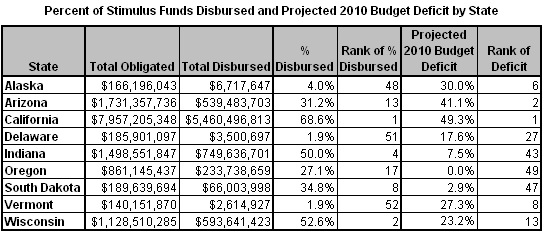
In contrast, Wisconsin has disbursed the second most funds of any state – 52.6 percent – even though its projected deficit is significantly lower than Arizona’s at 23.2 percent.
States with particularly low deficits have also not necessarily disbursed their stimulus funds at low rates. Oregon, with no projected deficit in 2010, has disbursed 27.1 percent of its obligated stimulus funds. Similarly, South Dakota has disbursed a reasonably high 34.8 percent of its stimulus funds, despite its low projected deficit of 2.9 percent.
Some states are really lagging on disbursing their obligated stimulus funds. Vermont is tied for last in percent of funds disbursed at 1.9 percent. This is particularly counterintuitive because Vermont has the eighth highest projected 2010 budget deficit at 27.3 percent. Delaware, the other state that has only disbursed 1.9 percent of funds, has a projected deficit of 17.6 percent. Similarly, Alaska has only disbursed 4.0 percent of funds even though it faces an expected 30.0 percent deficit.
To get a better sense of what this means for an individual state, we looked more closely at Arizona and Indiana, two similarly sized states that are expected to face drastically different deficits in 2010. While Arizona will face a deficit of 41.1 percent, Indiana will only grapple with a deficit of 7.5 percent.
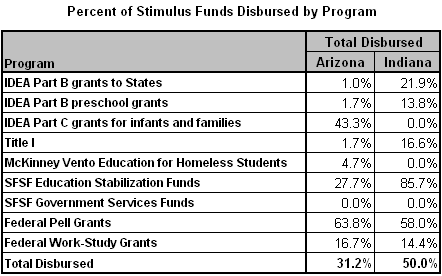
As the table suggests, Indiana has disbursed a much larger percentage of funds than Arizona. For example, significantly more IDEA Part B, Title I, and Education Stabilization funds have been disbursed in Indiana than in Arizona. While Arizona has disbursed more IDEA Part C and McKinney Vento funds than Indiana, these are significantly smaller programs. However, both states have disbursed similar percentages of Pell Grant and Work Study funds.
While some states are responding to desperate financial times by quickly disbursing their available stimulus funds, others have not acted so quickly. Granted, the school year has just begun and many states and localities are still identifying appropriate expenditures for the stimulus funds. At the same time, some states that are not expected to weather as significant of a financial storm are rapidly taking advantage of the newly available federal funds. This discrepancy highlights the fact that stimulus funds were not distributed according to a state’s financial need, but rather according to preexisting funding formulas or calculations that account for student population. In the absence of a more targeted distribution mechanism, it is no surprise that state behavior in disbursing the funds does not more closely reflect each state’s projected budget situation.
A full spreadsheet of this information for all states can be accessed here.
More About the Authors
Issues
Related

Accreditation on the Ground: A Q&A with Heather Perfetti