Lancy Downs
Senior Policy Analyst, Center on Education & Labor
Building the infrastructure for high-quality youth apprenticeship


Youth apprenticeship has the potential to transform how we prepare young people for careers, but realizing that potential requires more than promising programs. Since the Partnership to Advance Youth Apprenticeship (PAYA)’s launch in 2018, high-quality programs have emerged in nearly every state. In many places, state action has facilitated their development and launch. Yet, despite programmatic progress, most states don’t have a cohesive infrastructure for supporting and sustaining high-quality youth apprenticeship at scale.
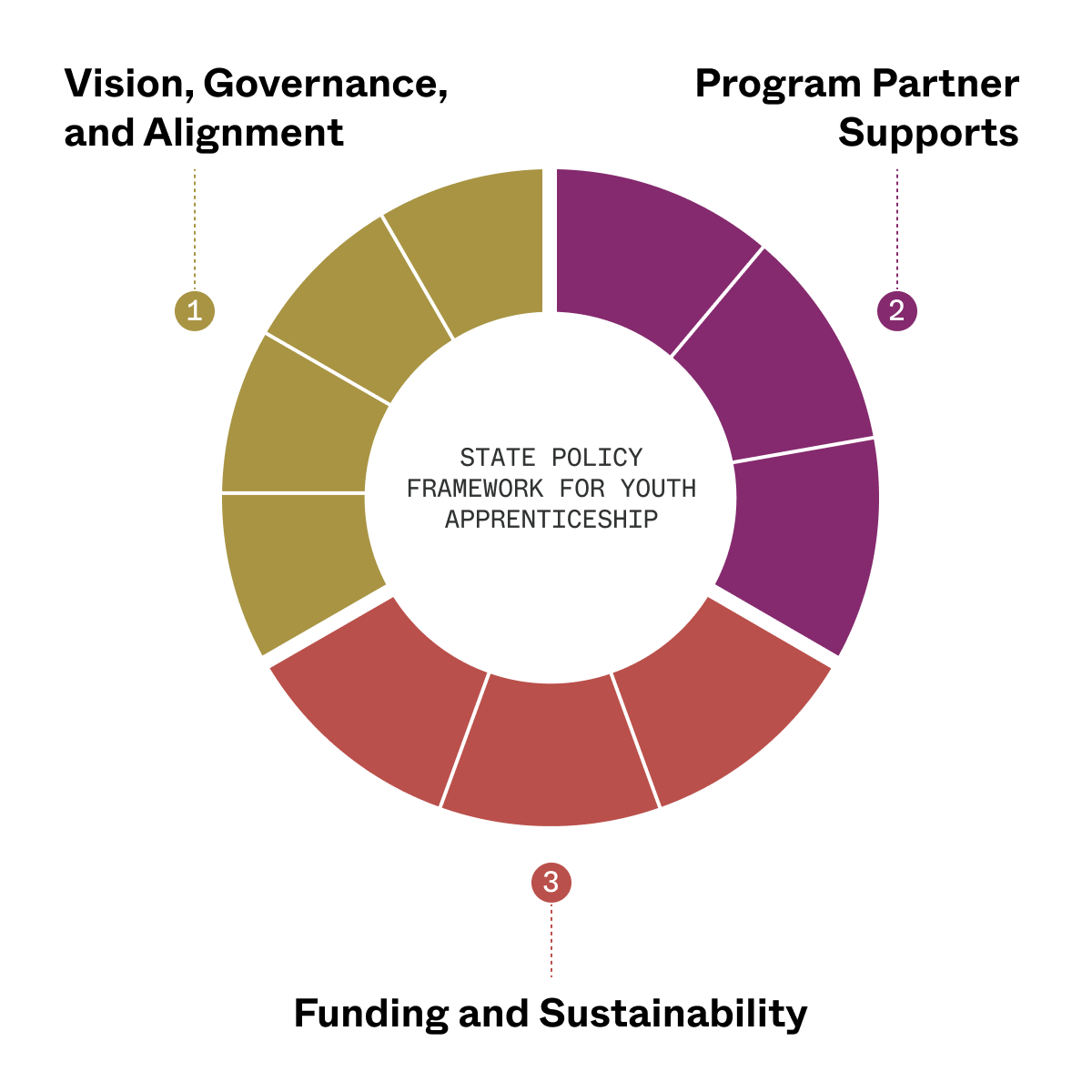
Many state leaders do not know where to start building the statewide policies and systems needed to make high-quality youth apprenticeship an accessible, widespread option for young people. This State Policy Framework for Youth Apprenticeship offers a vision for a strong state youth apprenticeship policy environment and identifies three key policy categories where states should focus their attention as they build their systems:
We have organized 10 essential state policy issues within these themes, each with a list of key elements that explain what adoption of this policy entails. Under each policy issue, we have included at least one state example. Our examples include a range of approaches, including some that have not been codified in state legislation, regulation, or formal policy documents. As policy is most durable when housed in these places, we hope states will strive toward a stable policy environment for youth apprenticeship that endures through transitions.
The policies recommended in this framework support the vision of high-quality youth apprenticeship as PAYA has defined it, where programs are a true postsecondary option: They begin in high school, include paid on-the-job training, provide classroom-based related instruction and assessment against established standards, and culminate in both a credential of value and postsecondary credit. Many states have created their own definitions of youth apprenticeship, some of which meet PAYA’s definition. While we acknowledge the different approaches states have taken, this framework is designed to help states realize a youth apprenticeship system that aligns with PAYA’s definition and vision.
A fillable PDF version of the framework is available as a companion resource and self-assessment tool to allow policymakers to take stock of their progress and identify opportunities for growth.
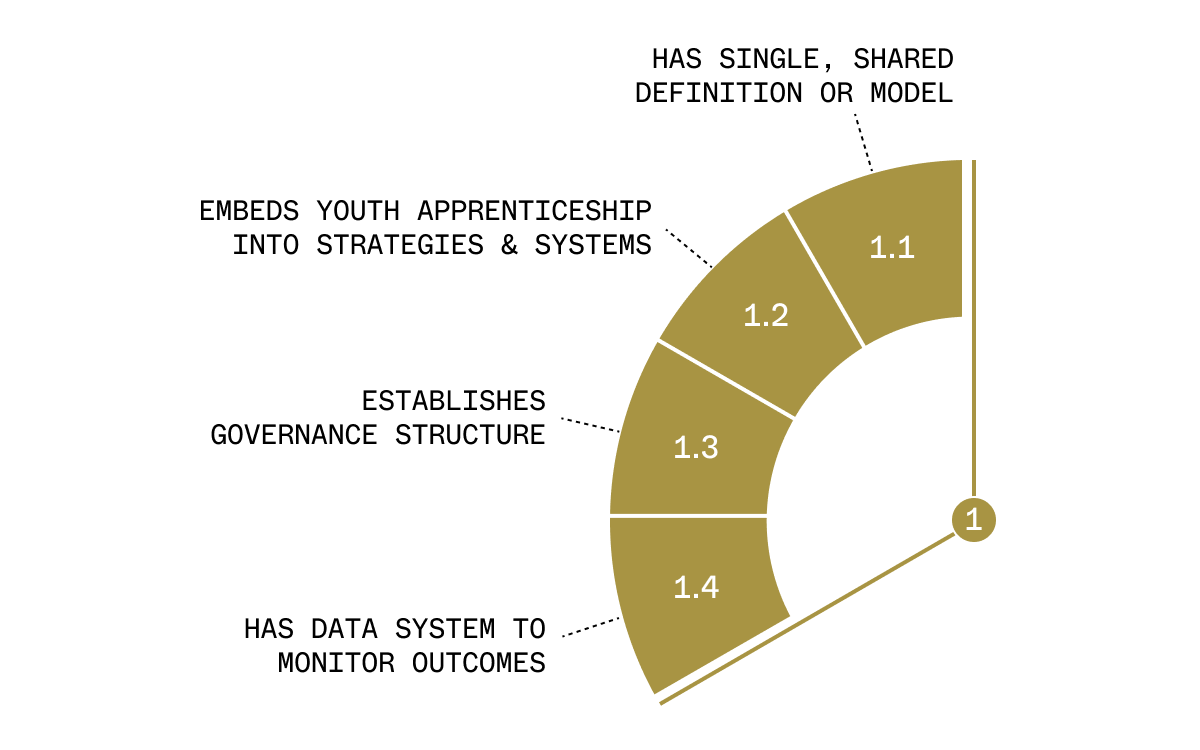
State agencies and partners need a common vision and governance structure to coordinate youth apprenticeship models that, by design, span K–12 education, postsecondary education, and workforce development systems. A clear, shared vision ensures all partners understand why youth apprenticeship matters for them and what quality looks like, while governance structures provide infrastructure for state agencies and partners to collaborate. The policy issues in this category aim to move states away from multiple agencies supporting youth apprenticeship and toward a coordinated state system for youth apprenticeship.
New Jersey: The definition of youth apprenticeship outlined in New Jersey’s Work-Based Learning Handbook (see page 42) specifies that youth apprenticeship is Registered Apprenticeship and that students must be at least 16 years old and enrolled in a state-approved CTE program. The handbook also says that programs must provide academic credit to youth apprentices for their apprenticeship, conduct safety training for apprentices at school and work, and align competencies with the state’s learning standards.
Illinois: This is one of 11 states that has defined youth apprenticeship as distinct from Registered Apprenticeship. The Illinois Career Pathways dictionary describes youth apprenticeship as a program in which youth (ages 16 to 24) in high school or pursuing a high school equivalency, including those with disabilities, complete 450 hours of paid on-the-job training and at least two semesters of related instruction coursework. The definition explicitly includes two vulnerable populations: out-of-school youth and youth with disabilities. The definition includes other quality elements programs must include, like wraparound supports and assessments that measure skill mastery. It requires programs to assist apprentices in applying to further career and education opportunities, including Registered Apprenticeship, upon completion of their youth apprenticeship.
Kentucky: The state’s youth apprenticeship model, Tech Ready Apprentices for Careers in Kentucky (TRACK), is a longstanding collaboration between the Department of Education’s Office of Career and Technical Education and the Kentucky Office of Apprenticeship. TRACK, which serves high school CTE concentrators, is highlighted as a core strategy in the state’s Workforce Innovation and Opportunity Act (WIOA) and Carl D. Perkins Career and Technical Education Act (Perkins) plans for meeting workforce and education goals. The state includes TRACK outcomes in district accountability measures. Industry-recognized credentials that students earn through TRACK can count toward career readiness indicators. In fact, a TRACK youth apprentice could potentially meet all four of the state’s postsecondary readiness indicators, which, under the state’s CTE performance incentive funding model, would mean more money for districts with TRACK apprentices.
South Carolina: Apprenticeship Carolina, a division of the state’s technical college system, is the lead for youth apprenticeship, while colleges within the system serve as local lead partners. Apprenticeship Carolina supports key functions like program development and stakeholder engagement. Apprenticeship Carolina consultants work with employers and industry associations, learning about their skills needs and connecting them to colleges and school districts to build apprenticeship programs. Consultants also coordinate with the U.S. Department of Labor, which approves programs, to ensure a smooth approval process and administer federal apprenticeship grants.
Utah: In 2026, Utah passed legislation authorizing a Statewide Youth Apprenticeship Governance Council. The council will define and formalize state agency roles and responsibilities in administering youth apprenticeship, coordinate state partners, and build data collection and reporting systems. The council will also establish a state definition of youth apprenticeship, quality standards, and a strategy for youth apprenticeship expansion. The legislation stipulates which offices and stakeholders across the K–12 education, higher education, and workforce systems must be represented on the council. The council also includes representatives from employer partners and school districts.
Kentucky: The Kentucky Center for Statistics (KYSTATS), a longitudinal data system, tracks and publishes data on participants in its youth apprenticeship program, TRACK, and other education and workforce programs in the state. For example, a report from PAYA National Partner Education Strategy Group found that about 80 percent of TRACK participants transition into full, adult registered apprenticeship programs. While KYSTATS makes data public through reports and dashboards, the state’s Department of Education’s Office of Career and Technical Education provides professional development training for educators on how to analyze and interpret the data and how to use it as a storytelling tool.
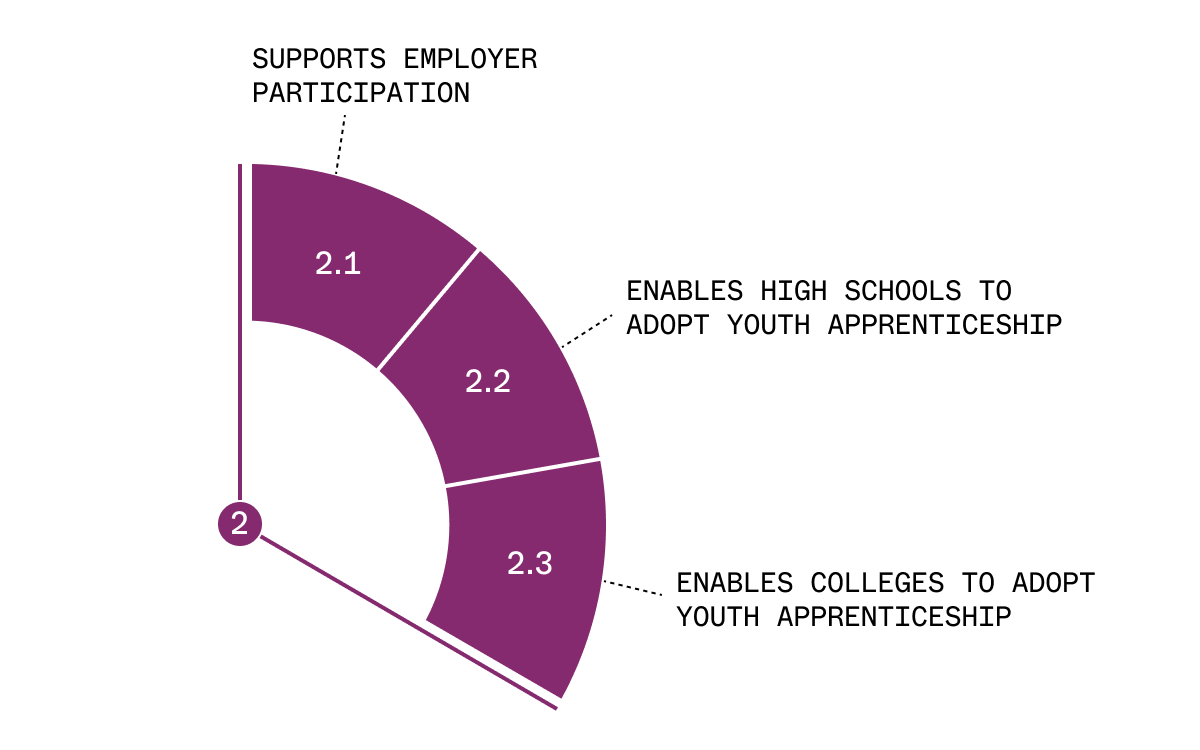
Employers, institutions of higher education, school districts, and other local partners translate state policy and priorities into practice, but they often face barriers related to capacity and alignment. State policy can reduce these points of friction by allowing youth apprenticeship to integrate in the K–12, higher education, and workforce systems. The policies in this category suggest ways states can equip a core network of partners to develop and implement high-quality youth apprenticeship statewide.
Kansas: The Office of Registered Apprenticeship partnered with the Kansas Department of Insurance (KDOI) to dispel the myth that hiring youth apprentices increases workers’ compensation costs. The guidance includes a letter from KDOI stating that “KDOI has not identified any statutory or regulatory barriers in obtaining workers compensation for registered apprentices,’’ including those under 18. The Office of Registered Apprenticeship has promoted the guidance to stakeholders, displaying it prominently on the state’s youth apprenticeship website and actively sharing it with education partners statewide.
Maryland: In 2026, the Maryland Apprenticeship Incentive Program launched, a funding opportunity for youth apprenticeship employers or sponsors to encourage their participation. The state will reimburse employers or sponsors up to $7,500 for each apprentice in Maryland’s high school level of Registered Apprenticeship, once the apprentice has completed seven months of an apprenticeship. Sponsors and employers can use the funding to cover training and recruitment costs, as well as costs associated with providing disability accommodations or supportive services for apprentices.
Oregon: The Work-Based Learning Handbook explains how youth apprenticeship and pre-apprenticeship fit into the state’s WBL continuum. The handbook defines criteria for high-quality WBL informed by equity considerations and designed to support continuous improvement. It provides guidance on building these criteria into a youth apprenticeship or pre-apprenticeship program and aligning apprenticeship opportunities with CTE programs of study.
Indiana and Florida: Both states have secondary course codes for youth apprenticeship, which allow school districts to provide students with academic credit for participating in apprenticeship programs.
Indiana added a course code for youth apprenticeship in the 2025–26 edition of its High School Career and Technical Education Course Titles and Descriptions, published by the Indiana Commission for Higher Education. This new course code is designed for youth apprenticeships that are not aligned with an established CTE program of study. For apprenticeships that are aligned with a program of study, the state recommends using existing CTE course codes.
The Florida Department of Education’s Curriculum Frameworks provide course codes for both high school pre-apprenticeship and high school apprenticeship–related instruction. Students completing on-the-job training for their apprenticeship should also enroll in Cooperative Education On-the-Job Training, which is a course for paid training completed off-campus as part of a work-based learning program like apprenticeship.
Maryland: In 2022, the Maryland Department of Labor and the Maryland Higher Education Commission issued joint guidance on the roles colleges can play in Registered Apprenticeship, including the high school level of a Registered Apprenticeship, and the Apprenticeship Maryland Program, the state’s youth apprenticeship model that is not federally registered. The guidance lays out how colleges can serve as sponsors and related instruction providers and the requirements of those roles. The guidance encourages colleges to develop transparent and equitable processes for awarding credit for prior learning for Registered Apprenticeships, including those that begin in high school.
Ohio: The Ohio Department of Higher Education provides two statewide transfer initiatives that allow youth apprentices to receive college credit for their apprenticeship experience. The Industry Recognized Credential Transfer Assurance Guides outline the industry-recognized credentials eligible for postsecondary credit at the state’s public colleges. Credential holders are eligible for this credit regardless of where or how they earned their credential, including in high school. Ohio also has Career-Technical Assurance Guides, which provide for the awarding of college credit for approved high school CTE coursework. The state created a credit transfer tool, where apprentices can input their earned credentials and completed CTE programs to see a list of equivalencies at higher education institutions in the state.
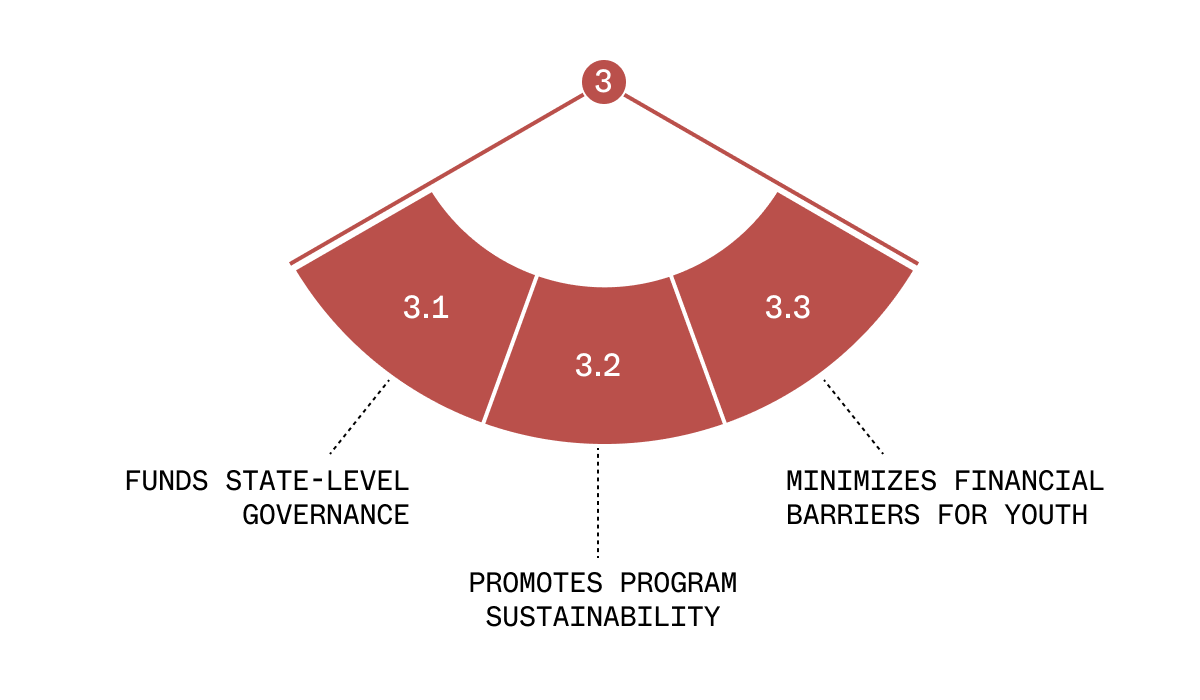
Reliable funding mechanisms enable youth apprenticeship programs to build the capacity, partnerships, and infrastructure needed for long-term success. Many states already fund critical pieces of the youth apprenticeship infrastructure, but need to rethink how they leverage, align, and braid those resources to make youth apprenticeship affordable for all stakeholders. The goal of this category is to move states from fragmented, short-term funding to sustainable, aligned funding that supports quality and scale.
Wisconsin: The Department of Workforce Development (DWD) has a team dedicated to leading the state’s youth apprenticeship program. This six-person team, funded via recurring state appropriations, has three key functions: oversight, quality control, and training; administration of the state’s youth apprenticeship grants to local partners; and the development of occupational pathways. Wisconsin’s youth apprenticeship office supported over 12,000 apprentices and 8,000 employers in the 2025–2026 school year.
Utah and South Dakota: Some states fund a statewide youth apprenticeship coordinator position to support state-level governance of youth apprenticeship.
Utah did not just create a governance system for youth apprenticeship (see 1.3) but also funded a position, state director of youth apprenticeships, to lead Talent Ready Apprenticeship Connection, Utah’s model for youth apprenticeship. It is housed between the governor’s office and Talent Ready Utah, an initiative in the Utah System of Higher Education that develops industry-aligned talent pipelines.
South Dakota created an apprenticeship coordinator position in 2026. This person will work with South Dakota high schools to create apprenticeship programs for students and local employers.
Wisconsin: The Wisconsin Youth Apprenticeship Grant Program reimburses local partnerships—called consortia—up to $1,100 per enrolled youth apprentice. The funding goes to each consortium’s lead organization, usually a school district, technical college, regional education agency, or workforce board. The state awarded $13.5 million in youth apprenticeship grants in 2026–27. This funding supports the coordination and administration activities consortia partners take on to implement youth apprenticeship, like recruiting employers, collaborating with high schools, and ensuring compliance with state requirements. Wisconsin is the only state to provide recurring funding to local youth apprenticeship partnerships.
Colorado: Apprenticeship Colorado, the state apprenticeship agency, recognizes and awards competitive grants to Qualified Apprenticeship Intermediaries (QAI). The 2024 legislation authorizing them says QAIs advance Registered Apprenticeship by connecting employers and learners, including youth, to apprenticeship programs or by convening partners to develop new programs. Many approved QAIs serve youth. The legislature also authorized a three-year grant for QAIs with the aim of expanding programs and diversifying the apprentice population and the geographic distribution of apprenticeship programs.
California: Since 2024, the state has awarded the California Opportunity Youth Apprenticeship (COYA) Grant to increase the participation of opportunity youth—young people disconnected from school and work—in apprenticeship and reconnect them to education, training, and support services. Grants are awarded to “nonprofit organizations partnering with high schools and industry leaders” to implement pre-apprenticeship or Registered Apprenticeship programs for opportunity youth. Grantees can use the funding to cover supportive services for apprentices or to launch and expand a program. Those serving pre-apprentices can use their award on supportive services, training, recruitment, and administrative costs or an educational stipend for the pre-apprentice.
North Carolina: Aligned funding streams across secondary and postsecondary systems ensure that as apprentices transition from high school to college, tuition isn’t a barrier to completion. The state’s Career & College Promise program provides free dual enrollment for high school students, including pre-apprentices and Registered Apprentices. North Carolina also provides a tuition waiver to recently graduated high school students who either enroll in an approved pre-apprenticeship during high school and continue in a Registered Apprenticeship within four months of high school graduation, or start a Registered Apprenticeship in high school and continue in the program after graduation. The waiver covers community college tuition until their apprenticeships are completed, so sudden new tuition costs won’t force them to quit their program.
Minnesota: Since 2021, Minnesota policy has stated that income earned through “student training programs” should be excluded when calculating household eligibility for cash assistance programs. Paid apprenticeship and pre-apprenticeship are named in the state’s examples of student training programs. This policy ensures that youth in apprenticeship or pre-apprenticeship programs won’t lose social welfare benefits because of apprenticeship earnings.
Kentucky and Washington: Aligning funding to support youth apprenticeship doesn’t require new funding streams. In both states, policymakers opted to clarify or change eligibility rules for state higher education scholarships rather than create new apprenticeship-specific programs.
In Kentucky, TRACK apprentices are eligible for Kentucky’s Educational Excellence Scholarship (KEES), which covers postsecondary education and training. A 2022 press release from the Kentucky Higher Education Assistance Authority said, “High school graduates can use KEES funds to be reimbursed for costs for approved registered apprenticeship or qualified workforce training programs.”
Washington State’s College Grant expanded its eligibility rules in 2020, to allow apprentices to cover costs associated with their apprenticeship programs.
Over the last decade, states have made progress in experimenting with and expanding youth apprenticeship. The next step is to strengthen both the programs themselves and the systems needed to support their growth and sustainability. This policy framework is designed to help state leaders assess where their policies and infrastructure are working well, identify gaps, and prioritize changes that can support improvement and expansion.
The policies in this framework’s three categories—vision, governance, and alignment; program partner supports; and funding—are interconnected and mutually reinforcing. States do not need to address every policy issue at once. They can use this framework to identify policy priorities based on their infrastructure, goals, and context.
Ultimately, effective youth apprenticeship policy must create the conditions for programs to launch and become sustainable, mainstream postsecondary options, so that both students and employers want to participate. By removing barriers, aligning systems, strengthening partnerships, and investing in infrastructure, states can move youth apprenticeship from a promising set of programs to a durable, high-quality statewide system that meets employers’ needs and expands access to meaningful learning, good jobs, and long-term economic opportunity for all young people.
We would like to thank Taylor White for her thought partnership and support throughout the development of this framework and Braden Goetz, Ivy Love, Morgan Polk, Erica Simon, Alexandra Simon, and Ivy Sullivan for their generous contributions. Thanks also to Liz Cory and Magdalena Navracruz for their design and visualization support and Katie Portnoy, Mandy Dean, and Sabrina Detlef for their communications support. We are grateful to Vanessa Bennett and Krysti Specht of Jobs for the Future (JFF) and Conor Freeley and Michael Qualter of CareerWise for their feedback on drafts of the framework. And most importantly, thanks to the state and program leaders we have worked with over the years who have helped us understand what it takes to build a statewide ecosystem that supports durable, high-quality youth apprenticeship programs.
New America is grateful to PAYA’s funders—the Andrew Carnegie Foundation, the Annie E. Casey Foundation, Bloomberg Philanthropies, JPMorgan Chase & Co., the Siemens Foundation, the Smidt Foundation, and the Walton Family Foundation—for their support of the initiative and publications like this one.
Senior Policy Analyst, Center on Education & Labor
Senior Policy Manager, Postsecondary Pathways for Youth