CESNA_State_Policy_Agenda.pdf
Government leaders across the United States are struggling to build dynamic and competitive economies in which the benefits of economic growth are broadly shared.
Government leaders across the United States are struggling to build dynamic and competitive economies in which the benefits of economic growth are broadly shared. Whether a state is recovering from the loss of its traditional manufacturing base, trying to fill skills gaps, or working to increase access to high wage jobs in sectors like information technology and healthcare, developing a broad base of educated and skilled workers is critical. States are seeking ways to make college more affordable and build their STEM workforce, but many find that traditional higher education is not enough to develop and retain workers.
Apprenticeship can meet the talent development needs of a wide range of industries while increasing access to good jobs for many more Americans. The programs generate excellent outcomes: apprentices leave their programs with valuable work experience, networks, credentials, and the ability to move into well-paying jobs. More than 80 percent of apprenticeship completers move directly into jobs with the employer who sponsored the apprenticeship.
What is Apprenticeship?
Apprenticeship is a proven education and workforce strategy that combines paid, structured, on-the-job training with related classroom learning. Our national system of Registered Apprenticeship was established in 1937 and has been successfully serving job seekers and employers ever since. While traditionally associated with the skilled trades, it is spreading into industries like healthcare, IT, advanced manufacturing, and financial services.
Registered Apprenticeship programs have five key elements that ensure they are high-quality and meet the needs of both employers and apprentices:
- Paid, structured, on-the-job learning
- Related classroom-based instruction
- Ongoing assessment against established skills and competency standards
- Wage increases commensurate with demonstrated increases in skills and abilities
- Culmination in a portable, industry-recognized credential
Registered programs are built on partnerships between employers and educators, often a community college or joint training fund, who collaborate on the development of curricula and competency standards. A growing number allow apprentices to earn college degrees.
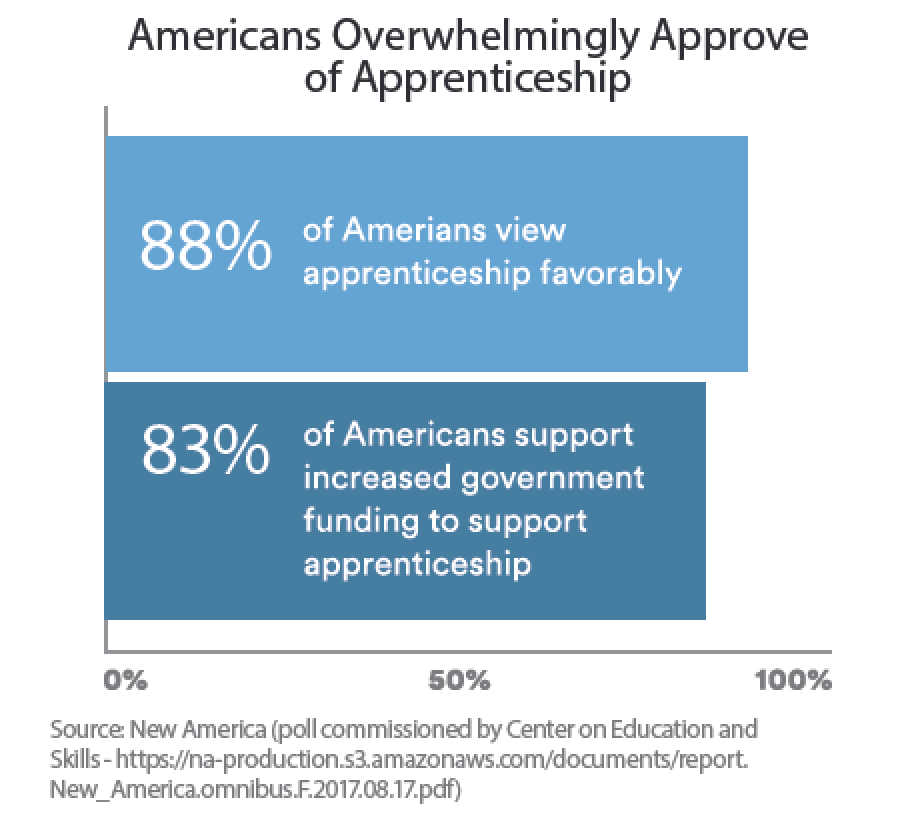
What Can Apprenticeship Do for Your State?
Among the many pressing economic and workforce development challenges facing state leaders, apprenticeship can help:
- Develop state and local economies: Stable, well-paid, middle-skill jobs are the linchpin of many state economic development strategies, but the employers that provide them face stiff talent demands. Ten years ago, South Carolina launched Apprenticeship Carolina to help meet the skill needs of German and Swiss companies. Since then, the state has helped set up more than 900 new apprenticeship programs, connected thousands of residents to well-paying jobs, and attracted new companies to the region.
- Provide an affordable path to and through college: Good jobs in America today require postsecondary education and,increasingly, a college degree. But higher education is more expensive than ever before. With the right partnerships and policies, apprenticeship offers an additional strategy for building a college-educated workforce while also addressing equity gaps in degree attainment and access to good jobs. For example, Harper College in Illinois has partnered with insurance giant Aon on a two-year Registered Apprenticeship program that culminates in an associate degree.
- Upskill and retrain workers: As jobs grow more knowledge-intensive, Americans need access to education
and training throughout their lives. Apprenticeship programs can be designed to help companies upskill their current workforce, which is often more cost-effective than providing tuition assistance to workers to train on their own time. Apprenticeships can also help experienced workers transition successfully into new careers. For example, Amazon has been using apprenticeship to train veterans for jobs in cloud computing, easing their transition into civilian jobs. - Connect underserved populations to education and employment: Every state has residents that face particular challenges getting into the labor market. Apprenticeship programs can help individuals overcome some of the most common barriers to employment, such as lack of work experience or credentials. For example, in Pennsylvania, state workforce and education agencies have teamed up with the Mayor of Philadelphia, Temple University, and local non-profits to build apprenticeships that help individuals transition into society after incarceration.
- Build opportunity in rural communities: Too often, young people growing up in rural areas have to leave their communities to access postsecondary education and good jobs. Apprenticeship programs can create opportunities for young people to learn valuable skills and gain credentials without having to move away. Montana, for example, has hired field representatives in industries like healthcare to convene education and business leaders to develop degree apprenticeships for rural and remote areas.

Core Components of a State Apprenticeship Infrastructure
Developing a statewide apprenticeship system that can address specific state priorities requires a policy and programmatic infrastructure. Successful apprenticeship systems depend on communication across a diverse array of stakeholders, including employers, education providers, and state and local agencies. They also require well-targeted financing strategies and performance management systems. There is no one-size-fits-all approach, but state leaders can:
Help create and sustain employer engagement: Apprenticeship cannot grow without steady demand from employers, and that requires ongoing outreach, marketing, and technical assistance. Many employers need help understanding how apprenticeship can meet their talent development needs. South Carolina has funded several full-time staff positions to support employer outreach efforts, a core element of its statewide strategy.
Encourage robust partnerships between employers and education providers: Apprenticeship combines rigorous on-the-job and classroom learning, which means that educators and employers have to work together on program design. That can present challenges. In Colorado, the governor established the Business Experiential Learning (BEL) Commission and charged it with laying a foundation for educators and employers to work together, a task that is now the responsibility of Careerwise Colorado, a statewide apprenticeship intermediary.
Coordinate across state and local agencies: Every state has a representative from the U.S. Department of Labor (DOL), and some states have state apprenticeship councils that register new programs. State workforce systems can provide supports to both apprentices and employers. Community colleges and a state’s career and technical education system can connect apprenticeship programs to conventional higher education. Economic development agencies can identify skills gaps, while TANF and SNAP programs can provide funding for tuition or wrap-around services. Without regular communication among these agencies, efforts to expand apprenticeship can stall.
Target funding and incentives: Apprenticeship programs can be expensive for companies to start, requiring some re-engineering of internal business processes and hiring practices. The classroom component of an apprenticeship program can also be expensive. States have addressed these challenges through a variety of strategies. South Carolina created a $1,000 tax credit for every apprentice a business employs. California and New Jersey recently launched grant programs to help businesses with start-up costs. North Carolina’s General Assembly provides annual funding for a tuition waiver that allows apprentices in high school to take community college courses for free.
Collect and evaluate data: Establishing clear protocols for collecting data and evaluating the performance of apprenticeship programs is critical to the success of any state strategy. Registered Apprenticeship programs are required to report outcomes data directly to DOL. States like Iowa and Mississippi have developed data-sharing agreements with DOL that allow them to collect and analyze program-level data. North Carolina has created demographic indicators to track progress toward equity goals.

Where to Start
Step 1: Determine your state’s goals
Apprenticeship can improve the prosperity and productivity of a state’s residents and increase the viability of its employers and industries. Before launching an apprenticeship initiative, leaders need to be clear on the specific challenges they wish to address. Your state’s economic development, workforce training, equity, or other goals need not be mutually exclusive, but they must be well-articulated in order to inform the policy infrastructure and the specific metrics used to determine whether apprenticeship is having the desired impact.
Step 2: Take stock of the apprenticeship landscape
Understanding how, if at all, your state has invested in apprenticeship programs in the past and the outcomes of those investments will help shape policy and legislative priorities moving forward. Understanding which agencies have the jurisdiction to fund, approve, and monitor apprenticeship programs is critical for determining how to best leverage and enhance existing infrastructure for apprenticeship.
Step 3: Identify the stakeholders integral to your strategy
Quality apprenticeship involves a wide range of organizations, including (but not limited to) employers, industry associations, labor-management organizations, state and local public workforce systems, education providers, and community-based organizations. Whether investing in apprenticeship to increase affordable access to college or to get individuals with barriers to employment on a path to family-sustaining careers, be sure to convene the appropriate entities to build and execute your strategy.
Step 4: Prioritize key industry sectors
No matter what goal your state is trying to achieve through the implementation of an apprenticeship strategy, it is essential to prioritize high-growth or emerging sectors based on an assessment of labor market information. Since an apprenticeship is a compact between employers and workers, understanding the local labor market and training needs of employers is crucial to ensuring a steady demand for apprenticeships.
Step 5: Establish metrics to measure progress
To support the continuous improvement of your state apprenticeship strategy and determine whether it is on track to meet its goals, conduct formal and informal assessments of program development; apprentice participation and completion; labor market outcomes; and coordination among key stakeholders in the apprenticeship system.

About Us
The Center on Education & Skills at New America (CESNA) is a research and policy development program focused on the intersection of our higher education, job training, and workforce development systems. For more apprenticeship resources from New America, please visit newamerica.org/apprenticeship or email apprenticeship@newamerica.org.
Get the PDF of this report here.
Downloads
More About the Authors