State Fiscal Stabilization Fund Application Update #4

The Department of Education recently approved the State Fiscal Stabilization Fund (SFSF) applications of five more states – Arizona, Colorado, Connecticut, New Jersey, and Ohio – the District of Columbia. These states join the 26 states/territories that have already begun to receive funds. As of June 12th, nearly $3.9 billion in SFSF monies have been disbursed to states. (Previous posts analyzing the applications of the first 26 states/territories can be found here, here, here, and here.)
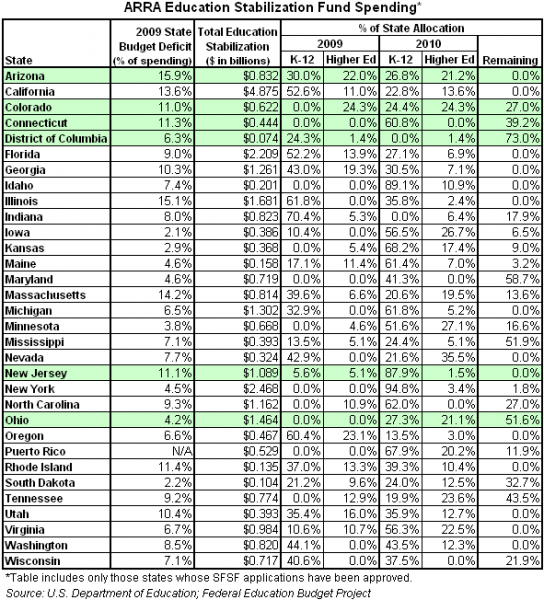
These five additional states and one district make up another $4.5 billion in Education Stabilization funds and $1.0 billion in Government Services funds under the American Recovery and Reinvestment Act of 2009. Unlike the most recent batch of approved applications, many of these states/districts are expected to face relatively high 2009 budget deficits as a percent of total state spending. According to the Center for Budget and Policy Priorities, Arizona is expected to face the largest budget deficit of all 50 states – 15.9 percent – while Ohio will experience the smallest of these six – 4.2 percent. Colorado, Connecticut, and New Jersey will all have deficits at or above 11.0 percent.
Surprisingly, Connecticut, despite its 11.3 percent predicted 2009 deficit, has elected to spend all of its SFSF Education Stabilization funds in 2010 rather than 2009. The only other states that have allocated all of their Education Stabilization funds to 2010 are Idaho, Maryland, New York, Ohio, and Puerto Rico. None of these states/territories have an expected 2009 deficit above 7.4 percent.
Arizona, on the other hand, has distributed its expenditure of Education Stabilization funds quite evenly between fiscal years 2009 and 2010 and K-12 and higher education purposes. It will spend 30.0 percent of funds on in 2009 and 26.8 percent in 2010 on K-12 and 21.4 and 22.0 percent on higher education in each year, respectively. No other state as allocated as even a distribution between K-12 and higher education in both years, likely due to the expansive higher education system in Arizona and their large pending deficit.
Colorado, Connecticut, the District of Columbia, and Ohio all expect to have significant amounts of their Education Stabilization funds remaining in 2011, as much as 73.0 percent in DC and 51.6 percent Ohio. This is unusual given the large deficits Colorado and Connecticut both anticipate. Although DC’s 2009 deficit will be under 7.0 percent, it will have more Education Stabilization funds remaining for 2011 than it spent in 2009 and 2010 combined. These funds will be distributed to the District’s charter and traditional LEAs via Title I formulas.
Government Services funds under the SFSF can be used for education purposes as well as other services like public safety and health care. Each state’s governor determines how funds will be used. Four of the recently approved states/districts will use at least some Government Services funds for K-12 purposes. Three of them will use these funds for higher education purposes and one will use some of the funds for “education data collection and analysis.” Other stated uses include public assistance, public safety, public housing, and agriculture.
Since our last update, the Department of Education has begun to release both a state’s approved SFSF application and its initially submitted application. This allows stakeholders to compare a state’s initial plans for SFSF monies with the final allocations. It appears that 10 additional states have submitted applications that have yet to be approved.
Additionally, Secretary Duncan released deadlines for the Race to the Top funds:
- Late July: Proposed rulemaking released.
- October: RFP published in the Federal Register.
- December: Phase 1 applications due.
- March 2010: Phase 1 grants awarded, winners announced.
- June 2010: Phase 2 applications due.
- September 2010: Phase 2 grants awarded, winners announced.
Ed Money Watch will continue to provide updates on the SFSF applications. Please check back for this coverage.
More About the Authors
Issues
Related


Misrepresenting Accreditation: A Q&A with Melissa Ryan

Trump Budget Torches Community College Workforce Programs