State Fiscal Stabilization and Higher Ed in Pennsylvania

Something funny is happening in Pennsylvania. Last Friday, Pennsylvania Governor Ed Rendell submitted the state’s State Fiscal Stabilization Fund (SFSF) application to the U.S. Department of Education. Although the application allocates funds to K-12 education, community colleges, a college of technology, and the state university system, it purposely leaves out the state’s four “state-related universities.” These four institutions – Pennsylvania State University, University of Pittsburgh, Temple University, and Lincoln University – expected to receive more than $41.9 million under the state’s original SFSF application.
The governor justifies the controversial move claiming that the four institutions are not under the “absolute control of the Commonwealth,” meaning that he has no influence over how they allocate funds or set tuition levels. Similarly, the institutions do not receive funds from the state university system. Instead, they are funded via a “non-preferred appropriation,” also referred to as “an appropriation to any charitable or educational institution.” However, these funds are allocated through the General Fund Budget, just like funding for the state’s Thaddeus Stevens College of Technology, which remains in the SFSF application. But this change may violate SFSF guidance which requires states to distribute SFSF monies to K-12 and higher education according to their share of the state’s budget deficit.
Excluding “state-related universities” from the SFSF application is in direct contrast to the preliminary application Governor Rendell signed in late April. That application lists the amount each of the four institutions would receive under the SFSF given state expenditures. Penn State was slated to receive $20.3 million, Pitt and Temple were each to receive more than $10.2 million and Lincoln was to receive just under $900,000.
News reports suggest that Governor Rendell believes that these four institutions are not public universities even though they receive some tax-payer funding. At the same time, representatives from the four excluded institutions have raised concerns over the effect it will have on their institutions and students, particularly with respect to tuition increases.
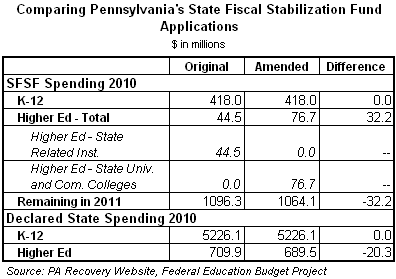
But what does this change really mean? Pennsylvania has declared that it will not spend any SFSF monies in fiscal year 2009 on either K-12 or higher ed. As a result, all of their SFSF monies will be spent in 2010 and 2011. A closer look at the original SFSF application reveals that the governor initially intended to give SFSF monies only to the state-related institutions and the Thaddeus Stevens College of Technology, totaling $44.5 million. Not including state universities and community colleges in the original application means that he had originally planned to maintain all funding for the state universities and community colleges through state funds.
But the amended higher education SFSF allocation is $32.2 million more than in the original application. This suggests that the governor decided to include the state universities and community colleges in the SFSF allocations to the tune of $76.7 million while excluding the state-related institutions completely. It looks like he plans to hit them with severe budget cuts and not provide any federal funds to make up the difference.
Beyond that, Pennsylvania lowered its declared spending of state funds on higher education in 2010 in its amended application. In fact, the state says it will spend $690 million in state funds in 2010 rather than the original $710 million. This $20 million difference may account for differences in spending between the state-related institutions and the state universities and community colleges.
Pennsylvania is on shaky ground with these amendments. The SFSF guidance requires states to distribute their SFSF between K-12 and higher education in proportion to each sector’s share of the budget deficit. According to 2009 budget documents, Pennsylvania spent more than $477 million on state universities, $236 million on community colleges, and nearly $670 million on state-related universities. If Governor Rendell plans to cut budgets for the state-related universities as he as previously threatened, then the guidance should compel him to include them in the SFSF allocations because they make up such a large proportion of state higher ed spending.
Hopefully Pennsylvania’s exclusion of state-related universities from the state’s declared baseline spending, as well as the actual SFSF allocations will send up a few flags as the Department of Education reviews the application. Otherwise, Pennsylvania college students may be in for a rather rude awakening when new tuition levels are set for the fall.
More About the Authors
Issues
Related


Misrepresenting Accreditation: A Q&A with Melissa Ryan

Trump Budget Torches Community College Workforce Programs