Table of Contents
- Executive Summary
- I. Introduction
- II. The Origins of Iran’s Afghan and Pakistani Shi’a Networks
- III. Crossroads in Khuzestan: Afghan Shi’a Mobilization During the Iran-Iraq War
- IV. The Arab Spring: A New Phase of Iranian Proxy Warfare Strategy
- V. Keeping the Faith in Sacred Defense
- VI. Spinning the Fatemiyoun: Raising an Army of Disposable Afghan Diaspora Online
- VII. The Future of the Fatemiyoun Division
- Conclusion: Soleimani’s Legacy and What it Means for the Future of Proxy Warfare
- Appendix I-Timeline: The Rise of Iran’s Afghan Shia Cadres
- Appendix II-Prominent Fatemiyoun Propaganda Organizations and Groups
V. Keeping the Faith in Sacred Defense
Iran Revives the Shia Jihad Narrative
After Hamedani’s freshly trained local militia forces successfully repelled a rebel attack near the presidential palace in early 2013, Assad gave Hamedani a much freer hand to build out a unified command structure for local Alawite and Shia paramilitaries under the National Defense Forces.1 Yet, Assad’s forces continued to lose ground to rebel forces affiliated with Jabhat al-Nusra. When, in the spring of that same year, Jabhat al-Nusra began shelling the Sayyida Zainab Mosque and was nearly at the gates of the suburban Damascus shrine complex where Ali and Fatima’s daughter and the Prophet Muhammad’s granddaughter is buried, Soleimani saw in the onslaught an opportunity to turn the tide.2
Before the 1979 Iranian revolution, the site of the Sayyida Zainab shrine was considered a lesser stop along the Shia route of Middle Eastern Shia pilgrimage sites, but after Iran financed improvements to the site that saw the construction of the site’s iconic golden domed mosque in the 1980’s it began to attract more visitors.3 Traffic to the site and its significance as a cultural node in Syria began to increase in the late 1980s and early 1990s when senior Shia leaders also pushed for the construction of a tomb and schools and offices nearby.4 Toward the end of the Iran-Iraq War in the 1990s, small waves of itinerant Afghan construction workers and former fighters began flocking to the site and formed a small community there.5
Situated in an area of suburban Damascus that for decades has been predominantly Sunni, the Sayyida Zainab shrine was a point of sectarian friction even before the Arab Spring brought tensions to a high boil.6 While the steady stream of Twelver Shia pilgrims that flooded the site each summer provided an economic boost to the area, their open displays of religious rituals occasionally provoked hostile responses from locals. Not surprisingly, the shrine also emerged as a central battleground in the early stages of Syria’s civil war. Jabhat al Nusra’s attacks on the Sayyida Zainab shrine and its subsequent desecration of the shrine of Hujr ibn Uday, a closer supporter of Ali and son-in-law of the Prophet Muhammad, in the Damascene suburb of Adra in May 2013 compounded sectarian tensions fears. In a documentary about the Fatemiyoun's formation, Origin Story, the desecration of Uday incident is cited as the reason that Tavassoli decided to form the Fatemiyoun Division.7
The attacks provided a bitter reminder of unsettled scores and entrenched caste divisions that had long roiled the Middle East, providing an opening for Iran to expand its influence. In his televised statements, Soleimani connected the defense of the Sayyida Zeynab shrine to the Imam Ali Shrine in Iraq's Najaf, and the Imam Reza Shrine in Iran's Mashhad, warning that "if Syria falls to these [Sunni extremists]" they will destroy "Shiite sanctities." Soleimani referenced the 2006 bombing in Samarra, Iraq when he explained in his oral history how he coined the term "shrine defenders" at "the beginning of the Syria crisis."8 Although nearly seven years had passed since the bombing of the al-Askari Mosque of the Golden Dome in Samarra, Iraq, the sectarian fury the bloody event unleashed had in no way faded.9
Throughout 2013, Iranian media expanded coverage of "shrine defenders” who died on the battlefield in Syria, though it generally covered the funerals of non-Iranians killed in action; a reflection of the desire to limit the perception of Iranian involvement for both foreign and domestic audiences. The singular exception was the assassination of Quds Force general Hasan Shateri, also known as Hesam Khoshnevis, in February 2013 as he traveled from Damascus to Beirut, where he was stationed.10 Whether the fighter was of high-rank like Khoshnevis or a lowly Afghan foot soldier, the Sacred Defense narrative served two purposes: to draw more frontline recruits and to build a stay-behind cadre of support as an insurance policy in the event of Assad’s downfall. Should Assad be removed from power, the foreign fighters who answered the call to defend sacred Shia sites could theoretically serve as a bulwark in the creation of a much smaller Alawite-led statelet that would still allow Iran to maintain its land bridge to Lebanon and Hezbollah.11
Protection of the holy Damascene shrines of Sayyida Zeynab and Sayyida Roqayya proved a highly effective motivation for mobilizing proxy forces from across the region and from Afghanistan in particular, where Hazara communities repeatedly came under attack from Taliban insurgents from 2001 forward. Relying on a narrative of persecution also helped connect the fight in Syria to the fight against Sunni extremists in Afghanistan and Pakistan.12 Drawing on collective Shiite memories of persecution dating to the Battle of Karbala, Syria, Iran, and Hezbollah capitalized on it to mobilize Shiite fighters.13
Fatwas for jihad in Syria by loyalist senior clerics like the Qom-based Ayatollah Kabuli and Iraqi Ayatollah Kazem Ha'eri, who has a large following among Iraqi paramilitaries, provided religious legitimacy to the cause, though other prominent senior clerics in Qom and Najaf disputed the ruling.14 Those objections proved to be largely inconsequential. The call to defend the shrines in Damascus went viral on social media and spread by word of mouth. Registration forms for volunteer fighters soon began appearing online in Iran.15
The Sacred Defense movement was nascent, but it would gain momentum in 2014. The Syrian crisis was sectarian before Tehran's entry, thanks to the Alawite-dominated leadership's policies.16 However, Iran embraced the sectarian narrative of defending the Shiite faith against "takfiris," a term used to describe Sunni extremists who ex-communicate other Muslims, but also any and all opposition fighters to Assad.17
Enter Fatemiyoun and Zeynabiyoun
The first public news in the English language press about the Fatemiyoun appeared in 2014, including an article in the Wall Street Journal that reported that Afghans deployed for promises of money and residency.18 The early reporting on the Fatemiyoun generally created a perception that Afghans, as well as Iranians, who deployed to Syria were mercenaries, a notion that Iran and its supporters felt compelled to push back against. Fatemiyoun fans took to social media platforms like Instagram to refute the claims, saying that fighters only wished to protect the shrines and defend their faith, and that they only received small stipends.19
In the early phases of the Syrian conflict, the IRGC covertly recruited Shia from across the region as part of its mobilization to defend the Assad regime. The first waves of Afghan fighters were auxiliaries of Iraqi contingents in Syria.20 The founders of the Fatemiyoun were 22 Afghans, many of whom were veterans of the wars against the Soviets, Ba’athists, and Taliban.21 Tavassoli played a key role in mobilizing Afghans in Iran for the defense of the shrines in Syria, and Tavassoli’s own history illustrates how Iran’s mobilization of proxies during the Arab Spring drew on the networks developed in the 1980s and 1990s in Afghanistan and Pakistan.
Tavassoli had deployed to the Iran-Iraq War but was refused a position at the front because he was a teenager. He later saw action against the Taliban in the 1990s while fighting for the reconstituted remnants of the Sepah-e Mohammad forces. According to the Fatemiyoun documentary about Tavassoli’s life, he and other Sepah-e Mohammad and Abouzar Brigade veterans who resided in Mashhad kept in touch through religious gatherings.22 In the documentary, his spouse avers that Tavassoli started holding weekly meetings with other veterans to discuss the wars they fought, and that he gradually convinced some to join (See Figure 3). The very first group affiliated with Tavassoli’s circle of veterans deployed in May 2013, but Fatemioyun at this time was covert.23 The founders decided to change the name of the group from the Corpsman of Muhammad, a legacy of the Muhammad Corps decades earlier, to Fatemiyoun, meaning "Fatima’s people."24
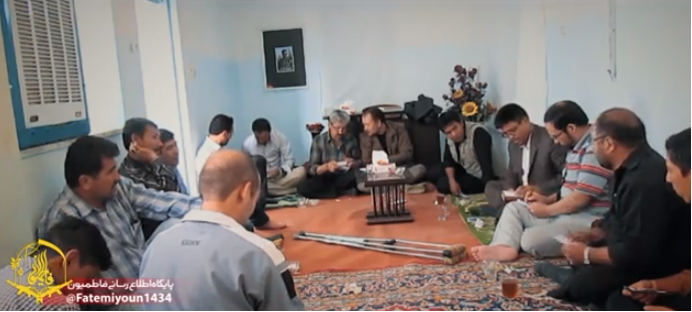
Footage from the documentary Time of Being in which a fighter recounts that Tavassoli gathered a meeting of 22 men to fight in Syria to "defend" the shrine.25
Most media accounts and oral histories of the Fatemiyoun Division credit Tavassoli with initiating the idea to form the Fatemiyoun in order to defend the shrines. The self-initiative account, however, seems unlikely. The IRGC at the time was overseeing the deployments of Lebanese Hezbollah and militant Iraqi-Shiite deployments to Syria.26 The Guard Corps likely obfuscates its role in the Fatemiyoun's formation to project an image that the narrative of the Islamic revolution was truly inspirational.
During this covert recruitment phase, Iranian media acknowledged some Afghan fatalities and directly tied them to the defense of the shrine. The first known official Fatemiyoun fatality was three months after the initial wave deployed to Syria in secret, but that death was hidden from the public because of "the people's lack of familiarity from Fatemiyoun Brigades jihadi activities in its early months," according to a report in IRGC-linked media years after the fact.27
In December 2013, documentary filmmaker Ruhollah Rafi'i told a gathering of Afsaran, a pro-IRGC group, that he met an Afghan in Syria who had gone to fight there on his own initiative, and fought as a component of the Syrian NDF (National Defense Forces).28 The filmmaker said that the Afghan was there to "defend the Islamic revolution" and the shrine.29 The filmmaker added that he spoke with the fellow when forces took Zeynabiyeh neighborhood in suburban Damascus, which is the area surrounding the shrines, around the time of Ashura, the most sacred holiday in the Shia religious calendar. That added even deeper religious significance, connected the battle to Karbala, and hinted at divine assistance.
While Afghans were buried in Iran initially in secret, that started to change toward late 2013, several months before the Fatemiyoun's official formation.30 The funerals of most fighters, however, were not publicized in order to minimize the perception of involvement. In one example, two fighters were called "defenders of the shrine of Hazrat-e Zeynab."31 Their joint funeral ceremony at their residence city of Qom was held at the shrine of Hazarat-e Fatima Ma'soumeh, the sister of the eighth Shiite Imam Reza. The fighters' caskets carried banners that read "Ya Hossein," meaning "Oh Hossein," a Shiite slogan.32 The two were buried in Qom's Behesht-e Ma'sumeh cemetery in a special section next to unknown martyrs.
The Pakistani Zeynabiyoun Brigade likewise formed covertly. A commander called Abbas said that the Quds Force formed ties with militants in 2001, when the United States invaded Afghanistan.33 After pleading with handlers, according to an official account, fighters eventually received the green light to form a unit of 50, but a condition was that they could only recruit from Pakistanis who lived in Iran, while "all of our trained warrior and jihadi forces were in Pakistan."34 A significant number of recruits were clerics who studied in Qom's Al-Mostafa University, an important state-owned seminary school where foreign students, like Tavassoli decades earlier, have studied.35
The first gathering of Pakistani recruits was in the winter of 2013-2014, and the first deployment was in spring 2014, according to an official history on the Iranian Judiciary's website.36 Among the Zeynabiyoun ranks were militiamen who fought against Sunni extremists in Pakistan.37 The Zeynabiyoun did not publicize their operations or fighters’ deaths in order to avoid scrutiny from Pakistan’s intelligence services or Salafi jihadists and to avoid tensions between Iran and Pakistan.38 Iran's desire to not advertise its use of Pakistani nationals in proxy warfare so as to not increase tensions with Islamabad stands in contrast with Iran's more liberal record of publicizing the role of Afghan militants, despite Kabul's protests.39
For Iran, the Afghan and Pakistani diaspora provided a cheap and disposable way to backfill the manpower deficits that had so concerned Hamedani and the IRGC. Large numbers of impoverished Afghans and Pakistanis provided a recruitment pool that could be connected to the existing networks characterized by figures like Tavassoli. The overwhelming majority of fighters were recruited in Iran, home to approximately 3 million Afghan refugees, only a third of whom are registered.40 Although the Guard Corps primarily recruited from the Afghan refugee diaspora in Iran, a smaller number of Afghans who lived in Syria around the Sayyida Zeynab shrine also took up arms.41
Hundreds were also directly recruited from Afghanistan.42 As previously mentioned, many Afghans migrated to Iran following the Soviet-Afghan war, and many continue to look to Iran for better opportunities. Afghans in Iran have faced, nonetheless, widespread discrimination, a fact openly acknowledged by Guard Corps commanders who often used it as leverage in enticing recruits.43 Moreover, a severe economic downturn in 2013-2014 stemming in part from the U.S. drawdown in Afghanistan contributed to an influx of Afghan Shia refugees to Iran.44 The Guard Corps ably exploited these vulnerabilities, paying Fatemiyoun meager salaries of anywhere between $400-$1,000 per month and promising Afghan refugees permanent residency status.45
While Pakistani Shiites number fewer than Afghans, an influx of refugees into Iran created a larger base of recruits. Zeynabiyoun fighter Abbas added the recruitment base grew after the United Arab Emirates expelled 12,000 Pakistani Shiites, many of whom went to Iran and enlisted in the Zeynabiyoun.46
Historian Tom Cooper, citing Guard sources, said that the Quds Force in 2012 had incurred significant losses after it deployed two divisions of Iranian fighters to Damascus.47 Iran's decision to expand the recruitment of Pakistani and Afghan fighters coincided with its decision to fully shift to proxy warfare in Syria as a result of early Iranian losses. By 2013, the IRGC concluded that it needed to expand the presence of foreign fighters under its command to augment the training of Syrian paramilitaries in the NDF. Facing the prospect of further losses and the hemorrhage of manpower in Assad's army, the Guard Corps doubled down on proxies. In 2013, Hezbollah also openly intervened, marking a turning point in the war.48 The Fatemiyoun announced its formation later that same year.
Proxy warfare via Pakistani and Afghan fighters allowed escalation control and a cheap means to change facts on the ground. As the Syrian uprising continued to devolve into war, Iran faced tightening international sanctions over its nuclear program and was reeling from the 2009 post-election protests.49 Deploying even larger numbers of Iranians elevated the risk of provoking even tighter sanctions. It would have also generated criticism back home, where many Iranians would have questioned the logic of escalating retaliatory risks for what many Persians viewed as an Arab autocracy. For these reasons, the Guard Corps maintained that its presence in Syria was limited to advise and assist operations, and it tried to obfuscate its presence on the ground. That is where the magic of the media and the IRGC’s propaganda machine came in handy.
Citations
- Babai, Message from Fishes, 446-447.
- Ruth Sherlock, "The Telegraph visits the mosque on Syria's front line," The Daily Telegraph, Posted May 17 2013, source.
- Toby Matthiesen, “Syria: Inventing a Religious War,” New York Review of Books, June 12, 2013. source.
- Toby Matthiesen, “Syria: Inventing a Religious War,” New York Review of Books, June 12, 2013. source.
- Phone interview with Hazara historian, August 2020.
- Sabrina Mervin, “Sayyida Zaynab, Banlieue de Damas Ou Nouvelle Ville Sainte Chiite ?” Cahiers d’Etudes sur La Méditerranée Orientale et Le Monde Turco-Iranien, 22:1996. source.
- The incident at Uday, however, is not prominently mentioned in other historiographies of the Fatemiyoun and may have only been added later to inflate Fatemiyoun’s mythology. The documentary was produced by the Fatemiyoun Media Center in 2019 cooperation with Arsh Cultural Institute, Oveys News Agency, IRGC-linked Tasnim News and Islamic Televisions and Radio Union: "مستند وقت بودن" ("mostanad-e vaqt-e budan," "Time of Being Documentary"), Aparat, 2019, source.
- Soleimani’s memoir was posthumously published by Ya Zahra Publications, an Iran based publisher which has released several books about the Guard Corps and the Islamic Revolution. A Farsi language review and excerpt published shortly after his death included details about his role in formulating the defense of the shrine narrative: "اولین فردی که لفظ 'مدافعان حرم' را بکار برد" ("avvalin fardi ke lafz-e 'modafe'an-e haram' ra be kar bord," "The First Person Who Used The Phrase 'Shrine Defenders'"), Fash News, January 25, 2020, source.
- Robert F. Worth, “Blast Destroys Shrine in Iraq, Setting Off Sectarian Fury,” New York Times, February 22, 2006. source.
- Will Fulton, "The assassination of Iranian Quds Force General Hassan Shateri in Syria," AEI's Critical Threats Project, February 28, 2013, source.
- Will Fulton, Joseph Holliday, & Sam Wyer, "Iranian Strategy in Syria," Institute for the Study of War, Critical Threats Project, 2013. source.
- Kathy Gannon, "Iran recruits Afghan and Pakistani Shiites to fight in Syria," Associated Press, September 16, 2018. source
- Dagher, Assad, 333.
- Ali Mamouri, "Shiite Seminaries Divided On Fatwas for Syrian Jihad," Al Monitor, July 29, 2013. source.
- Ibid.
- Dagher, Assad, 274-275, 294, 316.
- Ostovar, "Sectarian Dilemmas"
- Farnaz Fassihi, "Iran Pays Afghans to Fight for Assad," The Wall Street Journal, May 22, 2014. source.
- Mohammadi, Syria: A Spider Hole, 34; "نگاهی به نقش «فاطمیون» در جبهه مقاومت" ("negah-i be naqsh-e 'fatemiyun' dar jebhe-ye moqavemat," "A Look at The Role of The 'Fatemiyun' in The Resistance Font"), Jahan News, December 3, 2017. source.
- "مستند وقت بودن" ("mostanad-e vaqt-e budan," "Time of Being Documentary"), Aparat, 2019, source; Phillip Smyth, “The Shiite Jihad and Its Regional Effects, The Washington Institute For Near East Policy, February 2, 2015, 40-41.
- “Commander Documentary," Bultan News.
- “‘Commander' Documentary," Bultan News.
- "مستند وقت بودن" ("mostanad-e vaqt-e budan," "Time of Being Documentary"), Aparat, 2019. source.
- "ماجرای نامگذاری تیپ فاطمیون چه بود؟" ("majara-ye namgozari-ye tipp-e Fatemiyun che bud?," "What Was The Story of Naming The Fatemiyun Brigade"), Shohada-ye Iran, May 7, 2015. source.
- "مستند وقت بودن" ("mostanad-e vaqt-e budan," "Time of Being Documentary"), Aparat, 2019, source.
- Phillip Smyth, “The Shiite Jihad and Its Regional Effects, The Washington Institute For Near East Policy, February 2, 2015, 21-36.
- "نخستین شهید فاطمیون چه کسی بود؟" ("nokhostin shahid-e fatemiyoun che kasi bud?," "Who Was The First Fatemiyoun Martyr?"), Fash News, September 14, 2019, source.
- "دفاع برادران افغانی از انقلاب اسلامی در سوریه" ("defa-e baradaran-e afghani az enqelab-e eslami dar suriyeh," "Afghan Brothers' Defense of the Islamic Revolution in Syria"), YouTube, December 28, 2013. source.
- "نخستین شهید فاطمیون چه کسی بود؟" ("nokhostin shahid-e fatemiyoun che kasi bud?," "Who Was The First Fatemiyoun Martyr?"), Fash News, September 14, 2019, source; "دفاع برادران افغانی از انقلاب اسلامی در سوریه" ("defa-e baradaran-e afghani az enqelab-e eslami dar suriyeh," "Afghan Brothers' Defense of the Islamic Revolution in Syria"), YouTube, December 28, 2013. source.
- "تشییع پیکر شهدای افغان مدافع حرم حضرت زینب(س) در قم+ عکس" ("tashi-e peykar-e shohada-ye afghan-e modaf-e haram-e hazrat-e zeynab (s) dar qom + aks," "Burial of The Remains of the Martyred Afghan Defenders of The Shrine of Hazrat-e Zeynab (pbuh) in Qom + Photo)," Qom News, November 26, 2013, source.
- References to “shrine defenders’ are abundant in the numerous online and offline memorials to fallen Fatemiyoun fighters; See for instance: AbuhlBayt News Agency (ABNA),” Beheaded Body of Hazrat-e Zainab Holy Shrine Defender,” January 29, 2014. source.
- "تشییع پیکر شهدای افغان مدافع حرم حضرت زینب(س) در قم+ عکس" ("tashi-e peykar-e shohada-ye afghan-e modaf-e haram-e hazrat-e zeynab (s) dar qom + aks," "Burial of The Remains of the Martyred Afghan Defenders of The Shrine of Hazrat-e Zeynab (pbuh) in Qom + Photo)," Qom News, November 26, 2013. source.
- "گفت وگو با عباس یکی از مسئولین لشکر زینبیون پاکستان" ("goft va go ba abbas yeki az mas'ulin-e lashkar-e zeynabiyun-e pakestan," "Interview With One of The Commanders of The Pakistani Zeynabiyoun Division"), Martyr Rahimi International Institute, March 3, 2017. source.
- Ibid.
- "سرگذشت شیعیان غریب تیپ زینبیون" ("sargozasht-e shi'ayan-e gharib-e tipp-e zeynabiyun," "The Tale of The Obscure Shiites of The Zeynabiyoun Brigade"), Shahid News, July 9, 2016. source.
- "زینبیون؛ لشکری که سختترین عملیاتها را در سوریه انجام میداد" ("zeynabiyun; lashkari ke sakht-tarin amaliat-ha ra dar suriyeh anjam midad," "Zeynabiyun; The Army That Undertook The Most Difficult Operations in Syria"), Farhang-e Eslami, February 2, 2020, source. Archived at: source
- “مدافعان حرم” (“modafe’an-e haram,” “Shrine Defenders”) Martyr Ebrahim Hadi Cultural Group: Tehran, 2018, 52.
- "زینبیون؛ لشکری که سختترین عملیاتها را در سوریه انجام میداد" ("zeynabiyun; lashkari ke sakht-tarin amaliat-ha ra dar suriyeh anjam midad," "Zeynabiyun; The Army That Undertook The Most Difficult Operations in Syria"), Islamtimes.org, May 18, 2019. source.
- "مخالفت کابل با حضور شبهنظامیان افغان در سوریه و عراق" ("mokhalefat-e kabol ba hozur-e shebh-e nezamian-e afghan dar suriyeh va araq," "Kabul's Opposition With Afghan Paramilitary Presence in Syria and Iraq"), TRT News, November 27, 2017. source.
- "Iran Sending Thousands of Afghans to Fight in Syria," Human Rights Watch, January 29, 2016. source.
- "تشکیلات فعلی فاطمیون ابتدا یک هیئت خانگی مشهد بود" ("tashkilat-e fe'li-ye Fatemiyun ebteda yek hey'at-e khanegi-ye mashhad bud," "The Current Formation of Fatemiyun Was Initially a House Religious Gathering in Mashhad"), Buzdid, June 18, 2016, source.
- Sune Engel Rasmussen & Zahra Nader, "Iran covertly recruits Afghan Shias to fight in Syria," The Guardian, June 30, 2016. source.
- “Unwelcome Guests," Human Rights Watch, November 20, 2013, source; Amir Toumaj, "IRGC commander discusses Afghan militia, ‘Shia liberation army,’ and Syria," FDD's Long War Journal, August 24, 2016, source.
- Jamal, "The Fatemiyoun Army," 8.
- Toumaj, "IRGC commander discusses Afghan militia."
- "گفت وگو با عباس یکی از مسئولین لشکر زینبیون پاکستان" ("goft va go ba abbas yeki az mas'ulin-e lashkar-e zeynabiyun-e pakestan," "Interview With One of The Commanders of The Pakistani Zeynabiyoun Division"), Martyr Rahimi International Institute, March 3, 2017. source.
- "Iran And Its Iraqi Allies’ Role In The Syrian And Iraq Wars, Interview With Author Tom Cooper," Musings on Iraq, February 6, 2019. source.
- Marisa Sullivan, "Hezbollah in Syria," Institute For The Study of War, April 2014. source.
- Yeganeh Torbati & Marcus George, "Iranian police clash with protesters over currency plunge," Reuters, October 3, 2012. source.