Table of Contents
- Executive Summary
- I. Introduction
- II. The Origins of Iran’s Afghan and Pakistani Shi’a Networks
- III. Crossroads in Khuzestan: Afghan Shi’a Mobilization During the Iran-Iraq War
- IV. The Arab Spring: A New Phase of Iranian Proxy Warfare Strategy
- V. Keeping the Faith in Sacred Defense
- VI. Spinning the Fatemiyoun: Raising an Army of Disposable Afghan Diaspora Online
- VII. The Future of the Fatemiyoun Division
- Conclusion: Soleimani’s Legacy and What it Means for the Future of Proxy Warfare
- Appendix I-Timeline: The Rise of Iran’s Afghan Shia Cadres
- Appendix II-Prominent Fatemiyoun Propaganda Organizations and Groups
Executive Summary
Thousands of ethnic Afghan foreign fighters with the Iranian-backed Fatemiyoun Division and Zeynabiyoun Brigade have fought and died in Syria’s civil war over the last decade. Shia fighters from Afghanistan and Pakistan have been critical not only to Iran’s successful quest to restore Syrian President Bashar al Assad’s regime, but as an asset for Tehran in its fight for regional primacy against Israel and other rivals. Fatemiyoun fighters will continue to serve on the frontlines of Iran’s proxy wars across the Middle East long into the future.
The recruitment and deployment of thousands of Afghan paramilitary fighters at the knife’s edge of Iran’s proxy wars by the Islamic Revolutionary Guard Corps (IRGC) represents a watershed moment in the evolution of Tehran’s information warfare capabilities. Fatemiyoun fighters are the first forces to be deployed by Tehran at the peak of the age of militarized online “astroturfing” and propaganda by proxy and the IRGC has accordingly used social media to grow the Fatemiyoun brand online. Iranian financed propaganda about Afghan foreign fighters in Syria has played a vital role in making the IRGC’s proxy strategy a success. The Iranian support for the Fatemiyon Division’s media production unit illustrates the increased Iranian reliance upon and use of strategic narratives that bind together transnational mobilizations in the wake of the Arab Spring.
For 40 years, the IRGC has placed a premium on mobilizing volunteer Shi’a co-religionists to fight in Iran’s proxy wars. Afghan foreign fighters in Syria hail primarily from the ranks of migrant ethnic Hazara laborers whose families have traversed Iran’s eastern borders with Afghanistan and Pakistan for generations. Their commanders and Iranian handlers were part of a wave of recruits who defended Grand Ayatollah Ruhollah Khomeini’s regime during the Iran-Iraq War in the 1980s. Fatemiyoun fighting forces punch far above their weight in part because of their deep connections with key players in Iran’s revolutionary history.
However, the Fatemiyoun Division is the first unit to be reorganized from tooth to tail under the aegis of the IRGC’s evolving post-Arab Spring military doctrine of “forward” defense, which relies partly on irregular forces deployed beyond Iran’s borders to secure its foreign policy objectives and deter adversaries like the United States and Israel. Today’s Afghan foreign fighters were recruited from 2012 forward under guidance from the IRGC Quds Force’s late commander Qassem Soleimani. The Fatemiyoun Division has subsequently also become part of the everyday weave of Iranian life. This is true especially in parts of the country with strong pro-Islamist leanings where streets are named after fallen fighters. Murals and shrines to the fallen Fatemiyoun dot the landscape of Tehran as well as Qom and Mashhad, which are home to large ethnic Afghan communities.
The IRGC has revived and repurposed Afghan networks to fit Iran’s twenty-first century fight for regional primacy and effort to control post-Arab Spring narratives regarding regional conflicts, not just the military balance in particular conflicts. With support from Lebanese fighters from Hezbollah, Afghan-Shi’a foreign fighters have fought alongside Syrian-Arab Army regulars, local militias, and Russian mercenaries with the Wagner Group in some of the most strategically important battles in Syria. From their battles at the edge of the Golan Heights as part of Iran’s long running push to fight Israel to their repeated attempts to retake Palmyra, Aleppo, and strategic points in Quneitra and Deir Ezzor, Fatemiyoun fighters have extended Iran’s bridge to Hezbollah and increased Tehran’s ability to project power across the northern Middle East.
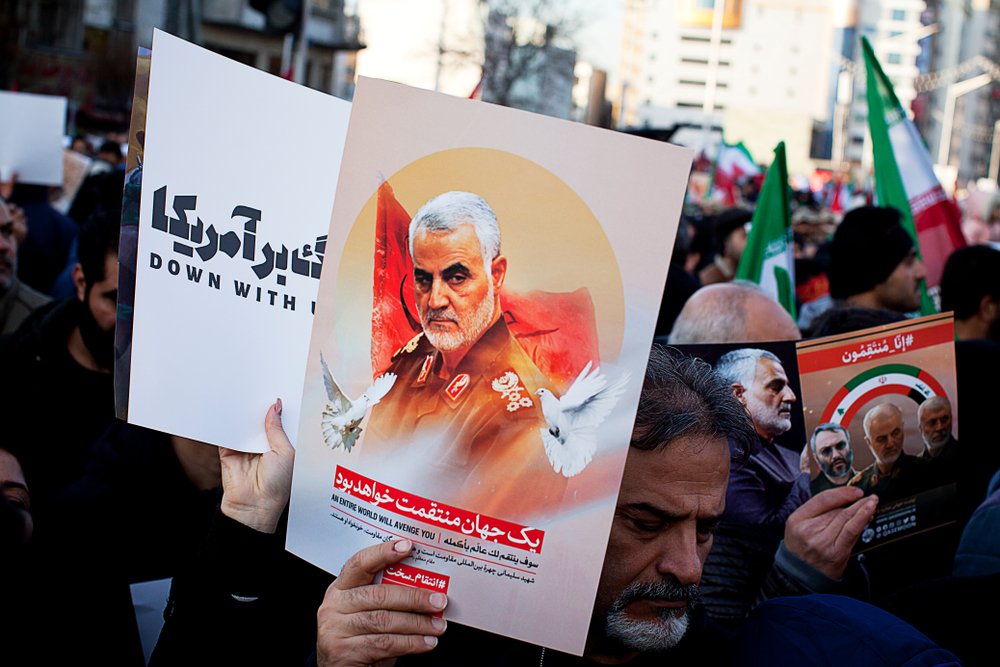
Right up until the moment of his death, Qassem Soleimani, the late commander of the IRGC's external operations branch the Quds Force, served as both medium and message, snapping frontline selfies with the Fatemiyoun, touting the glories of righteous war and recounting their heroics for the IRGC’s ever-present camera. Like many other proxy forces operating in the Middle East, the Fatemiyoun had a substantial social media following on YouTube and Twitter until both platforms took down their accounts. But they retain a presence on other social media platforms, nonetheless, as a result of IRGC investment. They also have thousands of followers on encrypted social media platforms such as Telegram and its Iranian government-controlled counterpart, Soroush.
The Guard Corps places a high value on cultural production and political warfare in its proxy strategy. Promoting the mythos of martyrdom on the frontlines of Iran’s forward defense strategy is central to that enterprise. However, in doing so, the IRGC has also linked conflicts across the region to a greater extent than it has before and played into sectarian narratives that may prove difficult to control in the future while giving power to a network that, while deeply indebted to Iran, is not fully under its control.
Key Findings
- The Fatemiyoun Division traces its antecedents to the IRGC’s decades-long proxy campaigns.
- The Fatemiyoun’s founding commanders fought in IRGC-backed proxy units against the Ba’athists in Iraq, and the Soviets in Afghanistan.
- The Fatemiyoun’s smaller sister unit, the Zeynabiyoun Brigade, also traces its roots back to the 1980s when Pakistani-Shi’a acolytes of Grand Ayatollah Ruhollah Khomeini preached revolution in the predominantly Shi’ite border town of Parachinar.
- The Fatemiyoun Division’s mobilization since 2013 reflects significant shifts in Tehran’s overall strategy that emphasize the critical role of narrative control.
- Proxy warfare is not simply a matter of guys with guns, it also includes the way states use propaganda to shape the story of their interventions and mobilize fighters.
- In the wake of the Arab Spring and the rise of ISIS, Iran increasingly promoted a narrative emphasizing transnational and religious aspects of its proxy network often at the cost of plausible deniability and covertness.
- When civil war broke out in Syria in 2011 it posed a threat to Iran’s one true Arab state ally, Syria, and to the IRGC’s regional influence. The IRGC tasked the Quds Force with deploying proxies in part to manage that challenge, gradually escalating its intervention as Assad’s grip on power devolved as a means of controlling escalation risks.
- Although Qassem Soleimani, the commander of the external operations branch, the Quds Force, was often credited as Iran’s military mastermind, the IRGC’s Hossein Hamedani was the original architect of Iran’s strategy in Syria.
- Hamedani and the IRGC drew on narratives of Sacred Defense to covertly mobilize and recruit Afghan and Pakistani Shi’ites until their numbers grew large enough to form distinct paramilitary units.
- The successful 2014 war against ISIS allowed Iran to promote a cult of personality around Soleimani that helped stoke the embers of cultural mobilization for proxy paramilitaries like the Fatemiyoun Division.
- Russian escalation in Syria in 2015 created the space for Iran to further promote Afghan and Pakistani paramilitaries.
- The number of Iranian forces in Syria increased significantly in the wake of Russia’s intervention, and Iran more aggressively promoted narratives about the Fatemiyoun Division and Zeynabiyoun Brigade.
- Iran’s Supreme Leader Ayatollah Ali Khamenei was one of the first senior Iranian officials to publicly embrace the Fatemiyoun in a speech given in Mashhad in 2016.
- The IRGC embraced the war in public, generating buzz via religious songs, public pageantry, traditional and social media about the Fatemiyoun and Zeynabiyoun volunteers.
- While Iranian coverage of the Fatemiyoun expanded in 2015 despite Afghanistan’s protests, Iran sought to minimize coverage of the Zeynabiyoun because it viewed the prospect of blowback from Pakistan as a serious risk.
- The Afghan and Pakistani Shi’a militias that Iran mobilized and the narratives through which Iran framed the mobilization will continue to shape the Greater Middle East for years to come even as the militias’ involvement in Syria winds down.
- After Iran declared the end of the Islamic State in late 2017, the Fatemiyoun Division and Zeynabiyoun Brigade declared they would fight anywhere, anytime. The Fatemiyoun subsequently announced a drawdown of its forces in Syria and a renewed focus on cultural affairs.
- Senior Iranian officials consolidated the Fatemiyoun Division’s propaganda wing. At the same time, the Fatemiyoun’s cultural affairs unit expanded the scope of its activities.
- Despite a brief lull in Fatemiyoun and Zeynabiyoun operations after the 2017 drawdown, fighters from both contingents were reportedly killed in the 2020 battle for Idlib.
- The IRGC began recalling Fatemiyoun fighters back to Iran as early as 2018, by some accounts, provoking controversy with the Iranian public, but even after Soleimani’s assassination the Fatemiyoun Division remains in a prime position to mobilize for Iran’s next proxy war ventures.
- IRGC investment in Fatemiyoun Division influence campaigns creates real battlefield dividends for Iran, but it also carries significant escalation risks.
- Inside Afghanistan, the practical effect of narratives around the Fatemiyoun Division’s battlefield successes may present an attractive alternative for embattled Shia communities that are increasingly being targeted by both ISIS and the Taliban as U.S. forces drawdown.
- Tehran’s suggestion in late 2020 that Fatemiyoun fighters might serve as a counterterrorism force for the Afghan government could increase the risk that Shia paramilitaries will compete for influence in what is shaping up to be a new chapter in Afghanistan's long running civil war, as the United States withdraws.
- The net effect of these dynamics could erode U.S. influence not only in Afghanistan but in South Asia writ large, because there is no telling if Tehran will be able to exert sustained control over its Afghan proxies long-term.