Solar Energy in the Competitive Space
What did THAT woman have to say about military energy security in a new era?

On September 26th, I delivered the following remarks (more or less) at the Solar Power and Energy Storage International Conference in Anaheim, California, largely because Julia Hamm, the CEO of the Smart Electric Power Alliance, invited me to. She's as smart and effective an advocate for renewable energy as you'll find in DC — or anywhere else. I also care a great deal about military energy security, including as a business opportunity, and I think solar and energy storage are important, exciting technologies. After my remarks, a member of the audience approached one of the other speakers and said: "tell that woman to shut her big, fat mouth. We don't need her kind here, and she alienated half the audience with her politics." Something like that. I think there might have been an expletive involved, too. Instead, I'm sharing my remarks with anyone who cares to read them. And I'm annotating them, too!
Hello, morning people [it's 8:00 am]! It’s good to see you all looking so lively. I’m delighted to be here [private joke: I am NOT a morning person], and I appreciate the invitation.
It was certainly my honor to speak for the Department of Defense at one time, but I should be clear that I no longer do [I worked there from 1994-2001 and 2010-2014, as the Assistant Secretary of Defense for Operational Energy in the latter]. I don’t speak for them, but I do speak about them. And that’s why I’m here, to talk about the Department of Defense, specifically as a place to do business with.
The Department of Defense is in many ways a consumer of energy just like any other commercial consumer of energy in the country. It has buildings that it has to light, and heat, and air condition. It has a fleet of vehicles it has to keep fueled. It has shareholders and customers, and it has a product.
Of course, the Department of Defense is also not like any other consumer. First, it has a great deal more scale. This is a business with a $700 billion annual budget — a trillion, once you count veterans and nuclear weapons overseen by the Department of Energy. It has more than 2 million employees, with a presence in nearly every country in the world, and every state in the country. That also means it owns or oversees around 28 million acres, some 500,000 buildings.
So it’s a very big energy consumer, indeed. It has a $4 billion annual electricity bill for its buildings, and around a $15 billion fuel bill for its fleet. Though that number fluctuates — it was up to $20 billion, when I took office in a high oil price environment.
Like any other business, it is looking to keep those costs down, to keep that bill low. There’s opportunity in that, of course, and in the Department of Defense’s scale.
In fact, most presidential administrations see opportunities in that scale: the Bush Administration was looking at using military scale to promote coal-to-liquid, for example. The United States is the Saudi Arabia of coal, they said. They wanted to fix the nation’s energy security, and that made sense at the time. Back then, oil was $100, $120, $140/barrel, and using DoD’s prodigious demand as leverage to solve that problem made sense. It didn’t work out, though — the CTL investment was too expensive, for too little return [and Congress passed Section 526 of the Energy Independence and Security Act, which basically prevented the Pentagon from making this investment]. For that matter, DoD is actually small potatoes, compared to the overall global market for fuel [DoD accounts for around 1 percent of total U.S. petroleum consumption and around .3 percent of global daily consumption].
Then the Obama Administration came in and wanted to harness military scale to promote renewable energy, again, to advance the cause of domestic energy security. That was a response to the same market dynamics, at least at first, but also to a long term challenge. There is no other way out of what climate change is going to do to our children and grandchildren than no-carbon energy. At least we had our hearts and minds in the right place, and not just in our wallets or voting blocs [A touch, a touch, I do confess it. All politicians are watching wallets and votes].
But it didn’t work out for the long haul. Partly because the Trump Administration came in with other ideas. Now they want to use military scale of demand to promote coal and nuclear. As I understand it [I'm hearing from various quarters that there's consideration of using Title I of the Defense Production Act, using military bases's dependency on the commercial grid as a justification], by forcing utilities to buy those feedstocks — a big protectionist wall around those industries. It’s like bizarro political world [this is a super nerdy reference to a comic book, where everything is the opposite of what it is in the real world], where the Republican Party is for tariffs and protectionism [I assume this is one of the things that offended the audience member. The Republican Party has been largely and sometimes passionately pro-free trade for about 100 years, though to be fair, it was apparently very protectionist in the 19th century].
Anyway, any Commander-in-Chief has the right to make a decision about national energy security policy, and even the right to try to harness DoD’s demand to some larger national security goal.
But that won’t ultimately be a lasting decision. Because a new Congress, a new president, or Adam Smith will come along with a different idea. And I mean Adam Smith the 18th century philosopher with the invisible hand, not the congressman from Seattle. Though, it could be him, too, depending on the outcome of the midterm elections [Yes, this is a reference to upcoming elections and the possibility of a Democratic Congress. I am not exactly the first person to point out that might happen. But my real point here is that policies advanced by political appointees may or may not survive the tenure of those political appointees — even without electoral change. That doesn't mean they're doing anything illegal or even bad. They're allowed to have ideas about what might work, and they're even allowed to be wrong. That's the job, to come in with a vision, to make things happen. But project developers should be realistic about this: if they hook up with a project that only reflects the priorities of a political appointee, it may not have a long shelf life].
I don’t say all of that to discourage anyone here from trying to do business with the Department of Defense.
You should.
They need you.
I do want to encourage you, though, to perhaps look at that business opportunity a little differently. Because the Pentagon is not really just like any other consumer, at the end of the day, and that’s really the key to doing business with them.
You see, their shareholders are Congress, and the customers are the American people and the product is a mission — the security of a country. When it comes to paying the energy bills at their facilities, DoD wants the same things any other consumer wants. A good deal. A reliable supply. High quality. But when it comes to the mission, that’s another story. The value proposition is different.
On the front lines where our forces are deployed, capability is king, not cost. Money still matters, but as a very smart Marine told me — everything is expensive in a war [This was actually a heated conversation about "the fully burdened cost of fuel." The brilliant Marine said, more or less: "harrumph to your fully burdened cost of fuel. Fully burdened cost of bread. Fully burdened cost of latrines. Everything is more expensive in a war!" Fair point, but the fully burdened cost of fuel was supposed to be more about the opportunity cost of fuel than the actual cost. It was an attempt to understand how much fuel efficiency, for example, might be worth for a system in terms of military efficacy. But it is admittedly a tough concept and a complicated calculation. Here's a great blog that explains it]. That’s not the point. Prevailing is the point.
That doesn’t mean that warfighters always understand the mission and capability costs of their energy consumption — they did not in Afghanistan or Iraq. Most did not realize they were taking more strategic, operational, and tactical risks than they needed to.
Consider remote combat outposts in Afghanistan, for example. Every insulated shelter, every solar hybrid generator meant fewer helicopters or fuel trucks going over poor roads in contested areas [this was one of my favorite projects in Afghanistan]. It meant those forces were not at risk, could do other missions, and the folks in the outpost have more range. Beyond that, anything that cuts into U.S. dependency on Russian fuel coming through Central Asia or Persian Gulf fuel coming through Pakistan is good. Keep in mind the U.S. has sanctions on Russia and just eliminated $800M is military aid for Pakistan, so we shouldn’t expect the convoys to always move smoothly. Anything that cuts tactical, strategic, and geopolitical energy risks is a good thing. And to their credit, the Army, the Marine Corps, the Air Force, the Navy have all been working to minimize some of those risks.
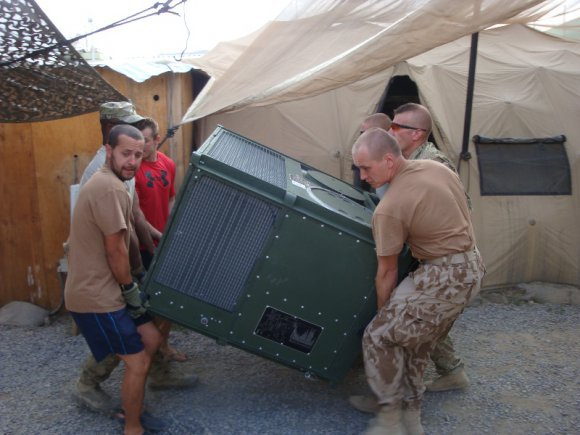
US Army
Today, however, the defense mission is changing, and so is the threat environment [and I really should have mentioned here that this is also one of the challenges of doing business with DoD — the mission just changes sometimes. The enemy gets a vote. So, vendors really need to keep an eye on what's happening in the world and in defense rhetoric].
A new National Defense Strategy came out in 2018 — you should read it, if you haven’t [you really should]. Not just if you want to do business with the Department of Defense, but as American taxpayers [This is not a negative comment on the strategy, but it is certainly ambitious, and it's a fair question as to whether current resources, already significant, will be enough. As a taxpayer, I want to know the answer to that]. This strategy makes explicit something that’s arguably been true for some time, and that is we’re once again in an era of “great power competition.” Not a Cold War, exactly, but not peace, either. And this Secretary of Defense has called on the armed forces to meet this new era with more lethality.
Putting aside larger questions about what all that means, what does it mean for energy? The strategy calls out China and Russia, and also North Korea and Iran. Those are the four scenarios that drive defense planning right now. There’s also a plus one, and that’s terrorism — or the 13 or so places U.S. forces are currently engaged.
Well, first, those places are far away. So, I think the Pentagon is going to be consuming a great deal of liquid fuel for a long time, and logistics are going to be far more important than they have been in these counter-terrorism and counter-insurgency fights. I always thought biofuels were a stupid thing for the Department of Defense to invest in [A very nice gentleman came up to me after the speech to say that two of the "stupid" projects are actually operational right now and are doing well. I am glad to hear that, and I certainly hope they successfully demonstrate that these technologies can be commercialized. I don't think biomass energy or even biofuels are stupid — not at all. The world is going to need new, low-carbon liquid fuels. But there are a lot of ways to get that wrong and limits to what military demand can do], but I tell you what, if you can generate a drop-in liquid fuel from municipal solid waste or biomass in the Philippines or Australia or Guam, that may well have military efficacy in the future [meaning that refineries and shipping through the Straits of Hormuz and Malacca can be major strategic, operational, and tactical choke points. A more distributed fuel network would be a good thing].
More in the here and now, China, Russia, Iran, and North Korea are all different, in terms of the kind of threat they represent as competitors and potential adversaries. But one thing they all have in common is high-end capability in the cyber domain, and all have shown the ability and the willingness to attack civilian targets with those means, including energy targets in the United States.
China has exfiltrated information on the U.S. grid system and and other critical infrastructure.
Russia used cyber means to attack the Ukrainian electric grid. The Department of Homeland Security and the FBI have issued warnings about Russian practice attacks on the U.S. electric grid and other critical infrastructure.
Iran hacked the industrial control system of a dam in New York, and conducted denial of service attacks on U.S. financial institutions.
North Korea has conducted cyber attacks in South Korea and against Sony [and has even hacked U.S.-South Korea war plans]. The DPRK is perhaps not as sophisticated as the other three, at least as far as the capability to attack industrial control systems is concerned, but it’s prudent not to rule them out. North Korea is a backwards, strange place, but where they concentrate funds and effort, they have capability.
This is a kind of threat that does not respect geographic boundaries; physical distance is not meaningful. That means an entirely new kind of homeland defense, and the United States is still catching up with that “new normal.”
For DoD, with almost all of its bases at home on the civilian grid, and many overseas, as well, this comes back to mission and capability. But it’s unfamiliar territory. Facilities, bases, that’s always been where the organization is most like a commercial consumer, as I said at the outset, and is principally looking at cost or compliance with policy or statutory targets.
Thinking of bases as fighting platforms that have to be defended? That’s still a relatively new concept.
A sign of this transition, though, is the use of the word “resilience.” As in, bases need to be energy resilient. So, that’s the framing that started at the end of the Obama Administration and continues to be embraced: mission resilience.
But it’s still early days in this new normal. It’s really hard to put a dollar value on resilience, and that’s problematic when you’re competing for budget. And no matter what the top line is, you’re always competing for budget in the Pentagon. It’s even hard to do the right kind of calculation: what’s the return on military efficacy for an investment in resilience?
So, that’s what you as developers need to keep in mind. The defense budget is huge, but most of it is spoken for. And even the part that’s liquid has many claimants. It’s not a big money tree that you can shake, to rain on your beautiful machine. Or if you do find a way, a mandate through a congressman, say, it will be fleeting. If your goal is to take the money and run, you can maybe find that kind of money, but if your goal is to have a lasting business relationship, that won’t work.
You need to be able to explain your beautiful machine in terms of the mission. And that is fundamentally warfighting, and right now that means great power competition and stability operations, defense of the homeland, and critical facilities.
Military bases need resilience inside the fenceline — often, they just have backup generators with a limited amount of fuel on hand. And they need resilience outside the fenceline, where their interdependencies with the civilian infrastructure lie. They don’t always know what that means yet, in terms of the return on efficacy — especially outside the fenceline.
So, there’s a new strategy, new threats and challenges, and it all comes back to missions and capabilities. I would say there’s also a need for new policies, new ideas, and new equipment.
But beware the new idea, because it can cut both ways. That’s something I think everyone here needs to be aware of and active on, that you need to look out for your own industry and find allies — even allies of convenience. [I did NOT intend this as a political statement, as though I was exhorting the audience to run out and vote for Democrats. What I meant was the Trump Administration appears to be considering some policy decisions that would favor coal and nuclear at the expense of efficiency, natural gas, and renewable energy. I personally think that's a terrible idea, certainly in the form they're allegedly considering, but if you're in those industries, it's more than a bad idea, it's your bottom line. You might want to stand up for your interests. If lawmakers don't hear what you want, they might not know.]
Thank you [And to the man who did not care for my remarks, if you had the courage of your convictions, you would have told me so directly — and I would have been glad to engage you in a conversation and maybe we would have left understanding each other better].
More About the Authors
Related
Climate Security: Building a Community of Practice

Climate Change, Peace and Security, and the UN Group of Friends

Infrequently Asked Questions