Table of Contents
- Executive Summary
- Introduction: A Network View of Syria’s Proxy War
- A Deeper Look at Patron Capacity: Networks of Solidarity in the Syrian Rebellion
- A Deeper Look at Patron Interests: The Logic of Gulf State Interventions
- The Syrian Proxy War: 2011–2016
- Case Study: The Proxy War in Manbij
- Conclusion
Case Study: The Proxy War in Manbij
Background: The Provincial Bourgeoisie of Manbij
The city of Manbij was liberated from Assad rule in July 2012; for the next 18 months, Manbij operated as a quasi-independent city-state. By early 2013, the local political scene was split between a Brotherhood-linked faction comprised of the city’s economic elite, who were ultimately backed by Qatar, and a poor and working-class movement, some elements of which had no foreign backing and other elements of which received Saudi support. These two wings of the revolutionary movement were rivals, leading to a standoff which Salafis, a third force, exploited. Ultimately, this divide laid the grounds for the city’s takeover by the Islamic State in early 2014. Manbij thus offers a case study that illustrates how class structure and social networks intersected with the Saudi-Qatari rivalry to produce patterns of mobilization that were repeated, mutatis mutandis, across Syria.
Lying about 60 miles northeast of Aleppo, Manbij before the war was home to about 100,000 people, most of them Arab, though the city had sizable Kurdish and Circassian minorities. Historically, Manbij was dominated by a wealthy Sunni merchant class engaged in trade with Aleppo, Turkey, and the interior desert regions of Syria. These trading families, who formed close ties with each other through intermarriage and business partnerships, much like the bazaari of Iran, were cut from a different cloth than the tribal, rural-minded folks who made up the majority of Manbij. Locally, this merchant class is known as Hadhrani, a term meaning “civilized,” denoting their deracinated, elite status. The traditional ruling class also included landowners from certain tribes like the Albu Sultan. Through the 1950s, Hadhrani families dominated retail, trade, and construction, while Albu Sultan members monopolized political posts like the mayorship.1
With the rise of leftist parties in the 1950s, some Hadhrani families gravitated to the anti-socialist, conservative message of the Muslim Brotherhood. When the Baʿthists seized power the following decade, Brotherhood ideas gained even greater currency among elite circles. The new regime carried out land reform, through which they cultivated a rural constituency and antagonized the wealthy. In Manbij, the party attacked the power of oppressive landowners and recruited from impoverished rural tribal communities such as the Hosh confederation and the Albu Banna.2 The Hadhrani bourgeoisie saw their fortunes fade as the Baʿth imposed price controls and monopolized foreign trade, while government posts were no longer the birthright of Albu Sultan elite. In the early 1970s, for example, the Hafez al-Assad regime replaced the Albu Sultan mayor3 with a Hosh figure—and the position, along with the leadership of the local Baʿth Party chapter, would largely remain with the Hosh for the next 40 years.4
By the late 1970s, Hadhrani families such as the Sheikh Weiss and Salal households formed the core of Manbij’s Muslim Brotherhood movement. When the insurrection was smashed in 1982, these families formally left the movement, but retained close ties with the Brotherhood through marriage and trading partnerships.5 When Bashar al-Assad assumed power in 2000, he ushered in a series of neoliberal reforms that reintroduced the market to Syrian life far beyond what his father had envisioned—but the gains of this economic opening largely accrued to Assad’s relatives and leading Sunni bourgeois families in Damascus and Aleppo. The merchants and traders of small towns like Manbij—the “provincial bourgeoisie”—were left in the lurch. Although wealthy by Manbij standards, merchants were second- and third-class citizens next to the Damascus-Aleppo bourgeoisie and the security services. They became leaders of the city’s revolution.
Qatar and the Manbij Revolutionary Council
Late one night in the winter of 2011, under the cover of darkness, a few dozen activists gathered in an old farmhouse outside Manbij. The city was roiling with almost nightly protests, and the men gathered there voted to form a body to take power should the local regime fall. Though the protest movement comprised all walks of life, the Revolutionary Council, as the body came to be called, was dominated by ex-Brotherhood Hadhrani and Albu Sultan liberals—the two elite groups marginalized by the dictatorship. The liberals lacked strong ties with their counterparts in other cities, but the Hadhrani were able to tap into national and international Brotherhood networks, thereby transforming the Revolutionary Council into the most important entity on the city’s revolutionary scene. A key Revolutionary Council financier was its director of external relations, Ahmed al-Taʿan, a professor in Damascus University’s faculty of Shariʿa and one of the founding members of the Syrian National Movement headed by Aimad al-Din al-Rashid.6 The council also forged links with merchants from northern Aleppo that belonged to ex-Brotherhood families—a network that would become the powerful Qatari-backed faction Liwa al-Tawhid.7
With such support, in early 2012, the Revolutionary Council created an armed wing, the first rebel group in the city.8 In this period of “open competition” (see section IV), activists sought to cultivate ties with anyone willing to furnish aid. So along with procuring weapons from Liwa al-Tawhid headquarters in Mareʿ, for example, Ahmed al-Taʿan regularly traveled to Jordan and Saudi Arabia to solicit donations for the Revolutionary Council’s field hospitals.9 By mid-2012, however, Saudi and Qatari policy began to veer apart. In July, the Qatari-Turkish push, as described in Section IV, allowed rebels flush with Libyan weapons to sweep across Idlib and Aleppo provinces. In the face of this onslaught, the regime fled Manbij on July 18, and the Revolutionary Council assumed power with hardly a shot fired.10
For the next 18 months, the council presided over a remarkable experiment in participatory democracy. The council established an upper house, which functioned like a parliament, issuing laws for the city. For the first time in 60 years, this corner of Syria experienced freedom of assembly and press—where there had been one state-run newspaper before, now nearly a dozen independent newspapers were in circulation. Ex-Muslim Brothers and liberals made up the majority of the Council, but even leftists, like the longtime political dissident Hassan Nefi, played a prominent role.11 Ultimately, though, it was the council’s links to Brotherhood networks—and Liwa al-Tawhid, in particular—that proved kingmaker. The Brotherhood sponsored projects throughout the city: the establishment of a court system, a police force, and, in an effort to unify Manbij’s rebel groups, a Military Council. Meanwhile, the Revolutionary Council used largesse from Liwa al-Tawhid to reorganize its armed wing, which now consisted of three battalions.12 Manbij therefore presents one of the few examples anywhere in Syria where armed factions were subordinate to a civilian body.13
Despite the Brotherhood and Qatari influence, the council’s democratic nature meant that its patrons were unable to exert full authority over the body. In September 2012, for instance, the Brotherhood sent a delegation led by the wealthy businessman Yasser al-Zakiri to assume direct control over the council’s day-to-day operations, but some council members—led by the leftist Nefi—blocked the efforts.14 Still, Brotherhood/Qatari patronage played a pivotal role in rebel strength and behavior. For example, Thuwwar Manbij, one of the battalions comprising the Council’s armed wing, was the city’s most well-equipped faction. This owed in large part to its commander, Anas Sheikh Weiss, a founding Council member, who belonged to one of the city’s leading Hadhrani Brotherhood households.15 Thuwwar Manbij was so well-stocked that, at one point, their arsenal included a few coveted Soviet-era 14.5mm anti-aircraft DShK weapons.16
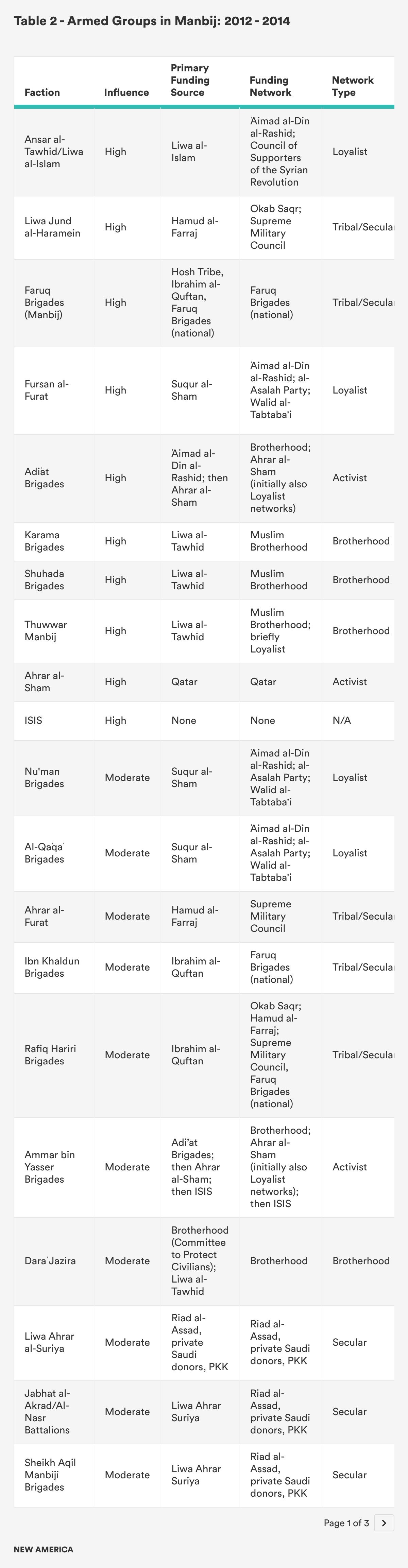
This stood in contrast to Manbij’s other factions. Nearly 70 armed groups had appeared following liberation, most outside the Turkey-Qatar-Brotherhood pipeline and desperately in search of support (Table 2). Arms dealers and middlemen proliferated, price gouging and extorting their clients. Looking back, one rebel commander in Manbij recalled,
The first thing I would have done was imprison every arms dealer and take their weapons. It was just ridiculous. The revolution was begging the world for weapons, and in Manbij alone, I recall six arms dealers… Once, we drove to al-Atarib to buy weapons. I remember walking into the guy’s shop, which was basically the size of a living room, and it was full of every type of weapon you could imagine. Of course, no anti-aircraft weapons or the types we really needed, but definitely small arms. He had Uzis, and even a bathtub full of diesel to remove the lubricant they came in. There were a lot of weapons, but they were inaccessible to us. A Kalashnikov, a real one, was $2,500. [We used to buy the fake ones] made in Saudi Arabia. It was horrible. It literally turned red when you fired it. If you fired it long enough then set it down by the wall, it would actually bend. This happened to me.17
Factions without Qatari patronage had to find other means of financing. Moreover, the Qatar factions were built on networks of businessmen—the provincial bourgeoisie—whereas the leadership of other factions tended to be of working class or rural origin. To fund their efforts, these other factions were forced to turn to banditry.
The Rise of the “Bread Factions”
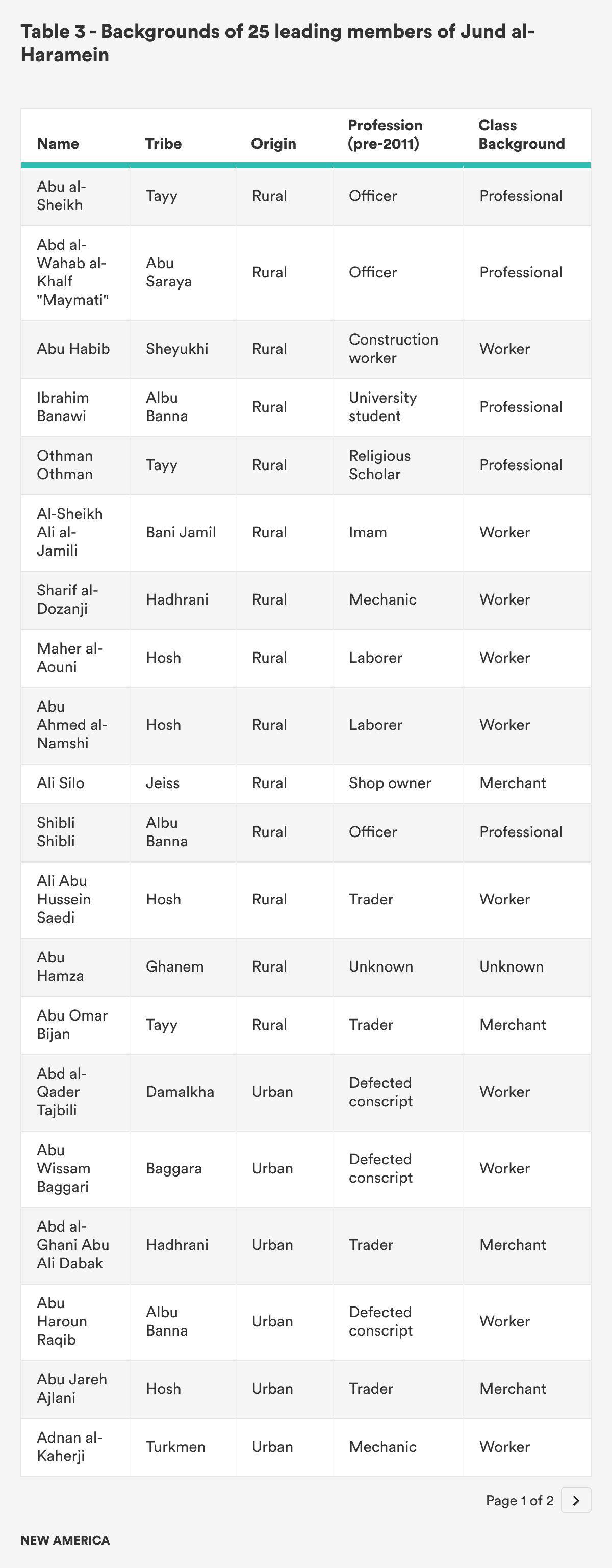
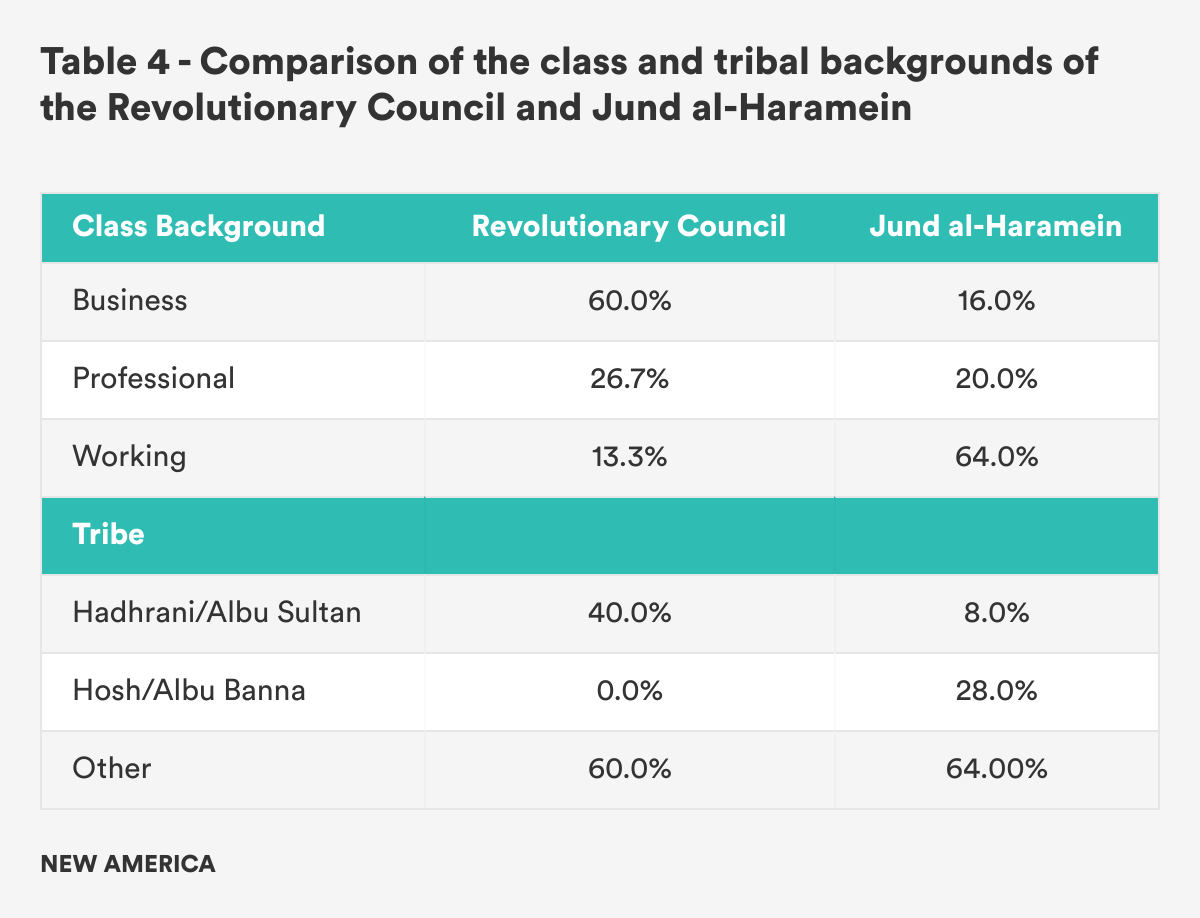
From the beginning, the Revolutionary Council had found it difficult to control its armed wing. Before liberation, some fighters were conducting freelance raids on police stations and refusing to share the spoils with the group.18 By the July 2012 liberation, the council’s armed wing effectively split; one group remained under the council’s authority, while the other became an independent faction called Jund al-Haramein (“The army of the two holy mosques,” in a bid to attract Saudi funding).19 Unlike the Revolutionary Council factions, Jund al-Haramein did not belong to Hadhrani Brotherhood networks and recruited primarily from the poor and working class (see Table 3).20 Table 4 compares the tribal and class compositions of Jund al-Haramein and the Revolutionary Council; while 60 percent of the council were businessmen, 64 percent of Jund al-Haramein leaders were of poor and working class backgrounds. They lacked preexisting ties with key council members, which made them difficult to control and encouraged an independent streak. This also placed them outside the Liwa al-Tawhid funding stream.
Other factions soon appeared with similar sociological compositions. Bereft of external support or links to the merchant class, they turned to other means to sustain themselves. Within weeks of liberation, Jund al-Haramein and allied factions unleashed a massive crime wave on Manbij.21 Reports of looting and kidnapping became commonplace.22 Al-Masar al-Horr, one of the revolutionary weeklies, denounced the chaos:23
Are we really living in a wild forest where the strong can rule and do whatever he wants?… Where is the freedom that the young and old cheered for with their hearts and their throats? We’ve lost safety and now live in the dark, where houses have been looted and the rich are kidnapped off the streets.
These factions refused to subordinate themselves to the city’s ruling authority, the Revolutionary Council. While the council controlled the city’s central furnace, producing 60,000 loaves of bread daily at full capacity, Jund al-Haramein seized control of Manbij’s reserve furnace and refused to surrender it.24 At times, the group would hoard supplies, or sell bread directly to private bakeries at lower prices to undercut the Revolutionary Council. The faction used these revenues to expand its footprint to Raqqa and the Aleppo countryside, where it took part in battles against the regime.25
Members of the Revolutionary Council would derisively term Jund al-Haramein and allies as the “bread factions,” and repeatedly attempt to clamp down. They critiqued the bread factions on moral terms, calling them corrupt or of poor character, but in truth Jund al-Haramein’s behavior can be explained by class position and lack of access to external support. Paradoxically, the bread factions even developed a popular following, especially in poor neighborhoods, where they were seen as an authentic—if flawed—representation of class grievances. Over the course of late 2012, as prices of basic living necessities climbed, popular anger toward the Revolutionary Council mounted.26 One figure who rode this wave was an enigmatic commander named The Prince, who headed the local chapter of the Faruq Brigades, which recruited almost exclusively from the Hosh tribal confederation. The Prince would kidnap the rich and pro-regime figures, while undertaking extraordinary exploits of bravery on the frontlines, to become something of a folk hero—and a sworn enemy of the Revolutionary Council.27
Ultimately, though, banditry and working-class sympathy were not enough. To fend off the regime—and to position themselves against the Revolutionary Council—the bread factions would need to find a patron of their own.
The Bread Factions Turn to Saudi Arabia
In September 2012, a bread faction belonging to a rebel leader named Abu Khalid al-Baggari kidnapped nine employees of Lafarge, a French company that owned a cement factory not far from Manbij. Al-Baggari ransomed the employees for hundreds of thousands of dollars; with the windfall, he acquired new weapons stockpiles and merged a number of factions into Fursan al-Furat (The Knights of the Euphrates).28 The previous month, the powerful Idlib faction Suqur al-Sham (see Section IV) had broken with the Muslim Brotherhood, after its commander Abu ʿIssa al-Sheikh accused his former patrons of “politicizing” aid and demanding excessive control over clients.29 The sudden appearance on the rebel scene of a well-financed rebel outfit free of Brotherhood control had immediate appeal to the Bread Factions of Manbij, who were looking to insulate themselves from Liwa al-Tawhid and the Revolutionary Council’s oversight. Flush with funds and fresh off a major military success, Baggari reached out to Suqur al-Sham, and an alliance was born. As one of Fursan al-Furat’s founders explained:
When choosing a patron, we wanted to make sure to go with someone with whom we could secure material support while still maintaining our own internal independence. Liwa al-Tawhid’s Sufi ideology, along with that of the Muslim Brotherhood, which Liwa al-Tawhid was tied to, is known for its emphasis on rigid hierarchies and obedience…Lower ranking members aren’t allowed to question their sheikhs…Furthermore, Abu ʿIssa al-Sheikh was known for having a calm personality, and being a leader who would encourage debate amongst his deputies and allow sub-factions a certain level of autonomy. Plus, by that point, he had rejected the Brotherhood.30
Suqur al-Sham’s prowess was due to its ability to tap multiple funding sources, including ʿAimad al-Din Rashid’s Brotherhood splinter, but it was their access to loyalist Salafist networks that proved most lucrative—and that linked them indirectly to Saudi Arabia. In the resulting proxy cascade, Saudi Arabia supported Kuwaiti Loyalist Salafis, who aided Suqur al-Sham in Idlib, who in turn funded Fursan al-Furat in Manbij.31 As a result, Fursan al-Furat became a major player locally, and other bread factions looked to follow suit.
By early 2013, Jund al-Haramein was heavily involved in battles against the regime in rural Raqqa, which enabled them to forge ties with the al-Nasser, an important clan in the area.32 For generations, sheikhs of this clan, which belongs to the Weldeh tribe, had presided over massive plantations—where they kept slaves and indentured servants—until the Baʿth land reforms of the 1960s stripped them of property.33 After 2011, eager to reclaim their land, Nasser sheikhs were quick to support the revolution, founding a string of influential FSA factions.34 The rough-and-tumble Jund al-Haramein and the elite sheikhs of the Nasser clan might seem like odd bedfellows, but Jund al-Haramein were capable fighters, while the sheikhs had something Jund craved: access to outside donors. Beginning in the 1970s, many Weldeh tribespeople had moved to Saudi Arabia for work, and a wealthy minority forged business and political ties with Saudi elites.35 These alliances paid off after the revolution; the Weldeh tribesman ʿAbd al-Jalil al-Saʿidi, for example, became a top advisor to Okab Saqr, the Lebanese Shia politician who was the Saudi point man for weapons distribution through the “Istanbul Room” (see Section IV).36 Al-Saʿidi would become instrumental in helping Jund al-Haramein access Istanbul Room weapons.37 Finally, through al-Nasser links, Jund al-Haramein also managed to ally with Hamud al-Faraj,38 a close associate of Saqr’s brother who regularly visited Saudi Arabia to coordinate the transfer of funds to al-Nasser-run FSA groups.39 In December 2012, when the United States and Saudi Arabia created the Supreme Military Council, the effort to create a unified, Saudi-friendly rebel command, Faraj was one of thirty opposition leaders appointed to coordinate aid on five separate fronts, with Faraj himself tasked to oversee Raqqa. As a result, Jund al-Haramein became one of Saudi’s top aid recipients in the greater Manbij-Raqqa corridor.40
Qatar versus Saudi Arabia in Manbij: Structured Competition
By late 2012, a tenuous balance hung over the revolutionary scene in Manbij. The Revolutionary Council, with its patrons in the Doha-backed Liwa al-Tawhid, remained the main authority in the city. However, against them stood a rival grouping, led by the Saudi-backed bread factions Jund al-Haramein, Fursan al-Furat, The Prince, and smaller formations. This grouping even supported its own rival council, called the Local Council, headed by an engineer named Muhammad al-Bishir.41 The same class divide marking the factions also reflected the rival Councils: while many upper- and middle-class activists supported the Revolutionary Council, the Bishir Council had a greater following among poorer segments of society. (Nonetheless, for the time being, it was the Revolutionary Council that successfully carried out state-like activities, such as social services).
However, the Saudi-led creation of the Supreme Military Council in December 2012 upset this balance. Seeing this Saudi move, correctly, as an attempt to sideline its clients, Doha retaliated by opening the spigot—primarily to Ahrar al-Sham. The group formally announced its presence in Manbij in early 2013, launching a populist program that won them admirers across the city’s political divide.42 On the one hand, they targeted the Revolutionary Council’s economic policies—especially the handling of bread, the prices of which continued to rise—by attending protests outside the city’s main bakery.43 On the other, they pledged to clean the streets of the criminal bread factions. At the top of this list was the Prince and his Faruq Brigades. As described in Section IV, the Faruq Brigades were a powerful anti-Brotherhood faction in Homs that was responsible for distributing Saudi-donated weapons nationwide. However, this actually fostered corruption, as commanders began skimming weapons to sell on the black market. They also entered into lucrative partnerships with Turkish smuggling networks.44 As a result, they eventually fell out of Saudi Arabia’s favor—and in this weakened state, Ahrar al-Sham moved in for the kill. In April 2013, the group attacked the Prince. The Revolutionary Council, sensing an opportunity to rid the city of a hated rival, requested back-up from Liwa al-Tawhid, which sent a contingent from Aleppo.45 The battle lasted a few intense hours and then, in a stunning dénouement, the Ahrar al-Sham-led forces captured the Prince.46
The rout changed the city’s power balance almost overnight. To the masses, Ahrar al-Sham proved that it was serious about cleaning up crime. The bread factions, meanwhile, felt they could not compete with Ahrar’s lavish Qatari funds or its ironclad organizational discipline, and they began disintegrating or switching sides. Jund al-Haramein gravitated toward its erstwhile enemy, the Revolutionary Council, and the Faruq Battalions dissolved.47 Fursan al-Furat, the Saudi-backed group, whose commanders had chafed at what they viewed as the rigid organizational and ideological control of the Brotherhood, eventually allied themselves with a small group of men who had recently appeared in the city. Occupying the cultural center downtown, these men were foreigners, and they were calling themselves The Islamic State of Iraq and Syria.48
Network Structure in Manbij’s Proxy War
By the summer of 2013, the Saudi-Qatari competition in Manbij was effectively over—with Qatar the clear winner. Although the United States and Saudi Arabia organized its proxies into the Supreme Military Council, they were unable to mold this entity into a cohesive force. By magnifying the case of Manbij, it becomes clear why this was the case. First, the Saudi-backed groups—the Bread factions—simply lacked the firepower to defeat Ahrar al-Sham and its allies militarily, even though they outnumbered them in personnel. This was due, in part, to the fact that Ahrar al-Sham was a direct beneficiary of Qatari funding, whereas the bread factions received aid through a cascade of intermediaries, such as Suqur al-Sham or tribal sheikhs. It was also because Ahrar al-Sham was able to access multiple networks for revenue: Brotherhood, Activist Salafist, and Jihadi Salafist. Second, the bread factions lacked cohesive preexisting ties and organizational structure. Even in the face of Ahrar al-Sham’s superior firepower, the Prince may have stood a chance had the other bread factions rallied to his support and presented a united front. But the bread factions did not constitute a cohesive network; in fact, there was little to unify them except having gone through the experience of revolution, as compared to the Qatari clients, who benefited from years or even decades of close interaction through business ties and political activity. Finally, but for a vague opposition to dictatorship, the bread factions expressed little in the way of ideology. The Qatari-backed factions, on the other hand, benefited from expansive, elaborate ideological frameworks that could respond to changing circumstances and help dictate strategic action.
Without strong social ties and ideological norms, there was little to constrain the bread factions from corruption and war profiteering. Therefore, patrons had few means to exert command and control. An example of how this worked in practice is the case of al-Shaʿr Gas Field, near Palmyra. In early 2013, a coalition of Idlib factions and Fursan al-Furat, the Manbij-based bread faction, planned to launch a campaign to capture the field from the regime. Fearing that flat desert terrain would provide little cover, Suqur al-Sham leader Abu ʿIssa al-Sheikh ordered his client Fursan al-Furat to abstain from participation.49 There was little linking Fursan al-Furat and Suqur al-Sham apart from the alliance they’d forged during the revolution; they did not share preexisting social networks, nor did Fursan have a well-thought-out ideological framework beyond a hazy, individualistic liberalism, to match Suqur’s Islamism. So Fursan leaders ignored the order, waited for a sandstorm for cover, and managed to seize the field. The ensuing revenue windfall allowed Fursan even greater independence from its patrons. A year later, as ISIS was advancing upon Manbij, Suqur al-Sham ordered Fursan to defend the city—which they also ignored. They had undertaken several joint ventures with the Islamic State, including a smuggling ring that trafficked organs harvested from prisoners’ bodies.50
The rich social ties among Qatar and its proxies, on the other hand, gave Doha the capacity to influence client behavior. So long as interests aligned, Doha’s support could make the difference between battlefield success and failure. But when interests diverged, clients found themselves constrained by Doha or its subsidiary patrons. In the summer of 2013, for example, two different Qatari proxies were the dominant forces in Manbij: Ahrar al-Sham and the Liwa al-Tawhid-linked Revolutionary Council. Ahrar al-Sham began attacking the latter’s laissez-faire economic policies, especially around the question of bread prices.51 As Ahrar gained popular support, seizing buildings around the city, Liwa al-Tawhid warned the Revolutionary Council not to escalate the situation by resisting. It was in the interests of Liwa al-Tawhid to preserve the peace between their clients in Manbij and Ahrar al-Sham, even if, locally, that was not in the Council’s interests.52 The council was forced to follow Liwa al-Tawhid’s orders, though the consequences would be tragic.
In July, Ahrar al-Sham and ISIS, who were controlling key granaries in Maskana and Raqqa, respectively, halted all grain shipments to Manbij.53 This siege temporarily forced the price of bread in the city to skyrocket, and ISIS seized the advantage, organizing protests that nearly brought down the Revolutionary Council and allowed them to assume control of the main bakery.54 By the time Liwa al-Tawhid recognized the calamity unfolding in Manbij, it was too late. Crucially, the group did not have the support of the other Qatar proxy, Ahrar al-Sham, who insisted on remaining neutral in the growing tensions between revolutionaries and ISIS—and they faced no sanction for doing so, because Qatar appeared uninterested in halting ISIS or even treating the group differently from any other faction.55 By January 2014, in the face of mounting economic crisis, the Revolutionary Council had lost the street. That month, the city’s beleaguered factions banded together in a final push to expel ISIS, but without Ahrar al-Sham or popular support, they proved no match for the Islamic State. Within days, ISIS seized complete control of the city, expelled all factions, and Manbij’s revolution was finished.
Manbij Today: Exploitative Phase
The ISIS takeover of Manbij and other parts of eastern Syria in 2014 marked a turning point in proxy relations countrywide. The United States shifted to anti-ISIS efforts, while Qatar gradually tempered its patronage, and ultimately ceased it altogether. Liwa al-Tawhid soon began to splinter and was no longer a patron in northern Syria.56 The former members of Manbij’s Revolutionary Council migrated to the patronage of Turkey. Due to the historic Brotherhood ties, as well as the council’s embeddedness in cohesive networks, Turkey wields significant capacity as patron. However, Turkey’s primary interest is in defeating the PKK, whereas the council’s core interest is in overthrowing Assad, meaning the two sides do not share a common goal. This combination of high patron capacity and divergent interests means that the remnants of the council are forced to do Ankara’s bidding. Today, these former council figures comprise the core component of the forces that Turkey hopes to employ to capture Manbij from the PKK-linked Syrian Democratic Forces.
The SDF liberated Manbij from ISIS rule in 2016, and the city is now under the control of the SDF-aligned Manbij Military Council. Remarkably, the MMC.-Turkish divide is actually the latest iteration of the same divide that has plagued the city since the 1960s—a division built on class and networks of patronage. To recap, recall that before the 1960s, urban-based Albu Sultan and Hadhrani elites controlled the city’s wealth and politics, until the Baʿthist coups and land reforms usurped their privileges. During the Assad years, power shifted to rural tribal sheikhs, particularly those from the Albu Banna and the Hosh tribal confederation. In response, some Hadhrani families gravitated toward the Muslim Brotherhood. In 2011, Hadhrani and Albu Sultan figures became the revolutionary leadership in Manbij, which took the shape of the Revolutionary Council, and allied themselves with a faction descendant from the Brotherhood, Liwa al-Tawhid. Meanwhile, though Albu Banna and Hosh sheikhs supported the regime, poorer members of these tribes also joined the revolution—but were not allied with the council. Instead, many joined the so-called bread factions, Free Syrian Army groups known for criminality. By 2013, the Revolutionary Council-bread faction split was the key divide in Manbij.
When Salafis like Ahrar al-Sham entered the scene, they represented a third force. In April 2013, they routed the bread factions, who dissolved or joined other, stronger groups. A pivotal moment then came in August, when many Hosh tribesmen, who had previously belonged to bread factions like the Prince’s Faruq Brigades, banded together with a Kurdish FSA group called Jabhat al-Akrad.57 This group, which had formed a year prior and had chapters in Manbij, Raqqa and elsewhere, was secretly a PKK proxy.58 The new Jabhat al-Akrad-bread faction alliance joined a rebel group called Ahrar al-Suriya, an anti-Liwa al-Tawhid faction headquartered in ʿAnadan. In other words, both the PKK and the Hosh tribespeople formed an alliance in the face of a common enemy, the Muslim Brotherhood-linked Liwa al-Tawhid.
In 2016, the Jabhat al-Akrad-Hosh alliance became the core of the newly formed Manbij Military Council.59 Before long, Jund al-Haramein also joined SDF, and the reiteration of Manbij’s classic divide was complete. Almost all the key Arab figures in the Manbij SDF and local administration today were once linked to the bread factions, or to tribal communities that had opposed the Hadhrani- and Albu Sultan-dominated Revolutionary Council.60 In this way, issues of class and patronage continue to run through the heart of the Syrian conflict today.61
Citations
- Author interviews with Hadhrani and Arab tribal figures from Manbij, 2017 – 2019.
- The Hosh is a confederation of five tribes found in the areas immediately south and east of Manbij: Bani Saʿid, al-ʿAun, al-Ghanaim, al-Kharraj, and al-ʿAjlan. The Albu Banna is a tribe found predominately in the south of Manbij, concentrated between Abu Qalqal and al-Khafseh sub-districts. After 2000, the tribe had a sizeable presence in Maskana sub-district as well.
- Strictly speaking, the post was رئيس البلدي
- Author interviews with revolutionary activist Muhammad Bashir al-Khalaf, Jund al-Haramein-linked Salah Muhammad, and Albu Sultan figure and president of the Revolutionary Council, Ahmed al-Rahmo, 2018-2020.
- Author interviews with Faruq Sheikh Weis and Hani Salal, 2018; Baʿthist restrictions on the free market were gradually lessened, beginning with Hafez al-Assad’s “corrective movement” in 1970 and continuing apace through the 1990s, meaning the Hadhrani bourgeoisie was able to regain some of their previous financial standing by 2000.
- As we described above, the Syrian National Movement was headed by ʿAimad al-Din Rashid, one of the leaders of the May 2012 delegation to Libya which was pivotal in helping Liwa al-Tawhid and other Brotherhood groups gain prominence.
- Author interviews with Revolutionary Council members Aimad al-Hanaydhil, Munzir Salal, Ahmed al-Rahmo, July 2019. See also, “Syria’s Islamists: The ‘National Movement’ Includes All Perspectives,” Al Ikhwan Online, December 10, 2011, source.
- That group was called the al-Nuʿman Brigades. Within six months, the al-Nuʿman Brigades would effectively split; some members would affiliate with the Revolutionary Council under new brigade names, while the remainder of the group kept the name al-Nuʿman Brigades and was no longer affiliated with the Revolutionary Council. Author interviews with two leaders of Jund al-Haramein, and one member of al-Nuʿman. July 2019.
- Even after the shift to “structured competition” and the Qatari–Saudi rivalry, individuals adept at managing foreign ties sometimes succeeded in drawing funds from both sides. As late as 2013, for example, Taʿan, managed to secure funding from the Saudi-backed Authenticity and Development front. Author interviews with Revolutionary Council members, including Munzir Salal. August 2019.
- That hardly a shot was fired is corroborated by multiple eyewitnesses. However, one child died while the regime troops were withdrawing, although the circumstances are unclear. The family believes it was due to a stray bullet. Author interview with family, other residents, Manbij, 2017–2019.
- Author interview with Revolutionary Council members, including Nefi, 2018-2020.
- The three battalions were Thuwwar Manbij (commander: Anas Sheikh Weiss), al-Karama (commander: Zakaria Qarisli) and Shuhada Manbij (commander: Abu Abdullah Baggari). Collectively, they comprised Liwa al-Tawhid’s 2nd Division. These three battalions are now part of the Syrian National Army and constitute the principal force directed against the Syrian Democratic Forces in Manbij today. See Shams al-Horreya, “News,” Issue 23; Masar al-Horr, “News,” Issue 20, January 28, 2013. These are locally produced newspapers documenting this period.
- The al-Nuʿman Brigades, which the council had been created six months earlier, still functioned but had become an independent faction.
- The delegation included an activist from the Brotherhood’s youth wing, Basil al-Hafar, and a member from a leading landowning family in Mareʿ, Yassin al-Najjar—further demonstrating the overlap between Mareʿ and Brotherhood networks. Author interviews with Revolutionary Council leading figures Munzir Salal, Ahmed Rahmo and RYM activists Abu al-Ows and Ahmed al-Faraj, 2018-2020.
- Author interviews with Weiss, other leading figures in Manbij, and corroborated by local newspapers.
- Author interviews with Revolutionary Council leading figures Munzir Salal, Ahmed al-Rahmo, 2019.
- Author interview with former rebel figure who operated in Manbij, 2019.
- Author interview with Jund al-Haramein associate Salah Muhammad, Revolutionary Council members ‘Aimad al-Hanaydhil and Ahmed al-Rahmo, 2019.
- Author interviews with Jund al-Haramein associate Salah Muhammad, Revolutionary Council members ‘Aimad al-Hanaydhil and Ahmed al-Rahmo, 2019. See also, “Ugarit Manbij Aleppo, Announcement of the Formation of the Jund al-Haramein Brigades 11 7 Manbij Aleppo,” Ugarit News – Syria, July 12, 2012, source
- The factions’ founders included Abd al-Wahab al-Khalaf “Maymati,” the Manbij Chief of Police who defected and brought many policemen with him. Jund al-Haramein also contained the highest number of defected conscript fighters of any Manbij faction. Author interviews with Revolutionary Council members and numerous Jund al-Haramein associates. September 2019.
- The allied factions included: al-Faruq Battalions, al-Qaʿqaʿ Brigade, and Abu Ayub al-Ansari Brigade; Shams al-Horreya, “Fatwa Fever,” Issue 11, October 7, 2012.
- Al-Masar al-Horr, “MRC Responds to Accusations Published in Masar al-Horr,” Issue 5,
- Masar al-Horr, “Victims of Freedom,” Issue 2, September 10 2012; Free Teachers Association Press Release, September 15, 2012; al-Masar al-Horr, “Kidnapping, A Temporary Phenomenon? Or Organized Crime?,” Issue 2, October 8, 2012; September 15, 2012; Shams al-Horreya, “News,” Issue 2, October 15, 2012;
- Masar al-Horr, “Interview with Revolutionary Council member (and head of bread distribution) ‘Aimad al-Hanaydhil See RC flour mill and mechanism for running it”, Issue 10, November 20, 2012.
- Jund al-Haramein would also reap income through extortion. Manbij’s wholesale fuel market was one of the largest in Aleppo province, attracting buyers from as far as Idlib looking to purchase shipments recently arrived from Deir ez-Zour. The market was adjacent to Jund al-Haramein’s main base in the north of the city, allowing the group to impose “taxes” on incoming traders seeking to sell their product. Similarly, Jund al-Haramein took money from the Turkish government to protect the tomb of the Ottoman folkloric hero Suleiman Shah, located across the Euphrates River in the town of Qara Quzak. See: Shams al-Horreya, “Meeting with Sheikh Hajji (Ammar bin Khattab brigades),” Issue 31, April 14, 2013; Malik Al-Abdeh, “Rebels Inc.,” Foreign Policy, November 21, 2013, source.
- Shams al-Horreya, “Baked Bread: First Investigation of Its Kind in 40 Years,” Issue1, November 25, 2012; Masar al-Horr, “Al-Masar Eye,” Issue 10, November 20, 2012.
- Author interviews with individuals from across the political spectrum in Manbij, 2018-2020. The Prince’s exploits were also described in detail in the revolutionary weeklies Masar al-Horr and Shams al-Horreya.
- Author interviews with Fursan al-Furat commander Mustafa Abu Suleiman, Author interview with Revolutionary Council member ‘Aimad al-Hanaydhil, June and September 2019, respectively. See also: Liz Alderman, Elian Peltier, and Hwaida Saad, “‘ISIS Is Coming!’ How a French Company Pushed the Limits in War-Torn Syria,” New York Times, March 10, 2018, source.
- Syrian Dreams, September 4, 2012, “Suqur al-Sham: Civilian Protection Body and the Muslim Brotherhood”: source
- Author interview with a Fursan al-Furat founder, 2019.
- Abouzeid, “Syria’s Secular and Islamist Rebels: Who Are the Saudis and the Qataris Arming?”; Rasha Abi Haider, “[Tr. Chairman of the Islamic Front’s Shura [Council]: A [Muslim Brotherhood Member] in the Arms of KSA and the US] source ,” Al-Akhbar, January 17, 2014, source ; Lefèvre, “The Muslim Brotherhood Prepares for a Comeback in Syria”; “Bahrain Says Islamist MPs Made Unofficial Syria Visit,” Naharnet, August 7, 2012, source; Husain Marhoon , “Bahraini Salafists in Spotlight,” Al-Monitor, June 18, 2013, source.
- The main Jund al-Haramein leader involved in these initiatives was Ibrahim al-Banawi; Author interviews with Jund al-Haramein affiliate Salah Muhammad and Revolutionary Council member Munzir Salal, 2019.
- The clan also lost land in the 1970s due to the construction of the Euphrates Dam. The Hafez al-Assad regime resettled some tribespeople along the Turkish border, in an attempt to create an “Arab belt” and strip Kurds of their land. See: Günter Meyer, “Rural Development and Migration in Northeast Syria,” in Anthropology and Development in North Africa and the Middle East., 1990, 245–78; Raymond Hinnebus et al., “Agriculture and Reform in Syria,” Syria Studies 3, no. 1 (2011): 83–109, source; Andrew J. Tabler, “A Tale of Six Tribes: Securing the Middle Euphrates River Valley,” Policy Notes (Washington Institute for Near East Policy, June 21, 2018), source; “[Tr. Tabqa before ISIS and after] الطبقة قبل داعش وبعدها,” Ain Al-Madina, April 18, 2017, source.
- These factions included: Uweis al-Qurni, Saraya al-Furat and Ahrar Tabqa.
- Author interviews with Hadiddiyin sheikh Khalaf al-Mudhi (financier from Deir Hafer), Ibrahim al-Muhammad (Director of Maskana’s central bread furnace under the FSA) and ʿAbd al-Rahman Suleiman (lawyer, founder of Mousab bin Umayr brigade). June 2019.
- Al-Saʿidi belongs to the al-Ghanem sub-clan of the Nasser, and is from Khafseh. Author interviews with Jund al-Haramein affiliate Salah Muhammad and Revolutionary Council member ‘Aimad al-Hanaydhil, 2019.
- These efforts to link to the Saudi network were led by Jund al-Haramein leader Ibrahim al-Banawi, who would also establish close ties to two Naser figures named Fayyad and ʿAiman al-Ghanem by way of their relative Abu Hamza al-Ghanem, a leader of the Ahrar Furat brigades in Khafsa who was killed fighting alongside Jund al-Haramein during the battle to liberate Maskana. Jund al-Haramein would maintain close ties to Abu Hamza’s al-Ghanem relatives even after the revolutionary period, as both would go on to join the Syrian Democratic Forces. In September 2016, photos leaked showing Fayyad al-Ghanem and Suheil al-Hassan, the notorious commander of the Syrian government’s “Tiger Forces” shaking hands, with Ibrahim al-Banawi in the background. Author interviews with Mustafa Suleiman (Fursan al-Furat), Salah Muhammad (Jund al-Haramein), Munzir Salal (Revolutionary Council) and other Revolutionary Council and Jund al-Haramein associates, 2019; “[Tr. What Did the SDF Leader Say about His Photo with Suheil Al-Hassan?] ماذا قال القيادي من قسد عن صورته مع سهيل الحسن,” Orient Net, August 28, 2017, source.
- Author interviews with Revolutionary Council members and Jund al-Haramein associates, 2019.
- Faraj belongs to the al-Salama clan of the Nasser tribe.
- Author interviews with Jund al-Haramein associate Salah Muhammad, and Revolutionary Council leaders Munzir Salal, and ‘Aimad al-Hanaydhil, 2019.
- Shams al-Horreya, “New Revolutionary Council … representing all segments,” Issue 9, November 11, 2012;Zajil Network, Aleppo Countryside Manbij, 2012-12-18- Formation of the Local Council, December 19, 2012, source.; Author interviews with Salah Muhammad, Muhammad Bashir Khalaf, Ahmed al-Farraj, 2018-2020.
- Shams al-Horreya, “Important Statement from the Ahrar al-Sham Brigades to the Dignified People of Manbij”, Issue 17, January 6, 2013; See also Shams al-Horreya, “News,” Issue 16, December 30, 2012; Shams al-Horreya, “Important Statement from Ahrar al-Sham to the Honorable People of Manbij,” Issue 17, December 30, 2012.
- Shams al-Horreya, “News,” Issue 16, December 30, 2012; Author interviews with Ahmed al-Rahmo (Revolutionary Council), Muhammad Bashir al-Khalaf (Opposition “Bishr Council”), 2018-2020.
- Abouzeid, No Turning Back.
- That contingent consisted of forces belonging to the “Shariʿa Committee,” a body comprised of the four most powerful factions in Aleppo: Liwa al-Tawhid, Ahrar al-Sham, Suqur al-Sham and, making their first appearance in Manbij, Jabhat al-Nusra.
- See: Aymenn Jawad Al-Tamimi, “The Islamic State of Iraq and Ash-Sham Expands Into Rural Northern Syria,” Syria Comment, July 18, 2013, source; “[Tr. The Shari’a Council Arrests Prince in Manbij…and His Fighters Respond with an Armed Attack on Their Headquarters] الهيئة الشرعية تلقي القبض على ‘البرنس’ في مدينة منبج .. و مقاتلوه يردون بهجوم مسلح على مقرها,” Aks Al-Seir, April 4, 2013, source; “Civil [Disobedience] Protesting ISIS [Abuses] in the City of Manbij in the Aleppo Countryside,” Akhbbar Alan, May 18, 2014, source; Shams al-Horreya, "News," Issue 30, April 7, 2013; “Terrorist [infighting]: Jabhat al-Nusra annihilates the Faruq Brigades and slaughters their leader ‘Prince’!!,” General Organization of Radio and TV – Syria, April 4, 2013, source; “A month after ‘Prince’s’ arrest…where is he now and will justice be dealt to him?,” Watan, November 4, 2014, source; Author interviews with Ahmed al-Farraj (Revolutionary Youth Movement), Abu Ma’an (Security Brigade), Zakaria Qarasli (al-Karama Batallion), 2018-2020.
- Many Faruq Battalion members joined a Saudi-backed anti-Liwa al-Tawhid faction called Ahrar al-Suriya. The Manbij chapter of this group, which had disproportionate Kurdish membership, had begun as a front group of the Kurdistan Workers Party (PKK). Others would reconstitute later under Prince’s command following his June 23, 2013 escape from prison and become allied with ISIS. On the Prince’s escape: Author interview with an activist who was imprisoned with him in Aleppo, February 2020.
- Author interviews with rebel affiliate Abu Ma’an, and Fursan al-Furat founder Mustafa Abu Suleiman, 2019.
- Author interviews with former Fursan al-Furat commander, 2019.
- Author interview with Mustafa Abu Suleiman (Fursan al-Furat). June 2019.
- At this point, certain key factions aligned with the Council, like the ʿAdiyat Battalion of Ahmed Taʿan, who had previously been an important Council fundraiser in the Brotherhood network, joined Ahrar al-Sham; Shams al-Horreya, “MRC Press Release”, Issue 43, July 8, 2013; Azad Minbic, Manbij Grain Silos Director Tells Us the Reason for His Arrest by Ahrar Al-Sham after His Release, 2013, source.
- Author interview with Zakaria Qarisli, 2018.
- Masar al-Horr, “Harvest season is over… the suffering of the peasants begins,” Issue 43, July 10, 2013; Author interview with Aimad al-Hanaydhil (Revolutionary Council), 2019.
- Shams al-Horreya, “Bread crisis…Problems and solutions,” Issue 43, July 8, 2013; Bisher albisher, Aleppo Countryside—Manbij: Large Protest against the Revolutionary Council in Manbij, August 28, 2018, source; MRC Statement Announcing Temporary Suspension of Activity. (September 05 2013); leaflet, Manbij Revolutionary Council; Author nterviews with Munzir Salal, Aimad al-Hanaydhil (Revolutionary Council), June and July 2019, respectively.
- “ISIS Prepares to Take over Manbij and AHS Hands Its Bases to Jabhat Al-Nusra,” Orient Net, January 17, 2014, source.
- The group still exists, albeit in a smaller, rebranded form as al-Jabhat al-Shamiya.
- In detail, Ahmed Arsh’s Sheikh Aqil Manbiji Brigades (Hosh tribe dominated), Hassan al-Aouni and Abu Khaldun’s Rafiq al-Hariri brigades (Hosh tribe dominated), Abu Adel’s Jabhat al-Akrad (Kurdish dominated), and other factions, united on August 18, 2013 to form the “Eastern Front” unit of Ahrar al-Suriya. See:Tall Refaat City, Aleppo Countryside, Statement Merging [Various] Fighting Legions into Liwa Ahrar Suriya, and the Formation of the Eastern Front, August 18, 2013, source.
- This information is based on two interviews in 2019 with figures closely linked to (and supportive of) the PYD in northern Syria. The PKK supported Jabhat al-Akrad as a means of having influence within the FSA and curbing the reach of Liwa al-Tawhid.
- By this point, Jabhat al-Akrad had merged with other factions to form the Northern Sun Battalions. The Northern Sun became the leading element in the Manbij Military Council.
- Notable examples include Ibrahim Quftan (Hosh tribesman, formerly closely aligned to the Prince) and Faruq al-Mashi (Albu Banna).
- For more on how the regime’s policies fragmented prewar networks, see: Anand Gopal, “The Arab Thermidor,” Catalyst Journal 4, no. 2 (Summer 2020), source.