Table of Contents
- Executive Summary
- Introduction: A Network View of Syria’s Proxy War
- A Deeper Look at Patron Capacity: Networks of Solidarity in the Syrian Rebellion
- A Deeper Look at Patron Interests: The Logic of Gulf State Interventions
- The Syrian Proxy War: 2011–2016
- Case Study: The Proxy War in Manbij
- Conclusion
A Deeper Look at Patron Capacity: Networks of Solidarity in the Syrian Rebellion
There are many factors that may influence a patron’s ability to shape its clients’ behavior, including levels of bureaucratic efficiency, funding, and expertise, as well as political realities within the sponsoring state. What is often overlooked, however, is that key features of the client also influence patron capacity. Perhaps the most important is the nature of client social networks. Social networks come in many forms; we call those which facilitated collective action in the Syrian conflict solidarity networks.
We can characterize the nature of a solidarity network by describing its “internal” and “external” features. Internally, the more cohesive a solidarity network is, the more easily its leadership is able to exert command and control over rank-and-file members, and the less likely banditry and other criminal behaviors are. Likewise, the more well-capitalized the network is—the wealthier its members—the more easily it can provide start-up revenue and the more able it is to withstand the vicissitudes of patron funding.
Externally, the more preexisting ties between the client and the patron, the more effectively the patron can control client leadership. Such ties allow patrons to better coordinate with their clients, grant them greater oversight over client activities, and generally serve to align interests.
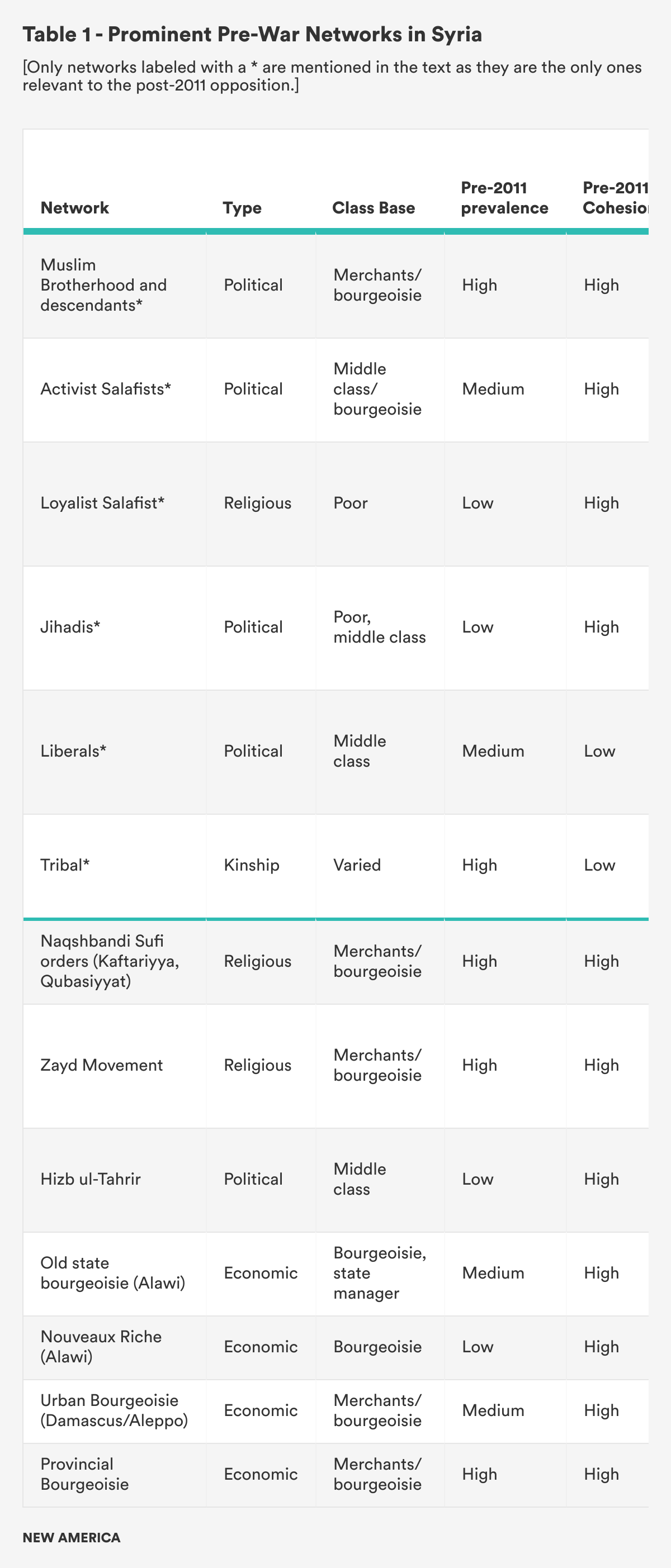
In Syria, there were dozens of prewar networks—Table 1 lists a few—but only some figured prominently in the conflict. Of these, the armed movement was dominated by six: liberals, tribal sheikhs, the Muslim Brotherhood, activist Salafis, loyalist Salafis, and jihadi Salafis. We described the fragmentary nature of liberal and tribal networks above. This section takes a closer look at the other four networks.
The Muslim Brotherhood
The Syrian Muslim Brotherhood is one of the most important organizations in modern Syrian history. Historically, the Brotherhood was closely aligned with the Syrian merchant class and harbored ties to multiple foreign actors, including (for a time) Saudi Arabia and Saddam Hussein’s Iraq.1 The formal organization was destroyed in the 1980s but survived under the guise of informal kinship and merchant networks. By 2011, this network represented the most organized, well-financed, and transnational political formation in the country. The group—in particular, its informal apparatus, which includes multiple offshoots—enjoyed close links with Turkey, Qatar, and revolutionary Libya. As a result, its characteristics made it a network well positioned, relative to other Syrian networks, to allow for high patron capacity.
The roots of the Syrian Muslim Brotherhood date to religious reform movements that appeared in the late nineteenth century across the Ottoman Empire. A series of thinkers responded to the supposed backwardness of Muslim lands, which were under colonial subjugation or in a state of decline, by arguing that Islam has the potential to modernize their societies and liberate them from Western imperialism.2 The most important of these “modernist” reformers was Hassan Banna, who founded the Muslim Brotherhood in Egypt in 1928. The Syrian branch was established in 1945 and composed of various preexisting networks of religious activists. In particular, the Hama-Aleppo network was Sufi in orientation, whereas the Damascus branch tended to reject traditional practices.3
In the 1960s, the Baʿth Party seized power and expropriated major landowners, many of whom had presided over exploitative quasi-feudal estates. By distributing land to millions of peasants, the regime cultivated a popular base in rural sectors and among the working class.4 In reaction, the bourgeoisie and landed aristocracy increasingly threw its support behind the Muslim Brotherhood—whose worldview aligned with that of the urban merchant class.5 This occurred primarily in regions where landholding had been most unequal, and therefore where the old elites had the most to lose from redistributive Baʿthist policies—areas such as Hama and Idlib.6 These class dynamics would have important consequences for the Syrian revolution.
Generally, the Muslim Brotherhood was a reformist project, seeking to win power through peaceful means, but in 1960s Egypt a revolutionary current emerged through the writings of Sayyed Qutb. He argued that the supreme legal and governmental authority is God, and a state is only legitimate if it is administered in accordance with God’s law.7 Crucially, this means that Muslims do not owe obedience to a state or ruler who contravenes God’s law. Under such conditions, a revolutionary vanguard should act. Before long, Bannaist and Qutbist wings of the Brotherhood emerged around the Middle East.
In Syria, the Qutbist wing took the form of the Fighting Vanguard, which launched an insurgency against the Baʿthist state in the late 1970s.8 However, because the Brotherhood’s social base was limited to a narrow section of the population—the urban merchant class and the landowning elite—the regime was able to isolate and crush the uprising.9 Afterward, many Brotherhood cadres fled the country, establishing businesses in the Gulf and Europe.10 Over the years, this developed into a network of merchants and traders, who commanded significant capital and hailed from former Brotherhood hotbeds like Jebel al-Zawiya, Mareʿ, and ʿAnadan. Most of these merchants were no longer formal members of the organization, but they constituted a network of trust based on their former affiliation. They were broadly Bannaist in political perspective, and Sufi in religious orientation. In the revolution, this Brotherhood network became one of the earliest funding conduits to penetrate the country. The most prominent rebel faction representing this trend was Liwa al-Tawhid, under the command of two merchants from Mareʿ and ʿAnadan.11
Activist Salafism
The movement that some scholars call activist Salafism actually consists of a few disparate lineages, all linked by their merger of Brotherhood-style concern with worldly politics and Wahhabi theology, as well as their independence from the Saudi regime.12 Qatar is the world’s premier backer of activist Salafism, while significant currents that function without state support are found in Kuwait, Saudi Arabia, and Yemen. In Syria before the war, activist Salafis constituted a small, tight-knit network that could be found in most major cities and in many small towns, and they tended to come from the same upper-middle-class background as the Muslim Brotherhood; indeed, the activists are in some sense one of the descendants of the Brotherhood.13 Like the Muslim Brotherhood, the activist Salafist network’s cohesiveness and access to capital contributed to the development of high patron capacity to influence it. Moreover, the activists harbored many pre-2011 ties to Qatar, making for a successful proxy relationship when the war started.
The activist Salafist trend ultimately traces its origins to Wahhabism, a doctrine associated with the eighteenth century religious reformer Muhammad ibn ʿAbd al-Wahhab, a theologian from Najd, the central region of modern-day Saudi Arabia. Ibn ʿAbd al-Wahhab’s teachings articulate how a Muslim’s practice should relate to the most fundamental aspect of the faith: monotheism. Contrary to prevailing theology, he argued that affirming belief in one God is insufficient to qualify as monotheistic practice—one must also deny all other forms of worship.14 Under this expansive conception of worship, everything from seeking saintly intercession at tombs to representing a living being on paper was a form of shirk, the association of another being with God. “Ibn Abd al-Wahhab noted that the unbelievers may well profess God’s oneness as the creator and the sustainer,” writes scholar of Wahhabism David Commins. “But if they call on the angels, or Jesus, or the saints to get closer to God, then they are unbelievers. Even if they pray night and day, live an austere life and donate all their wealth, they are still unbelievers and God’s enemy because of their belief in Jesus or some saint.”15 Those guilty of such a sin were effectively committing a form of disbelief in the unitary power of God himself—and in Ibn ʿAbd al-Wahhab’s view, such disbelief rendered their life and property subject to attack. In his eyes, the world around him was mired in shirk, especially in the form of Sufism and Shiism. In 1744, he allied with the tribal leader Muhammad ibn Saʿud, legitimizing the latter’s conquest over what Ibn ʿAbd al-Wahhab considered the idolatrous lands of the Najd.
By then, Wahhabism had developed a distinctive feature that would have important consequences in the twentieth century. Ibn ʿAbd al-Wahhab had managed to weave his iconoclastic notions into a broader, preexisting system of creed (ʿaqida) known variously as traditionalism or the Hanbali school. The Hanbali creed (as distinct from the Hanbali fiqh or jurisprudence) rejected theological schools that included reason alongside the Qur’an and the hadith as legitimate sources of religious knowledge. As a consequence, Ibn ʿAbd al-Wahhab maintained that a literal reading of the Qur’an is the only way to guard against unbelief. Though he championed the notion that jurists should not blindly imitate previous scholars in rendering legal decisions, he did not offer any advances in the field of Islamic law. In other words, Wahhabism is a theological doctrine, and its followers conceptualize their differences with other religious schools primarily on questions of creed—not on questions of politics in the modern sense. Wahhabi religious practice is primarily focused on the correct rituals and rules for personal conduct. Second, by allying with the house of al-Saʿud, Ibn ʿAbd al-Wahhab effectively created distinct spheres of responsibility; politics fell entirely under the emir’s domain, and questions of belief and practice under the purview of the ʿulema. Only the emir could call for jihad, and his rule was considered legitimate so long as this alliance held.
By the mid-twentieth century, Wahhabism remained clustered in Saudi Arabia and the Gulf, based on an ʿulema hailing from the Najd and allied to the House of al-Saud.16 The Muslim Brotherhood, on the other hand, had chapters in many countries—and, despite surface similarities, their brand of Islamic modernism differed sharply with the Wahhabi belief system.17 The core distinction is that the Wahhabi movement is oriented primarily toward creed, in particular to the question of which forms of personal conduct qualify as a legitimate religious belief, whereas the modernists emphasized the political nature of religious reform. Because the state and the market had radically transformed social life, it was impossible for the modernists to conceive of religion independent of such forces. Banna argued that Islam was a not merely a question of ritual or theological orientation, but rather a “complete system” that implied a total reordering of society through such reforms as constitutionalism and wealth redistribution.18 Such a notion would be unthinkable in classical Wahhabi doctrine. In fact, the very existence of the Brotherhood as a political party was an abomination to Wahhabi sensibilities, which viewed any form of hizbiyya (factionalism) as a threat to monotheism. Even surface similarities reveal, on closer inspection, a world of difference: like the Wahhabis, Banna and the modernists decried religious practices that they considered “innovations,” such as various Sufi traditions, but for entirely different reasons. Whereas Ibn ʿAbd al-Wahhab critiqued Sufism on theological grounds, the modernists did so on political grounds—that “backwards” superstitions hampered progress in Muslim lands. In general, Banna paid little attention to creed, instead tailoring Islam to the anti-colonial struggle. The Brotherhood did not declare Muslims apostates simply based on differences in ritualistic practice—as we saw above, Sufis filled the ranks of the Hama-Aleppo branch of the Syrian Brotherhood. Banna, in fact, advocated a big tent approach. “Let us cooperate in those things on which we can agree,” he said, “and be lenient in those on which we cannot.”19
It was in 1960s Saudi Arabia that these two disparate traditions merged, a novel synthesis out of which the modern Salafi movement appeared. Muslim reformers from the late nineteenth century have been described as “Salafis” but, as Henri Lauzière has shown, this term was misapplied by foreigners to thinkers who were far from what we now know as modern Salafism.20
In the 1960s, Gemal ʿAbd al-Nasser inspired millions across the Middle East with his secular message of Pan-Arab nationalism, while at the same time communist movements were spreading throughout the region, even within the Kingdom itself. In his groundbreaking study of the period, Stéphane Lacroix writes:21
[Saudi Crown Prince] Faysal understood the necessity of not surrendering the ideological arena to a master of propaganda like Nasser. To confront Nasser’s pan-Arab socialism, he had to make Islam, the kingdom’s chief symbolic resource, into a counterideology, but the very traditional Wahhabi ulema were quite incapable of engaging in a political debate of this magnitude. Thus the members of the Muslim Brotherhood in Saudi Arabia were increasingly brought into the anti-Nasser propaganda apparatus and became its core by 1962.
One of the émigrés was Mohammed Qutb, professor in the faculty of Shariʿa in Mecca, and younger brother of Sayed, who issued a series of books and lectures in the 1970s that attempted to reconcile the Qutbist strand of Brotherhood ideology with the Wahhabi doctrine. He grafted a Wahhabi conception of creed onto the Brotherhood’s political vision, while carefully downplaying elements of his brother’s revolutionary program that might make the authorities bristle.22 This fusion proved popular among Brotherhood expatriates who, with the regime’s encouragement, had filled the ranks of the university system. This fusion of Brotherhood and Wahhabi doctrines came to be known as the Sahwa (awakening). Over the decades, tens of thousands of young Saudis were influenced by Sahwi ideas, either by attending university or clubs organized by Sahwa luminaries. At first, these activities steered clear of criticizing the regime. But by the late 1980s, in the shadow of declining oil revenues, recent graduates faced dim career prospects and a religious establishment that remained impenetrable to outsiders.23 In 1991, the Sahwa movement erupted in protest following the regime’s decision to allow American soldiers on Saudi soil. The movement went on to call for wide-ranging reforms, including tentative steps towards democratization; however, by the mid-1990s the regime managed to crush the uprising and arrest most of its leaders.
Still, the Sahwa made a lasting contribution by helping give rise to the modern Salafi movement. By politicizing Wahhabi doctrines, the Sahwa produced a version of Wahhabi-inspired ideology that could engage with modern questions like political reform and social justice.24 One of the key Sahwa networks representing this synthesis sprung from the followers of a Syrian named Muhammad Surur bin Nayef Zayn al-ʿAbadeen. His acolytes, known as Sururis, perhaps most clearly exemplify the “brotherization” of Wahhabi belief; key Sahwi leaders Salman al-ʿAwda and Safar al-Hawwali were Sururis, and were imprisoned for four years for their roles in the protest movement.25 As Sahwi ideas expanded beyond Saudi borders, the Sururis became an important component of a network that we call “activist Salafism.” Activist Salafis typically seek to reform existing Muslim governments—and potentially support the overthrow of non-Muslim ones. Some prominent activist Salafis argue that there is no contradiction between democracy and Islam, while all agree with Qutb’s injunction that a state is only legitimate if it administers religious law.26 On matters of creed, most are similar to Wahhabis and share with them an intense sectarianism towards Shias.
In Syria, activist Salafism first took root in the 1990s. One of the movement’s founders was a schoolteacher named Abu Anas, from Saraqib. He recalls:27
We had a secret group in Aleppo, we used to meet each other in creative ways to avoid the security grip. We were five in our secret group; this was the core of the Salafi movement, and it started to spread and to expand in other areas. In Raqqa for example, because I was a teacher there, and in Idlib. There was no name for this group; the others were also university students. Our activities were mostly to distribute books, and to call people to Islam, to reawaken them. Usually we would organize against communism, or to support the Muslim cause. For example, during the Bosnia conflict, we started to raise awareness because the people didn't know anything about what was happening. We were interested in raising awareness about Shariʿa. In 1994, we began to warn people about the Shia.
By the mid-1990s, there were nearly two dozen people in Abu Anas’ group.28
Our main interest was in giving a response to communism [which was then popular on university campuses] and liberalism, and then later on to respond to the Iranians and the Sufi orders. We read al-Albani and the Sahwi Sheikhs of Saudi Arabia, such as Salman al ʿAwda, Safar al-Hawwali, Naser al-ʿUmar. The sheikhs of Sahwa were in the middle between the Brotherhood and Wahhabism. So they used to care about Muslims around the world, the jihad in Afghanistan, and Chechnya and Bosnia.
In 2011, Abu Anas became a key founder of Ahrar al-Sham, one of the most important rebel organizations, and arguably the largest recipient of funds accrued through the worldwide activist Salafist network.
Loyalist Salafism
Within Saudi Arabia, anti-Sahwa views emanated not only from the regime but from another major religious trend that took root there in the 1960s. Muhammad Nasir al-Din al-Albani, an Albanian scholar who grew up in Damascus, arrived in the kingdom in the sixties and began to arraign both the Brotherhood-influenced Sahwa generation and the official Wahhabi tradition. Against the former, he made familiar Wahhabi-style critiques of the politicization of religious practice. Jacob Olidort writes, “Albani summarized [his] attack on the Muslim Brotherhood [as]: ‘the ends do not justify the means.’” The Sahwa-style Salafis seek to tailor religious teachings to political ends, whereas Albani maintained that the “priority is to correct the means that Muslims use to achieve their ends; their method.”29 In other words, Albani believed that Muslims must purify their creed before engaging in political activity. Against the Wahhabi tradition, on the other hand, he criticized the Wahhabi ʿulema’s adherence to the Hanbali school of jurisprudence, arguing that the Qur’an and the hadith are the only legitimate sources of religious knowledge. He espoused a renewed science of the hadith, through a process of historical investigation and moral reasoning that was, in theory, open to anyone who committed themselves to the task. This removed the mastery of religious knowledge from the grip of the Wahhabi ʿulema, a closed religious aristocracy limited to a few families from the Najd. “Thus,” writes Stéphane Lacroix, “the science of hadith can be measured according to objective criteria unrelated to family, tribe, or regional descent, allowing for a previously absent measure of meritocracy.”30
However, like the Wahhabi ʿulema, Albani harbored a hostility toward political activity, so his thinking represented a quietist form of Salafism. Nonetheless, in practice, his followers often adopted de facto political positions: during the 1990s, for example, one current, led by Rabiʿ al-Madkhali, were staunch defenders of the Saudi state against the Sahwa protest movement.31 Other currents even engaged in de jure political activity, such as Kuwaiti Salafis, who participated in parliament. What unites these strands, ultimately, is not quietism but the fact that they do not oppose the Saudi regime. For this reason, we denote this trend as “loyalist Salafism.” With respect to the Syrian conflict, key loyalist Salafis include, in addition to al-Madkhali, Hayef al-Mutairi (Kuwaiti), and ʿAdnan ʿArour (Syrian, but based in Saudi Arabia), both of whom were among the most prominent fundraisers for the Syrian opposition.
In Syria, loyalist Salafi networks emerged in the 1990s, like their Activist counterpart. An early hotbed of Loyalist activity was in the Damascus suburb of Douma, from where local religious scholars had traveled to Saudi Arabia, where they became exposed to Salafi ideas.32 One of the leading Salafis in Douma was Sheikh Abdullah Alloush, imam of the Tawhid mosque, who moved to Saudi Arabia in the 1990s. After 2011, his son Zahran Alloush became the leader of the rebel faction Liwa al-Islam, which ruled the Damascus suburbs like a fiefdom, and which benefited primarily from funds drawn from loyalist Salafi networks backed by Saudi Arabia.33
Loyalist Salafist networks were not as pervasive in Syria as the Brotherhood networks, though they began to grow after the 1990s. One factor in this growth was globalization and migration to the Gulf, particularly in areas along the Euphrates river basin where local clans maintained historic kinship ties to tribes living within Saudi borders. Unlike Brotherhood or activist networks however, loyalists did not form a cohesive national network and came from a diverse class background. As a result, during the war the patrons backing loyalist networks did not enjoy high capacity in areas of northern Syria where the revolution was strongest, such as Idlib and the northern Aleppo provinces.
Even in cases where factions had longstanding ties to Saudi Arabia, the capacity of Riyadh to control these proxies proved limited in the long run due to the nature of the loyalist networks. In a stretch of the Middle Euphrates Valley encompassing the region of Tabqa, Maskana, Deir Hafer and al-Khafsa, a unique brand of Saudi-backed opposition emerged early in 2012. These factions were founded by the descendants of several of Syria’s former landowning tribal elite who were marginalized by the land reform policies of the Baʿth party.
The sheikhs of the Nasser, Khafaja, Hadidiyyin, and Ghanem clans in Tabqa, Maskana, Deir Hafer, and Khafsa, respectively, had owned tens of thousands of hectares land along the Euphrates, much of which was seized as part of state land redistribution policies. By the 1980s, many of these tribesmen relocated to Saudi Arabia, where they maintained kinship ties and used their remaining capital to launch businesses. This migration introduced Middle Euphrates Valley tribesmen to loyalist Salafism and helped them establish ties with the Saudi elite that proved useful after 2011. The founders of armed Syrian opposition factions in all four of these cities managed to secure significant Saudi funding in early 2012 and establish a loyalist Salafist belt along the Euphrates that was distinct from the Qatari-Brotherhood-backed belt in Idlib and the northern Aleppo countryside. Despite their initial backing from Riyadh, however, the majority of these factions ended up joining Ahrar al-Sham, and in rarer cases, Jabhat al-Nusra. One reason for this switch is that these factions contained individuals who had fought in Iraq, and had preexisting ties to donors in the activist and (occasionally) jihadi circuit.
Nonetheless, Saudi aid continued to flow to these groups throughout the first half of 2013. Like Riyadh’s willingness to work with certain elements of the Brotherhood in early 2012, Saudi Arabia’s preexisting ties to the tribes in these areas enabled Riyadh to justify compromising on the issue of activist Salafism and continue supporting these groups. By mid-2013, however, Saudi aid to these groups had largely ceased.34
Jihadi Salafism
Jihadi Salafism reflects a merger of various strands of political Islam. Its roots lie in a faction of the Qutbist wing of the Egyptian Muslim Brotherhood that turned violent and sought to overthrow the Egyptian state (of which Ayman Zawahiri is a prominent example). This trend merged with two others: one stemming from the Sahwa generation in Saudi Arabia (Osama bin Laden passed through a Sahwa network in the Hejaz), and another originating in a wing of Albani’s followers who radicalized and turned against the Saudi state (for whom the Jordanian Abu Muhammad al-Maqdisi played an important role as a theorist reconciling Qutbist ideas with Albani’s theology).35 Jihadi Salafi doctrine further developed through exigencies of the battlefield, which was a crucible of their worldview.
In Syria, the first Salafi jihadi network materialized around the firebrand preacher Abu al-Qaʿqaʿ, whom Syrian intelligence supported as a means to apply pressure on the U.S. occupation of Iraq. Many Syrians were moved by U.S. atrocities to cross the border and join the resistance in Iraq; a minority went through al-Qaʿqaʿs network and fell into al-Qaʿeda in Iraq (AQI) circles.36 In this way, AQI began to develop networks in Deir ez-Zour and the Damascus countryside, aided by porous borders and the regime’s blind eye. The regime also likely harbored links to Fateh al-Islam, a Jihadi Salafi group based in the Palestinian refugee camps of Lebanon, as a means to help manage its occupation there.37 Eventually, Damascus faced blowback: splinter elements from this group linked up with returnees from Iraq to form Jund al-Sham, which waged a low-level insurgency against the Syrian state during the mid 2000s.38 Key leaders of Jabhat al-Nusra and ISIS emerged from these networks.39
In Syria, jihadi Salafi networks were much smaller than the others, but nonetheless quite cohesive due to the time individuals spent together in prison or in underground cells. Compared to the others, these networks harbored few links to foreign state actors.40 One reason was due to regional powers’ restrictions, which made donations a risky endeavor. Another, and more important, was due to a strategic orientation, first outlined by Abu Musʿab al-Zarqawi during the Iraq war, to avoid reliance on outside funding in order to maintain independence.41 Despite the cohesion, jihadi Salafi networks interests’ rarely overlapped with foreign states, making the question of patron capacity irrelevant; jihadi Salafis were the actors least implicated in Syria’s proxy war.
Citations
- Lefèvre, Ashes of Hama.
- Albert Hourani, Arabic Thought in the Liberal Age, 1798-1939 (Cambridge [Cambridgeshire] ; New York: Cambridge University Press, 1983).
- Lefèvre, Ashes of Hama, 26; Author interviews with Fursan al-Furat member Mustafa Suleiman, 2020.
- Raymond A. Hinnebusch, Syria: Revolution from Above, The Contemporary Middle East (London ; New York: Routledge, 2002).
- Batatu, “Syria’s Muslim Brethren.”
- For information on historical landholding patterns, see: Bichara Khader, La Question Agraire Dans Le Monde Arabe: Le Cas de La Syrie (Louvain-la-Neuve: CIACO, 1984); Norman N. Lewis, Nomads and Settlers in Syria and Jordan, 1800-1980, Digitally printed version, Cambridge Middle East Library 9 (Cambridge London New York, N.Y: Cambridge University Press, 2009).
- S. Khatab, “Hakimiyyah and Jahiliyyah in the Thought of Sayyid Qutb,” Middle Eastern Studies 38, no. 3 (July 2002): 145–70, source.
- Lefèvre, Ashes of Hama.
- Batatu, “Syria’s Muslim Brethren”; Lawson, “Social Bases for the Hama Revolt.”
- Author interviews with Brotherhood-linked figures, 2018, 2019.
- Author interviews with high-ranking Liwa al-Tawhid leaders, 2020. Other prominent Brotherhood-linked groups included Ajnad al-Sham in eastern Ghouta and the short-lived Shields movement, and more recently, Faylaq al-Sham.
- See for example, Quintan Wiktorowicz, “Anatomy of the Salafi Movement,” Studies in Conflict & Terrorism 29, no. 3 (May 2006): 207–39, source.
- Author interview with Manbij revolutionary Abu Abdullah al-Salafi and other Salafist linked figures, 2019, 2020.
- Natana J. DeLong-Bas, Wahhabi Islam: From Revival and Reform to Global Jihad (Oxford: Oxford Univ. Press, 2004).
- David Dean Commins, The Wahhabi Mission and Saudi Arabia (London ; New York: I.B. Tauris, 2006), 25.
- The movement also had offshoots in South Asia.
- One early attempt to bridge this divide was through the late writings of Rashid Rida. However, this was still far removed from the novel synthesis that emerged in the 1970s in Saudi Arabia. See: Henri Lauzière, The Making of Salafism: Islamic Reform in the Twentieth Century, Religion, Culture, and Public Life (New York: Columbia University Press, 2016).
- Moussalli, Ahmad., “Hassan Al-Banna” in The Oxford Handbook of Islam and Politics, John L. Esposito and Emad Eldin Shahin, eds (Oxford, UK ; New York, NY: Oxford University Press, 2013).
- Richard P. Mitchell, The Society of the Muslim Brothers (New York: Oxford University Press, 1993), 217.
- Lauzière, The Making of Salafism.
- Stéphane Lacroix and George Holoch, Awakening Islam: The Politics of Religious Dissent in Contemporary Saudi Arabia (Cambridge, Mass: Harvard University Press, 2011), 41.
- Lacroix and Holoch, Awakening Islam.
- Lacroix and Holoch.
- Lacroix writes, “As opposed to Wahhabism, Salafism refers here to all the hybridations that have taken place since the 1960s between the teachings of Muhammad bin ‘Abd al-Wahhab and other Islamic schools of thought,” in Stéphane Lacroix, “Al-Albani’s Revolutionary Approach to Hadith,” ISIM Review 21, no. 1 (2008): 6–7. Of course, the term salafiyya has been in circulation for much longer than the Sahwa movement. However, as Henry Lauzière has shown, the term was never used by Islamic thinkers to describe a political or religious movement until the 1930s, and then only because it was (erroneously) introduced by orientalist scholarship. Although modern-day Salafism has its antecedents before the 1960s, particular in the late work of Rashid Rida, the movement only took shape in recent decades. See: Lauzière, The Making of Salafism.
- On Sururis in Syria, see: Pierret, Thomas, “Salafis at War in Syria: Logics of Fragmentation and Realignment,” in Salafism after the Arab Awakening: Contending with People’s Power, First published (London: Hurst & Company, 2016).
- See: Pall, Zoltan, “Salafi Dynamics in Kuwait: Politics, Fragmentation and Change,” in Salafism after the Arab Awakening: Contending with People’s Power (New York, NY: Oxford University Press, 2016); Lacroix and Holoch, Awakening Islam.
- Author interview with Abu Anas, May 2018.
- Author interview with Abu Anas, May 2018.
- Jacob Olidort, “The Politics of ‘Quietist’ Salafism,” Analysis Paper (Brookings Institution, February 2015), source.
- Lacroix, “Al-Albani’s Revolutionary Approach to Hadith.”
- Meijer, Roel, “Politicizing Al-Jarh Wa-l-Ta’di: Rabi b. Hadi Al-Madkhali and the Transnational Battle for Religious Authority,” in The Transmission and Dynamics of the Textual Sources of Islam: Essays in Honour of Harald Motzki, Nicolet Boekhoff- van der Voort et al., eds, Islamic History and Civilization 89 (Leiden: Brill, 2011), 380-381.
- Thomas Pieret, “Brothers in Alms: Salafi Financiers and the Syrian Insurgency,” Carnegie Middle East Center, May 18, 2018, source.
- Aron Lund, “Into the Tunnels: The Rise and Fall of Syria’s Rebel Enclave in the Eastern Ghouta” (The Century Foundation, December 21, 2016), 9, source.
- Author interviews conducted with Chairman of Maskana Local Council; Musa’ab bin Umayr Brigade commanders; Haddiyyin and Nasser tribesmen, 2019-2020.
- Joas Wagemakers, A Quietist Jihadi: The Ideology and Influence of Abu Muhammad Al-Maqdisi (Cambridge ; New York: Cambridge University Press, 2012).
- Charles R. Lister, The Syrian Jihad: Al-Qaeda, the Islamic State and the Evolution of an Insurgency (Oxford New York Auckland Cape Town Dar es Salaam Hong Kong Karachi Kuala Lumpur Madrid Melbourne Mexico City Nairobi New Delhi Shanghai Taipei Toronto: Oxford University Press, 2015), 32; Huzayfa Osman interview with Zacharia Qarisli, May 2018. Qarisli’s brother Omar, from Manbij, traveled to Iraq to fight. He was later killed in 2012 in battle with the Assad regime. He belonged to a Muslim Brotherhood-linked faction in Manbij.
- Line Khatib, Islamic Revivalism in Syria: The Rise and Fall of Ba’thist Secularism, 1. issued in paperback, Routledge Studies in Political Islam 7 (London: Routledge, 2014).
- Bilal Y. Saab, “Al-Qa`ida’s Presence and Influence in Lebanon,” CTC Sentinel 1, no. 12 (November 2008), source; Line Khatib, “The Pre-2011 Roots of Syria’s Islamist MIlitants,” Middle East Journal 72, no. 2 (Spring 2018).
- “[Tr. Abu Muhammad Al-Jolani. Commander of Jabhat Fatah Al-Sham] أبو محمد الجولاني.. زعيم جبهة فتح الشام,” Al Jazeera, July 26, 2015, source; “[Tr. Who Is ‘ISIS Commander’ Aimad Yassin] من هو ‘أمير داعش’ عماد ياسين؟,” Al Mudun, September 22, 2016, source.
- Al-Qaeda in Iraq received much of its funding from foreign fighters, but these were members of the organization, not independent funders. See: Brian Fishman et al., Bombers, Bank Accounts and Bleedout (Combating Terrorism Center, 2008), 74, source.
- Author nterview with TZ, former member of Iraq’s Mujahedeen Shura Council, a predecessor to ISIS, conducted in Iraq, 2013. See also, Lessons Learned from the Jihad Ordeal in Syria. Combating Terrorism Center’s Harmony Database, AFGP-2002-600080, source.