Social Networks, Class, and the Syrian Proxy War
Table of Contents
- Executive Summary
- Introduction: A Network View of Syria’s Proxy War
- A Deeper Look at Patron Capacity: Networks of Solidarity in the Syrian Rebellion
- A Deeper Look at Patron Interests: The Logic of Gulf State Interventions
- The Syrian Proxy War: 2011–2016
- Case Study: The Proxy War in Manbij
- Conclusion
Abstract
The Syrian conflict began in 2011 as a mass uprising, with protesters gathering in one small town after the next to demand the end of a 40-year dictatorship. It quickly morphed into a complex, multi-sided war. By 2014, the conflict was simultaneously a revolution, a civil war, and a proxy war involving nearly a dozen countries. This report explores how local social networks and socioeconomic class influenced the origins and trajectory of Syria’s proxy war. In Syria, social networks and class played a key role in determining which segments of the rebellion were more susceptible to forming transnational linkages, and when those linkages allowed foreign patrons to wield effective control over their proxies.
Downloads
Executive Summary
The Syrian conflict began in 2011 as a mass uprising, with protesters gathering in one small town after the next to demand the end of a 40-year dictatorship. It quickly morphed into a complex, multi-sided war. By 2014, the conflict was simultaneously a revolution, a civil war, and a proxy war involving nearly a dozen countries, including the United States, Saudi Arabia, Qatar, Turkey, and Jordan. Why did a peaceful uprising for democracy militarize and internationalize so rapidly? Why were some states able to intervene in the uprising with relative (albeit temporary) success, while others failed?
This report attempts to answer these questions by exploring how local social networks and socioeconomic class influenced the origins and trajectory of Syria’s proxy war. Social networks represent an important way through which individuals engage in political collective action: People occupy squares, join armed groups, and track down funding through friends, relatives, business partners, political allies, and coreligionists. An important factor in network formation is class because an individual’s economic position not only influences their worldview, it also defines the horizons of their opportunities. In Syria, social networks and class played a key role in determining which segments of the rebellion were more susceptible to forming transnational linkages, and when those linkages allowed foreign patrons to wield effective control over their proxies.
Much of the analysis of the Syrian war has prioritized the interests of sponsors and the level of control they hold over their proxies. While important, such analysis misses the way in which local context intersects with the designs of outside powers. A sponsor’s success in achieving its aims depends in part on the degree to which its interests overlap with that of the client, and in part, on its capacity to direct client behavior. While many factors influence a patron’s capacity, variables such as the nature of a client’s social networks and their class positions play an important and unheralded role.
Key Findings
- Proxy relationships are governed by an overlap in interests between patron and client, as well as the capacity of the patron to direct client behavior. The prewar social life of clients is an important and overlooked factor shaping both the extent of overlap in interests and patron capacity.
- In Syria, the social networks through which clients engaged in collective action and the economic positions of those clients were essential aspects of this social life.
- Social networks and class played a key role in determining which segments of the rebellion were more susceptible to forming transnational linkages and when those linkages allowed foreign patrons to wield effective control over their proxies.
- Where prewar client networks were cohesive and transnational, the patron enjoyed a greater capacity to direct client behavior. Where prewar client networks were fragmented or sub-national, patrons were unable to mold clients into an effective fighting force.
- Where clients were well-capitalized independent of outside funding, they were able to better withstand the vicissitudes of foreign aid.
- Class position also influenced the geographic reach of a network. Where clients belonged to the merchant class, transnational networks and ties were more likely to develop.
- In Syria, six prewar social networks played the preponderant role in shaping how clients engaged in collective action during the war: liberal, tribal, Muslim Brotherhood, activist Salafi, loyalist Salafi, and Salafi jihadi networks.
- Of the six networks, only two—the Brotherhood and activist Salafis—emerged from pervasive and cohesive pre-2011 networks.
- These two networks overlapped with transnational merchant networks, giving them copious start-up funds and effective command and control.
- These networks also harbored longstanding ties to foreign states, priming them for a proxy relationship.
- Liberal and tribal networks, on the other hand, generally lacked a cohesive pre-2011 structure, nor did they have meaningful transnational links.
- Liberal and tribal networks were fragmented and sub-national.
- Most liberals were middle class professionals who did not have extensive prewar ties to each other or to foreign states.
- By late 2012, the rebel movement against the Assad regime broadly fell into two camps—a U.S.-Saudi-Jordanian axis, and a Turkish-Qatari axis.
- The U.S.-Saudi-Jordanian axis generally relied on networks not conducive to effective patron capacity.
- The U.S.-Saudi alliance backed three types of actors in the uprising: liberals, loyalist Salafis, and tribal figures.
- In general, their proxies were poorer and more fragmented pre-2011 than those supported by Turkey and Qatar.
- In contrast, Qatar and Turkey chose to back Islamist forces that were built upon, or descended from, networks related to the Muslim Brotherhood and activist Salafis.
- These networks were more cohesive, with stronger transnational ties and greater prevalence in prewar Syria.
- These networks were also wealthier, belonging predominately to the merchant class.
- In some cases, individuals in these networks maintained business and political ties with foreign states like Qatar. After 2011, Qatar leveraged these preexisting ties to mobilize a cohesive network—in effect, Qatar’s capacity to influence battlefield dynamics was a reflection of the nature of the networks it chose to support.
- While U.S.-Saudi proxies were generally poorer (prior to infusions of funding) than Qatar’s proxies, that did not mean that Riyadh or Washington could more easily buy allegiance or their ability to act as an effective proxy. Instead the relative wealth of Qatar’s proxies helped Qatar exercise influence.
- The two foreign axes had diverging interests from each other, and often, from the rebel groups they backed.
- The U.S.-Saudi-Jordanian axis policy was driven by a desire to avoid collaboration with activist Salafis and the Brotherhood and to reach a negotiated settlement with the Assad regime.
- The Turkish-Qatari axis’s policy was precisely the opposite, supporting activist Salafis and the Brotherhood.
- While the two sides collaborated for a time, before long they were in open competition, leading to a confused and divided battlefield.
- The Syrian war passed through four phases. These phases and their shifts were structured not only by shifts in external state policy, but also by the character of the social networks comprising the client groups.
- From the start of the protests until late 2011, the uprising witnessed diaspora mobilization, in which funds trickled in through family networks. Because of prior political orientation, class position, and the way they were embedded in transnational networks, ex-Syrian Muslim Brotherhood members dominated this phase of funding.
- From late 2011 until late 2012, the uprising went through a period of open competition, when various non-Syrian individuals and entities began to channel funds into the country, and foreign states began to intervene. Funding in this stage was distributed widely, driven by revolutionary actors’ ability to traverse solidarity networks to attract cash and weapons from all possible sources.
- By late 2012, the uprising entered a period of structured competition, by which point a sharp distinction had arisen between Qatari and Saudi-backed funding networks, and most factions were forced to orient to this divide.
- After 2015, global priorities shifted with the rise of ISIS, while the Russian intervention tilted the balance decisively in the regime’s favor. Gulf funding dried up, leaving Turkey as the main patron, inaugurating an exploitative phase in which the client rebel factions had little room for independent action.
- No foreign actor—whether the United States, Saudi Arabia, or Qatar—had interests fully aligned with the majority of the Syrian opposition.
- The revolutionaries sought to overthrow the entire regime, not just Bashar al-Assad, whereas the policy of outside powers wavered between supporting a negotiated settlement to subordinating revolutionary objectives to other interests, such as fighting ISIS or the PKK.
- Even if patron interests had been aligned with the goal of Syria’s opposition, success for the revolutionaries would not have been guaranteed.
- Ultimately, the outcome of the interventions had as much to do with the structure of pre-2011 Syria as it had with the interests and strategies pursued by foreign actors.
- Though foreign funding shaped the battlefield, the key factors influencing the conflict ultimately depended on the nature of the prewar networks.
- The lack of rebel cohesion was not simply a strategic error on their part, but rather a reflection of the way the 40-year Assad dictatorship fragmented Syrian society.
Introduction: A Network View of Syria’s Proxy War
The Syrian conflict began as a mass uprising, with protesters gathering in one small town after the next, demanding the end of the Assad family’s 40-year dictatorship. The demonstrators linked arms, chanting “Peaceful! Peaceful!” waving placards with slogans championing liberal values and human rights. Within months, however, the movement for democratic reform mutated into an armed struggle to oust President Assad. The hand of regional powers could be seen and felt everywhere. The conflict became many things at once: an inspiring revolution, a devastating civil war, a magnet for Islamist radicals, and, especially, one of the most complicated and wide-ranging proxy wars in modern history. The United States, Jordan, Turkey, Qatar, and Saudi Arabia were all, to varying degrees, supporting the rebel movement, while Russia, Iran, Hizbullah, Iraqi, and Afghan militias stood behind the Assad regime.
With its hundreds of factions and dozens of foreign actors, the Syrian battlefield can seem numbingly complex, but underneath it all lies a logic. To grasp this logic, we must turn the analysis of the war on its head; Most studies of proxy war prioritize the interests of outside sponsors and the degree of control they hold over their proxies. While important, this misses the other side of the story: how such outside interests interact with the intimate forms of life on the ground, such as preexisting political currents, economic interests, cultural mores, religious practices, and, above all, the mosaic of friendships and rivalries that help form the fabric of everyday life.
In a proxy-client relationship, the aim of a local actor is to leverage outside support to pursue local objectives, and the aim of a patron is to enroll local actors in the pursuit of external interests. The patron’s interest in directing client behavior is distinct from its capacity to do so. Patron capacity depends on levels of financial support, but other factors can play a role as well, including:
- the strength of ties between patron and client,
- the internal cohesion of the client actors, and
- the client’s ability to secure alternative or independent means of support.
All three factors crucially depend on the features of social life before the conflict. Individuals form a number of stable relationship patterns, including those based on marriage, kinship, joint economic activity, shared geographic origins, shared political membership, and shared religious activity. Social networks such as these represent an important way through which individuals engage in collective action; people occupy squares, join armed groups, and track down funding through their friends, relatives, business partners, political allies and coreligionists. An often overlooked factor in network formation is class, because an individual’s economic position not only influences their worldview, it also defines the horizons for obtaining resources.
Social networks and class played a key role in determining which segments of the Syrian rebellion were more susceptible to forming transnational linkages, and when those linkages allowed foreign patrons to effectively control their proxies.
The rebel movement against the Assad regime broadly fell into two camps—a U.S.-Saudi-Jordanian axis, and a Turkish-Qatari axis. Generally, the U.S.-Saudi alliance backed three types of actors in the uprising: liberals, loyalist Salafis, and tribal figures. Early in the rebellion, it was “liberals”—secular activists emphasizing human rights and democratic freedoms—who played the leading role in nearly every rebelling town and city, where they formed collectives called local coordinating committees (LCCs). Though the LCCs played a pivotal role in organizing peaceful protests, they were not a cohesive national network that could undertake unified political action. Instead, most LCCs were limited to the towns and cities where they had been founded.1 This is because most LCC members did not have pre-2011 ties, making coordination amid violent regime crackdown difficult. The revolutionary liberals also lacked pre-2011 ties to foreign actors, with the exception of nongovernmental organizations—and Western NGOs typically sought to depoliticize those they supported, diverting their activity into technocratic tasks like grant making or conducting workshops.2 In many towns, the cultural elite consisted of liberals, but lacked the capital to function as an economic elite, so they were unable to use patronage to achieve coherency in their networks.3
Tribal elites, the second major group backed by the U.S.-Saudi alliance, did not form cohesive cross-tribe networks by the very nature of tribal structure, which is fragmented and fractal-like.4 Moreover, tribal sheikhs owe their authority to their ability to dispense patronage, which required that they maintain access to state power.5 As a result, those sheikhs who were relatively disadvantaged under the Assad regime also lacked significant revenue to cohere national and international networks.6
Finally, loyalist Salafis, referring here to a strain of Salafism that did not oppose the Saudi monarchy, did not constitute a cohesive nationwide network with access to wealth to the extent that other Salafis did7 Moreover, such Salafis were far too few in number to provide a base for nationwide mobilization. Rival strands of Salafism were able to play such a role, but they were opposed to Riyadh. In short, the United States and Saudi Arabia failed to mold their proxies into an effective force because they backed actors who lacked an extensive network of pre-2011 ties as well as access to revenues to sustain and cohere themselves in the early period of the uprising.
In contrast, Qatar and Turkey chose to back Islamist forces that were built upon, or descended from, networks related to the Muslim Brotherhood.8 In addition to the Brotherhood themselves, these Islamists included so-called activist Salafis, who represented a hybrid of Brotherhood-style political beliefs with a Wahhabi-influenced theology. Historically, the Brotherhood attracted support from Sunni merchant and landowning classes, in large part because their anti-socialist worldview resonated with the economic interests of these elites.9
After the insurgency of the 1980s was crushed, many Brotherhood members fled for the Gulf and opened businesses. A transnational merchant network developed, based partly on kinship and partly on business ties.10 Thus, the link between the Muslim Brotherhood and the “provincial bourgeoisie”—traders and capitalists from rural towns—was pivotal in the group’s ability to survive the 1980s defeat and appear on the stage in 2011 as one of the few organized and politically conscious segments of Syrian society. In some cases, individuals in this network maintained business and political ties with foreign states, such as Qatar. After 2011, Qatar leveraged these preexisting ties to mobilize a cohesive network—in effect, its capacity was actually a reflection of the nature of the network it chose to support.
Saudi-backed Free Syrian Army (FSA) groups, such as Jamal Maʿrouf’s Syria Martyrs Brigade, had few preexisting networks outside of kinship, meaning that as the group expanded beyond Maʿrouf’s kinsmen it proved difficult to control. As aid fluctuated, the group fragmented and relied on banditry to fund themselves.11 Qatar-backed Islamist groups, on the other hand, emerged from cohesive preexisting networks and were well-resourced because of their links to the provincial bourgeoisie, so were less likely to resort to banditry. Moreover, unlike their liberal counterparts, they maintained longstanding ties to foreign states. This holds an important, and counter-intuitive lesson about patron capacity: While U.S.-Saudi proxies were generally poorer (prior to infusions of funding) than Qatar’s proxies, that did not mean that Riyadh or Washington could more easily buy allegiance or their ability to act as an effective proxy. Instead the relative wealth and cohesion of Qatar’s proxies helped Qatar exercise influence.
In summary, because the nature of prewar social networks differed, the capacities of patron states differed. The remainder of this report is divided into five sections that explore this phenomenon in depth. The next section examines the nature of the key networks in Syria’s war, detailing the role that class played in their formation. Section III turns to the question of patron interests, examining the Gulf states’ motivations for intervention. Section IV narrates a history of the Syrian war through the proxy lens, focusing on how patron capacities intersected with local social structure. In Section V, we apply these concepts to a micro-historical case study of the northern city of Manbij. The conclusion places the issue of social networks and class within the broader context of Syrian history.
Citations
- On LCCs, see: Salwa Ismail, “The Syrian Uprising: Imagining and Performing the Nation,” Studies in Ethnicity and Nationalism 11, no. 3 (December 2011): 538–49, source; Robin Yassin-Kassab and Leila Al-Shami, Burning Country: Syrians in Revolution and War (London: Pluto Press, 2016).
- Julie Hearn and Abdulsalam Dallal, “The ‘NGOisation’ of the Syrian Revolution,” International Socialism Quarterly, October 17, 2019, source.
- Author interviews in Idlib, Manbij, Raqqa, and Turkey, 2017-2019. On the liberals, see also Anand Gopal, “Syria’s Last Bastion of Freedom,” The New Yorker, December 3, 2018, source. This is not to say that all those we are calling “liberal” were always cultural elites; some, like Jamal Ma’arouf, came from a poor background and were animated by anti-Muslim Brotherhood stance and a vague commitment to democracy.
- Haian Dukhan, “Tribes and Tribalism in the Syrian Uprising,” Syria Studies 6, no. 2 (2014), source.
- Fāliḥ ʻAbd al-Jabbār and Hosham Dawod, eds., Tribes and Power: Nationalism and Ethnicity in the Middle East (London: Saqi, 2001).
- An important exception is those sheikhs who maintained business ties abroad, especially in Saudi Arabia, such as the Nasser sheikhs of the Maskana-Tabqa area. Hence these sheikhs were able to dispense patronage to create powerful FSA groups, similar to the way Brotherhood-linked elites created strong Qatar-aligned factions in northern Syria.
- Loyalist Salafi networks were important locally in certain areas, such as Maskana-Tabqa, where the Nasser-backed FSA received funding from Adnan Arour, and eastern Ghouta, where Zahran Alloush’s Liwa’ al-Islam was a powerful and cohesive force that even developed a national presence.
- Dara Conduit, The Muslim Brotherhood in Syria, 2019, source; Naomí Ramírez Díaz, The Muslim Brotherhood in Syria: The Democratic Option of Islamism, Routledge/St. Andrews Syrian Studies Series 1 (London: Routledge, Taylor & Francis Group, 2018); Raphaël Lefèvre, Ashes of Hama: The Muslim Brotherhood in Syria (New York, NY: Oxford University Press, 2013).
- Hanna Batatu, “Syria’s Muslim Brethren,” MERIP Reports (Middle East Research and Information Project, December 1982), source; Fred H. Lawson, “Social Bases for the Hama Revolt,” MERIP Reports (Middle East Research and Information Project, December 1982), source.
- Author interviews with Manbij Revolutionary Council member Ahmed al-Ta’an and Marea’a activist Hussein Nasser, 2019.
- See, for example: Dominique Soguel, “How Saudi Aid Made a Construction Worker a Top Syrian Rebel Commander,” Christian Science Monitor, May 6, 2014, source.
A Deeper Look at Patron Capacity: Networks of Solidarity in the Syrian Rebellion
There are many factors that may influence a patron’s ability to shape its clients’ behavior, including levels of bureaucratic efficiency, funding, and expertise, as well as political realities within the sponsoring state. What is often overlooked, however, is that key features of the client also influence patron capacity. Perhaps the most important is the nature of client social networks. Social networks come in many forms; we call those which facilitated collective action in the Syrian conflict solidarity networks.
We can characterize the nature of a solidarity network by describing its “internal” and “external” features. Internally, the more cohesive a solidarity network is, the more easily its leadership is able to exert command and control over rank-and-file members, and the less likely banditry and other criminal behaviors are. Likewise, the more well-capitalized the network is—the wealthier its members—the more easily it can provide start-up revenue and the more able it is to withstand the vicissitudes of patron funding.
Externally, the more preexisting ties between the client and the patron, the more effectively the patron can control client leadership. Such ties allow patrons to better coordinate with their clients, grant them greater oversight over client activities, and generally serve to align interests.
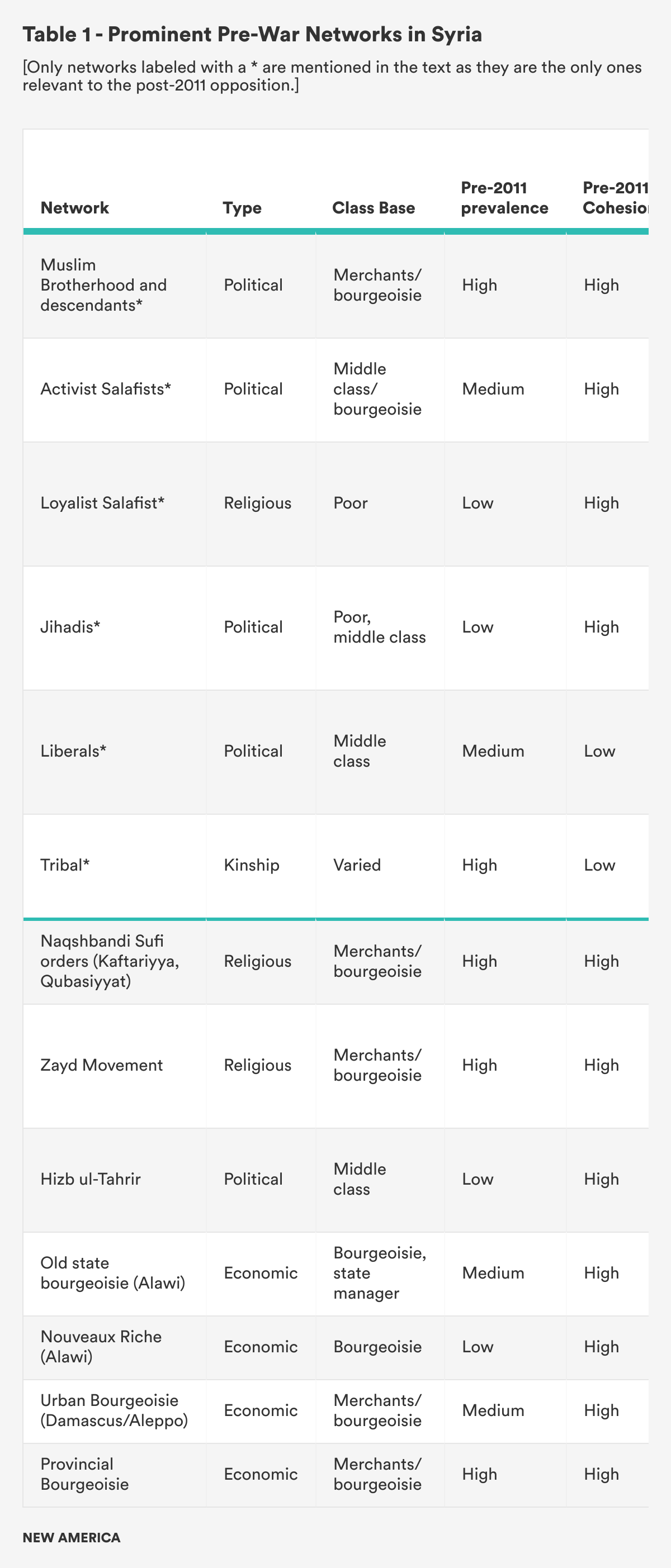
In Syria, there were dozens of prewar networks—Table 1 lists a few—but only some figured prominently in the conflict. Of these, the armed movement was dominated by six: liberals, tribal sheikhs, the Muslim Brotherhood, activist Salafis, loyalist Salafis, and jihadi Salafis. We described the fragmentary nature of liberal and tribal networks above. This section takes a closer look at the other four networks.
The Muslim Brotherhood
The Syrian Muslim Brotherhood is one of the most important organizations in modern Syrian history. Historically, the Brotherhood was closely aligned with the Syrian merchant class and harbored ties to multiple foreign actors, including (for a time) Saudi Arabia and Saddam Hussein’s Iraq.1 The formal organization was destroyed in the 1980s but survived under the guise of informal kinship and merchant networks. By 2011, this network represented the most organized, well-financed, and transnational political formation in the country. The group—in particular, its informal apparatus, which includes multiple offshoots—enjoyed close links with Turkey, Qatar, and revolutionary Libya. As a result, its characteristics made it a network well positioned, relative to other Syrian networks, to allow for high patron capacity.
The roots of the Syrian Muslim Brotherhood date to religious reform movements that appeared in the late nineteenth century across the Ottoman Empire. A series of thinkers responded to the supposed backwardness of Muslim lands, which were under colonial subjugation or in a state of decline, by arguing that Islam has the potential to modernize their societies and liberate them from Western imperialism.2 The most important of these “modernist” reformers was Hassan Banna, who founded the Muslim Brotherhood in Egypt in 1928. The Syrian branch was established in 1945 and composed of various preexisting networks of religious activists. In particular, the Hama-Aleppo network was Sufi in orientation, whereas the Damascus branch tended to reject traditional practices.3
In the 1960s, the Baʿth Party seized power and expropriated major landowners, many of whom had presided over exploitative quasi-feudal estates. By distributing land to millions of peasants, the regime cultivated a popular base in rural sectors and among the working class.4 In reaction, the bourgeoisie and landed aristocracy increasingly threw its support behind the Muslim Brotherhood—whose worldview aligned with that of the urban merchant class.5 This occurred primarily in regions where landholding had been most unequal, and therefore where the old elites had the most to lose from redistributive Baʿthist policies—areas such as Hama and Idlib.6 These class dynamics would have important consequences for the Syrian revolution.
Generally, the Muslim Brotherhood was a reformist project, seeking to win power through peaceful means, but in 1960s Egypt a revolutionary current emerged through the writings of Sayyed Qutb. He argued that the supreme legal and governmental authority is God, and a state is only legitimate if it is administered in accordance with God’s law.7 Crucially, this means that Muslims do not owe obedience to a state or ruler who contravenes God’s law. Under such conditions, a revolutionary vanguard should act. Before long, Bannaist and Qutbist wings of the Brotherhood emerged around the Middle East.
In Syria, the Qutbist wing took the form of the Fighting Vanguard, which launched an insurgency against the Baʿthist state in the late 1970s.8 However, because the Brotherhood’s social base was limited to a narrow section of the population—the urban merchant class and the landowning elite—the regime was able to isolate and crush the uprising.9 Afterward, many Brotherhood cadres fled the country, establishing businesses in the Gulf and Europe.10 Over the years, this developed into a network of merchants and traders, who commanded significant capital and hailed from former Brotherhood hotbeds like Jebel al-Zawiya, Mareʿ, and ʿAnadan. Most of these merchants were no longer formal members of the organization, but they constituted a network of trust based on their former affiliation. They were broadly Bannaist in political perspective, and Sufi in religious orientation. In the revolution, this Brotherhood network became one of the earliest funding conduits to penetrate the country. The most prominent rebel faction representing this trend was Liwa al-Tawhid, under the command of two merchants from Mareʿ and ʿAnadan.11
Activist Salafism
The movement that some scholars call activist Salafism actually consists of a few disparate lineages, all linked by their merger of Brotherhood-style concern with worldly politics and Wahhabi theology, as well as their independence from the Saudi regime.12 Qatar is the world’s premier backer of activist Salafism, while significant currents that function without state support are found in Kuwait, Saudi Arabia, and Yemen. In Syria before the war, activist Salafis constituted a small, tight-knit network that could be found in most major cities and in many small towns, and they tended to come from the same upper-middle-class background as the Muslim Brotherhood; indeed, the activists are in some sense one of the descendants of the Brotherhood.13 Like the Muslim Brotherhood, the activist Salafist network’s cohesiveness and access to capital contributed to the development of high patron capacity to influence it. Moreover, the activists harbored many pre-2011 ties to Qatar, making for a successful proxy relationship when the war started.
The activist Salafist trend ultimately traces its origins to Wahhabism, a doctrine associated with the eighteenth century religious reformer Muhammad ibn ʿAbd al-Wahhab, a theologian from Najd, the central region of modern-day Saudi Arabia. Ibn ʿAbd al-Wahhab’s teachings articulate how a Muslim’s practice should relate to the most fundamental aspect of the faith: monotheism. Contrary to prevailing theology, he argued that affirming belief in one God is insufficient to qualify as monotheistic practice—one must also deny all other forms of worship.14 Under this expansive conception of worship, everything from seeking saintly intercession at tombs to representing a living being on paper was a form of shirk, the association of another being with God. “Ibn Abd al-Wahhab noted that the unbelievers may well profess God’s oneness as the creator and the sustainer,” writes scholar of Wahhabism David Commins. “But if they call on the angels, or Jesus, or the saints to get closer to God, then they are unbelievers. Even if they pray night and day, live an austere life and donate all their wealth, they are still unbelievers and God’s enemy because of their belief in Jesus or some saint.”15 Those guilty of such a sin were effectively committing a form of disbelief in the unitary power of God himself—and in Ibn ʿAbd al-Wahhab’s view, such disbelief rendered their life and property subject to attack. In his eyes, the world around him was mired in shirk, especially in the form of Sufism and Shiism. In 1744, he allied with the tribal leader Muhammad ibn Saʿud, legitimizing the latter’s conquest over what Ibn ʿAbd al-Wahhab considered the idolatrous lands of the Najd.
By then, Wahhabism had developed a distinctive feature that would have important consequences in the twentieth century. Ibn ʿAbd al-Wahhab had managed to weave his iconoclastic notions into a broader, preexisting system of creed (ʿaqida) known variously as traditionalism or the Hanbali school. The Hanbali creed (as distinct from the Hanbali fiqh or jurisprudence) rejected theological schools that included reason alongside the Qur’an and the hadith as legitimate sources of religious knowledge. As a consequence, Ibn ʿAbd al-Wahhab maintained that a literal reading of the Qur’an is the only way to guard against unbelief. Though he championed the notion that jurists should not blindly imitate previous scholars in rendering legal decisions, he did not offer any advances in the field of Islamic law. In other words, Wahhabism is a theological doctrine, and its followers conceptualize their differences with other religious schools primarily on questions of creed—not on questions of politics in the modern sense. Wahhabi religious practice is primarily focused on the correct rituals and rules for personal conduct. Second, by allying with the house of al-Saʿud, Ibn ʿAbd al-Wahhab effectively created distinct spheres of responsibility; politics fell entirely under the emir’s domain, and questions of belief and practice under the purview of the ʿulema. Only the emir could call for jihad, and his rule was considered legitimate so long as this alliance held.
By the mid-twentieth century, Wahhabism remained clustered in Saudi Arabia and the Gulf, based on an ʿulema hailing from the Najd and allied to the House of al-Saud.16 The Muslim Brotherhood, on the other hand, had chapters in many countries—and, despite surface similarities, their brand of Islamic modernism differed sharply with the Wahhabi belief system.17 The core distinction is that the Wahhabi movement is oriented primarily toward creed, in particular to the question of which forms of personal conduct qualify as a legitimate religious belief, whereas the modernists emphasized the political nature of religious reform. Because the state and the market had radically transformed social life, it was impossible for the modernists to conceive of religion independent of such forces. Banna argued that Islam was a not merely a question of ritual or theological orientation, but rather a “complete system” that implied a total reordering of society through such reforms as constitutionalism and wealth redistribution.18 Such a notion would be unthinkable in classical Wahhabi doctrine. In fact, the very existence of the Brotherhood as a political party was an abomination to Wahhabi sensibilities, which viewed any form of hizbiyya (factionalism) as a threat to monotheism. Even surface similarities reveal, on closer inspection, a world of difference: like the Wahhabis, Banna and the modernists decried religious practices that they considered “innovations,” such as various Sufi traditions, but for entirely different reasons. Whereas Ibn ʿAbd al-Wahhab critiqued Sufism on theological grounds, the modernists did so on political grounds—that “backwards” superstitions hampered progress in Muslim lands. In general, Banna paid little attention to creed, instead tailoring Islam to the anti-colonial struggle. The Brotherhood did not declare Muslims apostates simply based on differences in ritualistic practice—as we saw above, Sufis filled the ranks of the Hama-Aleppo branch of the Syrian Brotherhood. Banna, in fact, advocated a big tent approach. “Let us cooperate in those things on which we can agree,” he said, “and be lenient in those on which we cannot.”19
It was in 1960s Saudi Arabia that these two disparate traditions merged, a novel synthesis out of which the modern Salafi movement appeared. Muslim reformers from the late nineteenth century have been described as “Salafis” but, as Henri Lauzière has shown, this term was misapplied by foreigners to thinkers who were far from what we now know as modern Salafism.20
In the 1960s, Gemal ʿAbd al-Nasser inspired millions across the Middle East with his secular message of Pan-Arab nationalism, while at the same time communist movements were spreading throughout the region, even within the Kingdom itself. In his groundbreaking study of the period, Stéphane Lacroix writes:21
[Saudi Crown Prince] Faysal understood the necessity of not surrendering the ideological arena to a master of propaganda like Nasser. To confront Nasser’s pan-Arab socialism, he had to make Islam, the kingdom’s chief symbolic resource, into a counterideology, but the very traditional Wahhabi ulema were quite incapable of engaging in a political debate of this magnitude. Thus the members of the Muslim Brotherhood in Saudi Arabia were increasingly brought into the anti-Nasser propaganda apparatus and became its core by 1962.
One of the émigrés was Mohammed Qutb, professor in the faculty of Shariʿa in Mecca, and younger brother of Sayed, who issued a series of books and lectures in the 1970s that attempted to reconcile the Qutbist strand of Brotherhood ideology with the Wahhabi doctrine. He grafted a Wahhabi conception of creed onto the Brotherhood’s political vision, while carefully downplaying elements of his brother’s revolutionary program that might make the authorities bristle.22 This fusion proved popular among Brotherhood expatriates who, with the regime’s encouragement, had filled the ranks of the university system. This fusion of Brotherhood and Wahhabi doctrines came to be known as the Sahwa (awakening). Over the decades, tens of thousands of young Saudis were influenced by Sahwi ideas, either by attending university or clubs organized by Sahwa luminaries. At first, these activities steered clear of criticizing the regime. But by the late 1980s, in the shadow of declining oil revenues, recent graduates faced dim career prospects and a religious establishment that remained impenetrable to outsiders.23 In 1991, the Sahwa movement erupted in protest following the regime’s decision to allow American soldiers on Saudi soil. The movement went on to call for wide-ranging reforms, including tentative steps towards democratization; however, by the mid-1990s the regime managed to crush the uprising and arrest most of its leaders.
Still, the Sahwa made a lasting contribution by helping give rise to the modern Salafi movement. By politicizing Wahhabi doctrines, the Sahwa produced a version of Wahhabi-inspired ideology that could engage with modern questions like political reform and social justice.24 One of the key Sahwa networks representing this synthesis sprung from the followers of a Syrian named Muhammad Surur bin Nayef Zayn al-ʿAbadeen. His acolytes, known as Sururis, perhaps most clearly exemplify the “brotherization” of Wahhabi belief; key Sahwi leaders Salman al-ʿAwda and Safar al-Hawwali were Sururis, and were imprisoned for four years for their roles in the protest movement.25 As Sahwi ideas expanded beyond Saudi borders, the Sururis became an important component of a network that we call “activist Salafism.” Activist Salafis typically seek to reform existing Muslim governments—and potentially support the overthrow of non-Muslim ones. Some prominent activist Salafis argue that there is no contradiction between democracy and Islam, while all agree with Qutb’s injunction that a state is only legitimate if it administers religious law.26 On matters of creed, most are similar to Wahhabis and share with them an intense sectarianism towards Shias.
In Syria, activist Salafism first took root in the 1990s. One of the movement’s founders was a schoolteacher named Abu Anas, from Saraqib. He recalls:27
We had a secret group in Aleppo, we used to meet each other in creative ways to avoid the security grip. We were five in our secret group; this was the core of the Salafi movement, and it started to spread and to expand in other areas. In Raqqa for example, because I was a teacher there, and in Idlib. There was no name for this group; the others were also university students. Our activities were mostly to distribute books, and to call people to Islam, to reawaken them. Usually we would organize against communism, or to support the Muslim cause. For example, during the Bosnia conflict, we started to raise awareness because the people didn't know anything about what was happening. We were interested in raising awareness about Shariʿa. In 1994, we began to warn people about the Shia.
By the mid-1990s, there were nearly two dozen people in Abu Anas’ group.28
Our main interest was in giving a response to communism [which was then popular on university campuses] and liberalism, and then later on to respond to the Iranians and the Sufi orders. We read al-Albani and the Sahwi Sheikhs of Saudi Arabia, such as Salman al ʿAwda, Safar al-Hawwali, Naser al-ʿUmar. The sheikhs of Sahwa were in the middle between the Brotherhood and Wahhabism. So they used to care about Muslims around the world, the jihad in Afghanistan, and Chechnya and Bosnia.
In 2011, Abu Anas became a key founder of Ahrar al-Sham, one of the most important rebel organizations, and arguably the largest recipient of funds accrued through the worldwide activist Salafist network.
Loyalist Salafism
Within Saudi Arabia, anti-Sahwa views emanated not only from the regime but from another major religious trend that took root there in the 1960s. Muhammad Nasir al-Din al-Albani, an Albanian scholar who grew up in Damascus, arrived in the kingdom in the sixties and began to arraign both the Brotherhood-influenced Sahwa generation and the official Wahhabi tradition. Against the former, he made familiar Wahhabi-style critiques of the politicization of religious practice. Jacob Olidort writes, “Albani summarized [his] attack on the Muslim Brotherhood [as]: ‘the ends do not justify the means.’” The Sahwa-style Salafis seek to tailor religious teachings to political ends, whereas Albani maintained that the “priority is to correct the means that Muslims use to achieve their ends; their method.”29 In other words, Albani believed that Muslims must purify their creed before engaging in political activity. Against the Wahhabi tradition, on the other hand, he criticized the Wahhabi ʿulema’s adherence to the Hanbali school of jurisprudence, arguing that the Qur’an and the hadith are the only legitimate sources of religious knowledge. He espoused a renewed science of the hadith, through a process of historical investigation and moral reasoning that was, in theory, open to anyone who committed themselves to the task. This removed the mastery of religious knowledge from the grip of the Wahhabi ʿulema, a closed religious aristocracy limited to a few families from the Najd. “Thus,” writes Stéphane Lacroix, “the science of hadith can be measured according to objective criteria unrelated to family, tribe, or regional descent, allowing for a previously absent measure of meritocracy.”30
However, like the Wahhabi ʿulema, Albani harbored a hostility toward political activity, so his thinking represented a quietist form of Salafism. Nonetheless, in practice, his followers often adopted de facto political positions: during the 1990s, for example, one current, led by Rabiʿ al-Madkhali, were staunch defenders of the Saudi state against the Sahwa protest movement.31 Other currents even engaged in de jure political activity, such as Kuwaiti Salafis, who participated in parliament. What unites these strands, ultimately, is not quietism but the fact that they do not oppose the Saudi regime. For this reason, we denote this trend as “loyalist Salafism.” With respect to the Syrian conflict, key loyalist Salafis include, in addition to al-Madkhali, Hayef al-Mutairi (Kuwaiti), and ʿAdnan ʿArour (Syrian, but based in Saudi Arabia), both of whom were among the most prominent fundraisers for the Syrian opposition.
In Syria, loyalist Salafi networks emerged in the 1990s, like their Activist counterpart. An early hotbed of Loyalist activity was in the Damascus suburb of Douma, from where local religious scholars had traveled to Saudi Arabia, where they became exposed to Salafi ideas.32 One of the leading Salafis in Douma was Sheikh Abdullah Alloush, imam of the Tawhid mosque, who moved to Saudi Arabia in the 1990s. After 2011, his son Zahran Alloush became the leader of the rebel faction Liwa al-Islam, which ruled the Damascus suburbs like a fiefdom, and which benefited primarily from funds drawn from loyalist Salafi networks backed by Saudi Arabia.33
Loyalist Salafist networks were not as pervasive in Syria as the Brotherhood networks, though they began to grow after the 1990s. One factor in this growth was globalization and migration to the Gulf, particularly in areas along the Euphrates river basin where local clans maintained historic kinship ties to tribes living within Saudi borders. Unlike Brotherhood or activist networks however, loyalists did not form a cohesive national network and came from a diverse class background. As a result, during the war the patrons backing loyalist networks did not enjoy high capacity in areas of northern Syria where the revolution was strongest, such as Idlib and the northern Aleppo provinces.
Even in cases where factions had longstanding ties to Saudi Arabia, the capacity of Riyadh to control these proxies proved limited in the long run due to the nature of the loyalist networks. In a stretch of the Middle Euphrates Valley encompassing the region of Tabqa, Maskana, Deir Hafer and al-Khafsa, a unique brand of Saudi-backed opposition emerged early in 2012. These factions were founded by the descendants of several of Syria’s former landowning tribal elite who were marginalized by the land reform policies of the Baʿth party.
The sheikhs of the Nasser, Khafaja, Hadidiyyin, and Ghanem clans in Tabqa, Maskana, Deir Hafer, and Khafsa, respectively, had owned tens of thousands of hectares land along the Euphrates, much of which was seized as part of state land redistribution policies. By the 1980s, many of these tribesmen relocated to Saudi Arabia, where they maintained kinship ties and used their remaining capital to launch businesses. This migration introduced Middle Euphrates Valley tribesmen to loyalist Salafism and helped them establish ties with the Saudi elite that proved useful after 2011. The founders of armed Syrian opposition factions in all four of these cities managed to secure significant Saudi funding in early 2012 and establish a loyalist Salafist belt along the Euphrates that was distinct from the Qatari-Brotherhood-backed belt in Idlib and the northern Aleppo countryside. Despite their initial backing from Riyadh, however, the majority of these factions ended up joining Ahrar al-Sham, and in rarer cases, Jabhat al-Nusra. One reason for this switch is that these factions contained individuals who had fought in Iraq, and had preexisting ties to donors in the activist and (occasionally) jihadi circuit.
Nonetheless, Saudi aid continued to flow to these groups throughout the first half of 2013. Like Riyadh’s willingness to work with certain elements of the Brotherhood in early 2012, Saudi Arabia’s preexisting ties to the tribes in these areas enabled Riyadh to justify compromising on the issue of activist Salafism and continue supporting these groups. By mid-2013, however, Saudi aid to these groups had largely ceased.34
Jihadi Salafism
Jihadi Salafism reflects a merger of various strands of political Islam. Its roots lie in a faction of the Qutbist wing of the Egyptian Muslim Brotherhood that turned violent and sought to overthrow the Egyptian state (of which Ayman Zawahiri is a prominent example). This trend merged with two others: one stemming from the Sahwa generation in Saudi Arabia (Osama bin Laden passed through a Sahwa network in the Hejaz), and another originating in a wing of Albani’s followers who radicalized and turned against the Saudi state (for whom the Jordanian Abu Muhammad al-Maqdisi played an important role as a theorist reconciling Qutbist ideas with Albani’s theology).35 Jihadi Salafi doctrine further developed through exigencies of the battlefield, which was a crucible of their worldview.
In Syria, the first Salafi jihadi network materialized around the firebrand preacher Abu al-Qaʿqaʿ, whom Syrian intelligence supported as a means to apply pressure on the U.S. occupation of Iraq. Many Syrians were moved by U.S. atrocities to cross the border and join the resistance in Iraq; a minority went through al-Qaʿqaʿs network and fell into al-Qaʿeda in Iraq (AQI) circles.36 In this way, AQI began to develop networks in Deir ez-Zour and the Damascus countryside, aided by porous borders and the regime’s blind eye. The regime also likely harbored links to Fateh al-Islam, a Jihadi Salafi group based in the Palestinian refugee camps of Lebanon, as a means to help manage its occupation there.37 Eventually, Damascus faced blowback: splinter elements from this group linked up with returnees from Iraq to form Jund al-Sham, which waged a low-level insurgency against the Syrian state during the mid 2000s.38 Key leaders of Jabhat al-Nusra and ISIS emerged from these networks.39
In Syria, jihadi Salafi networks were much smaller than the others, but nonetheless quite cohesive due to the time individuals spent together in prison or in underground cells. Compared to the others, these networks harbored few links to foreign state actors.40 One reason was due to regional powers’ restrictions, which made donations a risky endeavor. Another, and more important, was due to a strategic orientation, first outlined by Abu Musʿab al-Zarqawi during the Iraq war, to avoid reliance on outside funding in order to maintain independence.41 Despite the cohesion, jihadi Salafi networks interests’ rarely overlapped with foreign states, making the question of patron capacity irrelevant; jihadi Salafis were the actors least implicated in Syria’s proxy war.
Citations
- Lefèvre, Ashes of Hama.
- Albert Hourani, Arabic Thought in the Liberal Age, 1798-1939 (Cambridge [Cambridgeshire] ; New York: Cambridge University Press, 1983).
- Lefèvre, Ashes of Hama, 26; Author interviews with Fursan al-Furat member Mustafa Suleiman, 2020.
- Raymond A. Hinnebusch, Syria: Revolution from Above, The Contemporary Middle East (London ; New York: Routledge, 2002).
- Batatu, “Syria’s Muslim Brethren.”
- For information on historical landholding patterns, see: Bichara Khader, La Question Agraire Dans Le Monde Arabe: Le Cas de La Syrie (Louvain-la-Neuve: CIACO, 1984); Norman N. Lewis, Nomads and Settlers in Syria and Jordan, 1800-1980, Digitally printed version, Cambridge Middle East Library 9 (Cambridge London New York, N.Y: Cambridge University Press, 2009).
- S. Khatab, “Hakimiyyah and Jahiliyyah in the Thought of Sayyid Qutb,” Middle Eastern Studies 38, no. 3 (July 2002): 145–70, source.
- Lefèvre, Ashes of Hama.
- Batatu, “Syria’s Muslim Brethren”; Lawson, “Social Bases for the Hama Revolt.”
- Author interviews with Brotherhood-linked figures, 2018, 2019.
- Author interviews with high-ranking Liwa al-Tawhid leaders, 2020. Other prominent Brotherhood-linked groups included Ajnad al-Sham in eastern Ghouta and the short-lived Shields movement, and more recently, Faylaq al-Sham.
- See for example, Quintan Wiktorowicz, “Anatomy of the Salafi Movement,” Studies in Conflict & Terrorism 29, no. 3 (May 2006): 207–39, source.
- Author interview with Manbij revolutionary Abu Abdullah al-Salafi and other Salafist linked figures, 2019, 2020.
- Natana J. DeLong-Bas, Wahhabi Islam: From Revival and Reform to Global Jihad (Oxford: Oxford Univ. Press, 2004).
- David Dean Commins, The Wahhabi Mission and Saudi Arabia (London ; New York: I.B. Tauris, 2006), 25.
- The movement also had offshoots in South Asia.
- One early attempt to bridge this divide was through the late writings of Rashid Rida. However, this was still far removed from the novel synthesis that emerged in the 1970s in Saudi Arabia. See: Henri Lauzière, The Making of Salafism: Islamic Reform in the Twentieth Century, Religion, Culture, and Public Life (New York: Columbia University Press, 2016).
- Moussalli, Ahmad., “Hassan Al-Banna” in The Oxford Handbook of Islam and Politics, John L. Esposito and Emad Eldin Shahin, eds (Oxford, UK ; New York, NY: Oxford University Press, 2013).
- Richard P. Mitchell, The Society of the Muslim Brothers (New York: Oxford University Press, 1993), 217.
- Lauzière, The Making of Salafism.
- Stéphane Lacroix and George Holoch, Awakening Islam: The Politics of Religious Dissent in Contemporary Saudi Arabia (Cambridge, Mass: Harvard University Press, 2011), 41.
- Lacroix and Holoch, Awakening Islam.
- Lacroix and Holoch.
- Lacroix writes, “As opposed to Wahhabism, Salafism refers here to all the hybridations that have taken place since the 1960s between the teachings of Muhammad bin ‘Abd al-Wahhab and other Islamic schools of thought,” in Stéphane Lacroix, “Al-Albani’s Revolutionary Approach to Hadith,” ISIM Review 21, no. 1 (2008): 6–7. Of course, the term salafiyya has been in circulation for much longer than the Sahwa movement. However, as Henry Lauzière has shown, the term was never used by Islamic thinkers to describe a political or religious movement until the 1930s, and then only because it was (erroneously) introduced by orientalist scholarship. Although modern-day Salafism has its antecedents before the 1960s, particular in the late work of Rashid Rida, the movement only took shape in recent decades. See: Lauzière, The Making of Salafism.
- On Sururis in Syria, see: Pierret, Thomas, “Salafis at War in Syria: Logics of Fragmentation and Realignment,” in Salafism after the Arab Awakening: Contending with People’s Power, First published (London: Hurst & Company, 2016).
- See: Pall, Zoltan, “Salafi Dynamics in Kuwait: Politics, Fragmentation and Change,” in Salafism after the Arab Awakening: Contending with People’s Power (New York, NY: Oxford University Press, 2016); Lacroix and Holoch, Awakening Islam.
- Author interview with Abu Anas, May 2018.
- Author interview with Abu Anas, May 2018.
- Jacob Olidort, “The Politics of ‘Quietist’ Salafism,” Analysis Paper (Brookings Institution, February 2015), source.
- Lacroix, “Al-Albani’s Revolutionary Approach to Hadith.”
- Meijer, Roel, “Politicizing Al-Jarh Wa-l-Ta’di: Rabi b. Hadi Al-Madkhali and the Transnational Battle for Religious Authority,” in The Transmission and Dynamics of the Textual Sources of Islam: Essays in Honour of Harald Motzki, Nicolet Boekhoff- van der Voort et al., eds, Islamic History and Civilization 89 (Leiden: Brill, 2011), 380-381.
- Thomas Pieret, “Brothers in Alms: Salafi Financiers and the Syrian Insurgency,” Carnegie Middle East Center, May 18, 2018, source.
- Aron Lund, “Into the Tunnels: The Rise and Fall of Syria’s Rebel Enclave in the Eastern Ghouta” (The Century Foundation, December 21, 2016), 9, source.
- Author interviews conducted with Chairman of Maskana Local Council; Musa’ab bin Umayr Brigade commanders; Haddiyyin and Nasser tribesmen, 2019-2020.
- Joas Wagemakers, A Quietist Jihadi: The Ideology and Influence of Abu Muhammad Al-Maqdisi (Cambridge ; New York: Cambridge University Press, 2012).
- Charles R. Lister, The Syrian Jihad: Al-Qaeda, the Islamic State and the Evolution of an Insurgency (Oxford New York Auckland Cape Town Dar es Salaam Hong Kong Karachi Kuala Lumpur Madrid Melbourne Mexico City Nairobi New Delhi Shanghai Taipei Toronto: Oxford University Press, 2015), 32; Huzayfa Osman interview with Zacharia Qarisli, May 2018. Qarisli’s brother Omar, from Manbij, traveled to Iraq to fight. He was later killed in 2012 in battle with the Assad regime. He belonged to a Muslim Brotherhood-linked faction in Manbij.
- Line Khatib, Islamic Revivalism in Syria: The Rise and Fall of Ba’thist Secularism, 1. issued in paperback, Routledge Studies in Political Islam 7 (London: Routledge, 2014).
- Bilal Y. Saab, “Al-Qa`ida’s Presence and Influence in Lebanon,” CTC Sentinel 1, no. 12 (November 2008), source; Line Khatib, “The Pre-2011 Roots of Syria’s Islamist MIlitants,” Middle East Journal 72, no. 2 (Spring 2018).
- “[Tr. Abu Muhammad Al-Jolani. Commander of Jabhat Fatah Al-Sham] أبو محمد الجولاني.. زعيم جبهة فتح الشام,” Al Jazeera, July 26, 2015, source; “[Tr. Who Is ‘ISIS Commander’ Aimad Yassin] من هو ‘أمير داعش’ عماد ياسين؟,” Al Mudun, September 22, 2016, source.
- Al-Qaeda in Iraq received much of its funding from foreign fighters, but these were members of the organization, not independent funders. See: Brian Fishman et al., Bombers, Bank Accounts and Bleedout (Combating Terrorism Center, 2008), 74, source.
- Author nterview with TZ, former member of Iraq’s Mujahedeen Shura Council, a predecessor to ISIS, conducted in Iraq, 2013. See also, Lessons Learned from the Jihad Ordeal in Syria. Combating Terrorism Center’s Harmony Database, AFGP-2002-600080, source.
A Deeper Look at Patron Interests: The Logic of Gulf State Interventions
Patron capacity depends, in part, on the nature of client social networks. But capacity is only one element to the proxy-client relationship; the other is the objectives and goals of the patron. If the patron’s and client’s interests are fundamentally at odds, factors like client cohesion matter little. However, patron goals are themselves influenced by the character of solidarity networks and their transnational ties.
This section describes the logic underlying the interventions of the Gulf states, who were the most important backers of the armed opposition. The respective logics of intervention were strikingly divergent, leading eventually to the development of the two main axes of support: a U.S.-Saudi-Jordanian axis and a Turkish-Qatari axis. This division in turn led to battlefield incoherence that undermined the opposition’s ability to withstand the regime’s onslaught. The logic of intervention was rooted in the intervening power’s geopolitical interests, its domestic concerns, and its prewar ties with Syrian networks.
This section does not discuss Turkey and Jordan, the other key regional backers, but they followed lines similar to the Gulf states: Turkey was closely aligned with Qatar, while Jordan pursued a strategy similar to Saudi Arabia’s. The United States operated within the Saudi-Jordanian axis.
Saudi Arabia
In the beginning, Saudi Arabia adopted an anti-democratic, counter-revolutionary stance toward the Arab Spring in order to prevent the winds of political change from blowing across its borders. The threat to Riyadh came in two forms. The first stemmed from Saudi Arabia’s experience confronting jihadi Salafi networks that emerged from the ashes of the failed 1990s Sahwa movement. In the late 1990’s, a splinter group of ex-Sahwi activists merged with a strand of Albani followers and those from Bin Laden’s network to form a local al-Qaʿeda franchise. Between 2002 and 2006, this outfit waged a low-level insurgency in the kingdom that left more than 200 dead and 500 wounded.1 Though the group lacked a popular base, it managed to strike vital targets such as U.S. interests and petroleum infrastructure.2 At the same time, the rise of al-Qaʿeda in Iraq across the border raised the prospect of a multi-pronged threat to Saudi interests.
The second and more serious threat came from the potential of the pro-democracy movement in Syria, Egypt, and elsewhere spreading to Saudi Arabia and challenging the monarchy’s grip on power. After stamping out the Sahwa in the 1990s, the regime did its best to prevent the movement’s resurgence by rehabilitating key Sahwi leaders on the condition that they limit their critiques to the social arena (such as opposing women’s right to drive) and remain silent on political questions. At the same time, the palace undertook a rapprochement with foreign branches of the Muslim Brotherhood, who were allowed to return to the kingdom or intensify their activities so long as they were directed internationally.3 These policies bore fruit in the early days of the Arab Spring, as Sahwa and Muslim Brotherhood figures in country almost unanimously boycotted calls by local activists to hold a March 11, 2011 “Day of Anger” protest in solidarity with the revolutions around the region. 4
Upon the outbreak of the Syrian revolution, Riyadh was faced with a delicate predicament. On the one hand, the regime welcomed any development that might weaken an ally of Iran, its regional rival. On the other, the palace recognized that the rise of al-Qaʿeda was in part blowback from Riyadh’s earlier policy of nurturing the Muslim Brotherhood at home and supporting the jihad in Afghanistan. Moreover, it viewed the pro-democracy sentiments of the uprising with grave concern. For these reasons, Saudi Arabia avoided intervening in Syria during the first year of the conflict. In 2012, it slowly waded into the foray, primarily supporting secular groups and some Brotherhood factions as a means of limiting the strength of Activist Salafist groups. During 2012, though, the Brotherhood began to pull closer to Qatar, and the Saudis started to lose their influence over the group. The election of the Brotherhood’s Muhammad Morsi as president of Egypt raised the specter of a reinvigorated Sahwa movement within Saudi borders, pushing Riyadh to sharply alter course. By the end of 2012, Saudi Arabia had largely excluded Brotherhood and activist Salafi networks from its patronage—bringing it into direct competition with Qatar.
Qatar
Unlike Saudi Arabia, Qatar has never faced a strong grassroots opposition movement, nor does it share borders with fragile states, reducing the threat of jihadist spillover.5 On the contrary, Qatar’s foreign policy is driven by splits and rivalries within Doha’s ruling class—divisions that have been exacerbated by Saudi rulers. The Saudi royal family is tied by kinship to Qatar’s second most powerful tribe, the al-Attiya clan; historically, Riyadh used these links to wield influence over Khalifa bin Hamad al-Thani, Qatar’s emir from 1972 to 1995, who had married into the al-Attiya family. But Khalifa’s son, Hamid bin Khalifa, was an opponent of Saudi influence and refused to marry into the al-Attiya. In 1995, he led a coup against his father, signaling Doha’s attempt to steer a course independent of Saudi domination. Riyadh in turn retaliated by sponsoring a number of failed coup attempts.6
Hamid bin Khalifa also drifted closer to the U.S. orbit, as epitomized by the official opening of al-Udeid air base in March 2002. In October 2002, reports claimed that domestic opposition to Doha’s growing alliance with the U.S. led to a botched coup attempt led by factions within the royal family. Later in 2009, conservatives led by the Chief of Staff of Qatar’s Armed Forces General Hamid bin ali al-Attiya purportedly launched another failed coup attempt. There are indications that these oppositional ruling class factions were linked to Salafist networks in the country.7 Rather than risk confrontation with factions in the ruling elite, Hamid bin Khalifa attempted to placate these groups by making support for the Brotherhood and activist Salafis a core plank of his regime’s foreign policy, while awarding top government posts to figures with Activist sympathies.8 The strategy served the additional purpose of agitating Saudi Arabia by supporting its enemies abroad—forcing Riyadh to confront Qatar’s actions on foreign fronts rather than exert pressure on Doha at home.
There was an additional domestic benefit to the al-Thani regime’s support of the Brotherhood: While most Qataris practice Wahhabism, and the ruling al-Thani clan hails from the same Najd region as the Saudi elite, Doha’s embrace of the Brotherhood was in part an attempt to build an alternative form of religious legitimacy that could not be manipulated by Riyadh.9
For these reasons, during the Syrian revolution, Qatar was the principal supporter of Brotherhood and activist networks—and occasionally, even Salafist jihadis like Jabhat al-Nusra, al-Qaʿeda's official branch in Syria. During the first six months of 2012, Qatar and Saudi Arabia attempted to cooperate and channel funds to some of the same groups; however, by the summer of that year Doha’s largesse and historic ties with Islamist actors enabled it to wrest control of Brotherhood and activist networks. By 2013 the countries were in open competition. While Riyadh sought primarily to manage the uprising, hoping (along with the United States) for a Yemen-style solution where Assad would step down via a negotiated settlement that preserved the country’s institutions and key power brokers, Doha carelessly pumped funds to its favored networks.
Kuwait
While the Saudi and Qatari states directly intervened in Syria, the Kuwaiti state took a hands-off approach, ceding the ground to civil society, which quickly became a key fundraising circuit during the revolution. Kuwait’s tradition of parliamentary democracy and freedom of assembly, dating to 1962, created a thriving civil society with robust protections against state surveillance, allowing charities and political parties to channel aid without interference from law enforcement.10
A key fault line in Kuwaiti society is between the Sunni and Shia urban elite on the one hand, and newly urbanized Sunni tribespeople from the desert regions on the other. These recent tribal arrivals have faced stigmatization—a subset of this population, known as bidun (those without) have yet to be granted citizenship. This divide has led many tribespeople to gravitate toward the Muslim Brotherhood and activist Salafist movements. The urban elite, on the other hand, tend to support loyalist Salafist discourse backed by the ruling Sabah monarchy and Riyadh. 11
The Kuwaiti Salafist scene is split into activist and loyalist currents. The most important loyalist group is the Revival of Islamic Heritage Society (RIHS), which enjoys ties to the Kuwaiti and Saudi states. On the activist side are groups like the Salafist Movement and the al-Umma party. Leading activists include Hakim al-Mutairi, an important Sururi thinker, as well as Shafi al-ʿAjmi and Hajaj al-ʿAjmi; all three would become major fundraising conduits for groups like Ahrar al-Sham during the Syrian revolution. RIHS and other loyalist groups, meanwhile, would largely fall in line with Riyadh and back Saudi-sponsored groups such as the Authenticity and Development Front and Liwa al-Islam.12
Citations
- These attacks include: 1.) A May 12, 2003 assault on the Dorrat al-Jadaweel, al-Hamra Oasis Village and Vinnell compounds in Riyadh that killed 39, including 20 foreigners, and wounded 160. 2.) A November 8, 2003 car bomb detonated at the al-Mohaya housing compound in Laban Valley west of Riyadh that killed 17, including 6 foreigners, and wounded 122 (including 53 Lebanese and 17 Egyptians). 3.) 21 April 2004 car bomb at Riyadh’s traffic police headquarters that killed 5 and injured 148. 4.) A May 1, 2004 “Black Saturday” massacre at the ABB Lummus offices located at the Yanbu Petroleum Facility in the city of Yanbu al-Bahr that killed 7, including 6 foreigners. 5.) A May 29, 2004 “Al-Khobar Massacre” at the Arab Petroleum Investments Corporation building, al-Khobar Petroleum Centre and Oasis compound that killed 22, including 19 foreigners, and injured 25. 6.) A December 6, 2004 assault on the U.S. Consulate in Jedda that killed 18, including the five attackers, four consulate employees, four hostages and four Saudi Arabia special forces member, and injured 10 others.
- On the merger of Albani and Sahwi trends, see: Lacroix and Holoch, Awakening Islam.
- This effort was also motivated by the regime’s need to cultivate an alternative Islamist ally that could counter the rhetoric of the al-Qaʿeda insurgency.
- See: Courtney Freer, “From Co-Optation to Crackdown,” in The Qatar Crisis (Project on Middle East Political Science, 2017), source; Stéphane Lacroix, “Saudi Arabia’s Muslim Brotherhood Predicament,” in The Qatar Crisis (Project on Middle East Political Science, 2017), source.
- Qatar, with its tiny population, is much easier to police and per capita far richer than Saudi Arabia, where wealth is highly stratified. Unlike its much larger neighbor, Qatar has never been forced to contend with a significant population of marginalized young men that may be prone to organize an insurgency. Tacit support for the regime in Doha from the country’s myriad families and clans is furthermore secured through a tribal quota system that ensures that Qatar’s various kinship networks—including those with weak ties to the regime—are represented by their own members within official institutions. With the exception of a car bomb set off on the outskirts of Doha on March 20, 2005 that killed one British expatriate, the kingdom has never experienced any form of insurgent violence; Allen James Fromherz, Qatar: A Modern History, Updated edition (London ; New York: I.B. Tauris, 2017), 136; “Car Bomb Targets Theatre in Qatar,” BBC, March 20, 2005, source.
- Randeep Ramesh, “The Long-Running Family Rivalries behind the Qatar Crisis,” Guardian, July 21, 2017, source; Jamie Dettmer, “U.S. Ally Qatar Shelters Jihadi Moneymen,” Daily Beast, April 14, 2017, source; “[Tr. Get to the Know the Al-Ghufran Tribe That Complains That ‘Qatar Withdrew Citizenship from Its Members] تعرف على عشيرة الغفران التي تشكو ‘سحب قطر الجنسية من أبنائها,’” BBC Arabic, March 9, 2018, source.
- “Qatar Coup Plot May Thwart U.S. War Plans,” Stratfor, October 25, 2002, source.; “Doha Denies: Claims of a Coup Attempt in Qatar” Al-Dostour (republishing original Reuters piece), October 30, 2002; “Qatar Denies News of a Coup Attempt,” Albawaba (republishing of original Reuters piece), October 30, 2002; Dettmer, “U.S. Ally Qatar Shelters Jihadi Moneymen”; Michael R. Gordon and Eric Schmitt, “AFTEREFFECTS: BASES; U.S. Will Move Air Operations To Qatar Base,” New York Times, April 28, 2003, source.
- Robert Mendick, “Al-Qaeda Terror Financier Worked for Qatari Government,” Telegraph, October 12, 2014, source; Jay Solomon and Nour Malas, “Qatar’s Ties to Militants Strain Alliance,” Wall Street Journal, February 23, 2015, source.
- Andrew Hammond, “Qatar’s Leadership Transition: Like Father, like Son” (European Council on Foreign Relations, February 11, 2014), source; David B. Roberts, “Qatar, the Ikhwan, and Transnational Relations in the Gulf,” in The Qatar Crisis (Project on Middle East Political Science, 2017), 56, source.
- See for example, Jane Kinninmont, “Kuwait’s Parliament: An Experiment in Semi-Democracy” (Chatham House, August 2012), source.
- “Prisoners of the Past Kuwaiti Bidun and the Burden of Statelessness” (Human Rights Watch, June 13, 2011), source; Shafeeq Ghabra, “Kuwait: At the Crossroads of Change or Political Stagnation,” Middle East Institute, May 20, 2014, source.
- Zoltan Pall, “Kuwaiti Salafism and Its Growing Influence in the Levant” (Carnegie Endowment for International Peace, May 7, 2014), source.
The Syrian Proxy War: 2011–2016
The four solidarity networks—Brotherhood, activist, loyalist, and jihadi—were the raw “social” material out of which revolutionaries on the ground and powers in the region and beyond fashioned networks of patronage. This process passed through four stages, with the nature of these networks playing a key role in how the stages shifted from one to the next.
From the start of the protests until late 2011, the uprising witnessed diaspora mobilization, in which funds trickled in through family networks, usually comprised wealthy individuals acting in an individual capacity. Because of their prior political orientation, class position, and embeddedness in transnational networks, ex-Syrian Muslim Brotherhood members dominated this phase of funding.
From late 2011 until late 2012, the uprising went through a period of open competition, when various non-Syrian individuals and entities began to channel funds into the country, and foreign states such as Qatar and Saudi Arabia began to intervene. Funding in this stage was distributed widely, driven by revolutionary actors’ ability to traverse various solidarity networks to attract cash and weapons from all possible sources.
By late 2012, the uprising entered a period of structured competition, by which point a sharp distinction had arisen between Qatari and Saudi-backed funding networks, and most factions were forced to orient to this divide.
After 2015, global priorities shifted with the rise of ISIS, while the Russian intervention tilted the balance decisively in the regime’s favor. Gulf funding dried up, leaving Turkey as the main patron, inaugurating an exploitative phase in which the client rebel factions had little room for independent action.
April 2011–December 2011: Diaspora Mobilization
The first protests to oust Bashar al-Assad erupted in the spring of 2011, and by that summer, debates were simmering in activist circles about whether the revolutionary movement should arm itself. Syrian Muslim Brotherhood networks were a major instigator in the pro-arms camp, particularly in expatriate circles in the Gulf and in Europe. Most of these individuals were no longer members of the organization, but their experience in the 1980s convinced them that the regime could not be reformed, while their class position put them in command of revenue that could be transferred through business ties into Syria. An activist from Saraqib, Idlib, recalls:
Someone from Saudi called me, in the beginning of August [2011], and said ‘We’ll raise money to get you weapons.’ He was a former Muslim Brotherhood member, but he had fled Syria in the 1980s. He said, ‘My friends and I are ready to support you if you want to create an armed group to protect the country… we don’t want you to join our party, we just want to support you because we want to return to our country.’ 1
In some cases, direct descendants of the 1980s Brotherhood uprising joined the revolution and exploited their family links to collect start-up funds for their own brigades. In Saraqib, the ex-Brotherhood member Assad Hilal, who’d served eighteen years in detention, helped form the town’s first Free Syrian Army battalion. In the Idlib town of Taftanaz, members of the Brotherhood-linked Ghazal family did the same.2 Despite their Brotherhood origins, both FSA groups were liberal in political orientation. In the Jebel al-Zawiya region of southeast Idlib, on the other hand, the Brotherhood heritage bequeathed a prominent faction with Salafi ideology. In November of 2011, a merchant from the Jebel al-Zawiya town of Sarjeh named Abu ʿIssa al-Sheikh announced the formation of Suqur al-Sham.3 Al-Sheikh came from a Brotherhood family; his father was involved in the 1980s insurgency, and he himself was imprisoned in Sednaya in 2004. After his release in the summer of 2011, he was able to launch Suqur al-Sham with aid he’d procured through his family’s Brotherhood connections.4
December 2011–December 2012: Open Competition
By autumn 2011, the Syrian cause was stirring hearts across the region. For activist Salafis, the revolution represented more than a struggle for democracy: it was a defense of Sunnis facing extermination at the hands of a sectarian Shiʿa regime. In Kuwait, activist Salafis began to organize donation campaigns, bringing together Syrian expatriate communities with local charities. A leading light in this scene was Shafi al-ʿAjmi, a lecturer at the College of Shariʿa and Islamic Studies at Kuwait University and host of a popular television show.5 ʿAjmi took his soapbox demagoguery to Twitter, where his denunciations of Assad’s crimes were laced with vicious sectarianism, and where the screen flashed with bank account information for viewers to donate.6 Before long, RIHS and other loyalist Salafi groups also began raising funds. By December, the first donations trickled into Syria. Researcher Elizabeth Dickinson writes:
Each nascent rebel brigade would designate a Syrian representative in Kuwait, who was then responsible for dealing with the individual backers. Sitting for tea at Kuwait’s diwaniyas (home spaces used for public gatherings), the representatives would make their cases for support: ‘The representatives were Syrian, imagine they were from one village or another and creating their armed group. They received monthly payments, which at that time were small, maybe 20,000KD per month [$70,630], just according to the donations we received. … From RIHS, it was 80,000KD per month [$282,540]. At that time, in the creation stage, they didn’t need much money.’ 7
With Salafi patrons now intervening in the Syrian conflict, those rebel groups that could tap these networks—while simultaneously drawing from the Brotherhood diaspora—were able to leapfrog other FSA factions. Abu ʿIssa al-Sheikh, for example, could lean on his family’s Brotherhood ties and his own Salafi links cultivated in Sednaya prison to maneuver Suqur al-Sham into becoming a dominant faction in Idlib.8 Even more successful was Ahrar al-Sham. Founded in Saraqib, Ahrar al-Sham merged Brotherhood, activist, and jihadi lineages to become the largest Salafi rebel group in the country. Some Ahrar founders, like the aforementioned Abu Anas, were Sahwa-inspired activist Salafis, whereas others, like Hassan ʿAboud, were descended from a Brotherhood family. ʿAboud once said that he belonged to “a generation that grew up in circumstances of oppression, who sought revenge for what happened [in the 1970s and 1980s], and who became proud of their identity, which many of their fathers had struggled to forge.”9 A later Ahrar leader, Abu ʿAmmar from Taftanaz, descended from a Brotherhood family but then joined AQAP in Yemen, before returning to Syria sometime before 2011.10
By early 2012, Ahrar al-Sham became a favored recipient of aid from Shafi al-ʿAjmi and other Kuwaiti activist Salafis.11 At the same time, the group worked its Brotherhood networks to reach Qatari donors. In this way, the Qatari state itself began contributing to the Syrian cause—the first foreign country outside of Turkey to do so. On January 3, 2012, a Qatari Emiri Air Force C-130 touched down in Istanbul, the first arms shipment that had not reached the rebels through the black market.12 The growth of Ahrar al-Sham coincided with an even more ominous development. In late December 2011, twin car bombings killed 44 people and wounded more than 160 in Damascus’s Kafr Sousa neighborhood. The following week, a suicide car bomb ripped through a bus carrying the regime’s riot police—an attack that was later claimed by a shadowy new Salafi-jihadi group calling itself Jabhat al-Nusra.13
Riyadh watched these events with concern. Having previously kept its distance, Saudi Arabia began to wade into the conflict to control the flow of weapons and thwart the growth of Activist and Jihadi Salafi groups. In February 2012, Riyadh began supporting Mustafa al-Sheikh, a defected officer who was attempting to launch an umbrella rebel formation as a secular alternative to Islamist brigades.14 As private Saudi citizens began to donate to the uprising, loyalist Salafis like the popular satellite television host ʿAdnan ʿArour urged supporters to direct their aid toward al-Sheikh’s group and similar formations.15
However, Riyadh also began to cautiously and indirectly support Brotherhood formations during this period, both by allowing diaspora networks to fundraise on Saudi soil, and by exploring joint initiatives with Qatar. In March 2012, for example, the two powers launched the so-called Istanbul Room, headed by Lebanese Shia politician Oqab Sakr, a leading figure in Lebanese Prime Minister Saʿad al-Hariri’s Future Movement and a close ally of Saudi Arabia. The goal of the Istanbul Room was to organize rebels across Syria into 16 military councils, representing the country’s regions, which would channel weapons purchased in Libya to rebels on the ground.
The key conduit in this distribution network was the Faruq Brigades, a Free Syrian Army faction from Homs that had earned acclaim for fending off the regime assault on the Baba Amru neighborhood. Under the terms of the Istanbul Room arrangement, the Faruq Brigades were tasked with overseeing distribution, and in exchange were allowed to keep one-third of all weapons passing through the network. While the aim of this arrangement was to streamline distribution, it inadvertently transformed the Faruq Brigades into a corrupt powerbroker, and marked the beginning of the Saudi-Qatari split. The group was accused of hoarding weapons meant for other factions.16 In some instances, they even clashed with Brotherhood-linked militias. 17
In response, the Brotherhood leveraged its dominant position within the Syrian National Council (SNC), the Syrian opposition’s official government in exile. Since the SNC’s August 2011 founding, the Brotherhood had steadily taken over the body; in leaked emails from March 2012, SNC Chairman Burhan Ghalioun claimed that, by that point, the Brotherhood had “seized control” of the SNC’s Relief Committee, which was allegedly transferring $1 million every three days from its Qatari bank account into Turkey.18 Then, the Brotherhood used the SNC to wrest control of the Istanbul Group’s Libya weapons pipeline. Like the SNC, Libya’s interim National Transitional Council (NTC) government contained groupings close to the Libyan Brotherhood. In May 2012, SNC and Brotherhood members led by Haitham al-Rahma and ʿAimad al-Din al-Rashid made several visits to Libya, inking agreements to secure a $20 million grant for the SNC.19
Before long, activists on the ground began to complain that weapons shipments from Libya were being seized by the Turkish IHH charity and then transported to FSA groups exclusively affiliated with the Brotherhood.20 ʿAimad al-Din al-Rashid, founder of a Brotherhood splinter organization known as the Syrian National Movement, soon became one of the most prominent arms dealers in Syria, selling weapons to FSA groups in the Damascus suburbs, Aleppo province, and to Abu ʿIssa’s Suqur al-Sham.21
The Brotherhood’s marginalization of the Faruq Brigades—Saudi Arabia’s preferred proxy—was the first step in unraveling of the Saudi-Qatari alliance. The next blow came in late May, when the Assad regime slaughtered 108 civilians in the town of Taldou.22 The killings, which came to be known as the “Houla Massacre,” awakened many of Saudi Arabia’s leading activist Salafis, who launched a fundraising campaign for Syrian rebels.23 Fearing a revitalized Sahwa movement, Saudi authorities swiftly cracked down, arresting most of the campaign’s leaders. One of the targeted clerics, Muhammad al-ʿArifi, tweeted:
I have just returned from the building of the Emirate of Riyadh after spending two hours there and signing a pledge not to collect funds for Syria. I ask those who intended to come to the al-Bawardi mosque to donate not to tire themselves.24
Then, in early June 2012, Saudi Arabia’s Senior ʿUlema Council issued a decree outlawing all calls for citizens to “perform jihad” in Syria.25 But the unintended consequence of the Kingdom tightening the reins was that activists began to flock to the Qatari sphere of influence, even making regular fundraising trips to Doha.
A few weeks later, the Muslim Brotherhood’s Muhammad Morsi was elected president of Egypt—again potentially stirring Sahwa passions inside Saudi borders. Riyadh saw the region careening out of its control. Morsi soon compounded these fears by visiting Iran, Saudi Arabia’s arch-rival.26 Saudi proxies like Okab Saqr began to funnel funding to those factions Riyadh perceived as best able to counterbalance Brotherhood and activist networks, such as secular groups (e.g., Jamaal Maʿrouf’s Syria Martyrs Brigade), loyalist Salafis (e.g., Zahran ‘Aloush’s Liwa al-Islam), and tribal factions with historic ties to the kingdom. Before long, loyalist Salafis in Kuwait helped fund the creation of another Saudi-backed collection of rebel groups, the Authenticity and Development Front.27 Riyadh also worked with the U.S. Treasury Department to secure a license for the Syrian Support Group to fundraise for factions outside the influence of the SNC, the Brotherhood, and Qatar.28 It was during this period, early summer 2012, that the CIA established a regular presence in southern Turkey to better monitor weapons flows.
Qatar responded by redoubling support for Brotherhood and Activist networks. A key point man in this effort was Ahmed Ramadan, the leader of the National Action Group, an organization that had emerged as a split from the Brotherhood’s Aleppo wing.29 In early July, Ramadan marshalled funds from the Kuwaiti activist scene in an attempt to catalyze the merger of various factions, such as those close to Ahrar al-Sham.30 His principal success, however, was in bankrolling the unification of Brotherhood-linked groups in the northern Aleppo countryside. On July 9, ʿAbd al-ʿAziz Salama (“Hajji ʿAnadan”) and ʿAbd al-Qadr Saleh (“Hajji Mareʿa”) convened an eight-hour meeting with fifteen other rebel leaders that resulted in the formation of Liwa al-Tawhid, which soon became one of the most important rebel factions in northern Syria. Flush with Ramadan’s funds, Hajja Mareʿ transformed his hometown into a critical hub for dispensing Qatari patronage—so much so that, locally, the town of Mareʿ was dubbed the “Qurdaha” of the north, in reference to the way in which Assad’s hometown had been the ultimate source of all power and resources under the regime. A week after its formation, Liwa al-Tawhid led an assault on Aleppo, a city that was only partially with the revolution; some rebels argued that the attack would be seen by city-dwellers as an invasion by countryside rebels, but Ahmed Ramadan and Turkish intelligence allegedly forced the issue.31
In summary, the events of June and July 2012—Morsi’s election in Egypt, Riyadh’s exclusion of Brotherhood and activist networks, and Qatar’s opening of the floodgates in response—radically transformed the battlefield. Towns and cities across northern Syria fell to rebels, including key border crossings like Jarablus and major urban centers like Manbij. A bomb wiped out Assad confidante Asef Shawkat and three other senior officials, and fighting was raging in the Damascus suburbs. The regime seemed on the brink of collapse. 32 The Turkish government eased restrictions on materiel-bearing flights, and before long Qatari Air Force cargo jets were touching down three times a week.33
The United States grew increasingly concerned with the Qatari intervention—by autumn, Doha’s networks were even supplying small quantities of shoulder-fire anti-aircraft missiles to the Syrian battlefield.34 In fact, by most estimates, Qatari-sourced weapons made up the bulk of the arms pouring into the country, and they were exclusively reinforcing Activist and Brotherhood groups at the expense of secular formations. After Obama’s re-election, the United States finally decided to intervene by throwing its weight behind Saudi Arabia’s efforts. In early December, with American backing, Saudi Arabia organized the Conference for Change in Syria in the coastal Turkish city of Antalya, where 550 Syrian opposition leaders gathered to inaugurate a new mechanism to channel foreign patronage.35 The conference authorized the creation of the Supreme Military Council, under the command Salim Idris, which would oversee action on five military fronts across the country. At the same time, the United States authorized increased Saudi and Jordanian intervention, assisting both countries in sourcing weapons (usually from Croatia), which would then, in theory, be shipped to the SMC.36 The conference marked the first concerted attempt by the United States and Saudi Arabia to sideline Qatar, keep weapons out of the hands of Doha-linked Islamists, and cohere the rebel movement around a single source of patronage.
Unsurprisingly, Qatar soon retaliated by sponsoring a rival formation around Ahrar al-Sham that called itself the Syrian Islamic Front.37 Unlike liberal rebel groups, the cadre of Ahrar al-Sham had decades of political experience garnered through their associations in prison or from their families’ Muslim Brotherhood background. Together with Ahrar’s ability to tap into complementary networks—Brotherhood and activist—as well as the sheer scale of material support flooding in from Qatari and Kuwaiti donors, SIF quickly became the most important rebel alliance in the country. The Syrian battlefield was now split between an U.S.-Saudi-Jordanian axis on the one hand, and a Qatari-Turkish axis on the other. Nearly every faction was forced to orient to this divide, inaugurating a period of structured competition within the rebel movement.
December 2012–June 2014: Structured Competition
In the opening months of 2013, it was Saudi Arabia that enjoyed the advantage over Qatar in the battlefield. The United States was supplying the SMC with non-lethal aid, including armor and night vision equipment, and even provided intelligence to select rebel groups. At President Obama’s request, senior Saudi figures like Prince Salman bin Sultan and his brother, intelligence chief Prince Bandar, began to personally oversee the arms network.38 For example, in March, Salman provided SMC rebels with 120 tons of explosives, directing them to “light up Damascus” and “flatten” the airport.39
Then, on April 9, Jabhat al-Nusra officially split from its parent organization in Iraq. Thousands of fighters, including many foreigners, decided to stay with the parent organization, which was now called ISIS. Overnight, ISIS found itself in control of vast swathes of territory in eastern Syria. Qatar’s reckless policy of flooding Syria with weapons now took on an even more dangerous edge, as some of these weapons may have inadvertently wound up—through rebel realignments, theft, and transfers—first in the arsenal of Nusra and now ISIS. On April 23, two weeks after the Nusra-ISIS split, Obama met with Qatari Emir Hamad bin Khalifa al-Thani and allegedly warned Doha that its weapons were falling into the wrong hands. 40
The United States also supported Saudi efforts to purge the Syrian National Council of its Brotherhood influence, especially with respect to the president, Ghassan Hitto, who was close to Doha. 41 By July, the Saudis had politicked and cajoled their way to influence within the SNC, resulting in the election of Ahmed al-Jarba, a Shammar tribal leader with close ties to the kingdom. This would be Riyadh’s crowning move; prominent Brotherhood figures who had been critical nodes in the Qatari patronage network, like Nazir al-Hakim and Ahmed Ramadan, began to realign themselves with Saudi Arabia.42 Even Liwa al-Tawhid, the powerful Brotherhood faction from northern Aleppo, would momentarily drift into the Saudi orbit.43
But it was a pyrrhic victory. Though the United States and United Kingdom pledged to provide the SMC with $500 million as part of the shift towards Saudi networks, only small amounts were actually released, as receiving aid required a long vetting process that had not been in place for factions under Qatari stewardship. SMC commander Salim Idriss regularly complained that he had a hard time integrating the largest factions, such as Liwa al-Tawhid, Ahrar al-Sham and Suqur al-Sham, into his fighting structure.
For the moment, the battlefield hung in the balance between the Saudi and Qatari axes. When the turning point came in May 2013, it was neither Qatar nor Saudi that seized the advantage—it was the Assad regime. Assad’s forces attacked Qusayr, a strategic rebel-held town linking Damascus and Homs. This was the first significant military engagement overseen and financed almost entirely by Saudi Arabia and the SMC. For weeks, the rebels held off the regime advance, but—also a first—Assad relied heavily on Hizbullah from Lebanon, and managed to seize the town. The Battle of Qusayr marked the most significant inflection point on the battlefield since the war began; now, with Hizbullah’s forces by its side and willing to die in large numbers, the regime had halted the rebels’ momentum—and the rebels would never regain it.44
By late summer 2013, Qatar began to sharply reduce its aid. Meanwhile, ISIS was steadily expanding.45 Despite this, the release of the remainder of the U.S.-Saudi package to the opposition was not forthcoming, as Saudi officials demanded that Syrian opposition groups provide pledges to fight ISIS before aid could be dispersed.46 Intimidated by ISIS’s aggressive behavior and unwilling to open a second front that could detract from the fight against the regime, most factions were hesitant to agree. It was not until after the Assad regime’s chemical weapons attack in Douma in the Damascus suburbs, which killed 1,300 people, that the Obama administration released the remainder of its aid package.
The attack also allegedly prompted the United States to finally arm rebels directly.47 Under a covert CIA program codenamed Timber Sycamore, the first shipments of light arms began arriving in September to select rebel groups in the Saudi-Jordanian axis.48 The CIA provided training, while Riyadh supplied the funds to purchase weapons. But it was not enough. The U.S.-Saudi-backed forces failed to cohere into a potent battlefield force, or offer a viable alternative to the Qatar-backed Islamists. Unlike the Qatari factions, which were built on longstanding Brotherhood networks, most leaders of the U.S.-Saudi factions lacked preexisting ties. They tended to originate from poorer or more tribal backgrounds than their Qatari-backed counterparts, and they lacked access to merchant networks that could supplement the irregular flow of U.S.-Saudi aid.49 As a result, groups in this axis, like Jamal Maʿrouf’s Syria Revolutionaries Front, were roundly accused of criminality. Often, these groups were liberal or secular, which opened the door to criticism from Islamists, for whom the criminality was inherently linked to secularism’s supposed lack of values. In reality, these groups did not belong to longstanding cohesive networks like the Brotherhood, so there were few accountability mechanisms to stop rank-and-file members from engaging in predatory behavior. Regardless, by late 2013, these Saudi-backed forces were rapidly losing popular support to more radical factions like ISIS and Jabhat al-Nusra.
July 2014–Present: Exploitative Phase
In the spring of 2014, the United States authorized anti-tank weapons shipments to certain factions, but it was too little too late.50 The radicals were now dominating the battlefield; ISIS had captured most of the eastern half of the country. When ISIS seized Mosul and began to threaten Erbil and Baghdad, the United States shifted course and launched an anti-ISIS intervention. The interests of the U.S.-Saudi coalition were never aligned with those of the rebels; Washington preferred a negotiated settlement that removed Assad but preserved the state, whereas most rebels were fighting and dying for the sake of overthrowing the regime. Nonetheless, the two sides had partnered in a marriage of convenience. Now, however, U.S. and rebel aims were directly opposed; the United States began to pressure its proxies to prioritize fighting ISIS to Assad, whereas the rebels insisted on continuing to battle the regime, viewing Assad as the root cause of the Islamic State phenomenon. In the end, the United States not only lacked the capacity to direct rebel behavior, it also had divergent interests. Though it would not be officially shut down for a few more years, by 2015 Timber Sycamore was a dead letter. With it, the Saudi intervention wound down as well. Key Saudi proxies were cut off, leaving them to be routed by al-Nusra or ISIS.
Qatari proxies were suffering major battlefield losses as well. In late 2013, Liwa al-Tawhid’s leader Hajji Marʿe was killed, and the group whittled away until it was a shell of its former self.51 A half year later, most of the leadership of Ahrar al-Sham was wiped out in a bombing.52 In one town after the next, rank-and-file Ahrar al-Sham members were defecting to al-Nusra and ISIS. Meanwhile, Washington was tightening the pressure on Doha to crack down on funding networks. In December 2013, for example, the U.S. Treasury Department accused the Qatari professor ʿAbd al-Rahman al-Nuʿami of supporting terrorist groups (a charge he denies).53 Similar accusations appeared throughout 2014, and were amplified by right wing think tanks like the Foundation for the Defense of Democracies.54 The combination of external pressure from the U.S. and internal pressure from al-Nusra and ISIS meant that Qatar-backed groups found it ever harder to secure funding lines.
Remaining factions gradually fell under sole Turkish sponsorship. Bereft of grassroots support, and severed from other revenue streams, these groups had little scope for independent action. Turkey’s high capacity also stemmed from its control of the border and the fact that it hosted rebel leaders and millions of refugees on its soil. The Turkish-backed rebels (eventually rechristened as the Syrian National Army) were repurposed into an anti-SDF force, and the fight against Assad was abandoned.
The Story of Jeish al-Fateh
One important exception to the trends described in this report is the rise of Jeish al-Fateh, an Idlib-based coalition led by Jabhat al-Nusra and Ahrar al-Sham. The story of Jeish al-Fateh illustrates foreign intervention’s second-order effects, and how regional integration shapes proxy war. In the spring of 2015, the United States and other powers were making significant progress on an agreement with Iran to devote its nuclear activities for peaceful purposes in exchange for the lifting of sanctions. The so-called Iran deal signaled a historic détente between the United States and Iran—a terrifying prospect for allies like Saudi Arabia and Israel. The new Saudi monarch King Salman, who’d taken the throne just months earlier, abruptly veered course and decided to punish Iran in Syria. Riyadh and Doha engineered a temporary rapprochement to support Jeish al-Fateh’s attempt to capture the capital of Idlib province.55 The newly-formed rebel group was headed by Abdullah al-Muhaysini, a Saudi cleric close to al-Nusra, which was the dominant force in the alliance. Another key member group was Jund al-Aqsa, which was allied to ISIS. Together with Turkey, Saudi and Qatar opened the floodgates, sending massive amounts of materials and funding to Jeish al-Fatah, allowing the group to capture Idlib’s capital in just four days. A month later, they swept through western Idlib, seizing the strategic mountain town of Jisr al-Shugur. As an Ahrar al-Sham fighter explained at the time, “Jisr al-Shughur is more important than Idlib itself, [as] it is very close to the coastal area which is a regime area, [and] the coast now is within our fire reach.”56 By July, even Assad’s home region of Qurdaha was within range.57 The regime’s core constituency was now under threat. This ultimately triggered the Russian intervention into Syria. The first Russian bombs hit Jeish al-Fateh positions in northwestern Syria in September.58 Before long, it was clear that the Russian intervention had completely halted rebel momentum. Saudi and Qatar reverted to their previous postures of drawing down involvement, and the rebel defeat was sealed.
Citations
- Author interview with Osama al-Hossein, activist from Saraqib, Idlib, August 2017.
- Author interviews with multiple activists and rebels in Saraqib, Taftanaz, and Jebel al-Zawiya, 2012 – 2017.
- Author interview with al-Sheikh, 2012; interview with other members of his faction, Suqur al-Sham, 2017.
- “رئيس شورى «الجبهة الاسلامية»: «إخواني» في حضن السعودية وأميركا,” Al-Akhbar, January 17, 2014, source; “Tentative Jihad: Syria’s Fundamentalist Opposition,” Middle East & North Africa Report (International Crisis Group, October 12, 2012), 20, source.
- Pall, “Kuwaiti Salafism and Its Growing Influence in the Levant.”
- “Use of Social Media by Terrorist Fundraisers & Financiers” (Camstoll Group, 2016), 5.
- Elizabeth Dickinson, “Playing With Fire: Why Private Gulf Financing for Syria’s Extremist Rebels Risks Igniting Sectarian Conflict at Home,” Analysis Paper (Saban Center at Brookings, December 6, 2013), 6, source. The quote within this quotation is from an interview Dickinson conducted with a “logistics team member.”
- Author interviews in Sharjeh (2012); Taftanaz (2012); and Saraqib (2017).
- Ahrar Al-Sham Film (Al Jazeera Arabic, 2016), source
- “[Tr. New ‘AHS’ Leader: From ‘Al-Qa’ida’ to ‘the New Brotherhood’] قائد ‘أحرار الشام’ الجديد: من ‘القاعدة’ إلى ‘الإخوان المُجددين,’” Al-Mudun, November 30, 2016, source.
- Aron Lund, “Syria’s Salafi Insurgents: The Rise of the Syrian Islamic Front” (The Swedish Institute of International Affairs, March 2013), 30, source; Thomas Pierret, “Salafis at War in Syria: Logics of Fragmentation and Realignment,” 18–19; Dickinson, “Playing With Fire: Why Private Gulf Financing for Syria’s Extremist Rebels Risks Igniting Sectarian Conflict at Home,” 13.
- C..J. Chivers and Eric Schmitt, “Arms Airlift to Syria Rebels Expands, with Aid from C.I.A,” New York Times, March 24, 2013, source.
- Bill Roggio, “Al Nusrah Front Claims 3 More Sui Cide Attacks in Daraa,” Long War Journal, November 27, 2012, source.
- “[Tr. The Truth behind Brigadier General ‘Mustafa Al-Sheikh’: Contain the Revolution] حقيقة العميد المنشق ‘مصطفى الشيخ’: احتواء الثورة.,” Al-Durur Al-Shamia, September 12, 2013, source.
- Adnan Al Arour, With Syria Until Victory – Al-Sheikh Adnan Al-Arour 2012-4-26], 2012, source; Adnan Al Arour, With Syria Until Victory Al-Sheikh Adnan Al-Arour Hadi Al-Abdullah from Homs and the Brigadier General Mustafa Al-Sheikh Wisal Network 2012 7 12, 2012, source; Free Arab Media, With Syria until Victory, Sheikh Adnan Al-Aroor, Med Mustafa Al-Sheikh and Bashir Al-Hajji, Al-Tawhid Brigade, Aleppo and Major General Muhammad Al-Hajj Ali 09 08 2012, 2012, source.
- Rania Abouzeid, No Turning Back: Life, Loss, and Hope in Wartime Syria (New York: W. W. Norton & Company, 2018), 107–9, 146–50.
- Aron Lund, “Struggling to Adapt: The Muslim Brotherhood in a New Syria” (Carnegie Endowment for International Peace, May 7, 2013), source.
- Joseph Holiday, “Syria’s Maturing Insurgency” (Institute for the Study of War, June 2012), 28, source; Lefèvre, Ashes of Hama, 207.
- “[Tr. Zaman Al-Wasl Opens the Opposition’s Financial Portfolio…Where Did the LD52m to the SNC Go?] ‘زمان الوصل’ تفتح ملفات المعارضة المالية .. أين ذهبت 52 مليون دينار ليبي للمجلس الوطني؟,” Zaman Al-Wasl, March 8, 2015, source; Lund, “Struggling to Adapt: The Muslim Brotherhood in a New Syria.”
- Matthew Lee, “US Poised to Vet Possible Arms for Syrian Rebels,” AP, May 24, 2012, source; Sheera Frenkel, “Brotherhood ‘Buying Influence with Arms,’” The Times, September 14, 2012, source.
- “[Tr. The Syrian National Movement File Part 2] الرئيسية الوطني السوري الجزء الثاني,” Dar News, November 10, 2018, source; Raphaël Lefèvre, “The Muslim Brotherhood Prepares for a Comeback in Syria” (Carnegie Endowment for International Peace, May 15, 2013), source; Author interviews with rebels in East Ghouta, August 2020.
- Stephanie Nebehay, “Most Houla Victims Killed in Summary Executions: UN,” Reuters, May 29, 2012, source.
- Frederic Wehrey, “Saudi Arabia Reins in Its Clerics on Syria,” Carnegie Endowment for International Peace, June 14, 2012, source.
- Global Voices, June 9, 2012, “Saudi Arabia: No to Fundraising for Syria”: source
- “[Tr. Saudi Arabia…’leading Scholars’ Ban [Performing] Jihad in Syria ‘without Permission’] السعودية.. «كبار العلماء» تحرم الجهاد في سوريا «بدون إذن»,” Al-Shuruq, June 7, 2012, source
- Ernesto Londoño, “Visit by Egypt’s Morsi to Iran Reflects Foreign Policy Shift,” Washington Post, August 27, 2012, source.
- The Authenticity and Development Front was funded by a Kuwaiti Loyalist organization known as Al-Turath, whose parliamentary wing, the Salafist Gathering, is affiliated with RIHS and another Loyalist organization known as the Council of Supporters of the Syrian Revolution. On September 29, 2013, the Council of Supporters of the Syrian Revolution became one of the principal financiers of the merger of Zahran ʿAloush’s Liwa al-Islam with other brigades in East Ghouta to form Jeish al-Islam. See for example: Dickinson, “Playing With Fire: Why Private Gulf Financing for Syria’s Extremist Rebels Risks Igniting Sectarian Conflict at Home,” 13; Thomas Pieret, “Salafis at War in Syria: Logics of Fragmentation and Realignment,” 28. Nicholas Blanford, “Jihadis May Want to Kill Assad. But Is He Lucky to Have Them?,” Christian Science Monitor, October 10, 2013, source; “The Unknown Role of Kuwait’s Salafis in Syria,” The Syrian Observer (Translated from Al-Akhbar), March 26, 2014, source; “Tr. 2013/09/29 | ‘Council of Supporters for the Syrian Revolution in Kuwait’ Which Has Created for Us ‘Jaysh Al-Islam’ and Overees It!] 2013/09/29| ‘مجلس الداعمين للثورة السورية في الكويت’ الذي يؤسس لنا ‘جيش الإسلام’ ويشرف عليه!,” Support Guidance for the Revolution in the Face of the Syrian ‘Frivolous’ Party, September 29, 2013, source;; Pall, “Kuwaiti Salafism and Its Growing Influence in the Levant,” 27.
- Jay Solomon and Nour Malas, “U.S. Bolsters Ties to Fighters in Syria,” Wall Street Journal, June 13, 2012, source; Eric Schmitt, “C.I.A. Said to Aid in Steering Arms to Syrian Opposition,” New York Times, June 21, 2012, source; Ruth Sherlock and David Blair, “Muslim Brotherhood Establishes Militia inside Syria,” Telegraph, August 3, 2012, source; Rania Abouzeid, “Syria’s Secular and Islamist Rebels: Who Are the Saudis and the Qataris Arming?,” TIME, September 18, 2012, source; Abouzeid, No Turning Back, 146–50.
- Lund, “Struggling to Adapt: The Muslim Brotherhood in a New Syria”; “Ahmad Ramadan,” Carnegie Endowment for International Peace, December 20, 2011, source.
- Aron Lund, “Syrian Jihadism,” UIbrief (Swedish Institute of International Affairs, September 14, 2012); “Tentative Jihad: Syria’s Fundamentalist Opposition”; Lund, “Struggling to Adapt: The Muslim Brotherhood in a New Syria”; Anne Marie Baylouny and Creighton A. Mullins, “Cash Is King: Financial Sponsorship and Changing Priorities in the Syrian Civil War,” Studies in Conflict & Terrorism 41, no. 12 (December 2, 2018): 990–1010, source.
- Author interview with Arif Hajj Youssef, 2019; Charles Levinson, “Leadership Rifts Hobble Syrian Rebels,” Wall Street Journal, September 10, 2012, source; “[Tr. Map of Armed Factions in Aleppo] خريطة الفصائل المسلحة في حلب,” Al-Jumhuriyya, March 6, 201AD, source.
- “Syria Rebels Seize Key Border Crossings,” Al Jazeera, July 20, 2012, source; Neil MacFarquhar, “Syrian Rebels Land Deadly Blow to Assad’s Inner Circle,” New York Times, July 18, 2012, source.
- The C.I.A. played an instrumental role in helping organize and oversee the aviation network, while ensuring that the shipments did not contain anti-aircraft or anti-tank weapons—which ensured the proliferation of small arms while also making it impossible for the rebels to overthrow Assad, a contradiction only resolved through Washington’s insistence on a negotiated settlement between the two sides. See: Chivers and Schmitt, “Arms Airlift to Syria Rebels Expands, with Aid from C.I.A.”
- The first reports of MANPADS surfacing in Syria date to the autumn of 2012. See for example, “Syria’s FSA Reportedly Got Surface-to-Air Missiles, U.N. to Convene over Crisis,” Al-Arabiya, August 1, 2012, source. By 2013, such reports came regularly. On February 25, 2013, for example, a video surfaced online showing a group calling itself the Air Force Brigade, linked to the Aleppo Military Council, using Chinese made FN-6 shoulder-fired anti-aircraft missiles against regime Mi-8 Hip transport helicopter near the Menagh military base, despite the Obama Administration’s previous warnings to Gulf states against supplying anti-aircraft weapons to FSA forces. This came amidst further reports that factions affiliated with the Brotherhood’s official rebel network in country, the Commission of the Revolution’s Shields, had also begun receiving MANPADS. See, for example: Elizabeth Dickinson, “The Case Against Qatar,” Foreign Policy, September 30, 2014, source; Raphaël Lefèvre, “The Syrian Brotherhood’s Islamic State Challenge,” Carnegie Middle East Center, February 11, 2015, source; Military Council, Air Force Brigade within Aleppo’s Military Council Shoots Down a Helicopter at Menagh, 2013, source; David E. Sanger and Eric Schmitt, “U.S. Weighs Bolder Effort to Intervene in Syria’s Conflict,” New York Times, November 28, 2012, source; John Reed, “Chinese Surface-to-Air Missiles Are Being Used by Syrian Rebels,” Foreign Policy, February 28, 2013, source.
- Abouzeid, No Turning Back, 172–73.
- C..J. Chivers and Eric Schmitt, “Saudis Step Up Help for Rebels in Syria With Croatian Arms,” New York Times, February 25, 2013, source;.
- Abouzeid, No Turning Back, 172–73; Pierret, “Salafis at War in Syria: Logics of Fragmentation and Realignment,” 22; Lund, “Syria’s Salafi Insurgents: The Rise of the Syrian Islamic Front”; Chivers and Schmitt, “Arms Airlift to Syria Rebels Expands, with Aid from C.I.A”; “Ahrar Al-Sham,” Mapping MIlitant Organizations (Stanford University), n.d., source; “Ahrar Al-Sham Jihadists Emerge from Shadows in North Syria,” February 13, 2013, AFP, source.
- Abouzeid, No Turning Back, 213–14.
- Murtaza Hussain, “NSA Document Says Saudi Prince Directly Ordered Coordinated Attack by Syrian Rebels on Damascus,” Intercept, October 24, 2017, source.
- Mark Mazzetti, C..J. Chivers, and Eric Schmitt, “Taking Outsize Role in Syria, Qatar Funnels Arms to Rebels,” New York Times, June 29, 2013, source.
- Western countries led by the United States viewed Hitto as an obstructionist to the peace process due to his refusal to engage in negotiations with the Bashar al-Assad regime. Mariam Karoumy, “Saudi Edges Qatar to Control Syrian Rebel Support,” Reuters, May 31, 2013, source.
- Raphaël Lefèvre, “Can Syria’s Muslim Brotherhood Salvage Its Relations with Riyadh?,” Carnegie Middle East Center, March 28, 2014, source; Raphaël Lefèvre, “Saudi Arabia and the Syrian Brotherhood,” Middle East Institute, September 27, 2013, source.
- Hassan Hassan, “Syria Is Now Saudi Arabia’s Problem,” Foreign Policy, June 6, 2013, source.
- The battle temporarily breathed new life into Qatari networks, who viewed the defeat at the hands of a Shiaʿ militia as a disaster. On June 13, Activist Salafis hosted a conference in Cairo, where luminaries of the activist scene like Yusef al-Qaradawi and Ahrar al-Sham leader Hassan ʿAboud renewed calls for holy war in Syria following the loss of Qusayr. Kuwaiti and Qatari activists responded by launching the “Great Kuwait Campaign to Prepare 12,000 Mujahideen for the Sake of God.” Some participants claim that the campaign raised upwards of $30 million. Three days after the Cairo conference, the Kuwaiti activist Salafist Walid al-Tabtabaʿi visited Aleppo, where he delivered funds to Ahrar al-Sham, Liwa al-Tawhid, and others. While the majority of the aid was directed to activist and Brotherhood networks that focused their efforts on the regime, some funds raised by Hajaj al-ʿAjmi and others wound up in the hands of a coalition—which included Jabhat al-Nusra—that massacred hundreds of Alawi civilians across fifteen villages in the coastal province of Latakia. Shortly after, one of the factions uploaded a video thanking Hajaj al-ʿAjmi for providing “hundreds of thousands of euros” to fund the campaign. See: “The Unknown Role of Kuwait’s Salafis in Syria”; John Hudson, “Islamists Auction Off Cars to Buy Heat Seeking Missiles for Syrian Rebels,” Foreign Policy, June 27, 2013, source; Elizabeth Dickinson, “Sectarian Divides from Syria Extend Their Reach,” The National, July 26, 2013, source; Joby Warrick, “Private Donations Give Edge to Islamists in Syria, Officials Say,” Washington Post, September 21, 2013, source; “Kuwaitis Support the ‘Syrian Resistance’ with Nearly $100m,” Al Hayat, November 5, 2013, source; Elizabeth Dickinson, “Shaping the Syrian Conflict from Kuwait,” Foreign Policy, December 4, 2013, source; “Obama’s Decision Brings the Asian Jihad to Syria [While] the Flames of Sectarian Proxy War Increase While Awaiting Spiritual Calm,” AlMada Press, June 16, 2013, source; “[Tr. Walid Al-Tabtab’ai to Al-Watan: I Will Fight in Syria] وليد الطبطبائي لـ الوطن: سأقاتل في سورية,” Al Watan, June 14, 2013, source; Aaron Y. Zelin and Charles Lister, “The Crowning of the Syrian Islamic Front,” Foreign Policy, June 24, 2013, source; zarkia abdulkafi, Sadaq News Network: Speech by Sheikh Walid Al-Tabtaba’i Hosted by Liwa Al-Towhid], 2013, source; Mustafa al-Jaza’iri, Walid Al-Tabtaba’i in the Heart of Aleppo: We Want to Contribute towards Victory for the Syrian People with Actions, Not Words, 2013, source; “In Video and Picture…Al-Tabtaba’i: First Graduation of Fighters from Syria,” Awda-Dawa, July 12, 2013, source; “Video: ‘Meeting with Dr. Walid Al-Tabtaba’i’ after His Return from Syria to Distribute the Kuwaiti People’s Donations [for the Purpose of] Arming Revolutionaries on the Al-Majd Network 2013-7-1,” ALZIADIQ8, July 1, 2013, source.
- Aland Kobani LCC, Jarablus City: Commander of the Youssef Al-Jader Brigades Speaks on Jabhat Al-Nusra’s Terrorism 2013-6-13, 2013, source; Zeina Khodr, “Meeting Al-Qaeda in Syria,” Al Jazeera, July 9, 2013, source; “[Tr. ISIS Wars in Aleppo and It’s Countryside from August 2013 to August 2015] حروب داعش في حلب وريفها منذ آب 2013 وحتى آب 2015,” Orient, August 2015, source.
- Author interview with co-founder and lead financier for Liwa al-Tawhid and al-Jabha al-Shamia, July 2019; Yezid Sayigh, “Unifying Syria’s Rebels: Saudi Arabia Joins the Fray,” Carnegie Middle East Center, October 28, 2013, source.
- Ernesto Londoño and Greg Miller, “CIA Begins Weapons Delivery to Syrian Rebels,” Washington Post, September 11, 2013, source.
- On the history of Timber Sycamore, see, for example: Mark Mazzetti and Matt Apuzzo, “U.S. Relies Heavily on Saudi Money to Support Syrian Rebels,” New York Times, January 23, 2016, source.
- As noted above, a partial exception to this trend is in the Euphrates region around Lake Assad, where certain tribal elites had preexisting ties to Saudi Arabia. Yet this is only a partial exception, as these proxies were not able to survive the vicissitudes of Saudi funding.
- Liz Sly, “Syrian Rebels Who Received First U.S. Missiles of War See Shipment as ‘an Important First Step,’” Washington Post, April 27, 2014, source. In December 2013, the United States also sold 15,000 anti-tank missiles to Saudi Arabia, allegedly for distribution in Syria. See: “The Kingdom of Saudi Arabia – Tube-Launched, Optically-Tracked WireGuided 2A/2B Radio-Frequency (RF) Missiles,” News Release, Defense Security Cooperation Agency, December 5, 2013, source.
- Patrick J. McDonnell and Nabih Bulos, “Syrian Rebel Leader Killed in Another Blow to Assad Foes,” Lost Angeles Times, November 18, 2013, source.
- “Syria: Ahrar Al-Sham Leader Killed by Suicide Bomber,” BBC, September 10, 2014, source.
- Department of the Treasury, “Treasury Designates Al-Qa’ida Supporters in Qatar and Yemen,” December 18, 2013, source
- David Andrew Weinberg, “Qatar and Terror Finance Part 1: Negligence” (Foundation for Defense of Democracies, December 2014), source; David Andrew Weinberg, “Qatar and Terror Finance Part II: Private Funders of Al-Qaeda in Syria” (Foundation for Defense of Democracies, January 2017), source.
- David Ignatius, “A New Cooperation on Syria,” Washington Post, May 12, 2015, source.
- Mariam Karoumy, “Islamist Fighters Seize Syria’s Jisr Al-Shughour, Army Says Redeploys,” Reuters, April 25, 2015, source.
- “Jaish Al-Fatah: Bombardment of Qardaha Will Continue Until Zabadani Siege Ends,” Syrian Observer (Originally Published in Al-Souria), July 28, 2015, source.
- Vladimir Karnozov, “Russian Air Force Enters Middle East Fray With Strikes in Syria,” AINonline, October 5, 2015, source.
Case Study: The Proxy War in Manbij
Background: The Provincial Bourgeoisie of Manbij
The city of Manbij was liberated from Assad rule in July 2012; for the next 18 months, Manbij operated as a quasi-independent city-state. By early 2013, the local political scene was split between a Brotherhood-linked faction comprised of the city’s economic elite, who were ultimately backed by Qatar, and a poor and working-class movement, some elements of which had no foreign backing and other elements of which received Saudi support. These two wings of the revolutionary movement were rivals, leading to a standoff which Salafis, a third force, exploited. Ultimately, this divide laid the grounds for the city’s takeover by the Islamic State in early 2014. Manbij thus offers a case study that illustrates how class structure and social networks intersected with the Saudi-Qatari rivalry to produce patterns of mobilization that were repeated, mutatis mutandis, across Syria.
Lying about 60 miles northeast of Aleppo, Manbij before the war was home to about 100,000 people, most of them Arab, though the city had sizable Kurdish and Circassian minorities. Historically, Manbij was dominated by a wealthy Sunni merchant class engaged in trade with Aleppo, Turkey, and the interior desert regions of Syria. These trading families, who formed close ties with each other through intermarriage and business partnerships, much like the bazaari of Iran, were cut from a different cloth than the tribal, rural-minded folks who made up the majority of Manbij. Locally, this merchant class is known as Hadhrani, a term meaning “civilized,” denoting their deracinated, elite status. The traditional ruling class also included landowners from certain tribes like the Albu Sultan. Through the 1950s, Hadhrani families dominated retail, trade, and construction, while Albu Sultan members monopolized political posts like the mayorship.1
With the rise of leftist parties in the 1950s, some Hadhrani families gravitated to the anti-socialist, conservative message of the Muslim Brotherhood. When the Baʿthists seized power the following decade, Brotherhood ideas gained even greater currency among elite circles. The new regime carried out land reform, through which they cultivated a rural constituency and antagonized the wealthy. In Manbij, the party attacked the power of oppressive landowners and recruited from impoverished rural tribal communities such as the Hosh confederation and the Albu Banna.2 The Hadhrani bourgeoisie saw their fortunes fade as the Baʿth imposed price controls and monopolized foreign trade, while government posts were no longer the birthright of Albu Sultan elite. In the early 1970s, for example, the Hafez al-Assad regime replaced the Albu Sultan mayor3 with a Hosh figure—and the position, along with the leadership of the local Baʿth Party chapter, would largely remain with the Hosh for the next 40 years.4
By the late 1970s, Hadhrani families such as the Sheikh Weiss and Salal households formed the core of Manbij’s Muslim Brotherhood movement. When the insurrection was smashed in 1982, these families formally left the movement, but retained close ties with the Brotherhood through marriage and trading partnerships.5 When Bashar al-Assad assumed power in 2000, he ushered in a series of neoliberal reforms that reintroduced the market to Syrian life far beyond what his father had envisioned—but the gains of this economic opening largely accrued to Assad’s relatives and leading Sunni bourgeois families in Damascus and Aleppo. The merchants and traders of small towns like Manbij—the “provincial bourgeoisie”—were left in the lurch. Although wealthy by Manbij standards, merchants were second- and third-class citizens next to the Damascus-Aleppo bourgeoisie and the security services. They became leaders of the city’s revolution.
Qatar and the Manbij Revolutionary Council
Late one night in the winter of 2011, under the cover of darkness, a few dozen activists gathered in an old farmhouse outside Manbij. The city was roiling with almost nightly protests, and the men gathered there voted to form a body to take power should the local regime fall. Though the protest movement comprised all walks of life, the Revolutionary Council, as the body came to be called, was dominated by ex-Brotherhood Hadhrani and Albu Sultan liberals—the two elite groups marginalized by the dictatorship. The liberals lacked strong ties with their counterparts in other cities, but the Hadhrani were able to tap into national and international Brotherhood networks, thereby transforming the Revolutionary Council into the most important entity on the city’s revolutionary scene. A key Revolutionary Council financier was its director of external relations, Ahmed al-Taʿan, a professor in Damascus University’s faculty of Shariʿa and one of the founding members of the Syrian National Movement headed by Aimad al-Din al-Rashid.6 The council also forged links with merchants from northern Aleppo that belonged to ex-Brotherhood families—a network that would become the powerful Qatari-backed faction Liwa al-Tawhid.7
With such support, in early 2012, the Revolutionary Council created an armed wing, the first rebel group in the city.8 In this period of “open competition” (see section IV), activists sought to cultivate ties with anyone willing to furnish aid. So along with procuring weapons from Liwa al-Tawhid headquarters in Mareʿ, for example, Ahmed al-Taʿan regularly traveled to Jordan and Saudi Arabia to solicit donations for the Revolutionary Council’s field hospitals.9 By mid-2012, however, Saudi and Qatari policy began to veer apart. In July, the Qatari-Turkish push, as described in Section IV, allowed rebels flush with Libyan weapons to sweep across Idlib and Aleppo provinces. In the face of this onslaught, the regime fled Manbij on July 18, and the Revolutionary Council assumed power with hardly a shot fired.10
For the next 18 months, the council presided over a remarkable experiment in participatory democracy. The council established an upper house, which functioned like a parliament, issuing laws for the city. For the first time in 60 years, this corner of Syria experienced freedom of assembly and press—where there had been one state-run newspaper before, now nearly a dozen independent newspapers were in circulation. Ex-Muslim Brothers and liberals made up the majority of the Council, but even leftists, like the longtime political dissident Hassan Nefi, played a prominent role.11 Ultimately, though, it was the council’s links to Brotherhood networks—and Liwa al-Tawhid, in particular—that proved kingmaker. The Brotherhood sponsored projects throughout the city: the establishment of a court system, a police force, and, in an effort to unify Manbij’s rebel groups, a Military Council. Meanwhile, the Revolutionary Council used largesse from Liwa al-Tawhid to reorganize its armed wing, which now consisted of three battalions.12 Manbij therefore presents one of the few examples anywhere in Syria where armed factions were subordinate to a civilian body.13
Despite the Brotherhood and Qatari influence, the council’s democratic nature meant that its patrons were unable to exert full authority over the body. In September 2012, for instance, the Brotherhood sent a delegation led by the wealthy businessman Yasser al-Zakiri to assume direct control over the council’s day-to-day operations, but some council members—led by the leftist Nefi—blocked the efforts.14 Still, Brotherhood/Qatari patronage played a pivotal role in rebel strength and behavior. For example, Thuwwar Manbij, one of the battalions comprising the Council’s armed wing, was the city’s most well-equipped faction. This owed in large part to its commander, Anas Sheikh Weiss, a founding Council member, who belonged to one of the city’s leading Hadhrani Brotherhood households.15 Thuwwar Manbij was so well-stocked that, at one point, their arsenal included a few coveted Soviet-era 14.5mm anti-aircraft DShK weapons.16
This stood in contrast to Manbij’s other factions. Nearly 70 armed groups had appeared following liberation, most outside the Turkey-Qatar-Brotherhood pipeline and desperately in search of support (Table 2). Arms dealers and middlemen proliferated, price gouging and extorting their clients. Looking back, one rebel commander in Manbij recalled,
The first thing I would have done was imprison every arms dealer and take their weapons. It was just ridiculous. The revolution was begging the world for weapons, and in Manbij alone, I recall six arms dealers… Once, we drove to al-Atarib to buy weapons. I remember walking into the guy’s shop, which was basically the size of a living room, and it was full of every type of weapon you could imagine. Of course, no anti-aircraft weapons or the types we really needed, but definitely small arms. He had Uzis, and even a bathtub full of diesel to remove the lubricant they came in. There were a lot of weapons, but they were inaccessible to us. A Kalashnikov, a real one, was $2,500. [We used to buy the fake ones] made in Saudi Arabia. It was horrible. It literally turned red when you fired it. If you fired it long enough then set it down by the wall, it would actually bend. This happened to me.17
Factions without Qatari patronage had to find other means of financing. Moreover, the Qatar factions were built on networks of businessmen—the provincial bourgeoisie—whereas the leadership of other factions tended to be of working class or rural origin. To fund their efforts, these other factions were forced to turn to banditry.
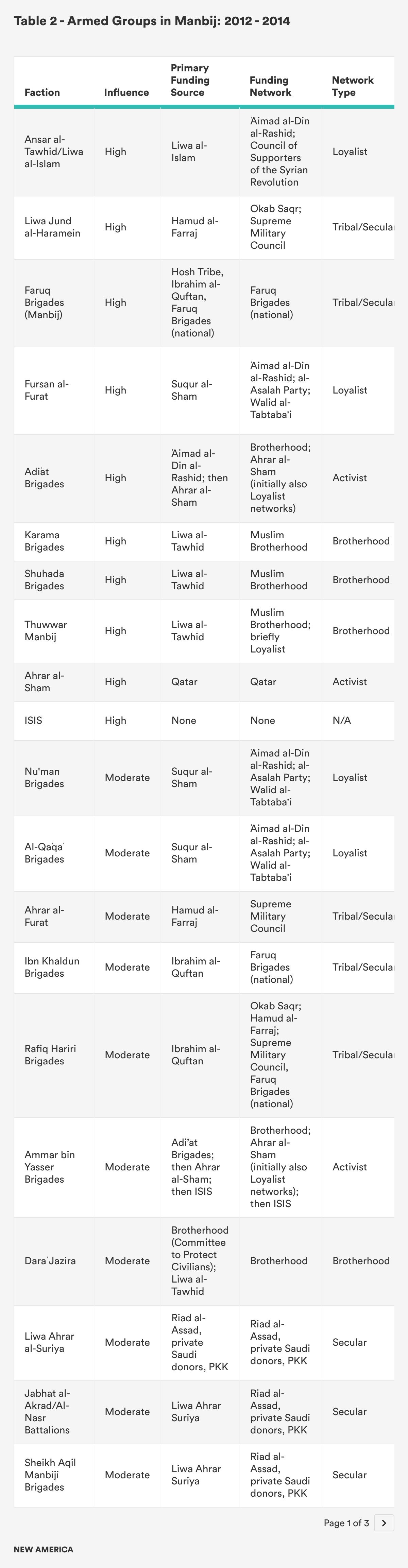
The Rise of the “Bread Factions”
From the beginning, the Revolutionary Council had found it difficult to control its armed wing. Before liberation, some fighters were conducting freelance raids on police stations and refusing to share the spoils with the group.18 By the July 2012 liberation, the council’s armed wing effectively split; one group remained under the council’s authority, while the other became an independent faction called Jund al-Haramein (“The army of the two holy mosques,” in a bid to attract Saudi funding).19 Unlike the Revolutionary Council factions, Jund al-Haramein did not belong to Hadhrani Brotherhood networks and recruited primarily from the poor and working class (see Table 3).20 Table 4 compares the tribal and class compositions of Jund al-Haramein and the Revolutionary Council; while 60 percent of the council were businessmen, 64 percent of Jund al-Haramein leaders were of poor and working class backgrounds. They lacked preexisting ties with key council members, which made them difficult to control and encouraged an independent streak. This also placed them outside the Liwa al-Tawhid funding stream.
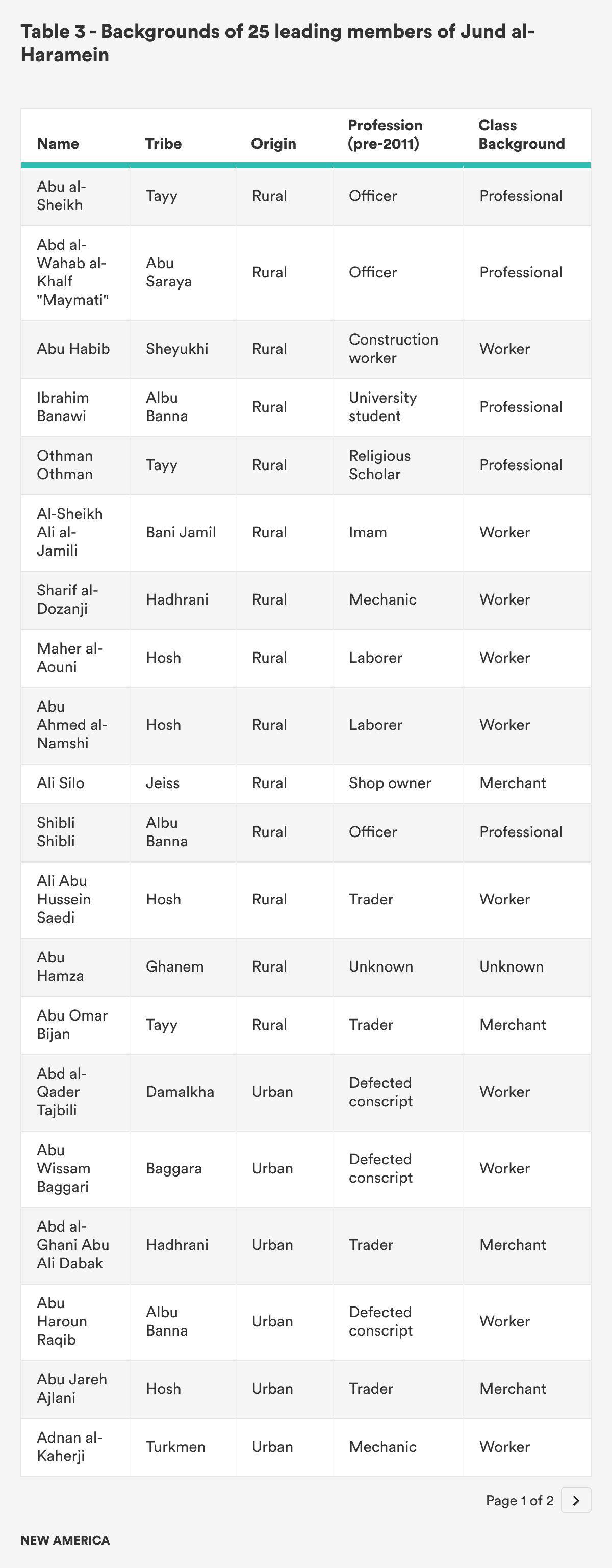
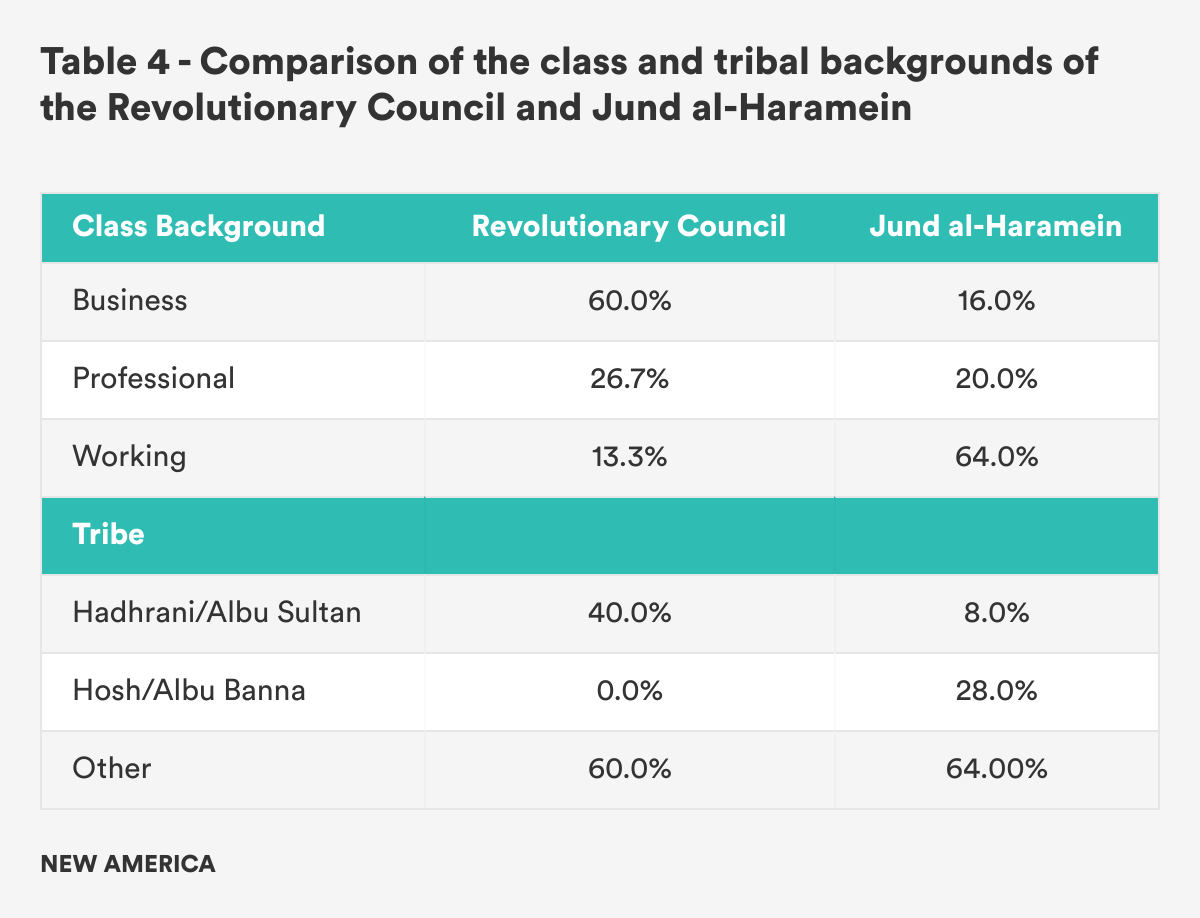
Other factions soon appeared with similar sociological compositions. Bereft of external support or links to the merchant class, they turned to other means to sustain themselves. Within weeks of liberation, Jund al-Haramein and allied factions unleashed a massive crime wave on Manbij.21 Reports of looting and kidnapping became commonplace.22 Al-Masar al-Horr, one of the revolutionary weeklies, denounced the chaos:23
Are we really living in a wild forest where the strong can rule and do whatever he wants?… Where is the freedom that the young and old cheered for with their hearts and their throats? We’ve lost safety and now live in the dark, where houses have been looted and the rich are kidnapped off the streets.
These factions refused to subordinate themselves to the city’s ruling authority, the Revolutionary Council. While the council controlled the city’s central furnace, producing 60,000 loaves of bread daily at full capacity, Jund al-Haramein seized control of Manbij’s reserve furnace and refused to surrender it.24 At times, the group would hoard supplies, or sell bread directly to private bakeries at lower prices to undercut the Revolutionary Council. The faction used these revenues to expand its footprint to Raqqa and the Aleppo countryside, where it took part in battles against the regime.25
Members of the Revolutionary Council would derisively term Jund al-Haramein and allies as the “bread factions,” and repeatedly attempt to clamp down. They critiqued the bread factions on moral terms, calling them corrupt or of poor character, but in truth Jund al-Haramein’s behavior can be explained by class position and lack of access to external support. Paradoxically, the bread factions even developed a popular following, especially in poor neighborhoods, where they were seen as an authentic—if flawed—representation of class grievances. Over the course of late 2012, as prices of basic living necessities climbed, popular anger toward the Revolutionary Council mounted.26 One figure who rode this wave was an enigmatic commander named The Prince, who headed the local chapter of the Faruq Brigades, which recruited almost exclusively from the Hosh tribal confederation. The Prince would kidnap the rich and pro-regime figures, while undertaking extraordinary exploits of bravery on the frontlines, to become something of a folk hero—and a sworn enemy of the Revolutionary Council.27
Ultimately, though, banditry and working-class sympathy were not enough. To fend off the regime—and to position themselves against the Revolutionary Council—the bread factions would need to find a patron of their own.
The Bread Factions Turn to Saudi Arabia
In September 2012, a bread faction belonging to a rebel leader named Abu Khalid al-Baggari kidnapped nine employees of Lafarge, a French company that owned a cement factory not far from Manbij. Al-Baggari ransomed the employees for hundreds of thousands of dollars; with the windfall, he acquired new weapons stockpiles and merged a number of factions into Fursan al-Furat (The Knights of the Euphrates).28 The previous month, the powerful Idlib faction Suqur al-Sham (see Section IV) had broken with the Muslim Brotherhood, after its commander Abu ʿIssa al-Sheikh accused his former patrons of “politicizing” aid and demanding excessive control over clients.29 The sudden appearance on the rebel scene of a well-financed rebel outfit free of Brotherhood control had immediate appeal to the Bread Factions of Manbij, who were looking to insulate themselves from Liwa al-Tawhid and the Revolutionary Council’s oversight. Flush with funds and fresh off a major military success, Baggari reached out to Suqur al-Sham, and an alliance was born. As one of Fursan al-Furat’s founders explained:
When choosing a patron, we wanted to make sure to go with someone with whom we could secure material support while still maintaining our own internal independence. Liwa al-Tawhid’s Sufi ideology, along with that of the Muslim Brotherhood, which Liwa al-Tawhid was tied to, is known for its emphasis on rigid hierarchies and obedience…Lower ranking members aren’t allowed to question their sheikhs…Furthermore, Abu ʿIssa al-Sheikh was known for having a calm personality, and being a leader who would encourage debate amongst his deputies and allow sub-factions a certain level of autonomy. Plus, by that point, he had rejected the Brotherhood.30
Suqur al-Sham’s prowess was due to its ability to tap multiple funding sources, including ʿAimad al-Din Rashid’s Brotherhood splinter, but it was their access to loyalist Salafist networks that proved most lucrative—and that linked them indirectly to Saudi Arabia. In the resulting proxy cascade, Saudi Arabia supported Kuwaiti Loyalist Salafis, who aided Suqur al-Sham in Idlib, who in turn funded Fursan al-Furat in Manbij.31 As a result, Fursan al-Furat became a major player locally, and other bread factions looked to follow suit.
By early 2013, Jund al-Haramein was heavily involved in battles against the regime in rural Raqqa, which enabled them to forge ties with the al-Nasser, an important clan in the area.32 For generations, sheikhs of this clan, which belongs to the Weldeh tribe, had presided over massive plantations—where they kept slaves and indentured servants—until the Baʿth land reforms of the 1960s stripped them of property.33 After 2011, eager to reclaim their land, Nasser sheikhs were quick to support the revolution, founding a string of influential FSA factions.34 The rough-and-tumble Jund al-Haramein and the elite sheikhs of the Nasser clan might seem like odd bedfellows, but Jund al-Haramein were capable fighters, while the sheikhs had something Jund craved: access to outside donors. Beginning in the 1970s, many Weldeh tribespeople had moved to Saudi Arabia for work, and a wealthy minority forged business and political ties with Saudi elites.35 These alliances paid off after the revolution; the Weldeh tribesman ʿAbd al-Jalil al-Saʿidi, for example, became a top advisor to Okab Saqr, the Lebanese Shia politician who was the Saudi point man for weapons distribution through the “Istanbul Room” (see Section IV).36 Al-Saʿidi would become instrumental in helping Jund al-Haramein access Istanbul Room weapons.37 Finally, through al-Nasser links, Jund al-Haramein also managed to ally with Hamud al-Faraj,38 a close associate of Saqr’s brother who regularly visited Saudi Arabia to coordinate the transfer of funds to al-Nasser-run FSA groups.39 In December 2012, when the United States and Saudi Arabia created the Supreme Military Council, the effort to create a unified, Saudi-friendly rebel command, Faraj was one of thirty opposition leaders appointed to coordinate aid on five separate fronts, with Faraj himself tasked to oversee Raqqa. As a result, Jund al-Haramein became one of Saudi’s top aid recipients in the greater Manbij-Raqqa corridor.40
Qatar versus Saudi Arabia in Manbij: Structured Competition
By late 2012, a tenuous balance hung over the revolutionary scene in Manbij. The Revolutionary Council, with its patrons in the Doha-backed Liwa al-Tawhid, remained the main authority in the city. However, against them stood a rival grouping, led by the Saudi-backed bread factions Jund al-Haramein, Fursan al-Furat, The Prince, and smaller formations. This grouping even supported its own rival council, called the Local Council, headed by an engineer named Muhammad al-Bishir.41 The same class divide marking the factions also reflected the rival Councils: while many upper- and middle-class activists supported the Revolutionary Council, the Bishir Council had a greater following among poorer segments of society. (Nonetheless, for the time being, it was the Revolutionary Council that successfully carried out state-like activities, such as social services).
However, the Saudi-led creation of the Supreme Military Council in December 2012 upset this balance. Seeing this Saudi move, correctly, as an attempt to sideline its clients, Doha retaliated by opening the spigot—primarily to Ahrar al-Sham. The group formally announced its presence in Manbij in early 2013, launching a populist program that won them admirers across the city’s political divide.42 On the one hand, they targeted the Revolutionary Council’s economic policies—especially the handling of bread, the prices of which continued to rise—by attending protests outside the city’s main bakery.43 On the other, they pledged to clean the streets of the criminal bread factions. At the top of this list was the Prince and his Faruq Brigades. As described in Section IV, the Faruq Brigades were a powerful anti-Brotherhood faction in Homs that was responsible for distributing Saudi-donated weapons nationwide. However, this actually fostered corruption, as commanders began skimming weapons to sell on the black market. They also entered into lucrative partnerships with Turkish smuggling networks.44 As a result, they eventually fell out of Saudi Arabia’s favor—and in this weakened state, Ahrar al-Sham moved in for the kill. In April 2013, the group attacked the Prince. The Revolutionary Council, sensing an opportunity to rid the city of a hated rival, requested back-up from Liwa al-Tawhid, which sent a contingent from Aleppo.45 The battle lasted a few intense hours and then, in a stunning dénouement, the Ahrar al-Sham-led forces captured the Prince.46
The rout changed the city’s power balance almost overnight. To the masses, Ahrar al-Sham proved that it was serious about cleaning up crime. The bread factions, meanwhile, felt they could not compete with Ahrar’s lavish Qatari funds or its ironclad organizational discipline, and they began disintegrating or switching sides. Jund al-Haramein gravitated toward its erstwhile enemy, the Revolutionary Council, and the Faruq Battalions dissolved.47 Fursan al-Furat, the Saudi-backed group, whose commanders had chafed at what they viewed as the rigid organizational and ideological control of the Brotherhood, eventually allied themselves with a small group of men who had recently appeared in the city. Occupying the cultural center downtown, these men were foreigners, and they were calling themselves The Islamic State of Iraq and Syria.48
Network Structure in Manbij’s Proxy War
By the summer of 2013, the Saudi-Qatari competition in Manbij was effectively over—with Qatar the clear winner. Although the United States and Saudi Arabia organized its proxies into the Supreme Military Council, they were unable to mold this entity into a cohesive force. By magnifying the case of Manbij, it becomes clear why this was the case. First, the Saudi-backed groups—the Bread factions—simply lacked the firepower to defeat Ahrar al-Sham and its allies militarily, even though they outnumbered them in personnel. This was due, in part, to the fact that Ahrar al-Sham was a direct beneficiary of Qatari funding, whereas the bread factions received aid through a cascade of intermediaries, such as Suqur al-Sham or tribal sheikhs. It was also because Ahrar al-Sham was able to access multiple networks for revenue: Brotherhood, Activist Salafist, and Jihadi Salafist. Second, the bread factions lacked cohesive preexisting ties and organizational structure. Even in the face of Ahrar al-Sham’s superior firepower, the Prince may have stood a chance had the other bread factions rallied to his support and presented a united front. But the bread factions did not constitute a cohesive network; in fact, there was little to unify them except having gone through the experience of revolution, as compared to the Qatari clients, who benefited from years or even decades of close interaction through business ties and political activity. Finally, but for a vague opposition to dictatorship, the bread factions expressed little in the way of ideology. The Qatari-backed factions, on the other hand, benefited from expansive, elaborate ideological frameworks that could respond to changing circumstances and help dictate strategic action.
Without strong social ties and ideological norms, there was little to constrain the bread factions from corruption and war profiteering. Therefore, patrons had few means to exert command and control. An example of how this worked in practice is the case of al-Shaʿr Gas Field, near Palmyra. In early 2013, a coalition of Idlib factions and Fursan al-Furat, the Manbij-based bread faction, planned to launch a campaign to capture the field from the regime. Fearing that flat desert terrain would provide little cover, Suqur al-Sham leader Abu ʿIssa al-Sheikh ordered his client Fursan al-Furat to abstain from participation.49 There was little linking Fursan al-Furat and Suqur al-Sham apart from the alliance they’d forged during the revolution; they did not share preexisting social networks, nor did Fursan have a well-thought-out ideological framework beyond a hazy, individualistic liberalism, to match Suqur’s Islamism. So Fursan leaders ignored the order, waited for a sandstorm for cover, and managed to seize the field. The ensuing revenue windfall allowed Fursan even greater independence from its patrons. A year later, as ISIS was advancing upon Manbij, Suqur al-Sham ordered Fursan to defend the city—which they also ignored. They had undertaken several joint ventures with the Islamic State, including a smuggling ring that trafficked organs harvested from prisoners’ bodies.50
The rich social ties among Qatar and its proxies, on the other hand, gave Doha the capacity to influence client behavior. So long as interests aligned, Doha’s support could make the difference between battlefield success and failure. But when interests diverged, clients found themselves constrained by Doha or its subsidiary patrons. In the summer of 2013, for example, two different Qatari proxies were the dominant forces in Manbij: Ahrar al-Sham and the Liwa al-Tawhid-linked Revolutionary Council. Ahrar al-Sham began attacking the latter’s laissez-faire economic policies, especially around the question of bread prices.51 As Ahrar gained popular support, seizing buildings around the city, Liwa al-Tawhid warned the Revolutionary Council not to escalate the situation by resisting. It was in the interests of Liwa al-Tawhid to preserve the peace between their clients in Manbij and Ahrar al-Sham, even if, locally, that was not in the Council’s interests.52 The council was forced to follow Liwa al-Tawhid’s orders, though the consequences would be tragic.
In July, Ahrar al-Sham and ISIS, who were controlling key granaries in Maskana and Raqqa, respectively, halted all grain shipments to Manbij.53 This siege temporarily forced the price of bread in the city to skyrocket, and ISIS seized the advantage, organizing protests that nearly brought down the Revolutionary Council and allowed them to assume control of the main bakery.54 By the time Liwa al-Tawhid recognized the calamity unfolding in Manbij, it was too late. Crucially, the group did not have the support of the other Qatar proxy, Ahrar al-Sham, who insisted on remaining neutral in the growing tensions between revolutionaries and ISIS—and they faced no sanction for doing so, because Qatar appeared uninterested in halting ISIS or even treating the group differently from any other faction.55 By January 2014, in the face of mounting economic crisis, the Revolutionary Council had lost the street. That month, the city’s beleaguered factions banded together in a final push to expel ISIS, but without Ahrar al-Sham or popular support, they proved no match for the Islamic State. Within days, ISIS seized complete control of the city, expelled all factions, and Manbij’s revolution was finished.
Manbij Today: Exploitative Phase
The ISIS takeover of Manbij and other parts of eastern Syria in 2014 marked a turning point in proxy relations countrywide. The United States shifted to anti-ISIS efforts, while Qatar gradually tempered its patronage, and ultimately ceased it altogether. Liwa al-Tawhid soon began to splinter and was no longer a patron in northern Syria.56 The former members of Manbij’s Revolutionary Council migrated to the patronage of Turkey. Due to the historic Brotherhood ties, as well as the council’s embeddedness in cohesive networks, Turkey wields significant capacity as patron. However, Turkey’s primary interest is in defeating the PKK, whereas the council’s core interest is in overthrowing Assad, meaning the two sides do not share a common goal. This combination of high patron capacity and divergent interests means that the remnants of the council are forced to do Ankara’s bidding. Today, these former council figures comprise the core component of the forces that Turkey hopes to employ to capture Manbij from the PKK-linked Syrian Democratic Forces.
The SDF liberated Manbij from ISIS rule in 2016, and the city is now under the control of the SDF-aligned Manbij Military Council. Remarkably, the MMC.-Turkish divide is actually the latest iteration of the same divide that has plagued the city since the 1960s—a division built on class and networks of patronage. To recap, recall that before the 1960s, urban-based Albu Sultan and Hadhrani elites controlled the city’s wealth and politics, until the Baʿthist coups and land reforms usurped their privileges. During the Assad years, power shifted to rural tribal sheikhs, particularly those from the Albu Banna and the Hosh tribal confederation. In response, some Hadhrani families gravitated toward the Muslim Brotherhood. In 2011, Hadhrani and Albu Sultan figures became the revolutionary leadership in Manbij, which took the shape of the Revolutionary Council, and allied themselves with a faction descendant from the Brotherhood, Liwa al-Tawhid. Meanwhile, though Albu Banna and Hosh sheikhs supported the regime, poorer members of these tribes also joined the revolution—but were not allied with the council. Instead, many joined the so-called bread factions, Free Syrian Army groups known for criminality. By 2013, the Revolutionary Council-bread faction split was the key divide in Manbij.
When Salafis like Ahrar al-Sham entered the scene, they represented a third force. In April 2013, they routed the bread factions, who dissolved or joined other, stronger groups. A pivotal moment then came in August, when many Hosh tribesmen, who had previously belonged to bread factions like the Prince’s Faruq Brigades, banded together with a Kurdish FSA group called Jabhat al-Akrad.57 This group, which had formed a year prior and had chapters in Manbij, Raqqa and elsewhere, was secretly a PKK proxy.58 The new Jabhat al-Akrad-bread faction alliance joined a rebel group called Ahrar al-Suriya, an anti-Liwa al-Tawhid faction headquartered in ʿAnadan. In other words, both the PKK and the Hosh tribespeople formed an alliance in the face of a common enemy, the Muslim Brotherhood-linked Liwa al-Tawhid.
In 2016, the Jabhat al-Akrad-Hosh alliance became the core of the newly formed Manbij Military Council.59 Before long, Jund al-Haramein also joined SDF, and the reiteration of Manbij’s classic divide was complete. Almost all the key Arab figures in the Manbij SDF and local administration today were once linked to the bread factions, or to tribal communities that had opposed the Hadhrani- and Albu Sultan-dominated Revolutionary Council.60 In this way, issues of class and patronage continue to run through the heart of the Syrian conflict today.61
Citations
- Author interviews with Hadhrani and Arab tribal figures from Manbij, 2017 – 2019.
- The Hosh is a confederation of five tribes found in the areas immediately south and east of Manbij: Bani Saʿid, al-ʿAun, al-Ghanaim, al-Kharraj, and al-ʿAjlan. The Albu Banna is a tribe found predominately in the south of Manbij, concentrated between Abu Qalqal and al-Khafseh sub-districts. After 2000, the tribe had a sizeable presence in Maskana sub-district as well.
- Strictly speaking, the post was رئيس البلدي
- Author interviews with revolutionary activist Muhammad Bashir al-Khalaf, Jund al-Haramein-linked Salah Muhammad, and Albu Sultan figure and president of the Revolutionary Council, Ahmed al-Rahmo, 2018-2020.
- Author interviews with Faruq Sheikh Weis and Hani Salal, 2018; Baʿthist restrictions on the free market were gradually lessened, beginning with Hafez al-Assad’s “corrective movement” in 1970 and continuing apace through the 1990s, meaning the Hadhrani bourgeoisie was able to regain some of their previous financial standing by 2000.
- As we described above, the Syrian National Movement was headed by ʿAimad al-Din Rashid, one of the leaders of the May 2012 delegation to Libya which was pivotal in helping Liwa al-Tawhid and other Brotherhood groups gain prominence.
- Author interviews with Revolutionary Council members Aimad al-Hanaydhil, Munzir Salal, Ahmed al-Rahmo, July 2019. See also, “Syria’s Islamists: The ‘National Movement’ Includes All Perspectives,” Al Ikhwan Online, December 10, 2011, source.
- That group was called the al-Nuʿman Brigades. Within six months, the al-Nuʿman Brigades would effectively split; some members would affiliate with the Revolutionary Council under new brigade names, while the remainder of the group kept the name al-Nuʿman Brigades and was no longer affiliated with the Revolutionary Council. Author interviews with two leaders of Jund al-Haramein, and one member of al-Nuʿman. July 2019.
- Even after the shift to “structured competition” and the Qatari–Saudi rivalry, individuals adept at managing foreign ties sometimes succeeded in drawing funds from both sides. As late as 2013, for example, Taʿan, managed to secure funding from the Saudi-backed Authenticity and Development front. Author interviews with Revolutionary Council members, including Munzir Salal. August 2019.
- That hardly a shot was fired is corroborated by multiple eyewitnesses. However, one child died while the regime troops were withdrawing, although the circumstances are unclear. The family believes it was due to a stray bullet. Author interview with family, other residents, Manbij, 2017–2019.
- Author interview with Revolutionary Council members, including Nefi, 2018-2020.
- The three battalions were Thuwwar Manbij (commander: Anas Sheikh Weiss), al-Karama (commander: Zakaria Qarisli) and Shuhada Manbij (commander: Abu Abdullah Baggari). Collectively, they comprised Liwa al-Tawhid’s 2nd Division. These three battalions are now part of the Syrian National Army and constitute the principal force directed against the Syrian Democratic Forces in Manbij today. See Shams al-Horreya, “News,” Issue 23; Masar al-Horr, “News,” Issue 20, January 28, 2013. These are locally produced newspapers documenting this period.
- The al-Nuʿman Brigades, which the council had been created six months earlier, still functioned but had become an independent faction.
- The delegation included an activist from the Brotherhood’s youth wing, Basil al-Hafar, and a member from a leading landowning family in Mareʿ, Yassin al-Najjar—further demonstrating the overlap between Mareʿ and Brotherhood networks. Author interviews with Revolutionary Council leading figures Munzir Salal, Ahmed Rahmo and RYM activists Abu al-Ows and Ahmed al-Faraj, 2018-2020.
- Author interviews with Weiss, other leading figures in Manbij, and corroborated by local newspapers.
- Author interviews with Revolutionary Council leading figures Munzir Salal, Ahmed al-Rahmo, 2019.
- Author interview with former rebel figure who operated in Manbij, 2019.
- Author interview with Jund al-Haramein associate Salah Muhammad, Revolutionary Council members ‘Aimad al-Hanaydhil and Ahmed al-Rahmo, 2019.
- Author interviews with Jund al-Haramein associate Salah Muhammad, Revolutionary Council members ‘Aimad al-Hanaydhil and Ahmed al-Rahmo, 2019. See also, “Ugarit Manbij Aleppo, Announcement of the Formation of the Jund al-Haramein Brigades 11 7 Manbij Aleppo,” Ugarit News – Syria, July 12, 2012, source
- The factions’ founders included Abd al-Wahab al-Khalaf “Maymati,” the Manbij Chief of Police who defected and brought many policemen with him. Jund al-Haramein also contained the highest number of defected conscript fighters of any Manbij faction. Author interviews with Revolutionary Council members and numerous Jund al-Haramein associates. September 2019.
- The allied factions included: al-Faruq Battalions, al-Qaʿqaʿ Brigade, and Abu Ayub al-Ansari Brigade; Shams al-Horreya, “Fatwa Fever,” Issue 11, October 7, 2012.
- Al-Masar al-Horr, “MRC Responds to Accusations Published in Masar al-Horr,” Issue 5,
- Masar al-Horr, “Victims of Freedom,” Issue 2, September 10 2012; Free Teachers Association Press Release, September 15, 2012; al-Masar al-Horr, “Kidnapping, A Temporary Phenomenon? Or Organized Crime?,” Issue 2, October 8, 2012; September 15, 2012; Shams al-Horreya, “News,” Issue 2, October 15, 2012;
- Masar al-Horr, “Interview with Revolutionary Council member (and head of bread distribution) ‘Aimad al-Hanaydhil See RC flour mill and mechanism for running it”, Issue 10, November 20, 2012.
- Jund al-Haramein would also reap income through extortion. Manbij’s wholesale fuel market was one of the largest in Aleppo province, attracting buyers from as far as Idlib looking to purchase shipments recently arrived from Deir ez-Zour. The market was adjacent to Jund al-Haramein’s main base in the north of the city, allowing the group to impose “taxes” on incoming traders seeking to sell their product. Similarly, Jund al-Haramein took money from the Turkish government to protect the tomb of the Ottoman folkloric hero Suleiman Shah, located across the Euphrates River in the town of Qara Quzak. See: Shams al-Horreya, “Meeting with Sheikh Hajji (Ammar bin Khattab brigades),” Issue 31, April 14, 2013; Malik Al-Abdeh, “Rebels Inc.,” Foreign Policy, November 21, 2013, source.
- Shams al-Horreya, “Baked Bread: First Investigation of Its Kind in 40 Years,” Issue1, November 25, 2012; Masar al-Horr, “Al-Masar Eye,” Issue 10, November 20, 2012.
- Author interviews with individuals from across the political spectrum in Manbij, 2018-2020. The Prince’s exploits were also described in detail in the revolutionary weeklies Masar al-Horr and Shams al-Horreya.
- Author interviews with Fursan al-Furat commander Mustafa Abu Suleiman, Author interview with Revolutionary Council member ‘Aimad al-Hanaydhil, June and September 2019, respectively. See also: Liz Alderman, Elian Peltier, and Hwaida Saad, “‘ISIS Is Coming!’ How a French Company Pushed the Limits in War-Torn Syria,” New York Times, March 10, 2018, source.
- Syrian Dreams, September 4, 2012, “Suqur al-Sham: Civilian Protection Body and the Muslim Brotherhood”: source
- Author interview with a Fursan al-Furat founder, 2019.
- Abouzeid, “Syria’s Secular and Islamist Rebels: Who Are the Saudis and the Qataris Arming?”; Rasha Abi Haider, “[Tr. Chairman of the Islamic Front’s Shura [Council]: A [Muslim Brotherhood Member] in the Arms of KSA and the US] source ,” Al-Akhbar, January 17, 2014, source ; Lefèvre, “The Muslim Brotherhood Prepares for a Comeback in Syria”; “Bahrain Says Islamist MPs Made Unofficial Syria Visit,” Naharnet, August 7, 2012, source; Husain Marhoon , “Bahraini Salafists in Spotlight,” Al-Monitor, June 18, 2013, source.
- The main Jund al-Haramein leader involved in these initiatives was Ibrahim al-Banawi; Author interviews with Jund al-Haramein affiliate Salah Muhammad and Revolutionary Council member Munzir Salal, 2019.
- The clan also lost land in the 1970s due to the construction of the Euphrates Dam. The Hafez al-Assad regime resettled some tribespeople along the Turkish border, in an attempt to create an “Arab belt” and strip Kurds of their land. See: Günter Meyer, “Rural Development and Migration in Northeast Syria,” in Anthropology and Development in North Africa and the Middle East., 1990, 245–78; Raymond Hinnebus et al., “Agriculture and Reform in Syria,” Syria Studies 3, no. 1 (2011): 83–109, source; Andrew J. Tabler, “A Tale of Six Tribes: Securing the Middle Euphrates River Valley,” Policy Notes (Washington Institute for Near East Policy, June 21, 2018), source; “[Tr. Tabqa before ISIS and after] الطبقة قبل داعش وبعدها,” Ain Al-Madina, April 18, 2017, source.
- These factions included: Uweis al-Qurni, Saraya al-Furat and Ahrar Tabqa.
- Author interviews with Hadiddiyin sheikh Khalaf al-Mudhi (financier from Deir Hafer), Ibrahim al-Muhammad (Director of Maskana’s central bread furnace under the FSA) and ʿAbd al-Rahman Suleiman (lawyer, founder of Mousab bin Umayr brigade). June 2019.
- Al-Saʿidi belongs to the al-Ghanem sub-clan of the Nasser, and is from Khafseh. Author interviews with Jund al-Haramein affiliate Salah Muhammad and Revolutionary Council member ‘Aimad al-Hanaydhil, 2019.
- These efforts to link to the Saudi network were led by Jund al-Haramein leader Ibrahim al-Banawi, who would also establish close ties to two Naser figures named Fayyad and ʿAiman al-Ghanem by way of their relative Abu Hamza al-Ghanem, a leader of the Ahrar Furat brigades in Khafsa who was killed fighting alongside Jund al-Haramein during the battle to liberate Maskana. Jund al-Haramein would maintain close ties to Abu Hamza’s al-Ghanem relatives even after the revolutionary period, as both would go on to join the Syrian Democratic Forces. In September 2016, photos leaked showing Fayyad al-Ghanem and Suheil al-Hassan, the notorious commander of the Syrian government’s “Tiger Forces” shaking hands, with Ibrahim al-Banawi in the background. Author interviews with Mustafa Suleiman (Fursan al-Furat), Salah Muhammad (Jund al-Haramein), Munzir Salal (Revolutionary Council) and other Revolutionary Council and Jund al-Haramein associates, 2019; “[Tr. What Did the SDF Leader Say about His Photo with Suheil Al-Hassan?] ماذا قال القيادي من قسد عن صورته مع سهيل الحسن,” Orient Net, August 28, 2017, source.
- Author interviews with Revolutionary Council members and Jund al-Haramein associates, 2019.
- Faraj belongs to the al-Salama clan of the Nasser tribe.
- Author interviews with Jund al-Haramein associate Salah Muhammad, and Revolutionary Council leaders Munzir Salal, and ‘Aimad al-Hanaydhil, 2019.
- Shams al-Horreya, “New Revolutionary Council … representing all segments,” Issue 9, November 11, 2012;Zajil Network, Aleppo Countryside Manbij, 2012-12-18- Formation of the Local Council, December 19, 2012, source.; Author interviews with Salah Muhammad, Muhammad Bashir Khalaf, Ahmed al-Farraj, 2018-2020.
- Shams al-Horreya, “Important Statement from the Ahrar al-Sham Brigades to the Dignified People of Manbij”, Issue 17, January 6, 2013; See also Shams al-Horreya, “News,” Issue 16, December 30, 2012; Shams al-Horreya, “Important Statement from Ahrar al-Sham to the Honorable People of Manbij,” Issue 17, December 30, 2012.
- Shams al-Horreya, “News,” Issue 16, December 30, 2012; Author interviews with Ahmed al-Rahmo (Revolutionary Council), Muhammad Bashir al-Khalaf (Opposition “Bishr Council”), 2018-2020.
- Abouzeid, No Turning Back.
- That contingent consisted of forces belonging to the “Shariʿa Committee,” a body comprised of the four most powerful factions in Aleppo: Liwa al-Tawhid, Ahrar al-Sham, Suqur al-Sham and, making their first appearance in Manbij, Jabhat al-Nusra.
- See: Aymenn Jawad Al-Tamimi, “The Islamic State of Iraq and Ash-Sham Expands Into Rural Northern Syria,” Syria Comment, July 18, 2013, source; “[Tr. The Shari’a Council Arrests Prince in Manbij…and His Fighters Respond with an Armed Attack on Their Headquarters] الهيئة الشرعية تلقي القبض على ‘البرنس’ في مدينة منبج .. و مقاتلوه يردون بهجوم مسلح على مقرها,” Aks Al-Seir, April 4, 2013, source; “Civil [Disobedience] Protesting ISIS [Abuses] in the City of Manbij in the Aleppo Countryside,” Akhbbar Alan, May 18, 2014, source; Shams al-Horreya, "News," Issue 30, April 7, 2013; “Terrorist [infighting]: Jabhat al-Nusra annihilates the Faruq Brigades and slaughters their leader ‘Prince’!!,” General Organization of Radio and TV – Syria, April 4, 2013, source; “A month after ‘Prince’s’ arrest…where is he now and will justice be dealt to him?,” Watan, November 4, 2014, source; Author interviews with Ahmed al-Farraj (Revolutionary Youth Movement), Abu Ma’an (Security Brigade), Zakaria Qarasli (al-Karama Batallion), 2018-2020.
- Many Faruq Battalion members joined a Saudi-backed anti-Liwa al-Tawhid faction called Ahrar al-Suriya. The Manbij chapter of this group, which had disproportionate Kurdish membership, had begun as a front group of the Kurdistan Workers Party (PKK). Others would reconstitute later under Prince’s command following his June 23, 2013 escape from prison and become allied with ISIS. On the Prince’s escape: Author interview with an activist who was imprisoned with him in Aleppo, February 2020.
- Author interviews with rebel affiliate Abu Ma’an, and Fursan al-Furat founder Mustafa Abu Suleiman, 2019.
- Author interviews with former Fursan al-Furat commander, 2019.
- Author interview with Mustafa Abu Suleiman (Fursan al-Furat). June 2019.
- At this point, certain key factions aligned with the Council, like the ʿAdiyat Battalion of Ahmed Taʿan, who had previously been an important Council fundraiser in the Brotherhood network, joined Ahrar al-Sham; Shams al-Horreya, “MRC Press Release”, Issue 43, July 8, 2013; Azad Minbic, Manbij Grain Silos Director Tells Us the Reason for His Arrest by Ahrar Al-Sham after His Release, 2013, source.
- Author interview with Zakaria Qarisli, 2018.
- Masar al-Horr, “Harvest season is over… the suffering of the peasants begins,” Issue 43, July 10, 2013; Author interview with Aimad al-Hanaydhil (Revolutionary Council), 2019.
- Shams al-Horreya, “Bread crisis…Problems and solutions,” Issue 43, July 8, 2013; Bisher albisher, Aleppo Countryside—Manbij: Large Protest against the Revolutionary Council in Manbij, August 28, 2018, source; MRC Statement Announcing Temporary Suspension of Activity. (September 05 2013); leaflet, Manbij Revolutionary Council; Author nterviews with Munzir Salal, Aimad al-Hanaydhil (Revolutionary Council), June and July 2019, respectively.
- “ISIS Prepares to Take over Manbij and AHS Hands Its Bases to Jabhat Al-Nusra,” Orient Net, January 17, 2014, source.
- The group still exists, albeit in a smaller, rebranded form as al-Jabhat al-Shamiya.
- In detail, Ahmed Arsh’s Sheikh Aqil Manbiji Brigades (Hosh tribe dominated), Hassan al-Aouni and Abu Khaldun’s Rafiq al-Hariri brigades (Hosh tribe dominated), Abu Adel’s Jabhat al-Akrad (Kurdish dominated), and other factions, united on August 18, 2013 to form the “Eastern Front” unit of Ahrar al-Suriya. See:Tall Refaat City, Aleppo Countryside, Statement Merging [Various] Fighting Legions into Liwa Ahrar Suriya, and the Formation of the Eastern Front, August 18, 2013, source.
- This information is based on two interviews in 2019 with figures closely linked to (and supportive of) the PYD in northern Syria. The PKK supported Jabhat al-Akrad as a means of having influence within the FSA and curbing the reach of Liwa al-Tawhid.
- By this point, Jabhat al-Akrad had merged with other factions to form the Northern Sun Battalions. The Northern Sun became the leading element in the Manbij Military Council.
- Notable examples include Ibrahim Quftan (Hosh tribesman, formerly closely aligned to the Prince) and Faruq al-Mashi (Albu Banna).
- For more on how the regime’s policies fragmented prewar networks, see: Anand Gopal, “The Arab Thermidor,” Catalyst Journal 4, no. 2 (Summer 2020), source.
Conclusion
The Syrian conflict can appear dizzyingly complicated, but grasping its underlying logic can help make sense of it all. The uprising was concentrated in rural towns that were marginalized by the regime’s neoliberal economic opening after 2000; in contrast, wealthy metropoles like western Aleppo and Damascus never wavered in their support for the regime. Within the marginalized rural towns, the Syrian opposition broadly fell into two camps: a relatively wealthy merchant and landowning elite who had historic links to the Muslim Brotherhood, and poor Syrians primarily engaged in informal labor. The merchant elite formed a cohesive network with transnational ties to foreign states; after 2011, they became the primary clients of the Qatar–Turkey axis. Because this network was cohesive, built on long-standing ties of trust, and displayed relative ideological coherence, they were easier for outside powers to control. Thus Qatar enjoyed significant capacity to influence battlefield dynamics. This proved most evident in the pivotal summer months of 2012, when a Turkish–Qatari push helped expel the regime from swathes of northern Syria, and pushed countryside rebels to invade and capture portions of Aleppo city. The poorer segment of the opposition, on the other hand, lacked strong pre-2011 ties beyond those of immediate kinship and neighborhood. There were few long-standing ties of trust between poor FSA rebels in, say, Idlib than those in Manbij. Moreover, they lacked pre-2011 ties to foreign powers. Finally, this milieu had little by way of ideological coherence. These factors together made it more difficult for outside powers to direct their behavior.
Yet to highlight the role of Syrian social structure in shaping patron capacity is not to reduce battlefield developments solely to patron-client dynamics. As the case of Manbij shows, the wealth and network divides among the opposition was central to shaping the trajectory of the revolution. Across eastern Syria, ISIS was able to exploit these divides, ultimately overthrowing both tendencies and destroying the opposition altogether. In the end, the question of class and network cohesion is pivotal to understanding both what happened internally in the uprising, and how these internal dynamics linked to the designs of foreign powers. While many commentators have pointed to the lack of cohesion of the FSA, they usually treat this as purely a strategic deficiency. Instead, the lack of cohesion stemmed from the nature of pre-2011 social structure in Syria. Rebels could not be expected to cohere under the trying conditions of the conflict when the social prerequisites for doing so simply did not exist. Ultimately, it was the policies of the Assad dictatorship itself that, over decades, ensured that the type of networks that could have grown into a cohesive insurgency never came into being.
More About the Authors

Anand Gopal
International Security Program Fellow; Bernard L. Schwartz Fellow, 2014

Jeremy Hodge
Research Fellow, Future Security
Issues
Programs/Projects/Initiatives
Related
Is the U.S. Conducting Air Strikes Against Al Qaeda in Yemen?

‘Killed Us Twice’: Families of US Drone Victims Seek Reparations in Somalia