Stephen Burd
Senior Writer & Editor, Higher Education

We have long been concerned that for-profit colleges and trade schools have been aggressively pushing financially needy students to take on high-cost private student loan debt to help cover their costs. Newly released data by the U.S. Department of Education’s National Center for Education Statistics (NCES) certainly appears to bear these concerns out.
According to an analysis of the data by our friends at the Project on Student Debt, the percentage of students at proprietary institutions taking out private loans has skyrocketed in recent years, from 13 percent in 2003-04 to 42 percent in 2007-08. In other words, more than 4 in 10 students took out these expensive loans last year to attend schools that have a spotty record of retaining and graduating students.
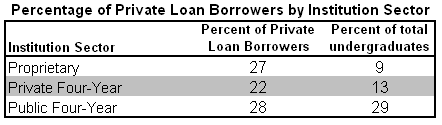
Overall, the analysis found that for-profit college students are borrowing private loans at rates that are incredibly disproportionate to their numbers. While only 9 percent of all undergraduates attend these institutions, these students represent 27 percent of all private loan borrowers.
The data in question come from the latest edition of the National Postsecondary Student Aid Study (NPSAS), a nationwide survey of college students that the NCES conducts every four years. The survey provides the most comprehensive data available on how students and their families pay for college.
The Project on Student Debt crunched the numbers to try and get a clearer picture of how private loan borrowing has changed on our nation’s campuses since the last survey was conducted in 2003-04. It found that the proportion of undergraduate students taking out private loans jumped considerably over the five year period, from 5 percent to 14 percent in 2007-08.
Meanwhile, the number of students taking out private loans without first exhausting their cheaper and safer federal student loan options is on the rise. The analysis found that the proportion of private loan borrowers who did not take out federal student loans rose to 26 percent from 22 percent in 2003-04. Fourteen percent of all private loan borrowers did not apply for federal financial aid last year, and 12 percent applied for aid but did not take out federal loans.
Private loan borrowers are not only overrepresented at proprietary schools, but at expensive private colleges as well. The data shows that students attending private colleges compose make up about 13 percent of all undergraduates, but 22 percent of those taking out private loans.
While the numbers of students taking out these loans at private colleges are troubling, we are most concerned about the rapid growth of private loan borrowing at for-profit colleges and trade schools because these institutions have such a poor record of graduating students. According to a study conducted last year by Mark Schneider, the Department’s Commissioner of Education Statistics from 2005 to 2008, for-profit schools have “the lowest median graduation rate” of any sector at 38 percent. This figure “is almost twenty points lower than their private nonprofit counterparts and seven points lower than public institutions,” including community colleges, Schneider wrote. The median rate at for-profit schools drops to less than 25 percent when counting only black students.
In addition, Schneider found that about half of proprietary school students attend institutions that graduate less than one-third of their students, compared to “around 10 percent in both private nonprofit institutions and public universities.” And while more than 30 percent of black students attend colleges that graduate less than one-third of their black students, the percentages jumps to more than 60 percent at proprietary institutions.
At Higher Ed Watch, we have often warned of the hazards of private loans, particularly for students attending questionable for-profit trade schools. Private loans almost always have worse terms than federal loans, and lack important safeguards. In addition, they offer far fewer options for borrowers in repayment.
The latest NPSAS data should set off alarms about the untenable position we’re putting many financially needy students in — loading them up with high-risk debt to attend schools that are more likely than not to leave them stranded. Hopefully, these alarms will no longer go unheard.
[Disclosure: Higher Ed Watch receives support from the Institute for College Access and Success, which runs the Project on Student Debt.]
Senior Writer & Editor, Higher Education